Question 115 of 276
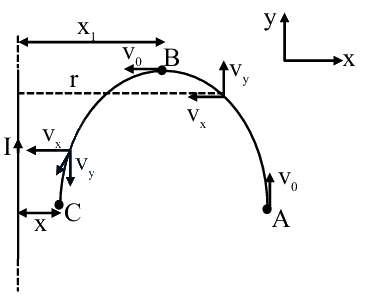
Consider a long thin conducting wire carrying a uniform current I. A particle having mass " M " and charge " " is released at a distance " " from the wire with a speed along the direction of current in the wire. The particle gets attracted to the wire due to magnetic force. The particle turns round when it is at distance from the wire. The value of is [ is vacuum permeability]
Show answer and solution
Answer: (A)
$\begin{aligned}
& \mathrm{zdz}=-\mathrm{v}_{\mathrm{x}} \mathrm{dv}_{\mathrm{x}} \\
& \frac{\mathrm{v}_{\mathrm{x}} \mathrm{dv}_x}{\sqrt{\mathrm{v}_0^2-\mathrm{v}_{\mathrm{x}}^2}}=\frac{-\mathrm{zdz}}{\mathrm{z}}=-\mathrm{dz}
\end{aligned}$
then integral becomes
$\begin{aligned}
& -\int_{\mathrm{v}_0}^0 \mathrm{dz}=-\frac{\mu_0 \mathrm{Iq}}{2 \pi \mathrm{~m}} \ln \frac{\mathrm{x}_1}{\mathrm{a}} \\
& \mathrm{v}_0=-\frac{\mu_0 \mathrm{Iq}}{2 \pi \mathrm{~m}} \ln \frac{\mathrm{x}_1}{\mathrm{a}}
\end{aligned}$
For B C
$\begin{aligned}
& \overrightarrow{\mathrm{v}}=-v_x \hat{\mathrm{i}}-v_y \hat{\mathrm{j}} \\
& \overrightarrow{\mathrm{~B}}=\frac{\mu_0 \mathrm{I}}{2 \pi \mathrm{r}}(-\hat{\mathrm{k}}) \\
& \overrightarrow{\mathrm{F}}=\mathrm{q}(\overrightarrow{\mathrm{v}} \times \overrightarrow{\mathrm{B}})=\frac{\mu_0 \mathrm{Iq}}{2 \pi r}\left(-v_x \hat{j}+v_y \hat{\mathrm{i}}\right)
\end{aligned}$
$\begin{aligned}
& \mathrm{a}_{\mathrm{x}}=+\frac{\mu_0 \mathrm{Iq}}{2 \pi \mathrm{~m}} \frac{\mathrm{v}_{\mathrm{y}}}{\mathrm{r}} \quad \mathrm{a}_{\mathrm{y}}=-\frac{\mu_0 \mathrm{Iq}}{2 \pi \mathrm{~m}} \cdot \frac{\mathrm{v}_{\mathrm{x}}}{\mathrm{r}} \\
& \frac{\mathrm{v}_{\mathrm{x}} \mathrm{dv}_{\mathrm{x}}}{\mathrm{dr}}=\frac{\mu_0 \mathrm{Iq}}{2 \pi \mathrm{~m}} \frac{\mathrm{v}_{\mathrm{y}}}{\mathrm{r}} \\
& \int_{v_0}^0 \frac{\mathrm{v}_{\mathrm{x}} \mathrm{dv}_{\mathrm{x}}}{\sqrt{\mathrm{v}_0^2-\mathrm{v}_{\mathrm{x}}^2}}=\frac{\mu_0 \mathrm{Iq}}{2 \pi \mathrm{~m}} \int_{\mathrm{x_1}}^{\mathrm{x}}\frac{dr}{r}
\end{aligned}$
$\begin{aligned}
& \frac{\mu_0 \mathrm{Iq}}{2 \pi \mathrm{~m}} \ln \frac{\mathrm{x}}{\mathrm{x}_1}=-\int_0^{\mathrm{v}_0} \mathrm{~d} \mathrm{z}=-\mathrm{v}_0 \\
& \mathrm{x}=\mathrm{x}_1 \mathrm{e}^{-\frac{2 \pi \mathrm{~m}_0}{\mu_0 \mathrm{Iq}}} \ldots \ldots \text { (2) }
\end{aligned}$
From equation 1 and 2