Biology · Class 11-12 · AP Biology
Cellular Respiration and ATP Synthesis
Cellular respirationis the biochemical process through which cells break down glucose in the presence of oxygen to release energy in the form ofATP (Adenosine Triphosphate), powering all life activities.
1Visual Overview & Complete Pathway Diagram
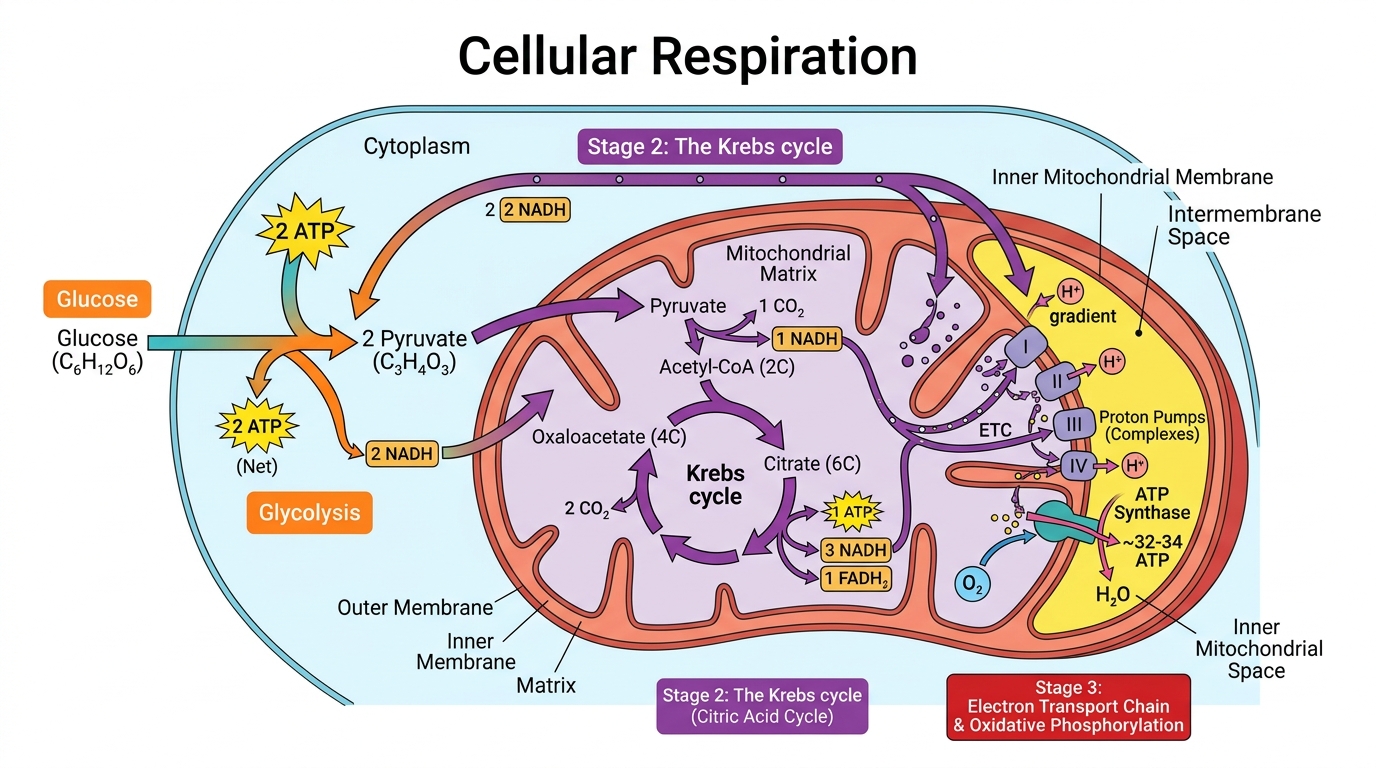
Every living cell requires energy to function. Inaerobic cellular respiration, nutrients (primarily glucose) undergo catabolic reactions yielding ATP, water, and carbon dioxide. Below is the complete pathway map from cytoplasm to the mitochondrial matrix.
 Full size
Cellular Respiration: Cytoplasm to Mitochondrion Pathway
A comprehensive map showing glucose breakdown in the cytoplasm, entry into the mitochondrial matrix, and high-yield ATP generation via the electron transport chain.
- 1Glycolysis — Occurs in the cytoplasm; splits 1 Glucose into 2 Pyruvate molecules producing a net 2 ATP and 2 NADH
- 2Pyruvate Oxidation (Link Reaction) — Pyruvate enters the mitochondrion and is converted into Acetyl-CoA, releasing CO2 and 1 NADH per pyruvate
- 3Krebs Cycle (Citric Acid Cycle) — Inside the matrix; Acetyl-CoA combines with Oxaloacetate to drive cyclical redox reactions generating NADH, FADH2, and ATP
- 4Electron Transport Chain (ETC) — Protein complexes (I-IV) on the inner membrane pump protons (H+) into the intermembrane space using high-energy electrons
- 5Proton Gradient & ATP Synthase — Chemiosmosis: H+ ions flow back into the matrix through ATP Synthase, driving the synthesis of 28-34 ATP
- 6Oxygen (O2) as Final Acceptor — O2 binds electrons and protons at Complex IV to form harmless metabolic water (H2O)
Overall Balanced Equation
- = Glucose (fuel molecule)
- = Oxygen (final electron acceptor)
- = Carbon dioxide (waste byproduct)
- = Water (byproduct)
- ATP = Usable chemical energy
The Three Main Stages at a Glance
| Stage | Cellular Location | Primary Input | Main Output | ATP Yield (Net) |
|---|---|---|---|---|
| Glycolysis | Cytoplasm (Cytosol) | 1 Glucose (6C) | 2 Pyruvate (3C), 2 NADH | 2 ATP (substrate-level) |
| Krebs Cycle | Mitochondrial Matrix | 2 Acetyl-CoA (2C) | 4 CO2, 6 NADH, 2 FADH2 | 2 ATP (substrate-level) |
| Oxidative Phosphorylation | Inner Mitochondrial Membrane | NADH, FADH2, O2 | H2O, NAD+, FAD | ~28-34 ATP (chemiosmosis) |
Glycolysis
- Cellular Location
- Cytoplasm (Cytosol)
- Primary Input
- 1 Glucose (6C)
- Main Output
- 2 Pyruvate (3C), 2 NADH
- ATP Yield (Net)
- 2 ATP (substrate-level)
Krebs Cycle
- Cellular Location
- Mitochondrial Matrix
- Primary Input
- 2 Acetyl-CoA (2C)
- Main Output
- 4 CO2, 6 NADH, 2 FADH2
- ATP Yield (Net)
- 2 ATP (substrate-level)
Oxidative Phosphorylation
- Cellular Location
- Inner Mitochondrial Membrane
- Primary Input
- NADH, FADH2, O2
- Main Output
- H2O, NAD+, FAD
- ATP Yield (Net)
- ~28-34 ATP (chemiosmosis)
2Substrate Flow: From Food to Usable ATP
Substrate Flow from Food to Energy
- 1
Glucose Intake
Glucose enters cytoplasm from extracellular fluid via transport proteins
- 2
Glycolysis Cleavage
Glucose (6C) is cleaved into two 3-carbon Pyruvates
- 3
Mitochondrial Transport
Pyruvate crosses double membrane into matrix, forming Acetyl-CoA
- 4
Electron Harvesting
Krebs cycle extracts electrons onto carrier coenzymes NADH & FADH2
- 5
Proton Pumping
ETC complexes use electron energy to pump H+ ions creating membrane potential
- 6
ATP Synthesis
ATP Synthase rotates like a molecular turbine, phosphorylating ADP into ATP
3Aerobic vs. Anaerobic Respiration (Fermentation)
When oxygen is unavailable or depleted (such as in heavily exercising muscle cells or anaerobic yeast), cells switch tofermentationto regenerate so glycolysis can continue producing minimal ATP.
Comparison of Energy Pathways
| Feature | Aerobic Respiration | Lactic Acid Fermentation | Alcoholic Fermentation |
|---|---|---|---|
| Oxygen Required? | Yes (strictly aerobic) | No (anaerobic) | No (anaerobic) |
| End Products | CO2 + H2O | Lactic Acid (Lactate) | Ethanol + CO2 |
| Typical Organisms | Plants, animals, humans, fungi | Human muscle cells, bacteria | Yeast, certain brewing bacteria |
| Total ATP Yield | 32 to 38 ATP per glucose | Only 2 ATP per glucose | Only 2 ATP per glucose |
Oxygen Required?
- Aerobic Respiration
- Yes (strictly aerobic)
- Lactic Acid Fermentation
- No (anaerobic)
- Alcoholic Fermentation
- No (anaerobic)
End Products
- Aerobic Respiration
- CO2 + H2O
- Lactic Acid Fermentation
- Lactic Acid (Lactate)
- Alcoholic Fermentation
- Ethanol + CO2
Typical Organisms
- Aerobic Respiration
- Plants, animals, humans, fungi
- Lactic Acid Fermentation
- Human muscle cells, bacteria
- Alcoholic Fermentation
- Yeast, certain brewing bacteria
Total ATP Yield
- Aerobic Respiration
- 32 to 38 ATP per glucose
- Lactic Acid Fermentation
- Only 2 ATP per glucose
- Alcoholic Fermentation
- Only 2 ATP per glucose
4Solved Exam Problems
Exam question · AP Biology & NEET Standard
- A.Because the Krebs cycle produces toxic levels of carbon dioxide.
- B.Because oxygen demand exceeds supply, causing pyruvate to convert into lactic acid while regenerating NAD+.
- C.Because ATP synthase permanently shuts down.
- D.Because glucose molecules run out entirely within seconds.
- 1. In intense sprinting, oxygen delivery to muscles cannot keep up with ATP consumption.
- 2. Without O2, the Electron Transport Chain halts, causing NADH to accumulate.
- 3. Muscle cells rely on lactic acid fermentation: pyruvate accepts electrons from NADH to form lactate, regenerating NAD+ so glycolysis can produce 2 ATP per cycle.
Answer: B. Because oxygen demand exceeds supply, causing pyruvate to convert into lactic acid while regenerating NAD+.
What it tests: Lactic acid fermentation keeps glycolysis operating under hypoxia by recycling NADH back to NAD+.
Remember
- Cellular respiration converts biochemical energy from glucose into universal cellular ATP currency.
- Glycolysis occurs in the cytoplasm and requires zero oxygen, producing net 2 ATP, 2 Pyruvate, and 2 NADH.
- The Krebs cycle takes place in the mitochondrial matrix, producing CO2, ATP, and vital electron donors (NADH and FADH2).
- The Electron Transport Chain and ATP Synthase on the inner membrane produce the majority of ATP (~30-34 ATP) via chemiosmosis.
- Oxygen is the terminal electron acceptor, without which the entire aerobic machinery stops.
Check yourself
Question 1
Where does the Citric Acid (Krebs) cycle take place in eukaryotic cells?Question 2
What is the immediate source of energy that directly drives ATP synthesis by ATP Synthase?Question 3
How many net ATP molecules are produced solely from one molecule of glucose during Glycolysis?Question 4
What happens to the electrons after they complete their journey through the Electron Transport Chain?