Biology · Class 12 / NEET & CBSE
Molecular Basis of Inheritance: DNA Replication & Transcription
Master molecular genetics: Semiconservative replication (Meselson-Stahl experiment), replication fork enzymes, transcription unit, Lac Operon, and genetic code.
11. Visual Overview & Intuitive Discovery: Molecular Basis of Inheritance: DNA Replication & Transcription
🔍 Clickable Interactive Study Prompts (Click to explore or jump to section):
Clickable### Intuitive Foundations & Real-World Reality
In 1958, Matthew Meselson and Franklin Stahl performed what scientists call "the most beautiful experiment in biology." By growing E. coli in heavy Nitrogen-15 isotope and centrifuging in CsCl density gradients, they proved that when DNA replicates, the double helix unwinds and each daughter duplex preserves one intact parental strand and one newly synthesized strand (Semiconservative Replication).
 Full size
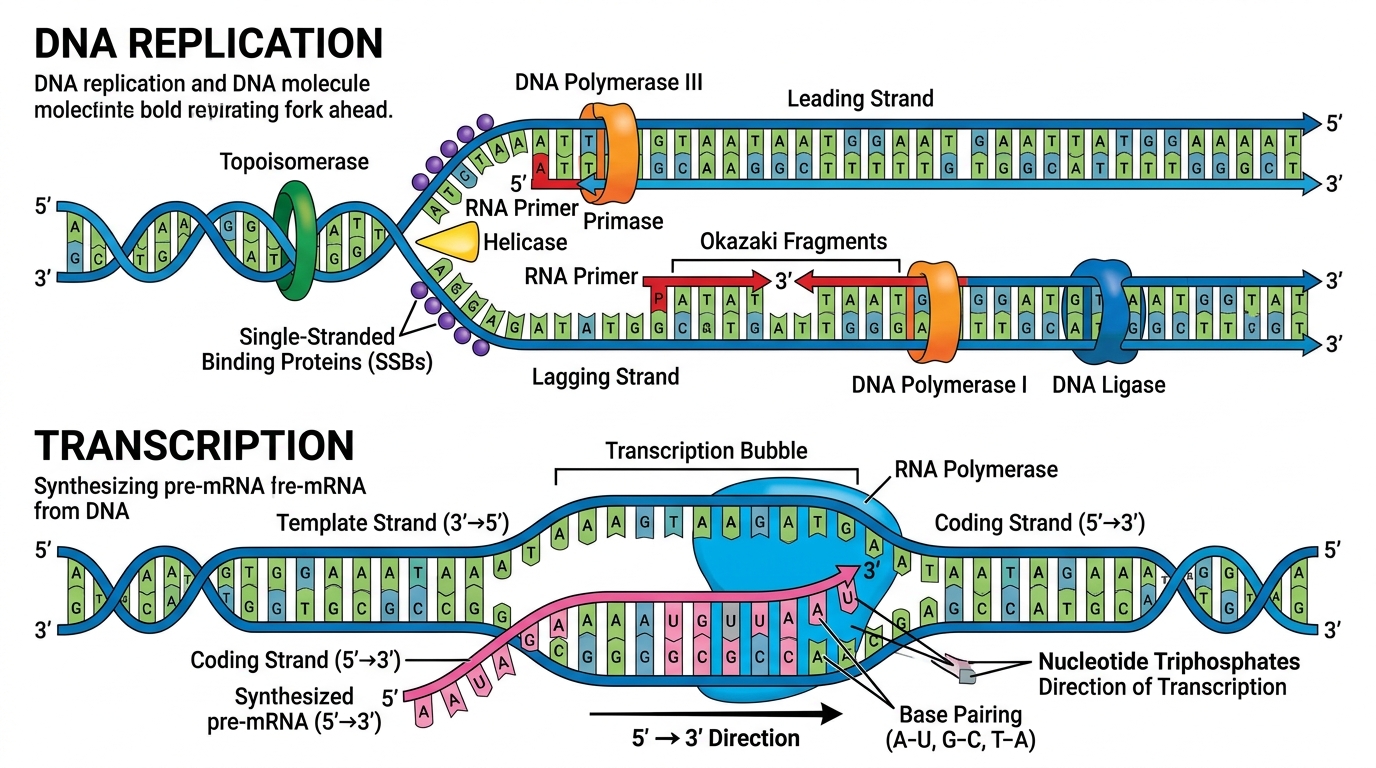
DNA Replication Fork & Transcription Mechanisms
Replication fork enzymes (helicase, DNA polymerase III, Okazaki fragments, ligase) and RNA polymerase transcription of template DNA into pre-mRNA.
- 1Core Anchor 1 — Meselson and Stahl Experiment: Proof of Semiconservative DNA Replication
- 2Core Anchor 2 — Replication Fork Enzymes: Helicase, Primase, DNA Pol III, Ligase
- 3Core Anchor 3 — Transcription Unit: Promoter, Structural Gene & Terminator
- 4Core Anchor 4 — Lac Operon Regulation: Negative Control by Repressor Protein
22. Concept & Decision Flowchart: Central Dogma of Molecular Biology Flowchart
Central Dogma of Molecular Biology Flowchart
- 1
1. DNA Replication (5' to 3')
DNA Helicase unzips helix -> DNA Polymerase III synthesizes continuous Leading Strand and discontinuous Okazaki fragments on Lagging Strand -> DNA Ligase seals nicks.
- 2
2. Transcription (DNA to mRNA)
RNA Polymerase binds Promoter with Sigma factor (σ) -> reads template strand (3' to 5') to synthesize pre-mRNA (5' to 3') -> Rho factor (ρ) terminates.
- 3
3. Post-Transcriptional Processing
Eukaryotic pre-mRNA undergoes 5'-Capping (methylguanosine), Splicing (spliceosome removes introns), and 3'-Polyadenylation (poly-A tail).
- 4
4. Translation (mRNA to Protein)
Ribosomes decode mRNA codons (AUG start codon) using tRNA anticodons to assemble peptide chains until a Stop Codon (UAA, UAG, UGA) is reached.
33. Step-by-Step Genetic Logic: The Meselson-Stahl Centrifugation Density Ratios
Derivation — Step-by-Step Genetic Logic: The Meselson-Stahl Centrifugation Density Ratios
- 1
All nitrogen bases incorporate heavy ¹⁵N isotope, producing a dense band at the bottom of the CsCl gradient.
- 2
Rules out Conservative Replication (which would have yielded 50% pure heavy and 50% pure light).
- 3
Two distinct equal bands confirm semiconservative replication.
- 4
Hybrid DNA remains constant at exactly 2 duplexes while light DNA expands exponentially.
44. Real-World Case Study & Industrial Application
### Biomedical Oncology: Telomerase and Cancer Immortality
Because DNA Polymerase cannot synthesize the 5' end of lagging strands, linear eukaryotic chromosomes lose 50-100 base pairs with every cell division (the End-Replication Problem), triggering cellular senescence after ~50 divisions (Hayflick limit). Over 90% of human malignant tumors express the enzyme Telomerase, which extends telomere repeat caps (TTAGGG), granting cancer cells lethal replicative immortality.
55. High-Yield Reference Data & Solved Problems
High-Yield Comparison & Key Constants
| Enzyme | Function in Replication | Direction of Polymerization |
|---|---|---|
| Helicase | Unwinds DNA double helix at origin | Breaks hydrogen bonds |
| Topoisomerase (Gyrase) | Relieves torsional supercoiling strain | Ahead of replication fork |
| DNA Polymerase III | Synthesizes new daughter DNA strand | Strictly 5' to 3' direction |
| DNA Polymerase I | Removes RNA primers & fills gaps (Proofreading) | 5' to 3' exonuclease & polymerase |
| DNA Ligase | Joins Okazaki fragments via phosphodiester bonds | Requires ATP / NAD⁺ |
Helicase
- Function in Replication
- Unwinds DNA double helix at origin
- Direction of Polymerization
- Breaks hydrogen bonds
Topoisomerase (Gyrase)
- Function in Replication
- Relieves torsional supercoiling strain
- Direction of Polymerization
- Ahead of replication fork
DNA Polymerase III
- Function in Replication
- Synthesizes new daughter DNA strand
- Direction of Polymerization
- Strictly 5' to 3' direction
DNA Polymerase I
- Function in Replication
- Removes RNA primers & fills gaps (Proofreading)
- Direction of Polymerization
- 5' to 3' exonuclease & polymerase
DNA Ligase
- Function in Replication
- Joins Okazaki fragments via phosphodiester bonds
- Direction of Polymerization
- Requires ATP / NAD⁺
Exam question · JEE Main, Advanced & NEET Standard
- 1. Total time = 80 minutes. Generation time = 20 minutes.
- 2. Number of generations n = 80 / 20 = 4 generations.
- 3. Total DNA molecules formed = 2⁴ = 16 duplexes.
- 4. According to semiconservative replication, the two original parental ¹⁵N strands remain intact in 2 hybrid molecules.
- 5. Hybrid DNA (¹⁵N/¹⁴N) = 2 molecules.
- 6. Pure Light DNA (¹⁴N/¹⁴N) = 16 - 2 = 14 molecules.
- 7. Proportion: Light : Hybrid = 14 : 2 = 7 : 1 (87.5% light, 12.5% hybrid).
Answer: 1. Total time = 80 minutes. Generation time = 20 minutes.
2. Number of generations n = 80 / 20 = 4 generations.
3. Total DNA molecules formed = 2⁴ = 16 duplexes.
4. According to semiconservative replication, the two original parental ¹⁵N strands remain intact in 2 hybrid molecules.
5. Hybrid DNA (¹⁵N/¹⁴N) = 2 molecules.
6. Pure Light DNA (¹⁴N/¹⁴N) = 16 - 2 = 14 molecules.
7. Proportion: Light : Hybrid = 14 : 2 = 7 : 1 (87.5% light, 12.5% hybrid).
What it tests: Tests rigorous conceptual mastery, dimensional analysis, and multi-step deduction.
Remember
- Molecular Basis of Inheritance: DNA Replication & Transcription: Foundational law governing physical, chemical, and biological phenomena.
- Mastered derivation: Step-by-Step Genetic Logic: The Meselson-Stahl Centrifugation Density Ratios.
- Avoided classic trap: The genetic code is degenerate (multiple codons code for the same amino acid), but it is NEVER ambiguous! A pa...
- Real-world relevance: Proven clinical, aerospace, and industrial significance.
- High-yield exam rule: Always verify dimensional consistency and physical boundary conditions.
Check yourself
Question 1
What is the primary governing principle of Molecular Basis of Inheritance: DNA Replication & Transcription?Question 2
In competitive examinations (JEE/NEET), what is the most critical pitfall in Molecular Basis of Inheritance: DNA Replication & Transcription?