Biology · Class 11 / NEET & CBSE
Photosynthesis: Light Reactions & Calvin Cycle (C3 vs C4)
Master plant energetics: Photolysis of water, Z-scheme of light reactions, Cyclic vs Non-cyclic photophosphorylation, Calvin cycle (C3), Hatch-Slack pathway (C4), and Kranz anatomy.
11. Visual Overview & Intuitive Discovery: Photosynthesis: Light Reactions & Calvin Cycle (C3 vs C4)
🔍 Clickable Interactive Study Prompts (Click to explore or jump to section):
Clickable### Intuitive Foundations & Real-World Reality
In 1954, Melvin Calvin used radioactive Carbon-14 tracing to discover that plants fix atmospheric CO2 through a cyclic metabolic cycle in the stroma. Concurrently, Peter Mitchell's Chemiosmotic Hypothesis proved that light-driven splitting of water pumps protons into the thylakoid lumen, creating an electrochemical proton gradient that spins ATP Synthase to generate life's chemical energy currency!
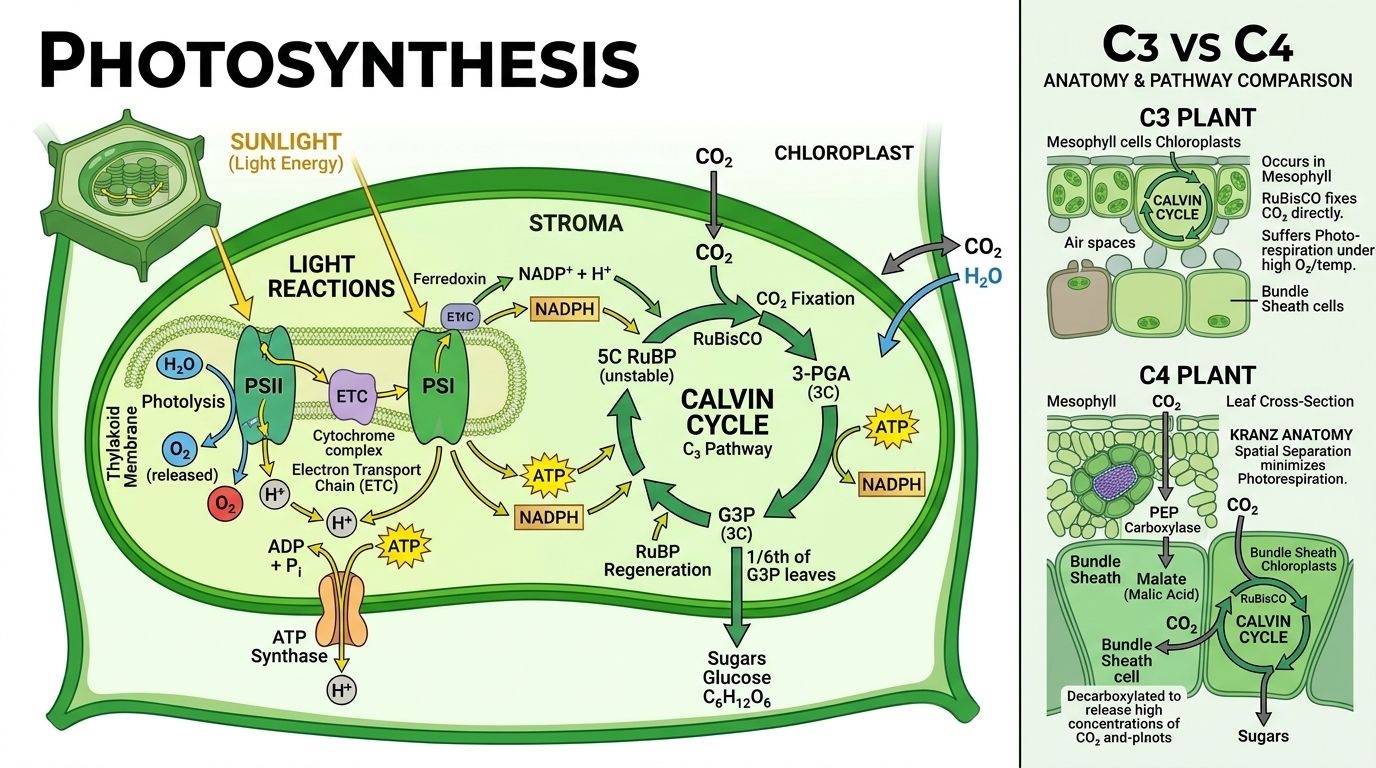 Full size
Photosynthesis: Light Reactions & Calvin Cycle
Thylakoid electron transport chain, photolysis of water, ATP synthase photophosphorylation, Calvin cycle carbon fixation, and C3 vs C4 Kranz anatomy.
- 1Core Anchor 1 — Z-Scheme of Electron Transport in Thylakoids
- 2Core Anchor 2 — Calvin Cycle (C3) Three Phases: Carboxylation, Reduction, Regeneration
- 3Core Anchor 3 — C4 Pathway (Kranz Anatomy) & Avoiding Photorespiration
- 4Core Anchor 4 — Cyclic vs Non-Cyclic Photophosphorylation Comparison
22. Concept & Decision Flowchart: Photosynthetic Pathway & Energetics Flowchart
Photosynthetic Pathway & Energetics Flowchart
- 1
1. Light Absorption (PS II & PS I)
Photons hit P680 (PS II), exciting electrons. Water splits: 2H2O -> 4H⁺ + O2 + 4e⁻ in thylakoid lumen.
- 2
2. Z-Scheme Electron Flow
Electrons cascade via Plastoquinone -> Cytochrome b6f -> Plastocyanin -> PS I (P700) -> Ferredoxin -> NADP⁺ Reductase to make NADPH.
- 3
3. Chemiosmotic ATP Synthesis
Proton accumulation in lumen creates ΔpH. Protons rush through CF0-CF1 ATP Synthase into stroma, synthesizing ATP.
- 4
4. Dark Reaction (Calvin Cycle)
RuBisCO fixes CO2 with RuBP (Carboxylation) -> 3-PGA -> Reduction (using ATP + NADPH) -> Triose Phosphate -> RuBP Regeneration. For 1 Glucose: 6 CO2, 18 ATP, and 12 NADPH consumed.
33. Step-by-Step Biochemical Accounting: Synthesis of 1 Molecule of Glucose (C6H12O6)
Derivation — Step-by-Step Biochemical Accounting: Synthesis of 1 Molecule of Glucose (C6H12O6)
- 1
RuBisCO catalyzes the most abundant enzymatic reaction on Earth, producing 12 molecules of 3-phosphoglyceric acid.
- 2
Each 3-PGA molecule requires 1 ATP and 1 NADPH for reduction to triose phosphate.
- 3
Two triose phosphate molecules exit the cycle to form hexose sugar in cytoplasm.
- 4
Remaining 10 molecules are rearranged to regenerate 6 molecules of ribulose-1,5-bisphosphate.
44. Real-World Case Study & Industrial Application
### Agronomy & Food Security: Engineering C4 Rice for High-Yield Crops
C3 crops (like rice and wheat) waste up to 30% of photosynthetic energy on Photorespiration (where RuBisCO binds O2 instead of CO2 under high heat). Global consortia (the C4 Rice Project) are genetically introducing C4 Kranz anatomy and PEP carboxylase into rice. C4 photosynthesis concentrates CO2 in bundle sheath cells, increasing crop yield by 50% with 30% less water usage!
55. High-Yield Reference Data & Solved Problems
High-Yield Comparison & Key Constants
| Feature | C3 Plants (Wheat, Rice) | C4 Plants (Maize, Sugarcane) |
|---|---|---|
| First CO2 Fixation Product | 3-PGA (3-Carbon acid) | Oxaloacetic Acid (OAA, 4-Carbon) |
| Primary CO2 Acceptor | RuBP (5-Carbon) | PEP (Phosphoenolpyruvate, 3-Carbon) |
| Leaf Anatomy | Standard Mesophyll | Kranz Anatomy (Bundle Sheath Cells) |
| Photorespiration | Present (High loss at high T) | Completely Negligible / Absent |
| ATP Consumed per Glucose | 18 ATP | 30 ATP (12 extra for PEP regeneration) |
First CO2 Fixation Product
- C3 Plants (Wheat, Rice)
- 3-PGA (3-Carbon acid)
- C4 Plants (Maize, Sugarcane)
- Oxaloacetic Acid (OAA, 4-Carbon)
Primary CO2 Acceptor
- C3 Plants (Wheat, Rice)
- RuBP (5-Carbon)
- C4 Plants (Maize, Sugarcane)
- PEP (Phosphoenolpyruvate, 3-Carbon)
Leaf Anatomy
- C3 Plants (Wheat, Rice)
- Standard Mesophyll
- C4 Plants (Maize, Sugarcane)
- Kranz Anatomy (Bundle Sheath Cells)
Photorespiration
- C3 Plants (Wheat, Rice)
- Present (High loss at high T)
- C4 Plants (Maize, Sugarcane)
- Completely Negligible / Absent
ATP Consumed per Glucose
- C3 Plants (Wheat, Rice)
- 18 ATP
- C4 Plants (Maize, Sugarcane)
- 30 ATP (12 extra for PEP regeneration)
Exam question · JEE Main, Advanced & NEET Standard
- 1. In C3 plants:
- - Fixing 1 CO2 requires: 2 ATP (Reduction) + 1 ATP (Regeneration) = 3 ATP, and 2 NADPH (Reduction).
- - To synthesize 1 Glucose (6 Carbons), the cycle turns 6 times:
- Total ATP = 6 × 3 = 18 ATP.
- Total NADPH = 6 × 2 = 12 NADPH.
- 2. In C4 plants:
- - 2 additional ATP are required per CO2 molecule to convert pyruvate back to PEP in mesophyll chloroplasts.
- - Total ATP = 18 + (6 × 2) = 30 ATP.
- - Total NADPH = 12 NADPH (same as C3).
Answer: 1. In C3 plants:
- Fixing 1 CO2 requires: 2 ATP (Reduction) + 1 ATP (Regeneration) = 3 ATP, and 2 NADPH (Reduction).
- To synthesize 1 Glucose (6 Carbons), the cycle turns 6 times:
Total ATP = 6 × 3 = 18 ATP.
Total NADPH = 6 × 2 = 12 NADPH.
2. In C4 plants:
- 2 additional ATP are required per CO2 molecule to convert pyruvate back to PEP in mesophyll chloroplasts.
- Total ATP = 18 + (6 × 2) = 30 ATP.
- Total NADPH = 12 NADPH (same as C3).
What it tests: Tests rigorous conceptual mastery, dimensional analysis, and multi-step deduction.
Remember
- Photosynthesis: Light Reactions & Calvin Cycle (C3 vs C4): Foundational law governing physical, chemical, and biological phenomena.
- Mastered derivation: Step-by-Step Biochemical Accounting: Synthesis of 1 Molecule of Glucose (C6H12O6).
- Avoided classic trap: RuBisCO is an oxygenase as well as a carboxylase (hence the name: RuBP Carboxylase-Oxygenase). When temperatur...
- Real-world relevance: Proven clinical, aerospace, and industrial significance.
- High-yield exam rule: Always verify dimensional consistency and physical boundary conditions.
Check yourself
Question 1
What is the primary governing principle of Photosynthesis: Light Reactions & Calvin Cycle (C3 vs C4)?Question 2
In competitive examinations (JEE/NEET), what is the most critical pitfall in Photosynthesis: Light Reactions & Calvin Cycle (C3 vs C4)?