Question 3 of 210
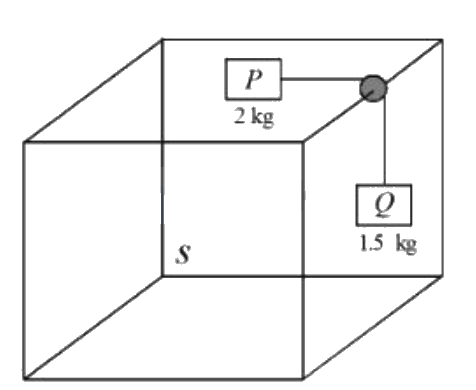
Two blocks ( and ) with respectively masses kg and kg are joined by a massless thread. These blocks are mounted on a frictionless pulley which is fixed on the edge of a cube (), as shown in the figure below. Block is positioned on the top surface which has no friction and block is in contact with side-surface, having coefficient friction . The cube () moves towards the right with acceleration of , where is gravitational acceleration. During this movement the block and remain stationary. The value of is _______. (take m/s)
Show answer and solution
Answer: (B)
Let us analyze the forces acting on blocks and in the non-inertial frame of reference of the cube , which is moving to the right with an acceleration .
In this frame, a pseudo force acts on both blocks towards the left.
For block (mass ):
The forces in the horizontal direction are the tension in the string (acting towards the right) and the pseudo force (acting towards the left). Since block is stationary relative to the cube and there is no friction on the top surface:
For block (mass ):
The horizontal forces are the normal reaction from the side surface of the cube (acting towards the right) and the pseudo force (acting towards the left). Since block is stationary horizontally relative to the cube:
The vertical forces acting on block are the downward gravitational force , the upward tension , and the frictional force .
The downward force is .
Since (), the block has a tendency to slide downwards, so the static friction must act upwards.
For vertical equilibrium of block :
To keep the block stationary, the required friction must be less than or equal to the maximum static friction (). Assuming the limiting case to find the value of :
Answer: