Physics · NEET, JEE Main
Laws of Motion
210 practice questions with a worked solution for each. Tap an option to see instantly if you are right.
180MCQ30Numerical76With diagram
- 1A body of mass is acted upon by two perpendicular forces and . The magnitude of its acceleration is:NEET/MCQ/Medium
- 2A block on rough horizontal floor () is connected to hanging mass . System acceleration is ():JEE Main/MCQ/Medium/With diagram
- 3Two blocks ( and ) with respectively masses kg and kg are joined by a massless thread. These blocks are mounted on a frictionless pulley which is fixed on the edge of a cube (), as shown in the figure below. Block is positioned on the top surface which has no friction and block is in contact with side-surface, having coefficient friction . The cube () moves towards the right with acceleration of , where is gravitational acceleration. During this movement the block and remain stationary. The value of is _______. (take m/s)
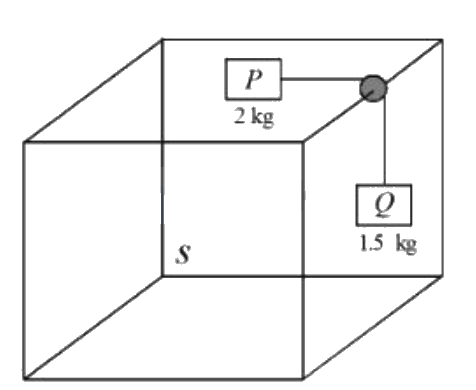 JEE Main/MCQ/Medium/Newton's laws of motion/With diagram
- 4A wedge with mass of kg and all frictionless surfaces and the inclined surface making with horizontal. A block with mass kg is placed at the highest point of the wedge as shown in figure is at rest. At wedge is pulled toward right with constant force of N. Taking the block at rest at , the time taken by it to slide down m on the slope, while is on the move, is _____ s.
(take and m/s)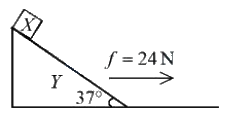 JEE Main/MCQ/Medium/Newton's laws of motion/With diagram
- 5Three masses kg, kg and kg are suspended from a fixed smooth frictionless pulley as shown in the figure below. The value of is _____.
(take m/s)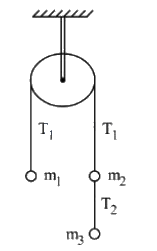 JEE Main/MCQ/Medium/Newton's laws of motion/With diagram
- 6At , a body of mass g starts moving under the influence of a force N. After s its position is m. The ratio is ______.JEE Main/MCQ/Medium/Newton's laws of motion
- 7A small block of mass slides down from the top of a frictionless inclined surface, while the inclined plane is moving towards left with constant acceleration . The angle between the inclined plane and ground is and its base length is . Assuming that initially the small block is at the top of the inclined plane, the time it takes to reach the lowest point of the inclined plane is .
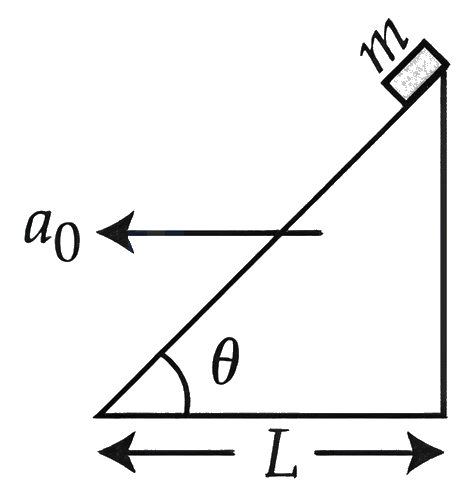 JEE Main/MCQ/Medium/Newton's laws of motion/With diagram
- 8A particle of mass falls from rest through a resistive medium having resistive force, , where is the velocity of the particle and is a constant. Which of the following graphs represents velocity () versus time ()?JEE Main/MCQ/Medium/Newton's laws of motion
- 9A 4 kg mass moves under the influence of a force where is the time in second. If mass starts from origin at , the velocity and position after will be:JEE Main/MCQ/Medium/Newton's laws of motion
- 10An object with mass 500 g moves along x -axis with speed . The force acting on the object is :JEE Main/MCQ/Medium/Newton's laws of motion
- 11A wooden block, initially at rest on the ground, is pushed by a force which increases linearly with time . Which of the following curve best describes acceleration of the block with time:JEE Main/MCQ/Medium/Newton's laws of motion
- 12A body of mass experiences two forces and The acceleration acting on the body is:JEE Main/MCQ/Medium/Newton's laws of motion
- 13A cricket player catches a ball of mass moving with speed. If the catching process is completed in then the magnitude of force exerted by the ball on the hand of player will be(in SI unit):JEE Main/MCQ/Medium/Newton's laws of motion
- 14Three blocks and are pulled on a horizontal smooth surface by a force of as shown in figure. The tensions in the string are respectively:
 JEE Main/MCQ/Medium/Newton's laws of motion/With diagram
- 15The position vector of a particle related to time is given by . The direction of net force experienced by the particle is :JEE Main/MCQ/Medium/Newton's laws of motion
- 16A body of mass moves along -axis such that it's velocity varies with displacement according to the relation the force acting on the body is:JEE Main/MCQ/Medium/Newton's laws of motion
- 17Given below are two statements: one is labelled as Assertion A and the other is labelled as Reason R
Assertion A : An electric fan continues to rotate for some time after the current is switched off.
Reason R: Fan continues to rotate due to inertia of motion.
In the light of above statements, choose the most appropriate answer from the options given below.JEE Main/MCQ/Medium/Newton's laws of motion - 18At any instant the velocity of a particle of mass is . If the force acting on the particle at is . Then the value of will be:JEE Main/MCQ/Medium/Newton's laws of motion
- 19The figure represents the momentum time curve for a particle moving along an axis under the influence of the force. Identify the regions on the graph where the magnitude of the force is maximum and minimum respectively ?
If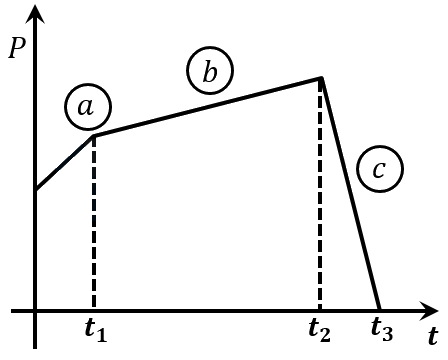 JEE Main/MCQ/Medium/Newton's laws of motion/With diagram
- 20Force acts for on a body of mass , starting from rest, after which the force ceases and then body describes in the next . The value of force will be :JEE Main/MCQ/Medium/Newton's laws of motion
- 21Given below are two statements:
Statement-I: An elevator can go up or down with uniform speed when its weight is balanced with the tension of its cable.
Statement-II: Force exerted by the floor of an elevator on the foot of a person standing on it is more than his/her weight when the elevator goes down with increasing speed.
In the light of the above statements, choose the correct answer from the options given below:JEE Main/MCQ/Medium/Newton's laws of motion - 22A uniform metal chain of mass and length passes over a massless and frictionless pulley. It is released from rest with a part of its length is hanging on one side and rest of its length is hanging on the other side of the pulley. At a certain point of time, when , the acceleration of the chain is . The value of is _____.
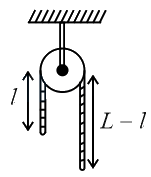 JEE Main/MCQ/Medium/Newton's laws of motion/With diagram
- 23A balloon has mass of in air. The air escapes from the balloon at a uniform rate with velocity . If the balloon shrinks in completely. Then, the average force acting on that balloon will be (in dyne).JEE Main/MCQ/Medium/Newton's laws of motion
- 24A block takes to slide down a frictionless incline of and length , kept inside a lift going up with uniform velocity . If the incline is changed to , the time taken by the block, to slide down the incline, will be approximately:JEE Main/MCQ/Medium/Newton's laws of motion
- 25A block of mass slides down on a rough inclined plane with constant velocity. The angle made by the incline plane with horizontal is . The magnitude of the contact force will be :JEE Main/MCQ/Medium/Newton's laws of motion
- 26Two masses and are tied together at the two ends of a light inextensible string that passes over a frictionless pulley. When the mass is twice that of . the acceleration of the system is . When the mass is thrice that of . The acceleration of The system is . The ratio will be
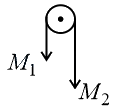 JEE Main/MCQ/Medium/Newton's laws of motion/With diagram
- 27A monkey of mass climbs on a rope which can withstand the tension of . If monkey initially climbs down with an acceleration of and then climbs up with an acceleration of . Choose the correct option JEE Main/MCQ/Medium/Newton's laws of motion
- 28Three masses and are arranged in a system as shown in figure. All the surfaces are frictionless and strings are inextensible and weightless. The pulleys are also weightless and frictionless. A force is applied on the system so that the mass moves upward with an acceleration of . The value of is
(Take )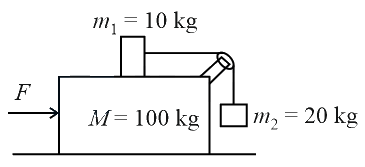 JEE Main/MCQ/Medium/Newton's laws of motion/With diagram
- 29A block of metal weighing is resting on a frictionless plane (as shown in figure). It is struck by a jet releasing water at a rate of and at a speed of . Then, the initial acceleration of the block, in , will be
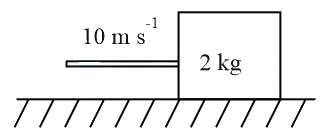 JEE Main/MCQ/Medium/Newton's laws of motion/With diagram
- 30A hanging mass is connected to a four times bigger mass by using a string pulley arrangement, as shown in the figure. The bigger mass is placed on a horizontal ice-slab and being pulled by force. In this situation, tension in the string is for _____. Neglect mass of the string and friction of the block (bigger mass) with ice slab.
(Given acceleration due to gravity)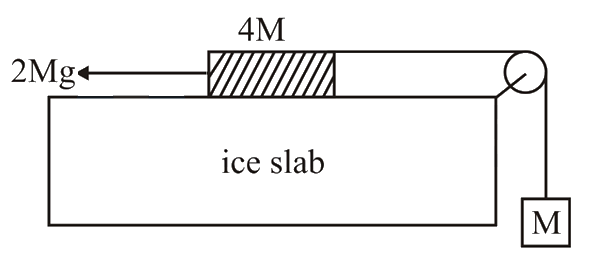 JEE Main/Numerical/Medium/Newton's laws of motion/With diagram
- 31A system to balls each of mass are connected via massless and unstretchable string. The system is allowed to slip over the edge of a smooth table as shown in figure. Tension on the string between the and ball is _____ when ball just leaves the table.
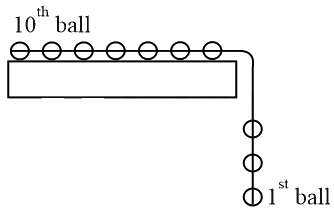 JEE Main/Numerical/Medium/Newton's laws of motion/With diagram
- 32A force on an object of mass is . The position of that object at is after starting from rest. The value of will be _____ .JEE Main/Numerical/Medium/Newton's laws of motion
- 33The initial mass of a rocket is . Calculate at what rate the fuel should be burnt so that the rocket is given an acceleration of, . The gases come out at a relative speed of , with respect to the rocket:
JEE Main/MCQ/Medium/Newton's laws of motion - 34A force acts on a body of mass . If the body starts from rest, its position vector at time will beJEE Main/MCQ/Medium/Newton's laws of motion
- 35Two billiard balls of equal mass strike a rigid wall with same speed of (as shown) but at different angles. If the balls get reflected with the same speed, then the ratio of the magnitude of impulses imparted to ball and ball by the wall along direction is:
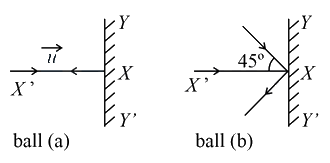 JEE Main/MCQ/Medium/Newton's laws of motion/With diagram
- 36A bullet of mass is fired from a gun of mass If the bullet moves with the muzzle speed of the impulse imparted to the gun and velocity of recoil of gun areJEE Main/MCQ/Medium/Newton's laws of motion
- 37A bullet of mass is fired on a wooden block to pierce through it, but it stops after moving a distance of into it. If the velocity of the bullet before hitting the wood is and, it slows down with uniform deceleration, then the magnitude of effective retarding force on the bullet is The value of to the nearest integer is,JEE Main/Numerical/Medium/Newton's laws of motion
- 38Consider a frame that is made up of two thin massless rods and as shown in the figure. A vertical force of magnitude is applied at point of the frame.
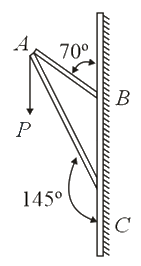
Suppose the force is resolved parallel to the arms and of the frame. The magnitude of the resolved component along the arm is . The value of , to the nearest integer, is ________.
[Given : ]JEE Main/Numerical/Medium/Newton's laws of motion/With diagram - 39Two masses and , each of mass are fixed together by a massless spring, A force acts on the mass as shown in figure. If the mass starts moving away from mass with acceleration , then the acceleration of mass will be :
 JEE Main/MCQ/Medium/Newton's laws of motion/With diagram
- 40A spaceship in space sweeps stationary interplanetary dust. As a result, its mass increases at a rate where is its instantaneous velocity. The instantaneous acceleration of the satellite is:JEE Main/MCQ/Medium/Newton's laws of motion
- 41A mass of is suspended by a rope of length , from the ceiling. A force is applied horizontally at the mid-point of the rope such that the top half of the rope makes an angle of with the vertical. Then equals: (Take and the rope to be massless)JEE Main/MCQ/Medium/Newton's laws of motion
- 42A block of mass is (i) pushed in case and (ii) pulled in case by a force making an angle of with the horizontal, as shown in the figures. The coefficient of friction between the block and floor is The difference between the accelerations of the block, in case and case will be:
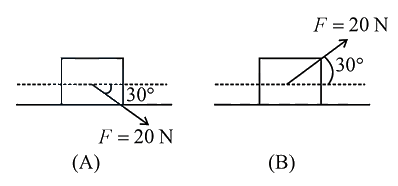 JEE Main/MCQ/Medium/Newton's laws of motion/With diagram
- 43A ball is thrown upward with an initial velocity from the surface of the earth. The motion of the ball is affected by a drag force equal to (where is mass of the ball, is its instantaneous velocity and is a constant). Time taken by the ball to rise to its zenith is:JEE Main/MCQ/Medium/Newton's laws of motion
- 44A vertical closed cylinder is separated into two parts by a frictionless piston of mass and of negligible thickness. The piston is free to move along the length of the cylinder. The length of the cylinder above piston is and that below the piston is such that Each part of the cylinder contains moles of an ideal gas at equal temperature If the piston is stationary, its mass will be given by:
( is universal gas constant and is the acceleration due to gravity)JEE Main/MCQ/Medium/Newton's laws of motion - 45A particle of mass is moving in a straight line with momentum p. Starting at time a force t acts in the same direction on the moving particle during time interval T so that its momentum changes from to . Here is a constant. The value of isJEE Main/MCQ/Medium/Newton's laws of motion
- 46The machine as shown has rods of length connected by a pivot at the top. The end of one rod is connected to the floor by a stationary pivot and the end of the other rod has roller that rolls along the floor in a slot. As the roller goes back and forth, a weight moves up and down. If the roller is moving towards right at a constant speed, the weight moves up with a :
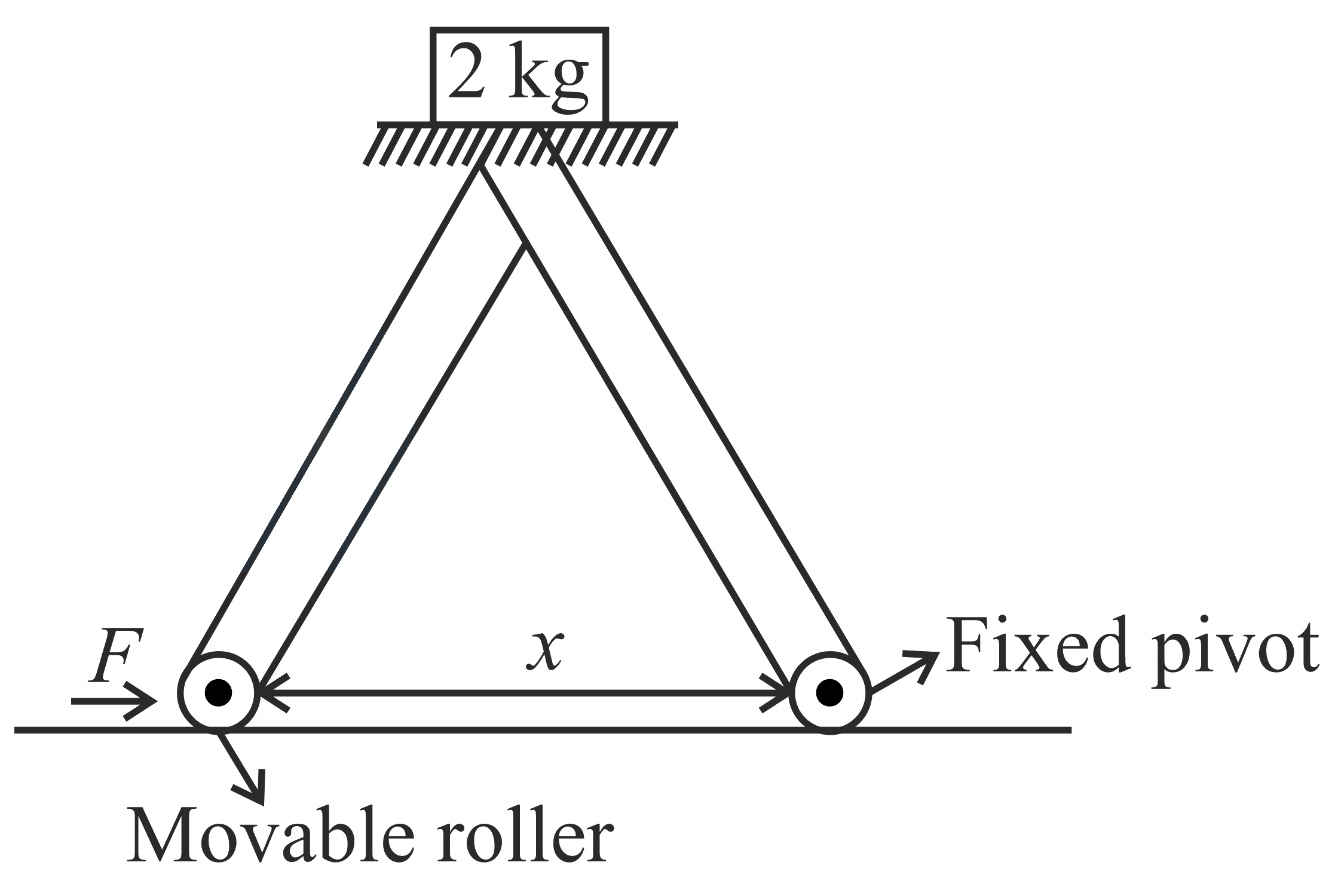 JEE Main/MCQ/Medium/Newton's laws of motion/With diagram
- 47A conical pendulum of length makes an angle with respect to axis and moves in a circle in the plane. The radius of the circle is and its center is vertically below . The speed of the pendulum, in its circular path, will be -
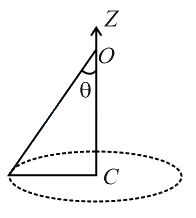 JEE Main/MCQ/Medium/Newton's laws of motion/With diagram
- 48A particle of mass is acted upon by a force given by the empirical law If this law is to be tested experimentally by observing the motion starting from rest, the best way is to plotJEE Main/MCQ/Medium/Newton's laws of motion
- 49Which of the following option correctly describes the variation of the speed and acceleration 'a' of a point mass falling vertically in a viscous medium that applies a force , where 'k' is a constant, on the body? (Graphs are schematic and not drown to scale)JEE Main/MCQ/Medium/Newton's laws of motion
- 50A large number of identical beads, each of mass and radius are strung on a thin smooth rigid horizontal rod of length and are at rest at random positions. The rod is mounted between two rigid supports (see figure). If one of the beads is now given a speed , the average force experienced by each support after a long time is (assume all collisions are elastic):
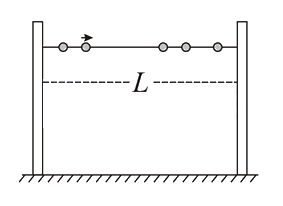 JEE Main/MCQ/Medium/Newton's laws of motion/With diagram
- 51A body of mass under the action of constant force has velocity at as and at as . The force is:JEE Main/MCQ/Medium/Newton's laws of motion
- 52Water is flowing at a speed of 1.5 m s-1 through a horizontal tube of cross-sectional area 10-2 m2 and you are trying to stop the flow by your palm. Assuming that the water stops immediately after hitting the palm, the minimum force that you must exert should be (density of water = 103 kg m-3)JEE Main/MCQ/Medium/Newton's laws of motion
- 53Two blocks of mass and are connected by a metal rod of mass . The system is pulled vertically up by applying a force of as shown. The tension at the mid-point of the rod is:
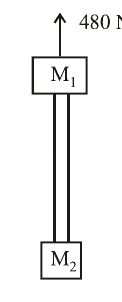 JEE Main/MCQ/Medium/Newton's laws of motion/With diagram
- 54This question has Statement 1 and Statement 2 . Of the four choices given after the Statements, choose the one that best describes the two Statements.
Statement 1: If you push on a cart being pulled by a horse so that it does not move, the cart pushes you back with an equal and opposite force.
Statement 2: The cart does not move because the force described in statement 1 cancel each other.JEE Main/MCQ/Medium/Newton's laws of motion - 55A satellite moving with velocity in a force free space collects stationary interplanetary dust at a rate of where is the mass (of satellite + dust) at that instant. The instantaneous acceleration of the satellite isJEE Main/MCQ/Medium/Newton's laws of motion
- 56Sand is being dropped on a conveyer belt at the rate of per second. The force necessary to keep the belt moving with a constant speed of will beJEE Main/MCQ/Medium/Newton's laws of motion
- 57An engine pumps water continuously through a hose. Water leaves the hose with velocity and is mass per unit length of the water jet. If this jet hits a surface and came to rest instantaneously, the force on the surface isJEE Main/MCQ/Medium/Newton's laws of motion
- 58A car of mass is moving at a speed of 30 . Brakes are applied to bring the car to rest. If the net retarding force is , the car comes to stop after travelling in . ThenJEE Main/MCQ/Medium/Newton's laws of motion
- 59A particle of mass is at rest at the origin at time . It is subjected to a force in the direction. Its speed is depicted by which of the following curves?JEE Main/MCQ/Medium/Newton's laws of motion
- 60Two fixed frictionless inclined plane making an angle and with the vertical are shown in the figure. Two block and are placed on the two planes. What is the relative vertical acceleration of with respect to ?
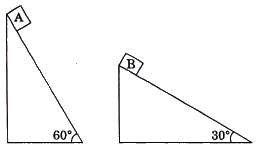 JEE Main/MCQ/Medium/Newton's laws of motion/With diagram
- 61A body weighing is suspended by two strings and long, their other ends being fastened to the extremities of a rod long. If the rod be so held that the body hangs immediately below the middle point. The tensions in the strings areJEE Main/MCQ/Medium/Newton's laws of motion
- 62A player caught a cricket ball of mass moving at a rate of . If the catching process is completed in , the force of the blow exerted by the ball on the hand of the player is equal toJEE Main/MCQ/Medium/Newton's laws of motion
- 63A particle of mass is subjected to a force with . What will be its initial acceleration if it is released from a point away from the origin?JEE Main/MCQ/Medium/Newton's laws of motion
- 64Two masses and tied to a string are hanging over a light frictionless pulley. What is the acceleration of the masses when lift free to move
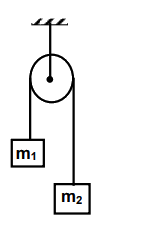 JEE Main/MCQ/Medium/Newton's laws of motion/With diagram
- 65A machine gun fires a bullet of mass with a velocity . The man holding it can exert a maximum force of on the gun. How many bullets can he fire per second at the most?JEE Main/MCQ/Medium/Newton's laws of motion
- 66A rocket with a lift-off mass is blasted upwards with an initial acceleration of . Then the initial thrust of the blast isJEE Main/MCQ/Medium/Newton's laws of motion
- 67A block of mass is pulled along a horizontal frictionless surface by a rope of mass . If a force is applied at the free end of the rope, the force exerted by the rope on the block isJEE Main/MCQ/Medium/Newton's laws of motion
- 68Three forces start acting simultaneously on a particle moving with velocity, . These forces are represented in magnitude and direction by the three sides of a triangle . The particle will now move with velocity
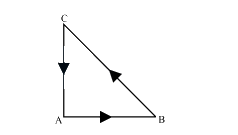 JEE Main/MCQ/Medium/Newton's laws of motion/With diagram
- 69A spring balance is attached to the ceiling of a lift. A man hangs his bag on the spring and the spring reads 49 , when the lift is stationary. If the lift moves downward with an acceleration of , the reading of the spring balance will beJEE Main/MCQ/Medium/Newton's laws of motion
- 70Three identical blocks of masses are drawn by a force with an acceleration of on a frictions surface, then what is the tension (in ) in the string between the blocks and ?
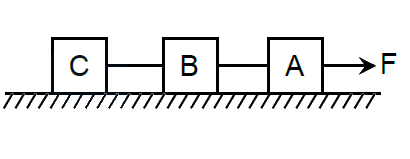 JEE Main/MCQ/Medium/Newton's laws of motion/With diagram
- 71When forces are acting on a particle of mass such that and are mutually perpendicular, then the particle remains stationary. If the force is now removed then the acceleration of the particle isJEE Main/MCQ/Medium/Newton's laws of motion
- 72A lift is moving down with acceleration a. A man in the lift drops a ball inside the lift. The acceleration of the
ball as observed by the man in the lift and a man standing stationary on the ground are respectivelyJEE Main/MCQ/Medium/Newton's laws of motion - 73A flexible chain of mass hangs between two fixed points at the same level. The inclination of the chain with the horizontal at the two points of support is . Considering the equilibrium of each half of the chain, the tension of the chain at the lowest point is .JEE Main/MCQ/Medium/Equilibrium of Forces
- 74A body of mass is suspended by two strings making angles and with the horizontal ceiling with tensions and simultaneously. and are related by . the angles and areJEE Main/MCQ/Medium/Equilibrium of Forces
- 75
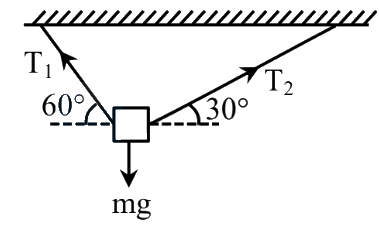
A body of mass 1 kg is suspended with the help of two strings making angles as shown in figure. Magnitude of tensions and , respectively, are (in N) :JEE Main/MCQ/Medium/Equilibrium of Forces/With diagram - 76
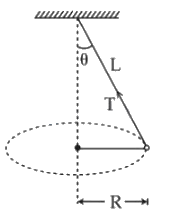
A string of length is fixed at one end and carries a mass of at the other end. The mass makes rotations per second about the vertical axis passing through end of the string as shown. The tension in the string is ML.JEE Main/Numerical/Medium/Equilibrium of Forces/With diagram - 77A mass is suspended from the ceiling by a rope of length . A horizontal force ' ' is applied at the mid point of the rope so that the rope makes an angle of with respect to the vertical axis as shown in figure. The magnitude of is :
(Assume that the system is in equilibrium and )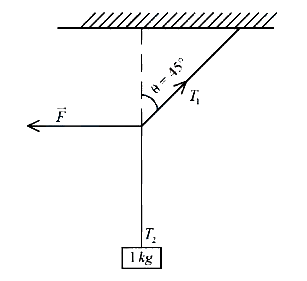 JEE Main/MCQ/Medium/Equilibrium of Forces/With diagram
- 78A light unstretchable string passing over a smooth light pulley connects two blocks of masses and . If the acceleration of the system is , then the ratio of the masses is :JEE Main/MCQ/Medium/Equilibrium of Forces
- 79A body of weight is suspended from a tree branch through a chain of mass . The branch pulls the chain by a force equal to (if ) :JEE Main/MCQ/Medium/Equilibrium of Forces
- 80A light string passing over a smooth light pulley connects two blocks of masses and (where ). If the acceleration of the system is , then the ratio of the masses is:JEE Main/MCQ/Medium/Equilibrium of Forces
- 81Three blocks having masses and respectively are hanging from a smooth pully using rope 1,2 and 3 as shown in figure. The tension in the rope when they are moving upward with acceleration of is _____ if ).
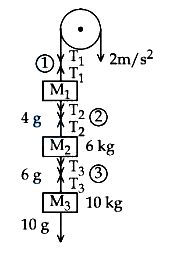 JEE Main/Numerical/Medium/Equilibrium of Forces/With diagram
- 82A wooden block of mass rests on a soft horizontal floor. When an iron cylinder of mass is placed on the top of the block, the floor yields and the block and the cylinder together go down with an acceleration of . The action force of the system on the floor is equal to:JEE Main/MCQ/Medium/Equilibrium of Forces
- 83A light string passing over a smooth light fixed pulley connects two blocks of masses and . If the acceleration of the system is , then the ratio of masses is
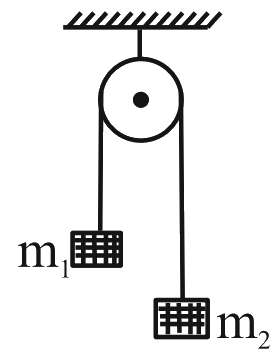 JEE Main/MCQ/Medium/Equilibrium of Forces/With diagram
- 84All surfaces shown in figure are assumed to be frictionless and the pulleys and the string are light. The acceleration of the block of mass is:
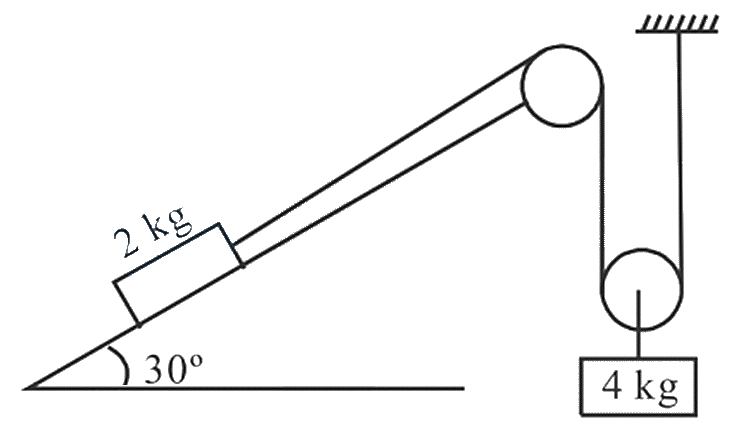 JEE Main/MCQ/Medium/Equilibrium of Forces/With diagram
- 85A stone of mass is tied to a string and moved in a vertical circle of radius making . The tension in the string, when the stone is at the lowest point is (if and )JEE Main/MCQ/Medium/Equilibrium of Forces
- 86As shown in the figure a block of mass lying on a horizontal surface is pulled by a force F acting at an angle , with horizontal. For , the block will just start to move for the value of : [Given g ]
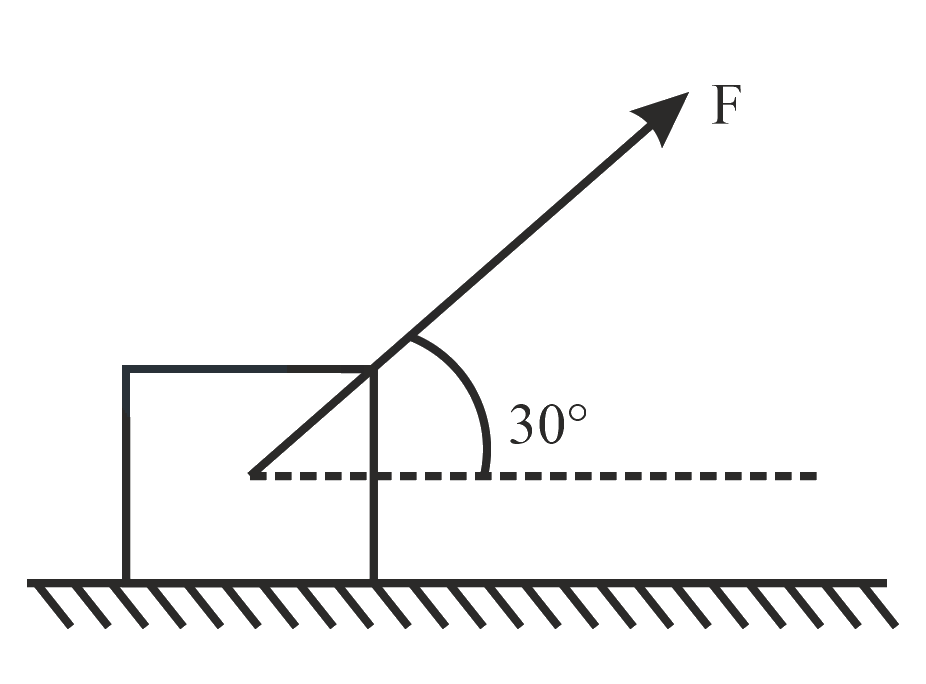 JEE Main/MCQ/Medium/Equilibrium of Forces/With diagram
- 87As shown in figure, a garden roller is pushed with a force of at an angle of with horizontal. The normal reaction on the roller is (Given )
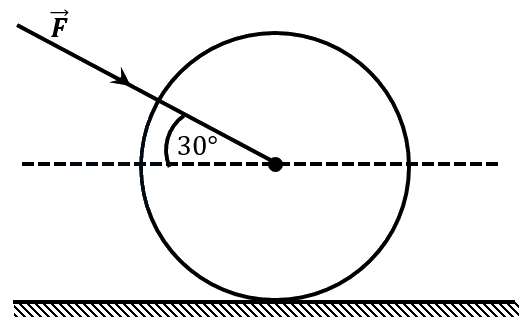 JEE Main/MCQ/Medium/Equilibrium of Forces/With diagram
- 88A block of is attached to a string whose other end is attached to the wall. An unknown force is applied so that the string makes an angle of with the wall. The tension is : (Given g )
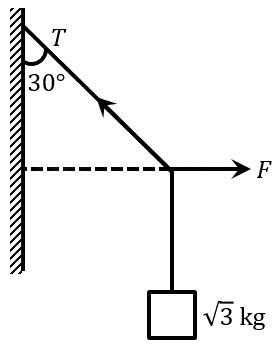 JEE Main/MCQ/Medium/Equilibrium of Forces/With diagram
- 89As per given figure, a weightless pulley is attached on a double inclined frictionless surface. The tension in the string (massless) will be (if )
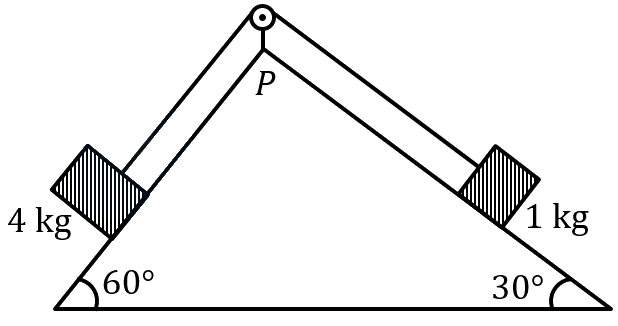 JEE Main/MCQ/Medium/Equilibrium of Forces/With diagram
- 90Two bodies of masses and are connected by a light string going over a smooth light pulley on a smooth inclined plane as shown in the figure. The system is at rest. The force exerted by the inclined plane on the body of mass will be : [Take ]
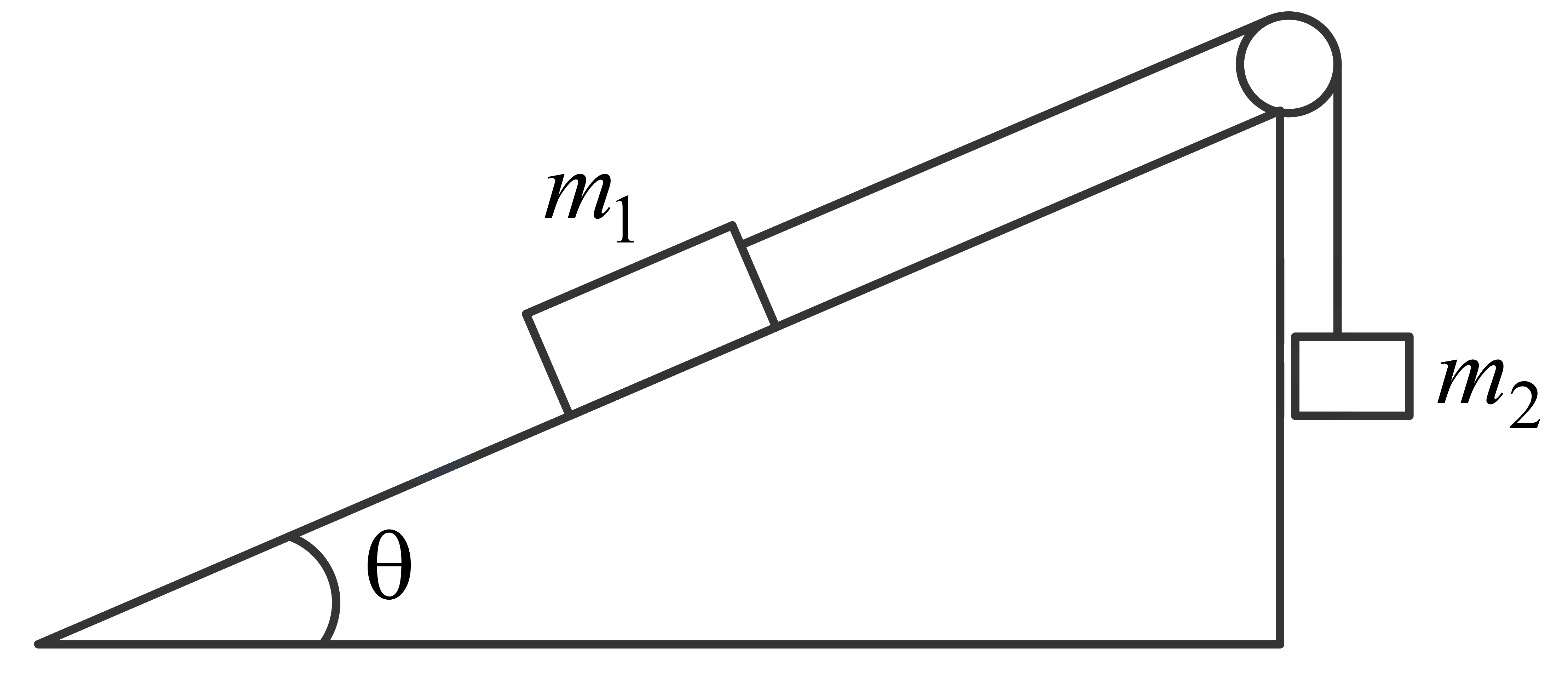 JEE Main/MCQ/Medium/Equilibrium of Forces/With diagram
- 91For a free body diagram shown in the figure, the four forces are applied in the '' and '' directions. What additional force must be applied and at what angle with positive -axis so that the net acceleration of body is zero?
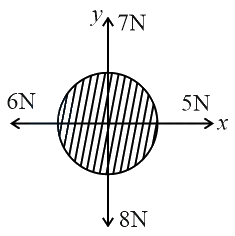 JEE Main/MCQ/Medium/Equilibrium of Forces/With diagram
- 92Four forces are acting at a point in equilibrium as shown in figure. The ratio of force to is where _____ .
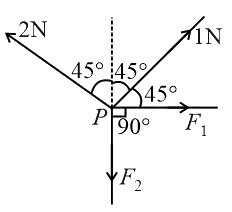 JEE Main/Numerical/Medium/Equilibrium of Forces/With diagram
- 93A block of mass placed inside a box descends vertically with acceleration . The block exerts a force equal to one-fourth of its weight on the floor of the box. The value of will beJEE Main/MCQ/Medium/Equilibrium of Forces
- 94A mass of is suspended vertically by a rope of length from the roof. A force of is applied at the middle point of rope in horizontal direction. The angle made by upper half of the rope with vertical is . The value of is _____ .
(Given, )JEE Main/Numerical/Medium/Equilibrium of Forces - 95In the arrangement shown in figure and are the accelerations of masses and respectively. Which of the following relation is true for this arrangement?
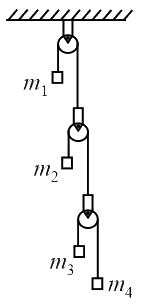 JEE Main/MCQ/Medium/Equilibrium of Forces/With diagram
- 96A block of mass is kept stationary on a smooth inclined plane by applying a minimum horizontal force as shown in figure.
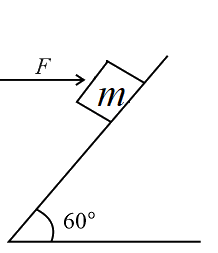
The value of x=_____.JEE Main/Numerical/Medium/Equilibrium of Forces/With diagram - 97A block of mass slides on the wooden wedge, which in turn slides backward on the horizontal surface. The acceleration of the block with respect to the wedge is:
Given
Assume all the surfaces shown in the figure to be frictionless.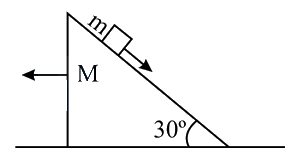 JEE Main/MCQ/Medium/Equilibrium of Forces/With diagram
- 98A car is moving on a plane inclined at to the horizontal with an acceleration of parallel to the plane upward. A bob is suspended by a string from the roof of the car. The angle in degrees which the string makes with the vertical is (Take )JEE Main/Numerical/Medium/Equilibrium of Forces
- 99The boxes of masses and are connected by a massless string passing over smooth pulleys. Calculate the time taken by box of mass to strike the ground starting from rest.
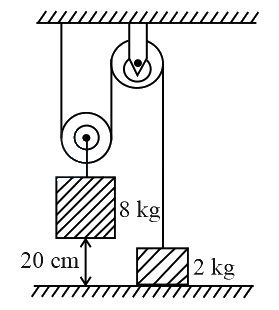 JEE Main/MCQ/Medium/Equilibrium of Forces/With diagram
- 100A particle is moving with uniform speed along the circumference of a circle of radius under the action of a central fictitious force which is inversely proportional to . Its time period of revolution will be given by :JEE Main/MCQ/Medium/Equilibrium of Forces
- 101A block of mass is kept on a platform which starts from rest with a constant acceleration upwards, as shown in the figure. Work done by normal reaction on block in time is
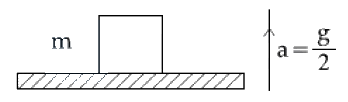 JEE Main/MCQ/Medium/Equilibrium of Forces/With diagram
- 102A mass of is suspended vertically by a rope from the roof. When a horizontal force is applied on the rope at some point, the rope deviated at an angle of at the roof point. If the suspended mass is at equilibrium, the magnitude of the force applied is JEE Main/MCQ/Medium/Equilibrium of Forces
- 103A block of mass is kept on a rough inclined plane as shown in the figure. A force of is applied on the block. The coefficient of static friction between the plane and the block is What should be the minimum value of force such that the block does not move downward? (take )
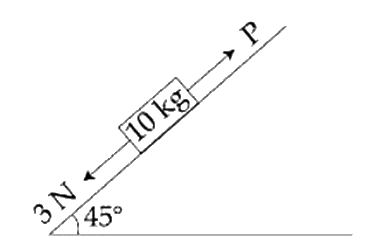 JEE Main/MCQ/Medium/Equilibrium of Forces/With diagram
- 104As shown in the figure, forces of each are applied in opposite directions, on the upper and lower faces of a cube of side , shifting the upper face parallel to itself by . If the side of another cube of the same material is, then under similar conditions as above, the displacement will be:
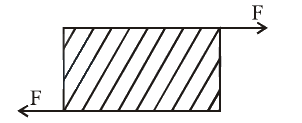 JEE Main/MCQ/Medium/Equilibrium of Forces/With diagram
- 105A uniform cylinder of length and mass having cross-sectional area is suspended, with its length vertical, from a fixed point by a massless spring, such that it is half submerged in a liquid of density at equilibrium position. The extension of the spring when it is in equilibrium is :JEE Main/MCQ/Medium/Equilibrium of Forces
- 106A mass of is suspended by a weightless string. The horizontal force that is required to displace it until the string makes an angle of with the initial vertical direction isJEE Main/MCQ/Medium/Equilibrium of Forces
- 107A block is kept on a frictionless inclined surface with angle of inclination . The incline is given an acceleration a to keep the block stationary. Then a is equal to
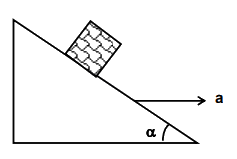 JEE Main/MCQ/Medium/Equilibrium of Forces/With diagram
- 108One end of a massless rope, which passes over a massless and frictionless pulley is tied to a hook while the other end is free. Maximum tension that the rope can bear is . With what value of maximum safe acceleration (in ) can a man of climb on the rope?
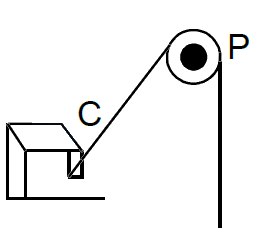 JEE Main/MCQ/Medium/Equilibrium of Forces/With diagram
- 109A light string passing over a smooth light pulley connects two blocks of masses and (vertically). If the acceleration of the system is , then the ratio of the masses isJEE Main/MCQ/Medium/Equilibrium of Forces
- 110A spring of force constant is cut into two pieces. If the ratio of their length is , then the force constant of smaller piece is .JEE Main/MCQ/Medium/Spring force
- 111The length of a light string is 1.4 m when the tension on it is 5 N. If the tension increases to 7 N , the length of the string is 1.56 m. The original length of the string is _____ m.JEE Main/Numerical/Medium/Spring force
- 112A massless spring gets elongated by amount under a tension of 5 N . Its elongation is under the tension of 7 N . For the elongation of , the tension in the spring will be,JEE Main/MCQ/Medium/Spring force
- 113A small block of mass is tied to a spring of spring constant and length The other end of spring is fixed at a particular point If the block moves in a circular path on a smooth horizontal surface with constant angular velocity about point then tension in the spring isJEE Main/MCQ/Medium/Spring force
- 114A mass is attached to two springs as shown in figure. The spring constants of two springs are and For the frictionless surface, the time period of oscillation of mass is
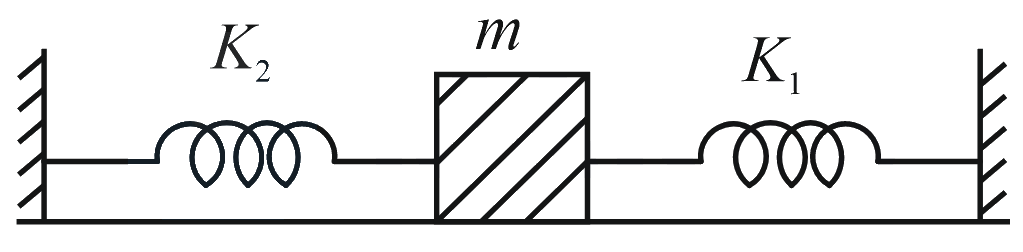 JEE Main/MCQ/Medium/Spring force/With diagram
- 115A body of mass is tied to a spring of spring constant , while the other end of spring is fixed at point . If the body moves about in a circular path on a smooth horizontal surface with constant angular speed , then the ratio of extension in the spring to its natural length will be :JEE Main/MCQ/Medium/Spring force
- 116One end of a massless spring of spring constant and natural length is fixed while the other end is connected to a small object of mass lying on a frictionless table. The spring remains horizontal on the table. If the object is made to rotate at an angular velocity about an axis passing trough fixed end, then the elongation of the spring will beJEE Main/MCQ/Medium/Spring force
- 117The motion of a mass on a spring, with spring constant is as shown in figure.
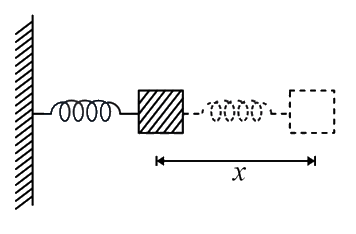
The equation of motion is given by, with .
Suppose that at time the position of mass is and velocity then its displacement can also be represented as where and areJEE Main/MCQ/Medium/Spring force/With diagram - 118Two identical blocks and each of mass resting on the smooth horizontal floor are connected by a light spring of natural length and spring constant . A third block of mass moving with a speed along the line joining and collides with .The maximum compression in the spring is
 JEE Main/MCQ/Medium/Spring force/With diagram
- 119If two similar springs each of spring constant are joined in series, the new spring constant and time period would be changed by a factor:JEE Main/MCQ/Medium/Spring force
- 120A particle of mass is fixed to one end of a light spring having force constant and unstretched length The other end is fixed. The system is given an angular speed about the fixed end of the spring such that it rotates in a circle in gravity free space. Then the stretch in the spring is:JEE Main/MCQ/Medium/Spring force
- 121A spring whose unstrentches length is has a force constant The spring is cut into two pieces of unstretches lengths and where, and is an integer. The ratio of the corresponding force constants, and will be:JEE Main/MCQ/Medium/Spring force
- 122This question has statement and statement . Of the four choices given after the statements, choose the one that best describes the two statements.
If two springs and of force constants and , respectively, are stretched by the same force, it is found that more work is done on spring than on spring .
Statement : If stretched by the same amount, work done on , will be more than that on
Statement JEE Main/MCQ/Medium/Spring force - 123A block slides on a horizontal floor with a speed of . It strikes a uncompressed spring, and compresses it till the block is motionless. The kinetic friction force is and spring constant is . The spring compresses byJEE Main/MCQ/Medium/Spring force
- 124A block of mass ' ' is connected to another block of mass ' ' by a spring (massless) of spring constant ' '. The blocks are kept on a smooth horizontal plane. Initially the blocks are at rest and the spring is unstretched. Then a constant force '' starts acting on the block of mass '' to pull it. Find the force on the block of mass ''JEE Main/MCQ/Medium/Spring force
- 125A light spring balance hangs from the hook of the other light spring balance and a block of mass M kg hangs from the former one. Then the true statement about the scale reading isJEE Main/MCQ/Medium/Spring force
- 126A block takes time to slide down a plane inclined at to the horizontal. If the surface is made smooth (frictionless), the block takes time to slide down the plane. The coefficient of friction between the block and the inclined plane is . The value of is __________.JEE Main/Numerical/Medium/Frictional force
- 127A mass of is kept on an inclined plane with inclination with respect to horizontal plane and it is at rest initially. Then the whole assembly is moved up with constant velocity of . The work done by the frictional force in time is _______ J. (Take )JEE Main/MCQ/Medium/Frictional force
- 128The time taken by a block of mass to slide down from the highest point to the lowest point on a rough inclined plane is more compared to the time taken by the same block on identical inclined smooth plane. Both inclined planes are at with the horizontal. The coefficient of kinetic friction between the rough inclined surface and block is _____.JEE Main/MCQ/Medium/Frictional force
- 129A kg mass is in contact against the inner wall of a cylindrical drum of radius m rotating about its vertical axis. The minimum rotational speed of the drum to enable the mass to remain stuck to the wall (without falling) is rad/s. The coefficient of friction between the drum's inner wall surface and mass is _______. (Take m/s)JEE Main/MCQ/Medium/Frictional force
- 130A block of mass 5 kg is moving on an inclined plane which makes an angle of with the horizontal. Friction coefficient between the block and inclined plane surface is . The force to be applied on the block so that the block will move down without acceleration is N.
.JEE Main/MCQ/Medium/Frictional force - 131In the given figure the blocks and weigh and 8 kg respectively. The co-efficient of sliding friction between any two surfaces is 0.5. The force required to slide the block with constant speed is N.
(Use )
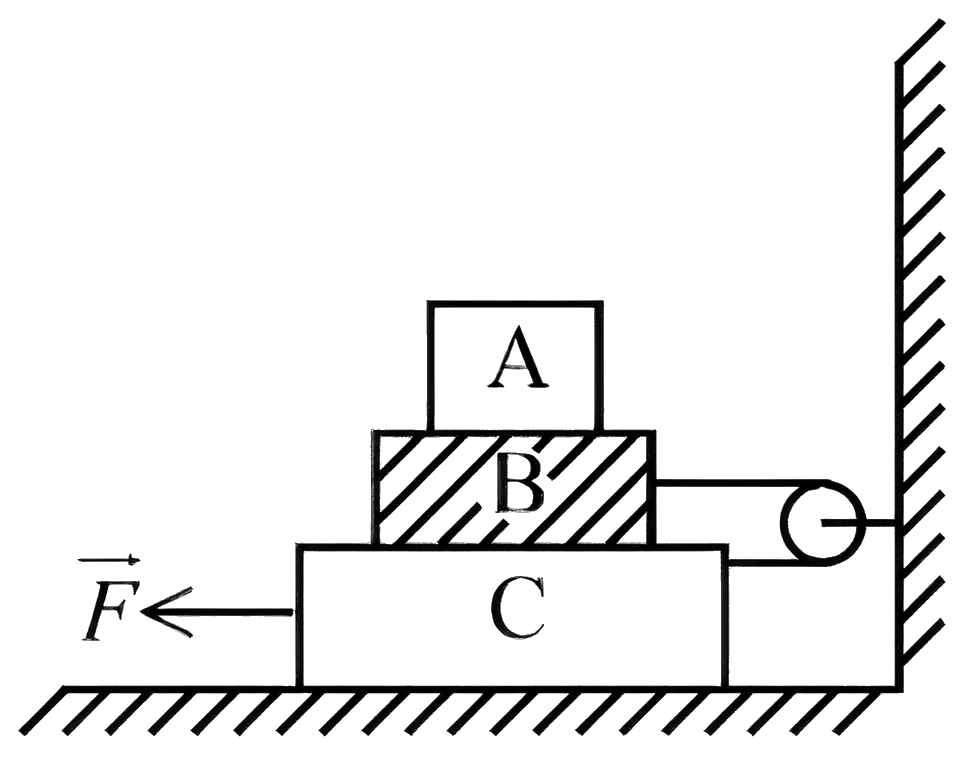 JEE Main/Numerical/Medium/Frictional force/With diagram
- 132A block is sliding down on an inclined plane of slope and at an instant this block is given an upward momentum so that it starts moving up on the inclined surface with velocity . The distance travelled by the block before its velocity become zero, is .
( gravitational acceleration)JEE Main/MCQ/Medium/Frictional force - 133A large drum having radius is spinning around its axis with angular velocity , as shown in figure. The minimum value of so that a body of mass remains stuck to the inner wall of the drum, taking the coefficient of friction between the drum surface and mass as , is :
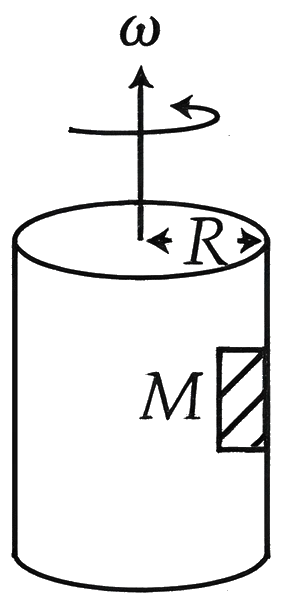 JEE Main/MCQ/Medium/Frictional force/With diagram
- 134A cubic block of mass is sliding down on an inclined plane at with an acceleration of , the value of coefficient of kinetic friction isJEE Main/MCQ/Medium/Frictional force
- 135A given object takes times the time to slide down rough inclined plane as it takes the time to slide down an identical perfectly smooth inclined plane. The coefficient of kinetic friction between the object and the surface of inclined plane is :JEE Main/MCQ/Medium/Frictional force
- 136A heavy box of mass is moving on a horizontal surface. If co-efficient of kinetic friction between the box and horizontal surface is 0.3 then force of kinetic friction is :JEE Main/MCQ/Medium/Frictional force
- 137A brick begins to slide over a surface which is inclined at an angle of with respect to horizontal axis. The co-efficient of static friction between their surfaces is:JEE Main/MCQ/Medium/Frictional force
- 138Consider a block and trolley system as shown in figure. If the coefficient of kinetic friction between the trolley and the surface is , the acceleration of the system in is: (Consider that the string is massless and unstretchable and the pulley is also massless and frictionless) :
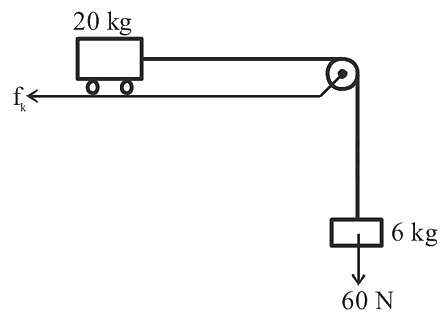 JEE Main/MCQ/Medium/Frictional force/With diagram
- 139A block of mass is placed on a rough inclined surface as shown in the figure. If is the force required to just move the block up the inclined plane and is the force required to just prevent the block from sliding down, then the value of is: [Use ]
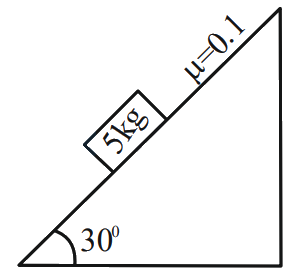 JEE Main/MCQ/Medium/Frictional force/With diagram
- 140A coin is placed on a disc. The coefficient of friction between the coin and the disc is . If the distance of the coin from the center of the disc is , the maximum angular velocity which can be given to the disc, so that the coin does not slip away, is :JEE Main/MCQ/Medium/Frictional force
- 141In the given arrangement of a doubly inclined plane two blocks of masses and are placed. The blocks are connected by a light string passing over an ideal pulley as shown. The coefficient of friction between the surface of the plane and the blocks is . The value of , for which will move down with an acceleration of , is: (take and )
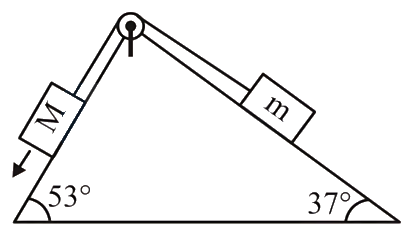 JEE Main/MCQ/Medium/Frictional force/With diagram
- 142A block of mass is placed on a surface having vertical cross section given by . If coefficient of friction is , the maximum height above the ground at which block can be placed without slipping is:JEE Main/MCQ/Medium/Frictional force
- 143Given below are two statements :
Statement (I) : The limiting force of static friction depends on the area of contact and independent of materials.
Statement (II) : The limiting force of kinetic friction is independent of the area of contact and depends on materials.
In the light of the above statements, choose the most appropriate answer from the options given below :JEE Main/MCQ/Medium/Frictional force - 144A coin placed on a rotating table just slips when it is placed at a distance of from the centre. If the angular velocity of the table is halved, it will just slip when placed at a distance of _____ from the centre:JEE Main/MCQ/Medium/Frictional force
- 145A block of mass is placed at rest on a table of rough surface. Now, if a force of is applied in the direction parallel to surface of the table, the block slides through a distance of in an interval of time . Coefficient of kinetic friction is (given, ):JEE Main/MCQ/Medium/Frictional force
- 146A body of mass is moving with an initial speed of . The body stops after due to friction between body and the floor. The value of the coefficient of friction is: (Take acceleration due to gravity )JEE Main/MCQ/Medium/Frictional force
- 147The time taken by an object to slide down rough inclined plane is times as it takes to slide down a perfectly smooth incline plane. The coefficient of kinetic friction between the object and the incline plane is:JEE Main/MCQ/Medium/Frictional force
- 148A block of mass slides down the plane inclined at angle with an acceleration . The value of coefficient of kinetic friction will be :JEE Main/MCQ/Medium/Frictional force
- 149Consider a block kept on an inclined plane (inclined at ) as shown in the figure. If the force required to just push it up the incline is times the force required to just prevent it from sliding down, the coefficient of friction between the block and inclined plane is equal to :
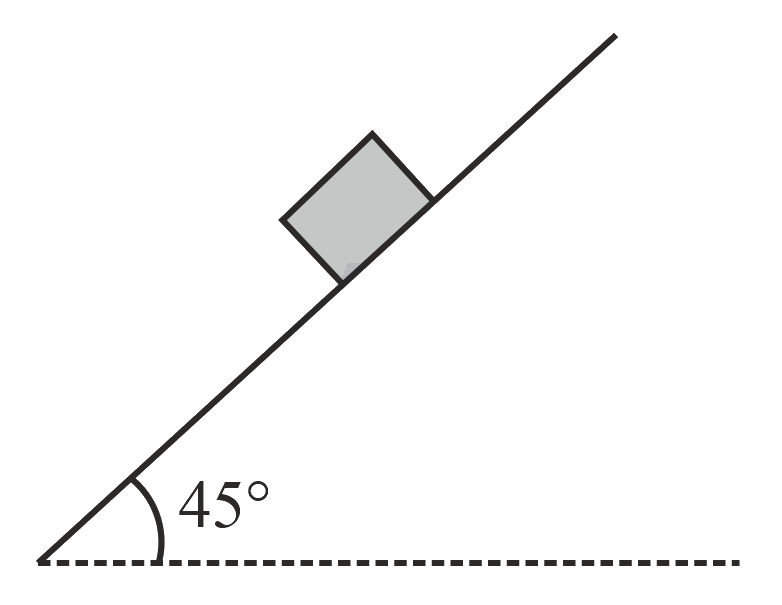 .JEE Main/MCQ/Medium/Frictional force/With diagram
- 150A bag is gently dropped on a conveyor belt moving at a speed of . The coefficient of friction between the conveyor belt and bag is Initially, the bag slips on the belt before it stops due to friction. The distance travelled by the bag on the belt during slipping motion is : [Take ]JEE Main/MCQ/Medium/Frictional force
- 151A block of mass slides over a surface, when a mass of is suspended through an inextensible massless string passing over frictionless pulley as shown below.
The coefficient of kinetic friction between the surface and block is . The acceleration of block is: (Given .)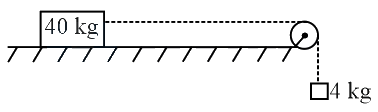 JEE Main/MCQ/Medium/Frictional force/With diagram
- 152A block of mass moving on a horizontal surface with speed of enters a rough surface ranging from to . The retarding force in this range of rough surface is related to distance by where . The speed of the block as it just crosses the rough surface will beJEE Main/MCQ/Medium/Frictional force
- 153A system of two blocks of masses and is placed on a smooth table as shown in figure. The coefficient of static friction between two blocks is . The maximum horizontal force that can be applied to the block of mass so that the blocks move together will be
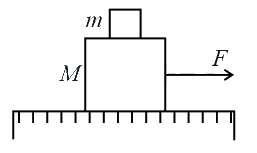 JEE Main/MCQ/Medium/Frictional force/With diagram
- 154A disc with a flat small bottom beaker placed on it at a distance from its center is revolving about an axis passing through the center and perpendicular to its plane with an angular velocity . The coefficient of static friction between the bottom of the beaker and the surface of the disc is . The beaker will revolve with the disc if :JEE Main/MCQ/Medium/Frictional force
- 155A uniform chain of length is placed on a table such that a part of its length is hanging over the edge of the table. The system is at rest. The co-efficient of static friction between the chain and the surface of the table is , the maximum length of the chain hanging from the table is _____ .JEE Main/Numerical/Medium/Frictional force
- 156A block of mass starts sliding on a surface with an initial velocity of . The coefficient of friction between the surface and block is . The distance covered by the block before coming to rest is :[use ]JEE Main/MCQ/Medium/Frictional force
- 157The average translational kinetic energy of gas molecules at _________C^{\circ} becomes equal to the of an electron accelerated from rest through a potential difference of
(Given (Fill the nearest integer).JEE Main/Numerical/Medium/Frictional force - 158The coefficient of static friction between two blocks is and the table is smooth. The maximum horizontal force that can be applied to move the blocks together is _______ (take
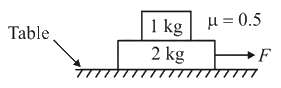 JEE Main/Numerical/Medium/Frictional force/With diagram
- 159A body of mass is launched up on a rough inclined plane making an angle of with the horizontal. The coefficient of friction between the body and plane is if the time of ascent is half of the time of descent. The value of isJEE Main/Numerical/Medium/Frictional force
- 160A steel block of rests on a horizontal floor as shown. When three iron cylinders are placed on it as shown, the block and cylinders go down with an acceleration The normal reaction by the floor if mass of the iron cylinders are equal and of each is ,
[Take and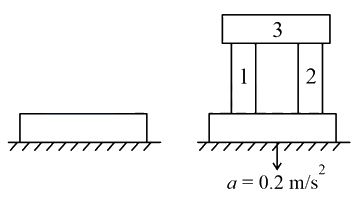 JEE Main/MCQ/Medium/Frictional force/With diagram
- 161A boy of mass is standing on a piece of wood having mass . If the coefficient of friction between the wood and the floor is the maximum force that the boy can exert on the rope so that the piece of wood does not move from its place is _______ . (Round off to the Nearest Integer)
[Take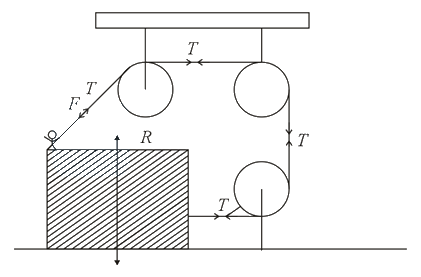 JEE Main/Numerical/Medium/Frictional force/With diagram
- 162A body of mass rests on a horizontal floor with which it has a coefficient of static friction . It is desired to make the body move by applying the minimum possible force . The value of will be _______.(Round off to the Nearest Integer) [Take ]JEE Main/Numerical/Medium/Frictional force
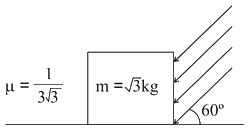
- 163Two blocks ( and ) are arranged on a horizontal frictionless table as shown in the figure. The coefficient of static friction between the two blocks is Then the maximum horizontal force that can be applied on the larger block so that the blocks move together is (Round off to the Nearest Integer) [Take as ]
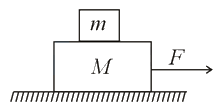 JEE Main/Numerical/Medium/Frictional force/With diagram
- 164A block of mass slides along a floor while a force of magnitude is applied to it at an angle as shown in figure. The coefficient of kinetic friction is . Then, the block's acceleration is given by : ( is acceleration due to gravity)
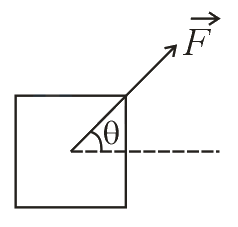 JEE Main/MCQ/Medium/Frictional force/With diagram
- 165An inclined plane making an angle of with the horizontal is placed in a uniform horizontal electric field as shown in the figure. A body of mass and charge is allowed to slide down from rest at a height of . If the coefficient of friction is find the time taken by the body to reach the bottom.
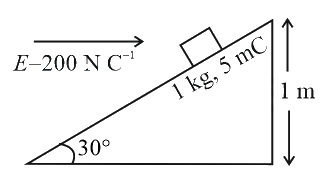 JEE Main/MCQ/Medium/Frictional force/With diagram
- 166As shown in the figure, a block of mass is kept on a horizontal rough surface of coefficient of friction . The critical force to be applied on the vertical surface as shown at an angle with horizontal such that it does not move, will be . The value of will
 JEE Main/Numerical/Medium/Frictional force/With diagram
- 167An inclined plane is bent in such a way that the vertical cross-section is given by where is in vertical and in horizontal direction. If the upper surface of this curved plane is rough with coefficient of friction the maximum height in at which a stationary block will not slip downward is________JEE Main/Numerical/Medium/Frictional force
- 168The coefficient of static friction between a wooden block of mass and a vertical rough wall is The magnitude of the horizontal force that should be applied on the block to keep it adhere to the wall will be______. JEE Main/Numerical/Medium/Frictional force
- 169An insect is at the bottom of a hemispherical ditch of radius . It crawls up the ditch but starts slipping after it is at height h from the bottom. If the coefficient of friction between the ground and the insect is then is JEE Main/MCQ/Medium/Frictional force
- 170A block starts moving up an inclined plane of inclination with an initial velocity of. It comes back to its initial position with velocity The value of the coefficient of kinetic friction between the block and the inclined plane is close to The nearest integer to is :JEE Main/Numerical/Medium/Frictional force
- 171A small block starts slipping down from a point on an inclined plane , which is making an angle with the horizontal section is smooth and the remaining section is rough with a coefficient of friction . It is found that the block comes to rest as it reaches the bottom (point A) of the inclined plane. If , the coefficient of friction is given by . The value of is .......
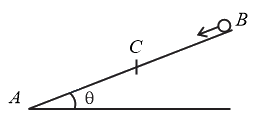 JEE Main/Numerical/Medium/Frictional force/With diagram
- 172
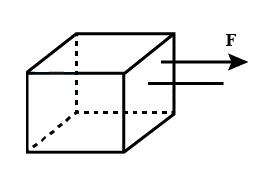
Consider a uniform cubical box of side a on a rough floor that is to be moved by applying minimum possible force at a point above its centre of mass (see figure). If the coefficient of friction is , the maximum possible value of for a box not to topple before moving is ________JEE Main/Numerical/Medium/Frictional force/With diagram - 173A electric motor lifts an elevator having a maximum total load capacity of If the frictional force on the elevator is the speed of the elevator at full load is close to : JEE Main/MCQ/Medium/Frictional force
- 174Two blocks and of masses and are kept on the table as shown in figure. The coefficients of friction between and is and between and the surface of the table is also The maximum force that can be applied on horizontally, so that the block does not slide over the block is : [Take ]
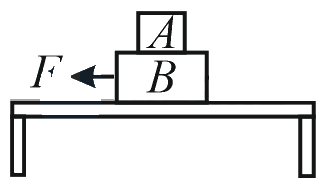 JEE Main/MCQ/Medium/Frictional force/With diagram
- 175A block kept on a rough inclined plane, as shown in the figure, remains at rest upto a maximum force down the inclined plane. The maximum external force up the inclined plane that does not move the block is The coefficient of static friction between the block and the plane is: [Take ]
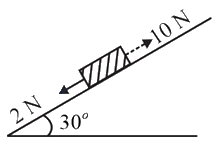 JEE Main/MCQ/Medium/Frictional force/With diagram
- 176A body of mass slides down with an acceleration of on a rough inclined plane having a slope of . The external force required to take the same body up the plane with the same acceleration will be: JEE Main/MCQ/Medium/Frictional force
- 177A given object takes times more time to slide down a rough inclined plane as it takes to slide down a perfectly smooth incline. The coefficient of kinetic friction between the object and the incline is:JEE Main/MCQ/Medium/Frictional force
- 178A given object takes times more time to slide down a rough inclined plane as it takes to slide down a perfectly smooth incline. The coefficient of kinetic friction between the object and the incline is :JEE Main/MCQ/Medium/Frictional force
- 179Two masses and , connected by an inextensible string over a frictionless pulley, are moving as shown in the figure. The coefficient of friction of horizontal surface is . The minimum weight m that should be put on top of to stop the motion is:
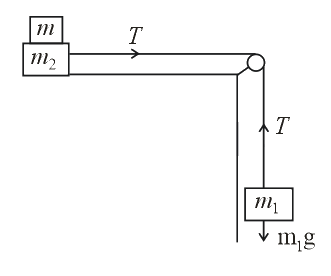 JEE Main/MCQ/Medium/Frictional force/With diagram
- 180A rocket is fired vertically from the earth with an acceleration of 2g, where g is the gravitational acceleration. On an inclined plane inside the rocket, making an angle with the horizontal, a point object of mass m is kept. The minimum coefficient of friction between the mass and the inclined surface such that the mass does not move is:JEE Main/MCQ/Medium/Frictional force
- 181A point particle of mass m, moves along the uniformly rough track PQR as shown in the figure. The coefficient of friction, between the particle and the rough track equals . The particle is released, from rest, from the point P and it comes to rest at a point R. The energies, lost by the ball, over the parts, PQ and QR, of the track, are equal to each other, and no energy is lost when particle changes direction from PQ to QR.
The values of the coefficient of friction and the distance , are respectively close to: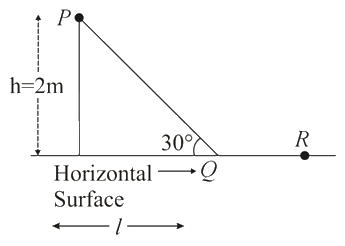 JEE Main/MCQ/Medium/Frictional force/With diagram
- 182
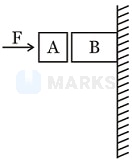
Given in the figure are two blocks and of weight and , respectively. These are being pressed against a wall by a force and kept in equilibrium as shown. If the coefficient of friction between the blocks is and between block and the wall is , the frictional force applied by the wall on block is:JEE Main/MCQ/Medium/Frictional force/With diagram - 183A heavy box is to be dragged along a rough horizontal floor. To do so, the person pushes it at an angle from the horizontal and requires a minimum force , while the person pulls the box at an angle from the horizontal and needs minimum force . If the coefficient of friction between the box and the floor is , the ratio isJEE Main/MCQ/Medium/Frictional force
- 184A bullet of mass is fired horizontally with a speed of into block of wood at rest on a table. If the coefficient of friction between the block and the table is , how far will the block slide approximately?JEE Main/MCQ/Medium/Frictional force
- 185A block A of mass 4 kg is placed on another block B of mass 5 kg, and the block B rests on a smooth horizontal table. If the minimum force that can be applied on A so that both the blocks move together is 12 N, the maximum force that can be applied on B for the blocks to move together will be :JEE Main/MCQ/Medium/Frictional force
- 186A block of mass is placed on a surface with a vertical cross section given by . If the coefficient of friction is , the maximum height above the ground at which the block can be placed without slipping isJEE Main/MCQ/Medium/Frictional force
- 187A body starts from rest on a long inclined plane of slope . The coefficient of friction between the body and the plane varies as , where is distance travelled down the plane. The body will have maximum speed (for ) when JEE Main/MCQ/Medium/Frictional force
- 188A block of weight rests on a horizontal floor with coefficient of static friction . It is desired to make the block move by applying minimum amount of force. The angle from the horizontal at which the force should be applied and magnitude of the force are respectively.JEE Main/MCQ/Medium/Frictional force
- 189An insect crawls up a hemispherical surface very slowly. The coefficient of friction between the insect and the surface is . If the line joining the centre of the hemispherical surface to the insect makes an angle with the vertical, the maximum possible value of so that the insect does not slip is given by
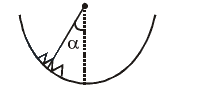 JEE Main/MCQ/Medium/Frictional force/With diagram
- 190Consider a car moving on a straight road with a speed of . The distance at which car can be stopped is JEE Main/MCQ/Medium/Frictional force
- 191The upper half of an inclined plane with inclination is perfectly smooth while the lower half is rough. A body starting from rest at the top will again come to rest at the bottom if the coefficient of friction for the lower half is given byJEE Main/MCQ/Medium/Frictional force
- 192A smooth block is released at rest on a incline and then slides a distance d. The time taken to slide is times as much to slide on rough incline than on a smooth incline. The coefficient of friction isJEE Main/MCQ/Medium/Frictional force
- 193A block rests on a rough inclined plane making an angle of with the horizontal. The coefficient of static friction between the block and the plane is . If the frictional force on the block is , the mass of the block (in ) is (take )JEE Main/MCQ/Medium/Frictional force
- 194A marble block of mass lying on ice when given a velocity of is stopped by friction in . Then the coefficient of friction isJEE Main/MCQ/Medium/Frictional force
- 195A horizontal force of is necessary to just hold a block stationary against a wall. The co-efficient of friction between the block and the wall is . The weight of the block is
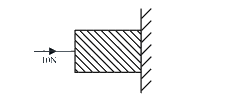 JEE Main/MCQ/Medium/Frictional force/With diagram
- 196The minimum velocity (in ) with which a car driver must traverse a flat curve of radius and coefficient of friction to avoid skidding isJEE Main/MCQ/Medium/Frictional force
- 197A car of mass ' ' moves on a banked road having radius ' ' and banking angle . To avoid slipping from banked road, the maximum permissible speed of the car is . The coefficient of friction between the wheels of the car and the banked road isJEE Main/MCQ/Medium/Non-uniform Circular Motion
- 198A car of is taking turn on a banked road of radius and angle of banking . If coefficient of static friction is 0.2 then the maximum speed with which car can negotiate the turn safely: JEE Main/MCQ/Medium/Non-uniform Circular Motion
- 199A particle is moving in a circle of radius in such a way that at any instant the normal and tangential components of its acceleration are equal. If its speed at is , the time taken to complete the first revolution will be , where ______.JEE Main/Numerical/Medium/Non-uniform Circular Motion
- 200A train is moving with a speed of on rails which are apart. To negotiate a curve radius , the height by which the outer rail should be raised with respect to the inner rail is (Given, ):JEE Main/MCQ/Medium/Non-uniform Circular Motion
- 201A car is moving on a horizontal curved road with radius . The approximate maximum speed of car will be, if friction between tyres and road is . [Take ]JEE Main/MCQ/Medium/Non-uniform Circular Motion
- 202A tube of length is filled completely with an incompressible liquid of mass and closed at both ends. The tube is then rotated in horizontal plane about one of its ends with a uniform angular velocity . If be the force exerted by the liquid at the other end then the value of will be _____ .JEE Main/Numerical/Medium/Non-uniform Circular Motion
- 203A smooth circular groove has a smooth vertical wall as shown in figure. A block of mass moves against the wall with a speed . Which of the following curve represents the correct relation between the normal reaction on the block by the wall and speed of the block ?
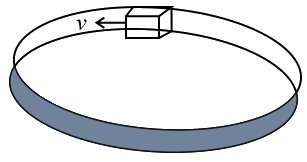 JEE Main/MCQ/Medium/Non-uniform Circular Motion/With diagram
- 204A ball is released from rest from point of a smooth semi-spherical vessel as shown in figure. The ratio of the centripetal force and normal reaction on the ball at point is while angular position of point is with respect to point . Which of the following graphs represent the correct relation between and when ball goes from to ?
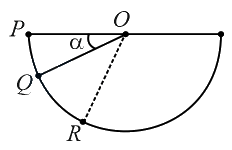 JEE Main/MCQ/Medium/Non-uniform Circular Motion/With diagram
- 205A curved in a level road has a radius . The maximum speed of a car turning this curved road can be without skidding. If radius of curved road is changed to and the coefficient of friction between the tyres and the road remains same, then maximum allowed speed would be _____ .JEE Main/Numerical/Medium/Non-uniform Circular Motion
- 206The normal reaction for a vehicle of mass, negotiating a turn on a banked road at maximum possible speed without skidding is ____ .JEE Main/MCQ/Medium/Non-uniform Circular Motion
- 207Statement I: A cyclist is moving on an unbanked road with a speed of and takes a sharp circular turn along a path of the radius of without reducing the speed. The static friction coefficient is . The cyclist will not slip and pass the curve
Statement II : If the road is banked at an angle of , cyclist can cross the curve of radius with the speed of without slipping. In the light of the above statements, choose the correct answer from the options given below.JEE Main/MCQ/Medium/Non-uniform Circular Motion - 208A disc rotates about its axis of symmetry in a hoizontal plane at a steady rate of revolutions per second. A coin placed at a distance of from the axis of rotation remains at rest on the disc. The coefficient of friction between the coin and the disc is JEE Main/MCQ/Medium/Non-uniform Circular Motion
- 209Two point masses of mass and are in outer space (far from gravitational influence of other objects) at a distance from each other. They move in circular orbits about their centre of mass with angular velocities for and for . In that caseJEE Main/MCQ/Medium/Non-uniform Circular Motion
- 210A bead of weight can slide on smooth circular wire in a vertical plane. The bead is attached by a light thread to the highest point of the wire and in equilibrium, the thread is taut and make an angle with the vertical then tension of the thread and reaction of the wire on the bead areJEE Main/MCQ/Medium/Non-uniform Circular Motion
NEET question paper PDF
This chapter includes NEET questions. Open a year to read the full paper, or download the PDF.
Opening paper…
JEE Main question paper PDF
This chapter includes JEE Main questions. Open a shift to read the paper, or download the PDF.
Opening paper…
Other Physics chapters
Current Electricity 380Electrostatics 311Kinematics 308Ray Optics 295Rotational Motion 280Magnetic Effects & Magnetism 276Atoms & Nuclei 239Gravitation 223Semiconductors 209Dual Nature of Matter 200Oscillations 194Fluid Mechanics 192Wave Optics 191Alternating Current 190Thermodynamics 190Work Energy Power 183Capacitors 180Kinetic Theory 168Electromagnetic Waves 165Electromagnetic Induction 153Units & Dimensions 149Waves 142Center of Mass, Momentum & Collision 130Thermal Properties of Matter 126Mathematics in Physics 121Mechanical Properties of Solids 118Experimental Physics 70Magnetic Properties of Matter 57Modern Physics 5
Stuck on a Laws of Motion question from your book?
Snap it and get a whiteboard video that solves it step by step. Your first video needs no login.