Question 8 of 210
A particle of mass falls from rest through a resistive medium having resistive force, , where is the velocity of the particle and is a constant. Which of the following graphs represents velocity () versus time ()?
Show answer and solution
Answer: (A) 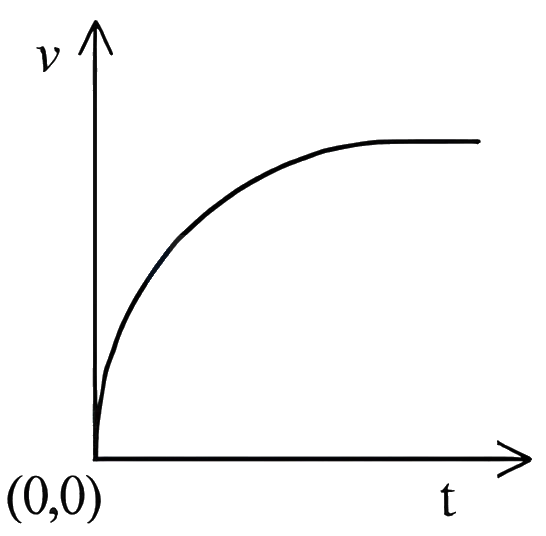
The particle experiences downward gravitational force (mg) and upward resistive force (-kv).
The equation of motion is .
Initially at , gives maximum acceleration .
As velocity increases, the resistive force increases, reducing the net acceleration.
Eventually the particle reaches terminal velocity when acceleration becomes zero.
The velocity-time graph shows an increasing curve starting from origin with decreasing slope, asymptotically approaching the terminal velocity.
This behavior matches option (1), which displays a curve starting at (0,0) with steep initial slope that gradually flattens.