Physics · JEE Main, NEET
Work Energy Power
183 practice questions with a worked solution for each. Tap an option to see instantly if you are right.
138MCQ45Numerical39With diagram
- 1A body of mass moving with velocity makes a 1D elastic collision with a stationary body of mass . The body of mass rebounds with velocity . The mass is:JEE Main/MCQ/Medium
- 2A spring of force constant is compressed by . The elastic potential energy stored is:NEET/MCQ/Medium
- 3The rain drop of mass g, starts with zero velocity from a height of km. It hits the ground with a speed of m/s. The work done by the unknown resistive force is _______ J. (take m/s)JEE Main/MCQ/Medium/Work done
- 4A kg block subjected to two simultaneous forces N and N is moved a distance of m along direction. The work done in this process is _____ J.JEE Main/Numerical/Medium/Work done
- 5A block of mass 25 kg is pulled along a horizontal surface by a force at an angle with the horizontal. The friction coefficient between the block and the surface is 0.25. The displacement of 5 m of the block is:JEE Main/MCQ/Medium/Work done
- 6A force acts on an object in the x -direction. The work done by the force is 5 J when the object is displaced by 1 m . If the constant then will beJEE Main/MCQ/Medium/Work done
- 7A force acts on a particle in a plane . The work done by this force during a displacement from to is Joule (round off to the nearest integer)JEE Main/Numerical/Medium/Work done
- 8A force is applied on a particle and it undergoes a displacement . What will be the value of , if work done on the particle is zero.JEE Main/MCQ/Medium/Work done
- 9A force displaces a body from to . Work done by this force is ________ .JEE Main/Numerical/Medium/Work done
- 10A particle of mass moves on a straight line with its velocity increasing with distance according to the equation , where is a constant. The total work done by all the forces applied on the particle during its displacement from to , will be :JEE Main/MCQ/Medium/Work done
- 11A block of mass is pushed up a surface inclined to horizontal at an angle of by a force of parallel to the inclined surface as shown in figure. When the block is pushed up by along inclined surface, the work done against frictional force is :
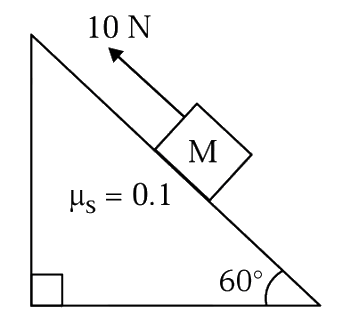 JEE Main/MCQ/Medium/Work done/With diagram
- 12A block of mass slides over a distance of on a horizontal surface. If the co-efficient of friction between the surfaces is , then the work done against friction (in ) is:JEE Main/MCQ/Medium/Work done
- 13A block of mass is moving along -axis under the action of force . The work done by the force in moving the block from to will be _______ .JEE Main/Numerical/Medium/Work done
- 14A force acts on a particle in the direction where is in Newton and is in meter. The work done by this force during a displacement from to is _____ .JEE Main/Numerical/Medium/Work done
- 15A force acts on a particle in the -direction, where is newton and is in meter. The work done by the force during a displacement from to is ______ .JEE Main/Numerical/Medium/Work done
- 16A small particle moves to position from its initial position under the action of force . The value of work done will be ______ .JEE Main/Numerical/Medium/Work done
- 17Identify the correct statements from the following:
(A) Work done by a man in lifting a bucket out of a well by means of a rope tied to the bucket is negative
(B) Work done by gravitational force in lifting a bucket out of a well by a rope tied to the bucket is negative
(C) Work done by friction on a body sliding down an inclined plane is positive
(D) Work done by an applied force on a body moving on a rough horizontal plane with uniform velocity is zero
(E) Work done by the air resistance on an oscillating pendulum is negative
Choose the correct answer from the options given below:JEE Main/MCQ/Medium/Work done - 18A body of mass travels on straight line path with velocity . The net work done by the force during its displacement from to isJEE Main/MCQ/Medium/Work done
- 19A particle of mass is moving in a straight line with velocity . The work done by the net force during its displacement from to is (Take ).JEE Main/MCQ/Medium/Work done
- 20Arrange the four graphs in descending order of total work done; where and are the work done corresponding to figure and respectively.
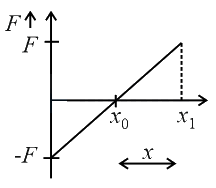
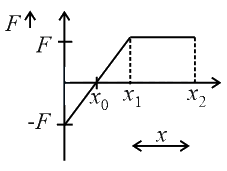
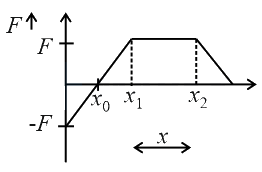
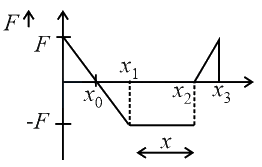 JEE Main/MCQ/Medium/Work done/With diagram
- 21Two persons and perform same amount of work in moving a body through a certain distance with application of forces acting at angles and with the direction of displacement respectively. The ratio of force applied by person to the force applied by person is The value of is _________.JEE Main/Numerical/Medium/Work done
- 22A force of acts on a particle. The work done by this force when the particle is moved from to is ________.JEE Main/Numerical/Medium/Work done
- 23A porter lifts a heavy suitcase of mass and at the destination lowers it down by a distance of with a constant velocity. Calculate the work done by the porter in lowering the suitcase. (take )JEE Main/MCQ/Medium/Work done
- 24A person pushes a box on a rough horizontal plateform surface. He applies a force of over a distance of . Thereafter, he gets progressively tired and his applied force reduces linearly with distance to . The total distance through which the box has been moved is . What is the work done by the person during the total movement of the box?JEE Main/MCQ/Medium/Work done
- 25Consider a force . The work done by this force in moving a particle from point to along the line segment is : (all quantities are in SI units)
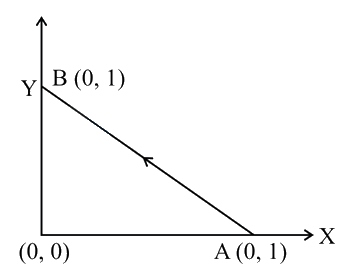 JEE Main/MCQ/Medium/Work done/With diagram
- 26A uniform cable of mass and length is placed on a horizontal surface such that its part is hanging below the edge of the surface. To lift the hanging part of the cable upto the surface, the work done should be:JEE Main/MCQ/Medium/Work done
- 27The velocity-time graph of a particle of mass is shown in the figure. The net work done on the particle in the first two seconds of the motion is
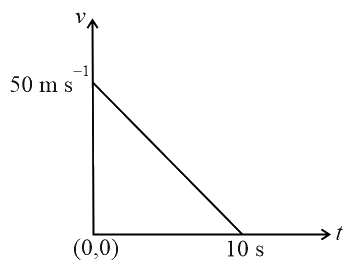 JEE Main/MCQ/Medium/Work done/With diagram
- 28When a rubber-band is stretched by a distance x, it exerts a restoring force of magnitude
F = ax + bx2 where a and b are constants. The work done in stretching the unstretched rubber-band by L is :JEE Main/MCQ/Medium/Work done - 29A ball of mass is thrown vertically upwards by applying a force by hand. If the hand moves which applying the force and the ball goes upto height further, find the magnitude of the force. Consider JEE Main/MCQ/Medium/Work done
- 30A particle of mass is thrown vertically upwards with a speed of . the work done by the force of gravity during the time the particle goes up isJEE Main/MCQ/Medium/Work done
- 31A wire fixed at the upper end stretches by length by applying a force F. The work done in stretching isJEE Main/MCQ/Medium/Work done
- 32A particle is acted upon by a force of constant magnitude which is always perpendicular to the velocity of the particle, the motion of the particle takes place in a plane. It follows thatJEE Main/MCQ/Medium/Work done
- 33A force is applied over a particle which displaces it from its origin to the point . The work done on the particle in joules isJEE Main/MCQ/Medium/Work done
- 34A uniform chain of length is kept on a table such that a length of hangs freely from the edge of the table. The total mass of the chain is . What is the work done in pulling the entire chain on the table?JEE Main/MCQ/Medium/Work done
- 35The velocity at which kg mass (shown in figure) strikes the ground when it is released from a height of m above the ground is __________ m/s. Assume pulley is massless and string is light and inextensible. (Take g m/s)
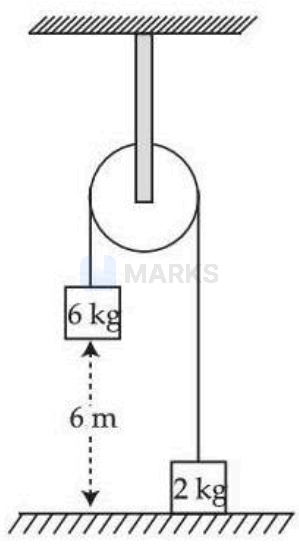 JEE Main/MCQ/Medium/Energy/With diagram
- 36A body of mass kg moves along a straight line with a velocity . The work done by the body during displacement from to m is __________ J.JEE Main/MCQ/Medium/Energy
- 37A smooth inclined plane ends in a vertical circular loop, as shown in the figure. A small body is released from height as shown. If the body exerts a force of three times its weight on the plane at the highest point of circle then the height . The value of is _______.
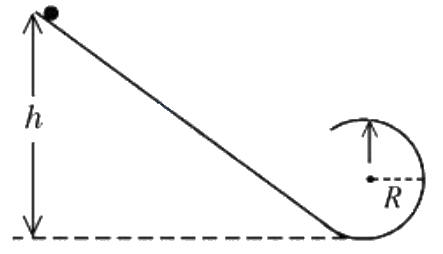 JEE Main/MCQ/Medium/Energy/With diagram
- 38A spherical ball of mass kg falls from a height of m and is brought to rest after penetrating cm into sand. The average force exerted by sand on the ball is _______ N. (Take m/s)JEE Main/MCQ/Medium/Energy
- 39A bead sliding on a frictionless semi-circular string and it is at point at and at this instant the horizontal component of its velocity is . Another bead of the same mass as is ejected from point at along the horizontal string , with the speed , friction between the beads and the respective strings may be neglected in both cases. Let and be the respective times taken by beads and to reach the point , then the relation between and is
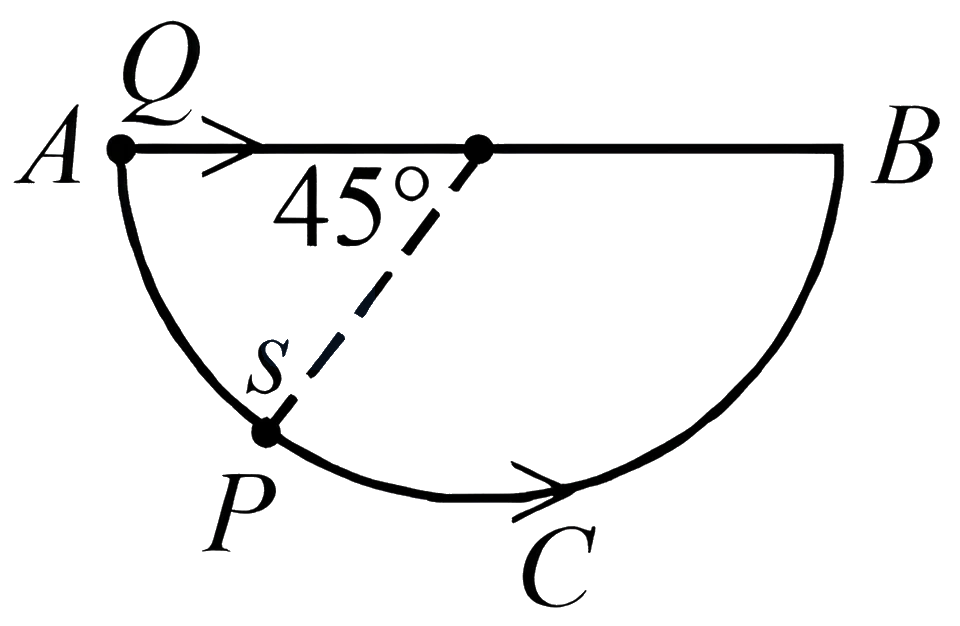 JEE Main/MCQ/Medium/Energy/With diagram
- 40A small bob of mass is attached to a massless rigid rod of length 1 m pivoted at point and kept at an angle of with vertical as shown in figure. At distance of 1 m below point , an identical bob is kept at rest on a smooth horizontal surface that extends to a circular track of radius as shown in figure. If bob just manages to complete the circular path of radius upto a point after being hit elastically by , then radius is m.
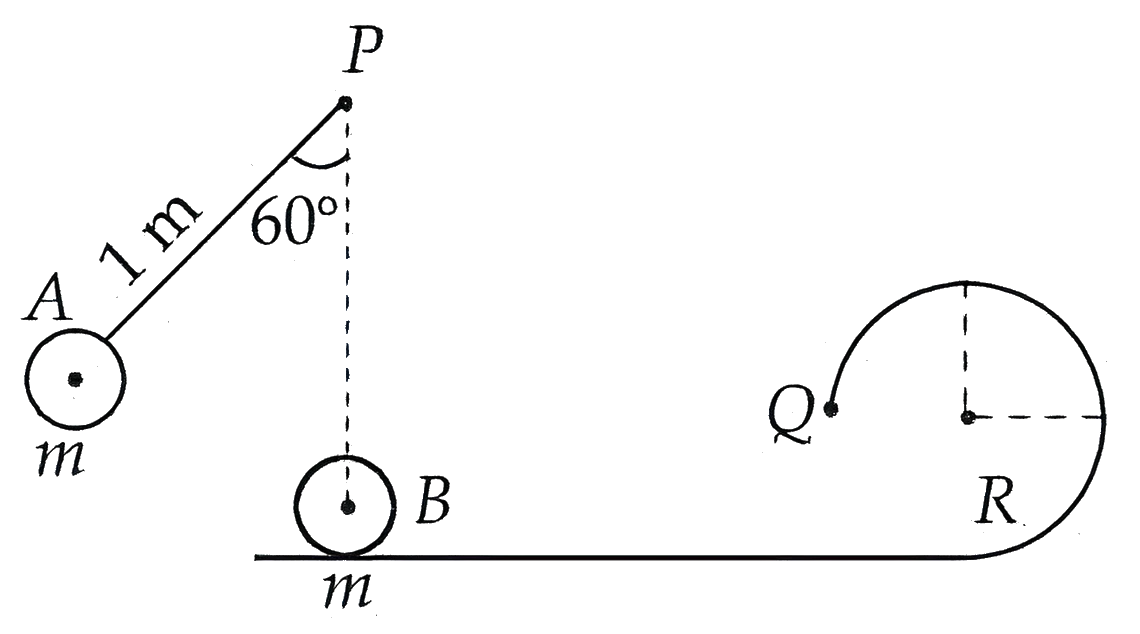 JEE Main/MCQ/Medium/Energy/With diagram
- 41Given below are two statements :
Statement I: An object moves from position to position under a conservative force field . The work done by the force is .
Statement II: Any object moving from one location to another location can follow infinite number of paths. Therefore, the amount of work done by the object changes with the path it follows for a conservative force.
In the light of the above statements, choose the correct answer from the options given below :JEE Main/MCQ/Medium/Energy - 42A body of mass 2 kg is moving along -direction such that its displacement as function of time is given by , where and . The work done on the body during the time interval to , is J.JEE Main/MCQ/Medium/Energy
- 43Potential energy () versus distance () is given by the graph. Rank various regions as per the magnitudes of the force (F) acting on a particle from high to low.
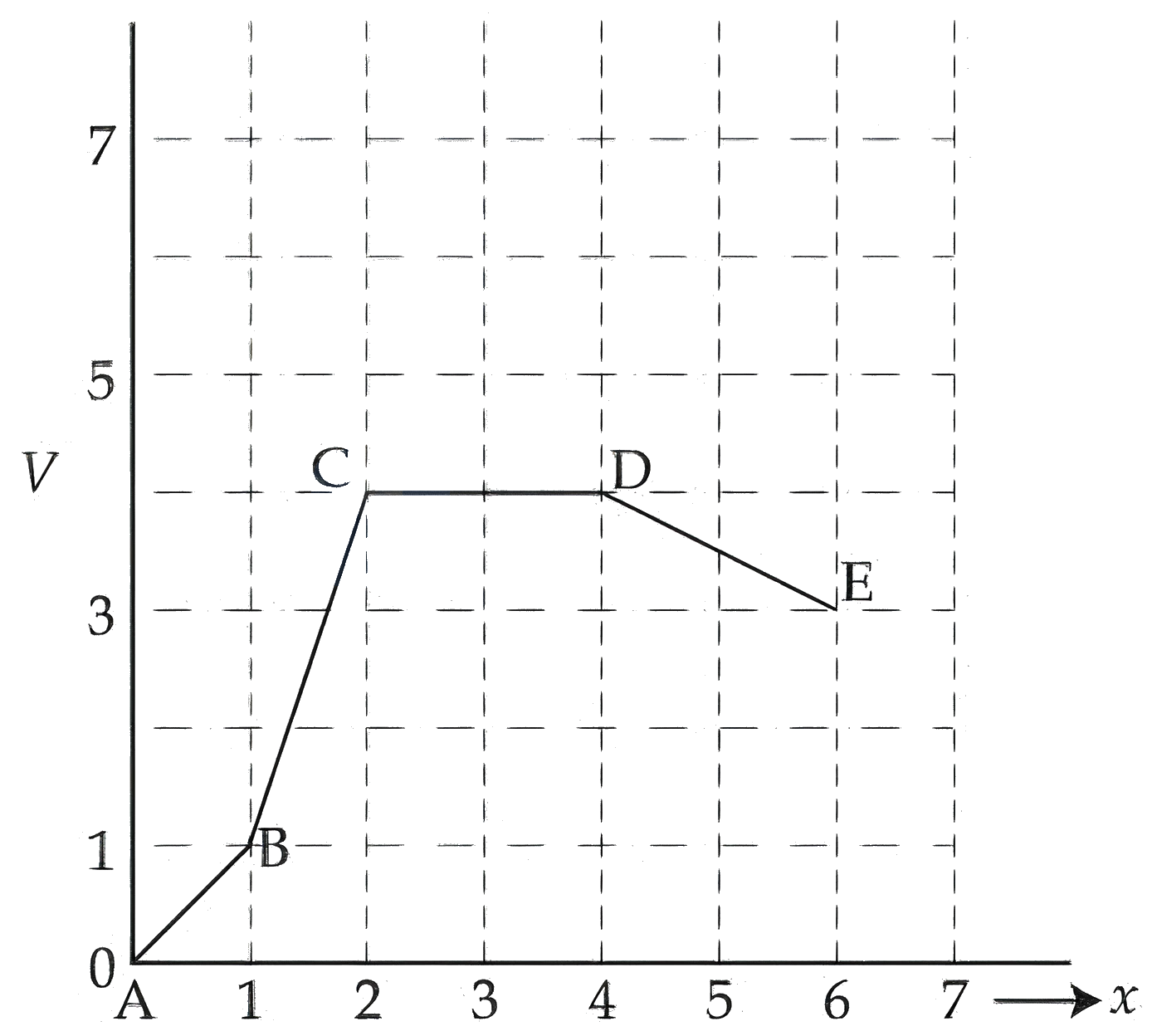 JEE Main/MCQ/Medium/Energy/With diagram
- 44A block of mass 2 kg is attached to one end of a massless spring whose other end is fixed at a wall. The spring-mass system moves on a frictionless horizontal table. The spring's natural length is 2 m and spring constant is . The block is pushed such that the length of the spring becomes 1 m and then released. At distance from the wall. the speed of the block will be :JEE Main/MCQ/Medium/Energy
- 45Which one of the following forces cannot be expressed in terms of potential energy?JEE Main/MCQ/Medium/Energy
- 46A block of mass 1 kg , moving along x with speed enters a rough region ranging from to . The retarding force acting on the block in this range is , with . Then the final speed of the block as it crosses rough region isJEE Main/MCQ/Medium/Energy
- 47A piston of mass is hung from a massless spring whose restoring force law goes as , where k is the spring constant of appropriate dimension. The piston separates the vertical chamber into two parts, where the bottom part is filled with ' ' moles of an ideal gas. An external work is done on the gas isothermally (at a constant temperature T) with the help of a heating filament (with negligible volume) mounted in lower part of the chamber, so that the piston goes up from a height to , the total energy delivered by the filament is (Assume spring to be in its natural length before heating)
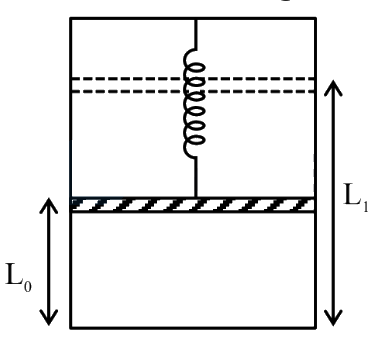 JEE Main/MCQ/Medium/Energy/With diagram
- 48A particle is released from height above the surface of the earth. At certain height its kinetic energy is three times its potential energy. The height from the surface of the earth and the speed of the particle at that instant are respectively.JEE Main/MCQ/Medium/Energy
- 49A bead of mass ' ' slides without friction on the wall of a vertical circular hoop of radius ' ' as shown in figure. The bead moves under the combined action of gravity and a massless spring ( k ) attached to the bottom of the hoop. The equilibrium length of the spring is ' '. If the bead is released from top of the hoop with (negligible) zero initial speed, velocity of bead, when the length of spring becomes ' R ', would be (spring constant is ' k ', g is accleration due to gravity)
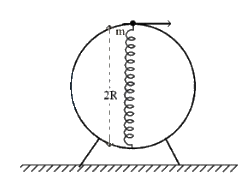 JEE Main/MCQ/Medium/Energy/With diagram
- 50Given below are two statements: one is labelled as Assertion and the other is labelled as Reason
Assertion A: In a central force field, the work done is independent of the path chosen.
Reason R: Every force encountered in mechanics does not have an associated potential energy.
In the light of the above statements, choose the most appropriate answer from the options given belowJEE Main/MCQ/Medium/Energy - 51A ball having kinetic energy KE, is projected at an angle of from the horizontal. What will be the kinetic energy of ball at the highest point of its flight ?JEE Main/MCQ/Medium/Energy
- 52A stationary particle breaks into two parts of masses and which move with velocities and respectively. The ratio of their kinetic energies is :JEE Main/MCQ/Medium/Energy
- 53A bullet of mass is fired with a speed on a plywood and emerges with . The percentage loss of kinetic energy is :JEE Main/MCQ/Medium/Energy
- 54A body of mass is lifted to a height of from the ground in the two different ways as shown in the figures. The ratio of work done against the gravity in both the respective cases, will be :
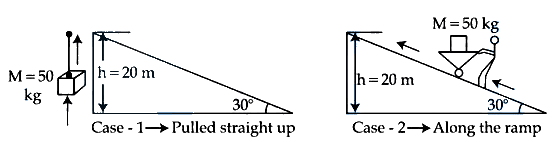 JEE Main/MCQ/Medium/Energy/With diagram
- 55A body of slides from rest along the curve of vertical circle from point to in friction less path. The velocity of the body at is:
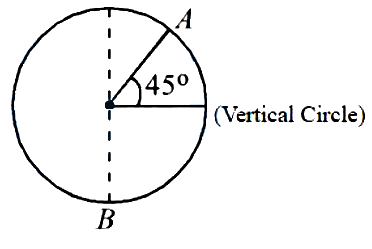
JEE Main/MCQ/Medium/Energy/With diagram - 56If a rubber ball falls from a height and rebounds upto the height of . The percentage loss of total energy of the initial system as well as velocity ball before it strikes the ground, respectively, are :JEE Main/MCQ/Medium/Energy
- 57A solid circular disc of mass rolls along a horizontal floor so that its center of mass has a speed of . The absolute value of work done on the disc to stop it is ______ .JEE Main/Numerical/Medium/Energy
- 58An artillery piece of mass fires a shell of mass horizontally. Instantaneously after the firing, the ratio of kinetic energy of the artillery and that of the shell is :JEE Main/MCQ/Medium/Energy
- 59A particle is placed at the point of a frictionless track as shown in figure. It is gently pushed towards right. The speed of the particle when it reaches the point is: Take .
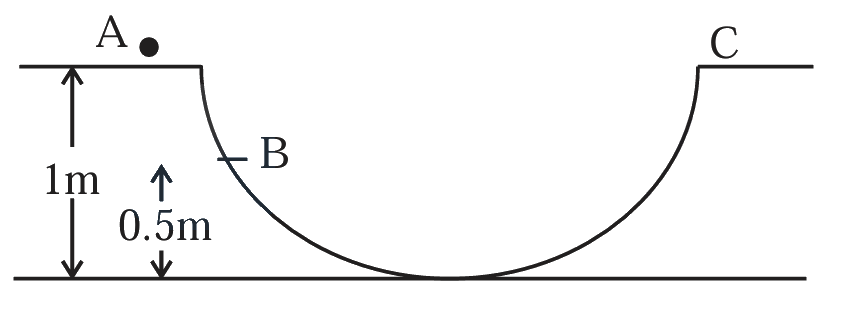 JEE Main/MCQ/Medium/Energy/With diagram
- 60A bob of mass is suspended by a light string of length . It is imparted a minimum horizontal velocity at the lowest point such that it just completes half circle reaching the top most position . The ratio of kinetic energies is :
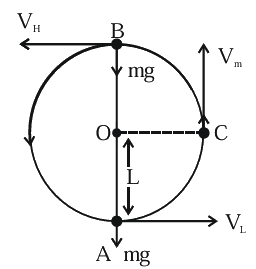 JEE Main/MCQ/Medium/Energy/With diagram
- 61The bob of a pendulum was released from a horizontal position. The length of the pendulum is . If it dissipates of its initial energy against air resistance, the speed with which the bob arrives at the lowest point is: [Use, ]JEE Main/MCQ/Medium/Energy
- 62The potential energy function (in ) of a particle in a region of space is given as . Here and are in meter. The magnitude of - component of force (in ) acting on the particle at point is:JEE Main/MCQ/Medium/Energy
- 63Two bodies of mass and are moving with equal kinetic energies. The ratio of magnitude of their linear momentum is :JEE Main/MCQ/Medium/Energy
- 64A body is released from a height equal to the radius of the earth. The velocity of the body when it strikes the surface of the earth will be: (Given acceleration due to gravity on the earth.)JEE Main/MCQ/Medium/Energy
- 65A car accelerates from rest of . The energy spent in this process is . The energy required to accelerate the car from to is . The value of is _____.JEE Main/Numerical/Medium/Energy
- 66A body of mass is moving with a velocity of Its kinetic energy will beJEE Main/MCQ/Medium/Energy
- 67A closed circular tube of average radius , whose inner walls are rough, is kept in vertical plane. A block of mass just fit inside the tube. The speed of block is , when it is introduced at the top of tube. After completing five oscillations, the block stops at the bottom region of tube. The work done by the tube on the block is ________ . (Given ).
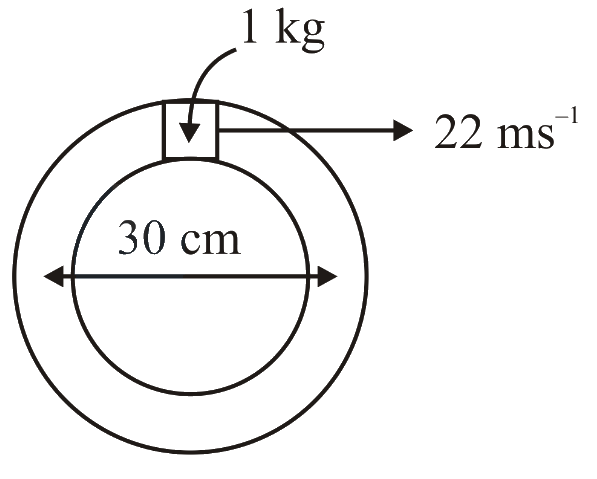 JEE Main/Numerical/Medium/Energy/With diagram
- 68A hollow spherical ball of uniform density rolls up a curved surface with an initial velocity (as shown in figure). Maximum height with respect to the initial position covered by it will be _____
(take, )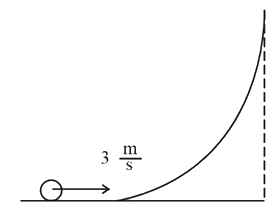 JEE Main/Numerical/Medium/Energy/With diagram
- 69A body of mass is moving with a momentum of . Now a force of acts on the body in the direction of its motion for . The increase in the Kinetic energy of the body is _____ .JEE Main/Numerical/Medium/Energy
- 70A bullet of mass moving horizontally with speed hits a wooden block of mass kept on a horizontal rough surface. The bullet gets embedded into the block and moves before coming to rest. The coefficient of friction between the block and the surface is _______.JEE Main/MCQ/Medium/Energy
- 71The momentum of a body is increased by . The percentage increase in the kinetic energy of the body is________%.JEE Main/Numerical/Medium/Energy
- 72A body is dropped on ground from a height and after hitting the ground, it rebounds to a height . If the ratio of velocities of the body just before and after hitting ground is , then percentage loss in kinetic energy of the body is . The value of is _____.JEE Main/Numerical/Medium/Energy
- 73A small particle of mass moves in such a way that its potential energy where is constant and is the distance of the particle from origin. Assuming Bohr’s quantization of momentum and circular orbit, the radius of orbit will be proportional toJEE Main/MCQ/Medium/Energy
- 74A block is fastened to a horizontal spring. The block is pulled to a distance from its equilibrium position (at ) on a frictionless surface from rest. The energy of the block at is . The spring constant of the spring is ______ .JEE Main/Numerical/Medium/Energy
- 75A lift of mass is descending with speed of . Its supporting cable begins to slip thus allowing it to fall with a constant acceleration of . The kinetic energy of the lift at the end of fall through to a distance of will be ______ .JEE Main/Numerical/Medium/Energy
- 76A mass takes to reach ground when dropped from a certain height above surface of earth. The loss of potential energy in the last second of fall is ______ . [Take ]JEE Main/Numerical/Medium/Energy
- 77An object of mass initially at rest on a smooth horizontal plane starts moving under the action of force . In the process of its linear motion, the angle (as shown in figure) between the direction of force and horizontal varies as , where is a constant and is the distance covered by the object from its initial position. The expression of kinetic energy of the object will be . The value of is ______.
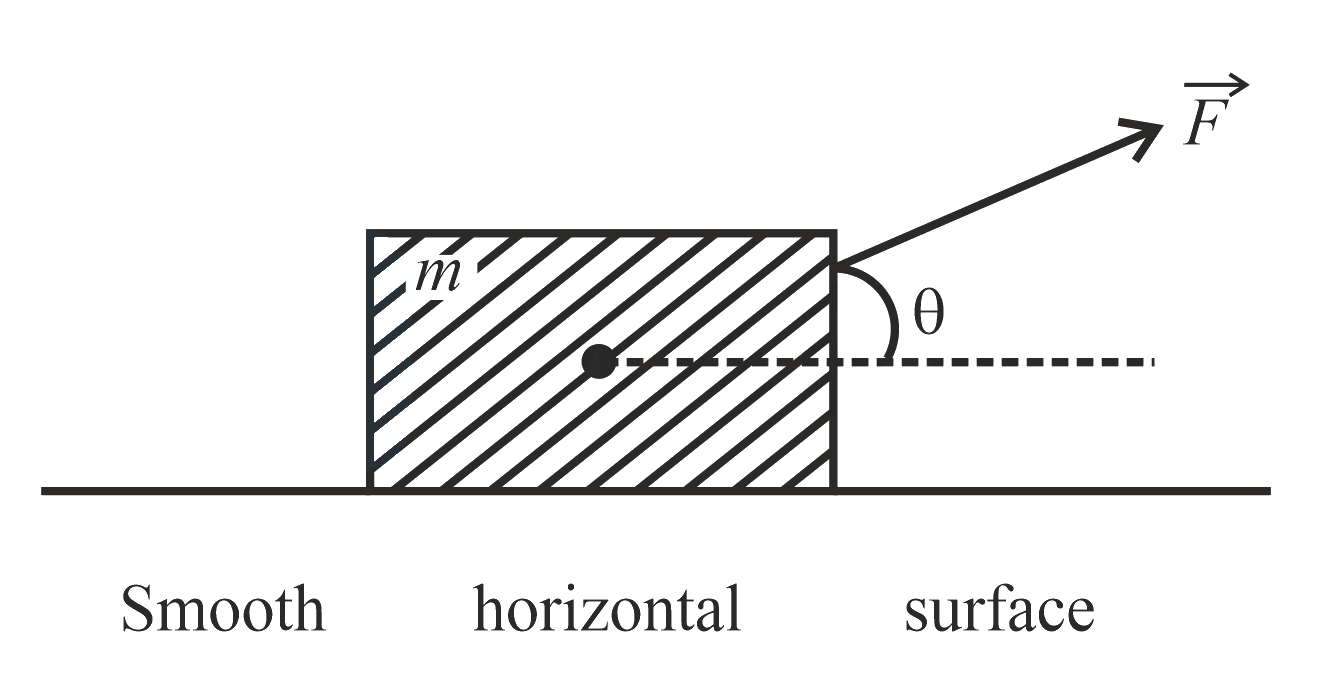 JEE Main/Numerical/Medium/Energy/With diagram
- 78A spherical body of mass starting from rest acquires a kinetic energy of at the end of second. The force acted on the body is _____ .JEE Main/Numerical/Medium/Energy
- 79If momentum of a body is increased by , then its kinetic energy increases by :JEE Main/MCQ/Medium/Energy
- 80A bullet of mass having initial kinetic energy is shot inside a long swimming pool as shown in the figure. If it's kinetic energy reduces to within , the minimum length of the pool, the bullet has to travel so that it completely comes to rest is
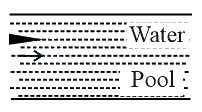 JEE Main/MCQ/Medium/Energy/With diagram
- 81A block of mass '' (as shown in figure) moving with kinetic energy compresses a spring through a distance when, its speed is halved. The value of spring constant of used spring will be for _____.
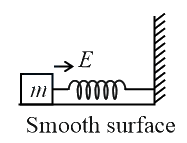 JEE Main/Numerical/Medium/Energy/With diagram
- 82Two inclined planes are placed as shown in figure.
A block is projected from the Point of inclined plane along its surface with a velocity just sufficient to carry it to the top Point at a height . After reaching the Point the block slides down on inclined plane . Time it takes to reach to the point from point is . The value of t is _____ (use )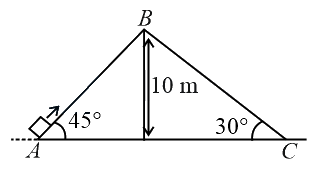 JEE Main/Numerical/Medium/Energy/With diagram
- 83As per the given figure, two blocks each of mass are connected to a spring of spring constant . If both are given velocity in opposite directions, then maximum elongation of the spring is
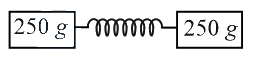 JEE Main/MCQ/Medium/Energy/With diagram
- 84A bag of sand of mass is suspended by a rope. bullet of travelling with speed gets embedded in it, then loss of kinetic energy will beJEE Main/MCQ/Medium/Energy
- 85In the given figure, the block of mass is dropped from the point . The expression for kinetic energy of block when it reaches point is
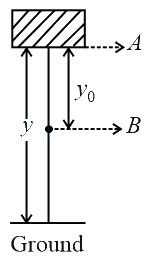 JEE Main/MCQ/Medium/Energy/With diagram
- 86Water falls from a high dam at the rate of per hour. Fifty percentage of gravitational potential energy can be converted into electrical energy. Using this hydro electric energy number of lamps, that can be lit, is
(Take )JEE Main/MCQ/Medium/Energy - 87A pendulum is suspended by a string of length . The mass of the bob of the pendulum is . The bob is pulled aside until the string is at with vertical as shown in the figure. After releasing the bob, the maximum velocity attained by the bob will be _____ . (if )
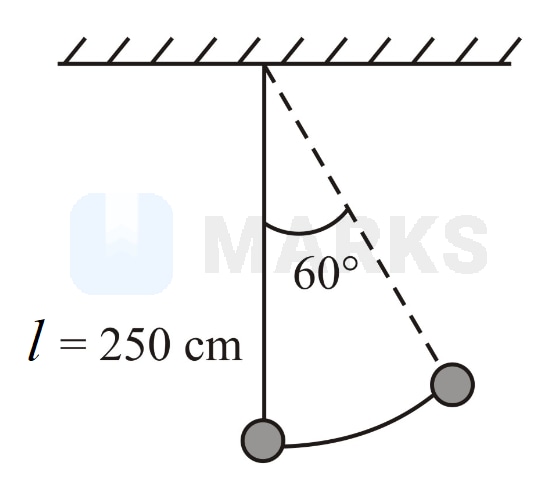 JEE Main/Numerical/Medium/Energy/With diagram
- 88A rolling wheel of is on an inclined plane at position and connected to a mass of through a string of fixed length and pulley as shown in figure.
Consider as friction free surface.
The velocity of centre of mass of the wheel when it reaches at the bottom of the inclined plane will be . The value of (rounded off to the nearest integer) is _____.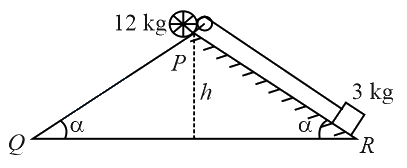 JEE Main/Numerical/Medium/Energy/With diagram
- 89A block moving at a speed of compresses a spring through a distance when its speed is halved. The spring constant of the spring will be _____ JEE Main/Numerical/Medium/Energy
- 90Potential energy as a function of is given by , where is the interatomic distance, and are positive constants. The equilibrium distance between the two atoms will be :JEE Main/MCQ/Medium/Energy
- 91A ball of mass is dropped from a height on a platform fixed at the top of a vertical spring (as shown in figure). The ball stays on the platform and the platform is depressed by a distance . The spring constant is _____
(Use )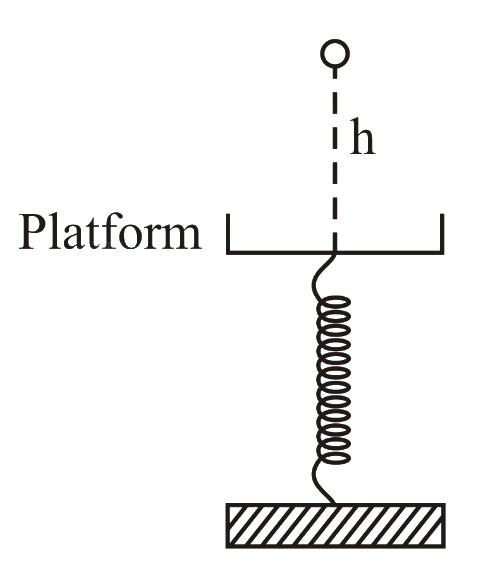 JEE Main/Numerical/Medium/Energy/With diagram
- 92A particle experiences a variable force in a horizontal plane. Assume distance in meters and force is newton. If the particle moves from point to point in the plane, then Kinetic Energy changes by :JEE Main/MCQ/Medium/Energy
- 93An engine is attached to a wagon through a shock absorber of length The system with a total mass of is moving with a speed of when the brakes are applied to bring it to rest. In the process of the system being brought to rest, the spring of the shock absorber gets compressed by . If of energy of the wagon is lost due to friction, the spring constant is _________\times {10}^{5}N{m}^{-1}.JEE Main/Numerical/Medium/Energy
- 94A body of mass dropped from a height reaches the ground with a speed of The value of work done by the air-friction is:JEE Main/MCQ/Medium/Energy
- 95A block moving horizontally on a smooth surface with a speed of splits into two parts with masses in the ratio of If the smaller part moves at in the same direction, then the fractional change in kinetic energy is :JEE Main/MCQ/Medium/Energy
- 96A block moving horizontally on a smooth surface with a speed of splits into two equal parts. If one of the parts moves at in the same direction, then the fractional change in the kinetic energy will be where ________.JEE Main/Numerical/Medium/Energy
- 97The height of victoria's falls is . What is the difference in the temperature of water at the top and at the bottom of the fall? [Given and specific heat of water JEE Main/MCQ/Medium/Energy
- 98A uniform chain of length and mass overhangs a smooth table with laying on the table. If is the kinetic energy of the chain in as it completely slips off the table, then the value of is
JEE Main/Numerical/Medium/Energy - 99Given below is the plot of a potential energy function for a system, in which a particle is in one dimensional motion, while a conservative force acts on it. Suppose that , the incorrect statement for this system is :
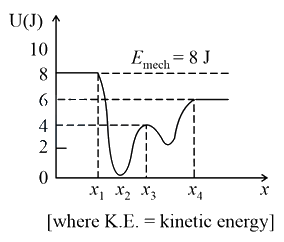 JEE Main/MCQ/Medium/Energy/With diagram
- 100If the kinetic energy of a moving body becomes four times its initial kinetic energy, then the percentage change in its momentum will be:JEE Main/MCQ/Medium/Energy
- 101A ball of mass , moving with a velocity of , collides with a spring of length and force constant . The length of the compressed spring is . The value of , to the nearest integer, is ___ .JEE Main/Numerical/Medium/Energy
- 102A particle of mass moves in a circular orbit under the central potential field, , where is a positive constant. The correct radius - velocity graph of the particle's motion is :JEE Main/MCQ/Medium/Energy
- 103As shown in the figure, a particle of mass is placed at a point When the particle is slightly displaced to its right, it starts moving and reaches the point The speed of the particle at is . (Take The value of to the nearest integer is
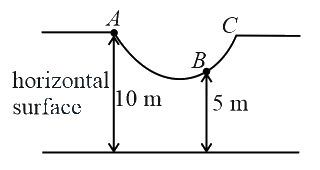 JEE Main/Numerical/Medium/Energy/With diagram
- 104A boy is rolling a ball on the frictionless floor with the speed of The ball gets deflected by an obstacle on the way. After deflection it moves with of its initial kinetic energy. What is the speed of the ball now?JEE Main/MCQ/Medium/Energy
- 105Two particles having masses and respectively are moving with equal kinetic energies. The ratio of the magnitudes of their linear momentum is . The value of will be ___.JEE Main/Numerical/Medium/Energy
- 106The potential energy of a diatomic molecule is a function dependent on (interatomic distance) as where, and are positive constants. The equilibrium distance between two atoms will be where ______ .JEE Main/Numerical/Medium/Energy
- 107Two solids and of mass and respectively are moving with equal linear momentum. The ratio of their kinetic energies will be so the value of will be _________.JEE Main/Numerical/Medium/Energy
- 108If the potential energy between two molecules is given by then at equilibrium, separation between molecules, and the potential energy are:JEE Main/MCQ/Medium/Energy
- 109Hydrogen ion and singly ionized helium atom are accelerated, from rest, through the same potential difference. The ratio of final speeds of hydrogen and helium ions is close to:JEE Main/MCQ/Medium/Energy
- 110A cricket ball of mass is thrown vertically up by a bowling machine so that it rises to a maximum height of after leaving the machine. If the part pushing the ball applies a constant force on the ball applies a constant force on the ball and moves horizontally a distance of while launching the ball, the value of is JEE Main/Numerical/Medium/Energy
- 111A particle slides down a frictionless track starting from rest at a point (height ). After reaching the particle continues to move freely in air as a projectile. When it reaching its highest point (height ), the kinetic energy of the particle (in ) is: (Figure drawn is schematic and not to scale; take ) ______________.
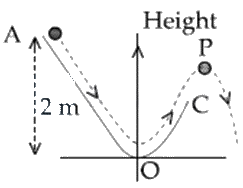 JEE Main/Numerical/Medium/Energy/With diagram
- 112A wedge of mass lies on a frictionless plane. A particle of mass approaches the wedge with speed There is no friction between the particle and the plane or between the particle and the wedge. The maximum height climbed by the particle on the wedge is given by:JEE Main/MCQ/Medium/Energy
- 113A particle moves in one dimension from rest under the influence of a force that varies with the distance traveled by the particle as shown in the figure. The kinetic energy of the particle after it has traveled is:
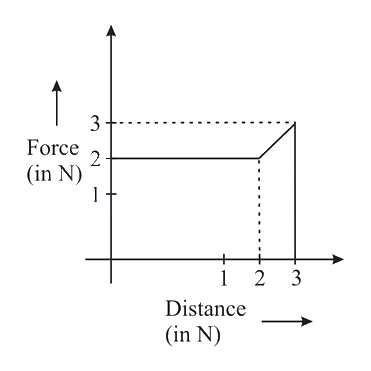 JEE Main/MCQ/Medium/Energy/With diagram
- 114A particle of mass is released with an initial velocity along the curve from the point as shown in the figure. The point is at height from point The particle slides along the frictionless surface. When the particle reaches point its angular momentum about will be: (Take )
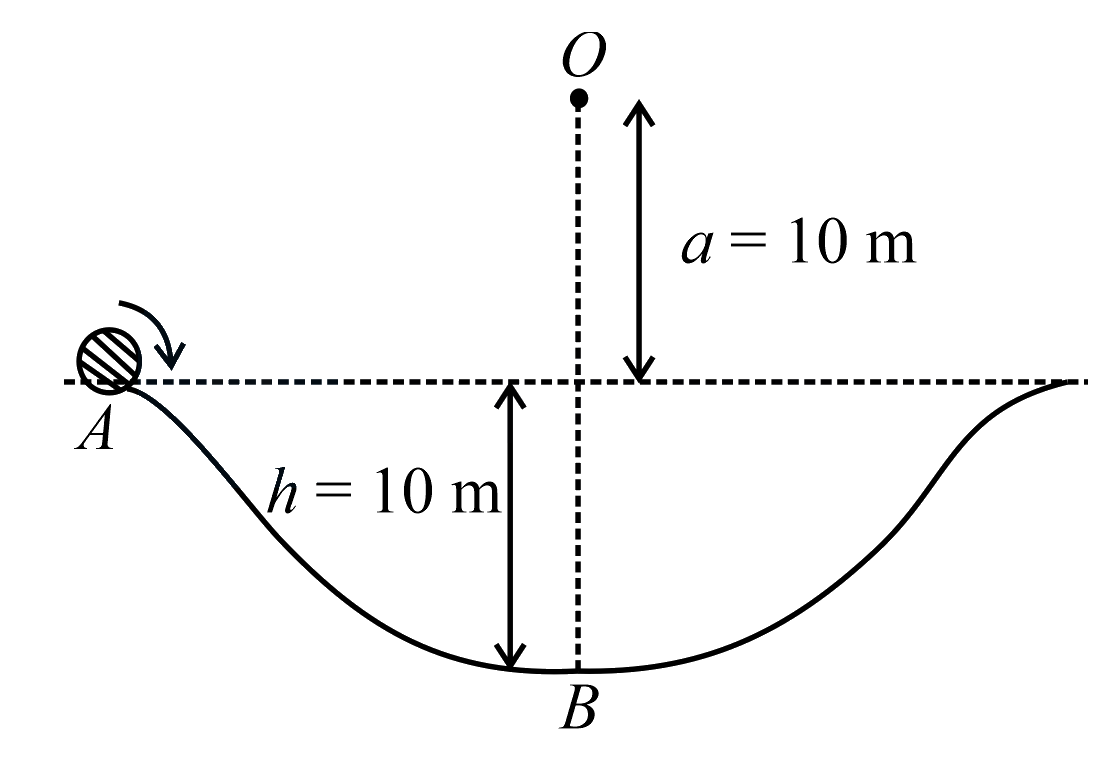 JEE Main/MCQ/Medium/Energy/With diagram
- 115A particle which is experiencing a force, given by , undergoes a displacement of . If the particle had a kinetic energy of at the beginning of the displacement, what is its kinetic energy at the end of the displacement?JEE Main/MCQ/Medium/Energy
- 116A force acts on a object so that its position is given as a function of time as What is the work done by this force in first seconds?JEE Main/MCQ/Medium/Energy
- 117A block of mass lying on a smooth horizontal surface, is attached to a spring (of negligible mass) of spring constant The other end of the spring is fixed, as shown in the figure. The block is initially at rest in its equilibrium position. If now the block is pulled with a constant force the maximum speed of the block is:
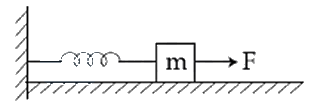 JEE Main/MCQ/Medium/Energy/With diagram
- 118Two particles of the same mass are moving in circular orbits because of force, given by . The first particle is at a distance , and the second, at . The best estimate for the ratio of kinetic energies of the first and the second particle is closest toJEE Main/MCQ/Medium/Energy
- 119A body of mass starts moving from rest along axis so that its velocity varies as where is a constant and is the distance covered by the body. The total work done by all the forces acting on the body in the first second after the start of the motion isJEE Main/MCQ/Medium/Energy
- 120A particle is moving in a circular path of radius a under the action of an attractive potential Its total energy is:JEE Main/MCQ/Medium/Energy
- 121An object is dropped from a height from the ground. Every time it hits the ground it loses of its kinetic energy. The total distance covered as is:JEE Main/MCQ/Medium/Energy
- 122A body of mass is moving in a medium and experiences a frictional force Its initial speed is After its kinetic energy is then value of will be:-JEE Main/MCQ/Medium/Energy
- 123A time dependent force acts on a particle of mass . If the particle starts from the rest, the work done by the force during the first will be:JEE Main/MCQ/Medium/Energy
- 124A person trying to lose weight by burning fat lifts a mass of 10 kg upto a height of 1m 1000 times. Assume that the potential energy lost each time he lowers the mass is dissipated. How much fat will he use up considering the work done only when the weight is lifted up? Fat supplies J of energy per kg which is converted to mechanical energy with a 20% efficiency rate. Take :JEE Main/MCQ/Medium/Energy
- 125A particle is moving in a circle of radius under the action of a force which is directed towards centre of the circle. Total mechanical energy (kinetic energy + potential energy) of the particle is (take potential energy for ):JEE Main/MCQ/Medium/Energy
- 126A block of mass is connected to a spring of unknown spring constant k. It is compressed to a distance from its equilibrium position and released from rest. After approaching half the distance from the equilibrium position, it hits another block and comes to rest momentarily, while the other block moves with velocity . The total initial energy of the spring is:JEE Main/MCQ/Medium/Energy
- 127A block of mass rests on a horizontal table. The coefficient of friction between the block and the table is . When hit by a bullet of mass moving with speed , that gets embedded in it, the block moves and comes to stop after moving a distance of on the table. If a freely falling object were to acquire speed after being dropped from height , then neglecting energy losses and taking , the value of is close toJEE Main/MCQ/Medium/Energy
- 128A spring of unstretched length 1 has a mass with one end fixed to a rigid support. Assuming spring to be made of a uniform wire, the kinetic energy possessed by it if its free end is pulled with uniform velocity is:JEE Main/MCQ/Medium/Energy
- 129A small ball of mass starts at a point with speed and moves along a frictionless track as shown. The track has coefficient of friction . The ball comes to stop at after travelling a distance which is:
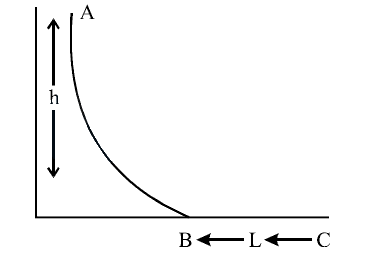 JEE Main/MCQ/Medium/Energy/With diagram
- 130Two springs of force constants (Spring A) and (Spring B) are joined together in series. The combination is compressed by . The ratio of energy stored in and is . Then is equal to:JEE Main/MCQ/Medium/Energy
- 131The force on a particle of mass , moving along the -axis is given in the figure as a function of its position . The particle is moving with a velocity of along the -axis at . What is the kinetic energy of the particle at
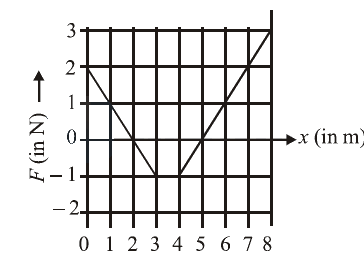 JEE Main/MCQ/Medium/Energy/With diagram
- 132A particle gets displaced by under the action of a force . The change in its kinetic energy isJEE Main/MCQ/Medium/Energy
- 133The potential energy function for the force between two atoms in a diatomic molecule is approximately given by , where a and are constants and is the distance between the atoms. If the dissociation energy of the molecule is isJEE Main/MCQ/Medium/Energy
- 134An athlete in the olympic games covers a distance of in . His kinetic energy can be estimated to be in the rangeJEE Main/MCQ/Medium/Energy
- 135The potential energy of a particle free move along the -axis is given by
The total mechanical energy of the particle . Then, the maximum speed (in ) isJEE Main/MCQ/Medium/Energy - 136A spherical ball of mass is stationary at the top of a hill of height . It rolls down a smooth surface to the ground, then climbs up another hill of height and finally rolls down to a horizontal base at a height of above the ground. The velocity attained by the ball isJEE Main/MCQ/Medium/Energy
- 137A bullet fired into a fixed target loses half of its velocity after penetrating . How much further it will penetrate before coming to rest assuming that it faces constant resistance to motion?JEE Main/MCQ/Medium/Energy
- 138A particle moves in a straight line with retardation proportional to its displacement. Its loss of kinetic energy for any displacement is proportional toJEE Main/MCQ/Medium/Energy
- 139A spring of spring constant is stretched initially by from the unstretched position. Then the work required to stretch it further by another isJEE Main/MCQ/Medium/Energy
- 140Consider the following two statements:
(A) Linear momentum of a system of particles is zero
(B) Kinetic energy of a system of particles is zero
ThenJEE Main/MCQ/Medium/Energy - 141A ball whose kinetic energy is E, is projected at an angle of to the horizontal. The kinetic energy of the ball at the highest point of its flight will beJEE Main/MCQ/Medium/Energy
- 142A spring of force constant has an extension of . The work done is extending it from to isJEE Main/MCQ/Medium/Energy
- 143A body of mass kg begins to move under the influence of time dependent force N, where and are unit vectors along and -axis respectively. The power produced by the force at s is _____ W.JEE Main/Numerical/Medium/Power
- 144An object of mass 1000 g experiences a time dependent force . The power generated by the force at time is :JEE Main/MCQ/Medium/Power
- 145A sand dropper drops sand of mass on a conveyer belt at a rate proportional to the square root of speed of the belt, i.e. . If P is the power delivered to run the belt at constant speed then which of the following relationship is true?JEE Main/MCQ/Medium/Power
- 146A body of mass 4 kg is placed on a plane at a point P having coordinate . Under the action of force , it moves to a new point Q having coordinates in 4 sec . The average power and instanteous power at the end of 4 sec are in the ratio of :JEE Main/MCQ/Medium/Power
- 147A body is moving unidirectionally under the influence of a constant power source. Its displacement in time is proportional to :JEE Main/MCQ/Medium/Power
- 148A body of mass begins to move under the action of a time dependent force given by . The power developed by the force at the time is given by:JEE Main/MCQ/Medium/Power
- 149The ratio of powers of two motors is that are capable of raising water in minutes and water in minutes respectively from a well of deep. The value of will beJEE Main/MCQ/Medium/Power
- 150To maintain a speed of by a bus of mass on a plane rough road for distance, the work done by the engine of the bus will be _____ . [The coefficient of friction between tyre of bus and road is ]JEE Main/Numerical/Medium/Power
- 151A block of mass starting from rest pulled up on a smooth incline plane making an angle of with horizontal with an effective acceleration of . The power delivered by the puling force at from the start is _____ .
[Use ]
(Calculate the nearest integer value)JEE Main/Numerical/Medium/Power - 152If the maximum load carried by an elevator is , which is moving up with a uniform speed of and the frictional force acting on it is , then the maximum power used by the motor is _____________JEE Main/Numerical/Medium/Power
- 153A body of mass is initially at rest. It starts moving unidirectionally under the influence of a source of constant power . Its displacement in is . The value of will be ______.JEE Main/Numerical/Medium/Power
- 154A body of mass begins to move under the action of a time dependent force , where and are the unit vectors along and axis. The power developed by above force, at the time , will be _______.JEE Main/Numerical/Medium/Power
- 155Sand is being dropped from a stationary dropper at a rate of on a conveyor belt moving with a velocity of . The power needed to keep belt moving with the same velocity will beJEE Main/MCQ/Medium/Power
- 156A particle of mass is moving in a circular path of constant radius such that its centripetal acceleration is varying with time as , where is a constant. The power delivered to the particle by the force acting on it is -JEE Main/MCQ/Medium/Power
- 157An automobile of mass accelerates starting from the origin and initially at rest, while the engine supplies constant power . The position is given as a function of time by:JEE Main/MCQ/Medium/Power
- 158A constant power delivering machine has towed a box, which was initially at rest, along a horizontal straight line. The distance moved by the box in time is proportional to :-JEE Main/MCQ/Medium/Power
- 159A body of mass is driven by an engine delivering a constant power of . the body starts from rest and moves in a straight line. After , the body has moved a distance (in )….JEE Main/Numerical/Medium/Power
- 160In a reactor, of fuel is fully used up in days. The energy released fission is . Given that the Avogadro number, per kilo mole and . The power output of the reactor is close to:JEE Main/MCQ/Medium/Power
- 161A particle of mass M is moving in a circle of fixed radius R in such a way that its centripetal acceleration at time t is given by , where is a constant. The power delivered to the particle by the force acting on it, is :JEE Main/MCQ/Medium/Power
- 162A car of weight W is on an inclined road that rises by 100 m over a distance of 1km and applies a constant frictional force on the car. While moving uphill on the road at a speed of , the car needs power P. If it needs power while moving downhill at speed then value of is:JEE Main/MCQ/Medium/Power
- 163A wind-powered generator converts wind energy into electrical energy. Assume that the generator converts a fixed fraction of the wind energy intercepted by its blades into electrical energy. For wind speed , the electrical power output will be most likely proportional toJEE Main/MCQ/Medium/Power
- 164A man leaps vertically into the air from a crouching position. To take the leap the man pushes the ground with a constant force to raise himself. The center of gravity rises by before he leaps. After the leap the c.g. rises by another . The maximum power delivered by the muscles is : (Take )JEE Main/MCQ/Medium/Power
- 165A body of mass is accelerated uniformly from rest to a speed in a time . The instantaneous power delivered to the body as a function time is given byJEE Main/MCQ/Medium/Power
- 166A body of mass , accelerates uniformly from rest to in time . The instantaneous power delivered to the body as a function of time isJEE Main/MCQ/Medium/Power
- 167A body is moved along a straight line by a machine delivering a constant power. The distance moved by the body in time ' ' is proportional toJEE Main/MCQ/Medium/Power
- 168In case of vertical circular motion of a particle by a thread of length if the tension in the thread is zero at an angle shown in figure, the velocity at the bottom point of the circular path is ( gravitational acceleration)
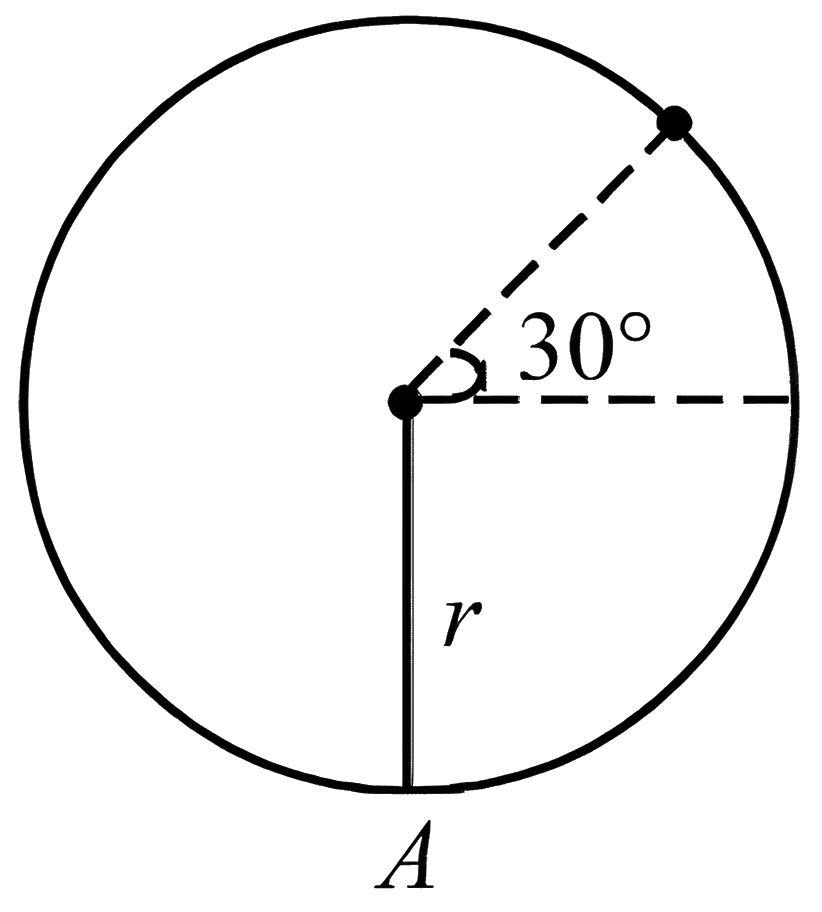 JEE Main/MCQ/Medium/Circular motion/With diagram
- 169A body of mass ' \(m\) ' connected to a massless and unstretchable string goes in verticle circle of radius ' \(R\) 'under gravity \(g\). The other end of the string is fixed at the center of circle. If velocity at top of circular path is \(n \sqrt{g R}\), where, \(n \geqslant 1\), then ratio of kinetic energy of the body at bottom to that at top of the circle isJEE Main/MCQ/Medium/Circular motion
- 170A body of mass 100 g is moving in circular path of radius 2 m on vertical plane as shown in figure. The velocity of the body at point is . The ratio of its kinetic energies at point and is :
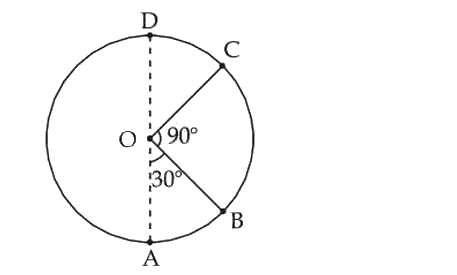
(Take acceleration due to gravity as )JEE Main/MCQ/Medium/Circular motion/With diagram - 171A bob of mass is suspended at a point by a light string of length and left to perform vertical motion (circular) as shown in figure. Initially, by applying horizontal velocity at the point ' A ', the string becomes slack when, the bob reaches at the point ' D '. The ratio of the kinetic energy of the bob at the points and is ______ -.
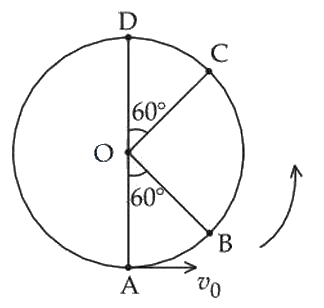 JEE Main/MCQ/Medium/Circular motion/With diagram
- 172A circular table is rotating with an angular velocity of about its axis (see figure). There is a smooth groove along a radial direction on the table. A steel ball is gently placed at a distance of on the groove. All the surfaces are smooth. If the radius of the table is , the radial velocity of the ball w.r.t. the table at the time ball leaves the table is , where the value of is _____.
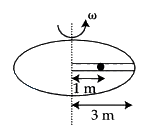 JEE Main/Numerical/Medium/Circular motion/With diagram
- 173A ball suspended by a thread swings in a vertical plane so that its magnitude of acceleration in the extreme position and lowest position are equal. The angle of thread deflection in the extreme position will be :JEE Main/MCQ/Medium/Circular motion
- 174A stone tide to a string of length is whirled in a vertical circle with the other end of the string at the centre. At a certain instant of time, the stone is at its lowest position and has a speed . The magnitude of change in its velocity, as it reaches a position where the string is horizontal, is . The value of isJEE Main/MCQ/Medium/Circular motion
- 175For a particle in uniform circular motion, the acceleration at any point on the circular path of radius is (when is measured from the positive -axis and is uniform speed):JEE Main/MCQ/Medium/Circular motion
- 176A stone of mass , tied to a string is being whirled in a vertical circle with a uniform speed. The tension in the string isJEE Main/MCQ/Medium/Circular motion
- 177Concrete mixture is made by mixing cement, stone and sand in a rotating cylindrical drum. If the drum rotates too fast, the ingredients remain stuck to the wall of the drum and proper mixing of ingredients does not take place. The maximum rotational speed of the drum in revolutions per minute (rpm) to ensure proper mixing is close to :
(Take the radius of the drum to be 1.25 m and its axle to be horizontal) :JEE Main/MCQ/Medium/Circular motion - 178If a body moving in a circular path maintains constant speed of , then which of the following correctly describes the relation between acceleration and radius?JEE Main/MCQ/Medium/Circular motion
- 179
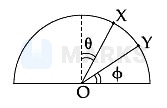
A particle is released on a vertical smooth semicircular track from point so that, makes angle from the vertical (see figure). The normal reaction of the track on the particle vanishes at the point where makes an angle with the horizontal. ThenJEE Main/MCQ/Medium/Circular motion/With diagram - 180A bullet of mass and speed is fired into a door and gets embedded exactly at the centre of the door. The door is wide and weighs . It is hinged at one end and rotates about a vertical axis practically without friction. The angular speed of the door just after the bullet embeds into it will be :JEE Main/MCQ/Medium/Circular motion
- 181Two cars of masses and are moving in circles of radii and , respectively. Their speeds are such that they make complete circles in the same time . The ratio of their centripetal acceleration isJEE Main/MCQ/Medium/Circular motion
- 182An annular ring with inner and outer radii and is rolling without slipping with a uniform angular speed. The ratio of the forces experienced by the two particles situated on the inner and outer parts of the ring, isJEE Main/MCQ/Medium/Circular motion
- 183Which of the following statements is false for a particle moving in a circle with a constant angular speed?JEE Main/MCQ/Medium/Circular motion
NEET question paper PDF
This chapter includes NEET questions. Open a year to read the full paper, or download the PDF.
Opening paper…
JEE Main question paper PDF
This chapter includes JEE Main questions. Open a shift to read the paper, or download the PDF.
Opening paper…
Other Physics chapters
Current Electricity 380Electrostatics 311Kinematics 308Ray Optics 295Rotational Motion 280Magnetic Effects & Magnetism 276Atoms & Nuclei 239Gravitation 223Laws of Motion 210Semiconductors 209Dual Nature of Matter 200Oscillations 194Fluid Mechanics 192Wave Optics 191Alternating Current 190Thermodynamics 190Capacitors 180Kinetic Theory 168Electromagnetic Waves 165Electromagnetic Induction 153Units & Dimensions 149Waves 142Center of Mass, Momentum & Collision 130Thermal Properties of Matter 126Mathematics in Physics 121Mechanical Properties of Solids 118Experimental Physics 70Magnetic Properties of Matter 57Modern Physics 5
Stuck on a Work Energy Power question from your book?
Snap it and get a whiteboard video that solves it step by step. Your first video needs no login.