Physics · JEE Main, NEET
Kinematics
308 practice questions with a worked solution for each. Tap an option to see instantly if you are right.
248MCQ60Numerical42With diagram
- 1A projectile is launched with velocity at an angle with horizontal. The ratio of maximum height to horizontal range is:JEE Main/MCQ/Medium
- 2A vehicle travelling at stops in a distance of upon applying brakes. If the speed is doubled to , the stopping distance under same retardation is (in m):JEE Main/Numerical/Medium
- 3A car accelerates from rest at for . The distance covered is:NEET/MCQ/Medium
- 4A sportsman runs around a circular track of radius such that he traverses the path . The distance travelled and displacement, respectively, are
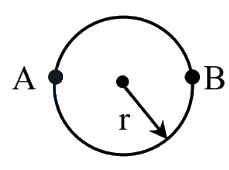 JEE Main/MCQ/Medium/Rest and Motion/With diagram
- 5A person travelling on a straight line moves with a uniform velocity for a distance x and with a uniform velocity for the next distance. The average velocity in this motion is . If is then _________ .JEE Main/Numerical/Medium/Rest and Motion
- 6A particle moving in a straight line covers half the distance with speed . The other half is covered in two equal time intervals with speeds and respectively. The average speed of the particle during the motion is :JEE Main/MCQ/Medium/Rest and Motion
- 7A clock has long second hand and minute hand respectively. In 30 minutes duration the tip of second hand will travel distance more than the tip of minute hand. The value of in meter is nearly (Take ) :JEE Main/MCQ/Medium/Rest and Motion
- 8A particle moves in a straight line so that its displacement at any time is given by . Its acceleration at any time is where ___________JEE Main/Numerical/Medium/Rest and Motion
- 9A train starting from rest first accelerates uniformly up to a speed of for time , then it moves with a constant speed for time . The average speed of the train for this duration of journey will be (in ) :JEE Main/MCQ/Medium/Rest and Motion
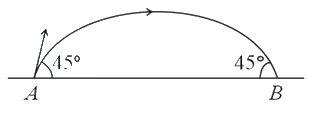
- 10A cyclist starts from the point of a circular ground of radius and travels along its circumference to the point . The displacement of a cyclist is:
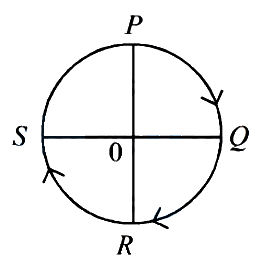 JEE Main/MCQ/Medium/Rest and Motion/With diagram
- 11A body travels in second and in second. The acceleration is :JEE Main/MCQ/Medium/Rest and Motion
- 12A particle is moving in one dimension (along axis) under the action of a variable force. It's initial position was right of origin. The variation of its position with time is given as where is in and is in The velocity of the particle when its acceleration becomes zero is _________ JEE Main/Numerical/Medium/Rest and Motion
- 13The displacement and the increase in the velocity of a moving particle in the time interval of to are and , respectively. The distance travelled by the particle in is ___________ .JEE Main/Numerical/Medium/Rest and Motion
- 14A particle is moving in a straight line. The variation of position as a function of time is given as . The velocity of the body when its acceleration becomes zero is:JEE Main/MCQ/Medium/Rest and Motion
- 15A particle starts from origin at with a velocity and moves in plane under action of a force which produces a constant acceleration of . If the -coordinate of the particle at that instant is , then the speed of the particle at this time is . The value of is _______.JEE Main/Numerical/Medium/Rest and Motion
- 16Position of an ant ( in metres) moving in plane is given by (where is in second). The magnitude and direction of velocity of the ant at will be :JEE Main/MCQ/Medium/Rest and Motion
- 17The position of a particle related to time is given by . The magnitude of velocity of the particle at s will be :JEE Main/MCQ/Medium/Rest and Motion
- 18The distance travelled by an object in time is given by . The instantaneous speed of the object at will be :JEE Main/MCQ/Medium/Rest and Motion
- 19Given below are two statements:
Statement I : A truck and a car moving with same kinetic energy are brought to rest by applying breaks which provide equal retarding forces. Both come to rest in equal distance.
Statement II : A car moving towards east takes a turn and moves towards north, the speed remains unchanged. The acceleration of the car is zero.
In the light of given statements, choose the most appropriate answer from the options given belowJEE Main/MCQ/Medium/Rest and Motion - 20A person travels distance with velocity and then distance with velocity in the same direction. The average velocity of the person is , then the relation between and will beJEE Main/MCQ/Medium/Rest and Motion
- 21As shown in the figure, a particle is moving with constant speed . Considering its motion from to , the magnitude of the average velocity is:
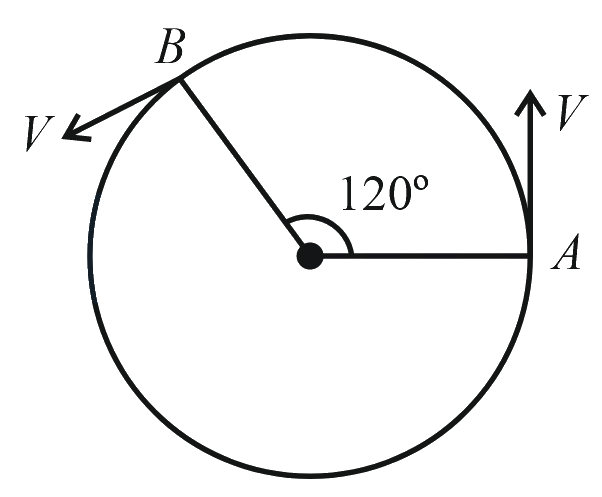 JEE Main/MCQ/Medium/Rest and Motion/With diagram
- 22An object moves with speed along a line segment respectively as shown in figure. Where , then average speed of the object will be :
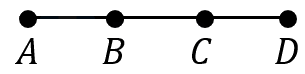 JEE Main/MCQ/Medium/Rest and Motion/With diagram
- 23A vehicle travels with speed of and another with speed of , then its average speed is :JEE Main/MCQ/Medium/Rest and Motion
- 24A car travels a distance of with speed and then same distance with speed in the same direction. The average speed of the car is:JEE Main/MCQ/Medium/Rest and Motion
- 25A small toy starts moving from the position of rest under a constant acceleration. If it travels a distance of in , the distance travelled by the toy in the next will be:JEE Main/MCQ/Medium/Rest and Motion
- 26A car covers distance with first one-third at velocity , second one-third at and last one-third at . If and , then the average velocity of the car is _____ .
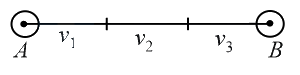 JEE Main/Numerical/Medium/Rest and Motion/With diagram
- 27Velocity and acceleration in two systems of units and are related as and respectively. Here and are constants. The relations for distance and time in two systems respectively areJEE Main/MCQ/Medium/Rest and Motion
- 28Two buses and start from a point at the same time and move in a straight line and their positions are represented by and . At what time, both the buses have same velocity ?JEE Main/MCQ/Medium/Rest and Motion
- 29The instantaneous velocity of a particle moving in a straight line is given as , where and are constants. The distance travelled by the particle between and is:JEE Main/MCQ/Medium/Rest and Motion
- 30The relation between time and distance for a moving body is given as , where and are constants. The retardation of the motion is: (When stands for velocity)JEE Main/MCQ/Medium/Rest and Motion
- 31A body at rest is moved along a horizontal straight line by a machine delivering a constant power. The distance moved by the body in time is proportional to:JEE Main/MCQ/Medium/Rest and Motion
- 32The velocity of a particle is . Its position is at then its displacement after time is :JEE Main/MCQ/Medium/Rest and Motion
- 33A mosquito is moving with a velocity and accelerating in uniform conditions. What will be the direction of mosquitoes after ?JEE Main/MCQ/Medium/Rest and Motion
- 34A scooter accelerates from rest for time at constant rate and then retards at constant rate for time and comes to rest. The correct value of will be :JEE Main/MCQ/Medium/Rest and Motion
- 35An engine of a train, moving with uniform acceleration, passes the signal-post with velocity and the last compartment with velocity . The velocity with which middle point of the train passes the signal post is :JEE Main/MCQ/Medium/Rest and Motion
- 36When a car is at rest, its driver sees rain drops falling on it vertically. When driving the car with speed , he sees that rain drops coming at an angle from the horizontal. On further increasing the speed of the car to , this angle changes to . The value of is close to :JEE Main/MCQ/Medium/Rest and Motion
- 37A particle moving in the -plane experiences a velocity dependent force , where and are the and components of its velocity . If is the acceleration of the particle, then which of the following statements is true for the particle ?JEE Main/MCQ/Medium/Rest and Motion
- 38A balloon is moving up in air vertically above a point on the ground. When it is a height a girl standing at a distance d (point B) from A (see figure) sees it at an angle with respect to the vertical. When the balloon climbs up a further height , it is seen at an angle with respect to the vertical if the girl moves further by a distance (point C). Then the height is (given ):
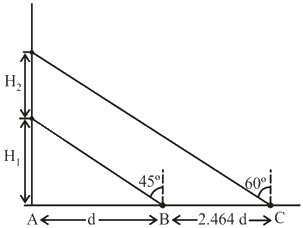 JEE Main/MCQ/Medium/Rest and Motion/With diagram
- 39The position vector of a particle changes with time according to the relation What is the magnitude of the acceleration at JEE Main/MCQ/Medium/Rest and Motion
- 40A paratrooper jumps from an aeroplane and opens a parachute after 2 s of free fall and starts deaccelerating with . At 10 m height from ground, while descending with the help of parachute, the speed of paratrooper is . The initial height of the airplane is m.
JEE Main/MCQ/Medium/Uniform Motion - 41Two cars and are moving on a road in the same direction. Acceleration of car increases linearly with time whereas car moves with a constant acceleration. Both cars cross each other at time , for the first time. The maximum possible number of crossing(s) (including the crossing at is ________.JEE Main/Numerical/Medium/Uniform Motion
- 42A bus moving along a straight highway with speed of is brought to halt within after applying the brakes. The distance travelled by the bus during this time (Assume the retardation is uniform) is _____m.JEE Main/Numerical/Medium/Uniform Motion
- 43The relation between time ‘’ and distance ‘’ is , where and are constants. The relation between acceleration and velocity is:JEE Main/MCQ/Medium/Uniform Motion
- 44A body starts moving from rest with constant acceleration covers displacement in first seconds and in first seconds. The displacement will be made in time :JEE Main/MCQ/Medium/Uniform Motion
- 45A bullet is fired into a fixed target looses one third of its velocity after travelling . It penetrates further before coming to rest. The value of is :JEE Main/MCQ/Medium/Uniform Motion
- 46A ball is thrown vertically upward with an initial velocity of . The ratio of velocity after and is . The value of is _____. {take, }JEE Main/MCQ/Medium/Uniform Motion
- 47A particle starts with an initial velocity of along -direction and accelerates uniformly at the rate of . The time taken by the particle to reach the velocity of is _____.JEE Main/MCQ/Medium/Uniform Motion
- 48For a train engine moving with speed of , the driver must apply brakes at a distance of before the station for the train to come to rest at the station. If the brakes were applied at half of this distance, the train engine would cross the station with speed . The value of is ______. (Assuming same retardation is produced by brakes)JEE Main/Numerical/Medium/Uniform Motion
- 49A horse rider covers half the distance with speed. The remaining part of the distance was travelled with speed for half the time and with speed for other half of the time. The mean speed of the rider averaged over the whole time of motion is . The value of is ______.JEE Main/Numerical/Medium/Uniform Motion
- 50The velocity of the bullet becomes one third after it penetrates in a wooden block. Assuming that bullet is facing a constant resistance during its motion in the block. The bullet stops completely after travelling at inside the block. The value of isJEE Main/MCQ/Medium/Uniform Motion
- 51A car is moving with speed of and after applying the brake it will move before it stops. If the same car is moving with a speed of one third the reported speed then it will stop after travelling _____ distance.JEE Main/Numerical/Medium/Uniform Motion
- 52If the velocity of a body related to displacement is given by then the acceleration of the body is _________ JEE Main/Numerical/Medium/Uniform Motion
- 53Two spherical balls having equal masses with radius of each are thrown upwards along the same vertical direction at an interval of with the same initial velocity of , then these balls collide at a height of _____,
(take )JEE Main/Numerical/Medium/Uniform Motion - 54A particle of mass originally at rest is subjected to a force whose direction is constant but magnitude varies with time according to the relation where and are constants. The force acts only for the time interval . The velocity of the particle after time is:JEE Main/MCQ/Medium/Uniform Motion
- 55A body of mass moves under a force of It starts from rest and was at the origin initially. After , its new coordinates are . The value of is ______.
(Round off to the Nearest Integer)JEE Main/Numerical/Medium/Uniform Motion - 56A boy pushes a box of mass with a force on a frictionless surface. If the box was initially at rest, then _______ is displacement along the -axis after JEE Main/Numerical/Medium/Uniform Motion
- 57A stone is dropped from the top of a building. When it crosses a point below the top, another stone starts to fall from a point below the top. Both stones reach the bottom of building simultaneously. The height of the building is :JEE Main/MCQ/Medium/Uniform Motion
- 58A helicopter rises from rest on the ground vertically upwards with a constant acceleration g. A food packet is dropped from the helicopter when it is at a height h. The time taken by the packet to reach the ground is close to [ is the acceleration due to gravity]:JEE Main/MCQ/Medium/Uniform Motion
- 59Starting from the origin at time , with initial velocity , a particle moves in the - plane with a constant acceleration of . At time , its coordinates are . The values of and are, respectively:JEE Main/MCQ/Medium/Uniform Motion
- 60A ball is dropped from the top of a high tower on a planet. In the last before hitting the ground, it covers a distance of Acceleration due to gravity (in ) near the surface on that planet is______JEE Main/Numerical/Medium/Uniform Motion
- 61A particle of mass and charge is released from rest in a uniform electric field. If there is no other force on the particle, the dependence of its speed on the distance travelled by it is correctly given by (graphs are schematic and not drawn to scale)JEE Main/MCQ/Medium/Uniform Motion
- 62A bullet of mass has an initial speed of , just before it starts penetrating a mud wall of thickness . If the wall offers a mean resistance of the speed of the bullet after emerging from the other side of the wall is close to:JEE Main/MCQ/Medium/Uniform Motion
- 63A ball is thrown vertically up (taken as ) from the ground. The correct momentum-height diagram is:JEE Main/MCQ/Medium/Uniform Motion
- 64An automobile, traveling at , can be stopped at a distance of by applying brakes. If the same automobile is traveling at , the minimum stopping distance in metres is (Assume no skidding):JEE Main/MCQ/Medium/Uniform Motion
- 65An automobile, travelling at , can be stopped at a distance of by applying brakes. If the same automobile is travelling at , the minimum stopping distance, in metres, is (assume no skidding)JEE Main/MCQ/Medium/Uniform Motion
- 66From the top of a metres high tower, a stone is thrown upwards vertically with the velocity of The greatest height (in metres) attained by the stone, assuming the value of the gravitational acceleration , is:JEE Main/MCQ/Medium/Uniform Motion
- 67A bullet loses of its velocity passing through one plank. Considering uniform retardation, the number of such planks that are required to stop the bullet can be:JEE Main/MCQ/Medium/Uniform Motion
- 68A goods train accelerating uniformly on a straight railway track, approaches an electric pole standing on the side of track. Its engine passes the pole with velocity and the guard's room passes with velocity . The middle wagon of the train passes the pole with a velocity.JEE Main/MCQ/Medium/Uniform Motion
- 69Consider a rubber ball freely falling from a height onto a horizontal elastic plate. Assume that the duration of collision is negligible and the collision with the plate is totally elastic. Then the velocity as a function of time the height as function of time will beJEE Main/MCQ/Medium/Uniform Motion
- 70A particle has an initial velocity and an acceleration of . Its speed after 10 s isJEE Main/MCQ/Medium/Uniform Motion
- 71A body falling from rest under gravity passes a certain point . It was at a distance of from prior to passing through . If , then the height above the point from where the body began to fall isJEE Main/MCQ/Medium/Uniform Motion
- 72 and are two like parallel forces. A couple of moment lies in the plane of and and is contained with them. The resultant of and after combining is displaced through a distanceJEE Main/MCQ/Medium/Uniform Motion
- 73Two points and move from rest along a straight line with constant acceleration and ' respectively. If takes sec. more than and describes ' ' units more than in acquiring the same speed thenJEE Main/MCQ/Medium/Uniform Motion
- 74A ball is thrown from a point with a speed at an angle of projection . From the same point and at the same instant person starts running with a constant speed to catch the ball. Will the person be able to catch the ball? If yes, what should be the angle of projection?JEE Main/MCQ/Medium/Uniform Motion
- 75An automobile travelling with speed of , can brake to stop within a distance of . If the car is going twice as fast, i.e , the stopping distance will beJEE Main/MCQ/Medium/Uniform Motion
- 76A body travels a distance in seconds. It starts from rest and ends at rest. In the first part of the journey, it moves with constant acceleration and in the second part with constant retardation . The value of is given byJEE Main/MCQ/Medium/Uniform Motion
- 77A car, moving with a speed of , can be stopped by brakes after at least . If the same car is moving at a speed of , the minimum stopping distance isJEE Main/MCQ/Medium/Uniform Motion
- 78Speeds of two identical cars are and at the specific instant. The ratio of the respective distances in which the two cars are stopped from that instant isJEE Main/MCQ/Medium/Uniform Motion
- 79If a body looses half of its velocity on penetrating 3 cm in a wooden block, then how much will it
penetrate more before coming to rest?JEE Main/MCQ/Medium/Uniform Motion - 80From a building two balls and are thrown such that is thrown upwards and downwards (both vertically). If and are their respective velocities on reaching the ground, thenJEE Main/MCQ/Medium/Uniform Motion
- 81The velocity () versus time () plot of a particle is shown in the figure, for a time interval of . The total distance travelled by the particle and the average velocity during this period are, respectively _______.
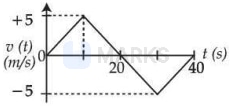 JEE Main/MCQ/Medium/Graphs of motion in one dimension/With diagram
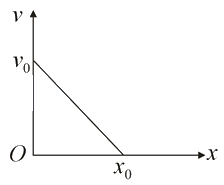
- 82The velocity - Distance graph is shown in figure. Which graph represents acceleration versus distance variation of this system?
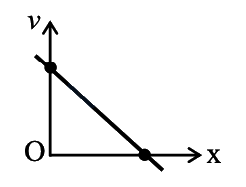 JEE Main/MCQ/Medium/Graphs of motion in one dimension/With diagram
- 83The displacement x versus time graph is shown below.
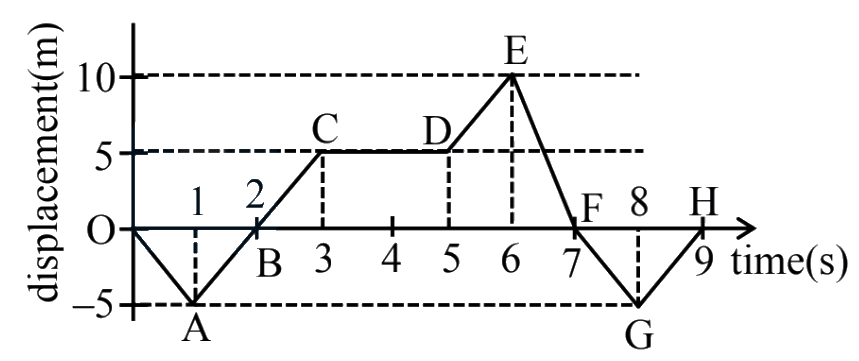
(A) The average velocity during 0 to 3 s is
(B) The average velocity during 3 to 5 s is
(C) The instantaneous velocity at is
(D) The average velocity during 5 to 7 s and instantaneous velocity at are equal
(E) The average velocity from to is zero
Choose the correct answer from the options given below:JEE Main/MCQ/Medium/Graphs of motion in one dimension/With diagram - 84Which of the following curves possibly represent one-dimensional motion of a particle?
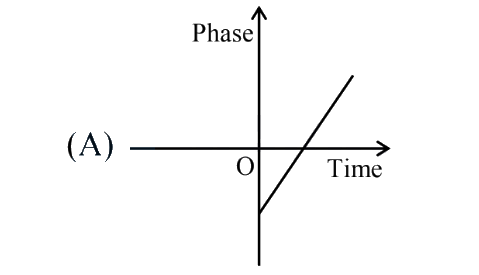
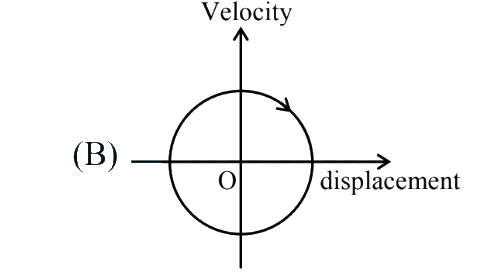
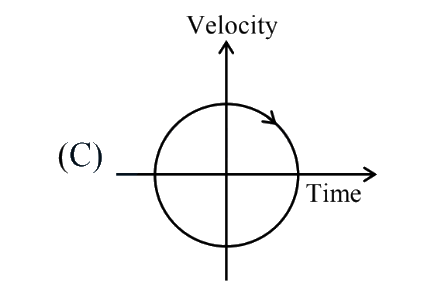
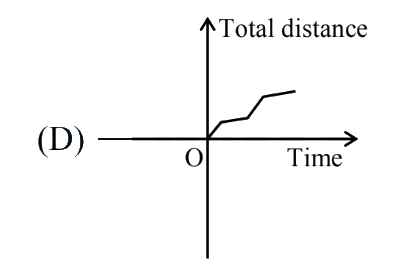
Choose the correct answer from the options given below :JEE Main/MCQ/Medium/Graphs of motion in one dimension/With diagram - 85The velocity-time graph of an object moving along a straight line is shown in figure. What is the distance covered by the object between to ?
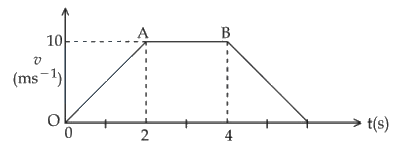 JEE Main/MCQ/Medium/Graphs of motion in one dimension/With diagram
- 86The motion of an airplane is represented by velocity-time graph as shown below. The distance covered by airplane in the first 30.5 second is _______ km .
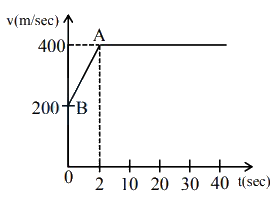 JEE Main/MCQ/Medium/Graphs of motion in one dimension/With diagram
- 87A small steel ball is dropped into a long cylinder containing glycerine. Which one of the following is the correct representation of the velocity time graph for the transit of the ball?JEE Main/MCQ/Medium/Graphs of motion in one dimension
- 88Form the graph shown, the ratio of distance to displacement in of motion is:
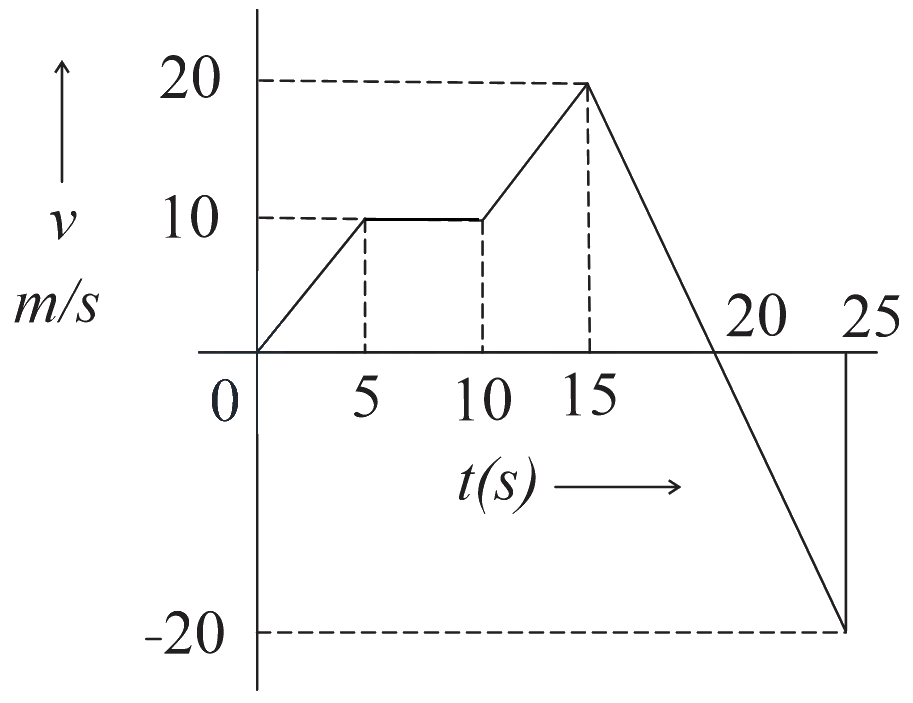 JEE Main/MCQ/Medium/Graphs of motion in one dimension/With diagram
- 89The position-time graphs for two students and returning from the school to their homes are shown in figure.
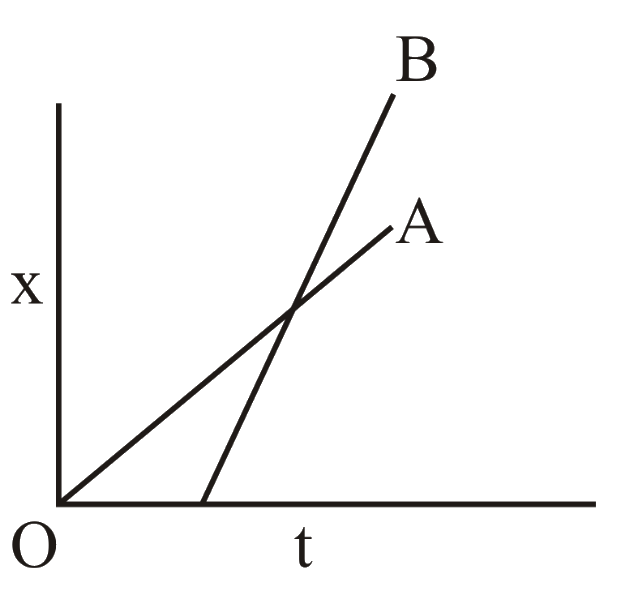
(A) lives closer to the school
(B) lives closer to the school
(C) takes lesser time to reach home
(D) travels faster than
(E) travels faster than
Choose the correct answer from the options given belowJEE Main/MCQ/Medium/Graphs of motion in one dimension/With diagram - 90Given below are two statements:
Statement I: Area under velocity-time graph gives the distance travelled by the body in a given time.
Statement II: Area under acceleration-time graph is equal to the change in velocity in the given time.
In the light of given statements, choose the correct answer from the options given below.JEE Main/MCQ/Medium/Graphs of motion in one dimension - 91Match Column-I with Column-II : Column-I (x-t graphs) Column-II (v-t graphs) A
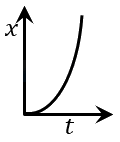 I
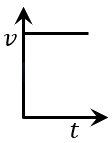 B
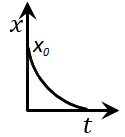 II
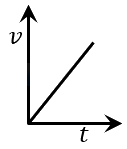 C
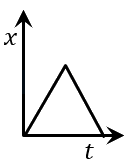 III
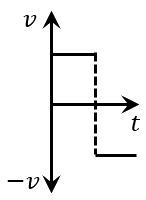 D
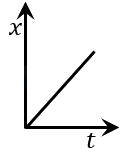 IV
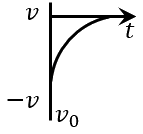 Choose the correct answer from the options given below:JEE Main/MCQ/Medium/Graphs of motion in one dimension/With diagram
- 92The velocity-time graph of a body moving in a straight line is shown in figure.
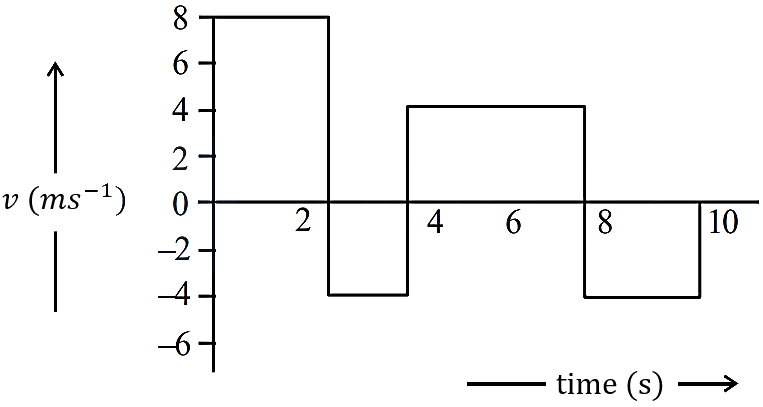 The ratio of displacement and distance travelled by the body in time to isJEE Main/MCQ/Medium/Graphs of motion in one dimension/With diagram
- 93A bullet is shot vertically downwards with an initial velocity of from a certain height. Within , the bullet reaches the ground and instantaneously comes to rest due to the perfectly inelastic collision. The velocity-time curve for total time will be : (Take )JEE Main/MCQ/Medium/Graphs of motion in one dimension
- 94An object of mass is being moved with a constant velocity under the action of an applied force of along a frictionless surface with following surface profile.
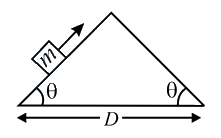
The correct applied force vs distance graph will be :JEE Main/MCQ/Medium/Graphs of motion in one dimension/With diagram - 95A particle is moving with constant acceleration Following graph shows versus (displacement) plot. The acceleration of the particle is _________
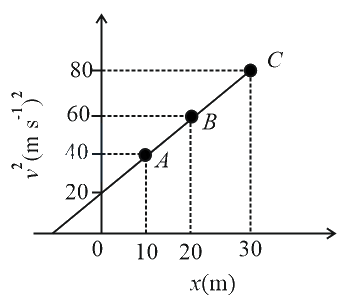 JEE Main/Numerical/Medium/Graphs of motion in one dimension/With diagram
- 96The velocity-displacement graph of a particle is shown in the figure.
The acceleration-displacement graph of the same particle is represented by :JEE Main/MCQ/Medium/Graphs of motion in one dimension/With diagram - 97The position, velocity and acceleration of a particle moving with a constant acceleration can be represented by :JEE Main/MCQ/Medium/Graphs of motion in one dimension
- 98A car accelerates from rest at a constant rate for some time after which it decelerates at a constant rate to come to rest. If the total time elapsed is t seconds, the total distance travelled is:JEE Main/MCQ/Medium/Graphs of motion in one dimension
- 99The velocity-displacement graph describing the motion of a bicycle is shown in the figure.
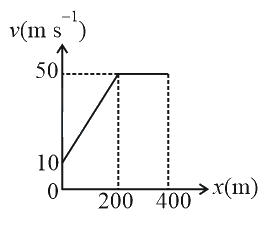
The acceleration-displacement graph of the bicycle's motion is best described by :JEE Main/MCQ/Medium/Graphs of motion in one dimension/With diagram - 100If the velocity-time graph has the shape what would be the shape of the corresponding acceleration-time graph?
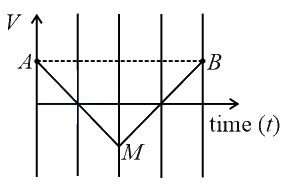 JEE Main/MCQ/Medium/Graphs of motion in one dimension/With diagram
- 101The velocity and time graph of a body in a straight line motion is shown in the figure. The point is at seconds. The total distance covered by the body in is :
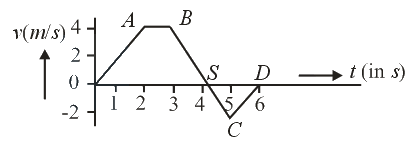 JEE Main/MCQ/Medium/Graphs of motion in one dimension/With diagram
- 102The speed verses time graph for a particle is shown in the figure. The distance travelled (in ) by the particle during the time interval to will be __________
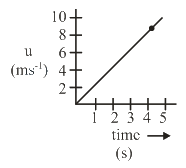 JEE Main/Numerical/Medium/Graphs of motion in one dimension/With diagram
- 103A particle is moving unidirectional on a horizontal plane under the action of a constant power supplying energy source. The displacement (s) – time (t) graph that describes the motion of the particle is (graphs are drawn schematically and are not to scale):JEE Main/MCQ/Medium/Graphs of motion in one dimension
- 104A particle starts from origin from rest and moves with a uniform acceleration along the positive . Identify all figures that correctly represent the motion qualitatively.
( acceleration, velocity, dispalcement, time)
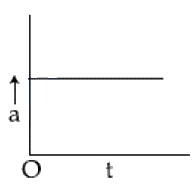
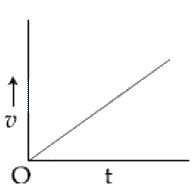
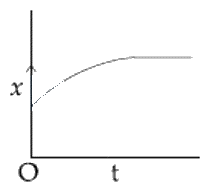
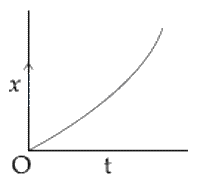 JEE Main/MCQ/Medium/Graphs of motion in one dimension/With diagram
- 105A particle starts from the origin at time and moves along the positive axis. The graph of velocity with respect to time is shown in figure. What is the position of the particle at time
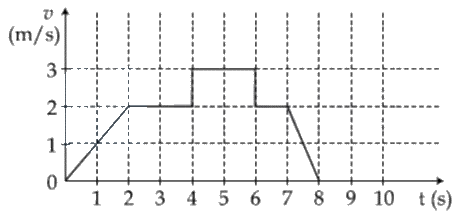 JEE Main/MCQ/Medium/Graphs of motion in one dimension/With diagram
- 106The velocity time graphs of a car and a scooter are shown in the figure. (i) The difference between the distance travelled by the car and the scooter in 15 s and (ii) the time at which the car will catch up with the scooter are, respectively.
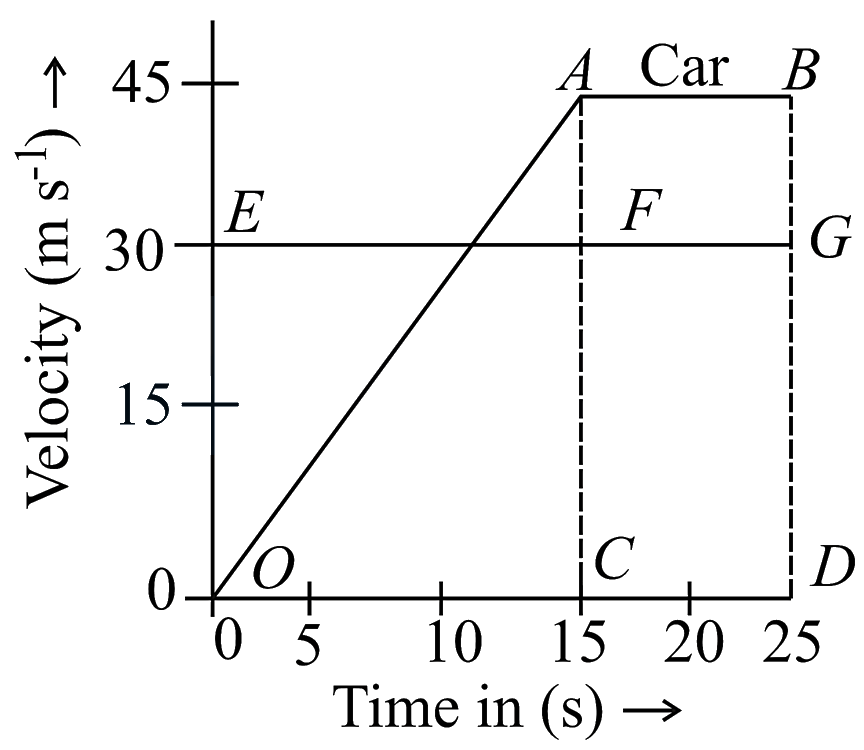 JEE Main/MCQ/Medium/Graphs of motion in one dimension/With diagram
- 107The velocity-time graphs of a car and a scooter are shown in the figure. (i) the difference between the distance travelled by the car and the scooter in and (ii) the time at which the car will catch up with the scooter are, respectively
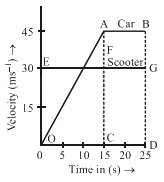 JEE Main/MCQ/Medium/Graphs of motion in one dimension/With diagram
- 108All the graphs below are intended to represent the same motion. One of them does it incorrectly. Pick it up.JEE Main/MCQ/Medium/Graphs of motion in one dimension
- 109Which graph corresponds to an object moving with a constant negative acceleration and a positive velocity?JEE Main/MCQ/Medium/Graphs of motion in one dimension
- 110A body is thrown vertically upwards. Which one of the following graphs correctly represents the velocity vs time ?JEE Main/MCQ/Medium/Graphs of motion in one dimension
- 111Two stones are thrown up simultaneously from the edge of a cliff high with an initial speed of and respectively. Which of the following graph best represents the time variation of the relative position of the second stone with respect to the first? (Assume stones do not rebound after hitting the ground and neglect air resistance, take )(the figure are schematic and not drawn to scale)JEE Main/MCQ/Medium/Graphs of motion in one dimension
- 112A block is placed on a rough horizontal plane. A time dependent horizontal force acts on the block, where is a positive constant. The acceleration - time graph of the block is :JEE Main/MCQ/Medium/Graphs of motion in one dimension
- 113A ball is dropped vertically downwards from a height above the ground. It hits the ground inelastically and bounces up vertically. Neglecting subsequent motion and air resistance, which of the following graph represents variation between speed and height correctly?JEE Main/MCQ/Medium/Graphs of motion in one dimension
- 114The distance travelled by a body moving along a line in time is proportional to .
The acceleration-time graph for the motion of the body will beJEE Main/MCQ/Medium/Graphs of motion in one dimension - 115The graph of an object's motion (along the axis) is shown in the figure. The instantaneous velocity of the object at points and are and respectively. Then
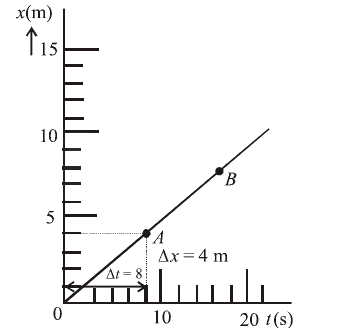 JEE Main/MCQ/Medium/Graphs of motion in one dimension/With diagram
- 116A body is at rest at . At , it starts moving in the positive -direction with a constant acceleration. At the same instant another body passes through moving in the positive direction with a constant speed. The position of the first body is given by after time ' ' and that of the second body by after the same time interval. Which of the following graphs correctly describes as a function of time ' '?JEE Main/MCQ/Medium/Graphs of motion in one dimension
- 117A car starting from rest accelerates at the rate through a distance , then continues at constant speed for time and then decelerates at the rate to come to rest. If the total distance traversed is , thenJEE Main/MCQ/Medium/Graphs of motion in one dimension
- 118Two masses of kg and kg are accelerated from an initial speed of m/s and m/s, respectively. The distances traversed by the masses in the second are m and m, respectively. The ratio of their momenta after s is . The value of is ________.JEE Main/Numerical/Medium/Non-uniform Motion
- 119The velocity of a particle is given as m/s. The magnitude of acceleration at point is _______ m/s.JEE Main/MCQ/Medium/Non-uniform Motion
- 120A particle starts moving from time and its coordinate is given as
A. The particle returns to its original position (origin) 0.866 units later
B. The particle is 1 unit away from origin at its turning point
C. Acceleration of the particle is non-negative
D. The particle is 0.5 units away from origin at its turning point
E. Particle never turns back as acceleration is non-negative
Choose the correct answer from the options given below :JEE Main/MCQ/Medium/Non-uniform Motion - 121A body of mass 2 kg moving with velocity of enters into a constant force field of 6 N directed along positive z -axis. If the body remains in the field for a period of seconds, then velocity of the body when it emerges from force field isJEE Main/MCQ/Medium/Non-uniform Motion
- 122A particle moves along the -axis and has its displacement varying with time according to the equation where and are constants of appropriate dimensions. Then, which of the following statements is correct?JEE Main/MCQ/Medium/Non-uniform Motion
- 123A body moves on a frictionless plane starting from rest. If is distance moved between and and is distance moved between and , then the ratio is for . The value of is ______.JEE Main/Numerical/Medium/Non-uniform Motion
- 124A particle initially at rest starts moving from reference point along -axis, with velocity that varies as . The acceleration of the particle is _____ .JEE Main/Numerical/Medium/Non-uniform Motion
- 125A particle of mass moves in a straight line with retardation where is the displacement in units. Its loss of kinetic energy for above displacement is The value of will be ________.JEE Main/Numerical/Medium/Non-uniform Motion
- 126The distance travelled by a particle is related to time as . The velocity of the particle at isJEE Main/MCQ/Medium/Non-uniform Motion
- 127If , then is:JEE Main/MCQ/Medium/Non-uniform Motion
- 128A particle is moving in a straight line such that its velocity is increasing at per meter. The acceleration of the particle is _____ at a point where its velocity is .JEE Main/Numerical/Medium/Non-uniform Motion
- 129An object is thrown vertically upwards. At its maximum height, which of the following quantity becomes zero ?JEE Main/MCQ/Medium/Non-uniform Motion
- 130A small ball of mass is thrown upward with velocity from the ground. The ball experiences a resistive force where is it speed. The maximum height attained by the ball is :JEE Main/MCQ/Medium/Non-uniform Motion
- 131A particle of charge and mass is subjected to an electric field in the direction, where a and are constants. Initially the particle was at rest at . Other than the initial position the kinetic energy of the particle becomes zero when the distance of the particle from the origin is :JEE Main/MCQ/Medium/Non-uniform Motion
- 132The distance covered by a paritcle in one dimensional motion varies with time as . If the acceleration of the particle depends on as , where is an integer, the value of is _________JEE Main/Numerical/Medium/Non-uniform Motion
- 133A particle is moving with speed along positive axis. Calculate the speed of the particle at time (assume that the particle is at origin at )JEE Main/MCQ/Medium/Non-uniform Motion
- 134The position of a particle as a function of time is given by where and are constants. When the particles zero acceleration, then its velocity will be:JEE Main/MCQ/Medium/Non-uniform Motion
- 135An object, moving with a speed of , is decelerated at a rate given by :
where is the instantaneous speed. The time taken by the object, to come to rest, would be:JEE Main/MCQ/Medium/Non-uniform Motion - 136The velocity of a particle is . If its position is at , then its displacement after unit time isJEE Main/MCQ/Medium/Non-uniform Motion
- 137A particle located at at time , starts moving along the positive -direction with a velocity ' ' that varies as . The displacement of the particle varies with time asJEE Main/MCQ/Medium/Non-uniform Motion
- 138The relation between time and distance is where and are constants. The acceleration isJEE Main/MCQ/Medium/Non-uniform Motion
- 139The co-ordinates of a moving particle at any time ' ' are given by and . The speed of the particle at time ' ' is given byJEE Main/MCQ/Medium/Non-uniform Motion
- 140Two cars and are moving in the same direction along a straight line with speeds km/h and km/h, respectively such that car is moving ahead of car . A person in car throws a stone with a speed so that it hits the car with a speed of m/s. The value of is ______ km/h.JEE Main/MCQ/Medium/Relative Motion
- 141The maximum speed of a boat in still water is \(27 \mathrm{~km} / \mathrm{h}\). Now this boat is moving downstream in a river flowing at \(9 \mathrm{~km} / \mathrm{h}\). A man in the boat throws a ball vertically upwards with speed of \(10 \mathrm{~m} / \mathrm{s}\). Range of the ball as observed by an observer at rest on the river bank, is _______ cm. (Take \(\mathrm{g}=10 \mathrm{~m} / \mathrm{s}^2\))JEE Main/Numerical/Medium/Relative Motion
- 142Two cars are travelling towards each other at speed of each. When the cars are apart, both the drivers apply brakes and the cars retard at the rate of . The distance between them when they come to rest is :JEE Main/MCQ/Medium/Relative Motion
- 143Train A is moving along two parallel rail tracks towards north with and train is moving towards south with speed . Velocity of train with respect to and velocity of ground with respect to are (in ):JEE Main/MCQ/Medium/Relative Motion
- 144A passenger sitting in a train A moving at observes another train B moving in the opposite direction for . If the velocity of the train B is , then length of train B is:JEE Main/MCQ/Medium/Relative Motion
- 145Two trains and of length and are travelling into a tunnel of length in parallel tracks from opposite directions with velocities and respectively. If train take less time than train to cross the tunnel then, length of tunnel is:
(Given )JEE Main/MCQ/Medium/Relative Motion - 146Train and train are running on parallel tracks in the opposite directions with speed of and , respectively. A person is walking in train in the direction opposite to its motion with a speed of . Speed of this person as observed from train will be close to: (take the distance between the tracks as negligible)JEE Main/MCQ/Medium/Relative Motion
- 147A particle is moving along the -axis with its coordinate with time given by Another particle is moving along the -axis with its coordinate as a function of time given by At the speed of the second particle as measured in the frame of the first particle is given as Then is ___________.JEE Main/Numerical/Medium/Relative Motion
- 148A car is standing behind a bus, which is also at rest. The two start moving at the same instant but with different forward accelerations. The bus has acceleration and the car has acceleration . The car will catch up with the bus after time :JEE Main/MCQ/Medium/Relative Motion
- 149A person climbs up a stalled escalator in . If standing on the same but escalator running with constant velocity he takes . How much time is taken by the person to walk up the moving escalator?JEE Main/MCQ/Medium/Relative Motion
- 150Two particles start simultaneously from the same point and move along two straight lines, one with uniform velocity and the other from rest with uniform acceleration . Let be the angle between their directions of motion. The relative velocity of the second particle w.r.t. the first is least after a time.JEE Main/MCQ/Medium/Relative Motion
- 151A gas balloon is going up with a constant velocity of m/s. When this balloon reached a height of m, a stone is dropped from it and balloon keeps moving up with the same velocity. The height of the balloon when the stone hits the ground is ________ m. (Take m/s)JEE Main/MCQ/Medium/Motion Under Gravity
- 152From m height above the ground a ball is dropped from rest. The height above the ground at which the magnitude of velocity equal to the magnitude of acceleration (in the same set of units) due to gravity is _____ m.
(Take m/s and neglect the air resistance)JEE Main/Numerical/Medium/Motion Under Gravity - 153Water drops fall from a tap on the floor, 5 m below, at regular intervals of time, the first drop strikes the floor when the sixth drop begins to fall. The height at which the fourth drop will be from ground, at the instant when the first drop strikes the ground is m.
JEE Main/MCQ/Medium/Motion Under Gravity - 154A helicopter flying horizontally with a speed of at an altitude of 2 km , drops an object at an instant. The object hits the ground at a point O , 20 s after it is dropped. Displacement of ' O ' from the position of helicopter where the object was released is :
(use acceleration due to gravity and neglect air resistance)JEE Main/MCQ/Medium/Motion Under Gravity - 155A body projected vertically upwards with a certain speed from the top of a tower reaches the ground in . If it is projected vertically downwards from the same point with the same speed, it reaches the ground in . Time required to reach the ground, if it is dropped from the top of the tower, is :JEE Main/MCQ/Medium/Motion Under Gravity
- 156A body falling under gravity covers two points and separated by in . The distance of upper point from the starting point is _____. Use JEE Main/Numerical/Medium/Motion Under Gravity
- 157An object is allowed to fall from a height above the earth, where is the radius of earth. Its velocity when it strikes the earth’s surface, ignoring air resistance, will be :JEE Main/MCQ/Medium/Motion Under Gravity
- 158A tennis ball is dropped on to the floor from a height of . It rebounds to a height . Ball comes in contact with the floor for . The average acceleration during contact is ______ . [Given ]JEE Main/Numerical/Medium/Motion Under Gravity
- 159A ball is released from a height . If and be the time required to complete first half and second half of the distance respectively. Then, choose the correct relation between and .JEE Main/MCQ/Medium/Motion Under Gravity
- 160A juggler throws balls vertically upwards with same initial velocity in air. When the first ball reaches its highest position, he throws the next ball. Assuming the juggler throws balls per second, the maximum height the balls can reach isJEE Main/MCQ/Medium/Motion Under Gravity
- 161A ball is thrown up vertically with a certain velocity so that, it reaches a maximum height . Find the ratio of the times in which it is at height while going up and coming down respectively.JEE Main/MCQ/Medium/Motion Under Gravity
- 162A ball is thrown vertically upwards with a velocity of from the top of a tower. The ball strikes the ground after . The height from the ground up to which the ball can rise will be . The value of is _____ (use )JEE Main/Numerical/Medium/Motion Under Gravity
- 163A NCC parade is going at a uniform speed of under a mango tree on which a monkey is sitting at a height of . At any particular instant, the monkey drops a mango. A cadet will receive the mango whose distance from the tree at time of drop is :
(Given )JEE Main/MCQ/Medium/Motion Under Gravity - 164Two balls and are placed at the top of tall tower. Ball is released from the top at . Ball is thrown vertically down with an initial velocity at . After a certain time, both balls meet above the ground. Find the value of in . [use ]JEE Main/MCQ/Medium/Motion Under Gravity
- 165Motion of a particle in plane is described by a set of following equations and . The path of the particle will beJEE Main/MCQ/Medium/Motion Under Gravity
- 166When a ball is dropped into a lake from a height above the water level, it hits the water with a velocity and then sinks to the bottom with the constant velocity . It reaches the bottom of the lake after it is dropped. The approximate depth of the lake isJEE Main/MCQ/Medium/Motion Under Gravity
- 167A ball is projected vertically upward with an initial velocity of at . At , another ball is projected vertically upward with same velocity. At ____, second ball will meet the first ball .JEE Main/Numerical/Medium/Motion Under Gravity
- 168A ball of mass is dropped from the height of . The height, at which the magnitude of velocity becomes equal to the magnitude of acceleration due to gravity, is _____ . [Use ]JEE Main/Numerical/Medium/Motion Under Gravity
- 169A person is standing in an elevator. In which situation, he experiences weight loss ?JEE Main/MCQ/Medium/Motion Under Gravity
- 170An object of mass is thrown vertically upwards from the ground. The air resistance produces a constant retarding force of throughout the motion. The ratio of time of ascent to the time of descent will be equal to : [Use ].JEE Main/MCQ/Medium/Motion Under Gravity
- 171From the top of a tower, a ball is thrown vertically upward which reaches the ground in . A second ball thrown vertically downward from the same position with the same speed reaches the ground in . A third ball released, from the rest from the same location, will reach the ground in _____ s.JEE Main/Numerical/Medium/Motion Under Gravity
- 172Water drops are falling from a nozzle of a shower onto the floor from a height of . The drops fall at a regular interval of time. When the first drop strikes the floor, at that instant, the third drop begins to fall. Locate the position of second drop from the floor when the first drop strikes the floor.JEE Main/MCQ/Medium/Motion Under Gravity
- 173A ball is thrown up with a certain velocity so that it reaches a height Find the ratio of the two different times of the ball reaching in both the directions.JEE Main/MCQ/Medium/Motion Under Gravity
- 174A balloon was moving upwards with a uniform velocity of . An object of finite mass is dropped from the balloon when it was at a height of from the ground level. The height of the balloon from the ground when object strikes the ground was around: (takes the value of as )JEE Main/MCQ/Medium/Motion Under Gravity
- 175Water droplets are coming from an open tap at a particular rate. The spacing between a droplet observed at second after its fall to the next droplet is . At what rate the droplets are coming from the tap ? (Take )JEE Main/MCQ/Medium/Motion Under Gravity
- 176A person standing on a spring balance inside a stationary lift measures . The weight of that person if the lift descends with uniform downward acceleration of will be . JEE Main/Numerical/Medium/Motion Under Gravity
- 177A tennis ball is released from a height and after freely falling on a wooden floor it rebounds and reaches height . The velocity versus height of the ball during its motion may be represented graphically by: (graphs are drawn schematically and on not to scale)JEE Main/MCQ/Medium/Motion Under Gravity
- 178An elevator in a building can carry a maximum of persons, with the average mass of each person being . The mass of the elevator itself is and it moves with a constant speed of . The frictional force opposing the motion is . If the elevator is moving up with its full capacity, the power delivered by the motor to the elevator must be at least:JEE Main/MCQ/Medium/Motion Under Gravity
- 179From a tower of height H, a particle is thrown vertically upwards with a speed u. The time taken by the particle, to hit the ground, is n times that taken by it to reach the highest point of its path.The relation between H, u and n is :JEE Main/MCQ/Medium/Motion Under Gravity
- 180A parachutist after bailing out falls without friction. When parachute opens, it decelerates at . He reaches the ground with a speed of . At what height, did he bail out?JEE Main/MCQ/Medium/Motion Under Gravity
- 181A ball is released from the top of a tower of height metres. It takes seconds to reach the ground. What is the position of the ball in seconds?JEE Main/MCQ/Medium/Motion Under Gravity
- 182A river of width 200 m is flowing from west to east with a speed of . A boat, moving with speed of in still water, is made to travel one-round trip (bank to bank of the river). Minimum time taken by the boat for this journey and also the displacement along the river bank are and respectively.JEE Main/MCQ/Medium/Relative motion
- 183A river is flowing from west to east direction with speed of . If a boat capable of moving at a maximum speed of in still water, crosses the river in half a minute, while moving with maximum speed at an angle of to direction of river flow, then the width of the river is :JEE Main/MCQ/Medium/Relative motion
- 184The position vector of a moving body at any instant of time is given as . The magnitude and direction of velocity at is,JEE Main/MCQ/Medium/Relative motion
- 185The speed of a swimmer is in still water. If the swimmer makes his strokes normal to the flow of river of width , he reaches a point down the stream on the opposite bank. The speed of the river water is ______ .JEE Main/Numerical/Medium/Relative motion
- 186At time a particle starts travelling from a height in a plane keeping coordinate constant. At any instant of time, it's position along the and directions are defined as and respectively. At acceleration of the particle will beJEE Main/MCQ/Medium/Relative motion
- 187A girl standing on road holds her umbrella at with the vertical to keep the rain away. If she starts running without umbrella with a speed of , the rain drops hit her head vertically. The speed of rain drops with respect to the moving girl isJEE Main/MCQ/Medium/Relative motion
- 188A swimmer wants to cross a river from point to point . Line AB makes an angle of with the flow of the river. The magnitude of the velocity of the swimmer is the same as that of the river. The angle with the line should be _______, so that the swimmer reaches point .
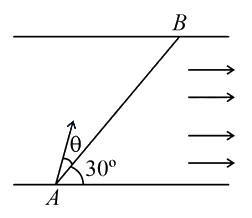 JEE Main/Numerical/Medium/Relative motion/With diagram
- 189A boy reaches the airport and finds that the escalator is not working. He walks up the stationary escalator in time If he remains stationary on a moving escalator then the escalator takes him up in time The time taken by him to walk up on the moving escalator will be:JEE Main/MCQ/Medium/Relative motion
- 190A butterfly is flying with a velocity in north-east direction. Wind is slowly blowing at from north to south. The resultant displacement of the butterfly in seconds is:JEE Main/MCQ/Medium/Relative motion
- 191A person is swimming with a speed of at an angle of with the flow and reaches to a point directly opposite on the other side of the river. The speed of the flow is The value of to the nearest integer is ______.JEE Main/Numerical/Medium/Relative motion
- 192A swimmer can swim with velocity of in still water. Water flowing in a river has velocity . The direction with respect to the direction of flow of river water he should swim in order to reach the point on the other bank just opposite to his starting point is ________.
(Round off to the Nearest Integer) (find the angle in degree)JEE Main/Numerical/Medium/Relative motion - 193The stream of a river is flowing with a speed of . A swimmer can swim at a speed of . The direction of the swimmer with respect to the flow of the river, to cross the river straight, isJEE Main/MCQ/Medium/Relative motion
- 194Two particles are moving on two concentric circles of radii and with equal angular speed At their positions and direction of motion are shown in the figure:
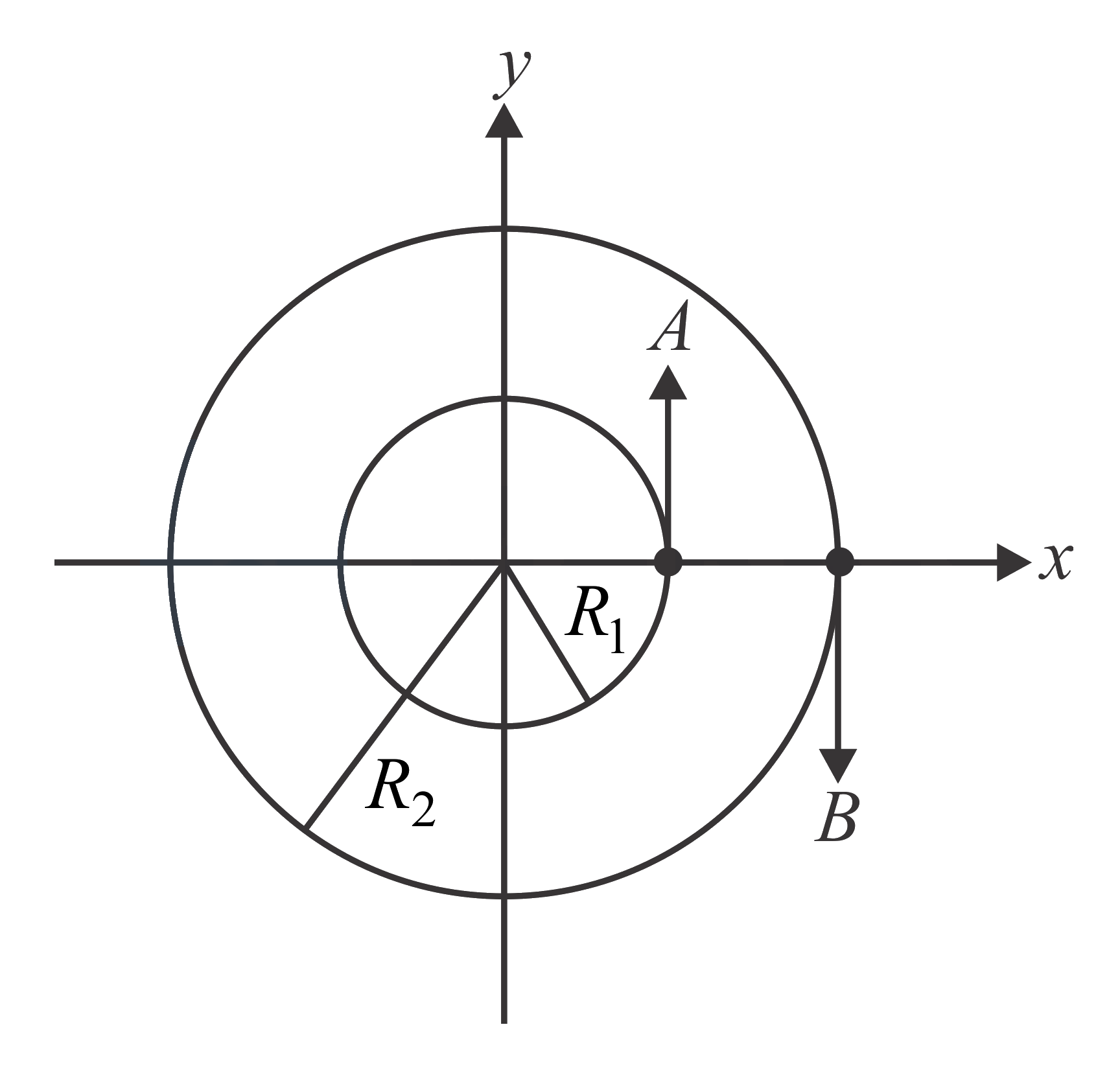
The relative velocity at is given by:JEE Main/MCQ/Medium/Relative motion/With diagram - 195A passenger train of length travels at a speed of . Another freight train of length travels at a speed of . The ratio of times taken by the passenger train to completely cross the freight train when: (i) they are moving in the same direction, and (ii) in the opposite directions is:JEE Main/MCQ/Medium/Relative motion
- 196In a car race on straight road, car takes a time less than car at the finish and passes finishing point with a speed more than that of car Both the cars start from rest and travel with constant acceleration and respectively. Then is equal to:JEE Main/MCQ/Medium/Relative motion
- 197A man in a car at location Q on a straight highway is moving with speed . He decides to reach a point in a field at a distance from highway (point ) as shown in the figure.Speed of the car in the field is half to that on the highway. What should be the distance RM, so that the time taken to reach is minimum?
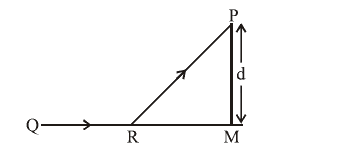 JEE Main/MCQ/Medium/Relative motion/With diagram
- 198Two identical bodies, projected with the same speed at two different angles cover the same horizontal range . If the time of flight of these bodies are s and s, respectively, then the value of is ________ m. (Take m/s)JEE Main/MCQ/Medium/Projectile motion
- 199A gun mounted on the ground fires bullets in all directions with same speed. The farthest distance the bullets could reach is m. The speed of the bullets from the gun is ______ m/s.
(take m/s)JEE Main/Numerical/Medium/Projectile motion - 200If and coordinates of a projectile as a function of time are given as and , respectively, then the angle (in degrees) made by the projectile with horizontal when s is ______.JEE Main/MCQ/Medium/Projectile motion
- 201Two projectiles are projected with the same initial velocities at the and with respect to the horizontal. The ratio of their ranges is . The value of is:JEE Main/MCQ/Medium/Projectile motion
- 202A boy throws a ball into air at from the horizontal to land it on a roof of a building of height . If the ball attains maximum height in 2 s and lands on the building in 3 s after launch, then value of is m.
JEE Main/MCQ/Medium/Projectile motion - 203An object is projected with kinetic energy from a point at an angle with the horizontal. The ratio of the difference in kinetic energies at points and to that at point (see figure), in the absence of air friction is :
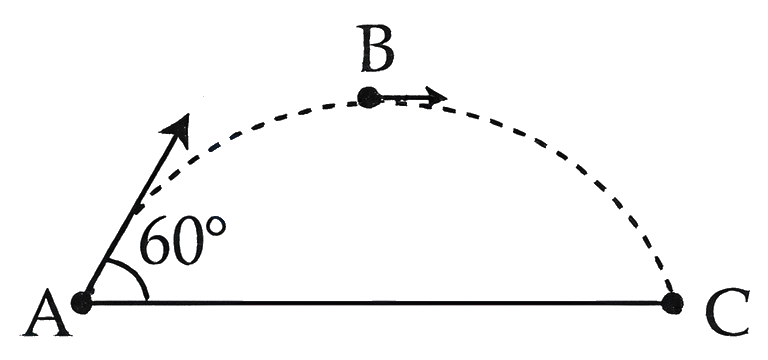 JEE Main/MCQ/Medium/Projectile motion/With diagram
- 204A projectile is thrown upward at an angle with the horizontal. The speed of the projectile is when its direction of motion is with the horizontal. The initial speed of the projectile is .JEE Main/MCQ/Medium/Projectile motion
- 205Two balls with same mass and initial velocity, are projected at different angles in such a way that maximum height reached by first ball is 8 times higher than that of the second ball. and are the total flying times of first and second ball, respectively, then the ratio of and is :JEE Main/MCQ/Medium/Projectile motion
- 206Two projectiles are fired from ground with same initial speeds from same point at angles and with horizontal direction. The ratio of their times of flights isJEE Main/MCQ/Medium/Projectile motion
- 207A particle is projected with velocity so that its horizontal range is three times the maximum height attained by it. The horizontal range of the projectile is given as , where value of is : (Given ' ' is the acceleration due to gravity).JEE Main/MCQ/Medium/Projectile motion
- 208The angle of projection of a particle is measured from the vertical axis as and the maximum height reached by the particle is . Here as function of can be presented asJEE Main/MCQ/Medium/Projectile motion
- 209Two projectiles are fired with same initial speed from same point on ground at angles of \(\left(45^{\circ}-\alpha\right)\) and \(\left(45^{\circ}+\alpha\right)\), respectively, with the horizontal direction. The ratio of their maximum heights attained is :JEE Main/MCQ/Medium/Projectile motion
- 210A ball of mass 100 g is projected with velocity at with horizontal. The decrease in kinetic energy of the ball during the motion from point of projection to highest point isJEE Main/MCQ/Medium/Projectile motion
- 211A particle is projected at an angle of from horizontal at a speed of . The height traversed by the particle in the first second is and height traversed in the last second, before it reaches the maximum height, is . The ratio is _________
[Take, ]JEE Main/Numerical/Medium/Projectile motion - 212A body of mass thrown horizontally with velocity from the top of the tower of height touches the ground at a distance of from the foot of the tower. A body of mass thrown at a velocity from the top of the tower of height will touch the ground at a distance of _____.JEE Main/Numerical/Medium/Projectile motion
- 213The angle of projection for a projectile to have same horizontal range and maximum height is :JEE Main/MCQ/Medium/Projectile motion
- 214The maximum height reached by a projectile is . If the initial velocity is halved, the new maximum height of the projectile is _____ .JEE Main/Numerical/Medium/Projectile motion
- 215The co-ordinates of a particle moving in plane are given by : .
The motion of the particle is :JEE Main/MCQ/Medium/Projectile motion - 216A particle moving in a circle of radius with uniform speed takes time to complete one revolution. If this particle is projected with the same speed at an angle to the horizontal, the maximum height attained by it is equal to . The angle of projection is then given by :JEE Main/MCQ/Medium/Projectile motion
- 217A body starts falling freely from height hits an inclined plane in its path at height . As a result of this perfectly elastic impact, the direction of the velocity of the body becomes horizontal. The value of for which the body will take the maximum time to reach the ground is _____.JEE Main/Numerical/Medium/Projectile motion
- 218Projectiles and are thrown at angles of and with vertical respectively from top of a high tower. If their times of flight are same, the ratio of their speeds of projection is:JEE Main/MCQ/Medium/Projectile motion
- 219A particle of mass projected with a velocity making an angle of with the horizontal. The magnitude of angular momentum of the projectile about the point of projection when the particle is at its maximum height is :JEE Main/MCQ/Medium/Projectile motion
- 220A ball rolls off the top of a stairway with horizontal velocity . The steps are high and wide. The minimum velocity with which that ball just hits the step of the stairway will be , where _______ [use ].JEE Main/Numerical/Medium/Projectile motion
- 221A projectile is projected at from horizontal with initial velocity . The velocity of the projectile at from the start will be:JEE Main/MCQ/Medium/Projectile motion
- 222A projectile fired at to the ground is observed to be at same height at time and after projection, during its flight. The speed of projection of the projectile is .
(Given )JEE Main/Numerical/Medium/Projectile motion - 223Two projectiles are projected at and with the horizontal with the same speed. The ratio of the maximum height attained by the two projectiles respectively is:JEE Main/MCQ/Medium/Projectile motion
- 224The range of the projectile projected at an angle of with horizontal is . If the projectile is projected with same velocity at an angle of with horizontal, then its range will beJEE Main/MCQ/Medium/Projectile motion
- 225The trajectory of projectile, projected from the ground is given by . Where and are measured in meter. The maximum height attained by the projectile will be.JEE Main/MCQ/Medium/Projectile motion
- 226Two projectiles and are thrown with initial velocities of and at angles and with the horizontal respectively. The ratio of their ranges respectively is JEE Main/MCQ/Medium/Projectile motion
- 227Given below are two statements: one is labelled as Assertion and the other is labelled as Reason
Assertion A: When a body is projected at an angle its range is maximum.
Reason R: For maximum range, the value of sin should be equal to one.
In the light of the above statements, choose the correct answer from the options given below:JEE Main/MCQ/Medium/Projectile motion - 228A child stands on the edge of the cliff above the ground and throws a stone horizontally with an initial speed of . Neglecting the air resistance, the speed with which the stone hits the ground will be _____ (given, ).JEE Main/MCQ/Medium/Projectile motion
- 229Two bodies are projected from ground with same speeds at two different angles with respect to horizontal. The bodies were found to have same range. If one of the body was projected at an angle of , with horizontal then sum of the maximum heights, attained by the two projectiles, is _____ . (Given )JEE Main/Numerical/Medium/Projectile motion
- 230The initial speed of a projectile fired from ground is . At the highest point during its motion, the speed of projectile is . The time of flight of the projectile is:JEE Main/MCQ/Medium/Projectile motion
- 231A particle of mass is projected at time with a speed at an angle to the horizontal as given in the figure. The magnitude of the angular momentum of the particle about the starting point at time is found to be . The value of is ______.
(Take )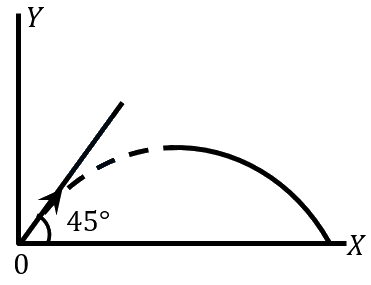 JEE Main/Numerical/Medium/Projectile motion/With diagram
- 232A stone is projected at angle to the horizontal. The ratio of kinetic energy of the stone at point of projection to its kinetic energy at the highest point of flight will be :JEE Main/MCQ/Medium/Projectile motion
- 233Two objects are projected with same velocity however at different angles and with the horizontal. If , the ratio of horizontal range of the first object to the object will be :JEE Main/MCQ/Medium/Projectile motion
- 234The maximum vertical height to which a man can throw a ball is . The maximum horizontal distance upto which he can throw the same ball isJEE Main/MCQ/Medium/Projectile motion
- 235An object is projected in the air with initial velocity at an angle . The projectile motion is such that the horizontal range , is maximum. Another object is projected in the air with a horizontal range half of the range of first object. The initial velocity remains same in both the case. The value of the angle of projection, at which the second object is projected, will be _____ degree.JEE Main/Numerical/Medium/Projectile motion
- 236A ball is projected with kinetic energy , at an angle of to the horizontal. The kinetic energy of this ball at the highest point of its flight will become :JEE Main/MCQ/Medium/Projectile motion
- 237A body of mass is projected at an angle of with the horizontal. The trajectory of the body is observed to pass through a point . If is the time of flight, then its momentum vector, at time , is _____ .
[Take ]JEE Main/MCQ/Medium/Projectile motion - 238A ball of mass is thrown vertically upward. Another ball of mass is thrown an angle with the vertical. Both the balls stay in air for the same period of time. The ratio of the heights attained by the two balls respectively is . The value of is _____ .JEE Main/Numerical/Medium/Projectile motion
- 239Two projectiles are thrown with same initial velocity making an angle of and with the horizontal respectively. The ratio of their respective ranges will beJEE Main/MCQ/Medium/Projectile motion
- 240If the initial velocity in horizontal direction of a projectile is unit vector and the equation of trajectory is . The component vector of the initial velocity is _____
(Take )JEE Main/Numerical/Medium/Projectile motion - 241Two projectile thrown at and with the horizontal respectively, reach the maximum height in same time. The ratio of their initial velocities isJEE Main/MCQ/Medium/Projectile motion
- 242A ball is projected from the ground with a speed at an angle with horizontal so that its range and maximum height are equal, then will be equal toJEE Main/MCQ/Medium/Projectile motion
- 243A person can throw a ball upto a maximum range of . How high above the ground he can throw the same ball?JEE Main/MCQ/Medium/Projectile motion
- 244A projectile is launched at an angle with the horizontal with a velocity . After , its inclination with horizontal is . The value of will be : .JEE Main/MCQ/Medium/Projectile motion
- 245A fighter jet is flying horizontally at a certain altitude with a speed of . When it passes directly overhead an anti-aircraft gun, a bullet is fired from the gun, at an angle with the horizontal, to hit the jet. If the bullet speed is , the value of will be _____ .JEE Main/Numerical/Medium/Projectile motion
- 246Given below are two statements. One is labelled as Assertion A and the other is labelled as Reason R.
Assertion A: Two identical balls and thrown with same velocity '' at two different angles with horizontal attained the same range . If A and reached the maximum height and respectively, then
Reason R: Product of said heights. JEE Main/MCQ/Medium/Projectile motion - 247A body is projected from the ground at an angle of with the horizontal. Its velocity after is . The maximum height reached by the body during its motion is _____ . (use )JEE Main/Numerical/Medium/Projectile motion
- 248A projectile is projected with velocity of at an angle with the horizontal. After seconds its inclination with horizontal becomes zero. If represents horizontal range of the projectile, the value of will be : [use ]JEE Main/MCQ/Medium/Projectile motion
- 249The ranges and heights for two projectiles projected with the same initial velocity at angles and with the horizontal are and respectively. Choose the correct option:JEE Main/MCQ/Medium/Projectile motion
- 250A helicopter is flying horizontally with a speed at an altitude has to drop a food packet for a man on the ground. What is the distance of helicopter from the man when the food packet is dropped ?JEE Main/MCQ/Medium/Projectile motion
- 251A player kicks a football with an initial speed of at an angle of from the ground. What are the maximum height and the time taken by the football to reach at the highest point during motion? (Take )JEE Main/MCQ/Medium/Projectile motion
- 252A bomb is dropped by a fighter plane flying horizontally. To an observer sitting in the plane, the trajectory of the bomb is a :JEE Main/MCQ/Medium/Projectile motion
- 253The water is filled up to a height of in a tank having vertical sidewalls. A hole is made in one of the walls at a depth below the water level. The value of for which the emerging stream of water strikes the ground at the maximum range is _____ .JEE Main/Numerical/Medium/Projectile motion
- 254A small block slides down from the top of hemisphere of radius as shown in the figure. The height at which the block will lose contact with the surface of the sphere is . (Assume there is no friction between the block and the hemisphere)
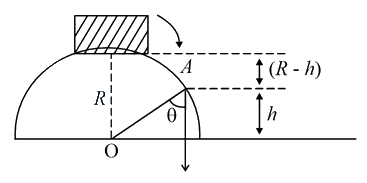 JEE Main/Numerical/Medium/Projectile motion/With diagram
- 255In a spring gun having spring constant a small ball of mass is put in its barrel (as shown in figure) by compressing the spring through . There should be a box placed at a distance on the ground so that the ball falls in it. If the ball leaves the gun horizontally at a height of above the ground. The value of is .
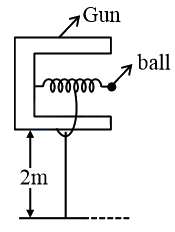 JEE Main/Numerical/Medium/Projectile motion/With diagram
- 256The projectile motion of a particle of mass is shown in the figure.
The initial velocity of the particle is and the air resistance is assumed to be negligible. The magnitude of the change in momentum between the points and is . The value of , to the nearest integer, is ___ .JEE Main/Numerical/Medium/Projectile motion/With diagram - 257The trajectory of a projectile in a vertical plane is where and are constants and x&y are respectively the horizontal and vertical distances of the projectile from the point of projection. The angle of projection and the maximum height attained are respectively given byJEE Main/MCQ/Medium/Projectile motion
- 258A particle is projected with velocity along -axis. A damping force is acting on the particle which is proportional to the square of the distance from the origin i.e. The distance at which the particle stops:JEE Main/MCQ/Medium/Projectile motion
- 259A particle starts from the origin at with an initial velocity of and moves in the plane with a constant acceleration The coordinate of the particle at the instant when its coordinate is is meters. The value of is:JEE Main/MCQ/Medium/Projectile motion
- 260Two particles are projected from the same point with the same speed u such that they have the same range R, but different maximum heights, and Which of the following is correct?JEE Main/MCQ/Medium/Projectile motion
- 261A shell is fired from a fixed artillery gun with an initial speed u such that it hits the target on the ground at a distance from it. If and are the values of the time taken by it to hit the target in two possible ways, the product is:JEE Main/MCQ/Medium/Projectile motion
- 262The trajectory of a projectile near the surface of the earth is given as If it were launched at an angle with speed then JEE Main/MCQ/Medium/Projectile motion
- 263A plane is inclined at an angle with respect to the horizontal. A particle is projected with a speed , from the base of the plane, making an angle with respect to the plane as shown in the figure. The distance from the base, at which the particle hits the plane is close to:
(Take )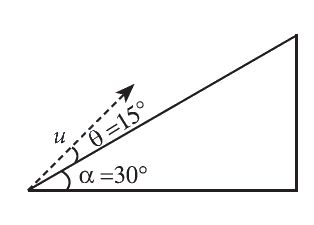 JEE Main/MCQ/Medium/Projectile motion/With diagram
- 264A body is projected at with a velocity at an angle of with the horizontal. The radius of curvature of its trajectory at s is . Neglecting air resistance and taking acceleration due to gravity , the value of is:JEE Main/MCQ/Medium/Projectile motion
- 265Two guns and can fire bullets at speeds and respectively. From a point on a horizontal ground, they are fired in all possible directions. The ratio of maximum areas covered by the bullets fired by the two guns, on the ground is:JEE Main/MCQ/Medium/Projectile motion
- 266The initial speed of a bullet fired from a rifle is . The rifle is fired at the centre of a target away at the same level as the target. How far above the centre of the target ?JEE Main/MCQ/Medium/Projectile motion
- 267The position of a projectile launched from the origin at t = 0 is given by at t = 2s. If the projectile was launched at an angle from the horizontal, then is (take g = 10 ms-2).JEE Main/MCQ/Medium/Projectile motion
- 268The maximum range of a bullet fired from a toy pistol mounted on a car at rest is . What will be the acute angle of inclination of the pistol for maximum range when the car is moving in the
direction of firing with uniform velocity on a horizontal surface? JEE Main/MCQ/Medium/Projectile motion - 269A ball projected from ground at an angle of just clears a wall in front. If point of projection is from the foot of wall and ball strikes the ground at a distance of on the other side of the wall, the height of the wall is :JEE Main/MCQ/Medium/Projectile motion
- 270A projectile is given an initial velocity of , where is along the ground and is along the vertical upward. If , the equation of its trajectory is :JEE Main/MCQ/Medium/Projectile motion
- 271A boy can throw a stone up to a maximum height of . The maximum horizontal distance that the boy can throw the same stone up to will beJEE Main/MCQ/Medium/Projectile motion
- 272A water fountain on the ground sprinkles water all around it. If the speed of water coming out of the fountain is , the total area around the fountain that gets wet is :JEE Main/MCQ/Medium/Projectile motion
- 273A small particle of mass is projected at an angle with the -axis with an initial velocity in the plane as shown in the figure. At a time , the angular momentum of the particle is
where and are unit vectors along and -axis respectively.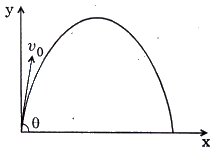 JEE Main/MCQ/Medium/Projectile motion/With diagram
- 274A particle is moving with velocity , where is a constant. The general equation for its path isJEE Main/MCQ/Medium/Projectile motion
- 275A particle just clears a wall of height at distance and strikes the ground at a distance from the point of projection. The angle of projection isJEE Main/MCQ/Medium/Projectile motion
- 276A particle is projected at to the horizontal with a kinetic energy . The kinetic energy at the highest point isJEE Main/MCQ/Medium/Projectile motion
- 277A particle is projected from a point with velocity at an angle of with the horizontal. When it is moving in a direction at right angles to its direction at , its velocity then is given byJEE Main/MCQ/Medium/Projectile motion
- 278A projectile can have the same range for two angles of projection. If and be the times of flights in the two cases, then the product of the two time of flights is proportional toJEE Main/MCQ/Medium/Projectile motion
- 279If and are the times of flight of two particles having the same initial velocity and range on the horizontal, then is equal toJEE Main/MCQ/Medium/Projectile motion
- 280A projectile can have the same range for two angles of projection. If and be the time of flights in the two cases, then the product of the two time of flights is directly proportional toJEE Main/MCQ/Medium/Projectile motion
- 281Two stones are projected from the top of a cliff metres high, with the same speed , so as to hit the ground at the same spot. If one of the stones is projected at an angle to the horizontal then the equalsJEE Main/MCQ/Medium/Projectile motion
- 282A boy playing on the roof of a high building throws a ball with a speed of at an angle of with the horizontal. How far from the throwing point will the ball be at the height of from the ground?
JEE Main/MCQ/Medium/Projectile motion - 283A car moving with a speed of km/h takes a turn of radius m. A simple pendulum is suspended from the ceiling of the car. Determine the angle made by the string of the pendulum with the vertical during the turning. (Take m/s)JEE Main/MCQ/Medium/Uniform Circular Motion
- 284A man carrying a monkey on his shoulder does cycling smoothly on a circular track of radius and completes 120 resolutions in 3 minutes. The magnitude of centripetal acceleration of monkey is in ) :JEE Main/MCQ/Medium/Uniform Circular Motion
- 285If the radius of curvature of the path of two particles of same mass are in the ratio , then in order to have constant centripetal force, their velocities will be in the ratio of:JEE Main/MCQ/Medium/Uniform Circular Motion
- 286A vehicle of mass is moving along a levelled curved road of radius with angular velocity of . The centripetal force acting on the vehicle is:JEE Main/MCQ/Medium/Uniform Circular Motion
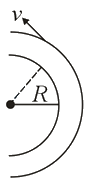
- 287A disc is rolling without slipping on a surface. The radius of the disc is At the top most point on the disc is as shown in figure. When the disc completes half of its rotation, the displacement of point from its initial position is
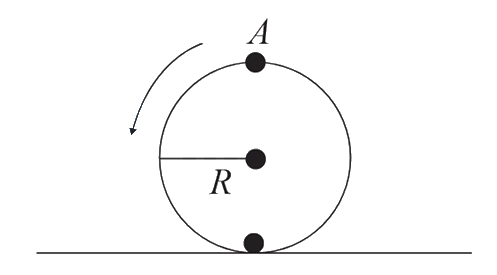 JEE Main/MCQ/Medium/Uniform Circular Motion/With diagram
- 288A child of mass is going round a merry-go-round that makes rotation in . The radius of the merry-go-round is . The centrifugal force on the child will beJEE Main/MCQ/Medium/Uniform Circular Motion
- 289A particle is moving with constant speed in a circular path. When the particle turns by an angle the ratio of instantaneous velocity to its average velocity is The value of will beJEE Main/MCQ/Medium/Uniform Circular Motion
- 290A stone of mass is tied to end of a massless string of length . If the breaking tension of the string is , then maximum linear velocity, the stone can have without breaking the string, while rotating in horizontal plane, is:JEE Main/MCQ/Medium/Uniform Circular Motion
- 291A stone tied to long string at its end is making revolutions in horizontal circle in every minute. The magnitude of acceleration of stone is . The value of ______.
[Take ]JEE Main/Numerical/Medium/Uniform Circular Motion - 292A car is moving on a circular path of radius such that the magnitudes of the tangential acceleration and centripetal acceleration are equal. The time taken by the car to complete first quarter of revolution, if it is moving with an initial speed of is . The value of is ______.JEE Main/Numerical/Medium/Uniform Circular Motion
- 293An object moves at a constant speed along a circular path in a horizontal plane with centre at the origin. When the object is at , its velocity is . The object’s velocity and acceleration at will beJEE Main/MCQ/Medium/Uniform Circular Motion
- 294A car is moving with a constant speed of in a circular horizontal track of radius . A bob is suspended from the roof of the car by a massless string. The angle made by the string with the vertical will be : (Take )JEE Main/MCQ/Medium/Uniform Circular Motion
- 295A ball is spun with angular acceleration where is in second and is in . At , the ball has angular velocity of and angular position of . The most appropriate expression for the angular position of the ball isJEE Main/MCQ/Medium/Uniform Circular Motion
- 296A boy ties a stone of mass to the end of a long string and whirls it around in a horizontal plane. The string can withstand the maximum tension of . If the maximum speed with which the stone can revolve is . The value of is :
(Assume the string is massless and un-stretchable)JEE Main/MCQ/Medium/Uniform Circular Motion - 297A particle of mass is suspended from a ceiling through a string of length . The particle moves in a horizontal circle of radius such that . The speed of particle will be :JEE Main/MCQ/Medium/Uniform Circular Motion
- 298If the angular velocity of earth's spin is increased such that the bodies at the equator start floating, the duration of the day would be approximately :
(Take : , the radius of earth, , Take )JEE Main/MCQ/Medium/Uniform Circular Motion - 299A modern grand-prix racing car of mass is travelling on a flat track in a circular arc of radius with a speed If the coefficient of static friction between the tyres and the track is then the magnitude of negative lift acting downwards on the car is:
 JEE Main/MCQ/Medium/Uniform Circular Motion/With diagram
- 300A block of mass moves with a uniform speed in a horizontal circular groove, with vertical side walls of radius . If the block takes to complete one round, the normal force by the side walls of the groove is:JEE Main/MCQ/Medium/Uniform Circular Motion
- 301A small bob tied at one end of a thin string of length is describing a vertical circle so that the maximum and minimum tension in the string is in the ratio . The velocity of the bob at the highest position is ______ . (Take )JEE Main/Numerical/Medium/Uniform Circular Motion
- 302A clock has a continuously moving second's hand of length. The average acceleration of the tip of the hand (in units of ]) is of the order of :JEE Main/MCQ/Medium/Uniform Circular Motion
- 303A uniform cylinder of mass and radius is to be pulled over a step of height a by applying a force at its centre perpendicular to the plane through the axes of the cylinder on the edge of the step (see figure). The minimum value of required is :
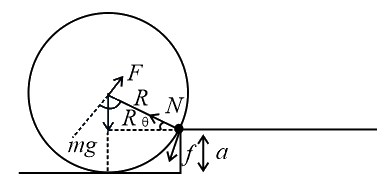 JEE Main/MCQ/Medium/Uniform Circular Motion/With diagram
- 304A bead of mass stays at point on a wire bent in the shape of a parabola and rotating with angular speed (see figure). The value of is (neglect friction)
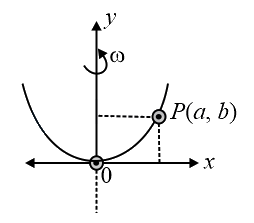 JEE Main/MCQ/Medium/Uniform Circular Motion/With diagram
- 305A spring mass system (mass spring constant and natural length ) rests in equilibrium on a horizontal disc. The free end of the spring is fixed at the centre of the disc. If the disc together with spring mass system rotates about it's axis with an angular velocity the relative change in the length of the spring is best given by the option:JEE Main/MCQ/Medium/Uniform Circular Motion
- 306A particle moves such that its position vector where is a constant and is time. Then which of the following statements is true for the velocity and acceleration of the particle:JEE Main/MCQ/Medium/Uniform Circular Motion
- 307A particle of mass is moving along a trajectory given by
The torque, acting on the particle about the origin, at is:JEE Main/MCQ/Medium/Uniform Circular Motion - 308A particle is moving along a circular path with a constant speed of . What is the magnitude of the change in velocity of the particle, when it moves through an angle of around the centre of the circle?JEE Main/MCQ/Medium/Uniform Circular Motion
NEET question paper PDF
This chapter includes NEET questions. Open a year to read the full paper, or download the PDF.
Opening paper…
JEE Main question paper PDF
This chapter includes JEE Main questions. Open a shift to read the paper, or download the PDF.
Opening paper…
Other Physics chapters
Current Electricity 380Electrostatics 311Ray Optics 295Rotational Motion 280Magnetic Effects & Magnetism 276Atoms & Nuclei 239Gravitation 223Laws of Motion 210Semiconductors 209Dual Nature of Matter 200Oscillations 194Fluid Mechanics 192Wave Optics 191Alternating Current 190Thermodynamics 190Work Energy Power 183Capacitors 180Kinetic Theory 168Electromagnetic Waves 165Electromagnetic Induction 153Units & Dimensions 149Waves 142Center of Mass, Momentum & Collision 130Thermal Properties of Matter 126Mathematics in Physics 121Mechanical Properties of Solids 118Experimental Physics 70Magnetic Properties of Matter 57Modern Physics 5
Stuck on a Kinematics question from your book?
Snap it and get a whiteboard video that solves it step by step. Your first video needs no login.