Physics · JEE Main
Center of Mass, Momentum & Collision
130 practice questions with a worked solution for each. Tap an option to see instantly if you are right.
102MCQ28Numerical37With diagram
- 1The position of an object having mass kg as a function of time is given as m. At s, which of the following statements are correct?
A. The linear momentum kg·m/s.
B. The force acting on the object N.
C. The angular momentum of the object about its origin J·s.
D. The torque acting on the object about its origin N·m.
Choose the correct answer from the options given below :JEE Main/MCQ/Medium/momentum - 2A body of mass 14 kg initially at rest explodes and breaks into three fragments of masses in the ratio . The two pieces of equal masses fly off perpendicular to each other with a speed of each. The velocity of the heavier fragment is .JEE Main/MCQ/Medium/momentum
- 3Given below are two statements :
Statement I: For a mechanical system of many particles total kinetic energy is the sum of kinetic energies of all the particles.
Statement II: The total kinetic energy can be the sum of kinetic energy of the center of mass w.r.t to the origin and the kinetic energy of all the particles w.r.t. the center of mass as the reference.
In the light of the above statements, choose the correct answer from the options given below :JEE Main/MCQ/Medium/momentum - 4
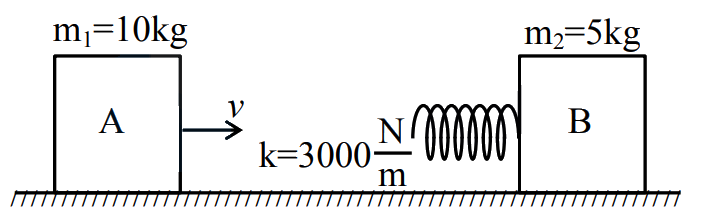
Consider two blocks A and B of masses and that are placed on a frictionless table. The block A moves with a constant speed towards the block B kept at rest. A spring with spring constant is attached with the block B as shown in the figure. After the collision, suppose that the blocks A and B, along with the spring in constant compression state, move together, then the compression in the spring is, (Neglect the mass of the spring)JEE Main/MCQ/Medium/momentum/With diagram - 5Three bodies A, B and C have equal kinetic energies and their masses are . and respectively. The ratio of their linear momenta is :JEE Main/MCQ/Medium/momentum
- 6When kinetic energy of a body becomes 36 times of its original value, the percentage increase in the momentum of the body will be:JEE Main/MCQ/Medium/momentum
- 7Four particles of mass , have same momentum, respectively. The particle with maximum kinetic energy is :JEE Main/MCQ/Medium/momentum
- 8A body of mass is moving horizontally with a velocity . If extra mass is added, the final velocity (in ) is:JEE Main/MCQ/Medium/momentum
- 9Two bodies are having kinetic energies in the ratio If they have same linear momentum, the ratio of their masses respectively is:JEE Main/MCQ/Medium/momentum
- 10A nucleus disintegrates into two nuclear parts, in such a way that ratio of their nuclear sizes is . Their respective speed have a ratio of . The value of is_________JEE Main/Numerical/Medium/momentum
- 11An average force of is applied on a machine gun firing bullets each of mass at the speed of to keep it in position. The number of bullets fired per second by the machine gun is :JEE Main/MCQ/Medium/momentum
- 12A machine gun of mass fires bullets at the rate of bullets per minute with a speed of each. The recoil velocity of the gun is :JEE Main/MCQ/Medium/momentum
- 13A body of mass and another of mass are moving with equal kinetic energy. The ratio of their respective momenta will beJEE Main/MCQ/Medium/momentum
- 14A body of mass at rest explodes into three pieces, in the ratio of masses . Two smaller pieces fly off perpendicular to each other with velocities of and respectively. The velocity of the third piece will beJEE Main/MCQ/Medium/momentum
- 15A man of is running on the road and suddenly jumps into a stationary trolly car of mass . Then the trolly car starts moving with velocity . The velocity of the running man was _____ , when he jumps into the car.JEE Main/Numerical/Medium/momentum
- 16A bullet of , moving with velocity , collides head-on with the stationary bob of a pendulum and recoils with velocity . The length of the pendulum is and mass of the bob is . The minimum value of , so that the pendulum describes a circle. (Assume the string to be inextensible and )
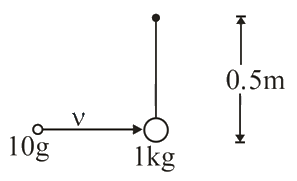 JEE Main/Numerical/Medium/momentum/With diagram
- 17A large block of wood of mass is hanging from two long massless cords. A bullet of mass is fired into the block and gets embedded in it. The (block bullet) then swing upwards, their center of mass rising a vertical distance before the (block bullet) pendulum comes momentarily to rest at the end of its arc. The speed of the bullet just before the collision is: (Take )
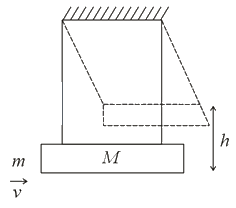 JEE Main/MCQ/Medium/momentum/With diagram
- 18Particle of mass moving with velocity collides with another particle of mass which is at rest initially. Let and be the velocities of particles and after collision respectively. If and after collision , the angle between and is :JEE Main/MCQ/Medium/momentum
- 19A thin rod of mass and length is suspended, at rest, from one end so that it can freely oscillate in the vertical plane. A particle of move moving in a straight line with velocity hits the rod at its bottom most point and sticks to it (see figure). The angular speed (in ) of the rod immediately after the collision will be …………
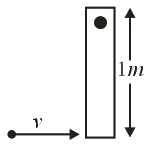 JEE Main/Numerical/Medium/momentum/With diagram
- 20Consider a uniform rod of mass and length pivoted about its centre. A mass moving with velocity making angle to the rod’s long axis collides with one end of the rod and sticks to it. The angular speed of the rod-mass system just after the collision is:JEE Main/MCQ/Medium/momentum
- 21A man (mass ) and his son (mass ) are standing on a frictionless surface facing each other. The man pushes his son so that he starts moving at a speed of with respect to the man. The speed of the man with respect to the surface is:JEE Main/MCQ/Medium/momentum
- 22A particle of mass is moving with speed and collides with a mass moving with speed in the same direction. After the collision, the first mass is stopped completely while the second one splits into two particles each of mass which move at an angle with respect to the original direction. The speed of each of the moving particle will beJEE Main/MCQ/Medium/momentum
- 23An alpha- particle of mass suffers dimensional elastic collision with a nucleus at rest of unknown mass. It is scattered directly backwards losing of its initial kinetic energy. The mass of the nucleus isJEE Main/MCQ/Medium/momentum
- 24A body of mass falls freely from a height of , on a platform of mass which is mounted on a spring having spring constant . The bodysticks to the platform and the spring's maximum compression is found to be . Given that the value of will be close to :JEE Main/MCQ/Medium/momentum
- 25A piece of wood of mass is dropped from the top of a height building. At the same time, a bullet of mass is fired vertically upward, with a velocity from the ground. The bullet gets embedded in the wood. Then the maximum height to which the combined system reaches above the top of the building before falling below is: JEE Main/MCQ/Medium/momentum
- 26In a collinear collision, a particle with an initial speed strikes a stationary particle of the same mass. If the final total kinetic energy is greater than the original kinetic energy, the magnitude of the relative velocity between the two particles, after the collision, isJEE Main/MCQ/Medium/momentum
- 27A projectile of mass is fired so that the horizontal range is . At the highest point the projectile explodes in two parts of masses and respectively and the heavier part starts falling down vertically with zero initial speed. The horizontal range (distance from point of firing) of the lighter part is :JEE Main/MCQ/Medium/momentum
- 28A boy of mass is standing on a free to move long cart. There is negligible friction between cart and ground. Initially, the boy is standing from a wall. If he walks on the cart towards the wall, then the final distance of the boy from the wall will beJEE Main/MCQ/Medium/momentum
- 29A spring is compressed between two blocks of masses and placed on a horizontal frictionless surface as shown in the figure. When the blocks are released, they have initial velocity of and as shown. The blocks travel distances and respectively before coming to rest. The ratio is
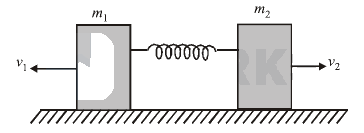 JEE Main/MCQ/Medium/momentum/With diagram
- 30A projectile moving vertically upwards with a velocity of breaks into two equal parts at a height of . One part starts moving vertically upwards with a velocity of . How much time it will take, after the break up with the other part to hit the ground?JEE Main/MCQ/Medium/momentum
- 31A block of mass is moving with a speed of on a smooth surface. It strikes another mass of and then they move together as a single body. The energy loss during the collision isJEE Main/MCQ/Medium/momentum
- 32A body of mass is moving along the -axis with a speed of . The magnitude of its momentum is recorded asJEE Main/MCQ/Medium/momentum
- 33A bomb of mass at rest explodes into two pieces of masses of and . The velocity of the mass is . The kinetic energy of the other mass isJEE Main/MCQ/Medium/momentum
- 34The block of mass moving on the frictionless horizontal surface collides with a spring of spring constant and compresses it by length . The maximum momentum of the block after collision is
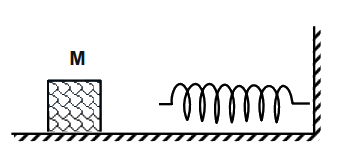 JEE Main/MCQ/Medium/momentum/With diagram
- 35The position of center of mass of three masses kg, kg and kg placed with respect to mid point () of normal bisector, as shown in the figure is _______.
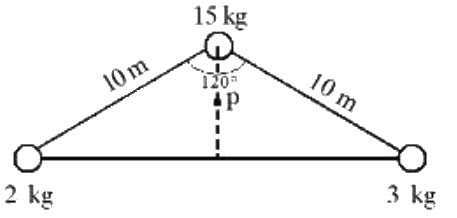 JEE Main/MCQ/Medium/Centre of mass of discrete particles/With diagram
- 36A rod of length 5 L is bent right angle keeping one side length as 2 L.
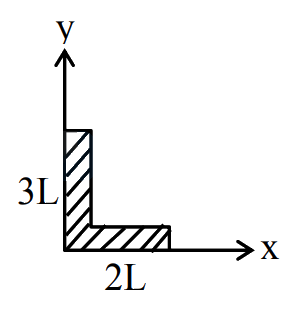
The position of the centre of mass of the system: (Consider )JEE Main/MCQ/Medium/Centre of mass of discrete particles/With diagram - 37The center of mass of a thin rectangular plate (fig - x ) with sides of length and , whose mass per unit area varies as (where is a constant), would be
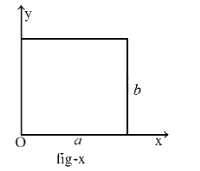 JEE Main/MCQ/Medium/Centre of mass of discrete particles/With diagram
- 38In a system two particles of masses and are placed at certain distance from each other. The particle of mass is moved towards the center of mass of the system through a distance . In order to keep the center of mass of the system at the original position, the particle of mass should move towards the center of mass by the distance _____ .JEE Main/Numerical/Medium/Centre of mass of discrete particles
- 39The identical spheres each of mass are placed at the corners of a right angled triangle with mutually perpendicular sides equal to each. Taking point of intersection of these two sides as origin, the magnitude of position vector of the centre of mass of the system is , where the value of is ________.JEE Main/Numerical/Medium/Centre of mass of discrete particles
- 40A nucleus disintegrates into two smaller parts, which have their velocities in the ratio . The ratio of their nuclear sizes will be . The value of ‘’ is:JEE Main/Numerical/Medium/Centre of mass of discrete particles
- 41Two bodies of mass and have position vectors and respectively. The magnitude of position vector of centre of mass of this system will be similar to the magnitude of vector :JEE Main/MCQ/Medium/Centre of mass of discrete particles
- 42Three identical spheres each of mass are placed at the corners of a right angled triangle with mutually perpendicular sides equal to each. Taking point of intersection of mutually perpendicular sides as origin, the magnitude of position vector of centre of mass of the system will be . The value of isJEE Main/Numerical/Medium/Centre of mass of discrete particles
- 43Two blocks of masses and are placed on the same straight line with coordinates and respectively. The block of is moved on the same line through a distance of towards the other block. The distance through which the block of must be moved to keep the position of centre of mass of the system unchanged isJEE Main/MCQ/Medium/Centre of mass of discrete particles
- 44Three point particles of masses and are placed at three corners of a right angle triangle of sides and as shown in the figure. The centre of mass of the system is at a point:
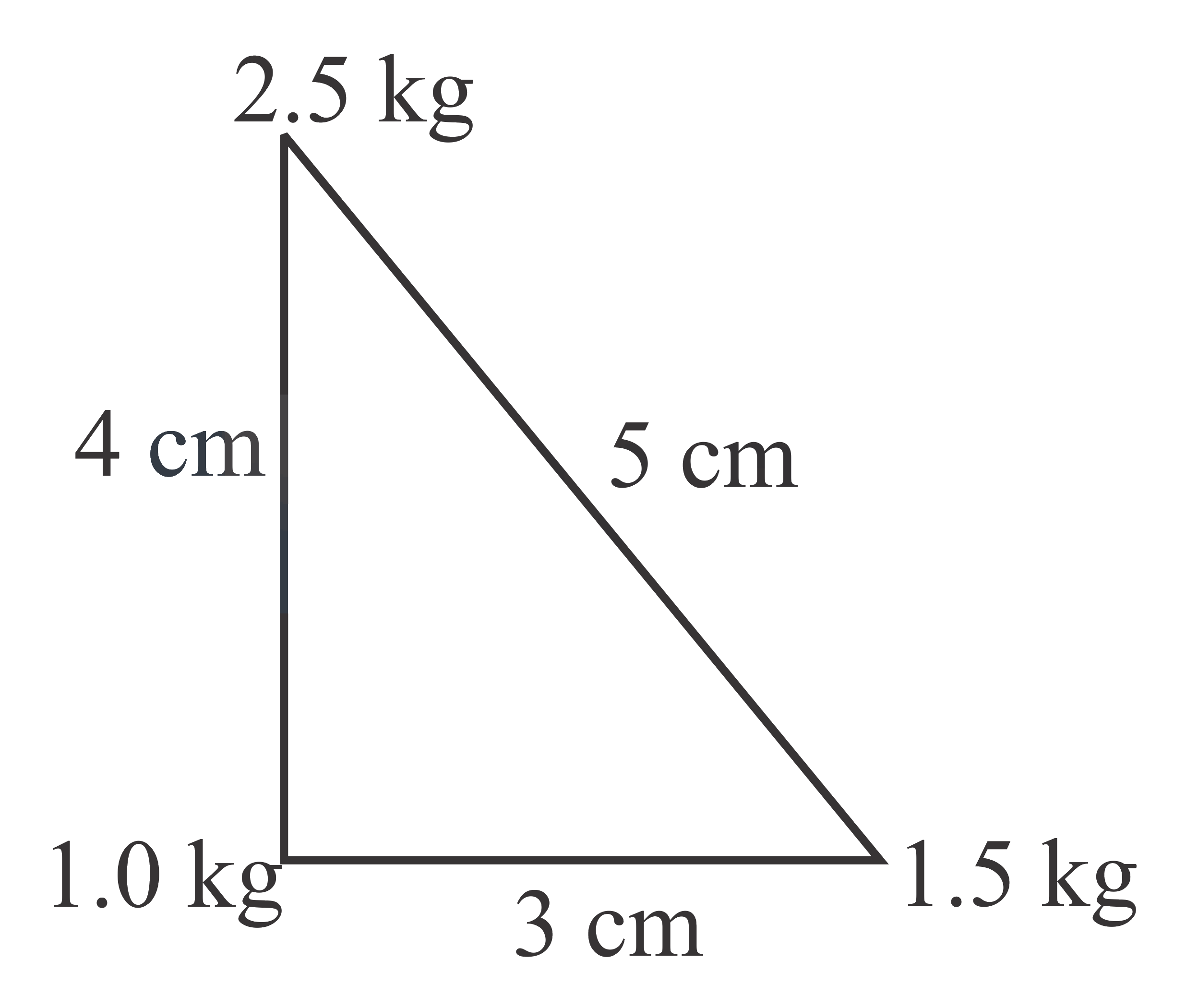 JEE Main/MCQ/Medium/Centre of mass of discrete particles/With diagram
- 45Three particles of masses , and are placed at the vertices of an equilateral triangle of side (as shown in the figure). The coordinates of the centre of mass will be:
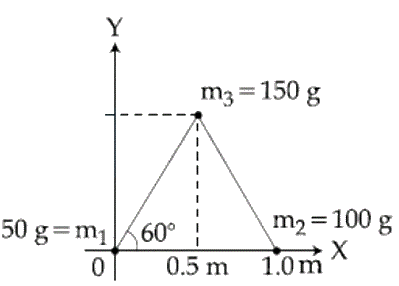 JEE Main/MCQ/Medium/Centre of mass of discrete particles/With diagram
- 46Consider a two particle system with particles having masses and . If the first particle is pushed towards the centre of mass through a distance , by what distance should the second particle be moved, so as to keep the centre of mass at the same position?JEE Main/MCQ/Medium/Centre of mass of discrete particles
- 47A uniform rod of mass 250 g having length 100 cm is balanced on a sharp edge at 40 cm mark. A mass of 400 g is suspended at 10 cm mark. To maintain the balance of the rod, the mass to be suspended at 90 cm mark, isJEE Main/MCQ/Medium/Centre of mass of continuous mass distribution
- 48Consider a circular disc of radius 20 cm with centre located at the origin. A circular hole of radius 5 cm is cut from this disc in such a way that the edge of the hole touches the edge of the disc. The distance of centre of mass of residual or remaining disc from the origin will beJEE Main/MCQ/Medium/Centre of mass of continuous mass distribution
- 49A uniform thin metal plate of mass with dimensions is shown. The ratio of and coordinates of center of mass of plate in . The value of is ________
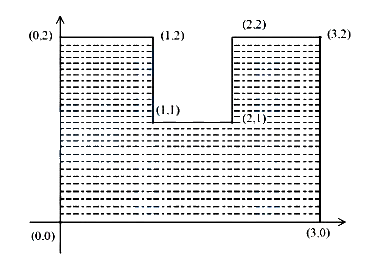 JEE Main/Numerical/Medium/Centre of mass of continuous mass distribution/With diagram
- 50The distance of centre of mass from end of a one dimensional rod having mass density and length (in meter) is . The value of is _____ (where is the distance form end )JEE Main/Numerical/Medium/Centre of mass of continuous mass distribution
- 51The position of the centre of mass of a uniform semi-circular wire of radius placed in plane with its centre at the origin and the line joining its ends as axis is given by, Then, the value of is JEE Main/Numerical/Medium/Centre of mass of continuous mass distribution
- 52The disc of mass with uniform surface mass density is shown in the figure. The center of mass of the quarter disc (the shaded area) is at the position where is _______ . (Round off to the Nearest Integer) [ is an area as shown in the figure]
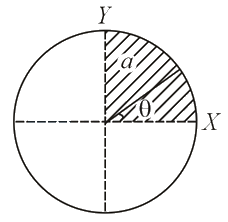 JEE Main/Numerical/Medium/Centre of mass of continuous mass distribution/With diagram
- 53A circular hole of radius is cut out of a circular disc of radius as shown in figure. The centroid of the remaining circular portion with respect to point will be:
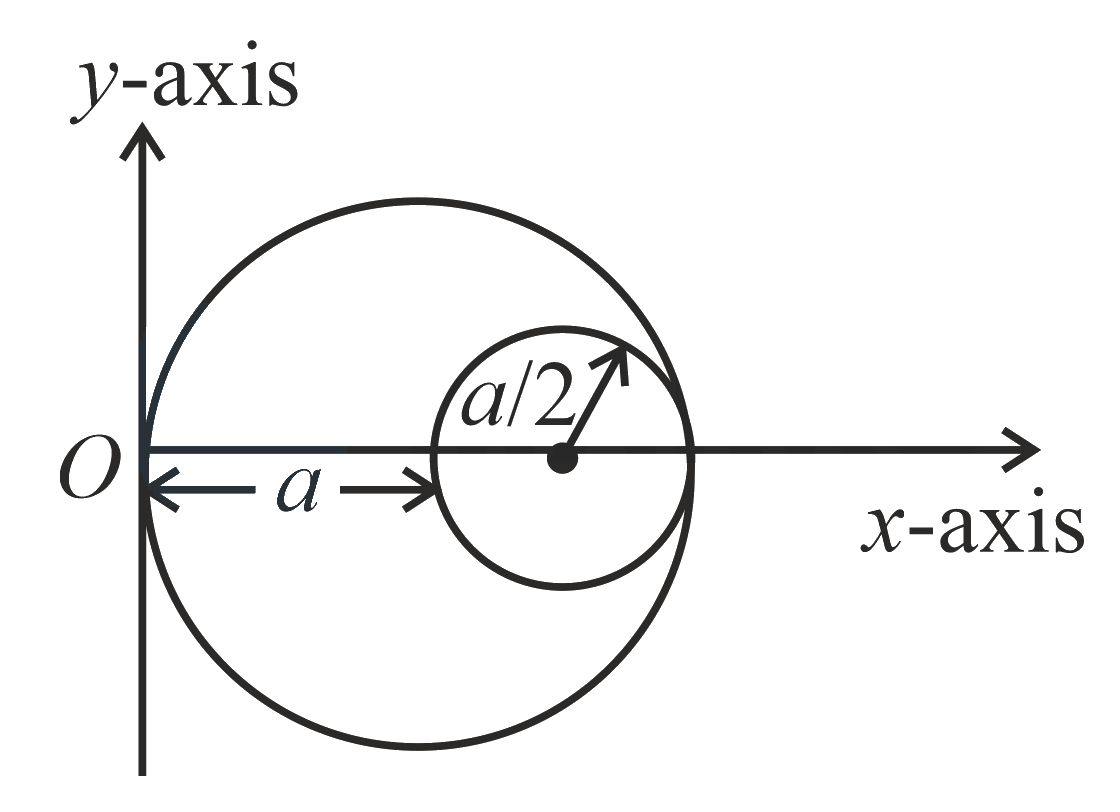 JEE Main/MCQ/Medium/Centre of mass of continuous mass distribution/With diagram
- 54The centre of mass of a solid hemisphere of radius is from the centre of the flat surface. Then value of isJEE Main/Numerical/Medium/Centre of mass of continuous mass distribution
- 55A square shaped hole of side is carved out at a distance from the centre '' of a uniform circular disk of radius a. If the distance of the centre of mass of the remaining portion from is , value of (to the nearest integer) is :
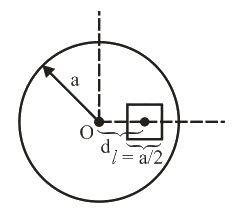 JEE Main/Numerical/Medium/Centre of mass of continuous mass distribution/With diagram
- 56A rod of length has non-uniform linear mass density given by where and are constants and The value of for the centre of mass of the rod is at:JEE Main/MCQ/Medium/Centre of mass of continuous mass distribution
- 57As shown in figure. When a spherical cavity (centred at ) of radius is cut out of a uniform sphere of radius (centred at ), the centre of mass of remaining (shaded part of sphere is at i.e., on the surface of the cavity. can be determined by the equation:
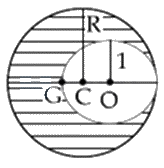 JEE Main/MCQ/Medium/Centre of mass of continuous mass distribution/With diagram
- 58The coordinates of the centre of mass of a uniform flag-shaped lamina (thin flat plate) of mass . (The coordinates of the same are shown in the figure) are:
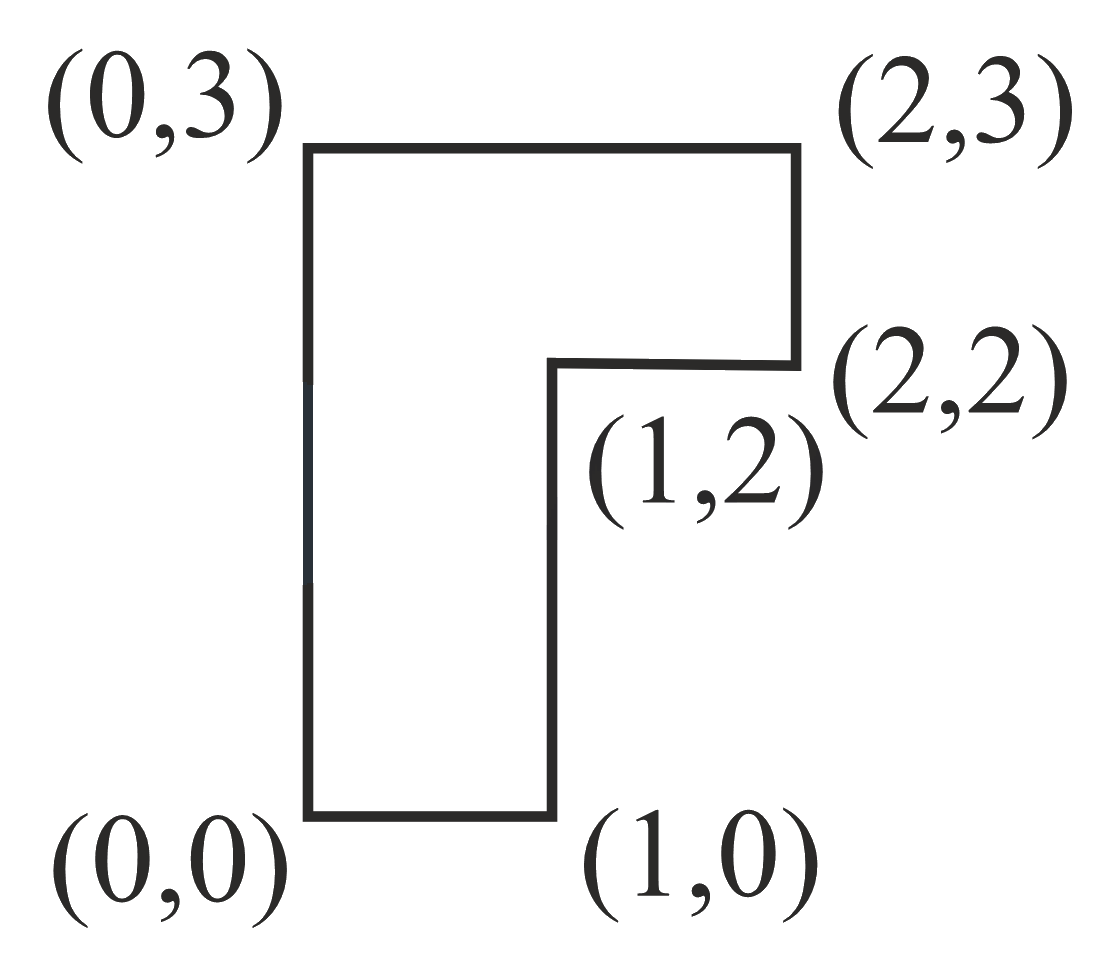 JEE Main/MCQ/Medium/Centre of mass of continuous mass distribution/With diagram
- 59A uniform rectangular thin sheet of mass has length and breadth , as shown in the figure. If the shaded portion is cut-off, the coordinates of the centre of mass of the remaining portion will be:
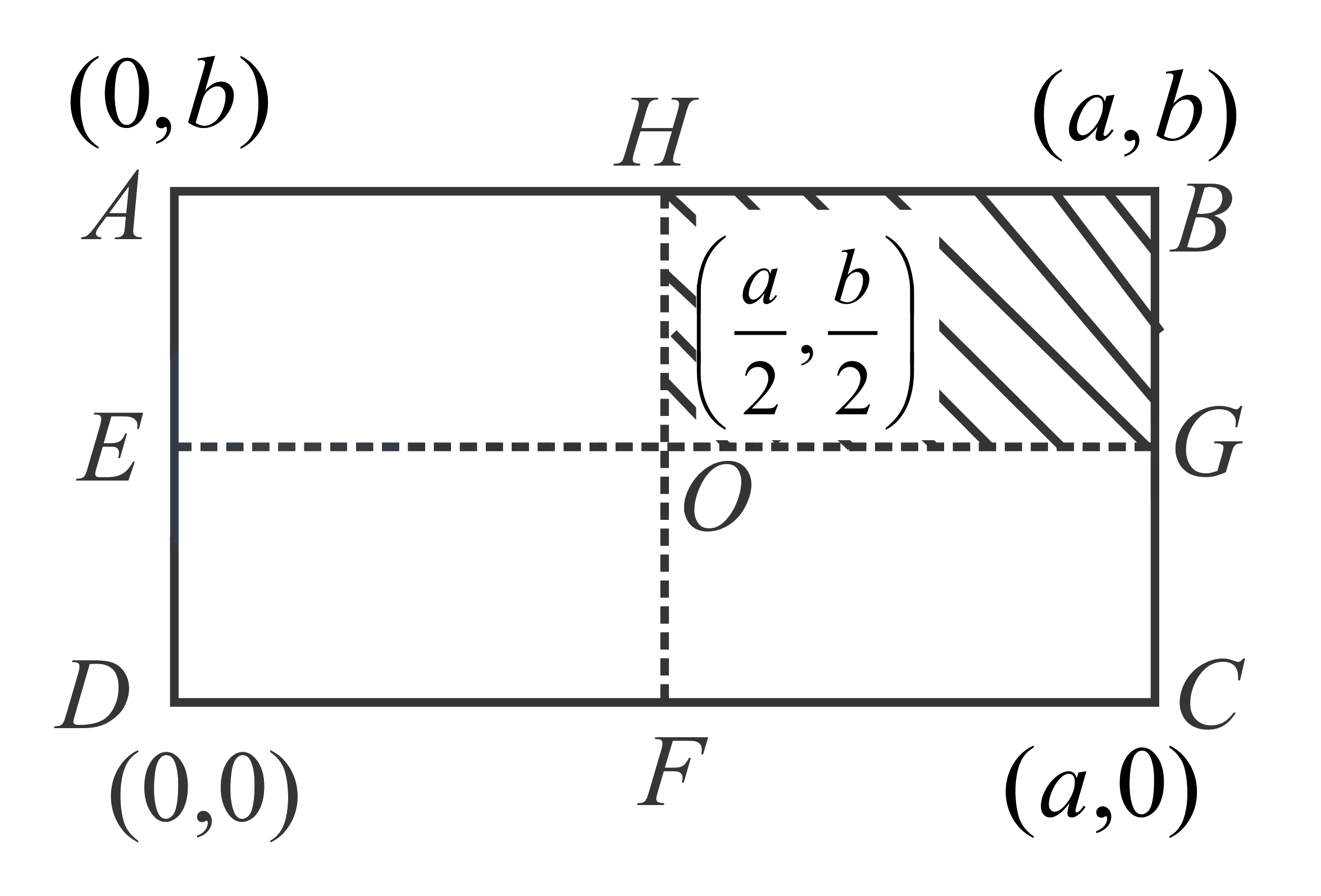 JEE Main/MCQ/Medium/Centre of mass of continuous mass distribution/With diagram
- 60The position vector of the center of mass of an asymmetric uniform bar of negligible area of cross-section as shown in figure is:
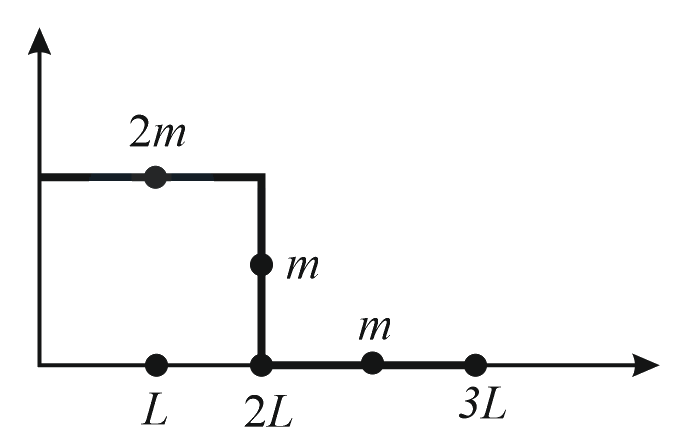 JEE Main/MCQ/Medium/Centre of mass of continuous mass distribution/With diagram
- 61In the figure shown is a uniform wire. If the center of mass of the wire lies vertically below point , then is close to
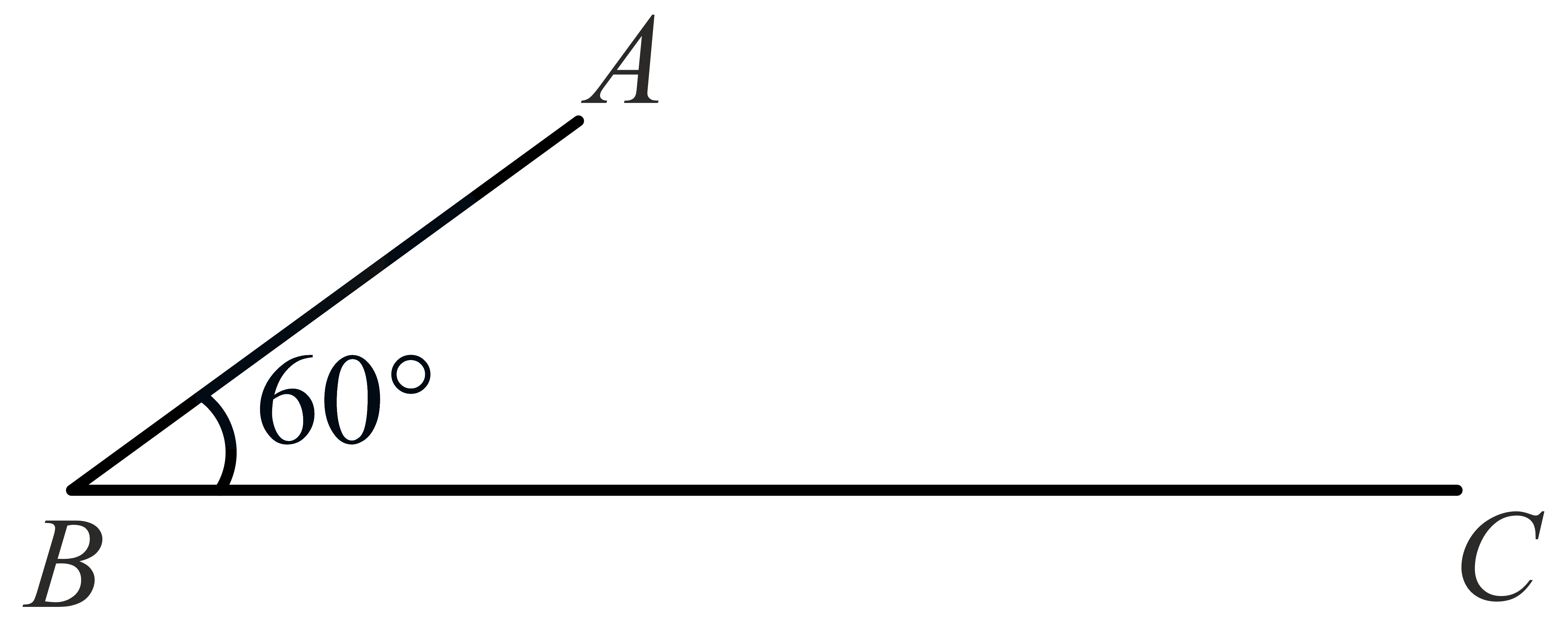 JEE Main/MCQ/Medium/Centre of mass of continuous mass distribution/With diagram
- 62A uniform thin rod AB of length has linear mass density , where is measured from A. If the CM of the rod lies at a distance of from A, then and are related as:JEE Main/MCQ/Medium/Centre of mass of continuous mass distribution
- 63Distance of the centre of mass of a solid uniform cone from its vertex is . If the radius of its base is and its height is then is equal to:JEE Main/MCQ/Medium/Centre of mass of continuous mass distribution
- 64A thin rod of length ' ' is lying along the -axis with its ends at and . Its linear density (mass/length) varies with ask , where can be zero or any positive number. If the position of the centre of mass of the rod is plotted against ' ', which of the following graphs best approximates the dependence of on ?JEE Main/MCQ/Medium/Centre of mass of continuous mass distribution
- 65A circular disc of radius is removed from a bigger circular disc of radius such that the circumferences of the discs coincide. The centre of mass of the new disc is from the centre of the bigger disc. The value of isJEE Main/MCQ/Medium/Centre of mass of continuous mass distribution
- 66Two identical bodies and of equal masses have initial velocities m/s and m/s respectively. The body has acceleration m/s while the acceleration of the other body is zero. The centre of mass of the two bodies moves in __________ path.JEE Main/MCQ/Medium/Motion of centre of mass
- 67Two blocks of masses kg and kg respectively, are tied to the ends of a string which passes over a light frictionless pulley as shown in the figure below. The masses are held at rest at the same horizontal level and then released. The distance traversed by the centre of mass in s is _______ m. (Take m/s)
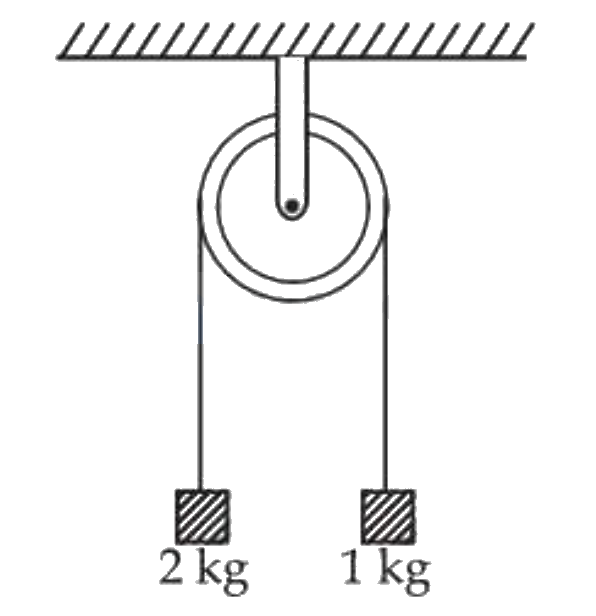 JEE Main/MCQ/Medium/Motion of centre of mass/With diagram
- 68Four particles and with masses and are at the corners of a square. They have accelerations of equal magnitude with directions as shown. The acceleration of the centre of mass of the particles is:
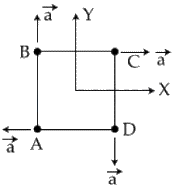 JEE Main/MCQ/Medium/Motion of centre of mass/With diagram
- 69A body of mass while falling vertically downwards under gravity breaks into two parts; a body B of mass and a body of mass . The centre of mass of bodies and taken together shifts compared to that of body towardsJEE Main/MCQ/Medium/Motion of centre of mass
- 70Two identical particles move towards each other with velocity and respectively. The velocity of centre of mass isJEE Main/MCQ/Medium/Motion of centre of mass
- 71A player caught a cricket ball of mass moving at a speed of . If the catching process is completed in , the magnitude of force exerted by the ball on the hand of the player is:JEE Main/MCQ/Medium/Impulse
- 72A uniform rod of mass and Length at rest on a smooth horizontal surface. An impulse of force is applied to end B. The time taken by the rod to turn through at right angles will be where ____.JEE Main/Numerical/Medium/Impulse
- 73A spherical body of mass is dropped from a height of from the ground. After hitting the ground, the body rebounds to a height of . The impulse of force imparted by the ground to the body is given by: (given )JEE Main/MCQ/Medium/Impulse
- 74A bullet of leaves the barrel of gun with a velocity of . If the barrel of gun is long and mass of gun is then value of impulse supplied to the gun will be:JEE Main/MCQ/Medium/Impulse
- 75Figures (a), (b), (c) and (d) show variation of force with time.
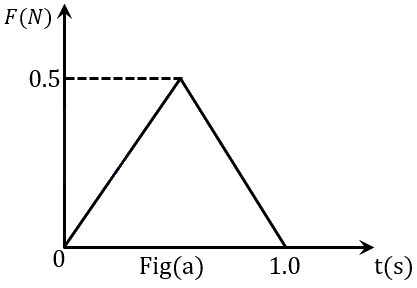
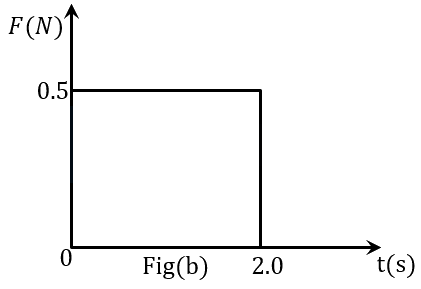
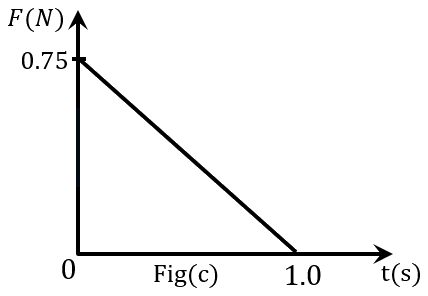
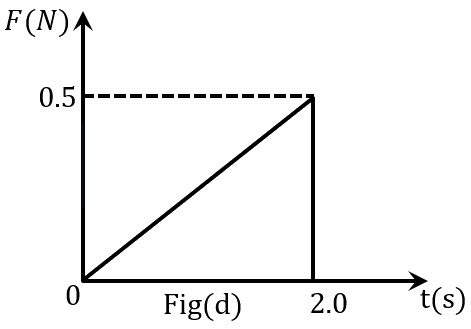
The impulse is highest in figure.JEE Main/MCQ/Medium/Impulse/With diagram - 76In two different experiments, an object of mass moving with a speed of hits two different walls and comes to rest within
(i) second, (ii) seconds, respectively.
Choose the correct option out of the following :JEE Main/MCQ/Medium/Impulse - 77A ball of mass hits the wall with its initial speed of and bounces back without changing its initial speed. If the force applied by the wall on the ball during the contact is . calculate the time duration of the contact of ball with the wall.JEE Main/MCQ/Medium/Impulse
- 78Two billiard balls of mass each moving in opposite directions with collide and rebound with the same speed. If the time duration of contact is , then what is the force exerted on the ball due to each other?JEE Main/MCQ/Medium/Impulse
- 79A batsman hits back a ball of mass straight in the direction of the bowler without changing its initial speed of . The impulse imparted to the ball is _____ .JEE Main/Numerical/Medium/Impulse
- 80If gas molecules each of mass kg collides with a surface (perpendicular to it) elastically per second over an area with a speed the pressure exerted by the gas molecules will be of the order of:JEE Main/MCQ/Medium/Impulse
- 81The figure shows the position - time graph of one-dimensional motion of a body of mass . The magnitude of each impulse is
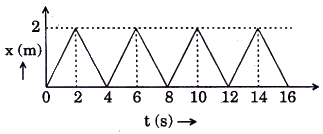 JEE Main/MCQ/Medium/Impulse/With diagram
- 82In a perfectly inelastic collision, two spheres made of the same material with masses 15 kg and 25 kg, moving in opposite directions with speeds of and , respectively, strike each other and stick together. The rise in temperature (in ), if all the heat produced during the collision is retained by these spheres, is : (specific heat of sphere material and )JEE Main/MCQ/Medium/Collisions
- 83Given below are two statements. One is labelled as Assertion (A) and the other is labelled as Reason (R).
Assertion (A) :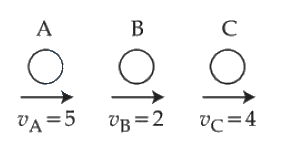
Three identical spheres of same mass undergo one dimensional motion as shown in figure with initial velocities . If we wait sufficiently long for elastic collision to happen, then , will be the final velocities.
Reason (R): In an elastic collision between identical masses, two objects exchange their velocities.
In the light of the above statements, choose the correct answer from the options given below :JEE Main/MCQ/Medium/Collisions/With diagram - 84As shown below, bob \(A\) of a pendulum having massless string of length ' \(R\) ' is released from \(60^{\circ}\) to the vertical. It hits another bob \(B\) of half the mass that is at rest on a friction less table in the center. Assuming elastic collision, the magnitude of the velocity of bob A after the collision will be (take g as acceleration due to gravity.)
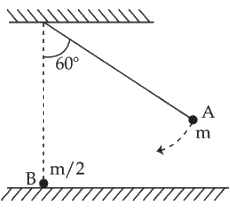 JEE Main/MCQ/Medium/Collisions/With diagram
- 85A simple pendulum of length has a wooden bob of mass . It is struck by a bullet of mass moving with a speed of . The bullet gets embedded into the bob. The height to which the bob rises before swinging back is. (use )JEE Main/MCQ/Medium/Collisions
- 86A particle of mass moving with velocity collides with a stationary particle of mass . After collision, they stick together and continue to move together with velocityJEE Main/MCQ/Medium/Collisions
- 87A ball is dropped from a height of . If the coefficient of restitution for the collision between ball and floor is , after hitting the floor, the ball rebounds to a height of ______ .JEE Main/Numerical/Medium/Collisions
- 88 balls each of mass moving with speed simultaneously strike a wall normally and reflected back with same speed, in time . The total force exerted by the balls on the wall isJEE Main/MCQ/Medium/Collisions
- 89A ball of mass rests on a vertical post of height . A bullet of mass , travelling in horizontal direction, hits the centre of the ball. After collision both travels independently. The ball hits the ground at a distance and the bullet at a distance of from the foot of the post. The value of initial velocity of the bullet will be (if ) :JEE Main/MCQ/Medium/Collisions
- 90As per the given figure, a small ball slides down the quadrant of a circle and hits the other ball of equal mass which is initially at rest. Neglecting the effect of friction and assume the collision to be elastic, the velocity of ball after collision will be :
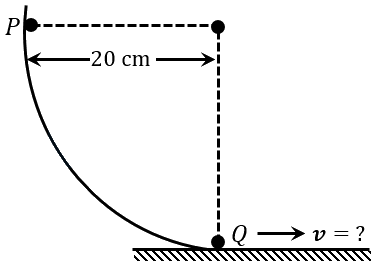 JEE Main/MCQ/Medium/Collisions/With diagram
- 91A body of mass collides head on elastically with a stationary body of mass . After collision, the smaller body reverses its direction of motion and moves with a speed of . The initial speed of the smaller body before collision is ______ .JEE Main/Numerical/Medium/Collisions
- 92A pendulum of length consists of a wooden bob of mass . A bullet of mass is fired towards the stationary bob with a speed . The bullet emerges out of the bob with a speed and the bob just completes the vertical circle. The value of is _____
(if ).JEE Main/Numerical/Medium/Collisions - 93What percentage of kinetic energy of a moving particle is transferred to a stationary particle when it strikes the stationary particle of times its mass?
(Assume the collision to be head-on elastic collision)JEE Main/MCQ/Medium/Collisions - 94A body of mass moving at speed collides elastically with a mass at rest. After the collision, the two masses move at angles and with respect to the initial direction of motion of the body of mass . The largest possible value of the ratio for which the angles and will be equal, is :JEE Main/MCQ/Medium/Collisions
- 95Three objects and are kept in a straight line on a frictionless horizontal surface. The masses of and are and respectively. moves towards with a speed of and makes an elastic collision with it. Thereafter makes a completely inelastic collision with All motions occur along the same straight line. The final speed of is :
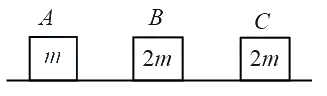 JEE Main/MCQ/Medium/Collisions/With diagram
- 96A body of mass moving with a speed of makes an elastic collision with another body at rest and continues to move in the original direction but with one fourth of its initial speed. The speed of the two body centre of mass is . Find the value of x.JEE Main/Numerical/Medium/Collisions
- 97A rod of mass and length is lying on a horizontal frictionless surface. A particle of mass travelling along the surface hits at one end of the rod with a velocity in a direction perpendicular to the rod. The collision is completely elastic. After collision, particle comes to rest. The ratio of masses is The value of will beJEE Main/Numerical/Medium/Collisions
- 98A body having specific charge is resting on a frictionless plane at a distance from the wall (as shown in the figure). It starts moving towards the wall when a uniform electric field of is applied horizontally towards the wall. If the collision of the body with the wall is perfectly elastic, then the time period of the motion will be ____s.
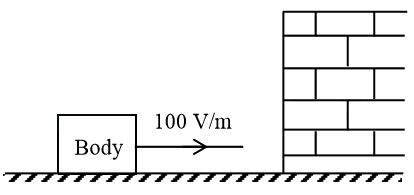 JEE Main/Numerical/Medium/Collisions/With diagram
- 99An object of mass collides with another object of mass , which is at rest. After the collision the objects move with equal speeds in opposite direction. The ratio of the masses is :JEE Main/MCQ/Medium/Collisions
- 100A ball of mass moving with a velocity along the -axis, hits another ball of mass which is at rest. After the collision, first ball comes to rest while the second ball disintegrates into two equal pieces. One piece starts moving along -axis with a speed of The second piece starts moving at an angle of with respect to the -axis. The velocity of the ball moving at with -axis is The configuration of pieces after the collision is shown in the figure below. The value of to the nearest integer is
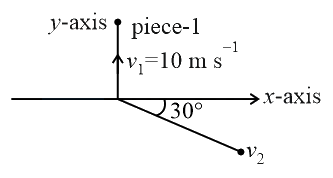 JEE Main/Numerical/Medium/Collisions/With diagram
- 101A rubber ball is released from a height of above the floor. It bounces back repeatedly, always rising to of the height through which it falls. Find the average speed of the ball. (Take )JEE Main/MCQ/Medium/Collisions
- 102Given below are two statements: one is labelled as Assertion A and the other is labelled as Reason R.
Assertion A : Body having mass moving with speed has head-on collision elastically with another body having mass initially at rest. If , body will have a maximum speed equal to after collision.
Reason R : During elastic collision, the momentum and kinetic energy are both conserved.
In the light of the above statements, choose the most appropriate answer from the options given below:JEE Main/MCQ/Medium/Collisions - 103A ball with a speed of collides with another identical ball at rest. After the collision, the direction of each ball makes an angle of with the original direction. If the ratio of velocities of the balls after the collision is , then what is the value of ?JEE Main/Numerical/Medium/Collisions
- 104Two bodies of the same mass are moving with the same speed, but in different directions in a plane. They have a completely inelastic collision and move together thereafter with a final speed which is half of their initial velocities of the two bodies (in degree) is -JEE Main/Numerical/Medium/Collisions
- 105A particle of mass collides with a hydrogen atom at rest. Soon after the collision, the particle comes to rest, and the atom recoils and goes to its first excited state. The initial kinetic energy of the particle (in ) is The value of is: (Given the mass of the hydrogen atom to be ).........JEE Main/Numerical/Medium/Collisions
- 106Blocks of masses and are arranged in a line of a frictionless floor. Another block of mass , moving with speed along the same line (see figure) collides with mass in perfectly inelastic manner. All the subsequent collisions are also perfectly inelastic. By the time the last block of mass starts moving the total energy loss is \text{p%} of the original energy. Value of ‘ ’ is close to:
 JEE Main/MCQ/Medium/Collisions/With diagram
- 107A block of mass is at rest at the edge of a table, of height 1 m. A bullet of mass collides with the block and sticks to it. If the velocity of the bullet is in the horizontal direction just before the collision then the kinetic energy just before the combined system strikes the floor, is [Take . Assume there is no rotational motion and loss of energy after the collision is negligible.]JEE Main/MCQ/Medium/Collisions
- 108A particle of mass is moving along the -axis with initial velocity . It collides elastically with a particle of mass at rest and then moves with half its initial kinetic energy (see figure). If then value of n is ________.
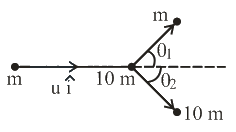 JEE Main/Numerical/Medium/Collisions/With diagram
- 109A particle of mass with an initial velocity collides perfectly elastically with a mass at rest. It moves with a velocity after collision, then, is given byJEE Main/MCQ/Medium/Collisions
- 110A particle of mass m is projected with a speed u from the ground at an angle w.r.t. horizontal (x-axis). When it has reached its maximum height, it collides completely inelastically with another particle of the same mass and velocity The horizontal distance covered by the combined mass before reaching the ground is:JEE Main/MCQ/Medium/Collisions
- 111Two particles of equal mass have respective initial velocities and . They collide completely inelastically. The energy lost in the process is:JEE Main/MCQ/Medium/Collisions
- 112A particle of mass is dropped from a height above the ground. At the same time another particle of the same mass is thrown vertically upwards from the ground with a speed of If they collide head-on completely inelastically, the time taken for the combined mass to reach the ground, in units of is:JEE Main/MCQ/Medium/Collisions
- 113A body of mass has an initial velocity of . It collides elastically with another body of the same mass which has an initial velocity of . After the collision, moves with a velocity . The energy of after the collision is written as . The value of isJEE Main/Numerical/Medium/Collisions
- 114Two particles of masses and moving with speeds of and , as shown in the figure. They collide at the origin and after that they move along the indicated directions with speeds and , respectively. The values of and are, nearly
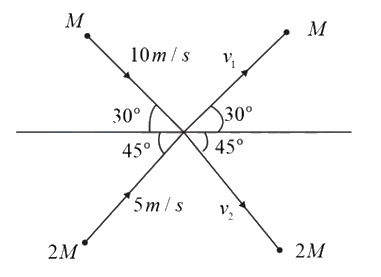 JEE Main/MCQ/Medium/Collisions/With diagram
- 115A body of mass makes an elastic collision with a second body at rest and continues to move in the original direction but with one fourth of its original speed. What is the mass of the second body?JEE Main/MCQ/Medium/Collisions
- 116A body of mass moving with an unknown velocity of undergoes a collinear collision with a body of mass moving with a velocity After the collision, and move with velocities of and respectively. If and then is:JEE Main/MCQ/Medium/Collisions
- 117A simple pendulum, made of a string of length and bob of mass is released from a small angle It strikes a block of mass kept on horizontal surface at its lowest point of oscillations, elastically. It bounces back and goes up to an angle Then is given by:JEE Main/MCQ/Medium/Collisions
- 118Three blocks and are lying on a smooth horizontal surface, as shown in the figure. and have equal masses, while has mass Block is given an initial speed towards due to which it collides with perfectly inelastically. The combined mass collides with also perfectly inelastically . of the initial kinetic energy is lost in the whole process. What is the value of ?
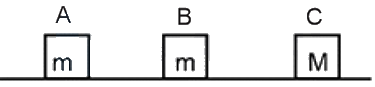 JEE Main/MCQ/Medium/Collisions/With diagram
- 119A proton of mass collides elastically with a particle of unknown mass at rest. After the collision, the proton and the unknown particle are seen moving at an angle of with respect to each other. The mass of unknown particle is:JEE Main/MCQ/Medium/Collisions
- 120The mass of a hydrogen molecule is If hydrogen molecules strike, per second, a fixed wall of the area at an angle of to the normal, and rebound elastically with a speed of then the pressure on the wall is nearly:JEE Main/MCQ/Medium/Collisions
- 121It is found that if a neutron suffers an elastic collinear collision with a deuterium at rest, the fractional loss of its energy is , while for its similar collision with a carbon nucleus at rest, the fractional loss of energy is . The values of and are respectivelyJEE Main/MCQ/Medium/Collisions
- 122Two particles and of equal mass are moving with the same speed as shown in figure. They collide completely inelastic and move as a single particle . The angle that the path of makes with the -axis is given by-
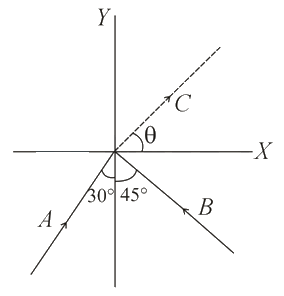 JEE Main/MCQ/Medium/Collisions/With diagram
- 123A particle of mass moving in the direction with speed is hit by another particle of mass moving in the direction with speed If the collision is perfectly inelastic, the percentage loss in the energy during the collision is close to:JEE Main/MCQ/Medium/Collisions
- 124Three masses and are moving in plane with speed and respectively as shown in figure. The three masses collide at the same point at and stick together. The velocity of resulting mass will be:
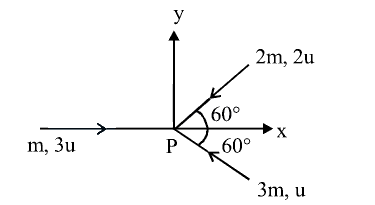 JEE Main/MCQ/Medium/Collisions/With diagram
- 125This question has and of the four choices given after the Statements, choose the one that best describes the two Statements.
A point particle of mass moving with speed collides with stationary point particle of mass . If the maximum energy loss possible is given as
then .
Maximum energy loss occurs when the particles get stuck together as a result of the collision.JEE Main/MCQ/Medium/Collisions - 126A moving particle of mass , makes a head on elastic collision with another particle of mass , which is initially at rest. The percentage loss in energy of the colliding particle on collision, is close toJEE Main/MCQ/Medium/Collisions
- 127Two bodies and of mass and respectively are placed on a smooth floor. They are connected by a spring of negligible mass. third body of mass is placed on the floor. The body moves with a velocity along the line joining and and collides elastically with . At a certain time after the collision it is found that the instantaneous velocities of and are same and the compression of the spring is . The spring constant will beJEE Main/MCQ/Medium/Collisions
- 128Statement-1 : Two particles moving in the same direction do not lose all their energy in a completely inelastic collision.
Statement-2 : Principle of conservation of momentum holds true for all kinds of collisions.
Of the four choices given after the statements, choose the one that best describes the two statements.
Of the four choices given after the statements, choose the one that best describes the two statements.JEE Main/MCQ/Medium/Collisions - 129A mass ' ' moves with a velocity and collides inelastically with another identical mass. After collision the mass moves with velocity in a direction perpendicular to the initial direction of motion. Find the speed of the mass after collision
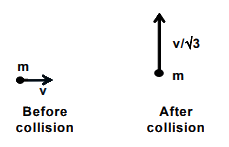 JEE Main/MCQ/Medium/Collisions/With diagram
- 130A balloon and its content having mass is moving up with an acceleration ' '. The mass that must be released from the content so that the balloon starts moving up with an acceleration ' will be
(Take ' g ' as acceleration due to gravity)JEE Main/MCQ/Medium/Variable mass system
JEE Main question paper PDF
This chapter includes JEE Main questions. Open a shift to read the paper, or download the PDF.
Opening paper…
Other Physics chapters
Current Electricity 380Electrostatics 311Kinematics 308Ray Optics 295Rotational Motion 280Magnetic Effects & Magnetism 276Atoms & Nuclei 239Gravitation 223Laws of Motion 210Semiconductors 209Dual Nature of Matter 200Oscillations 194Fluid Mechanics 192Wave Optics 191Alternating Current 190Thermodynamics 190Work Energy Power 183Capacitors 180Kinetic Theory 168Electromagnetic Waves 165Electromagnetic Induction 153Units & Dimensions 149Waves 142Thermal Properties of Matter 126Mathematics in Physics 121Mechanical Properties of Solids 118Experimental Physics 70Magnetic Properties of Matter 57Modern Physics 5
Stuck on a Center of Mass, Momentum & Collision question from your book?
Snap it and get a whiteboard video that solves it step by step. Your first video needs no login.