Physics · JEE Main, NEET
Gravitation
223 practice questions with a worked solution for each. Tap an option to see instantly if you are right.
206MCQ17Numerical21With diagram
- 1At what height above the Earth's surface does the acceleration due to gravity become , where is the radius of Earth?JEE Main/MCQ/Medium
- 2The acceleration due to gravity at the center of the Earth is:NEET/MCQ/Medium
- 3Three identical spheres of mass m , are placed at the vertices of an equilateral triangle of length a. When released, they interact only through gravitational force and collide after a time seconds. If the sides of the triangle are increased to length 2 a and also the masses of the spheres are made 2 m , then they will collide after _____ seconds.JEE Main/Numerical/Medium/Newton's Law of Gravitation
- 4A small point of mass is placed at a distance from the centre ' of a big uniform solid sphere of mass M and radius R . The gravitational force on ' m ' due to M is . A spherical part of radius is removed from the big sphere as shown in the figure and the gravitational force on m due to remaining part of M is found to be . The value of ratio is
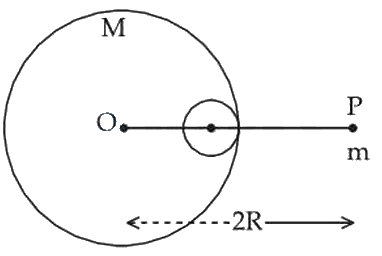 JEE Main/MCQ/Medium/Newton's Law of Gravitation/With diagram
- 5In hydrogen like system the ratio of coul0mbian force and gravitational force between an electron and a proton is in the order of :JEE Main/MCQ/Medium/Newton's Law of Gravitation
- 6A body placed at distance from surface of earth experiences gravitational pull of : JEE Main/MCQ/Medium/Newton's Law of Gravitation
- 7Two identical particles each of mass go round a circle of radius under the action of their mutual gravitational attraction. The angular speed of each particle will be :JEE Main/MCQ/Medium/Newton's Law of Gravitation
- 8A planet has double the mass of the earth. Its average density is equal to that of the earth. An object weighing on earth will weigh on that planet:JEE Main/MCQ/Medium/Newton's Law of Gravitation
- 9Two particles of equal mass move in a circle of radius under the action of their mutual gravitational attraction. The speed of each particle will be :JEE Main/MCQ/Medium/Newton's Law of Gravitation
- 10Assume that the earth is a solid sphere of uniform density and a tunnel is dug along its diameter throughout the earth. It is found that when a particle is released in this tunnel, it executes a simple harmonic motion. The mass of the particle is . The time period of the motion of the particle will be (approximately)
(take , radius of earth )JEE Main/MCQ/Medium/Newton's Law of Gravitation - 11Three identical particle and of mass each are placed in a straight line with . The gravitational force on a fourth particle of the same mass is , when placed at a distance from the particle on the perpendicular bisector of the line . The value of will be approximatelyJEE Main/MCQ/Medium/Newton's Law of Gravitation
- 12Two objects of equal masses placed at certain distance from each other attracts each other with a force of . If one-third mass of one object is transferred to the other object, then the new force will beJEE Main/MCQ/Medium/Newton's Law of Gravitation
- 13Statement I : The law of gravitation holds good for any pair of bodies in the universe.
Statement II : The weight of any person becomes zero when the person is at the centre of the earth.
In the light of the above statements, choose the correct answer from the options given below.JEE Main/MCQ/Medium/Newton's Law of Gravitation - 14Four particles each of mass move along a circle of radius under the action of their mutual gravitational attraction as shown in figure. The speed of each particle is :
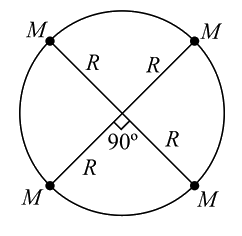 JEE Main/MCQ/Medium/Newton's Law of Gravitation/With diagram
- 15The masses and radii of the earth and moon are and respectively. Their centres are at a distance apart. Find the minimum escape velocity for a particle of mass to be projected from the middle of these two masses :JEE Main/MCQ/Medium/Newton's Law of Gravitation
- 16The planet Mars has two moons, if one of them has a period hours, minutes and an orbital radius of Find the mass of Mars.
Given JEE Main/MCQ/Medium/Newton's Law of Gravitation - 17Consider a binary star system of star and star with masses and revolving in a circular orbit of radii and respectively. If and are the time period of star and star respectively, then:JEE Main/MCQ/Medium/Newton's Law of Gravitation
- 18A person whose mass is travels from Earth to Mars in a spaceship. Neglect all other objects in sky and take acceleration due to gravity on the
surface of the Earth and Mars as and , respectively. Identify from the below figures, the curve that fits best for the weight of the passenger as a function of time.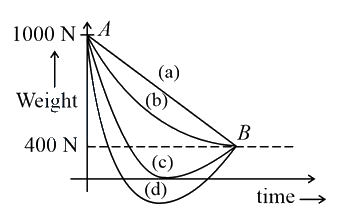 JEE Main/MCQ/Medium/Newton's Law of Gravitation/With diagram
- 19A solid sphere of radius gravitationally attracts a particle placed at from its centre with a force Now a spherical cavity of radius is made in the sphere (as shown in figure) and the force becomes . The value of is:
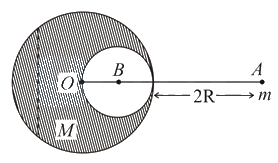 JEE Main/MCQ/Medium/Newton's Law of Gravitation/With diagram
- 20Two stars of masses and at a distance rotate about their common centre of mass in free space. The period of revolution isJEE Main/MCQ/Medium/Newton's Law of Gravitation
- 21Four identical particles of equal masses made to move along the circumference of a circle of radius under the action of their own mutual gravitational attraction. The speed of each particle will be:JEE Main/MCQ/Medium/Newton's Law of Gravitation
- 22The mass density of a spherical galaxy varies as over a large distance from its center. In that region, a small star is in a circular orbit of radius . Then the period of revolution, depends on as:JEE Main/MCQ/Medium/Newton's Law of Gravitation
- 23A satellite of mass is launched vertically upwards with an initial speed from the surface of the earth. After it reaches height ( radius of the earth), it ejects a rocket of mass so that subsequently the satellite moves in a circular orbit. The kinetic energy of the rocket is ( is the gravitational constant; is the mass of the earth):JEE Main/MCQ/Medium/Newton's Law of Gravitation
- 24The ratio of the weights of a body on Earth’s surface to that on the surface of a planet is The mass of the planet is of that of the Earth. If is the radius of the Earth, what is the radius of the planet? (Take the planets to have the same mass density)JEE Main/MCQ/Medium/Newton's Law of Gravitation
- 25Four identical particles of mass are located at the corners of a square of side . What should be their speed if each of them revolves under the influence of other’s gravitational field in a circular orbit circumscribing the square?
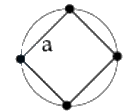 JEE Main/MCQ/Medium/Newton's Law of Gravitation/With diagram
- 26A straight rod of length extends from to The gravitational force it exerts on a point mass 'm' at if the mass per unit length of the rod is is given by:JEE Main/MCQ/Medium/Newton's Law of Gravitation
- 27Take the mean distance of the moon and the sun from the earth to be and respectively. Their masses are and respectively. The radius of the earth is . Let be the difference in the forces exerted by the moon at the nearest and farthest points on the earth and be the difference in the force exerted by the sun at the nearest and farthest points on the earth. Then, the number closest to is:JEE Main/MCQ/Medium/Newton's Law of Gravitation
- 28A particle is moving with a uniform speed in a circular orbit of radius R in a central force inversely proportional to the power of R. If the period of rotation of the particle is T, then:JEE Main/MCQ/Medium/Newton's Law of Gravitation
- 29Match List (Event) with List (Order of the time interval for the happening of the event) and select the correct option from the options given below the lists. List-I List-II The rotation period of earth Revolution period of earth Period of a light wave Period of a sound wave JEE Main/MCQ/Medium/Newton's Law of Gravitation
- 30Acceleration due to gravity on the surface of earth is ' '. If the diameter of earth is reduced to one third of its original value and mass remains unchanged, then the acceleration due to gravity on the surface of the earth is g.JEE Main/Numerical/Medium/Gravitational field
- 31A metal wire of uniform mass density having length and mass is bent to form a semicircular arc and a particle of mass is placed at the centre of the arc. The gravitational force on the particle by the wire is :JEE Main/MCQ/Medium/Gravitational field
- 32Four identical particles of mass are kept at the four corners of a square. If the gravitational force exerted on one of the masses by the other masses is , the length of the sides of the square isJEE Main/MCQ/Medium/Gravitational field
- 33If the radius of earth shrinks by while its mass remains same. The acceleration due to gravity on the earth's surface will approximatelyJEE Main/MCQ/Medium/Gravitational field
- 34The elongation of a wire on the surface of the earth is . The same wire of same dimensions is elongated by on another planet. The acceleration due to gravity on the planet will be _____ . (Take acceleration due to gravity on the surface of earth )JEE Main/Numerical/Medium/Gravitational field
- 35Inside a uniform spherical shell :
(a) The gravitational field is zero.
(b) The gravitational potential is zero.
(c) The gravitational field is the same everywhere.
(d) The gravitation potential is the same everywhere.
(e) All the above.
Choose the most appropriate answer from the options given below:JEE Main/MCQ/Medium/Gravitational field - 36Find the gravitational force of attraction between the ring and sphere as shown in the diagram, where the plane of the ring is perpendicular to the line joining the centres. If is the distance between the centres of a ring (of mass ) and a sphere (mass ) where both have equal radius
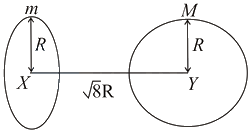 JEE Main/MCQ/Medium/Gravitational field/With diagram
- 37Consider two solid spheres of radii , and masses and respectively. The gravitational field due to sphere and are shown. The value of is:
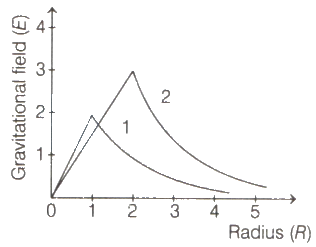 JEE Main/MCQ/Medium/Gravitational field/With diagram
- 38A test particle is moving in a circular orbit in the gravitational field produced by a mass density Identify the current relation between the radius of the particle’s orbit and its period JEE Main/MCQ/Medium/Gravitational field
- 39A solid sphere of mass and radius is surrounded by a uniform concentric spherical shell of thickness and mass The gravitational field at distance from the centre will be:JEE Main/MCQ/Medium/Gravitational field
- 40The mass density of a spherical body is given by for and for where is the distance from the center. The correct graph that describes qualitatively the acceleration, of a test particle as a function of is:JEE Main/MCQ/Medium/Gravitational field
- 41An astronaut of mass is working on a satellite orbiting the earth at a distance from the earth's surface. The radius of the earth is , while its mass is . The gravitational pull on the astronaut isJEE Main/MCQ/Medium/Gravitational field
- 42Four particles, each of mass and equidistant from each other, move along a circle of radius under the action of their mutual gravitational attraction. The speed of each particle isJEE Main/MCQ/Medium/Gravitational field
- 43The change in the value of acceleration of earth towards sun, when the moon comes from the position of solar eclipse to the position on the other side of earth in line with sun is:
(mass of the moon , radius of the moon's orbit ).JEE Main/MCQ/Medium/Gravitational field - 44The gravitational field, due to the 'left over part' of a uniform sphere (from which a part as shown, has been 'removed out'), at a very far off point, , located as shown, would be (nearly) :
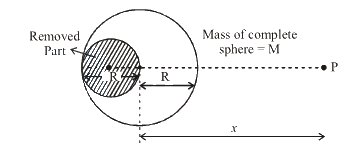 JEE Main/MCQ/Medium/Gravitational field/With diagram
- 45This question contains Statement and Statement-2. Of the four choices given after the statements, choose the one that best describes the two statements.
Statement - I:
For a mass kept at the centre of a cube of side ' ', the flux of gravitational field passing through its sides is GM.
and
Statement - II
If the direction of a field due to a point source is radial and its dependence on the distance ' ' for the source is given as , its flux through a closed surface depends only on the strength of the source enclosed by the surface and not on the size or shape of the surfaceJEE Main/MCQ/Medium/Gravitational field - 46Suppose the gravitational force varies inversely as the nth power of distance. Then the time period planet in circular orbit of radius around the sun will be proportional toJEE Main/MCQ/Medium/Gravitational field
- 47Two spherical bodies of mass and radii respectively are released in free space with initial separation between their centres equal to . If they attract each other due to gravitational force only, then the distance covered by the smaller body just before collision isJEE Main/MCQ/Medium/Gravitational field
- 48If suddenly the gravitational force of attraction between Earth and a satellite revolving around it
becomes zero, then the satellite willJEE Main/MCQ/Medium/Gravitational field - 49When one moves from a point km below the earth's surface to a point km above the earth's surface. The change in is approximately %. The value of is _____.
(Take radius of the earth km.)JEE Main/MCQ/Medium/Acceleration Due to Gravity - 50The height in terms of radius of the earth , at which the acceleration due to gravity becomes , where is acceleration due to gravity on earth's surface, is ______.JEE Main/MCQ/Medium/Acceleration Due to Gravity
- 51Assuming the earth to be a sphere of uniform mass density, a body weighed on the surface of earth. How much it would weigh at R/4 depth under surface of earth ?JEE Main/MCQ/Medium/Acceleration Due to Gravity
- 52A simple pendulum doing small oscillations at a place height above earth surface has time period of . would be it's time period if it is brought to a point which is at a height from earth surface. Choose the correct relation radius of earth :JEE Main/MCQ/Medium/Acceleration Due to Gravity
- 53If is the radius of the earth and the acceleration due to gravity on the surface of earth is , then the length of the second's pendulum at a height from the surface of earth will be:JEE Main/MCQ/Medium/Acceleration Due to Gravity
- 54At what distance above and below the surface of the earth a body will have same weight? (Take radius of earth as )JEE Main/MCQ/Medium/Acceleration Due to Gravity
- 55The acceleration due to gravity on the surface of earth is . If the diameter of earth reduces to half of its original value and mass remains constant, then acceleration due to gravity on the surface of earth would be :JEE Main/MCQ/Medium/Acceleration Due to Gravity
- 56Two planets A and B of radii and have densities and respectively. The ratio of acceleration due to gravity at the surface of B to A is:JEE Main/MCQ/Medium/Acceleration Due to Gravity
- 57The radii of two planets and are and and their densities are and respectively. The ratio of acceleration due to gravity at their surfaces will beJEE Main/MCQ/Medium/Acceleration Due to Gravity
- 58Given below are two statements:
Statement I : Rotation of the earth shows effect on the value of acceleration due to gravity .
Statement II : The effect of rotation of the earth on the value of at the equator is minimum and that at the pole is maximum.
In the light of the above statements, choose the correct answer from the options given belowJEE Main/MCQ/Medium/Acceleration Due to Gravity - 59Assuming the earth to be a sphere of uniform mass density, the weight of a body at a depth from the surface of earth, if its weight on the surface of earth is , will be : (Given radius of earth)JEE Main/MCQ/Medium/Acceleration Due to Gravity
- 60The acceleration due to gravity at height above the earth if (Radius of earth) is given byJEE Main/MCQ/Medium/Acceleration Due to Gravity
- 61The weight of a body on the earth is Then weight of the body when taken to a depth half of the radius of the earth will be:JEE Main/MCQ/Medium/Acceleration Due to Gravity
- 62The weight of a body on the surface of the earth is . The gravitational force on it when taken at a height, from the surface of earth, equal to one-fourth the radius of the earth is:JEE Main/MCQ/Medium/Acceleration Due to Gravity
- 63Given below are two statements :
Statement-I: Acceleration due to gravity is different at different places on the surface of earth.
Statement-II: Acceleration due to gravity increases as we go down below the earth's surface.
In the light of the above statements, choose the correct answer from the options given belowJEE Main/MCQ/Medium/Acceleration Due to Gravity - 64A body weight , is projected vertically upwards from earth's surface to reach a height above the earth which is equal to nine times the radius of earth. The weight of the body at that height will be:JEE Main/MCQ/Medium/Acceleration Due to Gravity
- 65Spherical insulating ball and a spherical metallic ball of same size and mass are dropped from the same height. Choose the correct statement out of the following {Assume negligible air friction}JEE Main/MCQ/Medium/Acceleration Due to Gravity
- 66At a certain depth below surface of earth, value of acceleration due to gravity becomes four times that of its value at a height above earth surface. Where is Radius of earth (Take ). The depth is equal toJEE Main/MCQ/Medium/Acceleration Due to Gravity
- 67 is the time period of simple pendulum on the earth's surface. Its time period becomes when taken to a height (equal to earth's radius) above the earth's surface. Then, the value of will be:JEE Main/MCQ/Medium/Acceleration Due to Gravity
- 68Given below are two statements: one is labelled as Assertion A and the other is labelled as Reason R
Assertion : A pendulum clock when taken to Mount Everest becomes fast.
Reason : The value of g (acceleration due to gravity) is less at Mount Everest than its value on the surface of earth.
In the light of the above statements, choose the most appropriate answer from the options given belowJEE Main/MCQ/Medium/Acceleration Due to Gravity - 69Given below are two statements:
Statement I: Acceleration due to earth's gravity decreases as you go 'up' or 'down' from earth's surface.
Statement II: Acceleration due to earth's gravity is same at a height '' and depth '' from earth's surface, if .
In the light of above statements, choose the most appropriate answer form the options given belowJEE Main/MCQ/Medium/Acceleration Due to Gravity - 70The weight of a body at the surface of earth is . The weight of the body at an altitude of above the earth's surface is (given, radius of earth )JEE Main/MCQ/Medium/Acceleration Due to Gravity
- 71If the acceleration due to gravity experienced by a point mass at a height above the surface of earth is same as that of the acceleration due to gravity at a depth ) from the earth surface. The value of will be _____ .
(use )JEE Main/Numerical/Medium/Acceleration Due to Gravity - 72Assume there are two identical simple pendulum Clocks- is placed on the earth and Clock- is placed on a space station located at a height h above the earth surface. Clock- and Clock- operate at time periods and respectively. Then the value of is -
(consider radius of earth and on earth )JEE Main/MCQ/Medium/Acceleration Due to Gravity - 73The percentage decrease in the weight of a rocket, when taken to a height of above the surface of earth will, be
(Radius of earth )JEE Main/MCQ/Medium/Acceleration Due to Gravity - 74An object is taken to a height above the surface of earth at a distance from the centre of the earth. Where radius of earth, . The percentage decrease in the weight of the object will beJEE Main/MCQ/Medium/Acceleration Due to Gravity
- 75The length of a seconds pendulum at a height from earth surface will be:
(Given: Radius of earth and acceleration due to gravity at the surface of earth )JEE Main/MCQ/Medium/Acceleration Due to Gravity - 76Given below are two statements: One is labelled as Assertion A and the other is labelled as Reason R.
Assertion A: If we move from poles to equator, the direction of acceleration due to gravity of earth always points towards the center of earth without any variation in its magnitude.
Reason R: At equator, the direction of acceleration due to the gravity is towards the center of earth.
In the light of above statements, choose the correct answer from the options given belowJEE Main/MCQ/Medium/Acceleration Due to Gravity - 77The variation of acceleration due to gravity with distance from the center of the earth is correctly represented by
(Given radius of earth)JEE Main/MCQ/Medium/Acceleration Due to Gravity - 78The height of any point above the surface of earth is equal to diameter of earth. The value of acceleration due to gravity at point will be : (Given acceleration due to gravity at the surface of earth).JEE Main/MCQ/Medium/Acceleration Due to Gravity
- 79The approximate height from the surface of earth at which the weight of the body becomes of its weight on the surface of earth is :
[Radius of earth and ]JEE Main/MCQ/Medium/Acceleration Due to Gravity - 80If be the radius of Earth, then the ratio between the acceleration due to gravity at a depth below and a height above the earth surface is:
(Given : )JEE Main/MCQ/Medium/Acceleration Due to Gravity - 81Consider a planet in some solar system that has a mass double the mass of earth and density equal to the average density of the earth. If the weight of an object on earth is , the weight of the same object on that planet will be:JEE Main/MCQ/Medium/Acceleration Due to Gravity
- 82In the reported figure of earth, the value of acceleration due to gravity is same at point and but it is smaller than that of its value at point (surface of the earth). The value of will be . The value of is
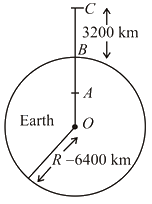 JEE Main/Numerical/Medium/Acceleration Due to Gravity/With diagram
- 83A body weighs on a spring balance at the north pole. What will be its weight recorded on the same weighing machine, if it is shifted to the equator?
[Use and radius of earth, ]JEE Main/MCQ/Medium/Acceleration Due to Gravity - 84The acceleration due to gravity on the earth's surface at the poles is and angular velocity of the earth about the axis passing through the pole is . An object is weighed at the equator and at a height above the poles by using a spring balance. If the weights are found to be same, then is: (, where is the radius of the earth)JEE Main/MCQ/Medium/Acceleration Due to Gravity
- 85The value of the acceleration due to gravity is at a height ( radius of the earth) from the surface of the earth. It is again equal to at a depth below the surface the earth. The ratio equals:JEE Main/MCQ/Medium/Acceleration Due to Gravity
- 86The mass density of a planet of radius R varies with the distance r from its centre as Then the gravitational field is maximum at:JEE Main/MCQ/Medium/Acceleration Due to Gravity
- 87The height ‘’ at which the weight of a body will be the same as that at the same depth ‘h’ from the surface of the earth is (Radius of the earth is and effect of the rotation of the earth is neglected)JEE Main/MCQ/Medium/Acceleration Due to Gravity
- 88A box weighs on a spring balance at the north pole. Its weight recorded on the same balance if it is shifted to the equator is close to (Take at the north pole and the radius of the earth ):JEE Main/MCQ/Medium/Acceleration Due to Gravity
- 89The value of acceleration due to gravity at Earth's surface is . The altitude above its surface at which the acceleration due to gravity decreases to , is close to: (Radius of earth )JEE Main/MCQ/Medium/Acceleration Due to Gravity
- 90The mass and the diameter of a planet are three times the respective values for the Earth. The period of oscillation of a simple pendulum on the Earth is . The period of oscillation of the same pendulum on the planet would be:JEE Main/MCQ/Medium/Acceleration Due to Gravity
- 91A heavy ball of mass is suspended from the ceiling of a car by a light string of mass When the car is at rest, the speed of transverse waves in the string is When the car has acceleration the wave-speed increases to The value of in terms of gravitational acceleration is closed toJEE Main/MCQ/Medium/Acceleration Due to Gravity
- 92Suppose that the angular velocity of rotation of the Earth is increased. Then, as a consequence,JEE Main/MCQ/Medium/Acceleration Due to Gravity
- 93Take the mean distance of the moon and the sun from the earth to be and , respectively. Their masses are and , respectively. The radius of the earth is . Let be the difference in the forces exerted by the moon at the nearest and farthest point on the earth, and be the difference in the forces exerted by the sun at the nearest and farthest points on the earth. Then, the number closest to is,JEE Main/MCQ/Medium/Acceleration Due to Gravity
- 94If the Earth has no rotational motion, the weight of a person on the equator is . Determine the speed with which the earth would have to rotate about its axis so that the person at the equator will weigh . The radius of the Earth is and JEE Main/MCQ/Medium/Acceleration Due to Gravity
- 95The variation of acceleration due to gravity with distance from the centre of the earth is best represented by (= Earth's radius):JEE Main/MCQ/Medium/Acceleration Due to Gravity
- 96Assuming the earth to be a sphere of uniform density, the acceleration due to gravity inside the earth at a distance of from the centre is proportional toJEE Main/MCQ/Medium/Acceleration Due to Gravity
- 97Which graph correctly presents the variation of acceleration due to gravity with the distance from the centre of the earth (radius of the earth )?JEE Main/MCQ/Medium/Acceleration Due to Gravity
- 98The height at which the acceleration due to gravity becomes (where the acceleration due to gravity on the surface of the earth) in terms of , the radius of the earth isJEE Main/MCQ/Medium/Acceleration Due to Gravity
- 99The change in the value of at a height ' ' above the surface of the earth is the same as at a depth 'd' below the surface of earth. When both ' ' and ' ' are much smaller than the radius of earth, then which one of the following is correct?JEE Main/MCQ/Medium/Acceleration Due to Gravity
- 100Average density of the earthJEE Main/MCQ/Medium/Acceleration Due to Gravity
- 101Net gravitational force at the center of a square is found to be when four particles having mass and are placed at the four corners of the square as shown in figure and it is when the positions of and are interchanged. The ratio is . The value of is .
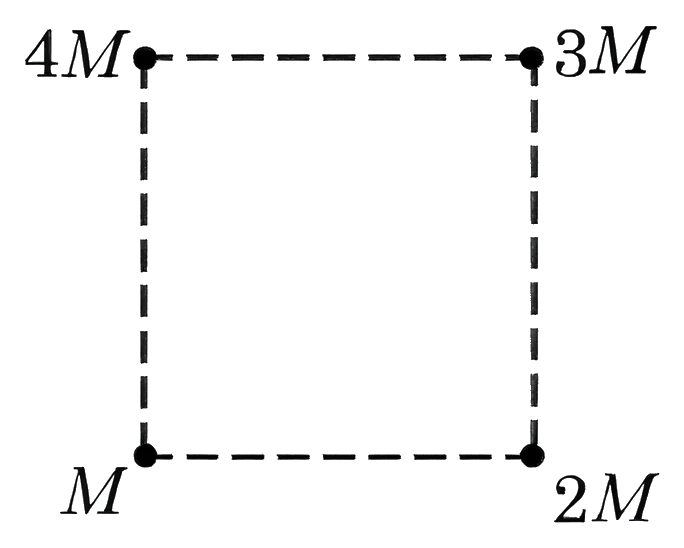 JEE Main/MCQ/Medium/Work done/With diagram
- 102Net gravitational force at the center of a square is found to be when four particles having mass and are placed at the four corners of the square as shown in figure and it is when the positions of and are interchanged. The ratio is . The value of is .JEE Main/MCQ/Medium/Newton’s Law of Gravitation/With diagram
- 103A body of mass is taken from the surface of earth to a height equal to twice the radius of earth (). The increase in potential energy will be _______.
( is acceleration due to gravity at the surface of earth)JEE Main/MCQ/Medium/Gravitational potential and Potential Energy - 104If a body of mass kg falls on the earth from infinity, it attains velocity and kinetic energy on reaching the surface of earth. The values of and respectively are _______. (Take radius of earth to be km and m/s)JEE Main/MCQ/Medium/Gravitational potential and Potential Energy
- 105Three masses and 400 kg are placed at the vertices of an equilateral triangle with sides 20 m. They are rearranged on the vertices of a bigger triangle of side 25 m and with the same centre. The work done in this process J. (Gravitational constant )JEE Main/MCQ/Medium/Gravitational potential and Potential Energy
- 106The escape velocity from a spherical planet is . The escape velocity from another planet whose density and radius are of those of planet , is .JEE Main/MCQ/Medium/Gravitational potential and Potential Energy
- 107An object is kept at rest at a distance of 3 R above the earth's surface where R is earth's radius. The minimum speed with which it must be projected so that it does not return to earth is :
(Assume mass of earth, Universal gravitational constant)JEE Main/MCQ/Medium/Gravitational potential and Potential Energy - 108Given below are two statements: one is labelled as Assertion and the other is labelled as Reason Assertion A : The kinetic energy needed to project a body of mass m from earth surface to infinity is , where R is the radius of earth.
Reason : The maximum potential energy of a body is zero when it is projected to infinity from earth surface.
In the light of the above statements, choose the correct answer from the option given belowJEE Main/MCQ/Medium/Gravitational potential and Potential Energy - 109A satellite of mass 1000 kg is launched to revolve around the earth in an orbit at a height of 270 km from the earth's surface. Kinetic energy of the satellite in this orbit is ______ .
(Mass of earth , Radius of earth , Gravitational constant
JEE Main/Numerical/Medium/Gravitational potential and Potential Energy - 110Earth has mass 8 times and radius 2 times that of a planet. If the escape velocity from the earth is , the escape velocity in from the planet will be :JEE Main/MCQ/Medium/Gravitational potential and Potential Energy
- 111An astronaut takes a ball of mass from earth to space. He throws the ball into a circular orbit about earth at an altitude of . From earth's surface to the orbit, the change in total mechanical energy of the ball is . The value of is (take :JEE Main/MCQ/Medium/Gravitational potential and Potential Energy
- 112To project a body of mass from earth's surface to infinity, the required kinetic energy is (assume, the radius of earth is acceleration due to gravity on the surface of earth):JEE Main/MCQ/Medium/Gravitational potential and Potential Energy
- 113Match List I with List II :
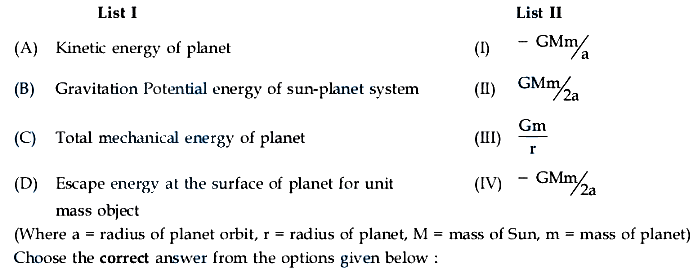 JEE Main/MCQ/Medium/Gravitational potential and Potential Energy/With diagram
- 114The mass of the moon is times the mass of a planet and its diameter times the diameter of a planet. If the escape velocity on the planet is v, the escape velocity on the moon will be:JEE Main/MCQ/Medium/Gravitational potential and Potential Energy
- 115Escape velocity of a body from earth is . If the radius of a planet be one-third the radius of earth and mass be one-sixth that of earth, the escape velocity from the plate is:JEE Main/MCQ/Medium/Gravitational potential and Potential Energy
- 116The gravitational potential at a point above the surface of earth is and the acceleration due to gravity at that point is . Assume that the mean radius of earth to be . The height of this point above the earth's surface is:JEE Main/MCQ/Medium/Gravitational potential and Potential Energy
- 117Given below are two statements:
Statement I : For a planet, if the ratio of mass of the planet to its radius increase, the escape velocity from the planet also increase.
Statement II : Escape velocity is independent of the radius of the planet.
In the light of above statements, choose the most appropriate answer from the options given belowJEE Main/MCQ/Medium/Gravitational potential and Potential Energy - 118A planet having mass and radius where and are mass and radius of earth respectively, has escape velocity in given by: (Given escape velocity on earth )JEE Main/MCQ/Medium/Gravitational potential and Potential Energy
- 119The ratio of escape velocity of a planet to the escape velocity of earth will be:-
Given: Mass of the planet is times mass of earth and radius of the planet is times the radius of earth.JEE Main/MCQ/Medium/Gravitational potential and Potential Energy - 120Two satellites and move round the earth in the same orbit. The mass of is twice the mass of . The quantity which is same for the two satellites will beJEE Main/MCQ/Medium/Gravitational potential and Potential Energy
- 121Given below are two statements:
Statement I: Ifbe the total energy of a satellite moving around the earth, then its potential energy will be .
Statement II: The kinetic energy of a satellite revolving in an orbit is equal to the half the magnitude of total energy .
In the light of the above statements, choose the most appropriate answer from the options given below.JEE Main/MCQ/Medium/Gravitational potential and Potential Energy - 122For a body projected at an angle with the horizontal from the ground, choose the correct statementJEE Main/MCQ/Medium/Gravitational potential and Potential Energy
- 123The escape velocities of two planets are in the ratio . If the ratio of their radii respectively is , then the ratio of acceleration due to gravity of planet to the acceleration of gravity of planet will be:JEE Main/MCQ/Medium/Gravitational potential and Potential Energy
- 124If earth has a mass nine times and radius twice to the of a planet . Then will be the minimum velocity required by a rocket to pull out of gravitational force of , where ve is escape velocity on earth. The value of isJEE Main/MCQ/Medium/Gravitational potential and Potential Energy
- 125If the gravitational field in the space is given as . Taking the reference point to be at with gravitational potential . Find the gravitational potentials at in SI unit (Given, that )JEE Main/MCQ/Medium/Gravitational potential and Potential Energy
- 126A body of mass is taken from earth surface to the height equal to twice the radius of earth , the increase in potential energy will be : ( acceleration due to gravity on the surface of earth)JEE Main/MCQ/Medium/Gravitational potential and Potential Energy
- 127An object of mass is taken to a height from the surface of earth which is equal to three times the radius of earth. The gain in potential energy of the object will be
[If, and radius of earth ]JEE Main/MCQ/Medium/Gravitational potential and Potential Energy - 128A body of mass is projected with velocity in vertically upward direction from the surface of the earth into space. It is given that is escape velocity and . If air resistance is considered to the negligible, then the maximum height from the centre of earth, to which the body can go, will be ( : radius of earth)JEE Main/MCQ/Medium/Gravitational potential and Potential Energy
- 129A body is projected vertically upwards from the surface of earth with a velocity equal to one third of escape velocity. The maximum height attained by the body will be
(Take radius of earth and )JEE Main/MCQ/Medium/Gravitational potential and Potential Energy - 130The escape velocity of a body on a planet is . The escape velocity of the body on another planet , whose density is four times and radius is half of the planet , isJEE Main/MCQ/Medium/Gravitational potential and Potential Energy
- 131Four spheres each of mass form square of side (as shown in figure). A fifth sphere of mass is situated at the centre of square. The total gravitational potential energy of the system is
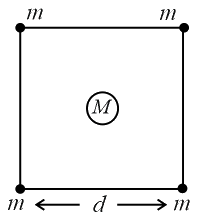 JEE Main/MCQ/Medium/Gravitational potential and Potential Energy/With diagram
- 132A mass of is placed at the center of a uniform spherical shell of mass and radius . If the gravitational potential at a point, from the center is . The value of is:JEE Main/MCQ/Medium/Gravitational potential and Potential Energy
- 133A body of mass splits into four masses which are rearranged to form a square as shown in the figure. The ratio of for which, the gravitational potential energy of the system becomes maximum is The value of is ________.
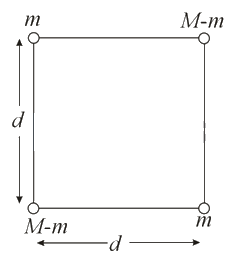 JEE Main/Numerical/Medium/Gravitational potential and Potential Energy/With diagram
- 134The minimum and maximum distances of a planet revolving around the Sun are and . If the minimum speed of the planet on its trajectory is , then its maximum speed will be:JEE Main/MCQ/Medium/Gravitational potential and Potential Energy
- 135A body is projected vertically upwards from the surface of earth with a velocity sufficient enough to carry it to infinity. The time taken by it to reach height is JEE Main/MCQ/Medium/Gravitational potential and Potential Energy
- 136The radius in kilometer to which the present radius of earth to be compressed so that the escape velocity is increased time is _______.JEE Main/Numerical/Medium/Gravitational potential and Potential Energy
- 137If one wants to remove all the mass of the earth to infinity in order to break it up completely. The amount of energy that needs to be supplied will be where is ________.
(Round off to the Nearest Integer)
( is the mass of earth, is the radius of earth, is the gravitational constant)JEE Main/Numerical/Medium/Gravitational potential and Potential Energy - 138The initial velocity required to project a body vertically upward from the surface of the earth to reach a height of , where is the radius of the earth, may be described in terms of escape velocity such that . The value of will beJEE Main/Numerical/Medium/Gravitational potential and Potential Energy
- 139Given below are two statements : one is labelled as Assertion and the other is labelled as Reason .
Assertion : The escape velocities of planet and are same. But and are of unequal mass.
Reason : The product of their mass and radius must be same. In the light of the above statements, choose the most appropriate answer from the options given below :JEE Main/MCQ/Medium/Gravitational potential and Potential Energy - 140Two planets have masses and and their radii are a and , respectively. The separation between the centres of the planets is . A body of mass is fired from the surface of the larger planet towards the smaller planet along the line joining their centres. For the body to be able to reach at the surface of smaller planet, the minimum firing speed needed is :JEE Main/MCQ/Medium/Gravitational potential and Potential Energy
- 141On the -axis and at a distance from the origin, the gravitational field due to a mass distribution is given by in the -direction. The magnitude of the gravitational potential on the -axis at a distance , taking its value to be zero at infinity is:JEE Main/MCQ/Medium/Gravitational potential and Potential Energy
- 142Planet has mass and radius Planet has half the mass and half the radius of Planet If the escape velocities from the Planets and are and respectively, then The value of is:JEE Main/MCQ/Medium/Gravitational potential and Potential Energy
- 143An asteroid is moving directly towards the centre of the earth. When at a distance of ( is the radius of the earth) from the centre of the earth, it has a speed of Neglecting the effect of earth's atmosphere, what will be the speed of the asteroid when it hits the surface of the earth (escape velocity from the earth is ? Give your answer to the nearest integer in __________.JEE Main/Numerical/Medium/Gravitational potential and Potential Energy
- 144A rocket has to be launched from earth in such a way that it never returns. If is the minimum energy delivered by the rocket launcher, what should be the minimum energy that the launcher should have, if the same rocket is to be launched from the surface of the moon? Assume that the density of the earth and the moon are equal and that the earth's volume is times the volume of the moon.JEE Main/MCQ/Medium/Gravitational potential and Potential Energy
- 145Two stars of masses each, and at distance rotate in a plane about their common centre of mass A meteorite passes through moving perpendicular to the stars,s rotation plane. In order to escape from the gravitational field of this double star, the minimum speed that meteorite should have at is ( Take Gravitational constant )JEE Main/MCQ/Medium/Gravitational potential and Potential Energy
- 146The energy required to take a satellite to a height above the Earth surface (radius of Earth ) is , and the kinetic energy required for the satellite to be in a circular orbit at this height is The value of for which and are equal, isJEE Main/MCQ/Medium/Gravitational potential and Potential Energy
- 147A body of mass is moving in a circular orbit of radius about a planet of mass . At some instant, it splits into two equal masses. The first mass moves in a circular orbit of radius . And the other mass, in a circular orbit of radius The difference between the final and the initial total energies isJEE Main/MCQ/Medium/Gravitational potential and Potential Energy
- 148A body of mass is moving in a circular orbit of radius about a planet of mass . At some instant, it splits into two equal masses. The first mass moves in a circular orbit of radius , and the other mass, in a circular orbit of radius . The difference between the final and initial total energies is:JEE Main/MCQ/Medium/Gravitational potential and Potential Energy
- 149Which of the following most closely depicts the correct variation of the gravitation potential, with distance due to a large planet of radius and uniform mass density? (figures are not drawn to scale)JEE Main/MCQ/Medium/Gravitational potential and Potential Energy
- 150From a solid sphere of mass and radius a spherical portion of radius is removed as shown in the figure. Taking gravitational potential at the potential at the centre of the cavity thus formed is (gravitational constant)
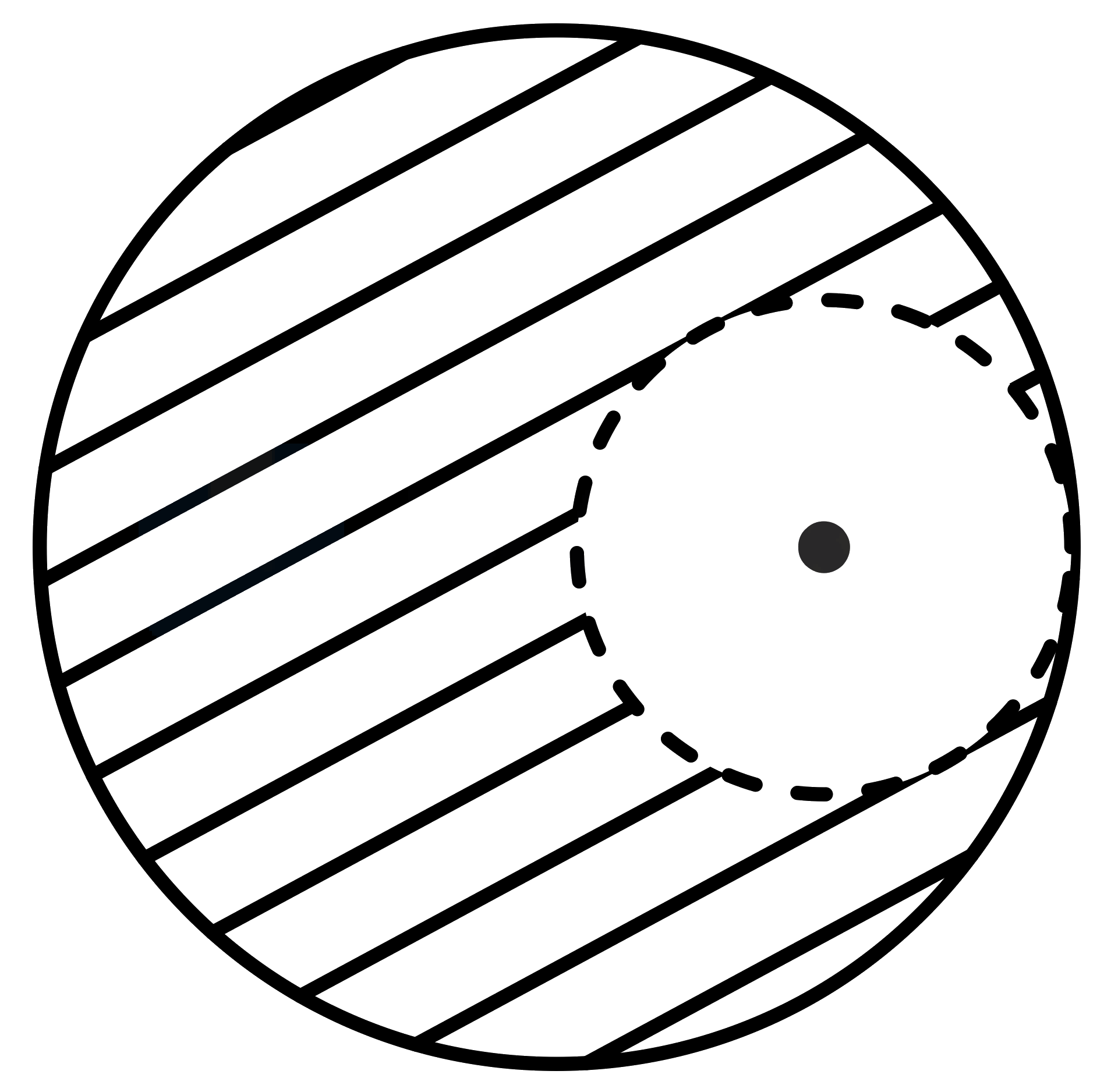 JEE Main/MCQ/Medium/Gravitational potential and Potential Energy/With diagram
- 151The gravitational field in a region is given by . The change in the gravitational potential energy of a particle of mass when it is taken from the origin to a point isJEE Main/MCQ/Medium/Gravitational potential and Potential Energy
- 152
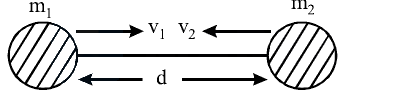
Two hypothetical planets of masses and are at rest when they are infinite distance apart. Because of the gravitational force they move towards each other along the line joining their centres. What is their speed when their separation is ' '?
(Speed of is and that of is )JEE Main/MCQ/Medium/Gravitational potential and Potential Energy/With diagram - 153From a sphere of mass and radius , a smaller sphere of radius is carved out such that the cavity made in the original sphere is between its centre and the periphery (See figure). For the configuration in the figure where the distance between the centre of the original sphere and the removed sphere is 3R, the gravitational force between the two sphere is:
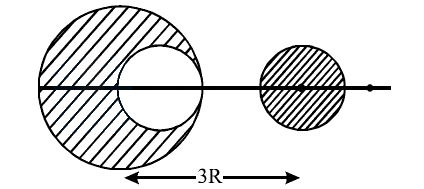 JEE Main/MCQ/Medium/Gravitational potential and Potential Energy/With diagram
- 154What is the minimum energy required to launch a satellite of mass from the surface of a planet of mass and radius in a circular orbit at an altitude of ?JEE Main/MCQ/Medium/Gravitational potential and Potential Energy
- 155A point particle is held on the axis of a ring of mass and radius at a distance from its centre . When released, it reaches under the gravitational attraction of the ring. Its speed at will beJEE Main/MCQ/Medium/Gravitational potential and Potential Energy
- 156The mass of a spaceship is . It is to be launched from the earth's surface out into free space. The value of ' ' and ' ' (radius of earth) are and respectively. The required energy for this work will be ;JEE Main/MCQ/Medium/Gravitational potential and Potential Energy
- 157Two bodies of masses and are placed at a distance . The gravitational potential at a point on the line joining them where the gravitational field is zero is:JEE Main/MCQ/Medium/Gravitational potential and Potential Energy
- 158A planet in a distant solar system is 10 times more massive than the earth and its radius is 10 times smaller. Given that the escape velocity from the earth is , the escape velocity from the surface of the planet would beJEE Main/MCQ/Medium/Gravitational potential and Potential Energy
- 159A particle of mass is kept on the surface of a uniform sphere of mass and radius . Find the work to be done against the gravitational force between them to take the particle far away from the sphere (you may take )JEE Main/MCQ/Medium/Gravitational potential and Potential Energy
- 160If is the acceleration due to gravity on the earth's surface, the gain in the potential energy of object of mass raised from the surface of the earth to a height equal to the radius of the earth isJEE Main/MCQ/Medium/Gravitational potential and Potential Energy
- 161The escape velocity for a body projected vertically upwards from the surface of earth is . If the body is projected at an angle of with the vertical, the escape velocity will beJEE Main/MCQ/Medium/Gravitational potential and Potential Energy
- 162The escape velocity of a body depends upon mass asJEE Main/MCQ/Medium/Gravitational potential and Potential Energy
- 163Energy required to move a body of mass m from an orbit of radius 2R to 3R isJEE Main/MCQ/Medium/Gravitational potential and Potential Energy
- 164The kinetic energy needed to project a body of mass from the earth surface (radius ) to infinity isJEE Main/MCQ/Medium/Gravitational potential and Potential Energy
- 165Given below are two statements:
Statement I: A satellite is moving around earth in the orbit very close to the earth surface. The time period of revolution of satellite depends upon the density of earth.
Statement II: The time period of revolution of the satellite is (for satellite very close to the earth surface), where radius of earth and acceleration due to gravity.
In the light of the above statements, choose the correct answer from the options given below :JEE Main/MCQ/Medium/Motion of satellite - 166Initially a satellite of 100 kg is in a circular orbit of radius . This satellite can be moved to a circular orbit of radius by supplying of energy. The value of is . (Take Radius of Earth and )JEE Main/MCQ/Medium/Motion of satellite
- 167A satellite is launched into a circular orbit of radius ' R ' around the earth. A second satellite is launched into an orbit of radius 1.03 R . The time period of revolution of the second satellite is larger than the first one approximately byJEE Main/MCQ/Medium/Motion of satellite
- 168A satellite of mass is revolving around earth in a circular orbit at a height of from earth surface. The angular momentum of the satellite is . The value of is ______ , where and are the mass and radius of earth, respectively. ( G is the gravitational constant)JEE Main/Numerical/Medium/Motion of satellite
- 169A satellite of mass is revolving in circular orbit of radius . If energy is supplied to the satellite, it would revolve in a new circular orbit of radius
(use radius of earth)JEE Main/MCQ/Medium/Motion of satellite - 170Two satellite and go round a planet in circular orbits having radii and respectively. If the speed of is , the speed of will be :JEE Main/MCQ/Medium/Motion of satellite
- 171Correct formula for height of a satellite from earths surface is:JEE Main/MCQ/Medium/Motion of satellite
- 172Given below are two statements : one is labelled as Assertion (A) and the other is labelled as Reason (R).
Assertion (A) : The angular speed of the moon in its orbit about the earth is more than the angular speed of the earth in its orbit about the sun.
Reason (R): The moon takes less time to move around the earth than the time taken by the earth to move around the sun.
In the light of the above statements, choose the most appropriate answer from the options given below :JEE Main/MCQ/Medium/Motion of satellite - 173A space ship of mass is launched into a circular orbit close to the earth surface. The additional velocity to be imparted to the space ship in the orbit to overcome the gravitational pull will be (if and radius of earth ):JEE Main/MCQ/Medium/Motion of satellite
- 174The time period of a satellite, revolving above earth's surface at a height equal to will be (Given radius of earth)JEE Main/MCQ/Medium/Motion of satellite
- 175Two satellites of masses and revolve around the earth in circular orbits of radii r&3r respectively. The ratio of orbital speeds of the satellites respectively isJEE Main/MCQ/Medium/Motion of satellite
- 176Given below are two statements: one is labelled as Assertion A and the other is labelled as Reason R.
Assertion A: Earth has atmosphere whereas moon doesn’t have any atmosphere.
Reason R: The escape velocity on moon is very small as compared to that on earth.
In the light of the above statements, choose the correct answer from the options given below:JEE Main/MCQ/Medium/Motion of satellite - 177The time period of a satellite of earth is hours. If the separation between the earth and the satellite is decreased to one fourth of the previous value, then its new time period will become.JEE Main/MCQ/Medium/Motion of satellite
- 178Every planet revolves around the sun in an elliptical orbit :
A. The force acting on a planet is inversely proportional to square of distance from sun.
B. Force acting on planet is inversely proportional to product of the masses of the planet and the sun.
C. The centripetal force acting on the planet is directed away from the sun.
D. The square of time period of revolution of planet around sun is directly proportional to cube of semi-major axis of elliptical orbit.
Choose the correct answer from the options given below :JEE Main/MCQ/Medium/Motion of satellite - 179If the distance of the earth from Sun is , then the distance of an imaginary planet from Sun, if its period of revolution is years is:JEE Main/MCQ/Medium/Motion of satellite
- 180Two satellites and having masses in the ratio are revolving in circular orbits of radii and respectively around the earth. The ratio of total mechanical energy of to isJEE Main/MCQ/Medium/Motion of satellite
- 181Two satellites and are revolving in circular orbits around a planet with radius and respectively. The ratio of speed of satellite to the speed of satellite in their respective orbits would be where JEE Main/Numerical/Medium/Motion of satellite
- 182Two identical particles of mass each go round a circle of radius , under the action of their mutual gravitational attraction. The angular speed of each particle is:JEE Main/MCQ/Medium/Motion of satellite
- 183Suppose two planets (spherical in shape) of radii and but mass and respectively have a centre to centre separation as shown in the figure. A satellite of mass is projected from the surface of the planet of mass directly towards the centre of the second planet. The minimum speed required for the satellite to reach the surface of the second planet is , then the value of is
[Given : The two planets are fixed in their position]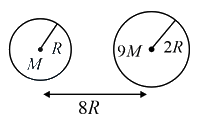 JEE Main/Numerical/Medium/Motion of satellite/With diagram
- 184A geostationary satellite is orbiting around an arbitrary planet at a height of above the surface of , being the radius of . The time period of another satellite in hours at a height of from the surface of is ________ has the time period of JEE Main/MCQ/Medium/Motion of satellite
- 185Two satellites and of masses and are revolving round the earth at height of and respectively. If and are the time periods of and respectively then the value of :
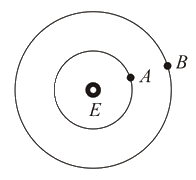
[ Given : radius of earth mass of earth ]JEE Main/MCQ/Medium/Motion of satellite/With diagram - 186Consider two satellites and with periods of revolution and respectively revolving around a planet in circular orbits. The ratio of angular velocity of satellite to the angular velocity of satellite is:JEE Main/MCQ/Medium/Motion of satellite
- 187A body is moving in a low circular orbit about a planet of mass and radius . The radius of the orbit can be taken to be itself. Then the ratio of the speed of this body in the orbit to the escape velocity from the planet is:JEE Main/MCQ/Medium/Motion of satellite
- 188A satellite is moving in a low nearly circular orbit around the earth. Its radius is roughly equal to that of the earth's radius By firing rockets attached to it, its speed is instantaneously increased in the direction of its motion so that it become times larger. Due to this the farthest distance from the centre of the earth that the satellite reaches is . Value of is :JEE Main/MCQ/Medium/Motion of satellite
- 189A body A of mass is moving in a circular orbit of radius about a planet. Another body B of mass collides with A with a velocity which is half the instantaneous velocity of A. The collision is completely inelastic. Then, the combined body:JEE Main/MCQ/Medium/Motion of satellite
- 190A spaceship orbits around a planet at a height of from its surface. Assuming that only gravitational field of the planet acts on the spaceship, what will be the number of complete revolutions made by the spaceship in hours around the planet?
[Given: Mass of planet ,
Radius of planet
Gravitational constant ]JEE Main/MCQ/Medium/Motion of satellite - 191Two satellites, and , have masses and respectively. is in a circular orbit of radius and is in a circular orbit of radius around the earth. The ratio of their kinetic energies, is:JEE Main/MCQ/Medium/Motion of satellite
- 192A satellite of mass is in a circular orbit of radius about the center of the earth. A meteorite of the same mass, falling towards the earth, collides with the satellite completely inelastic. The speeds of the satellite and the meteorite are the same, just before the collision. The subsequent motion of the combined body will be:JEE Main/MCQ/Medium/Motion of satellite
- 193A satellite is revolving in a circular orbit at a height h from the carth surface, such that where is the radius of the earth. Assuming that the effect of earth"s atmosphere can be neglected the minimum increase in the speed required so that the satellite could escape from the gravitational field of earth isJEE Main/MCQ/Medium/Motion of satellite
- 194A satellite is moving with a constant speed in circular orbit around the earth. An object of mass 'm' is ejected from the satellite such that it just escapes from the gravitational pull of the earth. At the time of ejection, the kinetic energy of the object is:JEE Main/MCQ/Medium/Motion of satellite
- 195A satellite is revolving in a circular orbit at a height from the earth's surface (radius of earth ; ). The minimum increase in its orbital velocity required, so that the satellite could escape from the earth's gravitational field, is close to (Neglect the effect of atmosphere.)JEE Main/MCQ/Medium/Motion of satellite
- 196The time period of an earth satellite in circular orbit is independent ofJEE Main/MCQ/Medium/Motion of satellite
- 197A satellite of mass revolves around the earth of radius at a height from its surface. If is the acceleration due to gravity on the surface of the earth, the orbital speed of the satellite isJEE Main/MCQ/Medium/Motion of satellite
- 198The time period of a satellite of earth is 5 hours. If the separation between the earth and the satellite is increased to 4 times the previous value, the new time period will becomeJEE Main/MCQ/Medium/Motion of satellite
- 199A planet is moving around the star of mass in the orbit of radius . Another planet is moving around another star of mass in a orbit of radius . Ratio of time periods of revolution of and is _______.JEE Main/MCQ/Medium/Kepler laws
- 200Given below are two statements: one is labelled as Assertion (A) and the other is labelled as Reason (R).
Assertion (A) : The radius vector from the Sun to a planet sweeps out equal areas in equal intervals of time and thus areal velocity of planet is constant.
Reason (R) : For a central force field the angular momentum is a constant.
In the light of the above statements, choose the most appropriate answer from the options given below :JEE Main/MCQ/Medium/Kepler laws - 201Two planets, and are orbiting a common star in circular orbits of radii and , respectively, with . The planet is times more massive than planet . The ratio of angular momentum of planet to that of planet is closest to integer ________.JEE Main/Numerical/Medium/Kepler laws
- 202If a satellite orbiting the Earth is 9 times closer to the Earth than the Moon, what is the time period of rotation of the satellite? Given rotational time period of Moon days and gravitational attraction between the satellite and the moon is neglected.JEE Main/MCQ/Medium/Kepler laws
- 203Two planets and having masses and move around the sun in circular orbits of and radii respectively. If angular momentum of is and that of is , the ratio of time period is:JEE Main/MCQ/Medium/Kepler laws
- 204A satellite revolving around a planet in stationary orbit has time period 6 hours. The mass of planet is one-fourth the mass of earth. The radius orbit of planet is :
Given Radius of geo-stationary orbit for earth is )JEE Main/MCQ/Medium/Kepler laws - 205A light planet is revolving around a massive star in a circular orbit of radius with a period of revolution If the force of attraction between planet and star is proportional to then choose the correct option :JEE Main/MCQ/Medium/Kepler laws
- 206A planet takes days to complete one revolution around the Sun. If the distance of the planet from Sun is reduced to one fourth of the original distance, how many days will it take to complete one revolution?JEE Main/MCQ/Medium/Kepler laws
- 207If the earth suddenly shrinks to of its original volume with its mass remaining the same, the period of rotation of earth becomes . The value of is ________JEE Main/Numerical/Medium/Kepler laws
- 208The orbital angular momentum of a satellite is , when it is revolving in a circular orbit at height from earth surface. If the distance of satellite from the earth centre is increased by eight times to its initial value, then the new angular momentum will beJEE Main/MCQ/Medium/Kepler laws
- 209Choose the incorrect statement from the following:JEE Main/MCQ/Medium/Kepler laws
- 210The time period of a satellite revolving around earth in a given orbit is hours. If the radius of orbit is increased to three times its previous value, then approximate new time period of the satellite will beJEE Main/MCQ/Medium/Kepler laws
- 211Two planets and of equal mass are having their period of revolutions and such that . These planets are revolving in the circular orbits of radii and respectively. Which out of the following would be the correct relationship of their orbits?JEE Main/MCQ/Medium/Kepler laws
- 212The distance between Sun and Earth is . The duration of year if the distance between Sun and Earth becomes will be :JEE Main/MCQ/Medium/Kepler laws
- 213When a body slides down from rest along a smooth inclined plane making an angle of with the horizontal, it takes time When the same body slides down from the rest along a rough inclined plane making the same angle and through the same distance, it takes time where is a constant greater than The co-efficient of friction between the body and the rough plane is where x=__________.JEE Main/Numerical/Medium/Kepler laws
- 214A satellite is launched into a circular orbit of radius around earth, while a second satellite is launched into a circular orbit of radius The percentage difference in the time periods of the two satellites is:JEE Main/MCQ/Medium/Kepler laws
- 215The angular momentum of a planet of mass moving around the sun in an elliptical orbit is . The magnitude of the areal velocity of the planet is :JEE Main/MCQ/Medium/Kepler laws
- 216The time period of a satellite in a circular orbit of the radius is The period of another satellite in a circular orbit of the radius is:JEE Main/MCQ/Medium/Kepler laws
- 217A planet revolving in elliptical orbit has :
A. a constant velocity of revolution.
B. has the least velocity when it is nearest to the sun.
C. its areal velocity is directly proportional to its velocity.
D. areal velocity is inversely proportional to its velocity.
E. to follow a trajectory such that the areal velocity is constant.
Choose the correct answer from the options given below:JEE Main/MCQ/Medium/Kepler laws - 218A satellite is in an elliptical orbit around a planet It is observed that the velocity of the satellite when it is farthest from the planet is 6 times less than that when it is closest to the planet. The ratio of distances between the satellite and the planet at closest and farthest points is :JEE Main/MCQ/Medium/Kepler laws
- 219If the angular momentum of a planet of mass moving around the Sun in a circular orbit is about the center of the Sun, its areal velocity is:JEE Main/MCQ/Medium/Kepler laws
- 220The relative uncertainty in the period of a satellite orbiting around the earth is . If the relative uncertainty in the radius of the orbit is negligible, the relative uncertainty in the mass of the earth is:JEE Main/MCQ/Medium/Kepler laws
- 221The figure shows an elliptical path of a planet around the sun such that the area of triangle is the area of the ellipse. (see figure) with as the major axis, and as the minor axis. If is the time taken for the planet to go over path and for path taken over then:
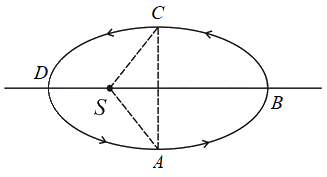 JEE Main/MCQ/Medium/Kepler laws/With diagram
- 222A very long (length ) cylindrical galaxy is made of uniformly distributed mass and has radius . A star outside the galaxy is orbiting the galaxy in a plane perpendicular to the galaxy and passing through its centre. If the time period of the star is and its distance from the galaxy's axis is , thenJEE Main/MCQ/Medium/Kepler laws
- 223India's Mangalyan was sent to the Mars by launching it into a transfer orbit EOM around the sun. It leaves the earth at and meets Mars at . If the semi-major axis of Earth's orbit is , that of Mar's orbit , taking Kepler's laws, give the estimate of time for Mangalyan to reach Mars from Earth.
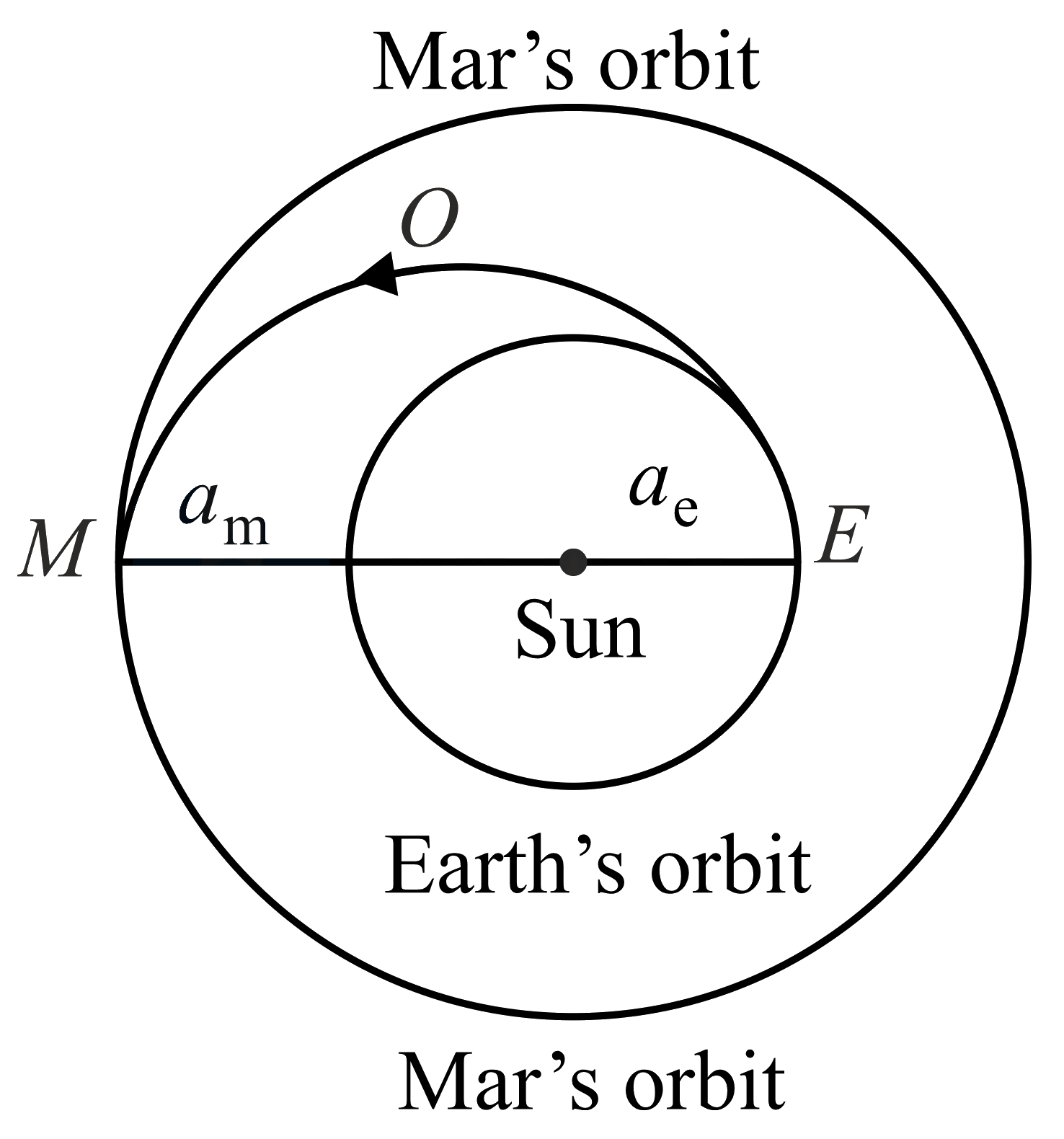 JEE Main/MCQ/Medium/Kepler laws/With diagram
NEET question paper PDF
This chapter includes NEET questions. Open a year to read the full paper, or download the PDF.
Opening paper…
JEE Main question paper PDF
This chapter includes JEE Main questions. Open a shift to read the paper, or download the PDF.
Opening paper…
Other Physics chapters
Current Electricity 380Electrostatics 311Kinematics 308Ray Optics 295Rotational Motion 280Magnetic Effects & Magnetism 276Atoms & Nuclei 239Laws of Motion 210Semiconductors 209Dual Nature of Matter 200Oscillations 194Fluid Mechanics 192Wave Optics 191Alternating Current 190Thermodynamics 190Work Energy Power 183Capacitors 180Kinetic Theory 168Electromagnetic Waves 165Electromagnetic Induction 153Units & Dimensions 149Waves 142Center of Mass, Momentum & Collision 130Thermal Properties of Matter 126Mathematics in Physics 121Mechanical Properties of Solids 118Experimental Physics 70Magnetic Properties of Matter 57Modern Physics 5
Stuck on a Gravitation question from your book?
Snap it and get a whiteboard video that solves it step by step. Your first video needs no login.