Physics · JEE Main, NEET
Oscillations
194 practice questions with a worked solution for each. Tap an option to see instantly if you are right.
152MCQ42Numerical26With diagram
- 1A particle executes SHM of amplitude . At what displacement from mean position is kinetic energy equal to potential energy?JEE Main/MCQ/Medium
- 2The time period of a simple pendulum of length on the surface of the Moon () will:NEET/MCQ/Medium
- 3A horizontal spring-mass system with and oscillates with amplitude . Maximum speed of mass is:JEE Main/MCQ/Medium
- 4A particle is executing simple harmonic motion. Its amplitude is and time period is sec. The time required by it to move from to is _______ sec.JEE Main/MCQ/Medium/Simple Harmonic Motion
- 5Match List-I with List-II.
List-IList-IIA. I. Periodic with time period but not simple harmonic motion (SHM)B. II. Periodic with time period but Not SHMC. III. Periodic with time period and SHMD. IV. Non-periodic
Choose the correct answer from the options given below :JEE Main/MCQ/Medium/Simple Harmonic Motion - 6The velocity of a particle executing simple harmonic motion along -axis is described as , where represents displacement. If the time period of motion is s, the value of is _____.JEE Main/Numerical/Medium/Simple Harmonic Motion
- 7The equation of motion of a particle is given by cm. The particle will come to rest at time and it will have zero acceleration at time . The and respectively are _______.JEE Main/MCQ/Medium/Simple Harmonic Motion
- 8As shown in the figure, a spring is kept in a stretched position with some extension by holding the masses 1 kg and 0.2 kg with a separation more than spring natural length and are released. Assuming the horizontal surface to be frictionless, the angular frequency (in SI unit) of the system is :
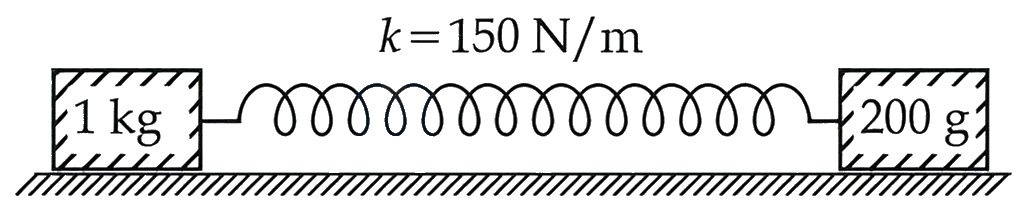 JEE Main/MCQ/Medium/Simple Harmonic Motion/With diagram
- 9A cylindrical block of mass and area of cross section is floating in a liquid of density and with its axis vertical. When depressed a little and released the block starts oscillating. The period of oscillation is .JEE Main/MCQ/Medium/Simple Harmonic Motion
- 10A particle is subjected two simple harmonic motions as :
and
where x is displacement and is time in seconds. The maximum acceleration of the particle is . The value of x is :JEE Main/MCQ/Medium/Simple Harmonic Motion - 11Two bodies A and B of equal mass are suspended from two massless springs of spring constant and , respectively. If the bodies oscillate vertically such that their amplitudes are equal, the ratio of the maximum velocity of to the maximum velocity of isJEE Main/MCQ/Medium/Simple Harmonic Motion
- 12A particle is executing simple harmonic motion with time period 2 s and amplitude 1 cm . If D and d are the total distance and displacement covered by the particle in 12.5 s , then isJEE Main/MCQ/Medium/Simple Harmonic Motion
- 13The position, velocity and acceleration of a particle executing simple harmonic motion are found to have magnitudes of and at a certain instant. The amplitude of the motion is where is ________JEE Main/Numerical/Medium/Simple Harmonic Motion
- 14An object of mass executes simple harmonic motion along axis with frequency of . At the position the object has kinetic energy and potential energy . The amplitude of oscillation is _____.JEE Main/Numerical/Medium/Simple Harmonic Motion
- 15A particle is doing simple harmonic motion of amplitude and time period . The maximum velocity of the particle is _______ .JEE Main/Numerical/Medium/Simple Harmonic Motion
- 16The displacement of a particle executing SHM is given by . The time period of motion is . The velocity of the particle at is ______.JEE Main/Numerical/Medium/Simple Harmonic Motion
- 17A particle performs simple harmonic motion with amplitude . Its speed is increased to three times at an instant when its displacement is . The new amplitude of motion is . The value of is _____.JEE Main/Numerical/Medium/Simple Harmonic Motion
- 18A simple harmonic oscillator has an amplitude and time period second. Assuming the oscillation starts from its mean position, the time required by it to travel from to will be , where x=_______.JEE Main/Numerical/Medium/Simple Harmonic Motion
- 19A particle executes simple harmonic motion with an amplitude of . At the mean position, velocity of the particle is . The distance of the particle from the mean position when its speed becomes is , where ______.JEE Main/Numerical/Medium/Simple Harmonic Motion
- 20In a linear Simple Harmonic Motion (SHM)
(A) Restoring force is directly proportional to the displacement.
(B) The acceleration and displacement are opposite in direction.
(C) The velocity is maximum at mean position.
(D) The acceleration is minimum at extreme points.
Choose the correct answer from the options given below:JEE Main/MCQ/Medium/Simple Harmonic Motion - 21For a periodic motion represented by the equation the amplitude of the motion isJEE Main/MCQ/Medium/Simple Harmonic Motion
- 22For particle revolving round the centre with radius of circular path and regular velocity , as shown in below figure, the projection of on the -axis at time is
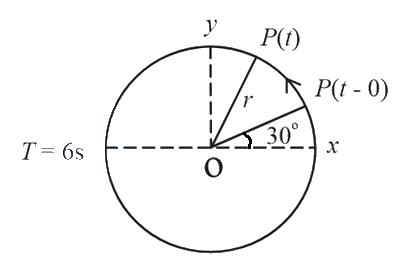 JEE Main/MCQ/Medium/Simple Harmonic Motion/With diagram
- 23A particle of mass executes a simple harmonic motion under a periodic force . The particle attains a maximum speed of during its oscillation. The amplitude of the motion is ______.JEE Main/Numerical/Medium/Simple Harmonic Motion
- 24A particle executes simple harmonic motion between . If time taken by particle to go from to is ; then time taken by particle in going from to is:JEE Main/MCQ/Medium/Simple Harmonic Motion
- 25The potential energy of a particle of mass in motion along the -axis is given by . The time period of the particle for small oscillation . The value of is _____ .JEE Main/Numerical/Medium/Simple Harmonic Motion
- 26When a particle executes simple Harmonic motion, the nature of graph of velocity as function of displacement will beJEE Main/MCQ/Medium/Simple Harmonic Motion
- 27Two waves executing simple harmonic motion travelling in the same direction with same amplitude and frequency are superimposed. The resultant amplitude is equal to the times of amplitude of individual motions. The phase difference between the two motions is _____ (degree)JEE Main/Numerical/Medium/Simple Harmonic Motion
- 28The motion of a simple pendulum executing S.H.M. is represented by the following equation , where time is measured in second. The length of pendulum isJEE Main/MCQ/Medium/Simple Harmonic Motion
- 29A body is performing simple harmonic with an amplitude of . The velocity of the body was tripled by air Jet when it is at from its mean position. The new amplitude of vibration is . The value of is _____ .JEE Main/Numerical/Medium/Simple Harmonic Motion
- 30A particle executes simple harmonic motion. Its amplitude is and time period is . The time it will take to travel from its position of maximum displacement to the point corresponding to half of its amplitude, is _____ JEE Main/Numerical/Medium/Simple Harmonic Motion
- 31The equation of a particle executing simple harmonic motion is given by . At , the speed of particle will be (Given: )JEE Main/MCQ/Medium/Simple Harmonic Motion
- 32Two massless springs with spring constants and , carry and masses at their free ends. These two masses oscillate vertically such that their maximum velocities are equal. Then, the ratio of their respective amplitudes will be :JEE Main/MCQ/Medium/Simple Harmonic Motion
- 33A bob of mass suspended by a thread of length undergoes simple harmonic oscillations with time period If the bob is immersed in a liquid that has density times that of the bob and the length of the thread is increased by of the original length, then the time period of the simple harmonic oscillations will be:JEE Main/MCQ/Medium/Simple Harmonic Motion
- 34A particle of mass is hanging from a spring of force constant The mass is pulled slightly downward and released so that it executes free simple harmonic motion with time period The time when the kinetic energy and potential energy of the system will become equal, is The value of is ________.JEE Main/Numerical/Medium/Simple Harmonic Motion
- 35Two simple harmonic motion, are represented by the equations
Ratio of amplitude of to . The value of isJEE Main/Numerical/Medium/Simple Harmonic Motion - 36Two simple harmonic motions are represented by the equations and The amplitude of the second motion is _____ times the amplitude in the first motion.JEE Main/Numerical/Medium/Simple Harmonic Motion
- 37A particle executes simple harmonic motion represented by displacement function as . If the position and velocity of the particle at are and respectively, then its amplitude is where the value of isJEE Main/Numerical/Medium/Simple Harmonic Motion
- 38An object of mass is executing simple harmonic motion. It amplitude is and time period (T) is . What will be the potential energy of the object at an instant starting from mean position. Assume that the initial phase of the oscillation is zero.JEE Main/MCQ/Medium/Simple Harmonic Motion
- 39A particle starts executing simple harmonic motion of amplitude and total energy At any instant, its kinetic energy is , then its displacement is given by:JEE Main/MCQ/Medium/Simple Harmonic Motion
- 40A particle performs simple harmonic motion with a period of second. The time taken by the particle to cover a displacement equal to half of its amplitude from the mean position is The value of to the nearest integer isJEE Main/Numerical/Medium/Simple Harmonic Motion
- 41A block of mass attached to a spring is made to oscillate with an initial amplitude of . After minutes the amplitude decreases to . Determine the value of the damping constant for this motion. (take )JEE Main/MCQ/Medium/Simple Harmonic Motion
- 42A particle executes S.H.M. with amplitude and time period . The displacement of the particle when its speed is half of maximum speed is The value of isJEE Main/Numerical/Medium/Simple Harmonic Motion
- 43A particle executes S.H.M., the graph of velocity as a function of displacement is :JEE Main/MCQ/Medium/Simple Harmonic Motion
- 44 is the time-displacement equation of a At the displacement of the particle is and it is moving along negative -direction. Then the initial phase angle will be:JEE Main/MCQ/Medium/Simple Harmonic Motion
- 45The point moves with a uniform speed along the circumference of a circle of radius and covers in . The perpendicular projection from on the diameter represents the simple harmonic motion of . The restoration force per unit mass when touches will be :
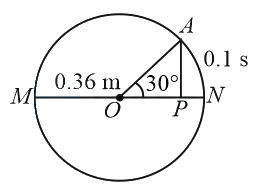 JEE Main/MCQ/Medium/Simple Harmonic Motion/With diagram
- 46When a particle executes SHM, the nature of graphical representation of velocity as a function of displacement is:JEE Main/MCQ/Medium/Simple Harmonic Motion
- 47A damped harmonic oscillator has a frequency of oscillations per second. The amplitude drops to half its value for every 10 oscillations. The time it will take to drop to of the original amplitude is close to:JEE Main/MCQ/Medium/Simple Harmonic Motion
- 48An oscillator of mass is at rest in its equilibrium position in a potential, . A particle of mass comes from the right with speed and collides completely inelastic with and sticks to it. This process repeats every time the oscillator crosses its equilibrium position. The amplitude of oscillations after collisions is: JEE Main/MCQ/Medium/Simple Harmonic Motion
- 49Two simple harmonic motions, as shown, are at right angles. They are combined to form Lissajous figures.
Identify the correct match belowJEE Main/MCQ/Medium/Simple Harmonic Motion - 50The ratio of maximum acceleration to maximum velocity in a simple harmonic motion is At, the displacement is What is the maximum acceleration? The initial phase is .JEE Main/MCQ/Medium/Simple Harmonic Motion
- 51Two particles are performing simple harmonic motion in a straight line about the same equilibrium point. The amplitude and time period for both particles are same and equal to and , respectively. At time one particle has displacement while the other one has displacement and they are moving towards each other. If they cross each other at time , then is:JEE Main/MCQ/Medium/Simple Harmonic Motion
- 52A particle performs simple harmonic motion with amplitude A. Its speed is tripled at the instant that it is at a distance from equilibrium position. The new amplitude of the motion is:JEE Main/MCQ/Medium/Simple Harmonic Motion
- 53A simple harmonic oscillator of angular frequency is acted upon by an external force If the oscillator is at rest in its equilibrium position at its position at later times is proportional to:JEE Main/MCQ/Medium/Simple Harmonic Motion
- 54 displacements of a particle are given as Its trajectory will look like:JEE Main/MCQ/Medium/Simple Harmonic Motion
- 55A body is in simple harmonic motion with time period and amplitude . Find the average velocity in the interval in which it moves from equilibrium position to half of its amplitude.JEE Main/MCQ/Medium/Simple Harmonic Motion
- 56Which of the following expressions corresponds to simple harmonic motion along a straight line, where is the displacement and are positive constants?JEE Main/MCQ/Medium/Simple Harmonic Motion
- 57A particle which is simultaneously subjected to two perpendicular simple harmonic motions represented by; and traces a curve given by :JEE Main/MCQ/Medium/Simple Harmonic Motion
- 58A particle moves with simple harmonic motion in a straight line. In first , after starting from rest it travels a distance a, and in next it travels 2a, in same direction, then :JEE Main/MCQ/Medium/Simple Harmonic Motion
- 59A mass is put on a flat pan attached to a vertical spring fixed on the ground. The mass of the spring and the pan is negligible. When pressed slightly and released, the mass executes simple harmonic motion. The spring constant is . What is the amplitude A of the motion, so that the mass tends to get detached from the pan ? (Take ).
The spring is stiff enough so that it does not get distorted during the motion.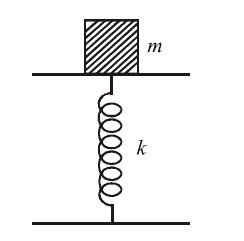 JEE Main/MCQ/Medium/Simple Harmonic Motion/With diagram
- 60Two simple pendulums of length and respectively are both given small displacement in the same direction at the same instant. They will be again in phase after the shorter pendulum has completed number of oscillations equal to:JEE Main/MCQ/Medium/Simple Harmonic Motion
- 61The displacement of a pendulum for is correctly represented byJEE Main/MCQ/Medium/Simple Harmonic Motion
- 62A mass , attached to a horizontal spring, executes S.H.M. with amplitude . When the mass passes through its mean position then a smaller mass is placed over it and both of them move together with amplitude . The ratio of is :JEE Main/MCQ/Medium/Simple Harmonic Motion
- 63Two particles are executing simple harmonic motion of the same amplitude and frequency along the -axis. Their mean position is separated by distance . If the maximum separation between them is , the phase difference between their motion is :JEE Main/MCQ/Medium/Simple Harmonic Motion
- 64If and a denote the displacement, the velocity and the acceleration of a particle executing simple harmonic motion of time period , then, which of the following does not change with time?JEE Main/MCQ/Medium/Simple Harmonic Motion
- 65A point mass oscillates along the -axis according to the law . If the acceleration of the particle is written as
JEE Main/MCQ/Medium/Simple Harmonic Motion - 66The displacement of an object attached to a spring and executing simple harmonic motion is given by metres. The time at which the maximum speed first occurs isJEE Main/MCQ/Medium/Simple Harmonic Motion
- 67A coin is placed on a horizontal platform which undergoes vertical simple harmonic motion of angular frequency . The amplitude of oscillation is gradually increased. The coin will leave contact with the platform for the first timeJEE Main/MCQ/Medium/Simple Harmonic Motion
- 68Two simple harmonic motions are represented by the equation and . The phase difference of the velocity of particle 1 w.r.t. the velocity of the particle 2 isJEE Main/MCQ/Medium/Simple Harmonic Motion
- 69The function representsJEE Main/MCQ/Medium/Simple Harmonic Motion
- 70The displacement of a particle varies according to the relation . The amplitude of the particle isJEE Main/MCQ/Medium/Simple Harmonic Motion
- 71Two particles and of equal masses are suspended from two massless springs of spring constant and , respectively. If the maximum velocities, during oscillation, are equal, the ratio of amplitude of and isJEE Main/MCQ/Medium/Simple Harmonic Motion
- 72The displacement of a particle, executing simple harmonic motion with time period , is expressed as , where is the amplitude. The maximum value of potential energy of this oscillator is found at . The value of is .JEE Main/Numerical/Medium/Energy of Simple Harmonic Motion
- 73Two blocks with masses 100 g and 200 g are attached to the ends of springs and as shown in figure. The energy stored in is . The energy stored in , when spring constants of and , respectively satisfy the relation , is :
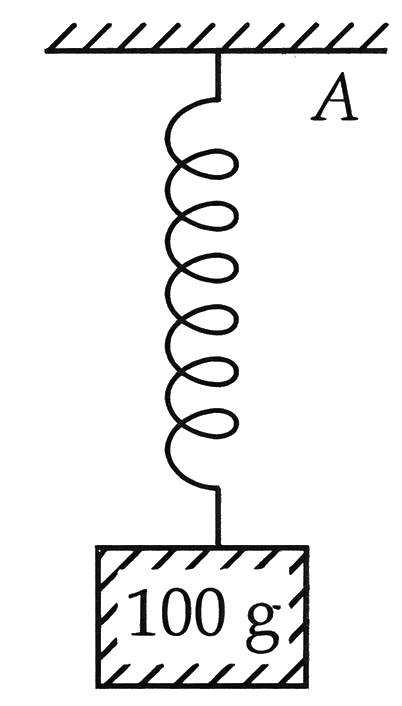
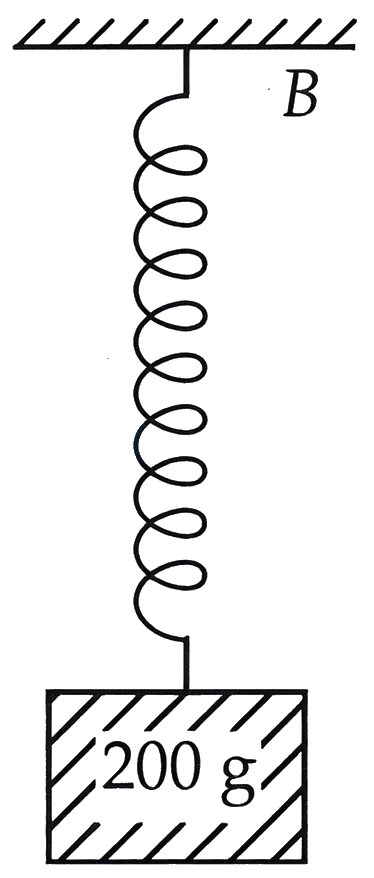 JEE Main/MCQ/Medium/Energy of Simple Harmonic Motion/With diagram
- 74The kinetic energy of a simple harmonic oscillator is oscillating with angular frequency of . The frequency of this simple harmonic oscillator is Hz. take JEE Main/MCQ/Medium/Energy of Simple Harmonic Motion
- 75A particle oscillates along the -axis according to the law, where . The kinetic energy of the particle as a function of is correctly represented by the graphJEE Main/MCQ/Medium/Energy of Simple Harmonic Motion
- 76When the displacement of a simple harmonic oscillator is one third of its amplitude, the ratio of total energy to the kinetic energy is , where _________.JEE Main/Numerical/Medium/Energy of Simple Harmonic Motion
- 77A particle executes SHM of amplitude. The distance from the mean position when its kinetic energy becomes equal to its potential energy is:JEE Main/MCQ/Medium/Energy of Simple Harmonic Motion
- 78At a given point of time the value of displacement of a simple harmonic oscillator is given as If amplitude is and kinetic energy at that time is the value of force constant . The value of is _____.JEE Main/Numerical/Medium/Energy of Simple Harmonic Motion
- 79Which graph represents the difference between total energy and potential energy of a particle executing vs its distance from mean position?JEE Main/MCQ/Medium/Energy of Simple Harmonic Motion
- 80A particle is executing simple harmonic motion (SHM). The ratio of potential energy and kinetic energy of the particle when its displacement is half of its amplitude will beJEE Main/MCQ/Medium/Energy of Simple Harmonic Motion
- 81The variation of kinetic energy (KE) of a particle executing simple harmonic motion with the displacement () starting from mean position to extreme position () is given byJEE Main/MCQ/Medium/Energy of Simple Harmonic Motion
- 82A simple pendulum with length and bob of mass is executing S.H.M of amplitude . The maximum tension in the string is found to be . The value of is _____.JEE Main/Numerical/Medium/Energy of Simple Harmonic Motion
- 83The amplitude of a particle executing SHM is . The displacement at which its kinetic energy will be more than the potential energy is: ______ .JEE Main/Numerical/Medium/Energy of Simple Harmonic Motion
- 84The general displacement of a simple harmonic oscillator is . Let be its time period. The slope of its potential energy () – time () curve will be maximum when . The value of is ______.JEE Main/Numerical/Medium/Energy of Simple Harmonic Motion
- 85A mass , attached to a horizontal spring, executes SHM with an amplitude . When this mass passes through its mean position, then a smaller mass of is placed over it and both masses move together with amplitude . If the ratio is , then the value of will be _____ .JEE Main/Numerical/Medium/Energy of Simple Harmonic Motion
- 86A mass of is connected to a spring. The potential energy curve of the simple harmonic motion executed by the system is shown in the figure. A simple pendulum of length has the same period of oscillation as the spring system. What is the value of acceleration due to gravity on the planet where these experiments are performed ?
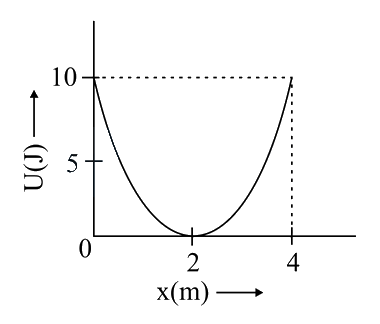 JEE Main/MCQ/Medium/Energy of Simple Harmonic Motion/With diagram
- 87For a body executing S.H.M. :
(a) Potential energy is always equal to its
(b) Average potential and kinetic energy over any given time interval are always equal.
(c) Sum of the kinetic and potential energy at any point of time is constant.
(d) Average in one time period is equal to average potential energy in one time period.
Choose the most appropriate option from the options given below :JEE Main/MCQ/Medium/Energy of Simple Harmonic Motion - 88The variation of displacement with time of a particle executing free simple harmonic motion is shown in the figure.
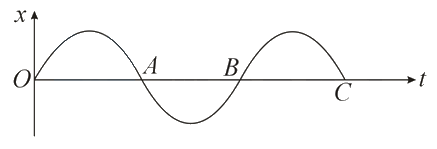
The potential energy versus time plot of the particle is correctly shown in figure:JEE Main/MCQ/Medium/Energy of Simple Harmonic Motion/With diagram - 89In a simple harmonic oscillation, what fraction of total mechanical energy is in the form of kinetic energy, when the particle is midway between mean and extreme position.JEE Main/MCQ/Medium/Energy of Simple Harmonic Motion
- 90For what value of displacement the kinetic energy and potential energy of a simple harmonic oscillation become equal?JEE Main/MCQ/Medium/Energy of Simple Harmonic Motion
- 91A block of mass m attached to a massless spring is performing oscillatory motion of amplitude 'A' on a frictionless horizontal plane. If half of the mass of the block breaks off when it is passing through its equilibrium point, the amplitude of oscillation for the remaining system become ƒA. The value of ƒ is:JEE Main/MCQ/Medium/Energy of Simple Harmonic Motion
- 92The displacement time graph of a particle executing SHM is given in figure: (sketch is schematic and not to scale)
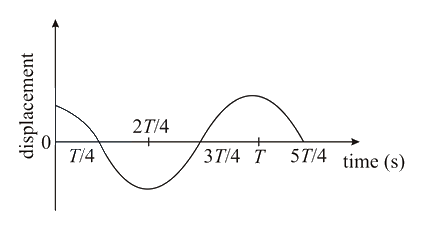
Which of the following statements is/are true for this motion?
(A) The force is zero at
(B) The magnitude of acceleration is maximum at
(C) The speed is maximum at
(D) The is equal to of the oscillation at JEE Main/MCQ/Medium/Energy of Simple Harmonic Motion/With diagram - 93A pendulum is executing simple harmonic motion and its maximum kinetic energy is . If the length of the pendulum is doubled and it performs simple harmonic motion with the same amplitude as in the first case, its maximum kinetic energy is JEE Main/MCQ/Medium/Energy of Simple Harmonic Motion
- 94A particle undergoing simple harmonic motion has time
dependent displacement given by . The ratio of kinetic to potential energy of this particle at will beJEE Main/MCQ/Medium/Energy of Simple Harmonic Motion - 95A particle is executing simple harmonic motion of amplitude along the -axis, about When its potential Energy equal kinetic energy the position of the particle will be:JEE Main/MCQ/Medium/Energy of Simple Harmonic Motion
- 96A body of mass and charge is connected to a spring of spring constant . It is oscillating along -direction about its equilibrium position in the horizontal plane, taken to be at , with an amplitude . An electric field is applied along the -direction. Which of the following statements is correct?JEE Main/MCQ/Medium/Energy of Simple Harmonic Motion
- 97A particle is executing simple harmonic motion with a time period . At time , it is at its position of equilibrium. The kinetic energy - time graph of the particle will look like:JEE Main/MCQ/Medium/Energy of Simple Harmonic Motion
- 98For a simple pendulum, a graph is plotted between its kinetic energy (K.E.) and potential energy (P.E.) against its displacement d. which one of the following represents these correctly? (graphs are schematic and not drawn to scale)JEE Main/MCQ/Medium/Energy of Simple Harmonic Motion
- 99A particle of mass executes simple harmonic motion with amplitude ' ' and frequency ' '. The average kinetic energy during its motion from the position of equilibrium to the end isJEE Main/MCQ/Medium/Energy of Simple Harmonic Motion
- 100Starting from the origin, a body oscillates simple harmonically with a period of . After what time will its kinetic energy be of the total energy?JEE Main/MCQ/Medium/Energy of Simple Harmonic Motion
- 101The total energy of particle, executing simple harmonic motion isJEE Main/MCQ/Medium/Energy of Simple Harmonic Motion
- 102A body executes simple harmonic motion. The potential energy (P.E), the kinetic energy (K.E) and total energy (T.E) are measured as a function of displacement . Which of the following statements is true?JEE Main/MCQ/Medium/Energy of Simple Harmonic Motion
- 103In a simple harmonic oscillator, at the mean positionJEE Main/MCQ/Medium/Energy of Simple Harmonic Motion
- 104A spring stretches by mm when it is loaded with a mass of g. From equilibrium position the mass is further pulled down by mm and released. The frequency associated with the system and maximum energy in the spring are __________ Hz and __________ J, respectively. (Take g m/s)JEE Main/MCQ/Medium/Time Period and Frequency
- 105The time period of a simple harmonic oscillator is . Measured value of mass of the object is 10 g with an accuracy of 10 mg and time for 50 oscillations of the spring is found to be 60 s using a watch of 2 s resolution. Percentage error in determination of spring constant is \%.JEE Main/MCQ/Medium/Time Period and Frequency
- 106Two blocks of masses and , are placed on a frictionless table as shown in figure. A massless spring with spring constant k is attached with the lower block. If the system is slightly displaced and released then
( coefficient of friction between the two blocks)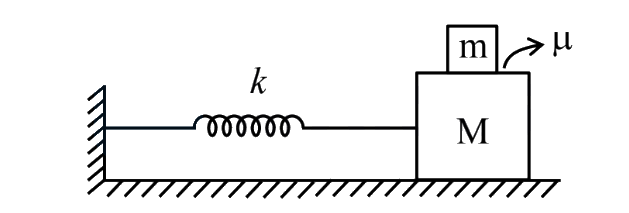
(A) The time period of small oscillation of the two blocks is
(B) The acceleration of the blocks is ( displacement of the blocks from the mean position)
(C) The magnitude of the frictional force on the upper block is
(D) The maximum amplitude of the upper block, if it does not slip, is
(E) Maximum frictional force can be .
Choose the correct answer from the options given below:JEE Main/MCQ/Medium/Time Period and Frequency/With diagram - 107Given below are two statements. One is labelled as Assertion (A) and the other is labelled as Reason (R).
Assertion (A) : Knowing initial position and initial momentum is enough to determine the position and momentum at any time for a simple harmonic motion with a given angular frequency .
Reason (R): The amplitude and phase can be expressed in terms of and .
In the light of the above statements, choose the correct answer from the options given below :JEE Main/MCQ/Medium/Time Period and Frequency - 108Given below are two statements. One is labelled as Assertion (A) and the other is labelled as Reason (R).
Assertion (A) : A simple pendulum is taken to a planet of mass and radius, 4 times and 2 times, respectively, than the Earth. The time period of the pendulum remains same on earth and the planet.
Reason (R): The mass of the pendulum remains unchanged at Earth and the other planet.
In the light of the above statements, choose the correct answer from the options given below :JEE Main/MCQ/Medium/Time Period and Frequency - 109A particle of mass executes simple harmonic motion under force . The time period of oscillation is . The value of is _______
(Given )JEE Main/Numerical/Medium/Time Period and Frequency - 110A mass is suspended from a spring of negligible mass and the system oscillates with a frequency The frequency of oscillations if a mass is suspended from the same spring is The value of is _____ .JEE Main/Numerical/Medium/Time Period and Frequency
- 111A simple pendulum is placed at a place where its distance from the earth's surface is equal to the radius of the earth. If the length of the string is , then the time period of small oscillations will be _________.
take ]JEE Main/Numerical/Medium/Time Period and Frequency - 112A particle executes S.H.M. of amplitude along -axis. At , the position of the particle is and it moves along positive -axis. The displacement of particle in time is , then the value will beJEE Main/MCQ/Medium/Time Period and Frequency
- 113Choose the correct length versus square of time period ) graph for a simple pendulum executing simple harmonic motion.JEE Main/MCQ/Medium/Time Period and Frequency
- 114The velocity of a particle executing SHM varies with displacement () as . The time period of oscillations is . The value of is ______.
[Take ]JEE Main/Numerical/Medium/Time Period and Frequency - 115A mass attached to free end of a spring executes SHM with a period of . If the mass is increased by the period of oscillation increases by one second, the value of mass is ________ .JEE Main/Numerical/Medium/Time Period and Frequency
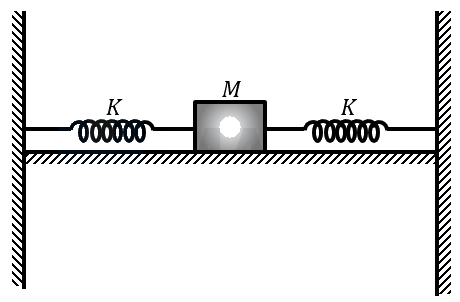
- 116A block of mass is attached with two identical springs of spring constant each. The block is placed on a frictionless surface and the ends of the springs are attached to rigid supports (see figure). When the mass is displaced from its equilibrium position, it executes a simple harmonic motion. The time period of oscillation is in SI unit. The value of is______.
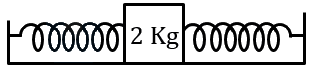 JEE Main/Numerical/Medium/Time Period and Frequency/With diagram
- 117The metallic bob of simple pendulum has the relative density . The time period of this pendulum is . If the metallic bob is immersed in water, then the new time period becomes . The value of will be _____ .JEE Main/Numerical/Medium/Time Period and Frequency
- 118The time period of oscillation of a simple pendulum of length suspended from the roof of a vehicle, which moves without friction down an inclined plane of inclination , is given by :JEE Main/MCQ/Medium/Time Period and Frequency
- 119As per given figures, two springs of spring constants and are connected to mass . If the period of oscillation in figure (a) is , then the period of oscillation in figure (b) will be . The value of is _____ .
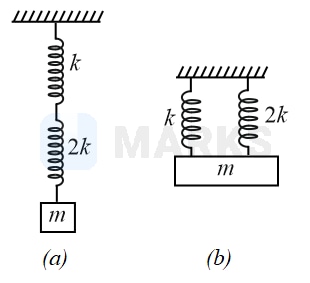 JEE Main/Numerical/Medium/Time Period and Frequency/With diagram
- 120The displacement of simple harmonic oscillator after seconds starting from its mean position is equal to half of its amplitude. The time period of harmonic motion isJEE Main/MCQ/Medium/Time Period and Frequency
- 121Time period of a simple pendulum in a stationary lift is . If the lift accelerates with vertically upwards then the time period will be
(Where acceleration due to gravity)JEE Main/MCQ/Medium/Time Period and Frequency - 122 is the time period of a simple pendulum at a place. If the length of the pendulum is reduced to times of its initial value, the modified time period isJEE Main/MCQ/Medium/Time Period and Frequency
- 123A particle is making simple harmonic motion along the -axis. If at a distances and from the mean position the velocities of the particle are and , respectively. The time period of its oscillation is given as:JEE Main/MCQ/Medium/Time Period and Frequency
- 124Time period of a simple pendulum is inside a lift when the lift is stationary. If the lift moves upwards with an acceleration , the time period of pendulum will be :JEE Main/MCQ/Medium/Time Period and Frequency
- 125If the time period of a two meter long simple pendulum is , the acceleration due to gravity at the place where pendulum is executing S.H.M. is:JEE Main/MCQ/Medium/Time Period and Frequency
- 126In the given figure, a body of mass is held between two massless springs, on a smooth inclined plane. The free ends of the springs are attached to firm supports. If each spring has spring constant the frequency of oscillation of given body is:
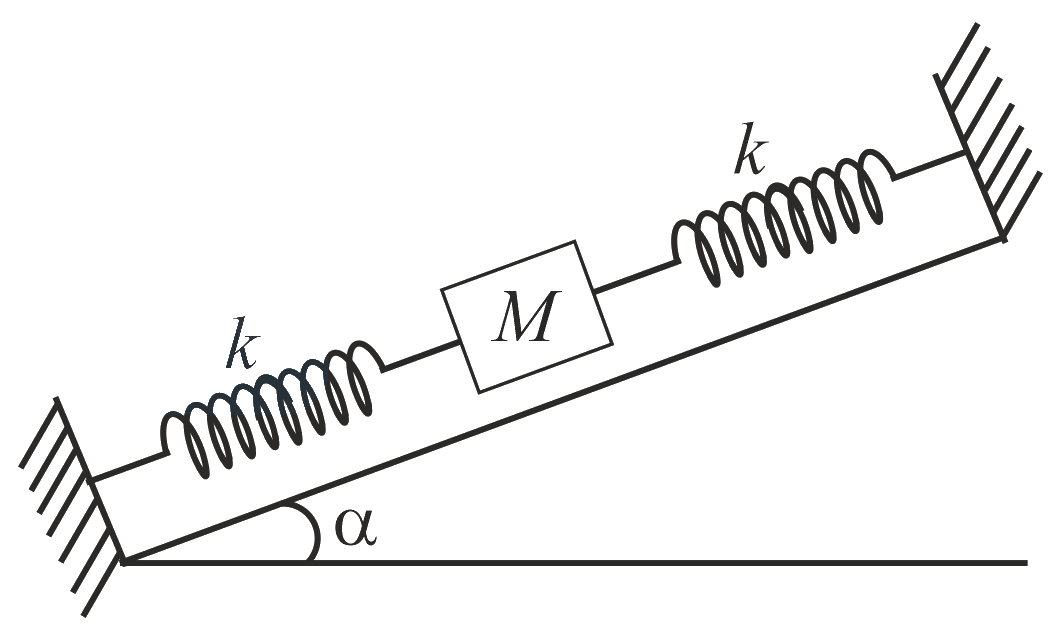 JEE Main/MCQ/Medium/Time Period and Frequency/With diagram
- 127An object of mass is suspended at the end of a massless wire of length and area of cross-section, A. Young modulus of the material of the wire is . If the mass is pulled down slightly its frequency of oscillation along the vertical direction is :JEE Main/MCQ/Medium/Time Period and Frequency
- 128A ring is hung on a nail. It can oscillate, without slipping or sliding (i) in its plane with a time period and (ii) back and forth in a direction perpendicular to its plane, with a period . The ratio will be :JEE Main/MCQ/Medium/Time Period and Frequency
- 129A simple pendulum oscillating in air has period . The bob of the pendulum is completely immersed in a non-viscous liquid. The density of the liquid is of the material of the bob. If the bob is inside liquid all the time, its period of oscillation in this liquid is:JEE Main/MCQ/Medium/Time Period and Frequency
- 130A simple harmonic motion is represented by:
The amplitude and time period of the motion are:JEE Main/MCQ/Medium/Time Period and Frequency - 131A simple pendulum of length is oscillating with an angular frequency . The support of the pendulum starts oscillating up and down with a small angular frequency of and an amplitude of . The relative change in the angular frequency of the pendulum is best given by :JEE Main/MCQ/Medium/Time Period and Frequency
- 132A cylindrical plastic bottle of negligible mass is filled with of water and left floating in a pond with still water. If pressed downward slightly and released, it starts performing simple harmonic motion at angular frequency If the radius of the bottle is then is close to: density of water JEE Main/MCQ/Medium/Time Period and Frequency
- 133A particle executes simple harmonic motion with an amplitude of . When the particle is at from the mean position, the magnitude of its velocity in units is equal to that of its acceleration. Then, its periodic time in seconds is:JEE Main/MCQ/Medium/Time Period and Frequency
- 134A hoop and a solid cylinder of same mass and radius are made of a permanent magnetic material with their respective axes. But the magnetic moment of hoop is twice of solid cylinder. They are placed in a uniform magnetic field in such a manner that their magnetic moments make a small angle with the field. If the oscillation periods of hoop and cylinder are and respectively, then:JEE Main/MCQ/Medium/Time Period and Frequency
- 135A particle executes simple harmonic motion and it is located at and at time respectively. The frequency of the oscillation is:JEE Main/MCQ/Medium/Time Period and Frequency
- 136A silver atom in a solid oscillates in simple harmonic motion in some direction with a frequency of . What is the force constant of the bonds connecting one atom with the other? (Mole wt. of silver, and Avogadro number )JEE Main/MCQ/Medium/Time Period and Frequency
- 137In an engine the piston undergoes vertical simple harmonic motion with amplitude 7cm. A washer rests on top of the piston and moves with it. The motor speed is slowly increased. The frequency of the piston at which the washer no longer stays in contact with the piston, is close to :JEE Main/MCQ/Medium/Time Period and Frequency
- 138The amplitude of a simple pendulum, oscillating in air with a small spherical bob, decreases from 10 cm to 8 cm in 40 seconds. Assuming that Stokes law is valid, and ratio of the coefficient of viscosity of air to that of carbon dioxide is 1.3, the time in which amplitude of this pendulum will reduce from 10 cm to 5 cm in carbondioxide will be close to (ln 5 = 1.601, ln 2 = 0.693).JEE Main/MCQ/Medium/Time Period and Frequency
- 139An ideal gas enclosed in a vertical cylindrical container supports a freely moving piston of mass . The piston and the cylinder have equal cross-sectional area . When the piston is in equilibrium, the volume of the gas is and its pressure is . The piston is slightly displaced from the equilibrium position and released. Assuming that the system is completely isolated from its surrounding, the piston executes a simple harmonic motion with frequency
[Assume the system is in space.]JEE Main/MCQ/Medium/Time Period and Frequency - 140The maximum velocity of a particle, executing simple harmonic motion with an amplitude , is . The period of oscillation isJEE Main/MCQ/Medium/Time Period and Frequency
- 141If a simple harmonic motion is represented by , its time period isJEE Main/MCQ/Medium/Time Period and Frequency
- 142A particle at the end of a spring executes simple harmonic motion with a period , while the corresponding period for another spring is . If the period of oscillation with the two springs in series is , thenJEE Main/MCQ/Medium/Time Period and Frequency
- 143The bob of a simple pendulum executes simple harmonic motion in water with a period , while the period of oscillation of the bob is in air. Neglecting frictional force of water and given that the density of the bob is . What relationship between and is true?JEE Main/MCQ/Medium/Time Period and Frequency
- 144A mass is suspended from a spring of negligible mass. The spring is pulled a little and then released so that the mass executes SHM of time period T. If the mass is increased by , the time period becomes . Then the ratio of isJEE Main/MCQ/Medium/Time Period and Frequency
- 145A child swinging on a swing in sitting position, stands up, then the time period of the swing willJEE Main/MCQ/Medium/Time Period and Frequency
- 146The frequency of oscillation of a mass suspended by a spring is . If the length of the spring is cut to half, the same mass oscillates with frequency . The value of is ________.JEE Main/MCQ/Medium/Applications of SHM
- 147A uniform disc of radius and mass is free to oscillate about the axis as shown in the figure. For small oscillations the time period is ______.
( is acceleration due to gravity)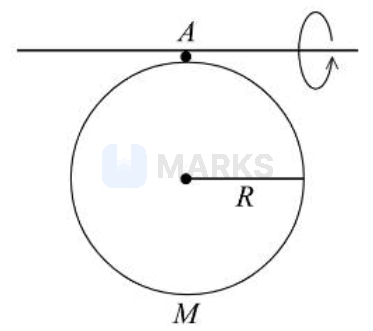 JEE Main/MCQ/Medium/Applications of SHM/With diagram
- 148A simple pendulum of string length 30 cm performs 20 oscillations in 10 s. The length of the string required for the pendulum to perform 40 oscillations in the same time duration is cm. [Assume that the mass of the pendulum remains same.]JEE Main/MCQ/Medium/Applications of SHM
- 149Using a simple pendulum experiment is determind by measuring its time period . Which of the following plots represent the correct relation between the pendulum length and time period ?JEE Main/MCQ/Medium/Applications of SHM
- 150Two simple pendulums having lengths and with negligible string mass undergo angular displacements and , from their mean positions, respectively. If the angular accelerations of both pendulums are same, then which expression is correct?JEE Main/MCQ/Medium/Applications of SHM
- 151Given below are two statements : one is labelled as Assertion (A) and the other is labelled as Reason (R).
Assertion (A) : Time period of a simple pendulum is longer at the top of a mountain than that at the base of the mountain.
Reason (R): Time period of a simple pendulum decreases with increasing value of acceleration due to gravity and vice-versa.
In the light of the above statements, choose the most appropriate answer from the options given below :JEE Main/MCQ/Medium/Applications of SHM - 152A light hollow cube of side length 10 cm and mass 10 g , is floating in water. It is pushed down and released to execute simple harmonic oscillations. The time period of oscillations is , where the value of is
(Acceleration due to gravity, , density of water )JEE Main/MCQ/Medium/Applications of SHM - 153In simple harmonic motion, the total mechanical energy of given system is . If mass of oscillating particle is doubled then the new energy of the system for same amplitude is:
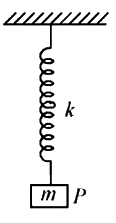 JEE Main/MCQ/Medium/Applications of SHM/With diagram
- 154The time period of simple harmonic motion of mass in the given figure is , where the value of is _______.
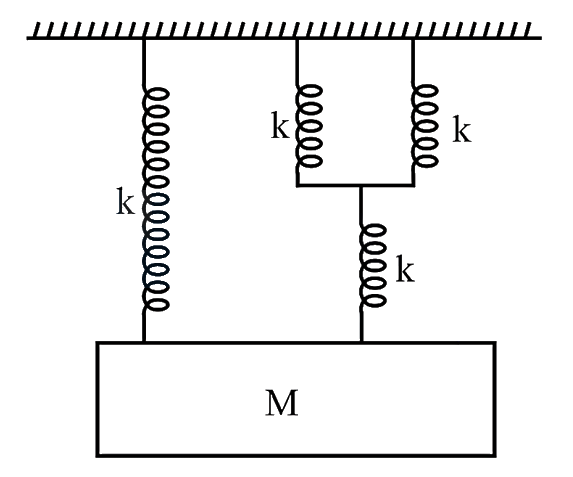 JEE Main/Numerical/Medium/Applications of SHM/With diagram
- 155A rectangular block of mass attached to a horizontal spiral spring executes simple harmonic motion of amplitude and time period . The maximum force exerted by spring on block is ___ .JEE Main/Numerical/Medium/Applications of SHM
- 156In the figure given below. a block of mass placed on a frictionless table is connected with two springs having same spring constant (). If the block is horizontally displaced through then the number of complete oscillations it will make in seconds will be ______.
 JEE Main/Numerical/Medium/Applications of SHM/With diagram
- 157The maximum potential energy of a block executing simple harmonic motion is . A is amplitude of oscillation. At , the kinetic energy of the block isJEE Main/MCQ/Medium/Applications of SHM
- 158For a simple harmonic motion in a mass spring system shown, the surface is frictionless. When the mass of the block is , the angular frequency is . When the mass block is the angular frequency is . The ratio is :
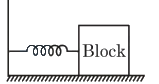 JEE Main/MCQ/Medium/Applications of SHM/With diagram
- 159In figure (A), mass is fixed on mass which is attached to two springs of spring constant . In figure (B), mass is attached to two spring of spring constant and . If mass in (A) and (B) are displaced by distance horizontally and then released, then time period and corresponding to (A) and (B) respectively follow the relation.
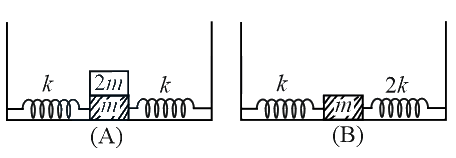 JEE Main/MCQ/Medium/Applications of SHM/With diagram
- 160Two identical tennis balls each having mass and charge are suspended from a fixed point by threads of length What is the equilibrium separation when each thread makes a small angle with the vertical?JEE Main/MCQ/Medium/Applications of SHM
- 161A pendulum bob has a speed of at its lowest position. The pendulum is long. The speed of bob, when the length makes an angle of to the vertical will be ______ .JEE Main/Numerical/Medium/Applications of SHM
- 162In the reported figure, two bodies of masses and are attached with the system of springs. Springs are kept in a stretched position with some extension when the system is released. The horizontal surface is assumed to be frictionless. The angular frequency will be _______ when .
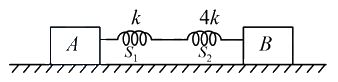 JEE Main/Numerical/Medium/Applications of SHM/With diagram
- 163Two particles and of equal masses are suspended from two massless springs of spring constants and respectively.If the maximum velocities during oscillations are equal, the ratio of the amplitude of and isJEE Main/MCQ/Medium/Applications of SHM
- 164Consider two identical springs each of spring constant and negligible mass compared to the mass as shown. Fig. shows one of them and Fig. shows their series combination. The ratios of time period of oscillation of the two SHM is where value of is ______.
(Round off to the Nearest Integer)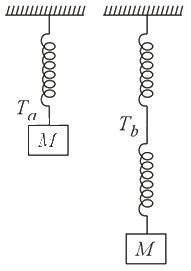 JEE Main/Numerical/Medium/Applications of SHM/With diagram
- 165The amplitude of a mass-spring system, which is executing simple harmonic motion decreases with time. If mass , Decay constant then how much time is required for the amplitude of the system to drop to half of its initial value? JEE Main/MCQ/Medium/Applications of SHM
- 166Time period of a simple pendulum is . The time taken to complete oscillations starting from mean position is . The value of is ______.JEE Main/Numerical/Medium/Applications of SHM
- 167Given below are two statements:
Statement : A second's pendulum has a time period of second.
Statement : It takes precisely one second to move between the two extreme positions. In the light of the above statements,
choose the correct answer from the options given belowJEE Main/MCQ/Medium/Applications of SHM - 168Assume that a tunnel is dug along a chord of the earth, at a perpendicular distance from the earth's centre, where is the radius of the earth. The wall of the tunnel is frictionless. If a particle is released in this tunnel, it will execute a simple harmonic motion with a time period:JEE Main/MCQ/Medium/Applications of SHM
- 169Two identical springs of spring constant are attached to a block of mass and to fixed support (see figure). When the mass is displaced from equilibrium position on either side, it executes simple harmonic motion. The time period of oscillations of this system is :
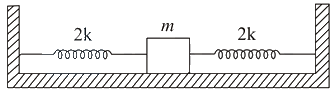 JEE Main/MCQ/Medium/Applications of SHM/With diagram
- 170In the given figure, a mass is attached to a horizontal spring which is fixed on one side to a rigid support. The spring constant of the spring is The mass oscillates on a frictionless surface with time period and amplitude When the mass is in equilibrium position, as shown in the figure, another mass is gently fixed upon it. The new amplitude of oscillation will be:
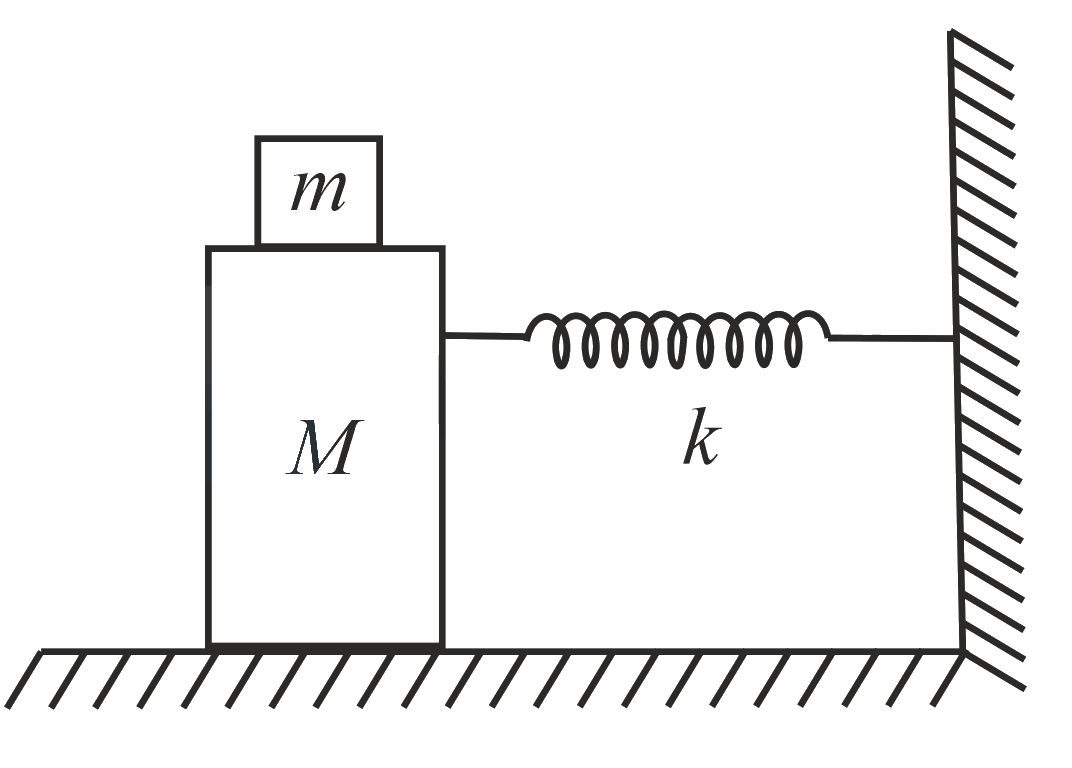 JEE Main/MCQ/Medium/Applications of SHM/With diagram
- 171When a particle of mass is attached to a vertical spring of spring constant and released, its motion, is described by , where '' is measured from the lower end of upstretched spring. Then is :JEE Main/MCQ/Medium/Applications of SHM
- 172The displacement of a damped harmonic oscillator is given by Here is in seconds. The time taken for its amplitude of vibration to drop to half of its initial value is close to:JEE Main/MCQ/Medium/Applications of SHM
- 173In an experiment to determine the period of a simple pendulum of length , it is attached to different spherical bobs of radii and . The two spherical bobs have uniform mass distribution. If the relative difference in the periods, is found to be , the difference in radii, is best-given byJEE Main/MCQ/Medium/Applications of SHM
- 174A block of mass is connected to an elastic spring of spring constant and oscillates in a damping medium of damping constant . The system dissipates its energy gradually. The time taken for its mechanical energy of vibration to drop to half of its initial value, is closest to-JEE Main/MCQ/Medium/Applications of SHM
- 175A block attached to a spring vibrates with a frequency of on a frictionless horizontal table. Two springs identical to the original spring are attached in parallel to ablock placed on the same table. So, the frequency of vibration of the block isJEE Main/MCQ/Medium/Applications of SHM
- 176A cylindrical block of wood (density = ), of base area and height , floats in a liquid of density . The block is depressed slightly and then released. The time period of the resulting oscillations of the block would be equal to that of a simple pendulum of length (nearly) :JEE Main/MCQ/Medium/Applications of SHM
- 177A pendulum with the time period of is losing energy due to damping. At a certain time, its energy is . If after completing oscillations its energy has become , then its damping constant (in ) will beJEE Main/MCQ/Medium/Applications of SHM
- 178Two bodies of masses and are connected to a vertical spring, as shown in the figure. The smaller mass executes simple harmonic motion of angular frequency , and amplitude while the bigger mass remains stationary on the ground. The maximum force exerted by the system on the floor is (take ).
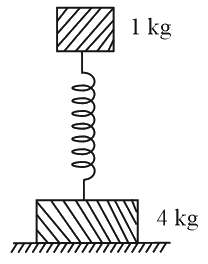 JEE Main/MCQ/Medium/Applications of SHM/With diagram
- 179A uniform cylinder of length and mass having cross-sectional area is suspended, with its length vertical, from a fixed point by a massless spring, such that it is half submerged in a liquid of density at equilibrium position. When the cylinder is given a downward push and released, it starts oscillating vertically with a small amplitude. The time period of the oscillations of the cylinder will be :JEE Main/MCQ/Medium/Applications of SHM
- 180Two charges, each equal to , are kept at and on the x-axis. A particle of mass and charge is placed at the origin. If charge is given a small displacement along the y-axis, the net force acting on the particle is proportional to :JEE Main/MCQ/Medium/Applications of SHM
- 181If a simple pendulum has significant amplitude (up to a factor of of original) only in the period between to , then may be called the average life of the pendulum. When the spherical bob of the pendulum suffers a retardation (due to viscous drag) proportional to its velocity, with '' as the constant of proportionality, the average life time of the pendulum is (assuming damping is small) in seconds:JEE Main/MCQ/Medium/Applications of SHM
- 182Two springs, of force constants and , are connected to a mass as shown. The frequency of oscillation of the mass is . If both and are made four times their original values, the frequency of oscillation becomes
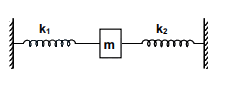 JEE Main/MCQ/Medium/Applications of SHM/With diagram
- 183The bob of a simple pendulum is a spherical hollow ball filled with water. A plugged hole near the bottom of the oscillation bob gets suddenly unplugged. During observation, till water is coming out, the time period of oscillation wouldJEE Main/MCQ/Medium/Applications of SHM
- 184If a spring has time period T, and is cut into n equal parts, then the time period of each part will beJEE Main/MCQ/Medium/Applications of SHM
- 185The amplitude and phase of a wave that is formed by the superposition of two harmonic travelling waves, and , are
(Take the angular frequency of initial waves same as )JEE Main/MCQ/Medium/Superposition of S.H.M’s and Resonance - 186Two simple harmonic waves having equal amplitudes of and equal frequency of are moving along the same direction. The resultant amplitude is also . The phase difference between the individual waves is _____ degree.JEE Main/Numerical/Medium/Superposition of S.H.M's and Resonance
- 187The function of time representing a simple harmonic motion with a period of is :JEE Main/MCQ/Medium/Superposition of S.H.M's and Resonance
- 188In forced oscillation of a particle the amplitude is maximum for a frequency of the force, while the energy is maximum for a frequency of the force, thenJEE Main/MCQ/Medium/Superposition of S.H.M's and Resonance
- 189Two light identical springs of spring constant are attached horizontally at the two ends of a uniform horizontal rod of length and mass The rod is pivoted at its center 'O' and can rotate freely in horizontal plane. The other ends of the two springs are fixed to rigid supports as shown in figure. The rod is gently pushed through a small angle and released. The frequency of resulting oscillation is:
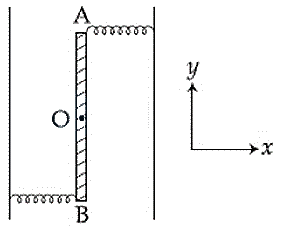 JEE Main/MCQ/Medium/Angular oscillations/With diagram
- 190A rod of mass and length is suspended at its middle by a wire. It exhibits torsional oscillations. If two masses, each of mass , are attached at a distance from its centre on both sides, it reduces the oscillation frequency by . The value of ratio is close toJEE Main/MCQ/Medium/Angular oscillations
- 191The angular frequency of the damped oscillator is given by, where is the spring constant, is the mass of the oscillator and is the damping constant. If the ratio is , the change in time period compared to the undamped oscillator is approximately as follows:JEE Main/MCQ/Medium/Angular oscillations
- 192Bob of a simple pendulum of length is made of iron. The pendulum is oscillating over a horizontal coil carrying direct current. If the time period of the pendulum is then :JEE Main/MCQ/Medium/Angular oscillations
- 193A ring is suspended from a point on its rim as shown in the figure. When displaced from equilibrium, it oscillates with time period of 1 second. The radius of the ring is (take )
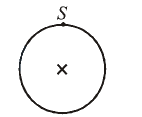 JEE Main/MCQ/Medium/Angular oscillations/With diagram
- 194A particle of mass is attached to a spring (of spring constant ) and has a natural angular frequency . An external force proportional to is applied to the oscillator. The time displacement of the oscillator will be proportional toJEE Main/MCQ/Medium/Angular oscillations
NEET question paper PDF
This chapter includes NEET questions. Open a year to read the full paper, or download the PDF.
Opening paper…
JEE Main question paper PDF
This chapter includes JEE Main questions. Open a shift to read the paper, or download the PDF.
Opening paper…
Other Physics chapters
Current Electricity 380Electrostatics 311Kinematics 308Ray Optics 295Rotational Motion 280Magnetic Effects & Magnetism 276Atoms & Nuclei 239Gravitation 223Laws of Motion 210Semiconductors 209Dual Nature of Matter 200Fluid Mechanics 192Wave Optics 191Alternating Current 190Thermodynamics 190Work Energy Power 183Capacitors 180Kinetic Theory 168Electromagnetic Waves 165Electromagnetic Induction 153Units & Dimensions 149Waves 142Center of Mass, Momentum & Collision 130Thermal Properties of Matter 126Mathematics in Physics 121Mechanical Properties of Solids 118Experimental Physics 70Magnetic Properties of Matter 57Modern Physics 5
Stuck on a Oscillations question from your book?
Snap it and get a whiteboard video that solves it step by step. Your first video needs no login.