Physics · JEE Main, NEET, Olympiad (NSEP)
Wave Optics
191 practice questions with a worked solution for each. Tap an option to see instantly if you are right.
141MCQ50Numerical19With diagram
- 1In a YDSE, if the distance between slits is halved and distance between screen and slits is doubled, fringe width becomes:JEE Main/MCQ/Medium
- 2In Young's double slit experiment, if monochromatic light is replaced by white light, the central fringe is:NEET/MCQ/Medium
- 3In a Lloyd's mirror experiment, light reflected from a glass mirror interferes with direct light from a slit. The central fringe closest to the mirror surface is:Olympiad (NSEP)/MCQ/Hard
- 4A monochromatic light of frequency travelling through air, is incident on a medium of refractive index ' 2 '. Wavelength of the refracted light will be :JEE Main/MCQ/Medium/Wave Theory and Wavefronts
- 5A light wave is propagating with plane wave fronts of the type constant. The angle made by the direction of wave propagation with the -axis is:JEE Main/MCQ/Medium/Wave Theory and Wavefronts
- 6Light emerges out of a convex lens when a source of light kept at its focus. The shape of wavefront of the light is :JEE Main/MCQ/Medium/Wave Theory and Wavefronts
- 7On a hot summer night, the refractive index of air is the smallest near the ground and increases with a height from the ground. When a light beam is directed horizontally, the Huygens' principle leads us to conclude that as it travels, the light beam,JEE Main/MCQ/Medium/Wave Theory and Wavefronts
- 8Two coherent point sources and are separated by a small distance as shown in the figure. The fringes obtained on the screen will be
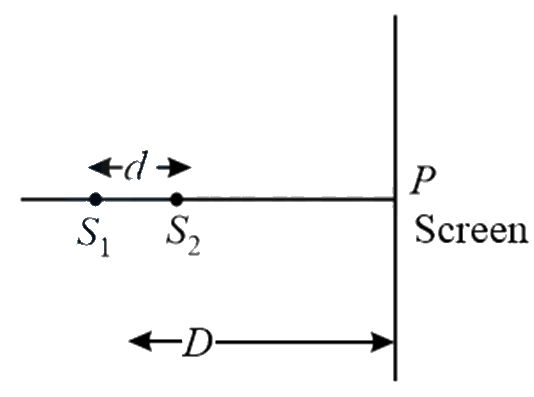 JEE Main/MCQ/Medium/Wave Theory and Wavefronts/With diagram
- 9In interference experiment the path difference between two interfering waves at a point on the screen is , where is the wavelength of these waves, and at another point the path difference is . The ratio of intensities at points and is _______.JEE Main/MCQ/Medium/Interference of Light
- 10Two coherent monochromatic light beams of intensities 4I and 9I are superimposed. The difference between the maximum and minimum intensities in the resulting interference pattern is xI. The value of is ______.JEE Main/Numerical/Medium/Interference of Light
- 11The ratio of the power of a light source to that the light source is is emitting photons per second at 600 nm . If the wavelength of the source is 300 nm , then the number of photons per second emitted by is .JEE Main/Numerical/Medium/Interference of Light
- 12Young's double slit inteference apparatus is immersed in a liquid of refractive index 1.44. It has slit separation of 1.5 mm . The slits are illuminated by a parallel beam of light whose wavelength in air is 690 nm . The fringe-width on a screen placed behind the plane of slits at a distance of 0.72 m , will be :JEE Main/MCQ/Medium/Interference of Light
- 13Two coherent monochromatic light beams of intensities I and are superimposed. The difference between maximum and minimum possible intensities in the resulting beam is . The value of is _________.JEE Main/Numerical/Medium/Interference of Light
- 14Two waves of intensity ratio cross each other at a point. The resultant intensities at the point, when (a) Waves are incoherent is Waves are coherent is and differ in phase by . If , then _________.JEE Main/Numerical/Medium/Interference of Light
- 15A beam of light consisting of two wavelengths and is used to obtain interference pattern in Young's double slit experiment. The distance between the slits is and the distance between the plane of slits and the screen is . The least distance from the central fringe, where the bright fringes due to both the wavelengths coincide, is . The value of is _____.JEE Main/Numerical/Medium/Interference of Light
- 16The interference pattern is obtained with two coherent light sources of intensity ratio . And the ratio is . Then, the value of will be equal to :JEE Main/MCQ/Medium/Interference of Light
- 17Two coherent light sources having intensity in the ratio produce an interference pattern. The ratio will beJEE Main/MCQ/Medium/Interference of Light
- 18In the figure below, and are two equally intense coherent sources emitting radiation of wavelength The separation between and is and the phase of is ahead of that of by and C are three distinct point of observation, each equidistant from the midpoint of PQ. The intensities of radiation at will be in the ratio :
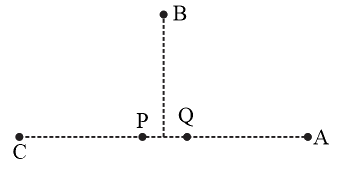 JEE Main/MCQ/Medium/Interference of Light/With diagram
- 19Two coherent sources of sound, and produce sound waves of the same wavelength are in phase. and are placed apart (see fig). A listener, located at , directly in front of , finds that the intensity is at a minimum when he is away from . The listener moves away from , keeping the distance from fixed. The adjacent maximum of intensity is observed when the listener is at a distance from . Then is :
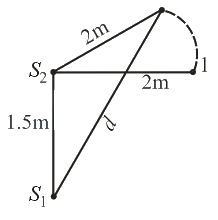 JEE Main/MCQ/Medium/Interference of Light/With diagram
- 20Interference fringes are observed on a screen by illuminating two thin slits apart with a light source . The distance between the screen and the slits is . If a bright fringe is observed on a screen at distance of from the central bright fringe, then the path difference between the waves, which are reaching this point from the slits is close to :JEE Main/MCQ/Medium/Interference of Light
- 21In an interference experiment the ratio of amplitudes of coherent waves is . The ratio of maximum and minimum intensities of fringes will be:JEE Main/MCQ/Medium/Interference of Light
- 22Two coherent sources produce waves of different intensities which interfere. After interference, the ratio of the maximum intensity to the minimum intensity is The intensity of the waves are in the ratio:JEE Main/MCQ/Medium/Interference of Light
- 23Interference pattern is observed at ' ' due to superimposition of two rays coming out from a source ' ' as shown in the figure. The value of ' ' for which maxima is obtained at ' ' is:
( is perfect reflecting surface)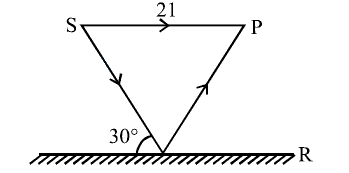 JEE Main/MCQ/Medium/Interference of Light/With diagram
- 24Two monochromatic light beams of intensity 16 and 9 units are interfering. The ratio of intensities of bright and dark parts of the resultant pattern is:JEE Main/MCQ/Medium/Interference of Light
- 25 identical waves each of intensity interfere with each other. The ratio of maximum intensities if the interference is (i) coherent and (ii) incoherent is :JEE Main/MCQ/Medium/Interference of Light
- 26Two coherent plane light waves of equal amplitude makes a small angle with each other. They fall almost normally on a screen. If is the wavelength of light waves, the fringe width of interference patterns of the two sets of waves on the screen isJEE Main/MCQ/Medium/Interference of Light
- 27Direction:
The question has a paragraph followed by two statements, Statement and statement . Of the given four alternatives after the statements, choose the one that describes the statements.
A thin air film is formed by putting the convex surface of a plane - convex lens over a plane glass plate. With monochromatic light, this film gives an interference pattern due to light reflected from the top (convex) surface and the bottom (glass plate) surface of the film.
Statement-1 : When light reflects from the air-glass plate interface, the reflected wave suffers a phase change of .
Statement-2 : The centre of the interference pattern is dark.JEE Main/MCQ/Medium/Interference of Light - 28To demonstrate the phenomenon of interference, we require two sources which emit radiationJEE Main/MCQ/Medium/Interference of Light
- 29In Young's double slit experiment, the fringe width of the interference pattern produced on the screen is m. If the experiment is carried out in another medium having refractive index , the fringe width will be _____ m.JEE Main/MCQ/Medium/Young's Double Slit Experiment
- 30In a Young double slit experiment, the wavelength of incident light is Å, the separation between slits and is cm and the distance between slits plane and screen is cm, as shown in the figure below. If the resultant intensity at is equal to the intensity due to individual slits, the path difference between interfering waves is __________ Å.
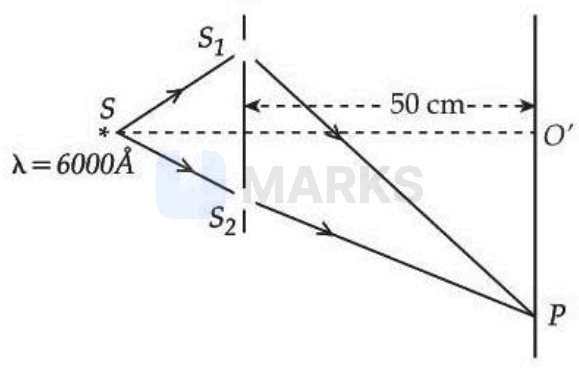 JEE Main/MCQ/Medium/Youngs Double Slit Experiment/With diagram
- 31The maximum intensity in a Young's double slit experiment is . Distance between the slits () is , where is the wavelength of light used. The intensity of the fringe, exactly opposite to one of the slits on the screen, placed at is _______.JEE Main/MCQ/Medium/Youngs Double Slit Experiment
- 32In a double slit experiment, when one of the slits is covered by a transparent mica sheet of refractive index , the central fringe shifts to the position of bright fringe, obtained with both slits uncovered. If the light source wavelength is nm, the thickness of mica sheet is m. The value of is ______.JEE Main/Numerical/Medium/Youngs Double Slit Experiment
- 33In a Young's double slit experiment, the intensity at some point on the screen is found to be times of the maximum of the interference pattern. The path difference between the interfering waves at this point is where is wavelength of the incident light. The value of is _______.JEE Main/Numerical/Medium/Youngs Double Slit Experiment
- 34A beam of light consisting of wavelengths 650 nm and 550 nm illuminates the Young's double slits with separation of 2 mm such that the interference fringes are formed on a screen, placed at a distance of 1.2 m from the slits. The least distance of a point from the central maximum, where the bright fringes due to both the wavelengths coincide, is .JEE Main/Numerical/Medium/Youngs Double Slit Experiment
- 35In the Young's double slit experiment the intensity produced by each one of the individual slits is . The distance between two slits is 2 mm. The distance of screen from slits is 10 m. The wavelength of light is . The intensity of light on the screen in front of one of the slits is .JEE Main/MCQ/Medium/Youngs Double Slit Experiment
- 36In two separate Young's double-slit experimental set-ups and two monochromatic light sources of different wavelengths are used to get fringes of equal width. The ratios of the slits separations and that of the wavelengths of light used are and respectively. The corresponding ratio of the distances between the slits and the respective screens () is .JEE Main/Numerical/Medium/Youngs Double Slit Experiment
- 37In a Young's double slit experiment set up, the two slits are kept 0.4 mm apart and screen is placed at 1 m from slits. If a thin transparent sheet of thickness is introduced in front of one of the slits then center bright fringe shifts by 20 mm on the screen. The refractive index of transparent sheet is given by , where is .JEE Main/Numerical/Medium/Youngs Double Slit Experiment
- 38Given below are two statements :
Statement I : In a Young's double slit experiment, the angular separation of fringes will increase as the screen is moved away from the plane of the slits
Statement II: In a Young's double slit experiment, the angular separation of fringes will increase when monochromatic source is replaced by another monochromatic source of higher wavelength.
In the light of the above statements, choose the correct answer from the options given below :JEE Main/MCQ/Medium/Youngs Double Slit Experiment - 39In a double slit experiment the distance between the slits is 0.1 cm and the screen is placed at 50 cm from the slits plane. When one slit is covered with a transparent sheet having thickness and refractive index , the central fringe shifts by 0.2 cm. The value of is cm.JEE Main/MCQ/Medium/Youngs Double Slit Experiment
- 40In a Young's double slit experiment, the source is white light. One of the slits is covered by red filter and another by a green filter. In this caseJEE Main/MCQ/Medium/Youngs Double Slit Experiment
- 41In a Young's double slit experiment, two slits are located 1.5 mm apart. The distance of screen from slits is 2 m and the wavelength of the source is 400 nm. If the 20 maxima of the double slit pattern are contained within the centre maximum of the single slit diffraction pattern, then the width of each slit is , where x -value is ________JEE Main/Numerical/Medium/Youngs Double Slit Experiment
- 42In a Young's double slit experiment, the slits are separated by 0.2 mm. If the slits separation is increased to 0.4 mm , the percentage change of the fringe width is:JEE Main/MCQ/Medium/Youngs Double Slit Experiment
- 43Width of one of the two slits in a Young's double slit interference experiment is half of the other slit. The ratio of the maximum to the minimum intensity in the interference pattern is :JEE Main/MCQ/Medium/Youngs Double Slit Experiment
- 44Two monochromatic light beams have intensities in the ratio 1:9. An interference pattern is obtained by these beams. The ratio of the intensities of maximum to minimum isJEE Main/MCQ/Medium/Youngs Double Slit Experiment
- 45If the measured angular separation between the second minimum to the left of the central maximum and the third minimum to the right of the central maximum is in a single slit diffraction pattern recorded using 628 nm light, then the width of the slit is _______ .JEE Main/Numerical/Medium/Youngs Double Slit Experiment
- 46A double slit interference experiment performed with a light of wavelength 600 nm forms an interference fringe pattern on a screen with 10 th bright fringe having its centre at a distance of 10 mm from the central maximum. Distance of the centre of the same 10th bright fringe from the central maximum when the source of light is replaced by another source of wavelength 660 nm would be _________ mm .JEE Main/Numerical/Medium/Youngs Double Slit Experiment
- 47The Young's double slit interference experiment is performed using light consisting of 480 nm and 600 nm wavelengths to form interference patterns. The least number of the bright fringes of 480 nm light that are required for the first coincidence with the bright fringes formed by 600 nm light isJEE Main/MCQ/Medium/Youngs Double Slit Experiment
- 48The width of one of the two slits in Young's double slit experiment is d while that of the other slit is . If the ratio of the maximum to the minimum intensity in the interference pattern on the screen is then what is the value of ?
(Assume that the field strength varies according to the slit width.)JEE Main/MCQ/Medium/Youngs Double Slit Experiment - 49Given below are two statements. One is labelled as Assertion (A) and the other is labelled as Reason (R).
Assertion (A) : In Young's double slit experiment, the fringes produced by red light are closer as compared to those produced by blue light.
Reason (R): The fringe width is directly proportional to the wavelength of light.
In the light of the above statements, choose the correct answer from the options given below :JEE Main/MCQ/Medium/Youngs Double Slit Experiment - 50Given below are two statements : one is labelled as Assertion (A) and the other is labelled as Reason (R).
Assertion-(A) : If Young's double slit experiment is performed in an optically denser medium than air, then the consecutive fringes come closer.
Reason-(R) : The speed of light reduces in an optically denser medium than air while its frequency does not change.
In the light of the above statements, choose the most appropriate answer from the options given below :JEE Main/MCQ/Medium/Youngs Double Slit Experiment - 51Monochromatic light of wavelength is used in Young's double slit experiment. An interference pattern is obtained on a screen. When one of the slits is covered with a very thin glass plate (refractive index ), the central maximum is shifted to a position previously occupied by the bright fringe. The thickness of the glass-plate is ______ .JEE Main/Numerical/Medium/Youngs Double Slit Experiment
- 52In a Young's double slit experiment, the intensity at a point is of the maximum intensity, the minimum distance of the point from the central maximum is ________ .
(Given : )JEE Main/Numerical/Medium/Youngs Double Slit Experiment - 53Two slits are apart and the screen is located away from the slits. A light of wavelength is used. The width of each slit to obtain 10 maxima of the double slit pattern within the central maximum of the single slit pattern is _____JEE Main/Numerical/Medium/Youngs Double Slit Experiment
- 54In a single slit experiment, a parallel beam of green light of wavelength passes through a slit of width . The transmitted light is collected on a screen away. The distance of first order minima from the central maximum will be . The value of is :JEE Main/Numerical/Medium/Youngs Double Slit Experiment
- 55In Young's double slit experiment, carried out with light of wavelength , the distance between the slits is and the screen is at from the slits. The central maximum is at . The value of for third maxima is _____.JEE Main/Numerical/Medium/Youngs Double Slit Experiment
- 56The width of one of the two slits in a Young's double slit experiment is 4 times that of the other slit. The ratio of the maximum of the minimum intensity in the interference pattern is:JEE Main/MCQ/Medium/Youngs Double Slit Experiment
- 57Two wavelengths and are used in Young's double slit experiment. and . The minimum order of fringe produced by which overlaps with the fringe produced by is . The value of is _____.JEE Main/Numerical/Medium/Youngs Double Slit Experiment
- 58In Young's double slit experiment, monochromatic light of wavelength is used. The slits are apart and screen is placed at away from slits. The distance from the centre of the screen where intensity becomes half of the maximum intensity for the first time is ______JEE Main/Numerical/Medium/Youngs Double Slit Experiment
- 59In Young's double slit experiment, light from two identical sources are superimposing on a screen. The path difference between the two lights reaching at a point on the screen is . The ratio of intensity of fringe at this point with respect to the maximum intensity of the fringe is:JEE Main/MCQ/Medium/Youngs Double Slit Experiment
- 60In a double slit experiment shown in figure, when light of wavelength is used, dark fringe is observed at . If , the minimum distance between the slits and is . Write the value of to the nearest integer.
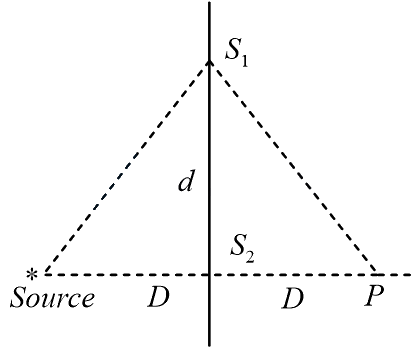 JEE Main/Numerical/Medium/Youngs Double Slit Experiment/With diagram
- 61A single slit of width is illuminated by a monochromatic light of wavelength . The value of for which first minimum appears at on the screen will be :JEE Main/MCQ/Medium/Youngs Double Slit Experiment
- 62In a Young’s double slit experiment, the ratio of amplitude of light coming from slits is . The ratio of the maximum to minimum intensity in the interference pattern isJEE Main/MCQ/Medium/Youngs Double Slit Experiment
- 63The ratio of intensities at two points and on the screen in a Young's double slit experiment where phase difference between two waves of same amplitude are and , respectively areJEE Main/MCQ/Medium/Youngs Double Slit Experiment
- 64The width of fringe is on the screen in a double slit experiment for the light of wavelength of . The width of the fringe for the light of wavelength will be:JEE Main/MCQ/Medium/Youngs Double Slit Experiment
- 65As shown in the figure, in Young's double slit experiment, a thin plate of thickness and refractive index is inserted infront of slit . The experiment is conducted in air () and uses a monochromatic light of wavelength . Due to the insertion of the plate, central maxima is shifted by a distance of . is the fringe-width before the insertion of the plate. The value of the is ______.
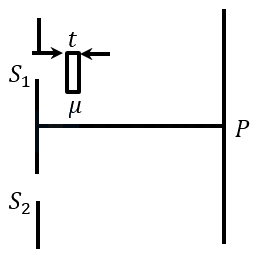 JEE Main/Numerical/Medium/Youngs Double Slit Experiment/With diagram
- 66Two light waves of wavelengths and are used in Young's double slit experiment to obtain interference fringes on a screen placed away from plane of slits. If the two slits are separated by , then shortest distance from the central bright maximum to the point where the bright fringes of the two wavelength coincide will be ______ .JEE Main/Numerical/Medium/Youngs Double Slit Experiment
- 67In a Young’s double slit experiment, the intensities at two points, for the path difference and ( being the wavelength of light used) are and respectively. If denotes the intensity produced by each one of the individual slits, then \dfrac{{I}_{1}+{I}_{2}}{{I}_{0}}=______.JEE Main/Numerical/Medium/Youngs Double Slit Experiment
- 68In Young’s double slit experiment, two slits and are distance apart and the separation from slits to screen is (as shown in figure). Now if two transparent slabs of equal thickness but refractive index and are introduced in the path of beam from and respectively. The central bright fringe spot will shift by ________ number of fringes.
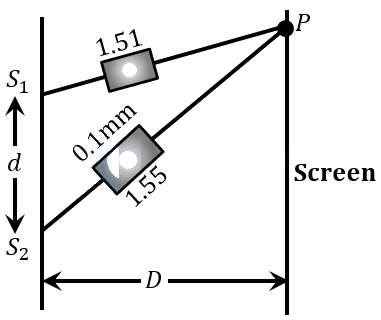 JEE Main/Numerical/Medium/Youngs Double Slit Experiment/With diagram
- 69In a Young’s double slit experiment, two slits are illuminated with a light of wavelength . The line joining is perpendicular to as shown in the figure. If the first minimum is detected at , the value of slits separation will be :
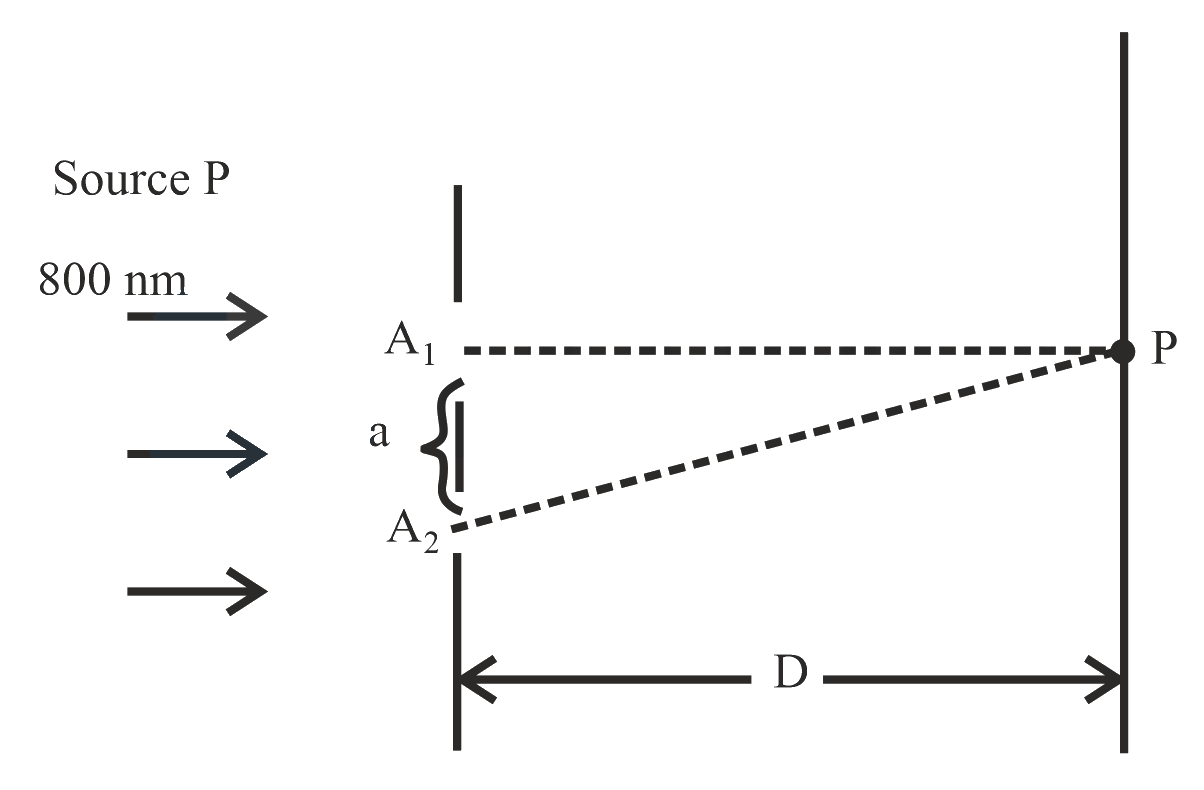
The distance of screen from slits .JEE Main/MCQ/Medium/Youngs Double Slit Experiment/With diagram - 70In Young's double slits experiment, the position of 5th bright fringe from the central maximum is . The distance between slits and screen is and wavelength of used monochromatic light is . The separation between the slits is:JEE Main/MCQ/Medium/Youngs Double Slit Experiment
- 71In a Young's double slit experiment, a laser light of produces an interference pattern with consecutive bright fringes' separation of . Now another light is used to produce an interference pattern with consecutive bright fringes' separation of . The wavelength of second light is _____ JEE Main/Numerical/Medium/Youngs Double Slit Experiment
- 72Two coherent sources of light interfere. The intensity ratio of two sources is . For this interference pattern if the value of is equal to , then will beJEE Main/MCQ/Medium/Youngs Double Slit Experiment
- 73Two beams of light having intensities and interfere to produce a fringe pattern on a screen. The phase difference between the two beams are and at points and respectively. The difference between the resultant intensities at the two points is . The value of will be _____ .JEE Main/Numerical/Medium/Youngs Double Slit Experiment
- 74In young's double slit experiment, the fringe width is . If the entire arrangement is placed in water of refractive index , then the fringe width becomes (in )JEE Main/MCQ/Medium/Youngs Double Slit Experiment
- 75In a double slit experiment with monochromatic light, fringes are obtained on a screen placed at some distance from the plane of slits. If the screen is moved by towards the slits, the change in fringe width is . If the distance between the slits is , then the wavelength of the light will be____.JEE Main/Numerical/Medium/Youngs Double Slit Experiment
- 76Using Young's double slit experiment, a monochromatic light of wavelength produces fringes of fringe width . If another monochromatic light of wavelength is used and the separation between the slits is doubled, then the new fringe width will beJEE Main/MCQ/Medium/Youngs Double Slit Experiment
- 77In a Young's double slit experiment, an angular width of the fringe is on a screen placed at away for particular wavelength of . The angular width of the fringe, when whole system is immersed in a medium of refractive index , is . The value of is _____ .JEE Main/Numerical/Medium/Youngs Double Slit Experiment
- 78In young's double slit experiment performed using a monochromatic light of wavelength , when a glass plate of thickness is introduced in the path of the one of the interfering beams, the intensity at the position where the central maximum occurred previously remains unchanged. The value of will beJEE Main/MCQ/Medium/Youngs Double Slit Experiment
- 79In Young's double slit experiment the two slits are distance apart. Interference pattern is observed on a screen at a distance from the slits. The first dark fringe is observed on the screen directly opposite to one of the slits. The wavelength of light will be _____ .JEE Main/Numerical/Medium/Youngs Double Slit Experiment
- 80The two light beams having intensities and interfere to produce a fringe pattern on a screen. The phase difference between the beams is at point and at point . Then the difference between the resultant intensities at and will be :JEE Main/MCQ/Medium/Youngs Double Slit Experiment
- 81Two satellites revolve around a planet in coplanar circular orbits in anticlockwise direction. Their period of revolutions are hour and hours respectively. The radius of the orbit of nearer satellite is The angular speed of the farther satellite as observed from the nearer satellite at the instant when both the satellites are closest is , where is _______.JEE Main/Numerical/Medium/Youngs Double Slit Experiment
- 82In a Young's double slit experiment, the slits are separated by and the screen is away from the plane of slits. Distance between fourth bright fringes on both sides of central bright fringe is The frequency of light used is JEE Main/Numerical/Medium/Youngs Double Slit Experiment
- 83The light waves from two coherent sources have same intensity In interference pattern the intensity of light at minima is zero. What will be the intensity of light at maxima?JEE Main/MCQ/Medium/Youngs Double Slit Experiment
- 84White light is passed through a double slit and interference is observed on a screen away. The separation between the slits is . The first violet and red fringes are formed and away from the central white fringes. The difference in wavelengths of red and violet light is JEE Main/Numerical/Medium/Youngs Double Slit Experiment
- 85In Young's double slit experiment, if the source of light changes from orange to blue then:JEE Main/MCQ/Medium/Youngs Double Slit Experiment
- 86In the Young's double slit experiment, the distance between the slits varies in time as ; where and are constants. The difference between the largest fringe width and the smallest fringe width obtained over time is given as:JEE Main/MCQ/Medium/Youngs Double Slit Experiment
- 87In Young's double slit arrangement, slits are separated by a gap of , and the screen is placed at a distance of from them. The distance between the first and the third bright fringe formed when the slits are illuminated by a monochromatic light of is :-JEE Main/MCQ/Medium/Youngs Double Slit Experiment
- 88A fringe width of was produced for two slits separated by apart. The screen is placed away. The wavelength of light used is . The value of to the nearest integer is ______.JEE Main/Numerical/Medium/Youngs Double Slit Experiment
- 89In a Young's double slit experiment two slits are separated by and the screen is placed one meter away. When a light of wavelength is used, the fringe separation will be :JEE Main/MCQ/Medium/Youngs Double Slit Experiment
- 90If the source of light used in a Young's double slit experiment is changed from red to violet:JEE Main/MCQ/Medium/Youngs Double Slit Experiment
- 91In a Young's double slit experiment, the width of the one of the slit is three times the other slit. The amplitude of the light coming from a slit is proportional to the slit-width. Find the ratio of the maximum to the minimum intensity in the interference pattern.JEE Main/MCQ/Medium/Youngs Double Slit Experiment
- 92A Young's double-slit experiment is performed using monochromatic light of wavelength . The intensity of light at a point on the screen, where the path difference is , is units. The intensity of light at a point where the path difference is is given by , where is an integer. The value of isJEE Main/Numerical/Medium/Youngs Double Slit Experiment
- 93In a Young's double slit experiment, light of is used to produce and interference pattern. When the distance between the slits is the angular width (in degree) of the fringes formed on the distance screen is close to :JEE Main/MCQ/Medium/Youngs Double Slit Experiment
- 94In a Young's double slit experiment, fringes are observed in a certain segment of the screen when light of wavelength is used. If the wavelength of light is changed to , the number of fringes observed in the same segment of the screen would be :JEE Main/MCQ/Medium/Youngs Double Slit Experiment
- 95In a Young's double slit experiment fringes are observed on a small portion of the screen when light of wavelength is used. Ten fringes are observed on the same section of the screen when another light source of wavelength is used. Then the value of is (in ) __________.JEE Main/Numerical/Medium/Youngs Double Slit Experiment
- 96In a double – slit experiment, at a certain point on the screen the path difference between the two interfering waves is of a wavelength. The ratio of the intensity of light at that point to that at the center of a bright fringe is:JEE Main/MCQ/Medium/Youngs Double Slit Experiment
- 97In a Young’s double slit experiment, the separation between the slits is . In the experiment, a source of light of wavelength is used and the interference pattern is observed on a screen kept away. The separation between the successive bright fringes on the screen is:JEE Main/MCQ/Medium/Youngs Double Slit Experiment
- 98In a double slit experiment, when a thin film of thickness having refractive index is introuduced in front of one of the slits, the maximum at the centre of the fringe pattern shifts by one fringe width. The value of is is the wavelength of the light used):JEE Main/MCQ/Medium/Youngs Double Slit Experiment
- 99In a Young's double-slit experiment, the ratio of the slit's width is . The ratio of the intensity of maxima to minima, close to the central fringe on the screen, will beJEE Main/MCQ/Medium/Youngs Double Slit Experiment
- 100The figure shows a Young's double slit experimental setup. It is observed that when a thin transparent sheet of thickness t and refractive index is put in front of one of the slits, the central maximum gets shifted by a distance equal to n fringe width. If the wavelength of light used is then will be:
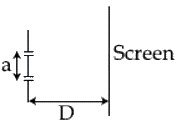 JEE Main/MCQ/Medium/Youngs Double Slit Experiment/With diagram
- 101In a Young's double slit experiment, the path difference, at a certain point on the screen, betwen two interfering waves is th of wavelength. The ratio of the intensity at this point to that at the centre of a bright fringe is close to:JEE Main/MCQ/Medium/Youngs Double Slit Experiment
- 102Consider a Young's double slit experiment as shown in figure. What should be the slit separation in terms of wavelength such that the first minima occurs directly in front of the slit ?
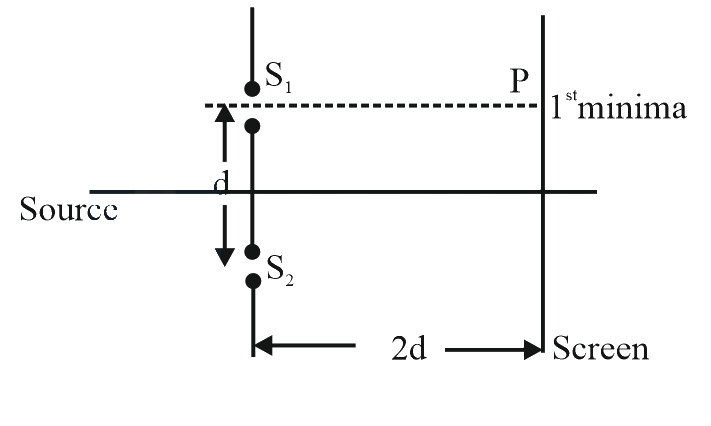 JEE Main/MCQ/Medium/Youngs Double Slit Experiment/With diagram
- 103In a Young's double slit experiment slit separation one observes a bright fringe at angle by using light of wavelength When the light of wavelength is used a bright fringe is seen at the same angle in the same set up. Given that and are in visible range their values are:JEE Main/MCQ/Medium/Youngs Double Slit Experiment
- 104In a young's double slit experiment, the slits are placed apart. Light of wavelength is incident on the slits. The total number of bright fringes that are observed in the angular range is:JEE Main/MCQ/Medium/Youngs Double Slit Experiment
- 105Light of wavelength falls normally on a slit of width . The angular position of the second minima from the central maximum will be (in radians):JEE Main/MCQ/Medium/Youngs Double Slit Experiment
- 106In a Young's double slit experiment, slits are separated by , and the screen is placed away. A beam of light consisting of two wavelengths, and , is used to obtain interference fringes on the screen. The least distance from the common central maximum to the point where the bright fringes due to both the wavelengths coincide is:JEE Main/MCQ/Medium/Youngs Double Slit Experiment
- 107In Young's double-slit experiment, the distance between slits and the screen is and monochromatic light of wavelength is being used. A person standing near the slits is looking at the fringe pattern. When the separation between the slits is varied, the interference pattern disappears for a particular distance between the slits. If the angular resolution of the eye is , then the value of is close toJEE Main/MCQ/Medium/Youngs Double Slit Experiment
- 108In a Young's double slit experiment with light of wavelength the separation of slits is and distance of screen is such that . If the Fringe width is , the distance from point of maximum intensity to the point where intensity falls to half of the maximum intensity on either side is:JEE Main/MCQ/Medium/Youngs Double Slit Experiment
- 109In Young’s double-slit experiment, the distance between the two identical slits is times larger than the slit width. Then the number of intensity maxima observed within the central maximum of the single-slit diffraction pattern is :JEE Main/MCQ/Medium/Youngs Double Slit Experiment
- 110Using monochromatic light of wavelength , an experimentalist sets up the Young's double slit experiment in three ways as shown.
If she observes that , the wavelength of light used is :
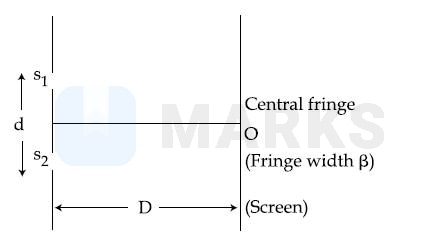
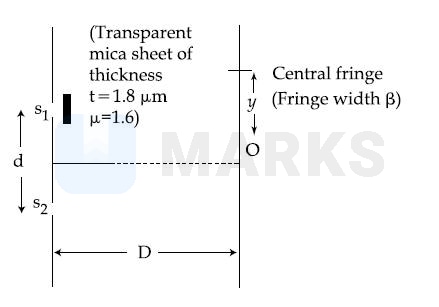
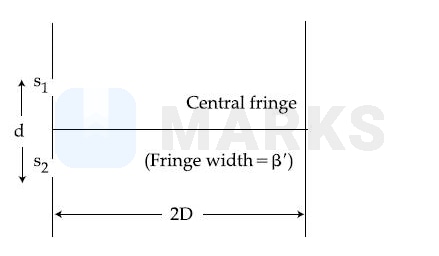 JEE Main/MCQ/Medium/Youngs Double Slit Experiment/With diagram
- 111This question has Statement-1 and Statement-2. Of the four choices given after the Statements, choose the one that best describes the two Statements.
Statement-1: In Young's double slit experiment, the number of fringes observed in the field of view is small with longer wavelength of light and is large with shorter wavelength of light.
Statement-2: In the double slit experiment the fringe width depends directly on the wavelength of light.JEE Main/MCQ/Medium/Youngs Double Slit Experiment - 112In Young's double slit interference experiment, the slit widths are in the ratio . Then the ratio of intensity at the maxima and minima in the interference pattern isJEE Main/MCQ/Medium/Youngs Double Slit Experiment
- 113The maximum number of possible interference maxima for slit separation equal to , where is the wavelength of light used, in a Young's double slit experiment isJEE Main/MCQ/Medium/Youngs Double Slit Experiment
- 114In a Young's double slit experiment with light of wavelength , fringe pattern on the screen has fringe width . When two thin transparent glass (refractive index ) plates of thickness and are placed in the path of the two beams respectively, the fringe pattern will shift by a distanceJEE Main/MCQ/Medium/Youngs Double Slit Experiment
- 115In Young's double slit experiment, one of the slit is wider than other, so that the amplitude of the light from one slit is double of that from other slit. If be the maximum intensity, the resultant intensity I when they interfere at phase difference is given byJEE Main/MCQ/Medium/Youngs Double Slit Experiment
- 116A mixture of light, consisting of wavelength and an unknown wavelength, illuminates Young's double slit and gives rise to two overlapping interference patterns on the screen. The central maximum of both lights coincide. Further, it is observed that the third bright fringe of known light coincides with the bright fringe of the unknown light. From this data, the wavelength of the unknown light isJEE Main/MCQ/Medium/Youngs Double Slit Experiment
- 117In a Young's double slit experiment the intensity at a point where the path difference is ( being the wavelength of the light used) is . If denotes the maximum intensity, is equal toJEE Main/MCQ/Medium/Youngs Double Slit Experiment
- 118A Young’s double slit experiment uses a monochromatic source. The shape of the
interference fringes formed on a screen isJEE Main/MCQ/Medium/Youngs Double Slit Experiment - 119The maximum number of possible interference maxima for slit-separation equal to twice the wavelength in Young's double-slit experiment isJEE Main/MCQ/Medium/Youngs Double Slit Experiment
- 120The source that illuminates the double slit in 'double - slit interference experiment' emits two distinct monochromatic waves of wavelength and , each of them producing its own pattern on the screen. At the central point of the pattern when path difference is zero, maxima of both the patterns coincide and the resulting interference pattern is most distinct at the region of zero path difference. But as one moves out of this central region, the two fringe systems are gradually out of step such that maximum due to on wavelength coincides with the minimum due to the other and the combined fringe system becomes completely indistinct. This may happen when path difference in is:JEE Main/MCQ/Medium/Special Cases in YDSE
- 121A thin glass plate of thickness is ( is wavelength of light used) and refractive index is inserted between one of the slits and the screen in Young's double slit experiment. At a point on the screen equidistant from the slits, the ratio of the intensities before and after the introduction of the glass plate is :JEE Main/MCQ/Medium/Special Cases in YDSE
- 122Some distant star is to be observed by some telescope of diameter of objective lens , at an angular resolution of radian. If the wavelength of light from the star reaching the telescope is nm, the minimum diameter of the objective lens of the telescope is ________ cm. (nearest integer)JEE Main/Numerical/Medium/Diffraction of Light
- 123A telescope with objective diameter is used to observe a distant star emitting light of wavelength nm, at a resolution of radian. The value of is _____ cm.JEE Main/MCQ/Medium/Diffraction of Light
- 124A slit of width is illuminated by light of wavelength . The linear separation between and minima in the diffraction pattern produced on a screen placed at a distance from the slit system is _____.JEE Main/MCQ/Medium/Diffraction of Light
- 125In single slit diffraction pattern, the wavelength of light used is nm and slit width is mm, the angular width of central maximum is degrees. The value of is _______.JEE Main/Numerical/Medium/Diffraction of Light
- 126Given below are two statements:
Statement I: A plane wave after passing through prism remains as plane wave but passing through small pin hole may become spherical wave.
Statement II: The curvature of a spherical wave emerging from a slit will increase for increasing slit width.
In the light of the above statements, choose the correct answer from the options given belowJEE Main/MCQ/Medium/Diffraction of Light - 127Which of the following are true for a single slit diffraction?
A. Width of central maxima increases with increase in wavelength keeping slit width constant.
B. Width of central maxima increases with decrease in wavelength keeping slit width constant.
C. Width of central maxima increases with decrease in slit width at constant wavelength.
D. Width of central maxima increases with increase in slit width at constant wavelength.
E. Brightness of central maxima increases for decrease in wavelength at constant slit width.JEE Main/MCQ/Medium/Diffraction of Light - 128Which of the following phenomena can not be explained by wave theory of light?JEE Main/MCQ/Medium/Diffraction of Light
- 129A parallel beam of monochromatic light of wavelength passes through single slit of width. Angular divergence corresponding to second order minima would be ______ .JEE Main/Numerical/Medium/Diffraction of Light
- 130A microwave of wavelength falls normally on a slit of width The angular spread of the central maxima of the diffraction pattern obtained on a screen away from the slit, will be:JEE Main/MCQ/Medium/Diffraction of Light
- 131A monochromatic light of wavelength is incident on the single slit of width . If the diffraction pattern is formed at the focus of the convex lens of focal length , the linear width of the central maximum is :JEE Main/MCQ/Medium/Diffraction of Light
- 132The diffraction pattern of a light of wavelength diffracting from a slit of width is focused on the focal plane of a convex lens of focal length . The width of the secondary maxima will be :JEE Main/MCQ/Medium/Diffraction of Light
- 133In a single slit diffraction pattern, a light of wavelength is used. The distance between the first and third minima in the diffraction pattern is found to be when the screen is placed away from slits. The width of the slit is ____.JEE Main/Numerical/Medium/Diffraction of Light
- 134A parallel beam of monochromatic light of wavelength is incident normally on a single narrow slit of width . The light is focused by convex lens on screen, placed on its focal plane. The first minima will be formed for the angle of diffraction of ______ (degree).JEE Main/Numerical/Medium/Diffraction of Light
- 135Given below are two statements: One is labelled as Assertion A and the other is labelled as Reason R
Assertion A : The beam of electrons shows wave nature and exhibit interference and diffraction.
Reason R : Davisson Germer Experimentally verified the wave nature of electrons.
In the light of the above statements. Choose the most appropriate answer from the options given below :JEE Main/MCQ/Medium/Diffraction of Light - 136Given below are two statements :
Statement I : If the Brewster's angle for the light propagating from air to glass is , then Brewster's angle for the light propagating from glass to air is .
Statement II : The Brewster's angle for the light propagating from glass to air is , where is the refractive index of glass.
In the light of the above statements, choose the correct answer from the options given below :JEE Main/MCQ/Medium/Diffraction of Light - 137Sodium light of wavelengths and is used to study diffraction at a single slit of aperture . The distance between the slit and the screen is . The separation between the positions of the first maxima of diffraction pattern obtained in the two cases is _____ JEE Main/Numerical/Medium/Diffraction of Light
- 138The difference in the number of waves when yellow light propagates through air and vacuum columns of the same thickness is one. The thickness of the air column is _____ . [Refractive index of air , the wavelength of yellow light in vacuum JEE Main/Numerical/Medium/Diffraction of Light
- 139Consider the diffraction pattern obtained from the sunlight incident on a pinhole of diameter If the diameter of the pinhole is slightly increased, it will affect the diffraction pattern such thatJEE Main/MCQ/Medium/Diffraction of Light
- 140Orange light of wavelength illuminates a single slit of width . The maximum possible number of diffraction minima produced on both sides of the central maximum is __________JEE Main/Numerical/Medium/Diffraction of Light
- 141The aperture diameter of a telescope is . The separation between the moon and the earth is . With light of wavelength of , the minimum separation between objects on the surface of moon, so that they are just resolved, is close to:JEE Main/MCQ/Medium/Diffraction of Light
- 142Visible light of wavelength falls normally on a single slit and produces a diffraction pattern. It is found that the second diffraction minimum is at from the central maximum. If the first minimum is produced at then is close toJEE Main/MCQ/Medium/Diffraction of Light
- 143In a double-slit experiment, green light falls on a double slit having a separation of and a width of . The number of bright fringes between the first and the second diffraction minima isJEE Main/MCQ/Medium/Diffraction of Light
- 144Light of wavelength falls normally on a slit of width . The angular position of the second minima from the central maximum will be (in radians)JEE Main/MCQ/Medium/Diffraction of Light
- 145The angular width of the central maximum in a single slit diffraction pattern is . The width of the slit is . The slit is illuminated by monochromatic plane waves. If another slit of the same width is made near it, Young's fringes can be observed on a screen placed at a distance from the slits. If the observed fringe width is , what is slit separation distance? (i.e., the distance between the centres of each slit.)JEE Main/MCQ/Medium/Diffraction of Light
- 146A single slit of width is illuminated by a parallel beam of light of wavelength and diffraction bands are observed on a screen from the slit. The distance of the third dark band from the central bright band is:JEE Main/MCQ/Medium/Diffraction of Light
- 147A single slit of width is illuminated by a coherent monochromatic light of wavelength If the second and fourth minima in the diffraction pattern at a distance from the slit are at and respectively from the central maximum, what is the width of the central maximum? (i.e. distance between first minimum on either side of the central maximum)JEE Main/MCQ/Medium/Diffraction of Light
- 148Two stars are 10 light years away from the earth. They are seen through a telescope of objective diameter 30 cm. The wavelength of light is 600nm. To see the stars just resolved by the telescope, the minimum distance between them should be of the order of :JEE Main/MCQ/Medium/Diffraction of Light
- 149The box of a pin hole camera, of length L, has a hole of radius a. It is assumed that when the hole is illuminated by a parallel beam of light of wavelength the spread of the spot (obtained on the opposite wall of the camera) is the sum of its geometrical spread and the spread due to diffraction. The spot would then have its minimum size (say ) when:JEE Main/MCQ/Medium/Diffraction of Light
- 150A parallel beam of electrons travelling in x - direction falls on a slit of width d (see figure). If after passing the slit, an electron acquires momentum in the y - direction then for a majority of electrons passing through the slit (h is Planck's constant):
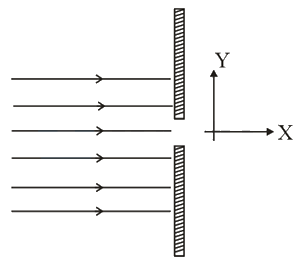 JEE Main/MCQ/Medium/Diffraction of Light/With diagram
- 151Assuming that the human pupil has a radius of and a comfortable viewing distance of . The minimum separation between two point objects that the human eye can resolve for the light of wavelength isJEE Main/MCQ/Medium/Diffraction of Light
- 152In an experiment of single slit diffraction pattern, first minimum for red light coincides with first maximum of some other wavelength. If wavelength of red light is , then wavelength of first maximum will be:JEE Main/MCQ/Medium/Diffraction of Light
- 153This question has Statement-1 and Statements2. Of the four choices given after the Statements, choose the one that best describes the two Statements.
Statement-1 : Out of radio waves and microwaves, the radio waves undergo more diffraction.
Statement-2 : Radio waves have greater frequency compared to microwaves.JEE Main/MCQ/Medium/Diffraction of Light - 154The first diffraction minimum due to the single slit diffraction is seen at for a light of wavelength falling perpendicularly on the slit. The width of the slit isJEE Main/MCQ/Medium/Diffraction of Light
- 155If is the intensity of the principal maximum in the single slit diffraction pattern, then what will be its intensity when the slit width is doubled?JEE Main/MCQ/Medium/Diffraction of Light
- 156Two point white dots are apart on a black paper. They are viewed by eye of pupil diameter . Approximately, what is the maximum distance at which these dots can be resolved by the eye? [ Take wavelength of light ]JEE Main/MCQ/Medium/Diffraction of Light
- 157Wavelength of light used in an optical instrument are and , then ratio of their respective resolving powers (corresponding to and ) isJEE Main/MCQ/Medium/Diffraction of Light
- 158An unpolarized light of intensity passes through polarizer and then through a certain optically active solution and finally it goes to analyser. If the angle between analyser and polariser is and intensity of light emerged from analyser is , the angle of rotation of the light by the solution with respect to analyser is _______ degrees.JEE Main/Numerical/Medium/Polarization of Light
- 159An unpolarized light of certain intensity passes through a combination of two polarizers whose transmission axes are at and , respectively, with respect to the horizontal axis. A third polarizer with its transmission axis at with the horizontal axis is placed between the two existing polarizers. The ratio of the output intensities with and without the third polarizer is ______.JEE Main/MCQ/Medium/Polarization of Light
- 160An unpolarized light is incident on the plane interface of air-dielectric medium shown in figure. If the incident angle is equal to Brewster angle, identify the expression representing reflected wave.
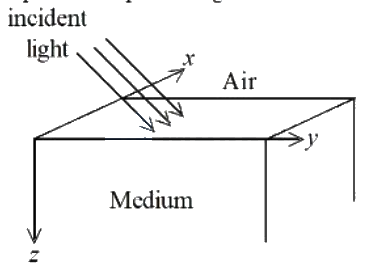 JEE Main/MCQ/Medium/Polarization of Light/With diagram
- 161An unpolarised light is incident at an interface of two dielectric media having refractive indices of 2 (incident medium) and (medium) respectively. To satisfy the condition that reflected and refracted rays are perpendicular to each other, the angle of incidence is .JEE Main/MCQ/Medium/Polarization of Light
- 162When an unpolarized light falls at a particular angle on a glass plate (placed in air), it is observed that the reflected beam is linearly polarized. The angle of refracted beam with respect to the normal is .
, refractive indices of air and glass are 1.00 and 1.52, respectively.)JEE Main/MCQ/Medium/Polarization of Light - 163Two polarisers and are placed in such a way that the intensity of the transmitted light will be zero. A third polariser is inserted in between and , at the particular angle between and . The transmitted intensity of the light passing the through all three polarisers is maximum. The angle between the polarisers and is :JEE Main/MCQ/Medium/Polarization of Light
- 164In a Young's double slit experiment, three polarizers are kept as shown in the figure. The transmission axes of and are orthogonal to each other. The polarizer covers both the slits with its transmission axis at to those of and . An unpolarized light of wavelength and intensity is incident on and . The intensity at a point after where the path difference between the light waves from and is , is
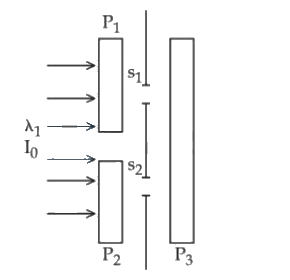 JEE Main/MCQ/Medium/Polarization of Light/With diagram
- 165When unpolarized light is incident at an angle of on a transparent medium from air. The reflected ray is completely polarized. The angle of refraction in the medium isJEE Main/MCQ/Medium/Polarization of Light
- 166A beam of unpolarised light of intensity is passed through a polaroid and then through another polaroid which is oriented so that its principal plane makes an angle of relative to that of . The intensity of emergent light is :JEE Main/MCQ/Medium/Polarization of Light
- 167When a polaroid sheet is rotated between two crossed polaroids then the transmitted light intensity will be maximum for a rotation of :JEE Main/MCQ/Medium/Polarization of Light
- 168Unpolarised light of intensity passes through the combination of three polaroids such that the pass axis of the last polaroids is perpendicular to that of the pass axis of first polaroids. If intensity of emerging light is , then the angle between pass axis of first two polaroids is _________.JEE Main/Numerical/Medium/Polarization of Light
- 169‘’ polarizing sheets are arranged such that each makes an angle with the proceeding sheet. An unpolarized light of intensity is incident into this arrangement. The output intensity is found to be . The value of will be:JEE Main/MCQ/Medium/Polarization of Light
- 170Two polaroids are placed in such a way that the pass-axis of polaroids are perpendicular to each other. Now, another polaroid is placed between bisecting angle between them. If intensity of unpolarised light is then intensity of transmitted light after passing through polaroid will be :JEE Main/MCQ/Medium/Polarization of Light
- 171Unpolarised light is incident on the boundary between two dielectric media, whose dielectric constants are (medium –) and (medium – ), respectively. To satisfy the condition, so that the reflected and refracted rays are perpendicular to each other, the angle of incidence should be , the value of is ______.
(Given for dielectric media, )JEE Main/Numerical/Medium/Polarization of Light - 172As shown in figures, three identical polaroids , and are placed one after another. The pass axis of and are inclined at angle of and with respect to axis of . The source has an intensity of . The intensity of light at point is _____.
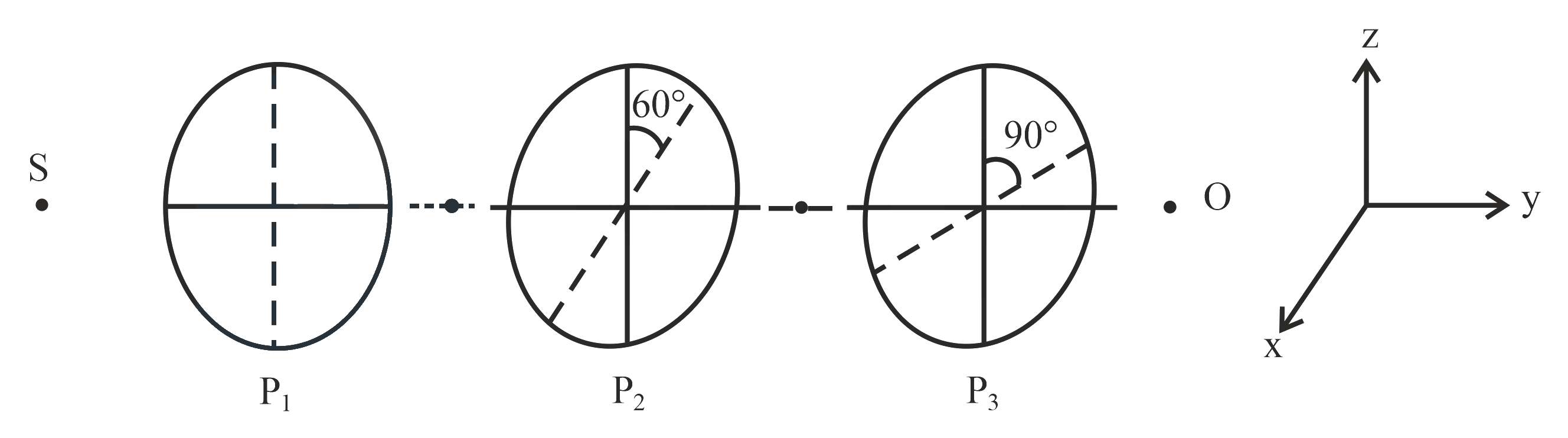 JEE Main/Numerical/Medium/Polarization of Light/With diagram
- 173An unpolarised light beam of intensity is passed through a polaroid and then through another polaroid which is oriented in such a way that its passing axis makes an angle of relative to that of . The intensity of the emergent light isJEE Main/MCQ/Medium/Polarization of Light
- 174A wave of frequency , strikes a particle of size of , then this phenomenon is called asJEE Main/MCQ/Medium/Polarization of Light
- 175A light whose electric field vectors are completely removed by using a good polaroid, allowed to incident on the surface of the prism at Brewster's angle. Choose the most suitable option for the phenomenon related to the prism.JEE Main/MCQ/Medium/Polarization of Light
- 176A source of light is placed in front of a screen. The intensity of light on the screen is . Two Polaroids and are so placed in between the source of light and screen that the intensity of light on the screen is . Then the , should be rotated by an angle of (degrees) so that the intensity of light on the screen becomes .JEE Main/Numerical/Medium/Polarization of Light
- 177An unpolarized light beam is incident on the polarizer of a polarization experiment and the intensity of light beam emerging from the analyzer is measured as Lumens. Now, if the analyzer is rotated around the horizontal axis (direction of light) by in clockwise direction, the intensity of emerging light will be _______Lumens.JEE Main/Numerical/Medium/Polarization of Light
- 178A beam of plane polarized light of large cross-sectional area and uniform intensity of falls normally on a polarizer (cross-sectional area ), which rotates about its axis with an angular speed of . The energy of light passing through the polarizer per revolution, is close to:JEE Main/MCQ/Medium/Polarization of Light
- 179A polarizer - analyser set is adjusted such that the intensity of light coming out of the analyser is just of the original intensity. Assuming that the polarizer - analyser set does not absorb any light, the angle by which the analyser needs to be rotated further, to reduce the output intensity to zero, is JEE Main/MCQ/Medium/Polarization of Light
- 180A system of three polarizers is set up such that the pass axis of is crossed with respect to that of . The pass axis of is inclined at to the pass axis of When a beam of unpolarized light of intensity is incident on the intensity of light transmitted by the three polarizers is . The ratio equals (nearly):JEE Main/MCQ/Medium/Polarization of Light
- 181Consider a tank made of glass (refractive index ) with a thick bottom. It is filled with a liquid of refractive index A student finds that, irrespective of what the incident angle (see figure) is for a beam of light entering the liquid, the light reflected from the liquid glass interface is never completely polarized. For this to happen, the minimum value of is:
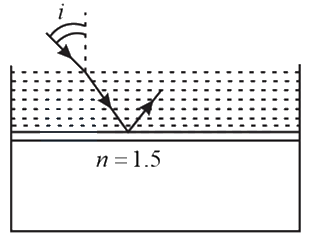 JEE Main/MCQ/Medium/Polarization of Light/With diagram
- 182Unpolarized light of intensity is incident on a system of two polarizers, followed by . The intensity of emergent light is . If a third the polarizer is placed between and the intensity of emergent light is reduced to . The angle between the polarizers and is , thenJEE Main/MCQ/Medium/Polarization of Light
- 183A plane polarized light is incident on a polariser with its pass axis making angle with -axis, as shown in the figure. At four different values of and , the observed intensities are same. What is the angle between the direction of polarization and -axis
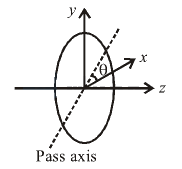 JEE Main/MCQ/Medium/Polarization of Light/With diagram
- 184Unpolarized light of intensity passes through an ideal polariser . Another identical polariser is placed behind . The intensity of light beyond B is found to be . Now another identical polariser is placed between and . The intensity beyond B is now found to be . The angle between polariser and isJEE Main/MCQ/Medium/Polarization of Light
- 185Unpolarized light of intensity is incident on surface of a block of glass at Brewster's angle. In that case, which one of the following statements is true?JEE Main/MCQ/Medium/Polarization of Light
- 186Two beams, A and B of plane polarized light with mutually perpendicular planes of polarization are seen through a polaroid. From the position when the beam A has maximum intensity (and beam B has zero intensity), a rotation of polaroid through 30o makes the two beams appear equally bright. If the initial intensities of the two beams are IA and IB respectively, then equals :JEE Main/MCQ/Medium/Polarization of Light
- 187A person lives in a high-rise building on the bank of a river wide. Across the river is a well lit tower of height . When the person, who is at a height of , looks through a polarizer at an appropriate angle at light of the tower reflecting from the river surface, he notes that intensity of light coming from distance from his building is the least and this corresponds to the light coming from light bulbs at height ' ' on the tower. The values of and are respectively close to (refractive index of water )
 JEE Main/MCQ/Medium/Polarization of Light/With diagram
- 188A beam of unpolarised light of intensity is passed through a polaroid and then through another polaroid which is oriented so that its principle plane makes an angle of relative to that of . The intensity of the emergent light is:JEE Main/MCQ/Medium/Polarization of Light
- 189Two polaroids have their polarizing directions parallel so that the intensity of a transmitted light is maximum. The angle through which either polaroid must be turned if the intensity is to drop by one-half isJEE Main/MCQ/Medium/Polarization of Light
- 190When an unpolarized light of intensity is incident on a polarizing sheet, the intensity of the light which does not get transmitted isJEE Main/MCQ/Medium/Polarization of Light
- 191The angle of incidence at which reflected light totally polarized for reflection from air to glass (refractive index ), isJEE Main/MCQ/Medium/Polarization of Light
NEET question paper PDF
This chapter includes NEET questions. Open a year to read the full paper, or download the PDF.
Opening paper…
JEE Main question paper PDF
This chapter includes JEE Main questions. Open a shift to read the paper, or download the PDF.
Opening paper…
Other Physics chapters
Current Electricity 380Electrostatics 311Kinematics 308Ray Optics 295Rotational Motion 280Magnetic Effects & Magnetism 276Atoms & Nuclei 239Gravitation 223Laws of Motion 210Semiconductors 209Dual Nature of Matter 200Oscillations 194Fluid Mechanics 192Alternating Current 190Thermodynamics 190Work Energy Power 183Capacitors 180Kinetic Theory 168Electromagnetic Waves 165Electromagnetic Induction 153Units & Dimensions 149Waves 142Center of Mass, Momentum & Collision 130Thermal Properties of Matter 126Mathematics in Physics 121Mechanical Properties of Solids 118Experimental Physics 70Magnetic Properties of Matter 57Modern Physics 5
Stuck on a Wave Optics question from your book?
Snap it and get a whiteboard video that solves it step by step. Your first video needs no login.