Physics · JEE Main
Kinetic Theory
168 practice questions with a worked solution for each. Tap an option to see instantly if you are right.
156MCQ12Numerical4With diagram
- 1The ratio of specific heats for a rigid diatomic gas molecule is:JEE Main/MCQ/Medium
- 2The RMS speed of gas molecules at absolute temperature is . If the temperature is increased to , the new RMS speed is:JEE Main/MCQ/Medium
- 3One gas of mole of molecules at temperature , volume , and pressure , and another gas of mole of molecules at temperature , volume , and pressure , are mixed resulting in pressure and volume of the mixture. The temperature of the mixture is _____.JEE Main/MCQ/Medium/Gas Laws
- 4A mixture of carbon dioxide and oxygen has volume cm, temperature K, pressure kPa and mass g. The number of moles of carbon dioxide and oxygen gases in the mixture respectively are _______.
(Assume both carbon dioxide and oxygen gases behave like ideal gases) J/mol.KJEE Main/MCQ/Medium/Gas Laws - 5The mean free path of a molecule of diameter at the temperature and pressure , is given as m.
(Given ).JEE Main/MCQ/Medium/Gas Laws - 6A gas of certain mass filled in a closed cylinder at a pressure of 3.23 kPa has temperature . The gas is now heated to double its temperature. The modified pressure is Pa. Note: Volume is constant.JEE Main/Numerical/Medium/Gas Laws
- 7Consider two boxes containing ideal gases and such that their temperatures, pressures and number densities are same. The molecular size of is half of that of and mass of molecule is four times that of . If the collision frequency in gas is then collision frequency in gas is .JEE Main/MCQ/Medium/Gas Laws
- 8If the collision frequency of hydrogen molecules in a closed chamber at is , then the collision frequency of the same system at is :JEE Main/MCQ/Medium/Gas Laws
- 9The parameter that remains the same for molecules of all gases at a given temperature is :JEE Main/MCQ/Medium/Gas Laws
- 10The temperature of a gas having molecules per cubic meter at (Given, is :JEE Main/MCQ/Medium/Gas Laws
- 11The number of air molecules per is increased from to The ratio of collision frequency of air molecules before and after the increase in number respectively is :JEE Main/MCQ/Medium/Gas Laws
- 12The pressure and temperature relationship of an ideal gas obeys the equation constant. The volume expansion coefficient of the gas will be :JEE Main/MCQ/Medium/Gas Laws
- 13A vessel contains of hydrogen and of oxygen at standard temperature and pressure. The volume of the vessel in is :JEE Main/MCQ/Medium/Gas Laws
- 14A mixture of hydrogen and oxygen has volume , temperature , pressure and mass . The ratio of number of moles of hydrogen to number of moles of oxygen in the mixture will be
[Take gas constant ]JEE Main/MCQ/Medium/Gas Laws - 15When a gas filled in a closed vessel is heated by raising the temperature by , its pressure increases by The initial temperature of the gas is _____ .JEE Main/Numerical/Medium/Gas Laws
- 16A balloon carries a total load of at normal pressure and temperature of What load will the balloon carry on rising to a height at which the barometric pressure is of and the temperature is Assuming the volume constant?JEE Main/MCQ/Medium/Gas Laws
- 17The temperature of an open room of volume increases from to due to the sunshine. The atmospheric pressure in the room remains . If and are the number of molecules in the room before and after heating, then will be:JEE Main/MCQ/Medium/Gas Laws
- 18Modern vacuum pumps can evacuate a vessel down to a pressure of atm. at room temperature (300 K). Taking R = 8.3 JK-1 mole-1, 1 atm = 105 Pa and , the mean distance between molecules of gas in an evacuated vessel will be of the order of :JEE Main/MCQ/Medium/Gas Laws
- 19This question has Statement-1 and Statement-2. Of the four choices given after the Statements, choose the one that best describes the two Statements.
Statement 1: The internal energy of a perfect gas is entirely kinetic and depends only on absolute temperature of the gas and not on its pressure or volume.
Statement 2: A perfect gas is heated keeping pressure constant and later at constant volume. For the same amount of heat the temperature of the gas at constant pressure is lower than that at constant volume.JEE Main/MCQ/Medium/Gas Laws - 20Three perfect gases at absolute temperatures and are mixed. The masses of molecules are , and and the number of molecules are and respectively. Assuming no loss of energy, the final temperature of the mixture is :JEE Main/MCQ/Medium/Gas Laws
- 21Two thermally insulated vessels 1 and 2 are filled with air at temperatures , volume and pressure respectively. If the valve joining two vessels is opened, the temperature inside the vessel at equilibrium will beJEE Main/MCQ/Medium/Gas Laws
- 22The r.m.s. speed of oxygen molecules at is equal to that of the hydrogen molecules kept at . (Mass of oxygen molecule/mass of hydrogen molecule )JEE Main/MCQ/Medium/Speed of Gas
- 23The mean free path and the average speed of oxygen molecules at 300 K and 1 atm are and respectively. Find the frequency of its collisions.JEE Main/MCQ/Medium/Speed of Gas
- 24The ratio of vapour densities of two gases at the same temperature is , then the ratio of r.m.s. velocities will be:JEE Main/MCQ/Medium/Speed of Gas
- 25For a particular ideal gas which of the following graphs represents the variation of mean squared velocity of the gas molecules with temperature?JEE Main/MCQ/Medium/Speed of Gas
- 26A sample contains mixture of helium and oxygen gas. The ratio of root mean square speed of helium and oxygen in the sample, is:JEE Main/MCQ/Medium/Speed of Gas
- 27If is the number density and is the diameter of the molecule, then the average distance covered by a molecule between two successive collisions (i.e. mean free path) is represented by :JEE Main/MCQ/Medium/Speed of Gas
- 28If the root mean square velocity of hydrogen molecule at a given temperature and pressure is the root mean square velocity of oxygen at the same condition in is:JEE Main/MCQ/Medium/Speed of Gas
- 29At which temperature the r.m.s. velocity of a hydrogen molecule equal to that of an oxygen molecule at ?JEE Main/MCQ/Medium/Speed of Gas
- 30The mean free path of molecules of a certain gas at STP is , where is the diameter of the gas molecules. While maintaining the standard pressure, the mean free path of the molecules at is approximately:JEE Main/MCQ/Medium/Speed of Gas
- 31The speed of oxygen molecule in a vessel at particular temperature is when is the average speed of the molecule. The value of will be:
(take )JEE Main/MCQ/Medium/Speed of Gas - 32If the r.m.s speed of chlorine molecule is at , the r.m.s speed of argon molecules at the same temperature will be (Atomic mass of argon , molecular mass of chlorine )JEE Main/MCQ/Medium/Speed of Gas
- 33The root mean square speed of molecules of nitrogen gas at is approximately: (Given mass of a nitrogen molecule and take Boltzmann constant )JEE Main/MCQ/Medium/Speed of Gas
- 34Three vessels of equal volume contain gases at the same temperature and pressure. The first vessel contains neon (monoatomic), the second contains chlorine (diatomic) and third contains uranium hexafluoride (polyatomic). Arrange these on the basis of their root mean square speed and choose the correct answer from the options given below:JEE Main/MCQ/Medium/Speed of Gas
- 35The temperature of an ideal gas is increased from to . If r.m.s. speed of gas at is . Then, r.m.s. speed of the gas at will be:JEE Main/MCQ/Medium/Speed of Gas
- 36A flask contains hydrogen and oxygen in the ratio of by mass at temperature . The ratio of average kinetic energy per molecule of hydrogen and oxygen respectively is :JEE Main/MCQ/Medium/Speed of Gas
- 37At , the rms speed of oxygen molecules is times to that of its average speed in the gas. Then, the value of will be (use )JEE Main/MCQ/Medium/Speed of Gas
- 38The root mean square velocity of molecules of gas isJEE Main/MCQ/Medium/Speed of Gas
- 39Given below are two statements:
Statement I: The temperature of a gas is . When the gas is heated to , the root mean square speed of the molecules is doubled.
Statement II : The product of pressure and volume of an ideal gas will be equal to translational kinetic energy of the molecules.
In the light of the above statements, choose the correct answer from the options given below:JEE Main/MCQ/Medium/Speed of Gas - 40The root mean square speed of smoke particles of mass in their Brownian motion in air at NTP is approximately.
[Given ]JEE Main/MCQ/Medium/Speed of Gas - 41A vessel contains of nitrogen gas at a temperature of . The amount of heat to be transferred to the gas to double the r.m.s. speed of its molecules will be : (Take )JEE Main/MCQ/Medium/Speed of Gas
- 42Given below are two statements:
Statement I :The average momentum of a molecule in a sample of an ideal gas depends on temperature.
Statement II : The rms speed of oxygen molecules in a gas is . If the temperature is doubled and the oxygen molecules dissociate into oxygen atoms, the rms speed will become .
In the light of the above statements, choose the correct answer from the options given below :JEE Main/MCQ/Medium/Speed of Gas - 43Same gas is filled in two vessels of the same volume at the same temperature. If the ratio of the number of molecules is , then
. The r.m.s. velocity of gas molecules in two vessels will be the same.
. The ratio of pressure in these vessels will be .
. The ratio of pressure will be .
. The r.m.s. velocity of gas molecules in two vessels will be in the ratio of .JEE Main/MCQ/Medium/Speed of Gas - 44What will be the effect on the root mean square velocity of oxygen molecules if the temperature is doubled and oxygen molecule dissociates into atomic oxygen?JEE Main/MCQ/Medium/Speed of Gas
- 45The relation between root mean square speed and most probable speed for the molar mass of oxygen gas molecule at the temperature of will beJEE Main/MCQ/Medium/Speed of Gas
- 46 of Nitrogen is enclosed in a vessel at a temperature of . The amount of heat required to double the speed of its molecules is_____ .
(Take )JEE Main/Numerical/Medium/Speed of Gas - 47If the R.M.S. speed of oxygen molecules at is . Find the R.M.S. speed of hydrogen molecules at .JEE Main/MCQ/Medium/Speed of Gas
- 48The R.M.S. speeds of the molecules of Hydrogen, Oxygen, and Carbon dioxide at the same temperature are and respectively, then:JEE Main/MCQ/Medium/Speed of Gas
- 49Consider a mixture of gas molecule of types and having masses The ratio of their root mean square speeds at normal temperature and pressure is:JEE Main/MCQ/Medium/Speed of Gas
- 50Consider a sample of oxygen behaving like an ideal gas. At , the ratio of root-mean-square (RMS) velocity to the average velocity of the gas molecule would be :
(Molecular weight of oxygen is )JEE Main/MCQ/Medium/Speed of Gas - 51Calculate the value of the mean free path for oxygen molecules at temperature and pressure . Assume the molecular diameter and the gas is ideal. JEE Main/MCQ/Medium/Speed of Gas
- 52The root-mean-square speed of molecules of a given mass of a gas at and atmosphere pressure is The root-mean-square speed of molecules of the gas at and atmosphere pressure is The value of will be __________.JEE Main/Numerical/Medium/Speed of Gas
- 53Assuming the nitrogen molecule is moving with . velocity at , the de-Broglie wave length of nitrogen molecule is close to : (Given : nitrogen molecule weight : , Boltzman constant : , Planck constant : )JEE Main/MCQ/Medium/Speed of Gas
- 54In a dilute gas at pressure and temperature '', the time between successive collision of a molecule varies with as :JEE Main/MCQ/Medium/Speed of Gas
- 55Nitrogen gas is at temperature. The temperature (in ) at which the rms speed of a molecule would be equal to the rms speed of a nitrogen molecule, is (Molar mass of gas ).JEE Main/Numerical/Medium/Speed of Gas
- 56An ideal gas in a closed container is slowly heated. As its temperature increases, which of the following statements are true ?
(A) the mean free path of the molecules decreases
(B) the mean collision time between the molecules decreases.
(C) the mean free path remains unchanged.
(D) the mean collision time relations unchanged.JEE Main/MCQ/Medium/Speed of Gas - 57Two gases - argon (atomic radius atomic weight ) and xenon (atomic radius atomic weight ) have the same number density and are at the same temperature. The ratio of their respective mean free times is closest to:JEE Main/MCQ/Medium/Speed of Gas
- 58The plot that depicts the behavior of the mean free time (time between two successive collisions) for the molecules of an ideal gas, as a function of temperature qualitatively, is: (Graphs are schematic and not drawn to scale)JEE Main/MCQ/Medium/Speed of Gas
- 59A volume cylinder is filled with mol of gas at room temperature . The molecular diameter of , and its root mean square speed, are found to be and , respectively. What is the average collision rate (per second) for an molecule?JEE Main/MCQ/Medium/Speed of Gas
- 60For given gas at pressure, speed of the molecules is at At pressure and at the speed of the molecules will be:JEE Main/MCQ/Medium/Speed of Gas
- 61The temperature, at which the root mean square velocity of hydrogen molecules equals their escape their escape velocity from the earth, is closest to:
Boltzmann Constant
Avogadro number
Radius of Earth:
Gravitational acceleration on Earth JEE Main/MCQ/Medium/Speed of Gas - 62An ideal gas is enclosed in a cylinder at pressure of atm and temperature, The mean time between two successive collisions is If the pressure is doubled and temperature is increased to the mean time between two successive collisions will be close to:JEE Main/MCQ/Medium/Speed of Gas
- 63A mixture of 2 moles of helium gas (atomic mass = 4u) and 1 mole of argon gas (atomic mass = 40 u) is kept at in a container. The ratio of their rms speeds is close to:JEE Main/MCQ/Medium/Speed of Gas
- 64At room temperature a diatomic gas is found to have an r.m.s. speed of . The gas is:JEE Main/MCQ/Medium/Speed of Gas
- 65In the isothermal expansion of of gas from volume to the work done by the gas is .
What is the root mean square speed of the molecules of the gas at that temperature?JEE Main/MCQ/Medium/Speed of Gas - 66At what temperature is the r.m.s. velocity of a hydrogen molecule equal to that of an oxygen molecule at ?JEE Main/MCQ/Medium/Speed of Gas
- 67Given below are two statements: one is labelled as Assertion A and the other is labelled as Reason R
Statement I: Change in internal energy of a system containing mole of ideal gas can be written as , where , initial temperature, final temperature.
Statement II: Relation between degree of freedom and is
Choose the correct answer from the options given belowJEE Main/MCQ/Medium/Degree of Freedom and Specific Heat - 68The volume of an ideal gas increases 8 times and temperature becomes of initial temperature during a reversible change. If there is no exchange of heat in this process then identify the gas from the following options (Assuming the gases given in the options are ideal gases):JEE Main/MCQ/Medium/Degree of Freedom and Specific Heat
- 69Match the with
Choose the answer from the options given below :JEE Main/MCQ/Medium/Degree of Freedom and Specific Heat - 70 is the specific heat ratio of monoatomic gas A having 3 translational degrees of freedom. is the specific heat ratio of polyatomic gas B having 3 translational, 3 rotational degrees of freedom and 1 vibrational mode. If , then the value of is _______.JEE Main/Numerical/Medium/Degree of Freedom and Specific Heat
- 71A mixture of one mole of monoatomic gas and one mole of a diatomic gas (rigid) are kept at room temperature . The ratio of specific heat of gases at constant volume respectively is:JEE Main/MCQ/Medium/Degree of Freedom and Specific Heat
- 72The specific heat at constant pressure of a real gas obeying equation is:JEE Main/MCQ/Medium/Degree of Freedom and Specific Heat
- 73During an adiabatic process, if the pressure of a gas is found to be proportional to the cube of its absolute temperature, then the ratio of for the gas is :JEE Main/MCQ/Medium/Degree of Freedom and Specific Heat
- 74The translational degrees of freedom and rotational degrees of freedom of molecule are:JEE Main/MCQ/Medium/Degree of Freedom and Specific Heat
- 75Two moles of a monoatomic gas is mixed with six moles of a diatomic gas. The molar specific heat of the mixture at constant volume is :JEE Main/MCQ/Medium/Degree of Freedom and Specific Heat
- 76If three moles of monoatomic gas is mixed with two moles of a diatomic gas , the value of adiabatic exponent for the mixture is:JEE Main/MCQ/Medium/Degree of Freedom and Specific Heat
- 77Two thermodynamical process are shown in the figure. The molar heat capacity for process and are and . The molar heat capacity at constant pressure and constant volume are represented by and , respectively. Choose the correct statement.
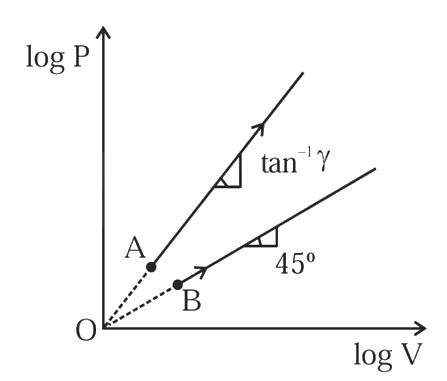 JEE Main/MCQ/Medium/Degree of Freedom and Specific Heat/With diagram
- 78 moles of a polyatomic gas must be mixed with two moles of a monoatomic gas so that the mixture behaves as a diatomic gas. The value of is:JEE Main/MCQ/Medium/Degree of Freedom and Specific Heat
- 79A gas mixture consists of moles of oxygen and moles of neon at temperature . Neglecting all vibrational modes, the total internal energy of the system will be:JEE Main/MCQ/Medium/Degree of Freedom and Specific Heat
- 80Match List I with List II: List I List II (A) Translational degrees of freedom (I) Monoatomic gases (B) Translational, rotational degrees of freedoms (II) Polyatomic gases (C) Translational, rotational and vibrational degrees of freedom (III) Rigid diatomic gases (D) Translational, rotational and more than one vibrational degrees of freedom (IV) Nonrigid diatomic gases Choose the correct answer from the options given below:JEE Main/MCQ/Medium/Degree of Freedom and Specific Heat
- 81One mole of a monoatomic gas is mixed with three moles of a diatomic gas. The molecular specific heat of mixture at constant volume is ; then the value of will be _____ . (Assume that the given diatomic gas has no vibrational mode.)JEE Main/Numerical/Medium/Degree of Freedom and Specific Heat
- 82Which statements are correct about degrees of freedom?
A. A molecule with degrees of freedom has different ways of storing energy.
B. Each degree of freedom is associated with average energy per mole.
C. A monoatomic gas molecule has rotational degree of freedom where as diatomic molecule has rotational degrees of freedom
D. has a total to degrees of freedom.
Choose the correct answer from the option given below:JEE Main/MCQ/Medium/Degree of Freedom and Specific Heat - 83A gas has degrees of freedom. The ratio of specific heat of gas at constant volume to the specific heat of gas at constant pressure will beJEE Main/MCQ/Medium/Degree of Freedom and Specific Heat
- 84According to kinetic theory of gases,
A. The motion of the gas molecules freezes at .
B. The mean free path of gas molecules decreases if the density of molecules is increased.
C. The mean free path of gas molecules increases if temperature is increased keeping pressure constant.
D. Average kinetic energy per molecule per degree of freedom is (for monoatomic gases).
Choose the most appropriate answer from the options given belowJEE Main/MCQ/Medium/Degree of Freedom and Specific Heat - 85The ratio of specific heats in terms of degree of freedom is given by :JEE Main/MCQ/Medium/Degree of Freedom and Specific Heat
- 86A monoatomic gas performs a work of where is the heat supplied to it. The molar heat capacity of the gas will be _____ during this transformation.
Where is the gas constant.JEE Main/Numerical/Medium/Degree of Freedom and Specific Heat - 87For a gas in a state and in a state and are the temperatures in two different states and , respectively. ThenJEE Main/MCQ/Medium/Degree of Freedom and Specific Heat
- 88The correct relation between the degrees of freedom and the ratio of specific heat is:JEE Main/MCQ/Medium/Degree of Freedom and Specific Heat
- 89If one mole of the polyatomic gas is having two vibrational modes and is the ratio of molar specific heats for polyatomic gas then the value of is :JEE Main/MCQ/Medium/Degree of Freedom and Specific Heat
- 90A polyatomic ideal gas has vibrational modes. What is the value of JEE Main/MCQ/Medium/Degree of Freedom and Specific Heat
- 91A monoatomic gas of mass is kept in an insulated container. The container is moving with velocity . If the container is suddenly stopped then a change in temperature of the gas (gas constant) is . Value of is,JEE Main/Numerical/Medium/Degree of Freedom and Specific Heat
- 92A diatomic gas, having and is heated at constant pressure. The ratio JEE Main/MCQ/Medium/Degree of Freedom and Specific Heat
- 93Molecules of an ideal gas are known to have three translational degrees of freedom. The gas is maintained at a temperature of T. The total internal energy, U of a mole of this gas, and the value of are given, respectively, byJEE Main/MCQ/Medium/Degree of Freedom and Specific Heat
- 94A bullet of mass , travelling with a speed of strikes a fixed wooden target. One half of its kinetic energy is converted into heat in the wood. The rise of temperature of the bullet if the specific heat of its material is close to :JEE Main/MCQ/Medium/Degree of Freedom and Specific Heat
- 95To raise the temperature of a certain mass of gas by at a constant pressure, calories of heat is required. When the same mass of gas is cooled by at constant volume, calories of heat is released. How many degrees of freedom does each molecule of this gas have (assume gas to be ideal)?JEE Main/MCQ/Medium/Degree of Freedom and Specific Heat
- 96
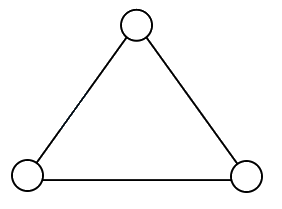
Consider a gas of triatomic molecules. The molecules are assumed to be triangular and made of massless rigid rods whose vertices are occupied by atoms. The internal energy of a mole of the gas at temperature T is:JEE Main/MCQ/Medium/Degree of Freedom and Specific Heat/With diagram - 97Consider two ideal diatomic gases and at some temperature . Molecules of the gas are rigid, and have a mass . Molecules of the gas have an additional vibrational mode and have a mass . The ratio of the specific heats of gas and respectively is:JEE Main/MCQ/Medium/Degree of Freedom and Specific Heat
- 98Consider a mixture of moles of helium gas and moles of oxygen gas (molecules taken to be rigid) as an ideal gas. Its value will be:JEE Main/MCQ/Medium/Degree of Freedom and Specific Heat
- 99Two moles of an ideal gas, with , are mixed with three moles of another ideal gas . The value of for the mixture isJEE Main/MCQ/Medium/Degree of Freedom and Specific Heat
- 100A diatomic gas with rigid molecules does of work when expanded at constant pressure. What would be the heat energy absorbed by the gas, in this process?JEE Main/MCQ/Medium/Degree of Freedom and Specific Heat
- 101Two moles of helium gas is mixed with three moles of hydrogen molecules (taken to be rigid). What is the molar specific heat of mixture at constant volume? JEE Main/MCQ/Medium/Degree of Freedom and Specific Heat
- 102When heat is supplied to a diatomic gas of rigid molecules, at constant volume its temperature increases by . The heat required to produce the same change in temperature, at a constant pressure is:JEE Main/MCQ/Medium/Degree of Freedom and Specific Heat
- 103A massless spring attached with a mass is completely immersed in of water. The spring is stretched by and released so that it starts vibrating. What would be the order of magnitude of the change in the temperature of water when the vibrations stop completely? (Assume that the water container and spring receive negligible heat and specific heat of mass specific heat of water )JEE Main/MCQ/Medium/Degree of Freedom and Specific Heat
- 104The specific heats, and of a gas of diatomic molecules, are given (in units of ) by and respectively. Another gas of diatomic molecules, has the corresponding values and If they are treated as ideal gases, then:JEE Main/MCQ/Medium/Degree of Freedom and Specific Heat
- 105An ideal gas occupies a volume of at a pressure of The energy of the gas is:JEE Main/MCQ/Medium/Degree of Freedom and Specific Heat
- 106A metal ball of mass is heated upto and dropped into a vessel of heat capacity and containing water. The initial temperature of water and vessel is . What is the approximate percentage increment in the temperature of the water? [Specific Heat Capacities of water and metal are, respectively, and ]JEE Main/MCQ/Medium/Degree of Freedom and Specific Heat
- 107When of a liquid at is added to of a liquid at temperature , the temperature of the mixture becomes . The temperature of the mixture, if of liquid at is added to of liquid at , will be:JEE Main/MCQ/Medium/Degree of Freedom and Specific Heat
- 108A gas mixture consists of 3 moles of oxygen and 5 moles of argon at temperature T. Considering only translational and rotational modes, the total internal energy of the system isJEE Main/MCQ/Medium/Degree of Freedom and Specific Heat
- 109An unknown metal of mass heated to a temperature of was immersed into a brass calorimeter of mass containing of water at a temperature of Calculate the specific heat of the unknown metal if water temperature stabilizes at Specific heat of brass is JEE Main/MCQ/Medium/Degree of Freedom and Specific Heat
- 110A mass of nitrogen gas is enclosed in a vessel at a temperature, . The amount of heat transferred to the gas, so that velocity of molecules is doubled, is about.
JEE Main/MCQ/Medium/Degree of Freedom and Specific Heat - 111Two moles of helium are mixed with n moles of hydrogen. If for the mixture then the value of is,JEE Main/MCQ/Medium/Degree of Freedom and Specific Heat
- 112The value closest to the thermal velocity of a Helium atom at room temperature in is:
JEE Main/MCQ/Medium/Degree of Freedom and Specific Heat - 113An ideal gas has molecules with degrees of freedom. The ratio of specific heats at constant pressure and at constant volume is:JEE Main/MCQ/Medium/Degree of Freedom and Specific Heat
- 114 and are specific heats at constant pressure and constant volume respectively. It is observed that, for hydrogen gas and for nitrogen gas. The correct relation between and is:JEE Main/MCQ/Medium/Degree of Freedom and Specific Heat
- 115An ideal gas undergoes a quasi-static, reversible process in which its molar heat capacity C remains constant. If during this process the relation of pressure P and volume V is given by constant, then n is given by (Here and are molar specific heat at constant pressure and constant volume, respectively) :JEE Main/MCQ/Medium/Degree of Freedom and Specific Heat
- 116If and denote the specific heats of nitrogen per unit mass at constant pressure and constant volume respectively, thenJEE Main/MCQ/Medium/Degree of Freedom and Specific Heat
- 117A gaseous mixture consists of of helium and of oxygen. The ratio of the mixture isJEE Main/MCQ/Medium/Degree of Freedom and Specific Heat
- 118One mole of ideal monoatomic gas is mixed with one mole of diatomic gas . What is for the mixture? denotes the ratio of specific heat at constant pressure, to that at constant volume.JEE Main/MCQ/Medium/Degree of Freedom and Specific Heat
- 119During an adiabatic process, the pressure of a gas is found to be proportional to the cube of its absolute temperature. The ratio for the gas isJEE Main/MCQ/Medium/Degree of Freedom and Specific Heat
- 1201 mole of a gas with is mixed with 1 mole of a gas with , then the value of for the resulting mixture isJEE Main/MCQ/Medium/Degree of Freedom and Specific Heat
- 121If mole of an ideal monoatomic gas at temperature , is mixed with mole of another ideal monoatomic gas at temperature then the temperature of mixture is :JEE Main/MCQ/Medium/Pressure and Energy of gas
- 122Given below are two statements: one is labelled as Assertion A and the other is labelled as Reason R
Assertion A: If the average kinetic energy of and molecules, kept in two different sized containers are same, then their temperatures will be same.
Reason R: The r.m.s. speed of and molecules are same at same temperature.
Choose the correct answer from the options given belowJEE Main/MCQ/Medium/Pressure and Energy of gas - 123A cylindrical tube of length , closed at both ends contains an ideal gas of 1 mol having molecular weight . The tube is rotated in a horizontal plane with constant angular velocity about an axis perpendicular to and passing through the edge at end , as shown in the figure. If and are the pressures at and respectively, then (Consider the temperature is same at all points in the tube)
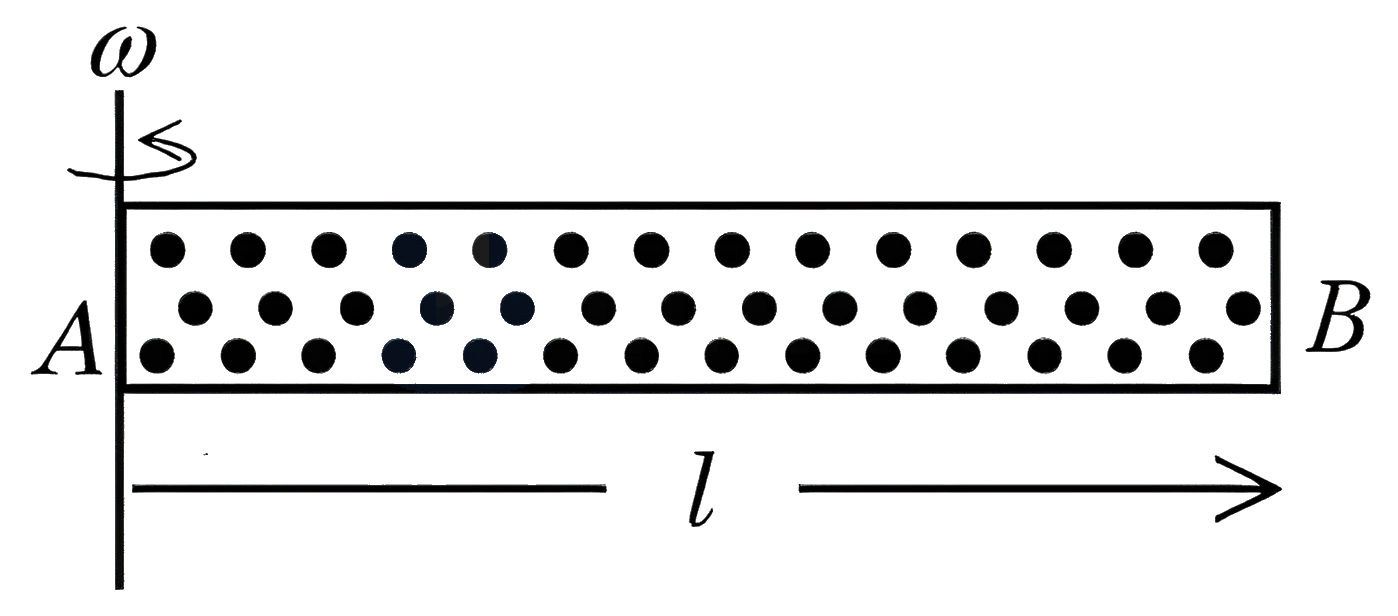 JEE Main/MCQ/Medium/Pressure and Energy of gas/With diagram
- 124The helium and argon are put in the flask at the same room temperature ( 300 K). The ratio of average kinetic energies (per molecule) of helium and argon is :
(Give : Molar mass of helium , Molar mass of argon )JEE Main/MCQ/Medium/Pressure and Energy of gas - 125The kinetic energy of translation of the molecules in 50 g of gas at isJEE Main/MCQ/Medium/Pressure and Energy of gas
- 126The temperature of a gas is and the average translational kinetic energy of its molecules is . The temperature at which the average translational kinetic energy of the molecules of the same gas becomes is :JEE Main/MCQ/Medium/Pressure and Energy of gas
- 127Given below are two statements :
Statement (I) : The mean free path of gas molecules is inversely proportional to square of molecular diameter.
Statement (II) : Average kinetic energy of gas molecules is directly proportional to absolute temperature of gas.
In the light of the above statements, choose the correct answer from the options given below :JEE Main/MCQ/Medium/Pressure and Energy of gas - 128Energy of 10 non rigid diatomic molecules at temperature is :JEE Main/MCQ/Medium/Pressure and Energy of gas
- 129A gas mixture consists of moles of argon and moles of oxygen at temperature . Neglecting all vibrational modes, the total internal energy of the system isJEE Main/MCQ/Medium/Pressure and Energy of gas
- 130Two vessels and are of the same size and are at same temperature. contains of hydrogen and contains of oxygen. and are the pressures of the gases in and respectively, then is :JEE Main/MCQ/Medium/Pressure and Energy of gas
- 131The total kinetic energy of mole of oxygen at is :
[Use universal gas constant ]JEE Main/MCQ/Medium/Pressure and Energy of gas - 132The average kinetic energy of a monatomic molecule is at temperature:
(Use )JEE Main/MCQ/Medium/Pressure and Energy of gas - 133A flask contains Hydrogen and Argon in the ratio by mass. The temperature of the mixture is . The ratio of average kinetic energy per molecule of the two gases is: (Given : Atomic Weight of )JEE Main/MCQ/Medium/Pressure and Energy of gas
- 134The temperature at which the kinetic energy of oxygen molecules becomes double than its value at isJEE Main/MCQ/Medium/Pressure and Energy of gas
- 135The average kinetic energy of a molecule of the gas isJEE Main/MCQ/Medium/Pressure and Energy of gas
- 136Following statements are given
(1) The average kinetic energy of a gas molecule decreases when the temperature is reduced.
(2) The average kinetic energy of a gas molecule increases with increase in pressure at constant temperature.
(3) The average kinetic energy of a gas molecule decreases with increases in volume.
(4) Pressure of a gas increases with increase in temperature at constant volume.
(5) The volume of gas decreases with increase in temperature.
Choose the correct answer from the options given below :JEE Main/MCQ/Medium/Pressure and Energy of gas - 137A flask contains argon and oxygen in the ratio of in mass and the mixture is kept at . The ratio of their average kinetic energy per molecule respectivelyJEE Main/MCQ/Medium/Pressure and Energy of gas
- 138A uniform heating wire of resistance is connected across a potential difference of The wire is then cut into half and a potential difference of is applied across each half separately. The ratio of power dissipation in first case to the total power dissipation in the second case would be where isJEE Main/Numerical/Medium/Pressure and Energy of gas
- 139A mixture of hydrogen and oxygen has volume temperature pressure and mass The ratio of masses of oxygen to hydrogen will be:JEE Main/MCQ/Medium/Pressure and Energy of gas
- 140For an ideal gas the instantaneous change in pressure with volume is given by the equation If at is the given boundary condition, then the maximum temperature one mole of gas can attain is: (Here is the gas constant)JEE Main/MCQ/Medium/Pressure and Energy of gas
- 141A cylindrical container of volume contains one mole of hydrogen and two moles of carbon dioxide. Assume the temperature of the mixture is . The pressure of the mixture of gases is :
[Take gas constant as JEE Main/MCQ/Medium/Pressure and Energy of gas - 142The number of molecules in one litre of an ideal gas at and atmospheric pressure with mean kinetic energy per molecule is:JEE Main/MCQ/Medium/Pressure and Energy of gas
- 143A system consists of two types of gas molecules and having the same number density . The diameter of and are and respectively. They suffer collisions at room temperature. The ratio of average distance covered by the molecule to that of between two successive collisions is ___________JEE Main/Numerical/Medium/Pressure and Energy of gas
- 144Two spherical soap bubbles of radii and in vacuum combine under isothermal conditions. The resulting bubble has a radius equal to:JEE Main/MCQ/Medium/Pressure and Energy of gas
- 145What will be the average value of energy for a monoatomic gas in thermal equilibrium at temperature JEE Main/MCQ/Medium/Pressure and Energy of gas
- 146What will be the average value of energy along one degree of freedom for an ideal gas in thermal equilibrium at a temperature ( is Boltzmann constant)JEE Main/MCQ/Medium/Pressure and Energy of gas
- 147Two ideal polyatomic gases at temperatures and are mixed so that there is no loss of energy. If and and and be the degrees of freedom, masses, number of molecules of the first and second gas respectively, the temperature of mixture of these two gases is:JEE Main/MCQ/Medium/Pressure and Energy of gas
- 148The volume of an enclosure contains a mixture of three gases, of oxygen, of nitrogen and of carbon dioxide at absolute temperature . Consider as universal gas constant. The pressure of the mixture of gases is :JEE Main/MCQ/Medium/Pressure and Energy of gas
- 149Given below are two statements:
Statement I: In a diatomic molecule, the rotational energy at a given temperature obeys Maxwell's distribution.
Statement II : In a diatomic molecule, the rotational energy at a given temperature equals the translational kinetic energy for each molecule.
In the light of the above statements, choose the correct answer from the options given below:JEE Main/MCQ/Medium/Pressure and Energy of gas - 150On the basis of kinetic theory of gases, the gas exerts pressure because its molecules:JEE Main/MCQ/Medium/Pressure and Energy of gas
- 151Number of molecules in a volume of of a perfect monoatomic gas at some temperature T and at a pressure of of mercury is close to? (Given, mean kinetic energy of a molecule (at T) is density of mercury )JEE Main/MCQ/Medium/Pressure and Energy of gas
- 152A closed vessel contains mole of a monoatomic ideal gas at . If mole of the same gas at is added to it, the final equilibrium temperature (in ) of the gas in the vessel will be close to ______JEE Main/Numerical/Medium/Pressure and Energy of gas
- 153A gas mixture consists of moles of oxygen and moles of argon at temperature . Assuming the gases to be ideal and the oxygen bond to be rigid, the total internal energy (in units of ) of the mixutre is :JEE Main/MCQ/Medium/Pressure and Energy of gas
- 154The number density of molecules of a gas depends on their distance r from the origin as, Then the numer of molecules is proportional to:JEE Main/MCQ/Medium/Pressure and Energy of gas
- 155An molecule has rotational, translational and vibrational motions. If the rms velocity of molecules in its gaseous phase is , m is its mass and is Boltzmann's constant, then its temperature will be:JEE Main/MCQ/Medium/Pressure and Energy of gas
- 156 of a monoatomic gas is at a pressure of . The density of the gas is . What is the order of energy of the gas due to its thermal motion?JEE Main/MCQ/Medium/Pressure and Energy of gas
- 157 moles of diatomic gas in a cylinder is at a temperature . Heat is supplied to the cylinder such that the temperature remains constant but moles of the diatomic gas get converted into monoatomic gas. The change in the total kinetic energy of the gas isJEE Main/MCQ/Medium/Pressure and Energy of gas
- 158Which of the following shows the correct relationship between the pressure and density of an ideal gas at constant temperature ?JEE Main/MCQ/Medium/Pressure and Energy of gas
- 159Using equipartition of energy, the specific heat (in ) of Aluminium at high temperature can be estimated to be (atomic weight of Aluminium )JEE Main/MCQ/Medium/Pressure and Energy of gas
- 160In an ideal gas at temperature T, the average force that a molecule applies on the walls of a closed container depends on . A good estimate for q is:JEE Main/MCQ/Medium/Pressure and Energy of gas
- 161A gas molecule of mass at the surface of the earth has kinetic energy equivalent to . If it were to go up straight without colliding with any other molecules, how high it would rise? Assume that the height attained is much less than the radius of the earth. ( is Boltzmann constant)JEE Main/MCQ/Medium/Pressure and Energy of gas
- 162
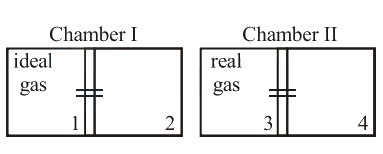
There are two identical chambers, completely thermally insulated from surroundings. Both chambers have a partition wall dividing the chambers in two compartments. Compartment is filled with an ideal gas and Compartment is filled with a real gas. Compartments and are vacuum. A small hole (orifice) is made in the partition walls and the gases are allowed to expand in vacuum.
No change in the temperature of the gas takes place when ideal gas expands in vacuum. However, the temperature of real gas goes down (cooling) when it expands in vacuum.
The internal energy of an ideal gas is only kinetic. The internal energy of a real gas is kinetic as well as potential.JEE Main/MCQ/Medium/Pressure and Energy of gas/With diagram - 163A thermally insulated vessel contains an ideal gas of molecular mass and ratio of specific heats . It is moving with speed and is suddenly brought to rest. Assuming no heat is lost to the surroundings, its temperature increases by :JEE Main/MCQ/Medium/Pressure and Energy of gas
- 164One kg of a diatomic gas is at a pressure of . The density of the gas is . What is the energy of the gas due to its thermal motion?JEE Main/MCQ/Medium/Pressure and Energy of gas
- 165An insulated container of gas has two chambers separated by an insulating partition. One of the chambers has volume and contains ideal gas at pressure and temperature . The other chamber has volume and contains ideal gas at pressure and temperature . If the partition is removed without doing any work on the gas, the final equilibrium temperature of the gas in the container will beJEE Main/MCQ/Medium/Pressure and Energy of gas
- 166Two rigid boxes containing different ideal gases are placed on a table. Box A contains one mole of nitrogen at temperature , while Box contains one mole of helium at temperature . The boxes are then put into thermal contact with each other and heat flows between them until the gases reach a common final temperature. (Ignore the heat capacity of boxes). Then, the final temperature of the gases, , in terms of isJEE Main/MCQ/Medium/Pressure and Energy of gas
- 167In the nuclear fusion reaction given that the repulsive potential energy between the two nuclei is , the temperature at which the gases must be heated to initiate the reaction is nearly [Boltzmann's Constant ]JEE Main/MCQ/Medium/Pressure and Energy of gas
- 168Cooking gas containers are kept in a lorry moving with uniform speed. The temperature of the gas molecules inside willJEE Main/MCQ/Medium/Pressure and Energy of gas
JEE Main question paper PDF
This chapter includes JEE Main questions. Open a shift to read the paper, or download the PDF.
Opening paper…
Other Physics chapters
Current Electricity 380Electrostatics 311Kinematics 308Ray Optics 295Rotational Motion 280Magnetic Effects & Magnetism 276Atoms & Nuclei 239Gravitation 223Laws of Motion 210Semiconductors 209Dual Nature of Matter 200Oscillations 194Fluid Mechanics 192Wave Optics 191Alternating Current 190Thermodynamics 190Work Energy Power 183Capacitors 180Electromagnetic Waves 165Electromagnetic Induction 153Units & Dimensions 149Waves 142Center of Mass, Momentum & Collision 130Thermal Properties of Matter 126Mathematics in Physics 121Mechanical Properties of Solids 118Experimental Physics 70Magnetic Properties of Matter 57Modern Physics 5
Stuck on a Kinetic Theory question from your book?
Snap it and get a whiteboard video that solves it step by step. Your first video needs no login.