Physics · JEE Main, Olympiad (NSEP)
Thermodynamics
190 practice questions with a worked solution for each. Tap an option to see instantly if you are right.
162MCQ28Numerical51With diagram
- 1A Carnot engine working between temperatures (source) and (sink) absorbs of heat per cycle. The work done per cycle is:JEE Main/MCQ/Medium
- 2For an ideal gas undergoing a polytropic process , the molar heat capacity is given by . The process is isothermal when:Olympiad (NSEP)/MCQ/Hard
- 3An ideal gas undergoes an isothermal expansion from volume to . The change in internal energy is:JEE Main/MCQ/Medium
- 4Consider the following statements:
A. Zeroth law of thermodynamics gives concept of temperature
B. First law of thermodynamics gives concept of internal energy
C. In isothermal expansion of ideal gas,
D. Product of intensive and extensive variables is extensive
E. The ratio of any extensive variable to mass will be an extensive variable
Choose the correct combination of statements from the options given below:JEE Main/MCQ/Medium/Thermodynamic Systems - 5There are two vessels filled with an ideal gas where volume of one is double the volume of other. The large vessel contains the gas at 8 kPa at 1000 K while the smaller vessel contains the gas at 7 kPa at 500 K. If the vessels are connected to each other by a thin tube allowing the gas to flow and the temperature of both vessels is maintained at 600 K , at steady state the pressure in the vessels will be (in kPa).JEE Main/MCQ/Medium/Thermodynamic Systems
- 6An ideal gas goes from an initial state to final state. During the process, the pressure of gas increases linearly with temperature.
A. The work done by gas during the process is zero.
B. The heat added to gas is different from change in its internal energy.
C. The volume of the gas is increased.
D. The internal energy of the gas is increased.
E. The process is isochoric (constant volume process)
Choose the correct answer from the options given below:JEE Main/MCQ/Medium/Thermodynamic Systems - 7 \[
\begin{array}{|l|p{6cm}|l|p{4cm}|}
\hline \textbf{LIST-I} & & \textbf{LIST-II} & \\
\hline A. & \text{Pressure varies inversely with volume of an ideal gas.} & I. & \text{Adiabatic process} \\
\hline B. & \text{Heat absorbed goes partly to increase internal energy and partly to do work.} & II. & \text{Isochoric process} \\
\hline C. & \text{Heat is neither absorbed nor released by a system.} & III. & \text{Isothermal process} \\
\hline D. & \text{No work is done on or by a gas.} & IV. & \text{Isobaric process} \\
\hline
\end{array}
\]
JEE Main/MCQ/Medium/Thermodynamic Systems - 8For a diatomic gas, if for rigid molecules and for another diatomic molecules, but also having vibrational modes. Then, which one of the following options is correct ? (Cp and Cv are specific heats of the gas at constant pressure and volume)JEE Main/MCQ/Medium/Thermodynamic Systems
- 9Given are statements for certain thermodynamic variables,
(A) Internal energy, volume (V) and mass (M) are extensive variables.
(B) Pressure (P), temperature (T) and density ( ) are intensive variables.
(C) Volume (V), temperature (T) and density ( ) are intensive variables.
(D) Mass (M), temperature (T) and internal energy are extensive variables.
Choose the correct answer from the options given below :JEE Main/MCQ/Medium/Thermodynamic Systems - 10Let be the ratio of molar specific heat at constant pressure and molar specific heat at constant volume of a monoatomic gas and be the similar ratio of diatomic gas. Considering the diatomic gas molecule as a rigid rotator, the ratio is:JEE Main/MCQ/Medium/Thermodynamic Systems
- 11Match the ratio for ideal gases with different type of molecules: Molecule Type (A) Monoatomic (I) (B) Diatomic rigid molecules (II) (C) Diatomic non-rigid molecules (III) (D) Triatomic rigid molecules (IV) JEE Main/MCQ/Medium/Thermodynamic Systems
- 12When a system is taken from state to state along the path , it is found that and . Along the path' . along the path is
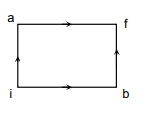 JEE Main/MCQ/Medium/Thermodynamic Systems/With diagram
- 13Which of the following statements is correct for any thermodynamic system?JEE Main/MCQ/Medium/Thermodynamic Systems
- 14Which of the following parameters does not characterize the thermodynamic state of matter?JEE Main/MCQ/Medium/Thermodynamic Systems
- 15Initial pressure and volume of a monoatomic ideal gas are and . The change in internal energy of this gas in adiabatic expansion to volume is ________ J.JEE Main/MCQ/Medium/First Law of Thermodynamics
- 16One mole of diatomic gas having rotational modes only is kept in a cylinder with a piston system. The cross-section area of the cylinder is cm. The gas is heated slowly to raise the temperature by C during which the piston moves by mm. The amount of heat supplied to the gas is ________ J. (Atmospheric pressure kPa, J/mol·K) (Neglect mass of the piston)JEE Main/MCQ/Medium/First Law of Thermodynamics
- 17 moles of unknown gas is heated at constant volume from to . The molar specific heat of this gas at constant pressure cal/mol.°C and J/mol.°C. The change in the internal energy of the gas is _______ calorie.JEE Main/Numerical/Medium/First Law of Thermodynamics
- 18Heat is supplied to a diatomic gas at constant pressure. Then the ratio of is _______.JEE Main/MCQ/Medium/First Law of Thermodynamics
- 1910 mole of an ideal gas is undergoing the process shown in the figure. The heat involved in the process from to is Joule ( and . The value of is .
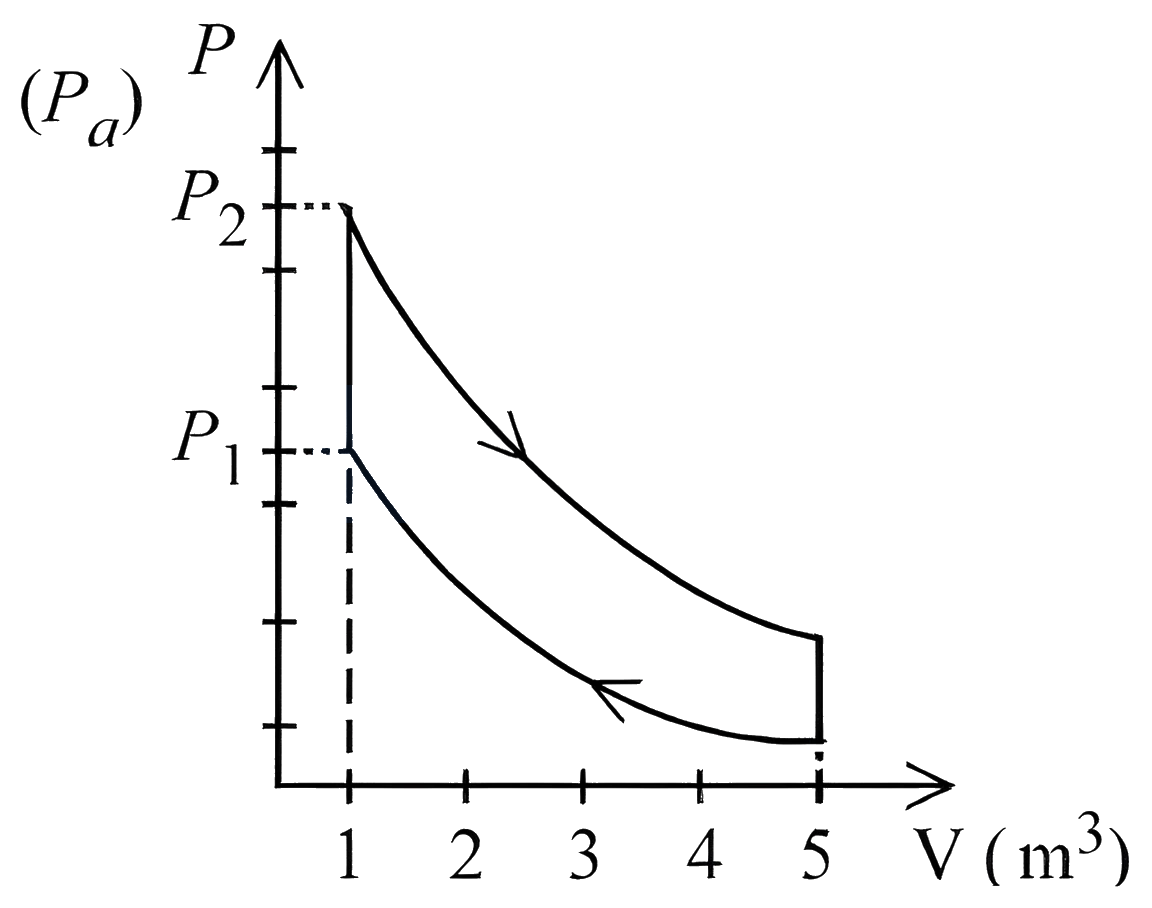 JEE Main/MCQ/Medium/First Law of Thermodynamics/With diagram
- 20Density of water at and are and respectively. The increase in internal energy of 4 kg of water when it is heated from to is J.
(specific heat capacity of water . and 1 atmospheric pressure )JEE Main/MCQ/Medium/First Law of Thermodynamics - 21The internal energy of a monoatomic gas is 3 nRT. One mole of helium is kept in a cylinder having internal cross section area of and fitted with a light movable frictionless piston. The gas is heated slowly by suppling 126 J heat. If the temperature rises by , then the piston will move cm.
(atmospheric pressure )JEE Main/MCQ/Medium/First Law of Thermodynamics - 2210 mole of oxygen is heated at constant volume from to . The change in the internal energy of the gas is cal. (The molecular specific heat of oxygen at constant pressure, and .)JEE Main/Numerical/Medium/First Law of Thermodynamics
- 23During the melting of a slab of ice at 273 K at atmospheric pressure :JEE Main/MCQ/Medium/First Law of Thermodynamics
- 24The internal energy of air in sized room at 1 atmospheric pressure will be _______ . (Consider air as diatomic molecule)JEE Main/Numerical/Medium/First Law of Thermodynamics
- 25Given below are two statements. One is labelled as Assertion (A) and the other is labelled as Reason (R).
Assertion (A) : In an insulated container, a gas is adiabatically shrunk to half of its initial volume. The temperature of the gas decreases.
Reason (R): Free expansion of an ideal gas is an irreversible and an adiabatic process.
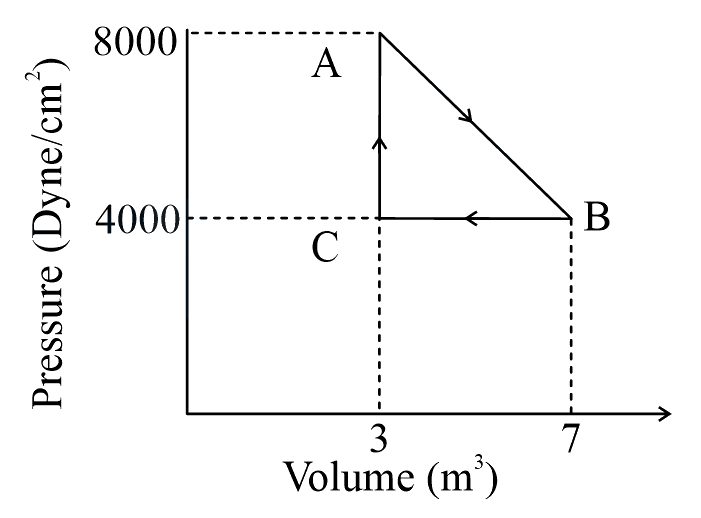
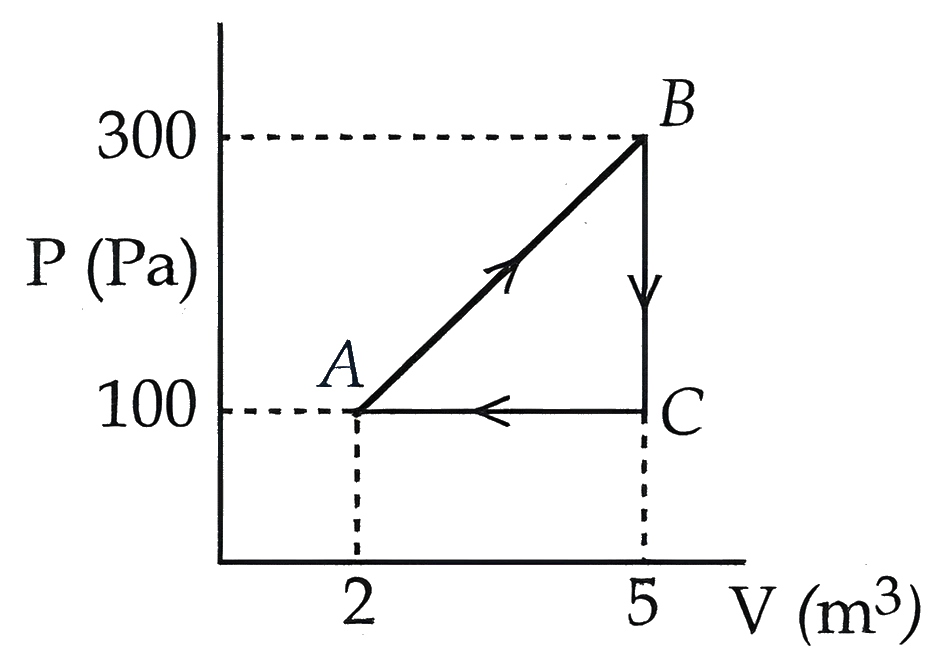
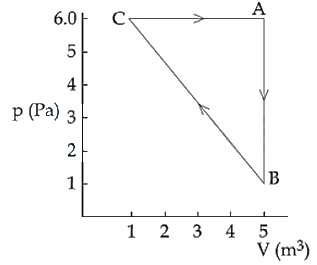
In the light of the above statements, choose the correct answer from the options given below :JEE Main/MCQ/Medium/First Law of Thermodynamics - 26The magnitude of heat exchanged by a system for the given cyclic process ABCA (as shown in figure) is (in SI unit) :
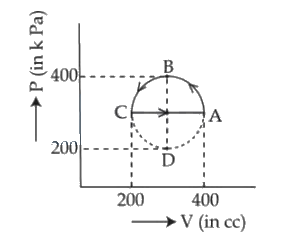 JEE Main/MCQ/Medium/First Law of Thermodynamics/With diagram
- 27The temperature of 1 mole of an ideal monoatomic gas is increased by at constant pressure. The total heat added and change in internal energy are and , respectively. If then the value of is _____JEE Main/Numerical/Medium/First Law of Thermodynamics
- 28
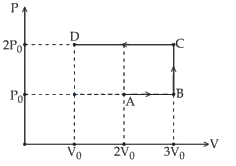
Using the given diagram, the work done by an ideal gas along the path ABCD is :JEE Main/MCQ/Medium/First Law of Thermodynamics/With diagram - 29A total of heat is given to one mole of helium kept in a cylinder. The temperature of helium increases by . The work done by the gas is:
Given, .JEE Main/MCQ/Medium/First Law of Thermodynamics - 30A thermodynamic system is taken from an original state to an intermediate state by a linear process as shown in the figure. Its volume is then reduced to the original value from to by an isobaric process. The total work done by the gas from to and to would be :
 JEE Main/MCQ/Medium/First Law of Thermodynamics/With diagram
- 31 air is heated at constant volume through . The specific heat of air at constant volume is 0.17kcal{kg}^{-1}^{\circ}{C}^{-1} and . The change in its internal energy is approximately.JEE Main/MCQ/Medium/First Law of Thermodynamics
- 32A thermodynamic system is taken through cyclic process. The total work done in the process is :
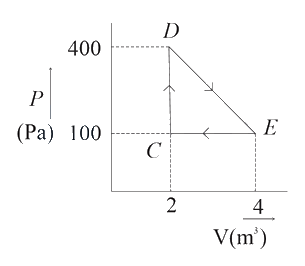 JEE Main/MCQ/Medium/First Law of Thermodynamics/With diagram
- 33Given below are two statements:
Statement I: If heat is added to a system, its temperature must increase.
Statement II: If positive work is done by a system in a thermodynamic process, its volume must increase.
In the light of the above statements, choose the correct answer from the options given belowJEE Main/MCQ/Medium/First Law of Thermodynamics - 34A source supplies heat to a system at the rate of If the system performs work at a rate of The rate at which internal energy of the system increases isJEE Main/MCQ/Medium/First Law of Thermodynamics
- 35The pressure of a gas changes linearly with volume from to as shown in figure. If no heat is supplied to or extracted from the gas then change in the internal energy of the gas will be
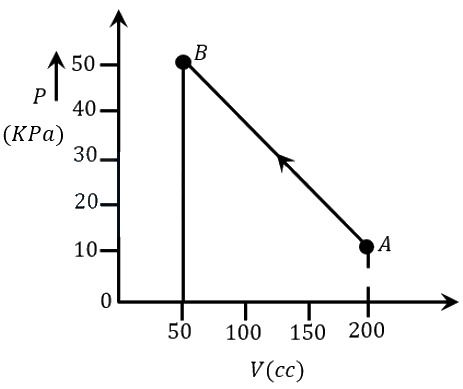 JEE Main/MCQ/Medium/First Law of Thermodynamics/With diagram
- 36Heat is given to an ideal gas in an isothermal process.
A. Internal energy of the gas will decrease.
B. Internal energy of the gas will increase.
C. Internal energy of the gas will not change.
D. The gas will do positive work.
E. The gas will do negative work.
Choose the correct answer from the options given below :JEE Main/MCQ/Medium/First Law of Thermodynamics - 37Given below are two statements. One is labelled as Assertion A and the other is labelled as Reason R.
Assertion A : If and represent the heat supplied to the system and the work done on the system respectively. Then according to the first law of thermodynamics .
Reason R : First law of thermodynamics is based on law of conservation of energy.
In the light of the above statements, choose the correct answer from the option given below :JEE Main/MCQ/Medium/First Law of Thermodynamics - 38 of a liquid is converted to vapour at pressure. If of the heat supplied is used for increasing the volume by during this phase change, then the increase in internal energy in the process will be :JEE Main/MCQ/Medium/First Law of Thermodynamics
- 39For a perfect gas, two pressures and are shown in figure. The graph shows
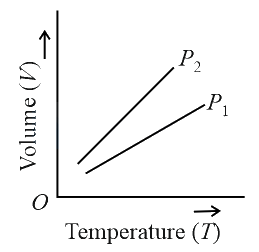 JEE Main/MCQ/Medium/First Law of Thermodynamics/With diagram
- 40A thermally insulated vessel contains an ideal gas of molecular mass and ratio of specific heats . Vessel is moving with speed and is suddenly brought to rest. Assuming no heat is lost to the surrounding and vessel temperature of the gas increases by :
( universal gas constant)JEE Main/MCQ/Medium/First Law of Thermodynamics - 41An electric appliance supplies , heat to the system. If the system delivers a power of . How long it would take to increase the internal energy by ?JEE Main/MCQ/Medium/First Law of Thermodynamics
- 42One mole of an ideal gas at is taken from to as shown in the given indicator diagram. The work done by the system will be _______ [Given, ] (Round off to the nearest integer)
(Round off to the nearest integer)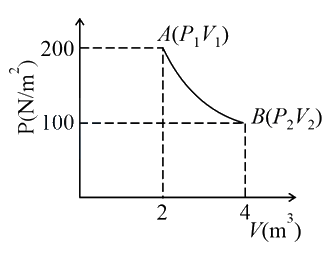 JEE Main/Numerical/Medium/First Law of Thermodynamics/With diagram
- 43The amount of heat needed to raise the temperature of of a rigid diatomic gas from to when no work is done is is the universal gas constant)JEE Main/MCQ/Medium/First Law of Thermodynamics
- 44In thermodynamics, heat and work are :JEE Main/MCQ/Medium/First Law of Thermodynamics
- 45The volume of a given mass of monoatomic gas changes with temperature according to the relation . The workdone when temperature changes by will be . The value of is
[ universal gas constant ]JEE Main/Numerical/Medium/First Law of Thermodynamics - 46 mole of rigid diatomic gas performs a work of when heat is supplied to it. The molar heat capacity of the gas during this transformation is The value of is
[ universal gas constant]JEE Main/Numerical/Medium/First Law of Thermodynamics - 47The internal energy , pressure and volume of an ideal gas are related as The gas isJEE Main/MCQ/Medium/First Law of Thermodynamics
- 48In a certain thermodynamical process, the pressure of a gas depends on its volume as . The work done when the temperature changes from to will be where denotes number of moles of a gas find ;JEE Main/Numerical/Medium/First Law of Thermodynamics
- 49If one mole of an ideal gas at is allowed to expand reversibly and isothermally ( to ) its pressure is reduced to one-half of the original pressure (see figure). This is followed by a constant volume cooling till its pressure is reduced to one-fourth of the initial value Then it is restored to its initial state by a reversible adiabatic compression ( to ). The net workdone by the gas is equal to:
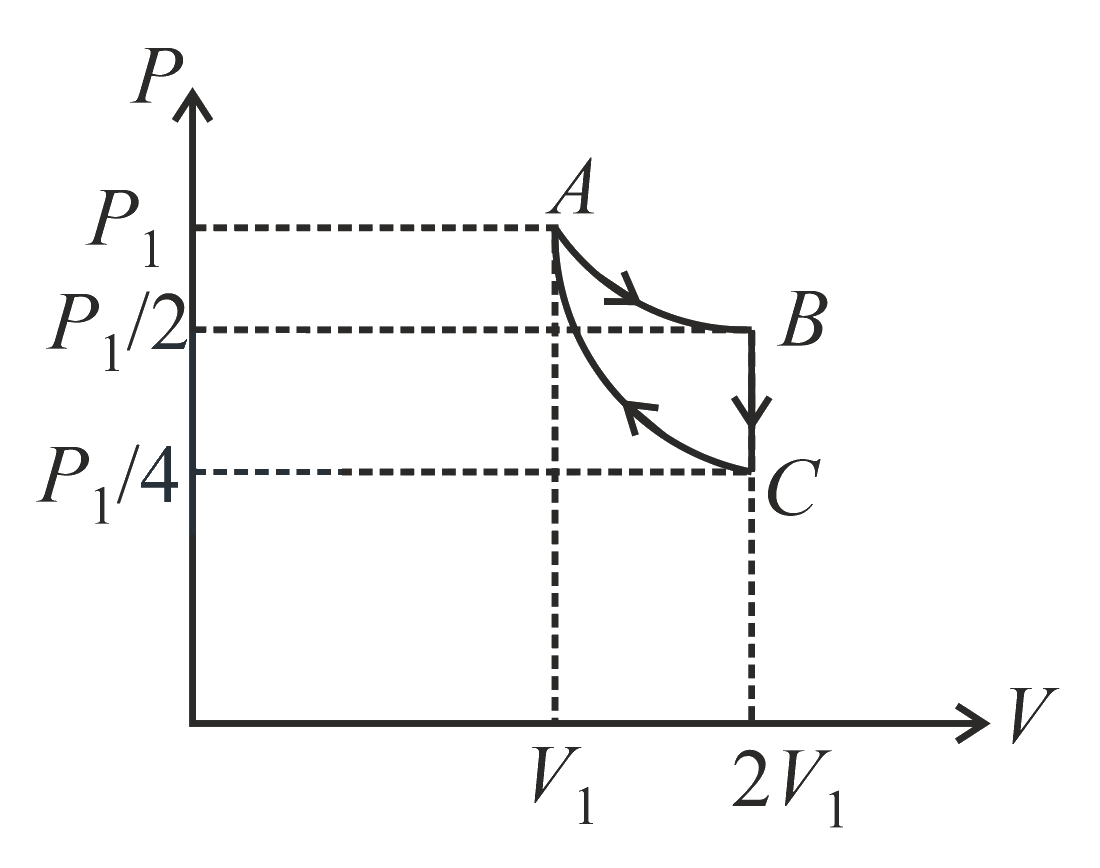 JEE Main/MCQ/Medium/First Law of Thermodynamics/With diagram
- 50Three different processes that can occur in an ideal monoatomic gas are shown in the vs diagram. The paths are labelled as and . The change in internal energies during these process are taken as and and the work done as and . The correct relation between these parameters are:
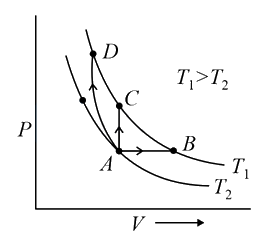 JEE Main/MCQ/Medium/First Law of Thermodynamics/With diagram
- 51An engine takes in moles of air at and , and compresses it adiabatically to of the original volume. Assuming air to be a diatomic ideal gas made up of rigid molecules, the change in its internal energy during this process comes out to be . The value of to the nearest integer is:JEE Main/Numerical/Medium/First Law of Thermodynamics
- 52A sample of an ideal gas is taken through the cyclic process as shown in the figure. The change in the internal energy of the gas along the path is The gas absorbs of heat along the path and along the path . The work done by the gas along the path is:
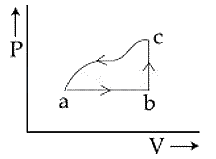 JEE Main/MCQ/Medium/First Law of Thermodynamics/With diagram
- 53 moles of an ideal gas with constant volume heat capacity undergo an isobaric expansion by certain volume. The ratio of the work done in the process, to the heat supplied is:JEE Main/MCQ/Medium/First Law of Thermodynamics
- 54Following figure shows two processes and for a gas. If and are the amount of heat absorbed by the system in two cases, and and are changes in internal energies, respectively, then:
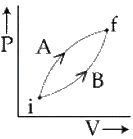 JEE Main/MCQ/Medium/First Law of Thermodynamics/With diagram
- 55
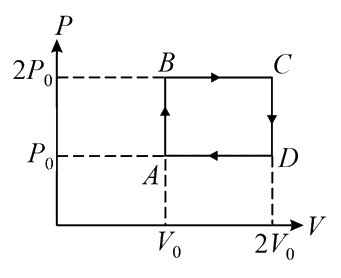
The above diagram represents the thermodynamic cycle of an engine, operating with an ideal mono-atomic gas. The amount of heat, extracted from the source in a single cycle, is:JEE Main/MCQ/Medium/First Law of Thermodynamics/With diagram - 56Which of the following is incorrect regarding the first law of thermodynamics?JEE Main/MCQ/Medium/First Law of Thermodynamics
- 57A cylinder with adiabatic walls is closed at both ends and is divided into two compartments by a frictionless adiabatic piston. Ideal gas is filled in both (left and right) the compartments at same . Heating is started from left side until pressure changes to . If initial volume of each compartment was litres then the final volume in right-hand side compartment is __________ litres. (for this ideal gas )JEE Main/MCQ/Medium/Thermodynamic Processes
- 58A certain gas is isothermally compressed to of its initial volume ( litre) by applying required pressure. If the bulk modulus of the gas is N/m, the magnitude of work done on the gas is _______ J.JEE Main/Numerical/Medium/Thermodynamic Processes
- 59Two closed vessels of same volume are joined through a narrow tube and both vessels are filled with air of pressure kPa and temperature K. Keeping the temperature of one vessel constant at K the second vessel temperature is raised to K. The final pressure in the vessels is _______ kPa.JEE Main/MCQ/Medium/Thermodynamic Processes
- 60An ideal gas at pressure and temperature is expanding such that constant. The coefficient of volume expansion of the gas is _______.JEE Main/MCQ/Medium/Thermodynamic Processes
- 61An ideal gas undergoes a process maintaining relation between pressure and volume as , where and are constants. If two samples and (two moles each) with initial volumes and respectively undergo above mentioned process and attain same pressure, then the difference at the temperatures of these samples, is _____. ( gas constant)JEE Main/MCQ/Medium/Thermodynamic Processes
- 62A vessel contains m of a gas at pressure bar and temperature C with and . It is expanded adiabatically till pressure falls to bar. The work done during this process is _______ kJ. ( is gas constant)JEE Main/Numerical/Medium/Thermodynamic Processes
- 63A thermodynamic system is taken through the cyclic process as shown in the figure. The total work done by the system during the cycle is J.
 JEE Main/Numerical/Medium/Thermodynamic Processes/With diagram
- 64In the following diagram the equation of state along the curved path is given by where is a constant. The total work done in the closed path is
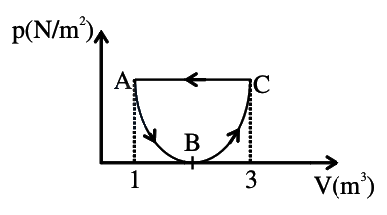 JEE Main/MCQ/Medium/Thermodynamic Processes/With diagram
- 65When 300 J of heat given to an ideal gas with its temperature raises from to keeping its volume constant. If n is the number of moles of the gas, then what is the value of ? JEE Main/Numerical/Medium/Thermodynamic Processes
- 66One mole of an ideal diatomic gas expands from volume to 2 V isothermally at a temperature and does joule of work. If the gas undergoes same magnitude of expansion adiabatically from doing the same amount of work , then its final temperature will be (close to) .
JEE Main/MCQ/Medium/Thermodynamic Processes - 67An insulated cylinder of volume is filled with a gas at and 2 atmospheric pressure. Then the gas is compressed making the final volume as while allowing the temperature to rise to . The final pressure is atmospheric pressure.JEE Main/Numerical/Medium/Thermodynamic Processes
- 68A diatomic gas does 100 J of work when it is expanded isobarically. Then the heat given to the gas J.JEE Main/Numerical/Medium/Thermodynamic Processes
- 69A monoatomic gas having is stored in a thermally insulated container and the gas is suddenly compressed to of its initial volume. The ratio of final pressure and initial pressure is: ( is the ratio of specific heats of the gas at constant pressure and at constant volume)JEE Main/MCQ/Medium/Thermodynamic Processes
- 70Match List-I with List-II.
Choose the correct answer from the options given below :JEE Main/MCQ/Medium/Thermodynamic Processes - 71An ideal gas has undergone through the cyclic process as shown in the figure. Work done by the gas in the entire cycle is ______ .
(Take )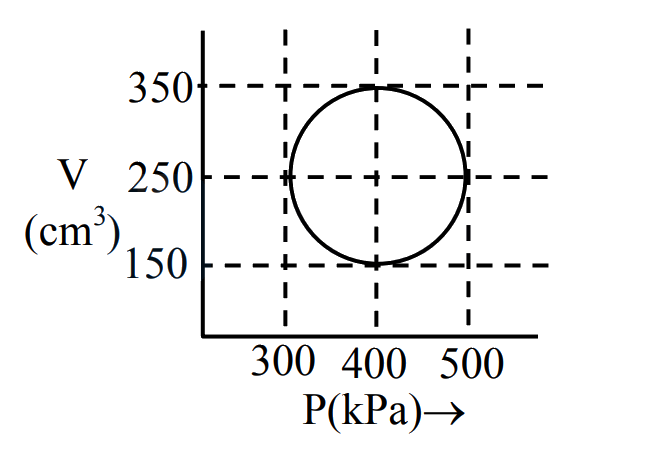 JEE Main/Numerical/Medium/Thermodynamic Processes/With diagram
- 72Match List-I with List-II.
\(\begin{array}{|l|l|l|l|} \hline & \text{List - I} & & \text{List - II} \\ \hline \text { (A) } & \text { Isobaric } & \text { (I) } & \Delta Q=\Delta W \\ \hline \text { (B) } & \text { Isochoric } & \text { (II) } & \Delta Q=\Delta U \\ \hline \text { (C) } & \text { Adiabatic } & \text { (III) } & \Delta Q=\text { zero } \\ \hline \text { (D) } & \text { Isothermal } & \text { (IV) } & \Delta Q=\Delta U+P \Delta V \\ \hline \end{array}\)
Heat supplied
Work done by the system
Change in internal energy
Pressure of the system
Change in volume of the system
Choose the correct answer from the options given below:JEE Main/MCQ/Medium/Thermodynamic Processes - 73An ideal gas exists in a state with pressure volume .It is isothermally expanded to 4 times of its initial volume , then isobarically compressed to its original volume. Finally the system is heated isochorically to bring it to its initial state. The amount of heat exchanged in this process is :JEE Main/MCQ/Medium/Thermodynamic Processes
- 74Pressure of an ideal gas, contained in a closed vessel, is increased by when heated by . Its initial temperature must be :JEE Main/MCQ/Medium/Thermodynamic Processes
- 75A gas is kept in a container having walls which are thermally non-conducting. Initially the gas has a volume of and temperature . The change in temperature when the gas is adiabatically compressed to is :
(Take is the ratio of specific heats at constant pressure and at constant volume)JEE Main/MCQ/Medium/Thermodynamic Processes - 76Identify the characteristics of an adiabatic process in a monoatomic gas.
(A) Internal energy is constant.
(B) Work done in the process is equal to the charge in internal energy.
(C) The product of temperature and volume is a constant.
(D) The product of pressure and volume is a constant.
(E) The work done to change the temperature from to is proportional to
Choose the correct answer from the options given below :JEE Main/MCQ/Medium/Thermodynamic Processes - 77In an adiabatic process, which of the following statements is true?JEE Main/MCQ/Medium/Thermodynamic Processes
- 78
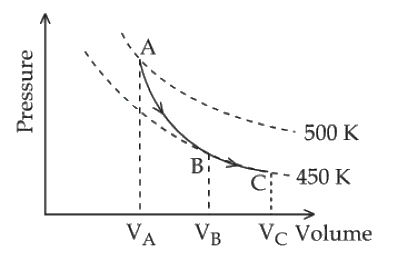
A poly-atomic molecule ( , where is gas constant) goes from phase space point to point to point . A to B is an adiabatic path and to is an isothermal path.
The net heat absorbed per unit mole by the system is :JEE Main/MCQ/Medium/Thermodynamic Processes/With diagram - 79Given below are two statements. One is labelled as Assertion (A) and the other is labelled as Reason (R).
Assertion (A) : With the increase in the pressure of an ideal gas, the volume falls off more rapidly in an isothermal process in comparison to the adiabatic process.
Reason (R) : In isothermal process, constant, while in adiabatic process constant. Here is the ratio of specific heats, P is the pressure and V is the volume of the ideal gas.
In the light of the above statements, choose the correct answer from the options given below :JEE Main/MCQ/Medium/Thermodynamic Processes - 80A container of fixed volume contains a gas at \(27^{\circ} \mathrm{C}\). To double the pressure of the gas, the temperature of gas should be raised to ______ \({ }^{\circ} \mathrm{C}\).JEE Main/Numerical/Medium/Thermodynamic Processes
- 81The workdone in an adiabatic change in an ideal gas depends upon only :JEE Main/MCQ/Medium/Thermodynamic Processes
- 82An ideal gas initially at temperature, is compressed suddenly to one fourth of its volume. If the ratio of specific heat at constant pressure to that at constant volume is , the change in temperature due to the thermodynamic process is _____ K.JEE Main/Numerical/Medium/Thermodynamic Processes
- 83A real gas within a closed chamber at undergoes the cyclic process as shown in figure. The gas obeys equation for the path to . The net work done in the complete cycle is (assuming ):
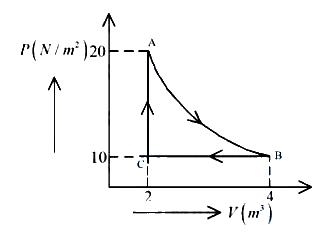 JEE Main/MCQ/Medium/Thermodynamic Processes/With diagram
- 84The volume of an ideal gas is changed adiabatically from 5 litres to 4 litres. The ratio of initial pressure to final pressure is:JEE Main/MCQ/Medium/Thermodynamic Processes
- 85A sample of 1 mole gas at temperature is adiabatically expanded to double its volume. If adiabatic constant for the gas is , then the work done by the gas in the process is:JEE Main/MCQ/Medium/Thermodynamic Processes
- 86A diatomic gas does of work in an isobaric expansion. The heat given to the gas is :JEE Main/MCQ/Medium/Thermodynamic Processes
- 87Two different adiabatic paths for the same gas intersect two isothermal curves as shown in P-V diagram. The relation between the ratio and the ratio is:
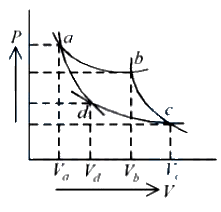 JEE Main/MCQ/Medium/Thermodynamic Processes/With diagram
- 88The heat absorbed by a system in going through the given cyclic process is :
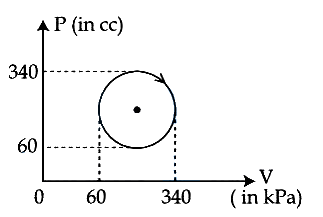 JEE Main/MCQ/Medium/Thermodynamic Processes/With diagram
- 89A sample of gas at temperature is adiabatically expanded to double its volume. Adiabatic constant for the gas is . The work done by the gas in the process is:
JEE Main/MCQ/Medium/Thermodynamic Processes - 90P-T diagram of an ideal gas having three different densities (in three different cases) is shown in the figure. Which of the following is correct :
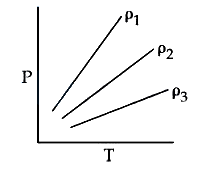 JEE Main/MCQ/Medium/Thermodynamic Processes/With diagram
- 91A diatomic gas does of work when it is expanded isobarically. The heat given to the gas in the process is :JEE Main/MCQ/Medium/Thermodynamic Processes
- 92The pressure and volume of an ideal gas are related as (Constant). The work done when the gas is taken from state to state is :JEE Main/MCQ/Medium/Thermodynamic Processes
- 93The given figure represents two isobaric processes for the same mass of an ideal gas, then
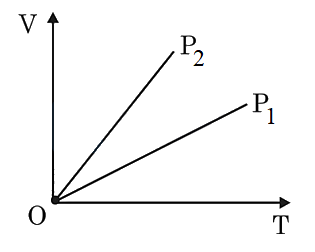 JEE Main/MCQ/Medium/Thermodynamic Processes/With diagram
- 94Choose the correct statement for processes & shown in figure.
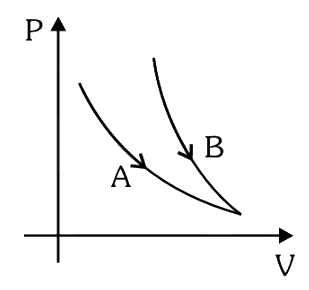 JEE Main/MCQ/Medium/Thermodynamic Processes/With diagram
- 95During an adiabatic process, the pressure of a gas is found to be proportional to the cube of its absolute temperature. The ratio of for the gas is :JEE Main/MCQ/Medium/Thermodynamic Processes
- 96The initial pressure and volume of an ideal gas are and . The final pressure of the gas when the gas is suddenly compressed to volume will be:
(Given = ratio of specific heats at constant pressure and at constant volume.)JEE Main/MCQ/Medium/Thermodynamic Processes - 97The thermodynamic process, in which internal energy of the system remains constant isJEE Main/MCQ/Medium/Thermodynamic Processes
- 98A gas is compressed adiabatically, which one of the following statement is NOT true?JEE Main/MCQ/Medium/Thermodynamic Processes
- 99Consider two containers and containing monoatomic gases at the same Pressure , Volume and Temperature . The gas in is compressed isothermally to of its original volume while the gas in is compressed adiabatically to of its original volume. The ratio of final pressure of gas in to that of gas in isJEE Main/MCQ/Medium/Thermodynamic Processes
- 100For three low density gases pressure versus temperature graphs are plotted while keeping them at constant volume, as shown in the figure
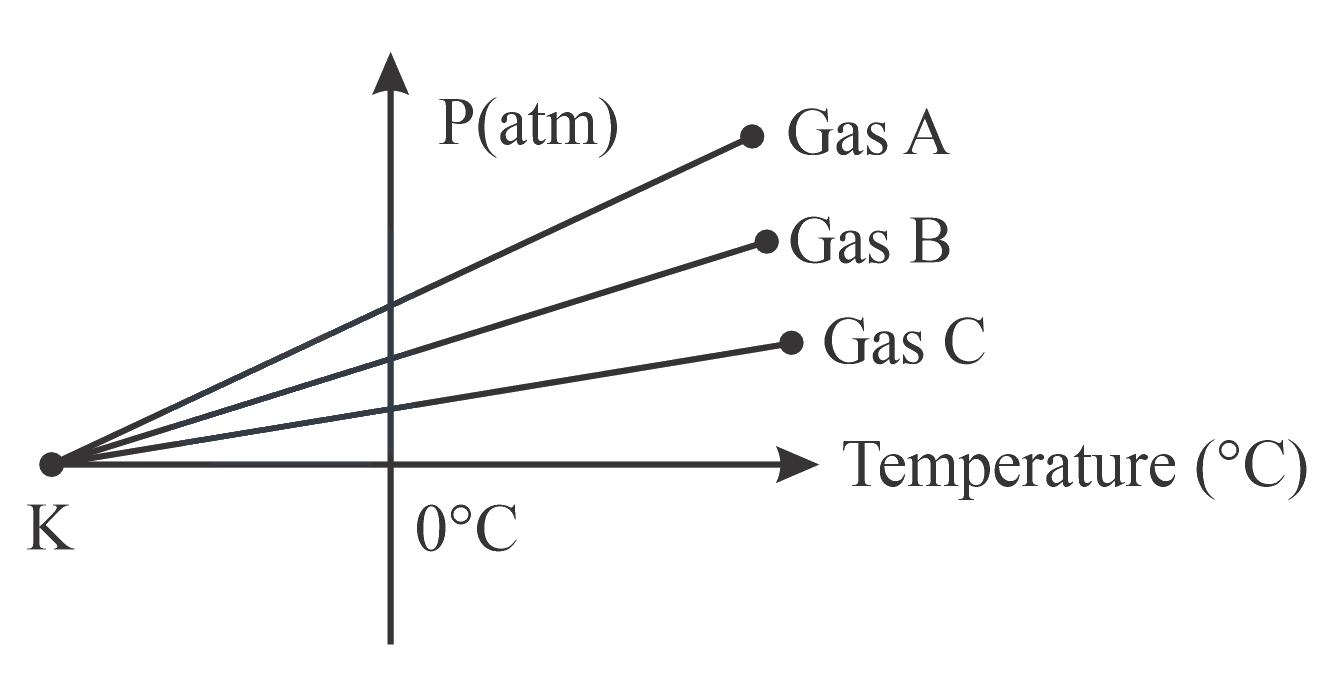
The temperature corresponding to the point is:JEE Main/MCQ/Medium/Thermodynamic Processes/With diagram - 101A sample of gas at temperature is adiabatically expanded to double its volume. The work done by the gas in the process is given, (given ) :JEE Main/MCQ/Medium/Thermodynamic Processes
- 102A hypothetical gas expands adiabatically such that its volume changes from litres to litres. If the ratio of final pressure of the gas to initial pressure of the gas is . Then the ratio of will be.JEE Main/MCQ/Medium/Thermodynamic Processes
- 103Heat energy of is given to a diatomic gas allowing the gas to expand at constant pressure. Each gas molecule rotates around an internal axis but do not oscillate. The increase in the internal energy of the gas will be:JEE Main/MCQ/Medium/Thermodynamic Processes
- 104The correct relation between and temperature is :JEE Main/MCQ/Medium/Thermodynamic Processes
- 105A bicycle tyre is filled with air having pressure of at . The approximate pressure of the air in the tyre when the temperature increases to isJEE Main/MCQ/Medium/Thermodynamic Processes
- 106Match List I with List II : List I List II A Isothermal Process I Work done by the gas decreases internal energy B Adiabatic Process II No change in internal energy C Isochoric Process III The heat absorbed goes partly to increase internal energy and partly to do work D Isobaric Process IV No work is done on or by the gas Choose the correct answer from the options given below :JEE Main/MCQ/Medium/Thermodynamic Processes
- 107In an Isothermal change, the change in pressure and volume of a gas can be represented for three different temperature; as:JEE Main/MCQ/Medium/Thermodynamic Processes
- 108A thermodynamic system is taken from an original state to an intermediate state by the linear process shown in the figure. Its volume is then reduced to the original volume from to by an isobaric process. The total work done by the gas from to to will be
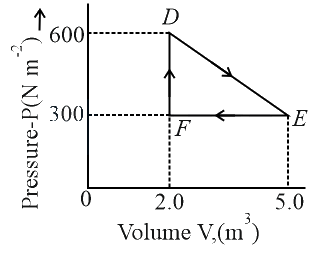 JEE Main/MCQ/Medium/Thermodynamic Processes/With diagram
- 109The pressure and density of diatomic gas changes suddenly to and respectively during an adiabatic process. The temperature of the gas increases and becomes____times of its initial temperature.
(given )JEE Main/Numerical/Medium/Thermodynamic Processes - 110At a certain temperature, the degrees of freedom per molecule for gas is . The gas performs of work when it expands under constant pressure. The amount of heat absorbed by the gas will be _____ .JEE Main/Numerical/Medium/Thermodynamic Processes
- 111A monoatomic gas at pressure and volume is suddenly compressed to one eighth of its original volume. The final pressure at constant entropy will beJEE Main/MCQ/Medium/Thermodynamic Processes
- 112 mole of certain monoatomic ideal gas undergoes a temperature increase of at constant pressure. The increase in the internal energy of the gas in this process is
(Given )JEE Main/MCQ/Medium/Thermodynamic Processes - 113A certain amount of gas of volume at temperature and pressure expands isothermally until its volume gets doubled. Later it expands adiabatically until its volume gets redoubled. The final pressure of the gas will be (Use )JEE Main/MCQ/Medium/Thermodynamic Processes
- 114Starting with the same initial conditions, an ideal gas expands from volume to in three different ways. The work done by the gas is if the process is purely isothermal, , if the process is purely adiabatic and if the process is purely isobaric. Then, choose the correct optionJEE Main/MCQ/Medium/Thermodynamic Processes
- 115A sample of an ideal gas is taken through the cyclic process as shown in figure. It absorbs, of heat during the part , no heat during and rejects of heat during . A work of is done on the gas during the part . The internal energy of the gas at is . The work done by the gas during the part is
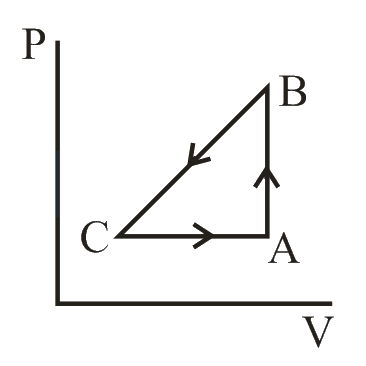 JEE Main/MCQ/Medium/Thermodynamic Processes/With diagram
- 116The total internal energy of two mole monoatomic ideal gas at temperature will be _____ . (Given )JEE Main/Numerical/Medium/Thermodynamic Processes
- 117Statement - I : When amount of an ideal gas undergoes adiabatic change from state to state , then work done is , where and universal gas constant.
Statement - II : In the above case, when work is done on the gas, the temperature of the gas would rise.JEE Main/MCQ/Medium/Thermodynamic Processes - 118A diatomic gas does of work when it is expanded isobarically. The heat given to the gas in the process is _____ .JEE Main/Numerical/Medium/Thermodynamic Processes
- 119The width of one of the two slits in a Young's double slit experiment is three times the other slit. If the amplitude of the light coming from a slit is proportional to the slit-width, the ratio of minimum to maximum intensity in the interference pattern is where is _______.JEE Main/Numerical/Medium/Thermodynamic Processes
- 120A sample of gas with is taken through an adiabatic process in which the volume is compressed from to If the initial pressure is The absolute value of the workdone by the gas in the process =________J.JEE Main/Numerical/Medium/Thermodynamic Processes
- 121One mole of an ideal gas is taken through an adiabatic process where the temperature rises from to . If the ideal gas is composed of polyatomic molecule that has 4 vibrational modes, which of the following is true? JEE Main/MCQ/Medium/Thermodynamic Processes
- 122In the reported figure, there is a cyclic process on a sample of mol of a diatomic gas. The temperature of the gas during the process and are and respectively.
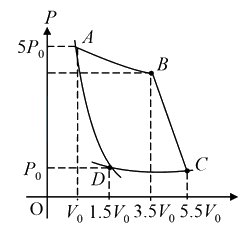
Choose the correct option out of the following for work done if processes and are adiabatic.JEE Main/MCQ/Medium/Thermodynamic Processes/With diagram - 123A monoatomic ideal gas, initially at temperature is enclosed in a cylinder fitted with a frictionless piston. The gas is allowed to expand adiabatically to a temperature by releasing the piston suddenly. If and are the lengths of the gas column, before and after the expansion respectively, then the value of will be:JEE Main/MCQ/Medium/Thermodynamic Processes
- 124Which of the following graphs represent the behaviour of an ideal gas? Symbols have their usual meaning.JEE Main/MCQ/Medium/Thermodynamic Processes
- 125In the reported figure, heat energy absorbed by a system in going through a cyclic process is ______
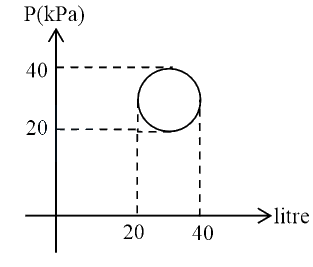 JEE Main/Numerical/Medium/Thermodynamic Processes/With diagram
- 126For an adiabatic expansion of an ideal gas, the fractional change in its pressure is equal to (where is the ratio of specific heats):JEE Main/MCQ/Medium/Thermodynamic Processes
- 127The diagram of a diatomic ideal gas system going under cyclic process as shown in figure. The work done during an adiabatic process is (use :
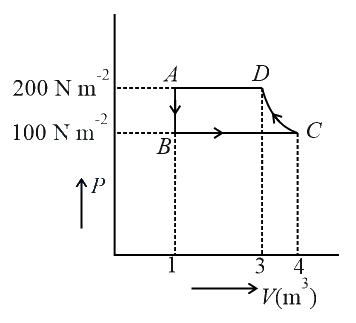 JEE Main/MCQ/Medium/Thermodynamic Processes/With diagram
- 128Which one is the correct option for the two different thermodynamic processes ?
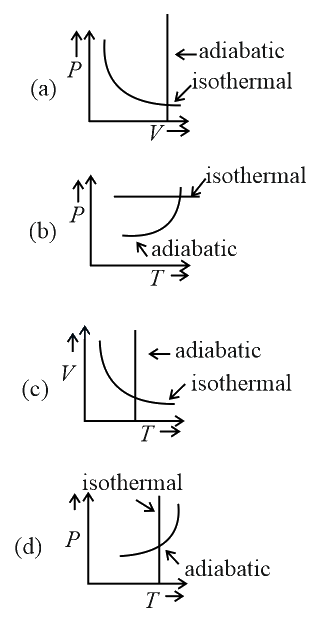 JEE Main/MCQ/Medium/Thermodynamic Processes/With diagram
- 129Thermodynamic process is shown below on a diagram for one mole of an ideal gas. If , then the ratio of temperature is :
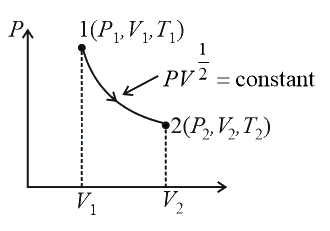 JEE Main/MCQ/Medium/Thermodynamic Processes/With diagram
- 130 mole of a perfect gas undergoes a cyclic process (see figure) consisting of the following processes.
Isothermal expansion at temperature so that the volume is doubled from to and pressure changes from to
Isobaric compression at pressure to initial volume
Isochoric change leading to change of pressure from to
Total work done in the complete cycle is: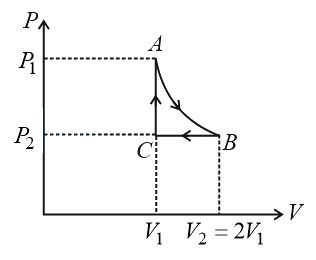 JEE Main/MCQ/Medium/Thermodynamic Processes/With diagram
- 131Match List with List List List (a) Isothermal (i) Pressure constant (b) Isochoric (ii) Temperature constant (c) Adiabatic (iii) Volume constant (d) Isobaric (iv) Heat content is constant Choose the correct answer from the options given below:JEE Main/MCQ/Medium/Thermodynamic Processes
- 132Initially a gas of diatomic molecules is contained in a cylinder of volume at a pressure and temperature . Assuming that of the molecules get dissociated causing a change in number of moles. The pressure of the resulting gas at temperature when contained in a volume is given by . The ratio is -JEE Main/Numerical/Medium/Thermodynamic Processes
- 133In an adiabatic process, the density of a diatomic gas becomes times its initial value. The final pressure of the gas is found to be times the initial pressure. The value of is:JEE Main/MCQ/Medium/Thermodynamic Processes
- 134The change in the magnitude of the volume of an ideal gas when a small additional pressure is applied at a constant temperature, is the same as the change when the temperature is reduced by a small quantity at constant pressure. The initial temperature and pressure of the gas were and respectively. If then value of in is __________JEE Main/Numerical/Medium/Thermodynamic Processes
- 135Match the thermodynamics processes taking place in a system with the correct conditions. In the table : is the heat supplied, is the work done and is change in internal energy of the system. Process Condition (I) Adiabatic (A) (II) Isothermal (B) (III) Isochoric (C) (IV) Isobaric (D) JEE Main/MCQ/Medium/Thermodynamic Processes
- 136A balloon filled with helium bursts. Immediately after wards the expansion of helium can be considered as :JEE Main/MCQ/Medium/Thermodynamic Processes
- 137Starting at temperature one mole of an ideal diatomic gas is first compressed adiabatically from volume to It is then allowed to expand isobarically to volume . If all the processes are the quasi-static then the final temperature of the gas (in ) is (to the nearest integer) ___________.JEE Main/Numerical/Medium/Thermodynamic Processes
- 138Which of the following is an equivalent cyclic process corresponding to the thermodynamic cyclic given in the figure? Where, is adiabatic. (Graphs are schematic and are not to scale)
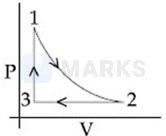 JEE Main/MCQ/Medium/Thermodynamic Processes/With diagram
- 139A thermodynamic cycle is shown on a - diagram.
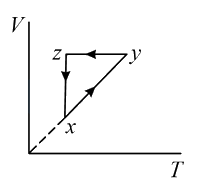
The - diagram that best describes this cycle is: (Diagrams are schematic and not to scale)JEE Main/MCQ/Medium/Thermodynamic Processes/With diagram - 140Under an adiabatic process, the volume of an ideal gas gets doubled. Consequently, the mean collision time between the gas molecule changes from to . If for this gas then a good estimate for is given byJEE Main/MCQ/Medium/Thermodynamic Processes
- 141A litre of dry air at STP expands adiabatically to a volume of litres. If the work done by air is: [Take air to be an ideal gas]JEE Main/MCQ/Medium/Thermodynamic Processes
- 142One mole of an ideal gas passes through a process where pressure and volume obey the relation . Here and are constants. Calculate the change in the temperature of the gas if its volume changes from to .JEE Main/MCQ/Medium/Thermodynamic Processes
- 143A cylinder with fixed capacity of litre contains helium gas at STP. The amount of heat needed to raise the temperature of the gas by is:
[Given that JEE Main/MCQ/Medium/Thermodynamic Processes - 144The given diagram shows four processes i.e., isochoric, isobaric, isothermal and adiabatic. The correct assignment of the processes, in the same order is given by:
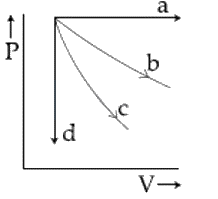 JEE Main/MCQ/Medium/Thermodynamic Processes/With diagram
- 145For the given cyclic process as shown for a gas, the work done is:
 JEE Main/MCQ/Medium/Thermodynamic Processes/With diagram
- 146In a process, temperature and volume of one mole of an ideal monoatomic gas are varied according to the relation where is a constant. In this process the temperature of the gas is increased by . The amount of heat absorbed by gas is (R is gas constant):JEE Main/MCQ/Medium/Thermodynamic Processes
- 147A rigid diatomic ideal gas undergoes an adiabatic process at room temperature. The relation between temperature and volume for this process is constant, then is:JEE Main/MCQ/Medium/Thermodynamic Processes
- 148Half mole of an ideal monoatomic gas is heated at a constant pressure of from to . Work done by the gas isGas constant,)JEE Main/MCQ/Medium/Thermodynamic Processes
- 149A gas can be taken from to via two different processes and .
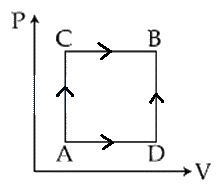
When path is used of heat flows into the system and of work is done by the system. If the path is used then work done by the system is , the heat flows into the system in the path is:JEE Main/MCQ/Medium/Thermodynamic Processes/With diagram - 150One mole of an ideal monatomic gas is taken along the path as shown in the diagram. The maximum temperature attained by the gas along the path is given by:
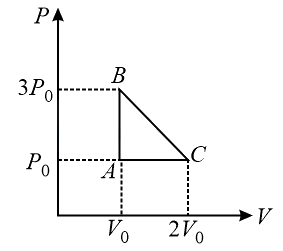 JEE Main/MCQ/Medium/Thermodynamic Processes/With diagram
- 151One mole of an ideal monatomic gas is compressed isothermally in a rigid vessel to double its pressure at room temperature, . The magnitude of work done on the gas will be:JEE Main/MCQ/Medium/Thermodynamic Processes
- 152One mole of an ideal monoatomic gas is compressed isothermally in a rigid vessel to double its pressure at room temperature, . The work done on the gas will be:JEE Main/MCQ/Medium/Thermodynamic Processes
- 153Two moles of an ideal monoatomic gas occupies a volume at . The gas expands adiabatically to a volume . Calculate the final temperature of the gas and change in its internal energy.JEE Main/MCQ/Medium/Thermodynamic Processes
- 154For the diagram given for an ideal gas
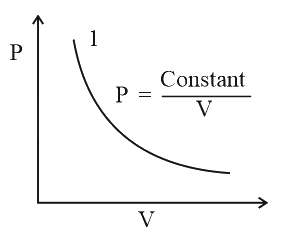
Out of the following which one correctly represents the diagram?JEE Main/MCQ/Medium/Thermodynamic Processes/With diagram - 155An engine operates by taking moles of an ideal gas through the cycle shown in figure. The thermal efficiency of the engine is:
(Take , where is gas constant)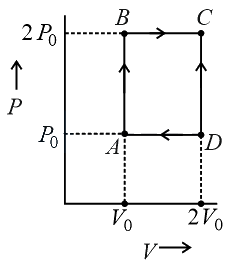 JEE Main/MCQ/Medium/Thermodynamic Processes/With diagram
- 156 water is heated from to . Ignoring the slight expansion of water, the change in its internal energy is close to (Given specific heat of water ):JEE Main/MCQ/Medium/Thermodynamic Processes
- 157The ratio of work done by an ideal monoatomic gas to the heat supplied to it in an isobaric process isJEE Main/MCQ/Medium/Thermodynamic Processes
- 158 moles of an ideal gas undergoes a process as shown in the figure. The maximum temperature of the gas during the process will be:
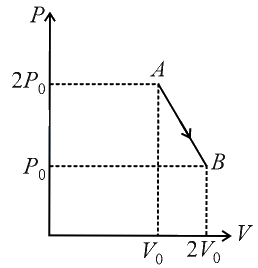 JEE Main/MCQ/Medium/Thermodynamic Processes/With diagram
- 159An ideal gas goes through a reversible cycle has the V - T diagram shown below. Process are adiabatic.
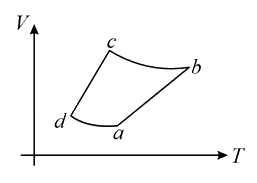
The corresponding P - V diagram for the process is (all figures are schematic and not drawn to scale) :JEE Main/MCQ/Medium/Thermodynamic Processes/With diagram - 160Consider a spherical shell of radius R at temperature T. The black body radiation inside it can be considered as an ideal gas of photons with internal energy per unit volume and pressure . If the shell now undergoes an adiabatic expansion the relation between T and R is:JEE Main/MCQ/Medium/Thermodynamic Processes
- 161Consider an ideal gas confined in an isolated closed chamber. As the gas undergoes an adiabatic expansion, the average time of collision between molecules increases as , where is the volume of the gas. The value of is:
JEE Main/MCQ/Medium/Thermodynamic Processes - 162A monoatomic gas is compressed from a volume of to a volume of at a constant pressure of . Then it is heated at constant volume by supplying of energy. As a result, the internal energy of the gasJEE Main/MCQ/Medium/Thermodynamic Processes
- 163An ideal monoatomic gas is confined in a cylinder by a spring loaded piston of cross section . Initially the gas is at and occupies a volume of and the spring is in its relaxed state as shown in figure. The gas is heated by a small heater until the piston moves out slowly by . The force constant of the spring is and the atmospheric pressure is . The cylinder and the piston are thermally insulated. The piston and the spring are massless and there is no friction between the piston and the cylinder. The final temperature of the gas will be: (Neglect the heat loss through the lead wires of the heater. The heat capacity of the heater coil is also negligible).
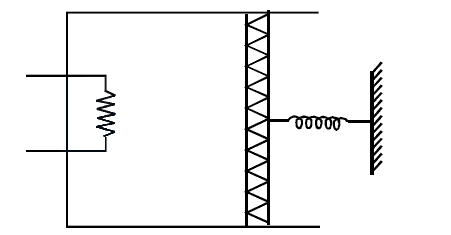 JEE Main/MCQ/Medium/Thermodynamic Processes/With diagram
- 164During an adiabatic compression, of work is done on 2 moles of a diatomic ideal gas to reduce its volume by . The change in its temperature is nearly: JEE Main/MCQ/Medium/Thermodynamic Processes
- 165The equation of state for a gas is given by , where n is the number of moles and is a positive constant. The initial temperature and pressure of one mole of the gas contained in a cylinder are T0 and P0 respectively. The work done by the gas when its temperature doubles isobarically will be :JEE Main/MCQ/Medium/Thermodynamic Processes
- 166One mole of diatomic ideal gas undergoes a cyclic process ABC as shown in figure. The process BC is adiabatic. The temperatures at A, B and C are 400 K, 800 K and 600 K respectively. Choose the correct statement :
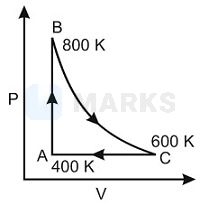 JEE Main/MCQ/Medium/Thermodynamic Processes/With diagram
- 167A sample of gas expands from to . In which of the following, the work done will be greatest?
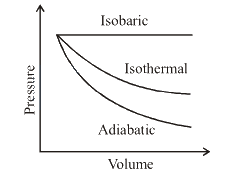 JEE Main/MCQ/Medium/Thermodynamic Processes/With diagram
- 168A certain amount of gas is taken through a cyclic process (A B C D A) that has two isobars, one isochore and one isothermal. The cycle can be represented on a indicator diagram as :JEE Main/MCQ/Medium/Thermodynamic Processes
- 169An ideal gas at atmospheric pressure is adiabatically compressed so that its density becomes 32 times of its initial value. If the final pressure of gas is 128 atmospheres, the value of ' 'of the gas is :JEE Main/MCQ/Medium/Thermodynamic Processes
- 170Figure shows the variation in temperature with the amount of heat supplied in an isobaric process corresponding to a monoatomic , diatomic and a polyatomic gas. The initial state of all the gases are the same and the scales for the two axes coincide. Ignoring vibrational degrees of freedom, the lines and respectively correspond to :
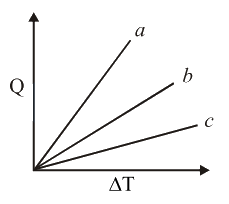 JEE Main/MCQ/Medium/Thermodynamic Processes/With diagram
- 171An ideal monatomic gas with pressure , volume and temperature is expanded isothermally to a volume and a final pressure . If the same gas is expanded adiabatically to a volume , the final pressure is . The ratio isJEE Main/MCQ/Medium/Thermodynamic Processes
- 172The pressure of an ideal gas varies with volume as , where is a constant. One mole of the gas is allowed to undergo expansion such that its volume becomes ' ' times its initial volume. The work done by the gas in the process isJEE Main/MCQ/Medium/Thermodynamic Processes
- 173 moles of an ideal gas undergo a process as shown in the figure. Maximum temperature of the gas during the process is
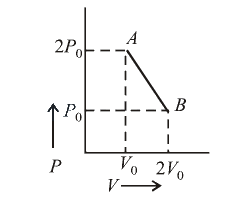 JEE Main/MCQ/Medium/Thermodynamic Processes/With diagram
- 174A given ideal gas with at a temperature . If the gas is compressed adiabatically to one-fourth of its initial volume, the final temperature will beJEE Main/MCQ/Medium/Thermodynamic Processes
- 175This question has Statement 1 and Statement 2. Of the four choices given after the Statements, choose the one that best describes the two Statements.
Statement 1: In an adiabatic process, change in internal energy of a gas is equal to work done on/ by the gas in the process.
Statement 2: The temperature of a gas remains constant in an adiabatic process.JEE Main/MCQ/Medium/Thermodynamic Processes - 176A perfect gas at is heated at constant pressure so as to double its volume. The final temperature of the gas will be, close toJEE Main/MCQ/Medium/Thermodynamic Processes
- 177Helium gas goes through a cycle (consisting of two isochoric and two isobaric lines) as shown in figure. Efficiency of this cycle is nearly:
(Assume the gas to be close to ideal gas)
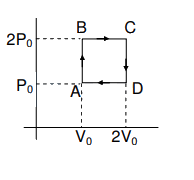 JEE Main/MCQ/Medium/Thermodynamic Processes/With diagram
- 178A diatomic ideal gas is used in a Car engine as the working substance. If during the adiabatic expansion part of the cycle, volume of the gas increases from to the efficiency of the engine isJEE Main/MCQ/Medium/Thermodynamic Processes
- 179The net work done on the gas in the cycle ABCDA isJEE Main/MCQ/Medium/Thermodynamic Processes
- 180The work done on the gas in taking it from to isJEE Main/MCQ/Medium/Thermodynamic Processes
- 181Assuming the gas to be ideal the work done on the gas in taking it from to isJEE Main/MCQ/Medium/Thermodynamic Processes
- 182The work of is performed in order to compress one kilo mole of gas adiabatically and in this process the temperature of the gas increases by . The gas is JEE Main/MCQ/Medium/Thermodynamic Processes
- 183A system goes from to via two processes I and II as shown in the figure. If and are the changes in internal energies in the processes I and II respectively, the
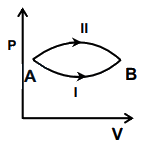 JEE Main/MCQ/Medium/Thermodynamic Processes/With diagram
- 184A Carnot engine is working between two temperatures 473 K and 273 K . In a new system two engines - engine works between 473 K to 373 K and engine works between 373 K to 273 K .
If and are the efficiencies of the engines and , respectively, thenJEE Main/MCQ/Medium/Heat Engine, Refrigerator and Second Law of Thermodynamics - 185Water of mass gram is slowly heated to increase the temperature from to The change in entropy of the water, given specific heat of water is , is :JEE Main/MCQ/Medium/Heat Engine, Refrigerator and Second Law of Thermodynamics
- 186The entropy of any system is given by,
where and are the constants. and are number of moles, mechanical equivalent of heat, Boltzmann's constant and gas constant, respectively.
Choose the incorrect option from the following:JEE Main/MCQ/Medium/Heat Engine, Refrigerator and Second Law of Thermodynamics - 187An ideal gas in a cylinder is separated by a piston in such a way that the entropy of one part is and that of the other part is . Given that . If the piston is removed then the total entropy of the system will be:JEE Main/MCQ/Medium/Heat Engine, Refrigerator and Second Law of Thermodynamics
- 188A solid body of constant heat capacity is being heated by keeping it in contact with reservoirs in two ways: (i) Sequentially keeping in contact with 2 reservoirs such that each reservoir supplies the same amount of heat. (ii) Sequentially keeping in contact with reservoirs such that each reservoir supplies the same amount of heat. In both, cases the body is brought from initial temperature to final temperature . Entropy change of the body in the two cases respectively is: Note: This question was awarded as a bonus since temperatures were given in centigrade instead of in Kelvin. Proper corrections are made in the question to avoid it.JEE Main/MCQ/Medium/Heat Engine, Refrigerator and Second Law of Thermodynamics
- 189The temperature-entropy diagram of a reversible engine cycle is given in the figure. Its efficiency is
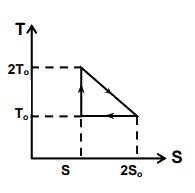 JEE Main/MCQ/Medium/Heat Engine, Refrigerator and Second Law of Thermodynamics/With diagram
- 190"Heat cannot by itself flow from a body at lower temperature to a body at higher temperature" is a statement or consequence ofJEE Main/MCQ/Medium/Heat Engine, Refrigerator and Second Law of Thermodynamics
JEE Main question paper PDF
This chapter includes JEE Main questions. Open a shift to read the paper, or download the PDF.
Opening paper…
Other Physics chapters
Current Electricity 380Electrostatics 311Kinematics 308Ray Optics 295Rotational Motion 280Magnetic Effects & Magnetism 276Atoms & Nuclei 239Gravitation 223Laws of Motion 210Semiconductors 209Dual Nature of Matter 200Oscillations 194Fluid Mechanics 192Wave Optics 191Alternating Current 190Work Energy Power 183Capacitors 180Kinetic Theory 168Electromagnetic Waves 165Electromagnetic Induction 153Units & Dimensions 149Waves 142Center of Mass, Momentum & Collision 130Thermal Properties of Matter 126Mathematics in Physics 121Mechanical Properties of Solids 118Experimental Physics 70Magnetic Properties of Matter 57Modern Physics 5
Stuck on a Thermodynamics question from your book?
Snap it and get a whiteboard video that solves it step by step. Your first video needs no login.