Physics · JEE Main, NEET
Dual Nature of Matter
200 practice questions with a worked solution for each. Tap an option to see instantly if you are right.
187MCQ13Numerical8With diagram
- 1When radiation of wavelength falls on a metal, stopping potential is . When wavelength is , stopping potential is . The threshold wavelength is:JEE Main/MCQ/Medium
- 2The slope of stopping potential versus frequency graph for photoelectric effect gives:NEET/MCQ/Medium
- 3In a photoelectric experiment, graph of stopping potential versus frequency has slope equal to:JEE Main/MCQ/Medium
- 4An oil drop of the radius with a density is held stationary under a constant electric field in the Millikan's oil drop experiment. What is the number of excess electrons that the oil drop will possess? .JEE Main/MCQ/Medium/Cathode Rays and Positive Rays
- 5The de Broglie wavelength for an electron accelerated through the potential difference of volt is . When the potential difference is changed to volt, the associated de Broglie wavelength is increased by . If , then the value of is __________.JEE Main/Numerical/Medium/Matter Waves
- 6An electron is travelling with a velocity in free space and when it enters a medium, its velocity is reduced by . The de Broglie wavelength of electron in the medium is , where is its de Broglie wavelength in free space. The value of is _______.JEE Main/MCQ/Medium/Matter Waves
- 7An electron of mass is moving in an electric field ( constant ), with an initial velocity ( constant ). If , its de Broglie wavelength at time is __________.
( charge of electron)JEE Main/MCQ/Medium/Matter Waves - 8The de Broglie wavelength associated with an electron accelerated through a potential difference V is and the de Broglie wavelength associated with a proton accelerated through the same potential difference is . If their corresponding masses are and , respectively, then the ratio of their de Broglie wavelengths is ______.JEE Main/MCQ/Medium/Matter Waves
- 9The ratio of de Broglie wavelength of a deutron with kinetic energy to that of an alpha particle with kinetic energy , is . The value of is .
(Assume mass of proton mass of neutron) :JEE Main/Numerical/Medium/Matter Waves - 10The de Broglie wavelength of an oxygen molecule at is . The value of is (take Planck's constant , Boltzmann constant , mass of oxygen molecule )JEE Main/MCQ/Medium/Matter Waves
- 11A particle having electric charge and mass is accelerated by applying an electric potential of 1.21 V. Wavelength of the matter wave associated with the particle is . The value of is - (Take Planck's constant )JEE Main/Numerical/Medium/Matter Waves
- 12A photo-emissive substance is illuminated with a radiation of wavelength so that it releases electrons with de-Broglie wavelength . The longest wavelength of radiation that can emit photoelectron is . Expression for de-Broglie wavelength is given by :
( mass of the electron, Planck's constant and : speed of light)JEE Main/MCQ/Medium/Matter Waves - 13An electron with mass ' ' with an initial velocity enters a magnetic field . If the initial de-Broglie wavelength at is then its value after time ' t ' would be :JEE Main/MCQ/Medium/Matter Waves
- 14If \(\lambda\) and \(K\) are de Broglie wavelength and kinetic energy, respectively, of a particle with constant mass. The correct graphical representation for the particle will beJEE Main/MCQ/Medium/Matter Waves
- 15A proton of mass ' ' has same energy as that of a photon of wavelength ' '. If the proton is moving at non-relativistic speed, then ratio of its de Broglie wavelength to the wavelength of photon is.JEE Main/MCQ/Medium/Matter Waves
- 16The energy and momentum of a moving body of mass are related by some equation. Given that c represents the speed of light, identify the correct equationJEE Main/MCQ/Medium/Matter Waves
- 17An electron of mass ' m ' with an initial velocity enters an electric field . If the initial de Broglie wavelength is , the value after time t would beJEE Main/MCQ/Medium/Matter Waves
- 18A sub-atomic particle of mass is moving with a velocity . Under the matter wave consideration, the particle will behave closely like JEE Main/MCQ/Medium/Matter Waves
- 19An electron in the ground state of the hydrogen atom has the orbital radius of while that for the electron in third excited state is . The ratio of the de Broglie wavelengths of electron in the excited state to that in the ground state isJEE Main/MCQ/Medium/Matter Waves
- 20A proton, an electron and an alpha particle have the same energies. Their de-Broglie wavelengths will be compared as :JEE Main/MCQ/Medium/Matter Waves
- 21A proton and an electron have the same de Broglie wavelength. If and be the kinetic energies of proton and electron respectively, then choose the correct relation :JEE Main/MCQ/Medium/Matter Waves
- 22A proton and an electron are associated with same de-Broglie wavelength. The ratio of their kinetic energies is:
(Assume h=6.63 and times )JEE Main/MCQ/Medium/Matter Waves - 23The de Broglie wavelengths of a proton and an particle are and respectively. The ratio of the velocities of proton and particle will be :JEE Main/MCQ/Medium/Matter Waves
- 24The de-Broglie wavelength of an electron is the same as that of a photon. If velocity of electron is of the velocity of light, then the ratio of K.E. of electron and K.E. of photon will be:JEE Main/MCQ/Medium/Matter Waves
- 25The de Broglie wavelength of an electron having kinetic energy is . If the kinetic energy of electron becomes , then its de-Broglie wavelength will be:JEE Main/MCQ/Medium/Matter Waves
- 26A proton and an -particle are accelerated from rest by and potentials, respectively. The ratio of their de-Broglie wavelength is :JEE Main/MCQ/Medium/Matter Waves
- 27The ratio of the de-Broglie wavelengths of proton and electron having same kinetic energy:
(Assume )JEE Main/MCQ/Medium/Matter Waves - 28The de Broglie wavelength of a molecule in a gas at room temperature is . If the temperature of the gas is increased to , then the de Broglie wavelength of the same gas molecule becomesJEE Main/MCQ/Medium/Matter Waves
- 29Proton and electron will have same de-Broglie wavelength when the ratio of their momentum is (assume, )JEE Main/MCQ/Medium/Matter Waves
- 30The kinetic energy of an electron, particle and a proton are given as and respectively. The de-Broglie wavelength associated with electron particle and the proton are as follows:JEE Main/MCQ/Medium/Matter Waves
- 31A proton moving with one tenth of velocity of light has a certain de Broglie wavelength of . An alpha particle having certain kinetic energy has the same de-Brogle wavelength . The ratio of kinetic energy of proton and that of alpha particle is :JEE Main/MCQ/Medium/Matter Waves
- 32An electron accelerated through a potential difference has a de-Broglie wavelength of . When the potential is changed to , its de-Broglie wavelength increases by . The value of is equal to :JEE Main/MCQ/Medium/Matter Waves
- 33The ratio of de-Broglie wavelength of an -particle and a proton accelerated from rest by the same potential is , the value of is:JEE Main/MCQ/Medium/Matter Waves
- 34Electron beam used in an electron microscope, when accelerated by a voltage of has a de-Broglie wavelength of . If the voltage is increased to then the de-Broglie wavelength associated with the electron beam would be:JEE Main/MCQ/Medium/Matter Waves
- 35An particle, a proton and an electron have the same kinetic energy. Which one of the following is correct in case of their de-Broglie wavelength:JEE Main/MCQ/Medium/Matter Waves
- 36An particle and a proton are accelerated from rest through the same potential difference. The ratio of linear momenta acquired by above two particals will be :JEE Main/MCQ/Medium/Matter Waves
- 37The kinetic energy of emitted electron is when the light incident on the metal has wavelength . To double the kinetic energy, the incident light must have wavelength:JEE Main/MCQ/Medium/Matter Waves
- 38The equation can be used to find the de-Broglie wavelength of an electron. In this equation stands for :
Where,
mass of electron
momentum of electron
Kinetic energy of electron
Accelerating potential in volts for electronJEE Main/MCQ/Medium/Matter Waves - 39An electron (mass ) with an initial velocity is moving in an electric field where is constant. If at , de-Broglie wavelength is , then its de-Broglie wavelength after time is given byJEE Main/MCQ/Medium/Matter Waves
- 40A nucleus of mass at rest splits into two parts having masses and . The ratio of de Broglie wavelength of two parts will beJEE Main/MCQ/Medium/Matter Waves
- 41The ratio of wavelengths of proton and deuteron accelerated by potential and is . Then, the ratio of to will beJEE Main/MCQ/Medium/Matter Waves
- 42The de Broglie wavelengths for an electron and a photon are and respectively. For the same kinetic energy of electron and photon, which of the following presents the correct relation between the de Broglie wavelengths of two?JEE Main/MCQ/Medium/Matter Waves
- 43An particle and a carbon atom has same kinetic energy . The ratio of their de-Broglie wavelengths isJEE Main/MCQ/Medium/Matter Waves
- 44An electron with speed and a photon with speed have the same de-Broglie wavelength. If the kinetic energy and momentum of electron are and and that of photon are and respectively. Which of the following is correct?JEE Main/MCQ/Medium/Matter Waves
- 45A proton, a neutron, an electron and an -particle have same energy. If and are the de Broglie's wavelengths of proton, neutron, electron and particle respectively, then choose the correct relation from the followingJEE Main/MCQ/Medium/Matter Waves
- 46The temperature of an ideal gas in three dimensions is The corresponding de-Broglie wavelength of the electron approximately at is:
mass of electron , Planck constant , Boltzmann constantJEE Main/MCQ/Medium/Matter Waves - 47Consider two separate ideal gases of electrons and protons having same number of particles. The temperature of both the gases are same. The ratio of the uncertainty in determining the position of an electron to that of a proton is proportional to:JEE Main/MCQ/Medium/Matter Waves
- 48A moving proton and electron have the same de-Broglie wavelength. If and denote the and momentum respectively. Then choose the correct option :JEE Main/MCQ/Medium/Matter Waves
- 49The de-Broglie wavelength of a particle having kinetic energy is How much extra energy must be given to this particle so that the de-Broglie wavelength reduces to of the initial value?JEE Main/MCQ/Medium/Matter Waves
- 50A particle of mass travels in a medium with a speed of and a photon of radiation of linear momentum travels in a vacuum. The wavelength of the photon is ____ times the wavelength of the particle.JEE Main/Numerical/Medium/Matter Waves
- 51An electron moving with speed and a photon moving with speed , have the same D-Broglie wavelength. The ratio of the kinetic energy of the electron to that of a photon is:JEE Main/MCQ/Medium/Matter Waves
- 52A particle of mass at rest disintegrates into two particles of mass and , respectively, having non zero velocities. The ratio of de-Broglie wavelength of particle of mass to that of mass will be:JEE Main/MCQ/Medium/Matter Waves
- 53What should be the order of arrangement of de-Broglie wavelength of electron , an -particle and proton given that all have the same kinetic energy ?JEE Main/MCQ/Medium/Matter Waves
- 54An electron of mass and a proton of mass are accelerated through the same potential difference. The ratio of the de-Broglie wavelength associated with the electron to that with the proton isJEE Main/MCQ/Medium/Matter Waves
- 55An electron having de-Broglie wavelength is incident on a target in a -ray tube. Cut-off wavelength of emitted -ray is:JEE Main/MCQ/Medium/Matter Waves
- 56A particle is travelling times as fast as an electron. Assuming the ratio of de-Broglie wavelength of a particle to that of electron is the mass of the particle is :-JEE Main/MCQ/Medium/Matter Waves
- 57An electron of mass and a photon have same energy The ratio of wavelength of electron to that of photon is : ( being the velocity of light)JEE Main/MCQ/Medium/Matter Waves
- 58The de-Broglie wavelength associated with an electron and a proton were calculated by accelerating them through same potential of . What should nearly be the ratio of their wavelengths JEE Main/MCQ/Medium/Matter Waves
- 59An electron of mass and a proton of mass are moving with the same speed. The ratio of their de Broglie wavelength will be :JEE Main/MCQ/Medium/Matter Waves
- 60An particle and a proton are accelerated from rest by a potential difference of . After this, their de Broglie wavelengths are and respectively. The ratio is :JEE Main/MCQ/Medium/Matter Waves
- 61The de Broglie wavelength of a proton and -particle are equal. The ratio of their velocities isJEE Main/MCQ/Medium/Matter Waves
- 62An electron, a doubly ionized helium ion () and proton are having the same kinetic energy. The relation between their respective de-Broglie wavelength and is :JEE Main/MCQ/Medium/Matter Waves
- 63Particle of mass moving along the -axis with velocity collides elastically with another particle at rest having mass . If both the particles move along the -axis after the collision, the change in the wavelength of the particle , in terms of its de-Broglie wavelength before the collision is:JEE Main/MCQ/Medium/Matter Waves
- 64A particle is moving times as fast as an electron. The ratio of the de-Broglie wavelength of the particle to that of the electron is . The mass of the particle is close to :JEE Main/MCQ/Medium/Matter Waves
- 65An electron of mass and magnitude of charge at rest, gets accelerated by a constant electric field . The rate of change of de-Broglie wavelength of this electron at a time is (ignore relativistic effects)JEE Main/MCQ/Medium/Matter Waves
- 66A particle moving with kinetic energy has de Broglie wavelength . If energy is added to its energy, the wavelength become . Value of is:JEE Main/MCQ/Medium/Matter Waves
- 67An electron (mass ) with initial velocity is in an electric filed If is initial de-Broglie wavelength of electron, its de-Broglie wave length at time is given by:JEE Main/MCQ/Medium/Matter Waves
- 68When photon of energy strikes the surface of a metal the ejected photoelectrons have maximum kinetic energy and de-Broglie wavelength The maximum kinetic energy of photoelectrons liberated from another metal by photon of energy is If the de-Broglie wavelength of these photoelectrons then the work function of metal is:JEE Main/MCQ/Medium/Matter Waves
- 69An electron (of mass ) and a photon have the same energy in the range of a few . The ratio of the de-Broglie wavelength associated with the electron and the wavelength of the photon is ( speed of light in vacuum)JEE Main/MCQ/Medium/Matter Waves
- 70Consider an electron in a hydrogen atom, revolving in its second excited state (having radius ). The de-Broglie wavelength of this electron is:JEE Main/MCQ/Medium/Matter Waves
- 71A particle is formed due to a completely inelastic collision of particles and having de-Broglie wavelengths and respectively. If and were moving in opposite directions, then the de-Broglie wavelength of is:JEE Main/MCQ/Medium/Matter Waves
- 72A nucleus with a finite de-broglie wavelength undergoes spontaneous fission into two nuclei and of equal mass. flies in the same direction as that of while flies in the opposite direction with a velocity equal to half of that of The de-Broglie wavelengths and of B and C are respectively:JEE Main/MCQ/Medium/Matter Waves
- 73Two particles move at right angle to each other. Their de Broglie wavelengths are and respectively. The particles suffer perfectly inelastic collision. The de Broglie wavelength of the final particle, is given by:JEE Main/MCQ/Medium/Matter Waves
- 74A particle of mass and charge is accelerated by a potential difference of Another particle of mass and charge is accelerated by a potential difference of The ratio of de-Broglie wavelengths is close to:JEE Main/MCQ/Medium/Matter Waves
- 75If the deBroglie wavelength of an electron is equal to times the wavelength of a photon of frequency , then the speed of electron is equal to :
(Speed of light
Planck's constant
Mass of electron JEE Main/MCQ/Medium/Matter Waves - 76In an electron microscope, the resolution that can be achieved is of the order of the wavelength of electrons used. To resolve a width of the minimum electron energy required is close to:JEE Main/MCQ/Medium/Matter Waves
- 77The de-Broglie wavelength associated with the electron orbiting in the second excited state of hydrogen atom is related to that in the ground state by:JEE Main/MCQ/Medium/Matter Waves
- 78If the de Broglie wavelengths associated with a proton and an -particle are equal, then the ratio of velocities of the proton and the -particle will be:JEE Main/MCQ/Medium/Matter Waves
- 79Two electrons are moving with non-relativistic speeds perpendicular to each other. If corresponding de brogile wavelengths are and , their de brogile wavelength in the frame of reference attached to their centre of mass is:JEE Main/MCQ/Medium/Matter Waves
- 80A particle of mass and initial velocity collides with a particle of mass which is at rest. The collision is head on, and elastic. The ratio of the de-Broglie wavelengths to after the collision is:JEE Main/MCQ/Medium/Matter Waves
- 81The de-Broglie wavelength associated with the electron in the level is:JEE Main/MCQ/Medium/Matter Waves
- 82De-Broglie wavelength of an electron accelerated by a voltage of is close to JEE Main/MCQ/Medium/Matter Waves
- 83For LED's to emit light in visible region of electromagnetic light, it should have energy band gap in the range of:JEE Main/MCQ/Medium/Matter Waves
- 84For which of the following particles will it be most difficult to experimentally verify the de-Broglie relationship?JEE Main/MCQ/Medium/Matter Waves
- 85Electrons are accelerated through a potential difference and protons are accelerated through a potential difference . The de-Broglie wavelengths are and for electrons and protons respectively. The ratio of is given by: (given is mass of electron and is mass of proton).JEE Main/MCQ/Medium/Matter Waves
- 86Photon of frequency has a momentum associated with it. If is the velocity of light, the momentum isJEE Main/MCQ/Medium/Matter Waves
- 87The time by a photoelectron to come out after the photon strikes is approximatelyJEE Main/MCQ/Medium/Matter Waves
- 88If the kinetic energy of a free electron doubles. Its deBroglie wavelength changes by the factorJEE Main/MCQ/Medium/Matter Waves
- 89Formation of covalent bonds in compounds exhibitsJEE Main/MCQ/Medium/Matter Waves
- 90 and be the maximum kinetic energies of photoelectrons emitted from a surface of a given material for the light of wavelength and , respectively. If then the work function of material is given by:JEE Main/MCQ/Medium/Photoelectric Effect
- 91Given below are two statements: one is labelled as Assertion (A) and the other is labelled as Reason (R).
Assertion (A): The electromagnetic wave exerts pressure on the surface on which they are allowed to fall.
Reason (R): There is no mass associated with the electromagnetic waves.
In the light of the above statements, choose the correct answer from the options given below :JEE Main/MCQ/Medium/Photoelectric Effect - 92Light source having wavelength nm is used to generate photo-electrons whose stopping potential is V. The work function of the used metal in the experiment is J. The value of is _____.
( J s, C and m/s)JEE Main/MCQ/Medium/Photoelectric Effect - 93Match the LIST-I with LIST-II
List-IList-IIA. Planck's constantI. B. Stopping potentialII. C. Work functionIII. D. Threshold frequencyIV.
Choose the correct answer from the options given below:JEE Main/MCQ/Medium/Photoelectric Effect - 94The graph shows variation of stopping potential with the frequency of the incident radiation for three photosensitive metals , and . Which metal will give out electrons with greater kinetic energy, for the same wavelength of incident radiation?
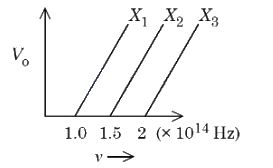 JEE Main/MCQ/Medium/Photoelectric Effect/With diagram
- 95For a certain metal, when monochromatic light of wavelength is incident, the stopping potential for photoelectrons is . When the same metal is illuminated by light of wavelength , then the stopping potential becomes . The threshold wavelength for photoelectric emission for the given metal is . The value of is _______.JEE Main/MCQ/Medium/Photoelectric Effect
- 96Number of photons of equal energy emitted per second by a 6 mW laser source operating at 663 nm is .
(Given : and )JEE Main/MCQ/Medium/Photoelectric Effect - 97When a light of a given wavelength falls on a metallic surface the stopping potential for photoelectrons is 3.2 V. If a second light having wavelength twice of first light is used, the stopping potential drops to 0.7 V. The wavelength of first light is m. JEE Main/MCQ/Medium/Photoelectric Effect
- 98Light is incident on a metallic plate having work function . If the produced photoelectrons have zero kinetic energy then the angular frequency of the incident light is rad/s. .JEE Main/MCQ/Medium/Photoelectric Effect
- 99A light wave described by (in SI units) falls on a metal surface of work function 2.8 eV. The maximum kinetic energy of ejected photoelectron is (approximately) eV. . s. and JEE Main/MCQ/Medium/Photoelectric Effect
- 100A small mirror of mass is suspended by a massless thread of length . Then the small angle through which the thread will be deflected when a short pulse of laser of energy falls normal on the mirror ( speed of light in vacuum and acceleration due to gravity)JEE Main/MCQ/Medium/Photoelectric Effect
- 101Given below are two statements: one is labelled as Assertion A and the other is labelled as Reason
Assertion A: In photoelectric effect, on increasing the intensity of incident light the stopping potential increases.
Reason R : Increase in intensity of light increases the rate of photoelectrons emitted, provided the frequency of incident light is greater than threshold frequency.
In the light of the above statements, choose the correct answer from the options given belowJEE Main/MCQ/Medium/Photoelectric Effect - 102The work function of a metal is 3 eV. The color of the visible light that is required to cause emission of photoelectrons isJEE Main/MCQ/Medium/Photoelectric Effect
- 103The radiation pressure exerted by a 450 W light source on a perfectly reflecting surface placed at 2 m away from it, is :JEE Main/MCQ/Medium/Photoelectric Effect
- 104A monochromatic light is incident on a metallic plate having work function . An electron, emitted normally to the plate from a point with maximum kinetic energy, enters a constant magnetic field, perpendicular to the initial velocity of electron. The electron passes through a curve and hits back the plate at a point . The distance between A and B is :
(Given : The magnitude of charge of an electron is e and mass is is Planck's constant and c is velocity of light. Take the magnetic field exists throughout the path of electron)JEE Main/MCQ/Medium/Photoelectric Effect - 105In an experiment with photoelectric effect, the stopping potential,JEE Main/MCQ/Medium/Photoelectric Effect
- 106In photoelectric effect, the stopping potential frequency curve is plotted.
( h is the Planck's constant and is work function of metal )
(A) is linear.
(B) The slope of curve
(C) h constant is related to the slope of line.
(D) The value of electric charge of electron is not required to determine using the curve.
(E) The work function can be estimated without knowing the value of .
Choose the correct answer from the options given below :JEE Main/MCQ/Medium/Photoelectric Effect - 107In photoelectric effect an em-wave is incident on a metal surface and electrons are ejected from the surface. If the work function of the metal is 2.14 eV and stopping potential is 2 V , what is the wavelength of the em-wave ?
(Given hc where h is the Planck's constant and c is the speed of light in vaccum.)JEE Main/MCQ/Medium/Photoelectric Effect - 108A light source of wavelength illuminates a metal surface and electrons are ejected with maximum kinetic energy of 2 eV . If the same surface is illuminated by a light source of wavelength , then the maximum kinetic energy of ejected electrons will be (The work function of metal is 1 eV )JEE Main/MCQ/Medium/Photoelectric Effect
- 109The work functions of cesium (Cs) and lithium (Li) metals are 1.9 eV and 2.5 eV , respectively. If we incident a light of wavelength 550 nm on these two metal surfaces, then photo-electric effect is possible for the case ofJEE Main/MCQ/Medium/Photoelectric Effect
- 110UV light of is incident on a photosensitive metal surface having work function . The maximum kinetic energy of ejected photoelectrons will be:JEE Main/MCQ/Medium/Photoelectric Effect
- 111Average force exerted on a non-reflecting surface at normal incidence is . If is the light energy flux during span of 1 hour 30 minutes, Then the area of the surface is:JEE Main/MCQ/Medium/Photoelectric Effect
- 112When UV light of wavelength is incident on the metal surface having work function , electron emission takes place. The stopping potential is:
(Given hc )JEE Main/MCQ/Medium/Photoelectric Effect - 113Which of the following phenomena does not explain by wave nature of light.
A. reflection
B. diffraction
C. photoelectric effect
D. interference
E. polarization
Choose the most appropriate answer from the options given below:JEE Main/MCQ/Medium/Photoelectric Effect - 114In photoelectric experiment energy of irradiates a photo sensitive material. The stopping potential was measured to be . Work function of the photo sensitive material is :JEE Main/MCQ/Medium/Photoelectric Effect
- 115Which of the following statement is not true about stopping potential ?JEE Main/MCQ/Medium/Photoelectric Effect
- 116Given below are two statements :
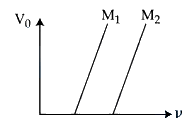
Statement I : Figure shows the variation of stopping potential with frequency for the two photosensitive materials and . The slope gives value of , where is Planck's constant, is the charge of electron.
Statement II : will emit photoelectrons of greater kinetic energy for the incident radiation having same frequency.
In the light of the above statements, choose the most appropriate answer from the options given below.JEE Main/MCQ/Medium/Photoelectric Effect/With diagram - 117Given below are two statements: one is labelled as Assertion and the other is labelled as Reason R.
Assertion A: Number of photons increases with increase in frequency of light.
Reason R: Maximum kinetic energy of emitted electrons increases with the frequency of incident radiation.
In the light of the above statements, choose the most appropriate answer from the options given below:JEE Main/MCQ/Medium/Photoelectric Effect - 118Which figure shows the correct variation of applied potential difference (V) with photoelectric current (I) at two different intensities of light of same wavelengths :JEE Main/MCQ/Medium/Photoelectric Effect
- 119Monochromatic light of frequency is produced by a laser. The power emitted is How many photons per second on an average, are emitted by the source?
(Given )JEE Main/MCQ/Medium/Photoelectric Effect - 120In a photoelectric effect experiment a light of frequency times the threshold frequency is made to fall on the surface of photosensitive material. Now if the frequency is halved and intensity is doubled, the number of photo electrons emitted will be:JEE Main/MCQ/Medium/Photoelectric Effect
- 121When a metal surface is illuminated by light of wavelength , the stopping potential is . When the same surface is illuminated by light of wavelength , stopping potential is . The threshold wavelength for this surface is :JEE Main/MCQ/Medium/Photoelectric Effect
- 122For the photoelectric effect, the maximum kinetic energy of the photoelectrons is plotted against the frequency of the incident photons as shown in figure. The slope of the graph gives
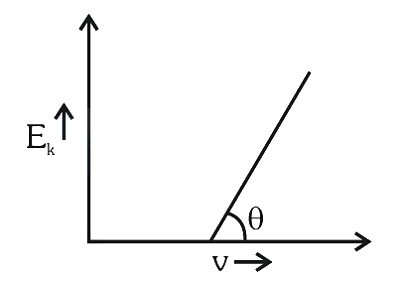 JEE Main/MCQ/Medium/Photoelectric Effect/With diagram
- 123If the total energy transferred to a surface in time is , then the magnitude of the total momentum delivered to this surface for complete absorption will be :JEE Main/MCQ/Medium/Photoelectric Effect
- 124The work function of a substance is . The longest wavelength of light that can cause the emission of photoelectrons from this substance is approximately:JEE Main/MCQ/Medium/Photoelectric Effect
- 125Two sources of light emit with a power of . The ratio of number of photons of visible light emitted by each source having wavelengths and respectively, will be :JEE Main/MCQ/Medium/Photoelectric Effect
- 126The threshold frequency of a metal with work function is :JEE Main/MCQ/Medium/Photoelectric Effect
- 127The difference between threshold wavelengths for two metal surfaces and having work function and in is:
{Given, }JEE Main/MCQ/Medium/Photoelectric Effect - 128A metallic surface is illuminated with radiation of wavelength , the stopping potential is . If the same surface is illuminated with radiation of wavelength , the stopping potential becomes . The threshold wavelength for this metallic surface will beJEE Main/MCQ/Medium/Photoelectric Effect
- 129The variation of stopping potential as a function of the frequency of the incident light for a metal is shown in figure. The work function of the surface is
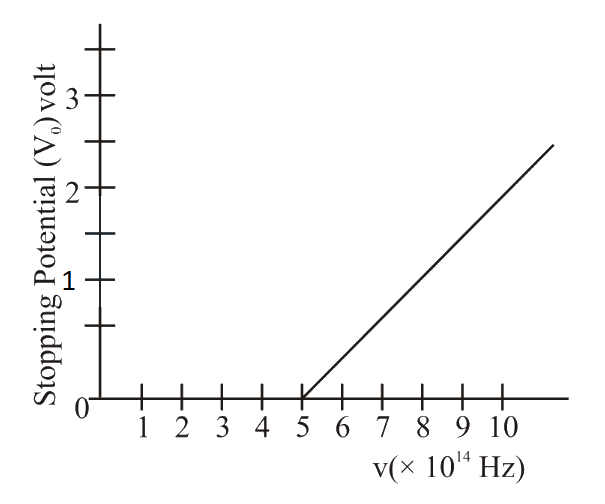 JEE Main/MCQ/Medium/Photoelectric Effect/With diagram
- 130In photoelectric effect
A. The photocurrent is proportional to the intensity of the incident radiation.
B. Maximum kinetic energy with which photoelectrons are emitted depends on the intensity of incident light.
C. Max K.E. with which photoelectrons are emitted depends on the frequency of incident light.
D. The emission of photoelectrons require a minimum threshold intensity of incident radiation.
E. Max K.E. of the photoelectrons is independent of the frequency of the incident light.
Choose the correct answer from the options given below:JEE Main/MCQ/Medium/Photoelectric Effect - 131The work functions of Aluminium and Gold are and respectively. The ratio of the slope of the stopping potential versus frequency plot for Gold to that of Aluminium isJEE Main/MCQ/Medium/Photoelectric Effect
- 132The threshold frequency of metal is . When the light of frequency is incident on the metal plate, the maximum velocity of photoelectron is . When the frequency of incident radiation is increased to . the maximum velocity of photoelectrons emitted is . The ratio of to is:JEE Main/MCQ/Medium/Photoelectric Effect
- 133If the two metals and are exposed to radiation of wavelength . The work functions of metals and are . Then choose the correct optionJEE Main/MCQ/Medium/Photoelectric Effect
- 134If a source of electromagnetic radiation having power produces photons per second, the radiation belongs to a part of spectrum is :
(Take Planck constant JEE Main/MCQ/Medium/Photoelectric Effect - 135A point source of emits light with efficiency. At a distance of from the source, the intensity produced by the electric field component is:JEE Main/MCQ/Medium/Photoelectric Effect
- 136A point source of light is placed at the centre of curvature of a hemispherical surface. The source emits a power of . The radius of curvature of hemisphere is and the inner surface is completely reflecting. The force on the hemisphere due to the light falling on it is ______ .JEE Main/Numerical/Medium/Photoelectric Effect
- 137A small object at rest, absorbs a light pulse of power and duration . Assuming speed of light as . The momentum of the object becomes equal to :JEE Main/MCQ/Medium/Photoelectric Effect
- 138The threshold wavelength for photoelectric emission from a material is . Photoelectrons will be emitted, when this material is illuminated with monochromatic radiation from a
A. infra-red lamp
B. infra-red lamp
C. ultra-violet lamp
D. ultra-violet lamp
Choose the correct answer from the options given below :JEE Main/MCQ/Medium/Photoelectric Effect - 139Given below are two statements :
Statement I : Stopping potential in photoelectric effect does not depend on the power of the light source.
Statement II : For a given metal, the maximum kinetic energy of the photoelectron depends on the wavelength of the incident light.
In the light of above statements, choose the most appropriate answer from the options given below.JEE Main/MCQ/Medium/Photoelectric Effect - 140From the photoelectric effect experiment, following observations are made. Identify which of these are correct
A. The stopping potential depends only on the work function of the metal.
B. The saturation current increases as the intensity of incident light increases.
C. The maximum kinetic energy of a photo electron depends on the intensity of the incident light.
D. Photoelectric effect can be explained using wave theory of light.
Choose the correct answer from the options given below:JEE Main/MCQ/Medium/Photoelectric Effect - 141Two streams of photons, possessing energies to five and ten times the work function of metal are incident on the metal surface successively. The ratio of the maximum velocities of the photoelectron emitted, in the two cases respectively, will beJEE Main/MCQ/Medium/Photoelectric Effect
- 142With reference to the observations in photo-electric effect, identify the correct statements from below:
A. The square of maximum velocity of photoelectrons varies linearly with frequency of incident light.
B. The value of saturation current increases on moving the source of light away from the metal surface.
C. The maximum kinetic energy of photo-electrons decreases on decreasing the power of LED (light emitting diode) source of light.
D. The immediate emission of photo-electrons out of metal surface can not be explained by particle nature of light/electromagnetic waves.
E. Existence of threshold wavelength can not be explained by wave nature of light/electromagnetic waves.
Choose the correct answer from the options given below:JEE Main/MCQ/Medium/Photoelectric Effect - 143A parallel beam of light of wavelength and intensity is incident on a surface perpendicular to the beam. The number of photons crossing area perpendicular to the beam in one second isJEE Main/MCQ/Medium/Photoelectric Effect
- 144A metal exposed to light of wavelength and emits photoelectrons with a certain kinetic energy. The maximum kinetic energy of photo-electron doubles when light of wavelength is used. The work function of the metal is
(Take ).JEE Main/MCQ/Medium/Photoelectric Effect - 145The electric field at a point associated with a light wave is given by
Given:
If this light falls on a metal surface having a work function of , the maximum kinetic energy of the photoelectrons will beJEE Main/MCQ/Medium/Photoelectric Effect - 146Given below are two statements: one is labelled as Assertion A and the other is labelled as Reason R.
Assertion A : The photoelectric effect does not take place, if the energy of the incident radiation is less than the work function of a metal.
Reason R : Kinetic energy of the photoelectrons is zero, if the energy of the incident radiation is equal to the work function of a metal.JEE Main/MCQ/Medium/Photoelectric Effect - 147Let and be the maximum kinetic energies of photo-electrons emitted when two monochromatic beams of wavelength and , respectively are incident on a metallic surface. If then :JEE Main/MCQ/Medium/Photoelectric Effect
- 148The stopping potential for photoelectrons emitted from a surface illuminated by light of wavelength is . If the threshold frequency is , where is (nearest integer): (Given, speed light . Planck's constant )JEE Main/Numerical/Medium/Photoelectric Effect
- 149The light of two different frequencies whose photons have energies and respectively, illuminate a metallic surface whose work function is successively. The ratio of maximum speeds of emitted electrons for the two frequencies respectively will be :JEE Main/MCQ/Medium/Photoelectric Effect
- 150When light of frequency twice the threshold frequency is incident on the metal plate, the maximum velocity of emitted electron is . When the frequency of incident radiation is increased to five times the threshold value, the maximum velocity of emitted electron becomes . If , the value of will be _____ .JEE Main/Numerical/Medium/Photoelectric Effect
- 151A monochromatic neon lamp with wavelength of illuminates a photo-sensitive material which has a stopping voltage of . What will be the stopping voltage if the source light is changed with another source of wavelength of ?JEE Main/MCQ/Medium/Photoelectric Effect
- 152In a photoelectric experiment, increasing the intensity of incident light:JEE Main/MCQ/Medium/Photoelectric Effect
- 153In a photoelectric experiment, ultraviolet light of wavelength is used with lithium cathode having work function . If the wavelength of incident light is switched to , find out the change in the stopping potential.
JEE Main/MCQ/Medium/Photoelectric Effect - 154An electron and proton are separated by a large distance. The electron starts approaching the proton with energy . The proton captures the electrons and forms a hydrogen atom in second excited state. The resulting photon is incident on a photosensitive metal of threshold wavelength What is the maximum kinetic energy of the emitted photoelectron?JEE Main/MCQ/Medium/Photoelectric Effect
- 155A light beam of wavelength is incident on a metal having work function of , placed in a magnetic field of intensity . The electrons emitted perpendicular to the magnetic field , with maximum kinetic energy are bent into a circular arc of radius . The value of is ________.
Given , the mass of the electron.JEE Main/Numerical/Medium/Photoelectric Effect - 156When radiation of wavelength is incident on a metallic surface, the stopping potential of ejected photoelectrons is . If the same surface is illuminated by radiation of double the previous wavelength, then the stopping potential becomes . The threshold wavelength of the metal is:JEE Main/MCQ/Medium/Photoelectric Effect
- 157A certain metallic surface is illuminated by monochromatic radiation of wavelength . The stopping potential for photoelectric current for this radiation is If the same surface is illuminated with a radiation of wavelength the stopping potential is The threshold wavelength of this surface for photoelectric effect is___________JEE Main/Numerical/Medium/Photoelectric Effect
- 158Two identical photocathodes receive the light of frequencies and respectively. If the velocities of the photo-electrons coming out are and respectively, thenJEE Main/MCQ/Medium/Photoelectric Effect
- 159The stopping potential in the context of photoelectric effect depends on the following property of incident electromagnetic radiation:JEE Main/MCQ/Medium/Photoelectric Effect
- 160Two stream of photons, possessing energies equal to twice and ten times the work function of metal are incident on the metal surface successively. The value of ratio of maximum velocities of the photoelectrons emitted in the two respective cases is The value of isJEE Main/Numerical/Medium/Photoelectric Effect
- 161The stopping potential for electrons emitted from a photosensitive surface illuminated by light of wavelength is When the incident wavelength is changed to a new value, the stopping potential is The new wavelength is :JEE Main/MCQ/Medium/Photoelectric Effect
- 162Given below are two statements:
Statement Two photons having equal linear momenta have equal wavelengths.
Statement If the wavelength of the photon is decreased, then the momentum and energy of a photon will also decrease.
In the light of the above statements, choose the correct answer from the options given below.JEE Main/MCQ/Medium/Photoelectric Effect - 163The surface of a metal is illuminated alternately with photons of energies and respectively. The ratio of maximum speeds of the photoelectrons emitted in the two cases is The work function of the metal in is..........JEE Main/Numerical/Medium/Photoelectric Effect
- 164In a photoelectric effect experiment, the graph of stopping potential versus reciprocal of wavelength obtained is shown in the figure. As the intensity of incident radiation is increased :
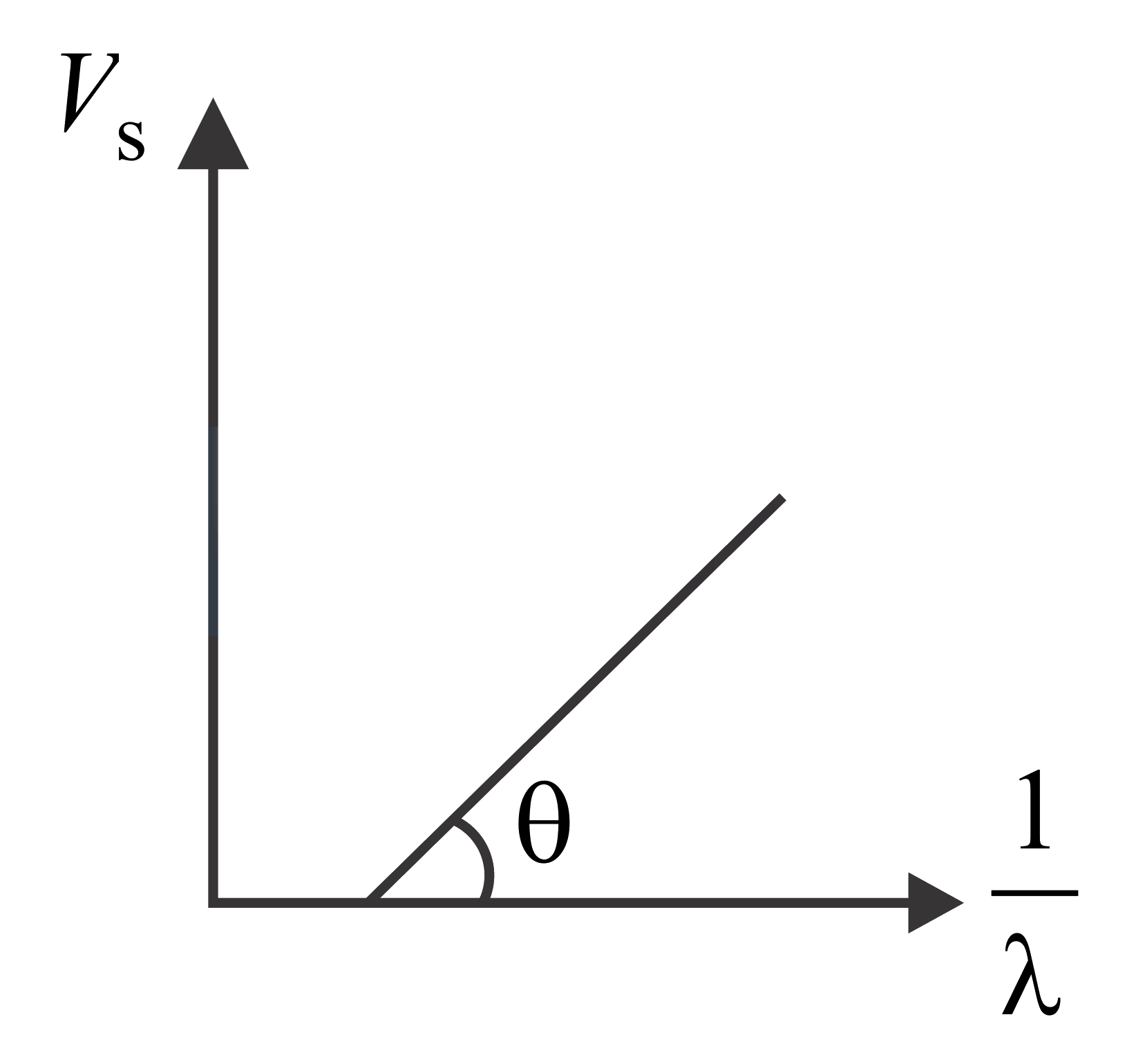 JEE Main/MCQ/Medium/Photoelectric Effect/With diagram
- 165Given figure shows few data points in a photo-electric effect experiment for a certain metal. The minimum energy for ejection of electrons from its surface is: (Planck's constant )
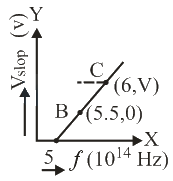 JEE Main/MCQ/Medium/Photoelectric Effect/With diagram
- 166When the wavelength of radiation falling on a metal is changed from , the maximum kinetic energy of the photoelectrons becomes three times larger. The work function of the metal is close to:JEE Main/MCQ/Medium/Photoelectric Effect
- 167When radiation of wavelength is used to illuminate a metallic surface, the stopping potential is . When the same surface is illuminated with radiation of wavelength , the stopping potential is . If the threshold wavelength for the metallic surface is then value of will be :JEE Main/Numerical/Medium/Photoelectric Effect
- 168A beam of electromagnetic radiation of intensity is comprised of wavelength, . It falls normally on a metal (work function ) of surface area of . If one in photons ejects an election, total number of electrons ejected in is . then is ___________JEE Main/Numerical/Medium/Photoelectric Effect
- 169The stopping potential (in volt) as a function of frequency for a sodium emitter, is shown in the figure. The work function of sodium, form the data plotted in the figure, will be:
(Given: Planck’s constant , electron charge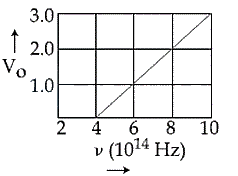 JEE Main/MCQ/Medium/Photoelectric Effect/With diagram
- 170A laser operates at a wavelength of . The number of photons that will be emitted per second is:
[Given Planck's constant speed of light ]JEE Main/MCQ/Medium/Photoelectric Effect - 171Light is incident normally on a completely absorbing surface with an energy flux of . If the surface has an area of , the momentum transferred to the surface in time duration will be:JEE Main/MCQ/Medium/Photoelectric Effect
- 172In a photoelectric effect experiment, the threshold wavelength of light is . If the wavelength of incident light is , the maximum kinetic energy of emitted electrons will be
Given (in ) JEE Main/MCQ/Medium/Photoelectric Effect - 173The electric field of light wave is given as \vec{E}={10}^{–3}\cos \left(\dfrac{2\pi x}{5\times {10}^{–7}}-2\pi \times 6\times {10}^{14}t\right)x^{^}\dfrac{N}{C} . This light falls on a metal plate of work function . The stopping potential of the photo-electrons is:
Given, (in ) JEE Main/MCQ/Medium/Photoelectric Effect - 174When a certain photosensitive surface is illuminated with a monochromatic light of frequency the stopping potential of the photo current is When the surface is illuminated by monochromatic light of frequency the stopping potential is The threshold frequency for photoelectric emission isJEE Main/MCQ/Medium/Photoelectric Effect
- 175In a photoelectric experiment, the wavelength of the light incident on a metal is changed from to . The decrease in the stopping potential is close to :
JEE Main/MCQ/Medium/Photoelectric Effect - 176A metal plate of area is illuminated by a radiation of intensity . The work function of the metal is The energy of the incident photons is and only of it produces photo electrons. The number of emitted photo electron per second and their maximum energy, respectively, will be: JEE Main/MCQ/Medium/Photoelectric Effect
- 177The magnetic field associated with a light wave is given, at the origin, by If this light falls on a silver plate having a work function of what will be the maximum kinetic energy of the photoelectrons?
JEE Main/MCQ/Medium/Photoelectric Effect - 178The surface of certain metal is first illuminated with light of wavelength and then, by a light of wavelength It is found that the maximum speed of the photoelectrons in the two cases differ by a factor of . The work function of the metal (in ) is close to
(Energy of photon )JEE Main/MCQ/Medium/Photoelectric Effect - 179A laser light of wavelength is used to weld Retina detachment. If a laser pulse of width and power is used, the approximate number of photons in the pulse are (Take Planck's Constant, JEE Main/MCQ/Medium/Photoelectric Effect
- 180The maximum velocity of the photoelectrons emitted from the surface is when light of frequency falls on a metal surface. If the incident frequency is increased to , the maximum velocity of the ejected photoelectrons will be:JEE Main/MCQ/Medium/Photoelectric Effect
- 181A photoelectric surface is illuminated successively by monochromatic light of wavelengths If the maximum kinetic energy of the emitted photoelectrons in the second case is 3 times that in the first case, the work function of the surface is :JEE Main/MCQ/Medium/Photoelectric Effect
- 182When photons of wavelength are incident on an isolated sphere, the corresponding stopping potential is found to be . When photons of wavelength are used, the corresponding stopping potential was thrice that of the above value. If light of wavelength is used then find the stopping potential for this case:JEE Main/MCQ/Medium/Photoelectric Effect
- 183Radiation of wavelength is incident on a photocell. The fastest emitted photoelectron has a speed . If the wavelength is changed to , the speed of the fastest emitted photoelectron will beJEE Main/MCQ/Medium/Photoelectric Effect
- 184A beam of light has two wavelengths of and with a total intensity of equally distributed among the two wavelengths. The beam falls normally on an area of of a clean metallic surface of work function . Assume that there is no loss of light by reflection and that each capable photon ejects one electron. The number of photoelectrons liberated in is approximately:JEE Main/MCQ/Medium/Photoelectric Effect
- 185A copper ball of radius and work function is irradiated with ultraviolet radiation of wavelength . The effect of irradiation results in the emission of electrons from the ball. Further the ball will acquire charge and due to this there will be a finite value of the potential on the ball. The charge acquired by the ball is :JEE Main/MCQ/Medium/Photoelectric Effect
- 186In an experiment on photoelectric effect, a student plots stopping potential against reciprocal of the wavelength of the incident light for two different metals and . These are shown in the figure.
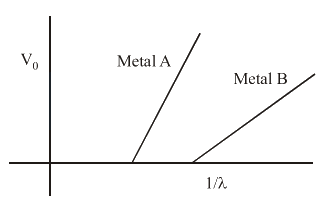
Looking at the graphs, you can most appropriately say that:JEE Main/MCQ/Medium/Photoelectric Effect/With diagram - 187The anode voltage of a photocell is kept fixed. The wavelength of the light falling on the cathode is gradually changed. The plate current of the photocell varies as follows :JEE Main/MCQ/Medium/Photoelectric Effect
- 188Photoelectrons are ejected from a metal when light of frequency falls on it. Pick out the wrong statement from the following.JEE Main/MCQ/Medium/Photoelectric Effect
- 189This question has Statement 1 and Statement 2. Of the four choices given after the Statements, choose the one that best describes the two Statements.
Statement 1: A metallic surface is irradiated by a monochromatic light of frequency (the threshold frequency). If the incident frequency is now doubled, the photocurrent and the maximum kinetic energy are also doubled.
Statement 2: The maximum kinetic energy of photoelectrons emitted from a surface is linearly dependent on the frequency of the incident light. The photocurrent depends only on the intensity of the incident light.JEE Main/MCQ/Medium/Photoelectric Effect - 190This question has Statement and Statement . Of the four choices given after the statements, choose the one that best describes the two statements.
Statement-1 : A metallic surface is irradiated by a monochromatic light of frequency (the threshold frequency). The maximum kinetic energy and the stopping potential are and respectively. If the frequency incident on the surface doubled, both the and are also doubled.
Statement-2 : The maximum kinetic energy and the stopping potential of photoelectrons emitted from a surface are linearly dependent on the frequency of incident light.JEE Main/MCQ/Medium/Photoelectric Effect - 191Statement-1 : When ultraviolet light is incident on a photocell, its stopping potential is and the maximum kinetic energy of the photoelectrons is . When the ultraviolet light is replaced by rays, both and increase.
Statement-2 : Photoelectrons are emitted with speeds ranging from zero to a maximum value because of the range of frequencies present in the incident light.
Of the four choices given after the statements, choose the one that best describes the two statements.JEE Main/MCQ/Medium/Photoelectric Effect - 192The surface of a metal is illuminated with the light of . The kinetic energy of the ejected photoelectrons was found to be . The work function of the metal is JEE Main/MCQ/Medium/Photoelectric Effect
- 193The anode voltage of a photocell is kept fixed. The wavelength of the light falling on the cathode is gradually changed. The plate current of the photocell varies as follows :JEE Main/MCQ/Medium/Photoelectric Effect
- 194The threshold frequency for a metallic surface corresponds to an energy of , and the stopping potential for a radiation incident on this surface . The incident radiation lies inJEE Main/MCQ/Medium/Photoelectric Effect
- 195A photocell is illuminated by a small bright source placed away. When the same source of light is placed away, the number of electrons emitted by photo cathode wouldJEE Main/MCQ/Medium/Photoelectric Effect
- 196The work function of a substance is . Then longest wavelength of light that can cause photoelectron emission from this substance approximatelyJEE Main/MCQ/Medium/Photoelectric Effect
- 197According to EInstein's photoelectric equation, the plot of the kinetic energy of the emitted photo electrons from a metal the frequency, of the incident radiation gives straight line whose slopeJEE Main/MCQ/Medium/Photoelectric Effect
- 198A radiation of energy falls normally on a perfectly reflecting surface. The momentum transferred to the surface isJEE Main/MCQ/Medium/Photoelectric Effect
- 199Two identical photocathodes receive light of frequencies and . If the velocities of the photo electrons (of mass ) coming out are respectively and , thenJEE Main/MCQ/Medium/Photoelectric Effect
- 200Sodium and copper have work functions and respectively. Then the ratio of the wave lengths is nearest toJEE Main/MCQ/Medium/Photoelectric Effect
NEET question paper PDF
This chapter includes NEET questions. Open a year to read the full paper, or download the PDF.
Opening paper…
JEE Main question paper PDF
This chapter includes JEE Main questions. Open a shift to read the paper, or download the PDF.
Opening paper…
Other Physics chapters
Current Electricity 380Electrostatics 311Kinematics 308Ray Optics 295Rotational Motion 280Magnetic Effects & Magnetism 276Atoms & Nuclei 239Gravitation 223Laws of Motion 210Semiconductors 209Oscillations 194Fluid Mechanics 192Wave Optics 191Alternating Current 190Thermodynamics 190Work Energy Power 183Capacitors 180Kinetic Theory 168Electromagnetic Waves 165Electromagnetic Induction 153Units & Dimensions 149Waves 142Center of Mass, Momentum & Collision 130Thermal Properties of Matter 126Mathematics in Physics 121Mechanical Properties of Solids 118Experimental Physics 70Magnetic Properties of Matter 57Modern Physics 5
Stuck on a Dual Nature of Matter question from your book?
Snap it and get a whiteboard video that solves it step by step. Your first video needs no login.