Physics · JEE Main, NEET
Electrostatics
311 practice questions with a worked solution for each. Tap an option to see instantly if you are right.
254MCQ57Numerical93With diagram
- 1An electric dipole of moment is placed in a uniform electric field . The torque acting on the dipole is maximum when the angle between and is:JEE Main/MCQ/Medium
- 2Two point charges and repel each other with force . If each is given , new force is:NEET/MCQ/Medium
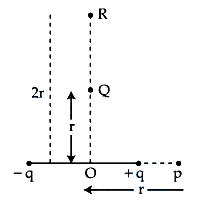
- 3Two concentric conducting spherical shells of radii and () carry charges and . Electric field in region is:JEE Main/MCQ/Medium/With diagram
- 4A parallel plate capacitor with plate separation has capacitance . A dielectric slab (, thickness ) is placed inside. The new capacitance is:JEE Main/MCQ/Medium/With diagram
- 5Two concentric spherical shells of radii and carry charges and . The electric potential at distance from center is:JEE Main/MCQ/Medium
- 6Two point charges and are placed at points and respectively. Force on charge is ________ N. JEE Main/MCQ/Medium/Electric Charge and Coulomb's law
- 7A point charge is located at a distance 2 cm from one end of a thin insulating wire of length 10 cm having a charge , distributed uniformly along its length, as shown in figure. Force between and wire is N. (Use : )
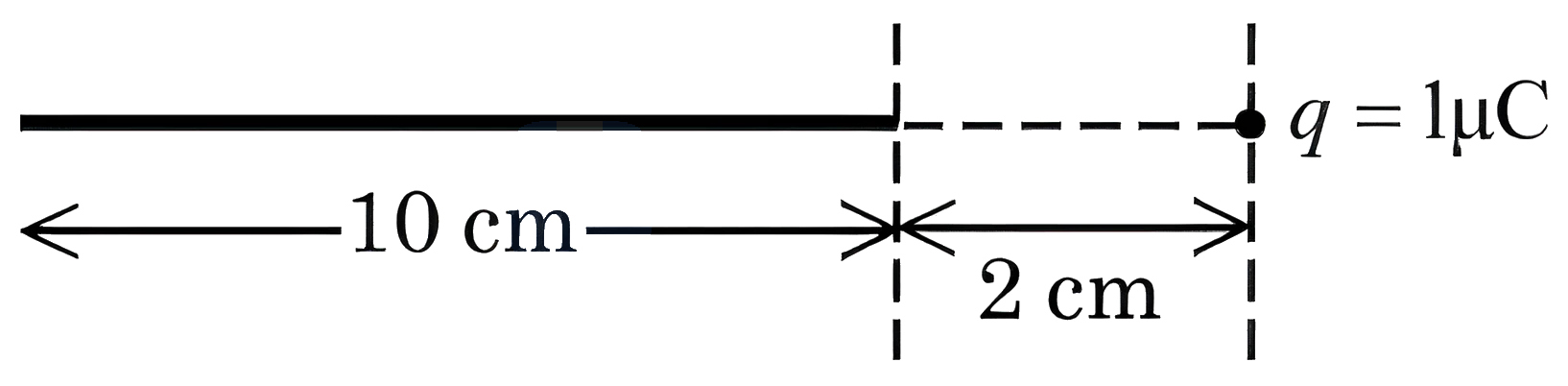 JEE Main/Numerical/Medium/Electric Charge and Coulomb's law/With diagram
- 8Two metal spheres of radius and have same surface charge density . If they are brought in contact and then separated, the surface charge density on smaller and bigger sphere becomes and , respectively. The ratio is.JEE Main/MCQ/Medium/Electric Charge and Coulomb's law
- 9A small bob of mass 100 mg and charge is connected to an insulating string of length 1 m. It is brought near to an infinitely long nonconducting sheet of charge density ' ' as shown in figure. If string subtends an angle of with the sheet at equilibrium the charge density of sheet will be :
(Given, and acceleration due to gravity, )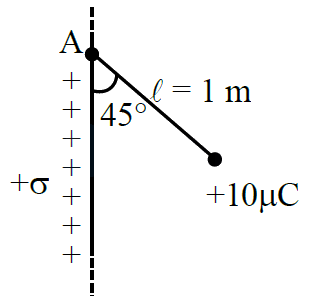 JEE Main/MCQ/Medium/Electric Charge and Coulomb's law/With diagram
- 10A small uncharged conducting sphere is placed in contact with an identical sphere but having charge and then removed to a distance such that the force of repulsion between them is . The distance between them is (Take as units)JEE Main/MCQ/Medium/Electric Charge and Coulomb's law
- 11A positive ion and a negative ion has charges and , and masses and respectively. At an instant, the ions are separated by a certain distance r. At that instant the ratio of the magnitudes of electrostatic force to gravitational force is , where the value of 10 is
(Take and universal gravitational constant as )
Assume that charge may not be an integral multiple of electrons.JEE Main/Numerical/Medium/Electric Charge and Coulomb's law - 12Two identical conducting spheres and with charge on each, repel each other with a force . A third identical uncharged conducting sphere is successively brought in contact with the two spheres. The new force of repulsion between and is :JEE Main/MCQ/Medium/Electric Charge and Coulomb's law
- 13The vehicles carrying inflammable fluids usually have metallic chains touching the ground :JEE Main/MCQ/Medium/Electric Charge and Coulomb's law
- 14Two identical charged spheres are suspended by strings of equal lengths. The strings make an angle with each other. When suspended in water the angle remains the same. If density of the material of the sphere is the dielectric constant of water will be ______.
(Take density of water )JEE Main/Numerical/Medium/Electric Charge and Coulomb's law - 15Force between two point charges and placed in vacuum at apart is . Force between them when placed in a medium having dielectric at apart will be:JEE Main/MCQ/Medium/Electric Charge and Coulomb's law
- 16Two identical charged spheres are suspended by strings of equal lengths. The string make an angle of with each other. When suspended in a liquid of density , the angle remains same. If density of material of the sphere is , the dielectric constant of the liquid is _____ JEE Main/Numerical/Medium/Electric Charge and Coulomb's law
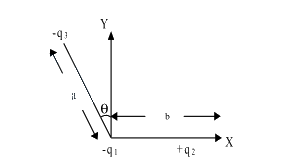
- 17Three point charges and are placed on axis at a distance and respectively from origin as shown. If and , the magnitude of net force experienced by the charge is _____ .
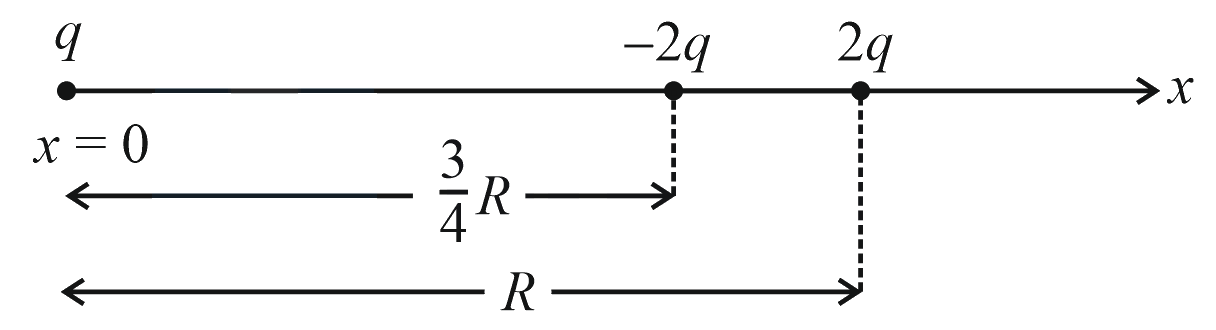 JEE Main/Numerical/Medium/Electric Charge and Coulomb's law/With diagram
- 18A charge is divided into two parts and placed at distance so that the repulsive force between them is maximum. The charges of the two parts are:JEE Main/MCQ/Medium/Electric Charge and Coulomb's law
- 19As shown in the figure, a configuration of two equal point charges is placed on an inclined plane. Mass of each point charge is . Assume that there is no friction between charge and plane. For the system of two point charges to be in equilibrium (at rest) the height . The value of is
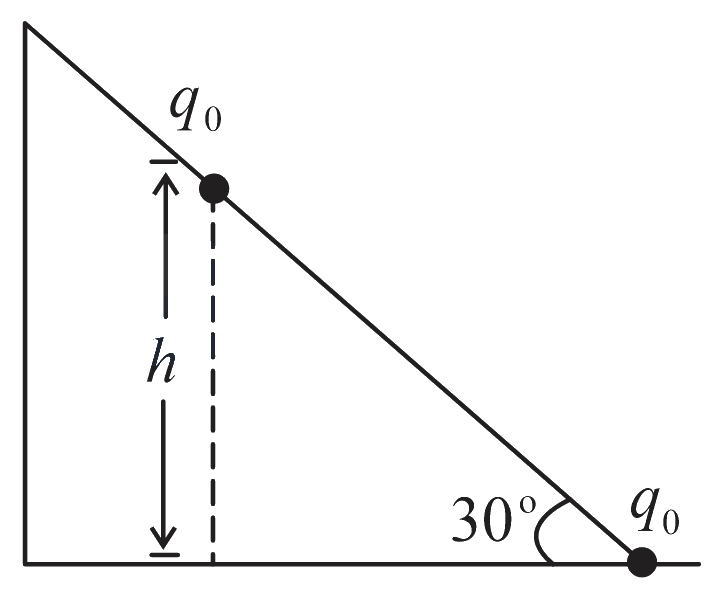 JEE Main/Numerical/Medium/Electric Charge and Coulomb's law/With diagram
- 20Experimentally it is found that energy is required to separate a hydrogen atom into a proton and an electron. So the orbital radius of the electron in a hydrogen atom is .
The value of the is: _____.
( and electronic charge )JEE Main/Numerical/Medium/Electric Charge and Coulomb's law - 21A point charge is placed at origin. Another point charge is placed at . Charge of proton is . The proton is placed on -axis so that the electrostatic force on the proton in zero. In this situation, the position of the proton from the origin is ______ .JEE Main/Numerical/Medium/Electric Charge and Coulomb's law
- 22If two charges and are separated with distance and placed in a medium of dielectric constant . What will be the equivalent distance between charges in air for the same electrostatic force?JEE Main/MCQ/Medium/Electric Charge and Coulomb's law
- 23Two identical metallic spheres and when placed at certain distance in air repel each other with a force of . Another identical uncharged sphere is first placed in contact with and then in contact with and finally placed at midpoint between spheres and . The force experienced by sphere will be :JEE Main/MCQ/Medium/Electric Charge and Coulomb's law
- 24A charge of is to be divided into two. The distance between the two divided charges is constant. The magnitude of the divided charges so that the force between them is maximum, will be:JEE Main/MCQ/Medium/Electric Charge and Coulomb's law
- 25Two identical positive charges each are fixed at a distance of apart from each other. Another point charge with mass is placed at midpoint between two fixed charges. For a small displacement along the line joining the fixed charges, the charge executes SHM. The time period of oscillation of charge will beJEE Main/MCQ/Medium/Electric Charge and Coulomb's law
- 26Three point charges of magnitude and are located at the vertices of a right angled triangle whose sides are , and and point is the right angle corner. Charge at point experiences _____ of electrostatic force due to the other two charges.JEE Main/Numerical/Medium/Electric Charge and Coulomb's law
- 27Two point charges each are placed at a distance apart. A third point charge is placed at a distance from mid-point on the perpendicular bisector. The value of at which charge will experience the maximum Coulomb's force is:JEE Main/MCQ/Medium/Electric Charge and Coulomb's law
- 28Three identical charged balls each of charge are suspended from a common point by silk threads of each (as shown in figure). They form an equilateral triangle of side .
The ratio of net force on a charged ball to the force between any two charged balls will be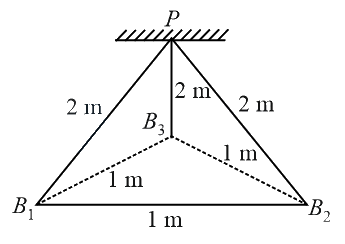 JEE Main/MCQ/Medium/Electric Charge and Coulomb's law/With diagram
- 29Sixty four conducting drops each of radius and each carrying a charge of are combined to form a bigger drop. The ratio of surface density of bigger drop to the smaller drop will beJEE Main/MCQ/Medium/Electric Charge and Coulomb's law
- 30Two identical charged particles each having a mass and charge are placed on a horizontal table with a separation of between them such that they stay in limited equilibrium. If the coefficient of friction between each particle and the table is , find the value of . [Use ]JEE Main/MCQ/Medium/Electric Charge and Coulomb's law
- 31The relative permittivity of distilled water is The velocity of light in it will be: Given JEE Main/MCQ/Medium/Electric Charge and Coulomb's law
- 32A particle of mass and charge is lying at the mid-point of two stationary particles kept at a distance when each is carrying same charge . If the free charged particle is displaced from its equilibrium position through distance . The particle executes SHM. Its angular frequency of oscillation will be _______ (if )JEE Main/Numerical/Medium/Electric Charge and Coulomb's law
- 33A certain charge is divided into two parts and How should the charges and be divided so that and placed at a certain distance apart experience maximum electrostatic repulsion?JEE Main/MCQ/Medium/Electric Charge and Coulomb's law
- 34An infinite number of point charges, each carrying charge, are placed along the y-axis at
The total force on a point charge, placed at the origin, is . The value of , to the nearest integer, is ___ .
[Take ]JEE Main/Numerical/Medium/Electric Charge and Coulomb's law - 35Two identical conducting spheres with negligible volume have and charges, respectively. They are brought into contact and then separated by a distance of . The electrostatic force acting between the spheres is ___.
[Given : SI unit]JEE Main/Numerical/Medium/Electric Charge and Coulomb's law - 36Two electrons each are fixed at a distance A third charge proton placed at the midpoint is displaced slightly by a distance perpendicular to the line joining the two fixed charges. Proton will execute simple harmonic motion having angular frequency:
( mass of charged particle)JEE Main/MCQ/Medium/Electric Charge and Coulomb's law - 37Consider the force on a charge '' due to a uniformly charged spherical shell of radius carrying charge distributed uniformly over it. Which one of the following statements is true for , if '' is placed at distance from the centre of the shell?JEE Main/MCQ/Medium/Electric Charge and Coulomb's law
- 38A solid sphere of radius carries a charge distributed uniformly over its volume. A very small point like piece of it of mass gets detached from the bottom of the sphere and falls down vertically under gravity. This piece carries charge . If it acquires a speed when it has fallen through a vertical height (see figure), then (assume the remaining portion to be spherical)
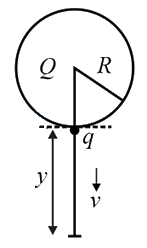 JEE Main/MCQ/Medium/Electric Charge and Coulomb's law/With diagram
- 39Two isolated conducting spheres and of radius and have and charges, respectively, and are at a large distance from each other, They are now connected by a conducting wire. A long time after this is done the charges on and are respectively:JEE Main/MCQ/Medium/Electric Charge and Coulomb's law
- 40A charge Q is distributed over two concentric conducting thin spherical shells radii and . If the surface charge densities on the two shells are equal, the electric potential at the common centre is :
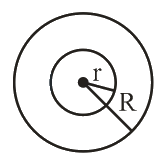 JEE Main/MCQ/Medium/Electric Charge and Coulomb's law/With diagram
- 41Charge is distributed within a sphere of radius with a volume charge density where and are constants. If is the total charge of this charge distribution, the radius is:JEE Main/MCQ/Medium/Electric Charge and Coulomb's law
- 42Three charges are placed respectively, at distance, and from the origin, on the -axis. If the net force experienced by placed at is zero, then value of is:JEE Main/MCQ/Medium/Electric Charge and Coulomb's law
- 43Two identical conducting spheres and carry an equal charges. They are separated by a distance much larger than their diameters, and the force between them is . A third identical conducting sphere, , is uncharged. Sphere is first touched to , then to , and then removed. As a result, the force between and would be equal to:JEE Main/MCQ/Medium/Electric Charge and Coulomb's law
- 44A copper rod of cross-sectional area A carries a uniform current I through it. At temperature T, if the volume charge density of the rod is , how long will the charges take to travel a distance ?JEE Main/MCQ/Medium/Electric Charge and Coulomb's law
- 45A liquid drop having 6 excess electrons is kept stationary under a uniform electric field of . The density of liquid is . The radius of the drop is (neglect buoyancy).JEE Main/MCQ/Medium/Electric Charge and Coulomb's law
- 46Consider a finite insulated, uncharged conductor placed near a finite positively charged conductor. The uncharged body must have a potential :JEE Main/MCQ/Medium/Electric Charge and Coulomb's law
- 47Two identical charged spheres suspended from a common point by two massless strings of length I are initially a distance apart because of their mutual repulsion. The charge begins to leak from both the spheres at a constant rate. As a result the charges approach each other with a velocity . Then as a function of distance between them,JEE Main/MCQ/Medium/Electric Charge and Coulomb's law
- 48Two identical charged spheres are suspended by strings of equal lengths. The strings make an angle of with each other. When suspended in a liquid of density , the angle remains the same. If density of the material of the sphere is , the dielectric constant of the liquid isJEE Main/MCQ/Medium/Electric Charge and Coulomb's law
- 49If and are the accelerations due to gravity on the surfaces of the earth and the moon respectively and if Millikan's oil drop experiment could be performed on the two surfaces, one will find the ratio to beJEE Main/MCQ/Medium/Electric Charge and Coulomb's law
- 50Charges are placed on the vertices of a square as shown. Let be the electric field and the potential at the centre. If the charges on and are interchanged with those on and respectively, then
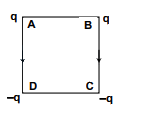 JEE Main/MCQ/Medium/Electric Charge and Coulomb's law/With diagram
- 51Two point charges and are located at and respectively. The location of a point on the axis at which the net electric field due to these two point charges is zero isJEE Main/MCQ/Medium/Electric Charge and Coulomb's law
- 52Two spherical conductor and having equal radii and carrying equal charges in them repel each other with a force when kept apart at some distance. A third spherical conductor having same radius as that of but uncharged brought in contact with , then brought in contact with and finally removed away from both. The new force of repulsion, between and isJEE Main/MCQ/Medium/Electric Charge and Coulomb's law
- 53A thin half ring of radius cm is uniformly charged with a total charge of coulomb. If the magnitude of the electric field at centre of the half ring is V/m, then the value of is _______ nC. ( C/Nm and )JEE Main/MCQ/Medium/Electric Field and Electric Field Lines
- 54A particle of charge and mass is projected from origin with an initial velocity . There exists a uniform magnetic field and a space varying electric field within the region . After travelling a distance such that -coordinate has changed from to , the change in the kinetic energy is _______.JEE Main/MCQ/Medium/Electric Field and Electric Field Lines
- 55Given below are two statements: one is labelled as Assertion A and the other is labelled as Reason R
Assertion A: In electrostatics, a conductor does not store any net charge inside.
Reason R: Inside the capacitor (with no dielectric medium), the free charge carriers, if placed between the plates of capacitor, experience force and drift.
Choose the correct answer from the options given belowJEE Main/MCQ/Medium/Electric Field and Electric Field Lines - 56Two metal plates are kept horizontally with separation of cm, with plate A on the top. An atomizer jet sprays oil (density g/cm) droplets of radius mm horizontally. All oil droplets carry a charge nC. The potentials and are required on plates A and B respectively in order to ensure the droplets do not descend. The values of and are _______.
(Neglect the air resistance to the droplets and take m/s)JEE Main/MCQ/Medium/Electric Field and Electric Field Lines - 57Identify the correct statements :
A. Electrostatic field lines form closed loops.
B. The electric field lines point radially outward when charge is greater than zero.
C. The Gauss - Law is valid only for inverse - square force.
D. The workdone in moving a charged particle in a static electric field around a closed path is zero.
E. The motion of a particle under Coulomb's force must take place in a plane.
Choose the correct answer from the options given below :JEE Main/MCQ/Medium/Electric Field and Electric Field Lines - 58A simple pendulum has a bob with mass and charge . The pendulum string has negligible mass. When a uniform and horizontal electric field is applied, the tension in the string changes. The final tension in the string, when pendulum attains an equilibrium position is . (g: acceleration due to gravity)JEE Main/MCQ/Medium/Electric Field and Electric Field Lines
- 59Six point charges are kept apart from each other on the circumference of a circle of radius as shown in figure. The net electric field at the center of the circle is . ( is permittivity of free space)
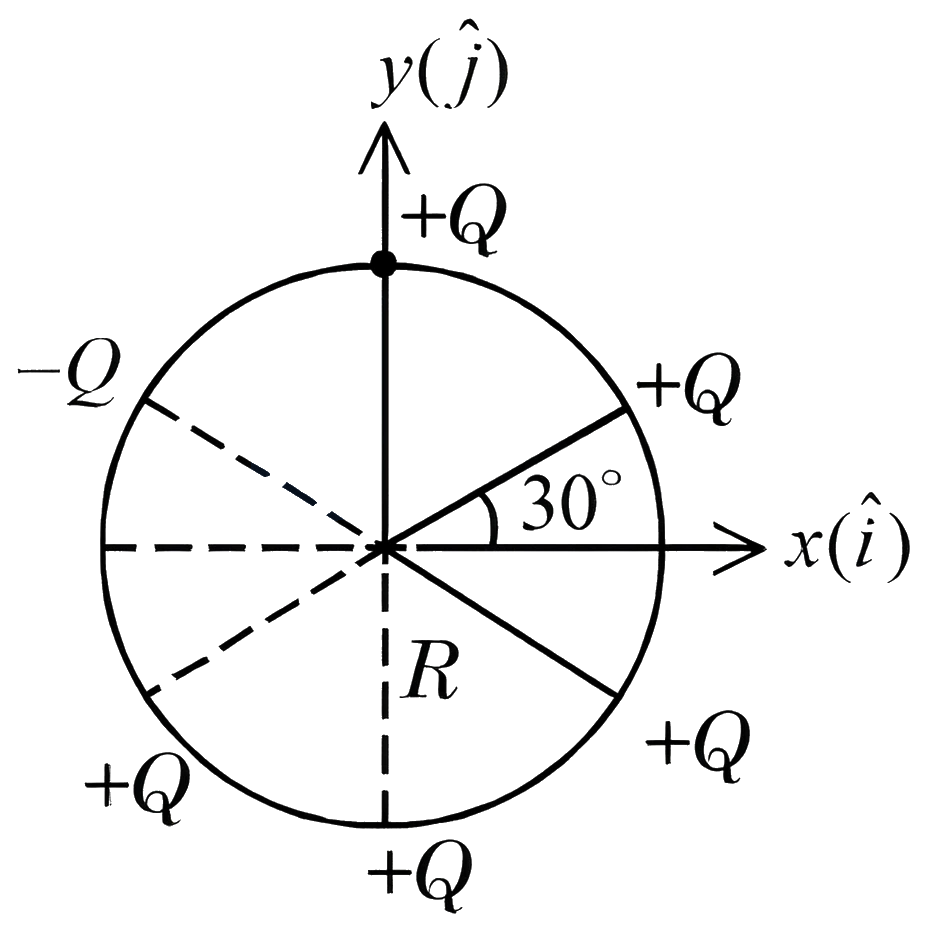 JEE Main/MCQ/Medium/Electric Field and Electric Field Lines/With diagram
- 60An electron is released from rest near an infinite non-conducting sheet of uniform charge density ' '. The rate of change of de-Broglie wave length associated with the electron varies inversely as power of time. The numerical value of is ________.JEE Main/Numerical/Medium/Electric Field and Electric Field Lines
- 61Electric charge is transferred to an irregular metallic disk as shown in figure. If and are charge densities at given points then, choose the correct answer from the options given below:
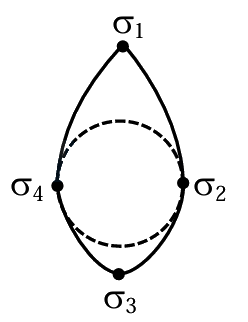
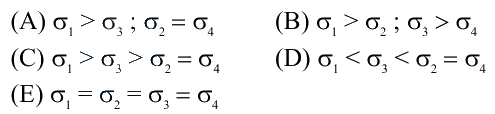 JEE Main/MCQ/Medium/Electric Field and Electric Field Lines/With diagram
- 62Given below are two statements: one is labelled as Assertion (A) and the other is labelled as Reason (R).
Assertion (A) : The outer body of an air craft is made of metal which protects persons sitting inside from lightning-strikes.
Reason (R) : The electric field inside the cavity enclosed by a conductor is zero.
In the light of the above statements, chose the most appropriate answer from the options given below :JEE Main/MCQ/Medium/Electric Field and Electric Field Lines - 63Two infinite identical charged sheets and a charged spherical body of charge density ' ' are arranged as shown in figure. Then the correct relation between the electrical fields at and D points is :
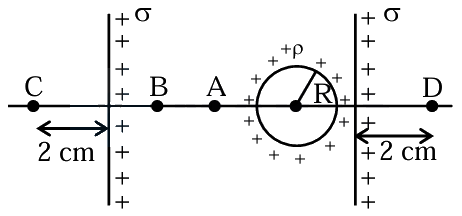 JEE Main/MCQ/Medium/Electric Field and Electric Field Lines/With diagram
- 64Consider two infinitely large plane parallel conducting plates as shown below. The plates are uniformly charged with a surface charge density and . The force experienced by a point charge +q placed at the mid point between two plates will be :
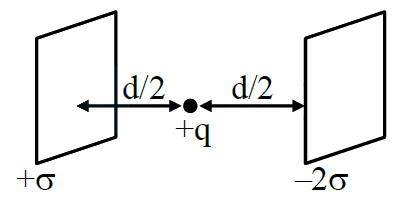 JEE Main/MCQ/Medium/Electric Field and Electric Field Lines/With diagram
- 65A point charge +q is placed at the origin. A second point charge +9 q is placed at in Cartesian coordinate system. The point in between them where the electric field vanishes is :JEE Main/MCQ/Medium/Electric Field and Electric Field Lines
- 66A particle of mass ' ' and charge ' ' is fastened to one end ' ' of a massless string having equilibrium length , whose other end is fixed at point ' '. The whole system is placed on a frictionless horizontal plane and is initially at rest. If uniform electric field is switched on along the direction as shown in figure, then the speed of the particle when it crosses the x -axis is
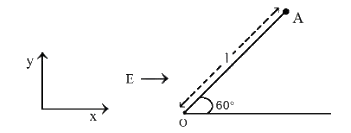 JEE Main/MCQ/Medium/Electric Field and Electric Field Lines/With diagram
- 67An electron is made to enter symmetrically between two parallel and equally but oppositely charged metal plates, each of 10 cm length. The electron emerges out of the electric field region with a horizontal component of velocity . If the magnitude of the electric field between the plates is , then the vertical component of velocity of electron is (mass of electron and charge of electron )JEE Main/MCQ/Medium/Electric Field and Electric Field Lines
- 68If the net electric field at point along axis is zero, then the ratio of is , where _____.
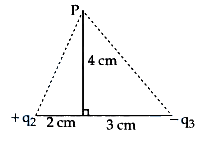 JEE Main/Numerical/Medium/Electric Field and Electric Field Lines/With diagram
- 69Three infinitely long charged thin sheets are placed as shown in figure. The magnitude of electric field at the point is . The value of is _______ (all quantities are measured in SI units).
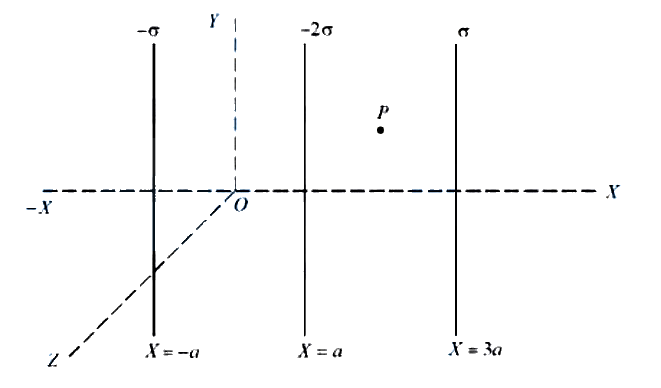 JEE Main/Numerical/Medium/Electric Field and Electric Field Lines/With diagram
- 70An infinite plane sheet of charge having uniform surface charge density is placed on plane. Another infinitely long line charge having uniform linear charge density is placed at plane and parallel to -axis. If the magnitude values then at point , the ratio of magnitudes of electric field values due to sheet charge to that of line charge is . The value of is_______.JEE Main/Numerical/Medium/Electric Field and Electric Field Lines
- 71An infinitely long positively charged straight thread has a linear charge density . An electron revolves along a circular path having axis along the length of the wire. The graph that correctly represents the variation of the kinetic energy of electron as a function of radius of circular path from the wire is :JEE Main/MCQ/Medium/Electric Field and Electric Field Lines
- 72Suppose a uniformly charged wall provides a uniform electric field of normally. A charged particle of mass being suspended through a silk thread of length and remain stayed at a distance of from the wall. Then the charge on the particle will be where ________ [use ]JEE Main/Numerical/Medium/Electric Field and Electric Field Lines
- 73Two charges and are separated by a distance ‘’ in air. At a distance from charge , the resultant electric field is zero. The value of is :JEE Main/MCQ/Medium/Electric Field and Electric Field Lines
- 74A particle of charge and mass moves in a circle of radius around an infinitely long line charge of linear density . Then time period will be given as:
(Consider as Coulomb's constant)JEE Main/MCQ/Medium/Electric Field and Electric Field Lines - 75An electron is moving under the influence of the electric field of a uniformly charged infinite plane sheet having surface charge density . The electron at is at a distance of from and has a speed of . The maximum value of , if the electron strikes at is . The value of is _____.JEE Main/Numerical/Medium/Electric Field and Electric Field Lines
- 76Given below are two statements : one is labelled as Assertion (A) and the other is labelled as Reason(R)
Assertion (A) : Work done by electric field on moving a positive charge on an equipotential surface is always zero.
Reason (R) : Electric lines of forces are always perpendicular to equipotential surfaces.
In the light of the above statements, choose the most appropriate answer from the options given below :JEE Main/MCQ/Medium/Electric Field and Electric Field Lines - 77A thin metallic wire having cross sectional area of is used to make a ring of radius . A positive charge of is uniformly distributed over the ring, while another positive charge of is kept at the centre of the ring. The tension in the ring is _______N; provided that the ring does not get deformed (neglect the influence of gravity).
(Given, SI units)JEE Main/Numerical/Medium/Electric Field and Electric Field Lines - 78A thin infinite sheet charge and an infinite line charge of respective charge densities and are placed parallel at distance from each other. Points and are at and perpendicular distances from line charge towards sheet charge, respectively. and are the magnitudes of resultant electric field intensities at point and respectively. If for then the value of is _____.JEE Main/Numerical/Medium/Electric Field and Electric Field Lines
- 79An electron revolves around an infinite cylindrical wire having uniform linear charge density in circular path under the influence of attractive electrostatic field as shown in the figure. The velocity of electron with which it is revolving is ______________ . Given mass of electron
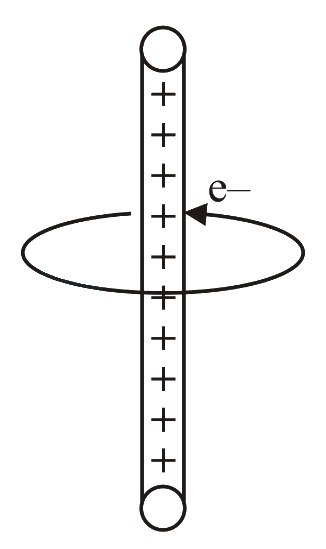 JEE Main/Numerical/Medium/Electric Field and Electric Field Lines/With diagram
- 80Graphical variation of electric field due to a uniformly charged insulating solid sphere of radius with distance from the centre is represented by:
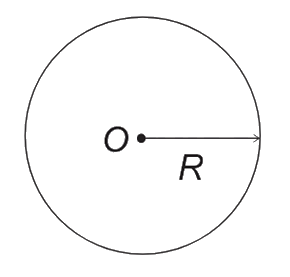 JEE Main/MCQ/Medium/Electric Field and Electric Field Lines/With diagram
- 81A cubical volume is bounded by the surfaces . The electric field in the region is given by . Where . If , the charge contained in the cubical volume is . The value of is ______.
(Take )JEE Main/Numerical/Medium/Electric Field and Electric Field Lines - 82Two equal positive point charges are separated by a distance . The distance of a point from the centre of the line joining two charges on the equatorial line (perpendicular bisector) at which force experienced by a test charge becomes maximum is . The value of is ______.JEE Main/Numerical/Medium/Electric Field and Electric Field Lines
- 83Considering a group of positive charges, which of the following statements is correct?JEE Main/MCQ/Medium/Electric Field and Electric Field Lines
- 84As shown in the figure, a point charge is placed at the centre of conducting spherical shell of inner radius and outer radius . The electric field due to charge in three different regions is given by :
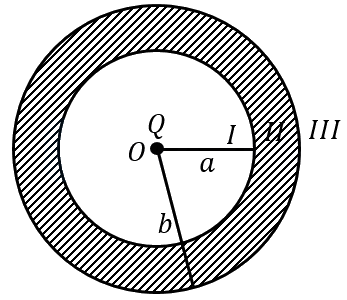 JEE Main/MCQ/Medium/Electric Field and Electric Field Lines/With diagram
- 85A point charge of is placed at the origin. At what location on the -axis should a point charge of be placed so that the net electric field is zero at on the -axis ?JEE Main/MCQ/Medium/Electric Field and Electric Field Lines
- 86A uniform electric field of is created between two parallel charged plates (as shown in figure). An electron enters the field symmetrically between the plates with a kinetic energy The length of each plate is . The angle of deviation of the path of electron as it comes out of the field is ______(in degree).
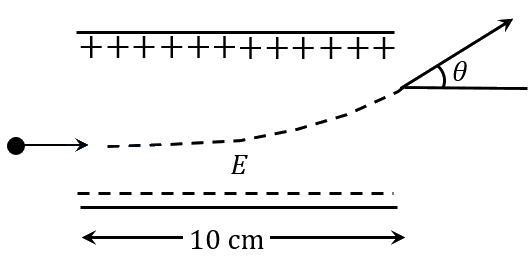 JEE Main/Numerical/Medium/Electric Field and Electric Field Lines/With diagram
- 87A stream of a positively charged particles having and velocity is deflected by an electric field . The electric field exists in a region of along direction. Due to the electric field, the deflection of the charge particles in the direction is _____ .JEE Main/Numerical/Medium/Electric Field and Electric Field Lines
- 88A spherically symmetric charge distribution is considered with charge density varying as
Where, is the distance from the centre (as shown in figure). The electric field at point will be :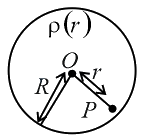 JEE Main/MCQ/Medium/Electric Field and Electric Field Lines/With diagram
- 89A uniform electric field is created between two parallel plates of length as shown in figure, (where mass of electron and charge of electron). An electron enters the field symmetrically between the plates with a speed of . The angle of the deviation of the path of the electron as it comes out of the field will be _____ .
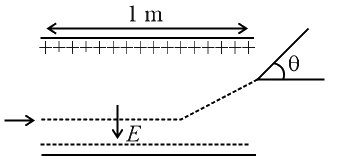 JEE Main/MCQ/Medium/Electric Field and Electric Field Lines/With diagram
- 90A long copper wire carries a current of . If the cross section of the wire is and the resistivity of copper is . The force experienced by moving electron in the wire is _____
(Charge of electron )JEE Main/Numerical/Medium/Electric Field and Electric Field Lines - 91A positive charge particle of is thrown in opposite direction to a uniform electric field of strength . If the charge on the particle is and the initial velocity is , how much distance it will travel before coming to the rest momentarilyJEE Main/MCQ/Medium/Electric Field and Electric Field Lines
- 92Two point charges and of magnitude and respectively are placed at a distance apart. The electric field at the middle point between the charges is . The distance '' between the point charges and isJEE Main/MCQ/Medium/Electric Field and Electric Field Lines
- 93The three charges and are placed at the corners and of a square of side as shown in figure. The magnitude of electric field at the corner of the square, is
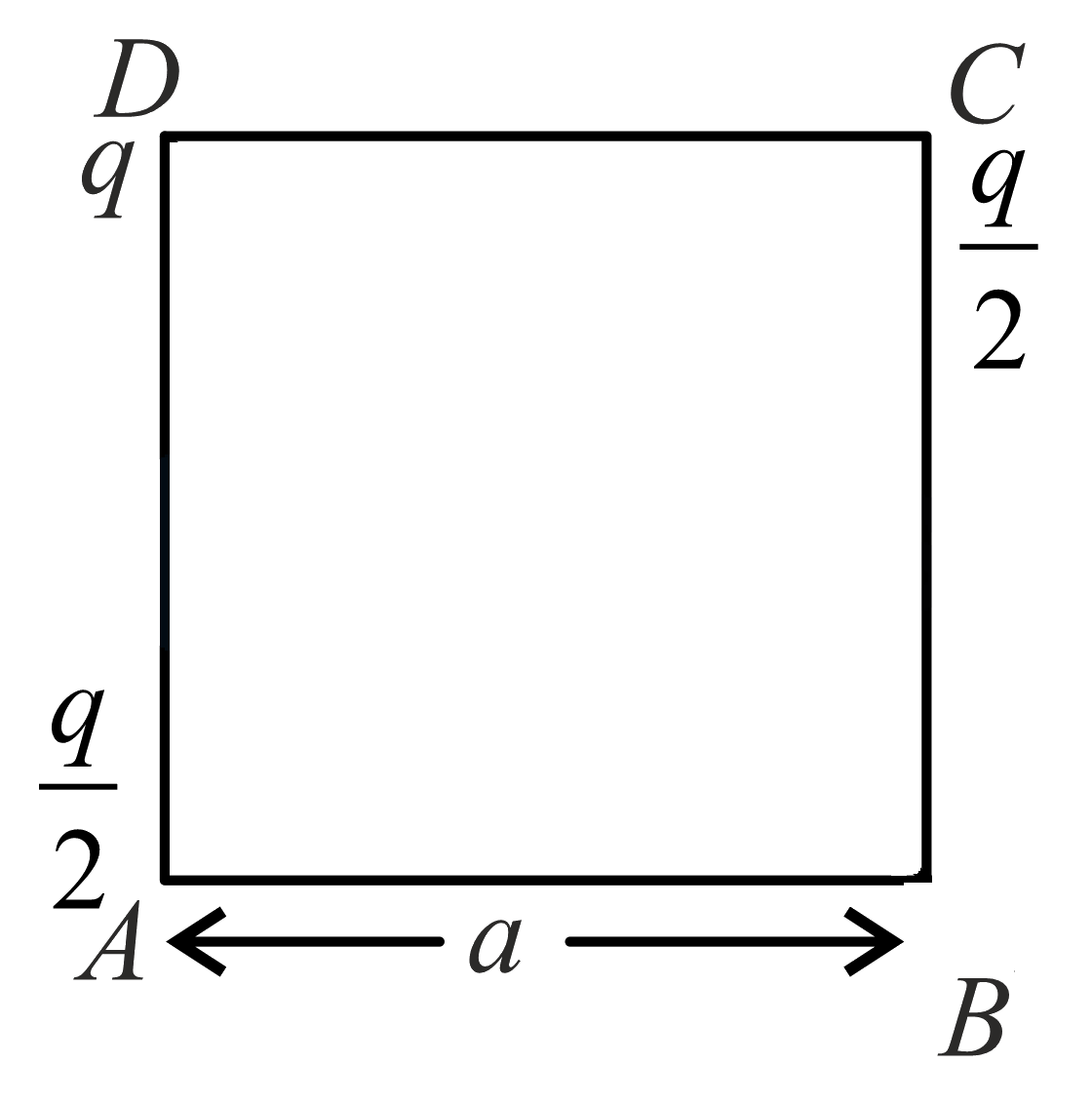 JEE Main/MCQ/Medium/Electric Field and Electric Field Lines/With diagram
- 94Statement-I : A point charge is brought in an electric field. The value of electric field at a point near to the charge may increase if the charge is positive.
Statement-II : An electric dipole is placed in a uniform electric field. The net electric force on the dipole will not be zero.JEE Main/MCQ/Medium/Electric Field and Electric Field Lines - 95In the figure, a very large plane sheet of positive charge is shown. and are two points at distance and from the charge distribution. If is the surface charge density, then the magnitude of electric fields and at and respectively are
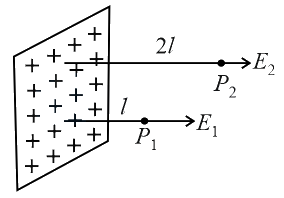 JEE Main/MCQ/Medium/Electric Field and Electric Field Lines/With diagram
- 96A long cylindrical volume contains a uniformly distributed charge of density . The radius of cylindrical volume is . A charge particle revolves around the cylinder in a circular path. The kinetic energy of the particle is :JEE Main/MCQ/Medium/Electric Field and Electric Field Lines
- 97A vertical electric field of magnitude just prevents a water droplet of a mass from falling. The value of charge on the droplet will be : (Given )JEE Main/MCQ/Medium/Electric Field and Electric Field Lines
- 98Choose the incorrect statement:
(a) The electric lines of force entering into a Gaussian surface provide negative flux.
(b) A charge is placed at the centre of a cube. The flux through all the faces will be the same.
(c) In a uniform electric field net flux through a closed Gaussian surface containing no net charge, is zero.
(d) When an electric field is parallel to a Gaussian surface, it provides a finite non-zero flux.
Choose the most appropriate answer from the options given below:JEE Main/MCQ/Medium/Electric Field and Electric Field Lines - 99Two particles and having charges and respectively are held fixed with a separation of At what position a third charged particle should be placed so that it does not experience a net electric force ?
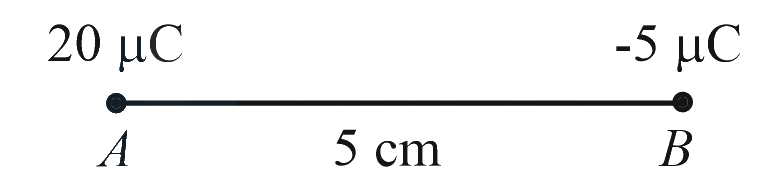 JEE Main/MCQ/Medium/Electric Field and Electric Field Lines/With diagram
- 100Figure shows a rod , which is bent in a circular arc of radius . A charge is uniformly distributed over rod . What is the electric filed at the centre of curvature ?
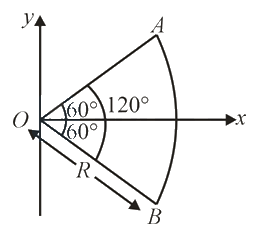 JEE Main/MCQ/Medium/Electric Field and Electric Field Lines/With diagram
- 101A uniformly charged disc of radius having surface charge density is placed in the plane with its center at the origin. Find the electric field intensity along the -axis at a distance from origin:JEE Main/MCQ/Medium/Electric Field and Electric Field Lines
- 102What will be the magnitude of the electric field at point as shown in the figure? Each side of the figure is and perpendicular to the other?
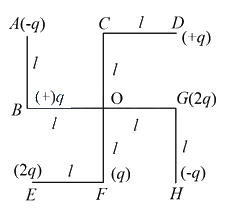 JEE Main/MCQ/Medium/Electric Field and Electric Field Lines/With diagram
- 103A simple pendulum of mass ' ', length ' ' and charge suspended in the electric field produced by two conducting parallel plates as shown. The value of deflection of pendulum in equilibrium position will be
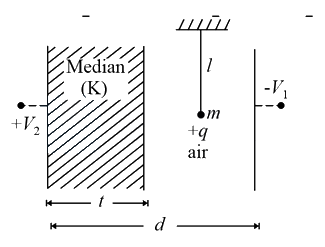 JEE Main/MCQ/Medium/Electric Field and Electric Field Lines/With diagram
- 104Given below are two statements
Statement : An electric dipole is placed at the centre of a hollow sphere. The flux of electric field through the sphere is zero, but the electric field is not zero anywhere in the sphere.
Statement : If is the radius of a solid metallic sphere and be the total charge on it. The electric field at any point on the spherical surface of radius is zero but the electric flux passing through this closed spherical surface of radius is not
In the light of the above statements, choose the correct answer from the options given below:JEE Main/MCQ/Medium/Electric Field and Electric Field Lines - 105Find the electric field at point (as shown in figure) on the perpendicular bisector of a uniformly charged thin wire of length carrying a charge . The distance of the point from the centre of the rod is
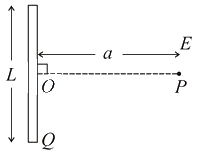 JEE Main/MCQ/Medium/Electric Field and Electric Field Lines/With diagram
- 106Two small spheres each of mass are suspended from a point by threads long. They are equally charged and repel each other to a distance of . The charge on each of the sphere is The value of will be ___.[Given ]JEE Main/Numerical/Medium/Electric Field and Electric Field Lines
- 107The peak electric field produced by the radiation coming from the bulb at a distance of is . The efficiency of the bulb is and it is a point source. The value of is,JEE Main/Numerical/Medium/Electric Field and Electric Field Lines
- 108A cube of side has point charges located at each of its vertices except at the origin where the charge is The electric field at the centre of cube is:
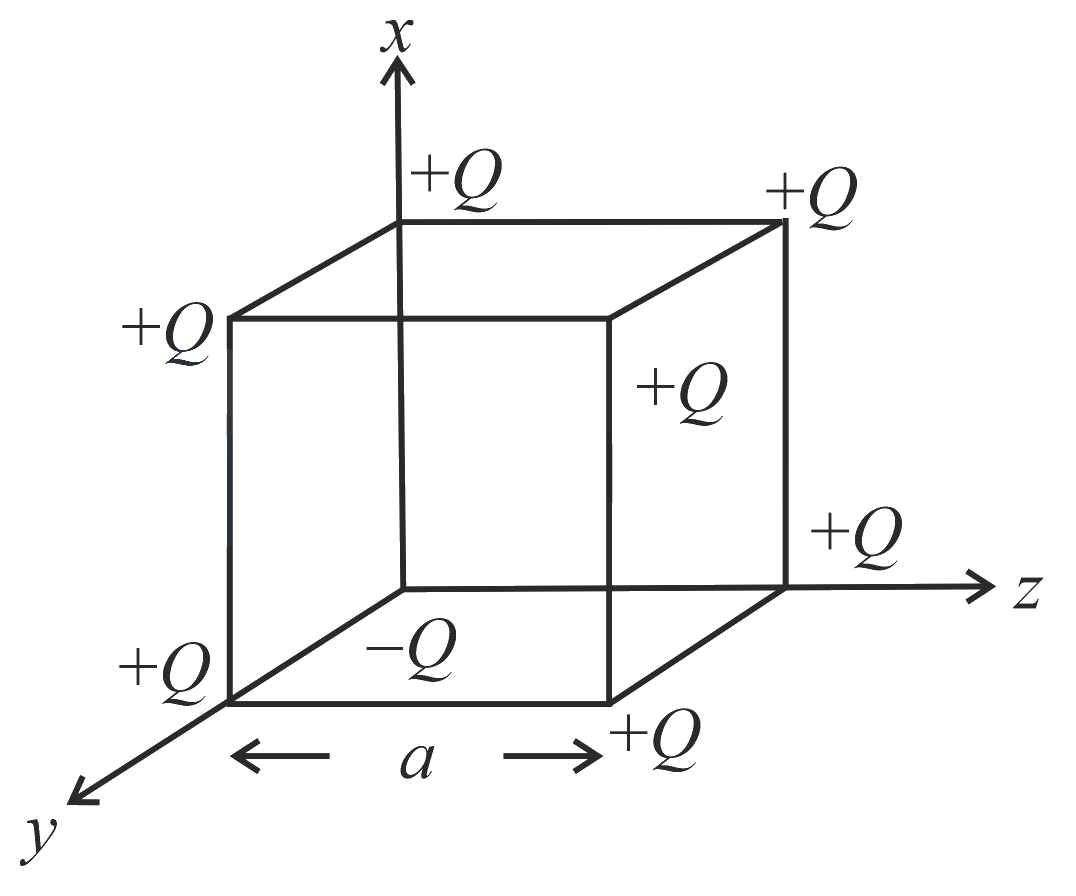 JEE Main/MCQ/Medium/Electric Field and Electric Field Lines/With diagram
- 109Charges and are at points and of a right-angled triangle . The resultant electric field at point is perpendicular to the hypotenuse, then is proportional to:
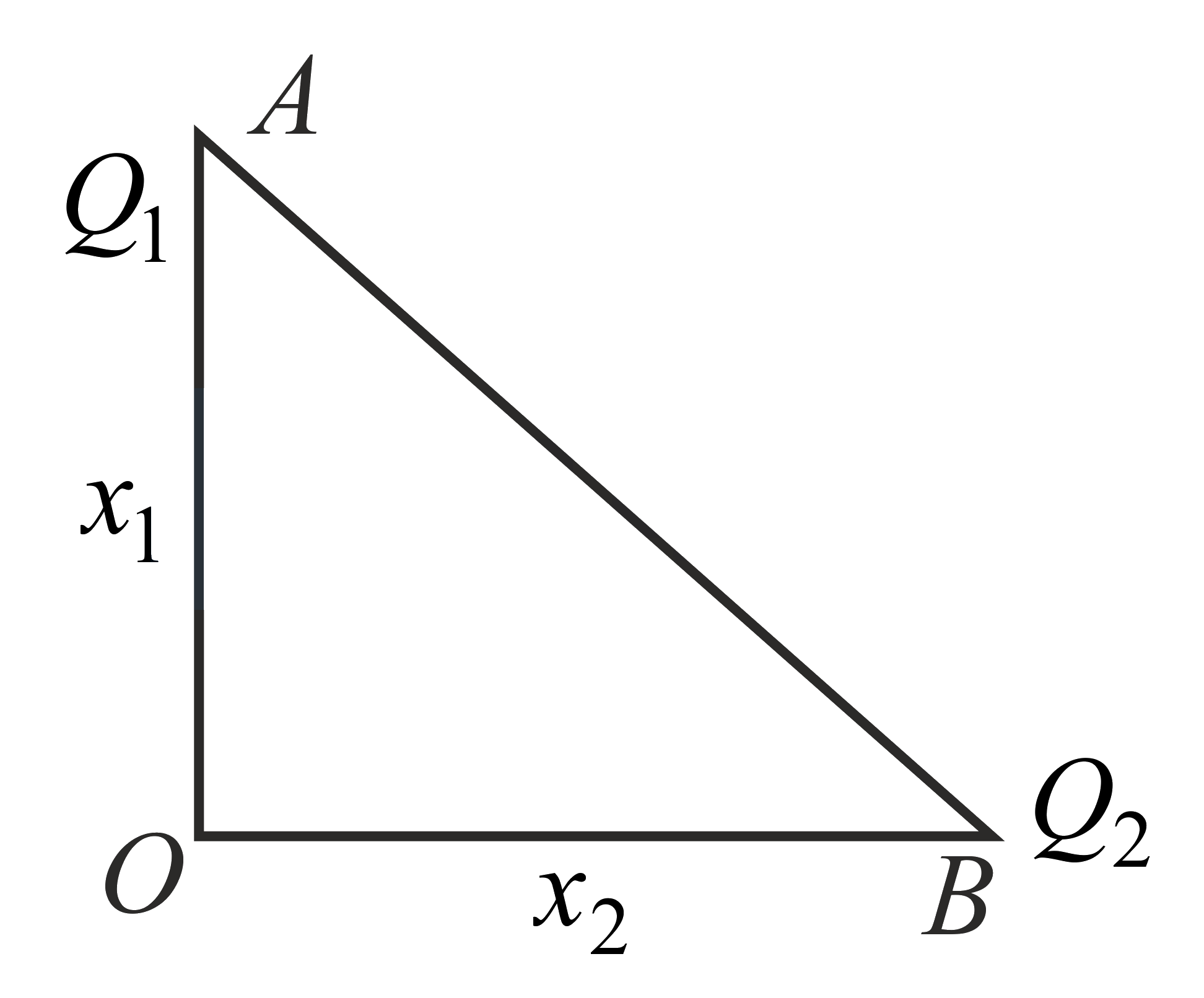 JEE Main/MCQ/Medium/Electric Field and Electric Field Lines/With diagram
- 110Two charged thin infinite plane sheets of uniform charge density and , where , intersect at the right angle. Which of the following best represents the electric field lines for the system:JEE Main/MCQ/Medium/Electric Field and Electric Field Lines
- 111Consider a sphere of radius which carries a uniform charge density . If a sphere of radius is carved out of it, as shown, the ratio of magnitude of electric field and , respectively, at points and due to the remaining portion is:
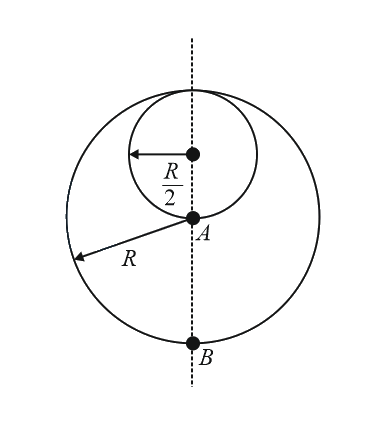 JEE Main/MCQ/Medium/Electric Field and Electric Field Lines/With diagram
- 112Three charged particles and with charges and are present on the circumference of a circle of radius The charged particles and centre of the circle formed an equilateral triangle as shown in the figure. The electric field at the point is
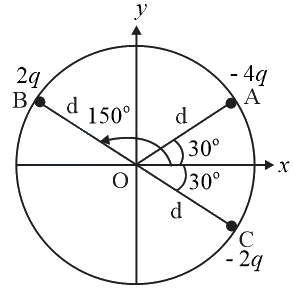 JEE Main/MCQ/Medium/Electric Field and Electric Field Lines/With diagram
- 113A particle of mass and charge has an initial velocity . If an electric field and magnetic field act on the particle, its speed will double after a timeJEE Main/MCQ/Medium/Electric Field and Electric Field Lines
- 114Two infinite planes each with uniform surface charge density are kept in such a way that the angle between them is . The electric field in the region shown between them is given by:
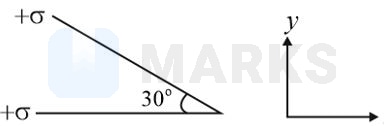 JEE Main/MCQ/Medium/Electric Field and Electric Field Lines/With diagram
- 115A simple pendulum of length is placed between the plates of a parallel plate capacitor having electric field , as shown in figure. Its bob has mass and charge . The time period of the pendulum is given by:
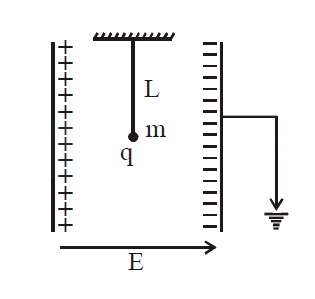 JEE Main/MCQ/Medium/Electric Field and Electric Field Lines/With diagram
- 116Four point charges and are placed on y-axis at and respectively. The magnitude of the electric field at a point on the x-axis at with will behave as:JEE Main/MCQ/Medium/Electric Field and Electric Field Lines
- 117A positive point charge is released from rest at a distance from a positive line charge with uniform charge density. The speed of the point charge, as a function of instantaneous distance from line charge, is proportional to
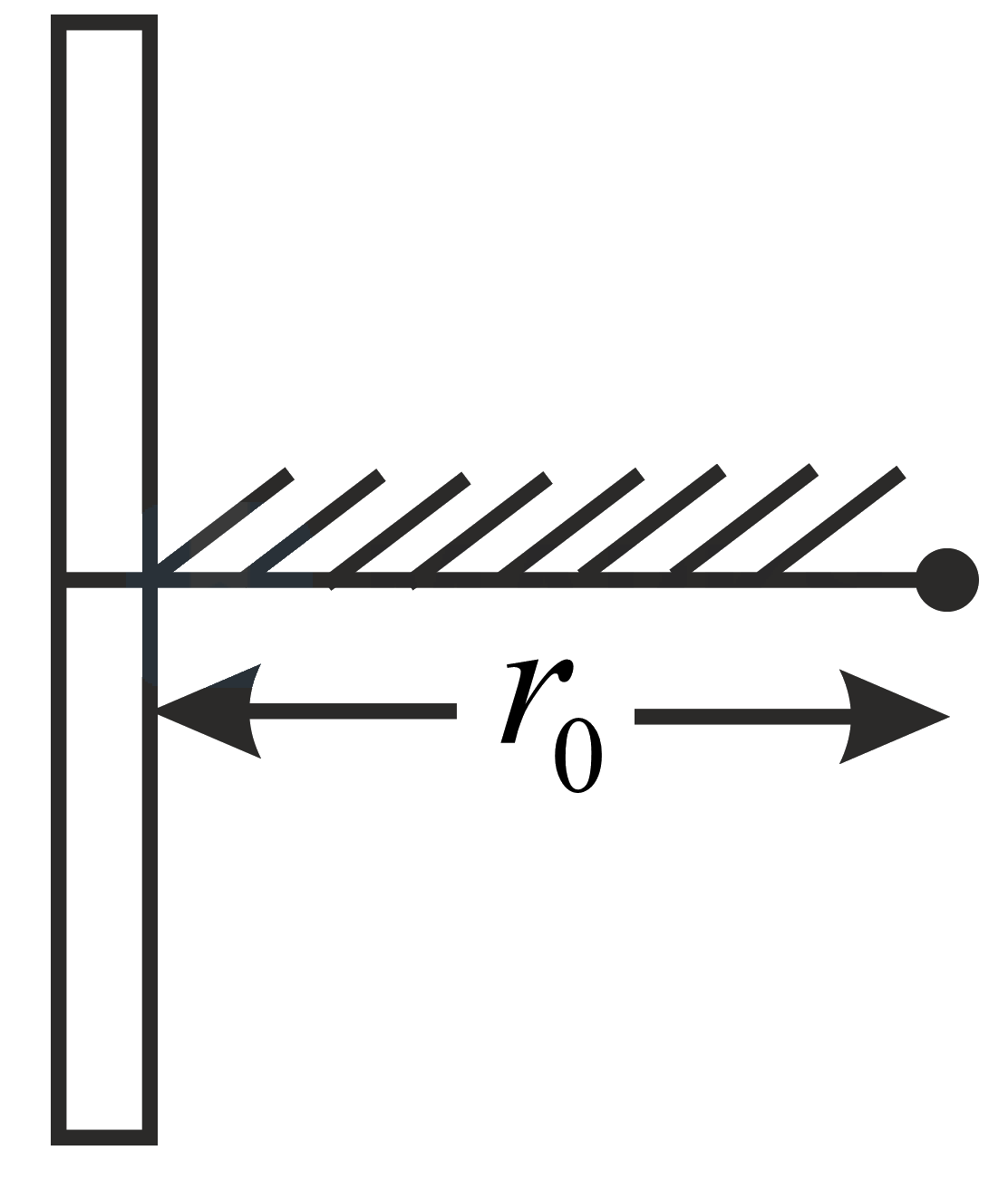 JEE Main/MCQ/Medium/Electric Field and Electric Field Lines/With diagram
- 118The bob of a simple pendulum has mass and a charge of It is at rest in a uniform horizontal electric field of intensity At equilibrium, the angle that the pendulum makes with the vertical is:
JEE Main/MCQ/Medium/Electric Field and Electric Field Lines - 119A parallel plate capacitor with plates of area each, are at a separation of If the electric field between the plates is the magnitude of charge on each plate is: JEE Main/MCQ/Medium/Electric Field and Electric Field Lines
- 120Two point charges and are placed on the -axis at and respectively. The electric field at a point on -axis is,
JEE Main/MCQ/Medium/Electric Field and Electric Field Lines - 121For a uniformly charged ring of radius the electric field on its axis has the largest magnitude at a distance from its centre. Then value of is:JEE Main/MCQ/Medium/Electric Field and Electric Field Lines
- 122[12]
A solid ball of radius has a charge density given by for . The electric field outside the ball is:JEE Main/MCQ/Medium/Electric Field and Electric Field Lines - 123A body of mass and charge is connected to a spring of spring constant . It is oscillating along -direction about its equilibrium position, taken to be at , with an amplitude . An electric field is applied along the -direction. Which of the following statements is correct?JEE Main/MCQ/Medium/Electric Field and Electric Field Lines
- 124A negative test charge is moving near a long straight wire carrying a current. The force acting on the test charge is parallel to the direction of the current. The motion of the charge is:JEE Main/MCQ/Medium/Electric Field and Electric Field Lines
- 125The region between two concentric spheres of radii 'a' and 'b', respectively (see figure), has volume charge density , where A is a constant and r is the distance from the centre. At the centre of the spheres is a point charge Q. The value of A such that the electric field in the region between the spheres will be constant, is:
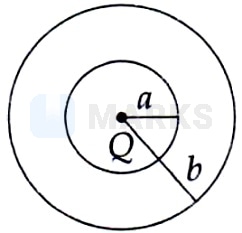 JEE Main/MCQ/Medium/Electric Field and Electric Field Lines/With diagram
- 126A wire of length is bent into a semi-circular arc and the two equal halves of the arc are uniformly charged with charges and as shown in the figure. The magnitude of the charge on each half is , where is the permittivity of free the space. The net electric field at the centre is
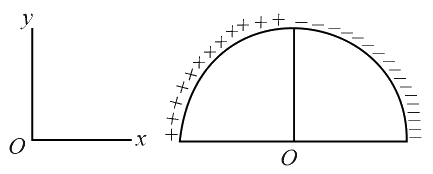 JEE Main/MCQ/Medium/Electric Field and Electric Field Lines/With diagram
- 127A thin disc of radius has a concentric hole of radius in it (see figure). It carries uniform surface charge on it. If the electric field on its axis at a height from its centre is given as then the value of is
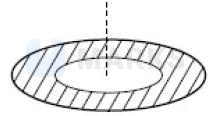 JEE Main/MCQ/Medium/Electric Field and Electric Field Lines/With diagram
- 128Shown in the figure are two point charges and inside the cavity of a spherical shell. The charges are kept near the surface of the cavity on opposite sides of the centre of the shell. If is the surface charge on the inner surface and net charge on it and the surface charge on the outer surface and net charge on it then:
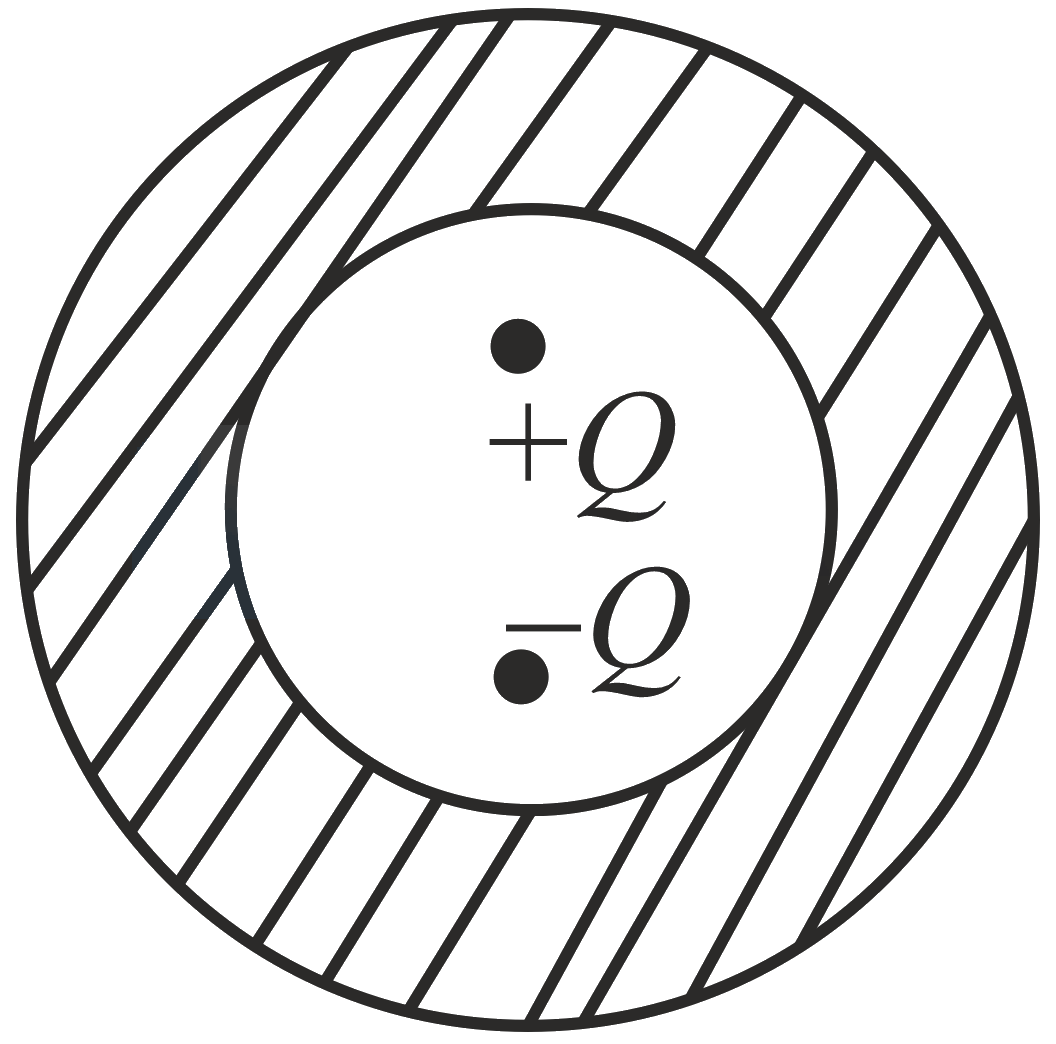 JEE Main/MCQ/Medium/Electric Field and Electric Field Lines/With diagram
- 129A long cylindrical shell carries positive surface charge in the upper half and negative surface charge in the lower half. The electric field lines around the cylinder will look like figure given in:
(figures are schematic and not drawn to scale)JEE Main/MCQ/Medium/Electric Field and Electric Field Lines - 130
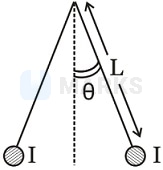
Two long currents carrying thin wires, both with current , are held by insulating threads of length L and are in equilibrium as shown in the figure, with threads making an angle ' ' with the vertical. If wires have a mass per unit length then the value of is:
( gravitational acceleration)JEE Main/MCQ/Medium/Electric Field and Electric Field Lines/With diagram - 131A spherically symmetric charge distribution is characterised by a charge density having the following variations:
for
for
Where is the distance from the centre of the charge distribution is a constant. The electric field at an internal point is:JEE Main/MCQ/Medium/Electric Field and Electric Field Lines - 132The surface charge density of a thin charged disc of radius is . The value of the electric field at the centre of the disc is . With respect to the field at the centre, the electric field along the axis at a distance from the centre of the disc:JEE Main/MCQ/Medium/Electric Field and Electric Field Lines
- 133Two small equal point charges of magnitude are suspended from a common point on the ceiling by insulating mass less strings of equal lengths. They come to equilibrium with each string making angle from the vertical. If the mass of each charge is , then the electrostatic potential at the centre of line joining them will be
JEE Main/MCQ/Medium/Electric Field and Electric Field Lines - 134Two balls of same mass and carrying equal charge are hung from a fixed support of length . At electrostatic equilibrium, assuming that angles made by each thread is small, the separation, between the balls is proportional to :JEE Main/MCQ/Medium/Electric Field and Electric Field Lines
- 135Three positive charges of equal value are placed at vertices of an equilateral triangle. The resulting lines of force should be sketched as inJEE Main/MCQ/Medium/Electric Field and Electric Field Lines
- 136In a uniformly charged sphere of total charge and radius , the electric field is plotted as a function of distance from the centre. The graph which would correspond to the above will beJEE Main/MCQ/Medium/Electric Field and Electric Field Lines
- 137Let there be a spherically symmetric charge distribution with charge density varying as upto , and for , where is the distance from the origin. The electric field at a distance from the origin is given byJEE Main/MCQ/Medium/Electric Field and Electric Field Lines
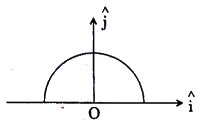
- 138A thin semi-circular ring of radius has a positive charge distributed uniformly over it. The net field at the centre is
 JEE Main/MCQ/Medium/Electric Field and Electric Field Lines/With diagram
- 139A charge is placed at each of the opposite corners of a square. A charge is placed at each of the other two corners. If the net electrical force on is zero, then the equalsJEE Main/MCQ/Medium/Electric Field and Electric Field Lines
- 140Let be the charge density distribution for a solid sphere of radius and total charge . for a point ' ' inside the sphere at distance from the centre of the sphere, the magnitude of electric field isJEE Main/MCQ/Medium/Electric Field and Electric Field Lines
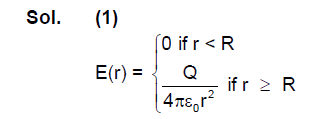
- 141A thin spherical shell of radius has charge spread uniformly over its surface. Which of the following graphs most closely represents the electric field produced by the shell in the range , where is the distance from the centre of the shell?
 JEE Main/MCQ/Medium/Electric Field and Electric Field Lines/With diagram
- 142Two spherical conductors and of radii and are separated by a distance of and are uniformly charged. If the spheres are connected by a conducting wire then in equilibrium condition, the ratio of the magnitude of the electric fields at the surface of spheres and isJEE Main/MCQ/Medium/Electric Field and Electric Field Lines
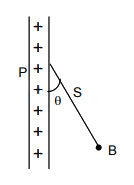
- 143A charged ball B hangs from a silk thread which makes an angle with a large charged conducting sheet , as show in the figure. The surface charge density of the sheet is proportional to
 JEE Main/MCQ/Medium/Electric Field and Electric Field Lines/With diagram
- 144A charged oil drop is suspended in a uniform field of so that it neither falls nor rises. The charge on the drop will be (take the mass of the charge and )JEE Main/MCQ/Medium/Electric Field and Electric Field Lines
- 145Four charges equal to are placed at the four corners of a square and a charge is at its centre. If the system is in equilibrium the value of isJEE Main/MCQ/Medium/Electric Field and Electric Field Lines
- 146Three charges and are placed as shown in the figure. The -component of the force on is proportional to
 JEE Main/MCQ/Medium/Electric Field and Electric Field Lines/With diagram
- 147If a charge is placed at the centre of the line joining two equal charges such that the system is in equilibrium then the value of isJEE Main/MCQ/Medium/Electric Field and Electric Field Lines
- 148The electric potential as a function of is given by V. The electric field at a point m is __________ V/m.JEE Main/MCQ/Medium/Electric Potential and Potential Energy
- 149A three coulomb charge moves from the point to the point in an electric field expressed as N/C. The work done in moving the charge is _______ J.JEE Main/Numerical/Medium/Electric Potential and Potential Energy
- 150Two charged conducting spheres and of radii cm and cm are connected to each other by a wire. After equilibrium is established, the ratio of electric fields on and spheres are and respectively. The value of is _______.JEE Main/MCQ/Medium/Electric Potential and Potential Energy
- 151Two point charges of 1 nC and 2 nC are placed at the two corners of equilateral triangle of side 3 cm. The work done in bringing a charge of 3 nC from infinity to the third corner of the triangle is .
JEE Main/MCQ/Medium/Electric Potential and Potential Energy - 152The electrostatic potential in a charged spherical region of radius varies as , where and are constants. The total charge in the sphere of unit radius is . The value of is .
(permittivity of vacuum is )JEE Main/MCQ/Medium/Electric Potential and Potential Energy - 153There are three co-centric conducting spherical shells and of radii and respectively and they are charged with charge and respectively. The potentials of the spheres and respectively, are :JEE Main/MCQ/Medium/Electric Potential and Potential Energy
- 154Two charges and are placed at and respectively in an external field , where . Considering the potential at infinity is 0, the electrostatic energy of the configuration is J.JEE Main/MCQ/Medium/Electric Potential and Potential Energy
- 155Three small identical bubbles of water having same charge on each coalesce to form a bigger bubble. Then the ratio of the potentials on one initial bubble and that on the resultant bigger bubble is :JEE Main/MCQ/Medium/Electric Potential and Potential Energy
- 156Five positive charges each having charge are placed at the vertices of a pentagon as shown in the figure. The electric potential and the electric field at the center of the pentagon due to these five positive charges are:
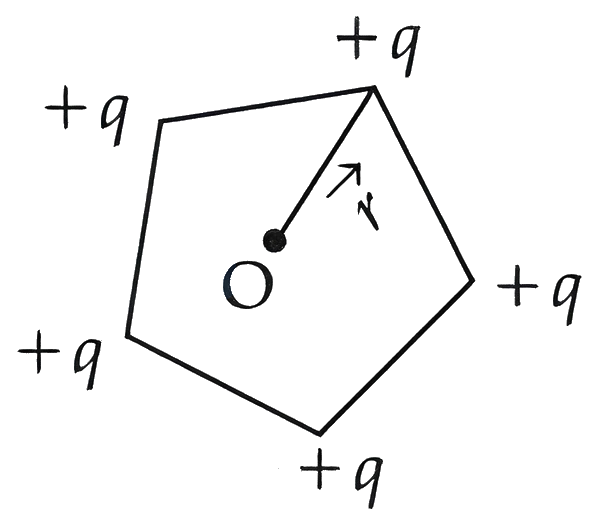 JEE Main/MCQ/Medium/Electric Potential and Potential Energy/With diagram
- 157Electric field in a region is given by , where and . If the electric potential at a point is 500 V, then the electric potential at origin is V.JEE Main/MCQ/Medium/Electric Potential and Potential Energy
- 158Consider two identical metallic spheres of radius each having charge and mass . Their centers have an initial separation of . Both the spheres are given an initial speed of towards each other. The minimum value of , so that they can just touch each other is :
(Take and assume where is the Gravitational constant)JEE Main/MCQ/Medium/Electric Potential and Potential Energy - 159A point charge of is placed at origin. The work done in moving a point charge from point to is J. in SI units JEE Main/MCQ/Medium/Electric Potential and Potential Energy
- 160Given below are two statements : one is labelled as Assertion A and the other is labelled as Reason Assertion A : Work done in moving a test charge between two points inside a uniformly charged spherical shell is zero, no matter which path is chosen.
Reason : Electrostatic potential inside a uniformly charged spherical shell is constant and is same as that on the surface of the shell. In the light of the above statements, choose the correct answer from the options given belowJEE Main/MCQ/Medium/Electric Potential and Potential Energy - 161Two charges and are separated by a distance of 30 cm. A third charge initially at ' C ' as shown in the figure, is moved along the circular path of radius 40 cm from C to D. If the difference in potential energy due to movement of from to is given by , the value of K is :
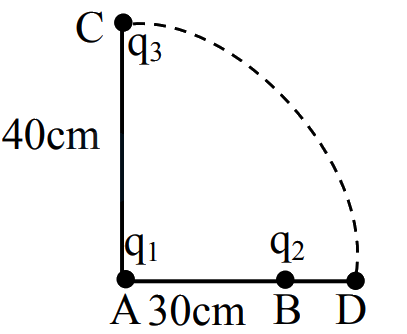 JEE Main/MCQ/Medium/Electric Potential and Potential Energy/With diagram
- 162A metallic ring is uniformly charged as shown in figure. AC and BD are two mutually perpendicular diameters. Electric field due to to ' O ' is ' E ' is magnitude. What would be the magnitude of electric field at ' O ' due to arc ABC ?
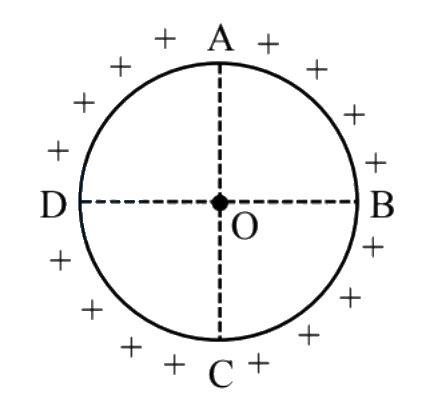 JEE Main/MCQ/Medium/Electric Potential and Potential Energy/With diagram
- 163Two small spherical balls of mass 10 g each with charges and , are attached to two ends of very light rigid rod of length 20 cm. The arrangement is now placed near an infinite nonconducting charge sheet with uniform charge density of such that length of rod makes an angle of with electric field generated by charge sheet. Net torque acting on the rod is:
(Take )JEE Main/MCQ/Medium/Electric Potential and Potential Energy - 164The electrostatic potential on the surface of uniformly charged spherical shell of radius is 120 V. The potential at the centre of shell, at a distance from centre, and at a distance from the centre of the shell respectively, are :JEE Main/MCQ/Medium/Electric Potential and Potential Energy
- 165Consider a circular loop that is uniformly charged and has a radius . Find the position along the positive z -axis of the cartesian coordinate system where the electric field is maximum if the ring was assumed to be placed in xy-plane at the origin :JEE Main/MCQ/Medium/Electric Potential and Potential Energy
- 166Two large plane parallel conducting plates are kept 10 cm apart as shown in figure. The potential difference between them is . The potential difference between the points A and B (shown in the figure) is :
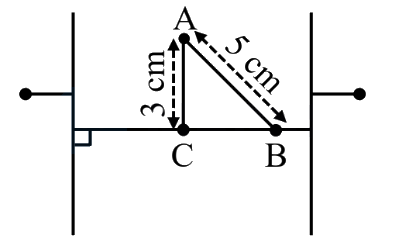 JEE Main/MCQ/Medium/Electric Potential and Potential Energy/With diagram
- 167Match List - I with List - II.
\(\begin{array}{l|l}
\text { List - I } & \text { List - II } \\
\hline \text { (A) }\begin{array}{l}
\text { Electric field inside (distance } r>0 \text { from center) } \\
\text { of a uniformly charged spherical shell with } \\
\text { surface charge density } \sigma \text {, and radius R. }
\end{array} & \text { (I) } \begin{array}{l}
\sigma / \epsilon_0
\end{array} \\
\text { (B) } \begin{array}{l}
\text { Electric field at distance r>0 from a uniformly } \\
\text { charged infinite plane sheet with surface } \\
\text { charge density } \sigma .
\end{array} & \text { (II) } \sigma / 2 \epsilon_0 \\
\text { (C) } \begin{array}{l}
\text { Electric field outside (distance r>0 from center) } \\
\text { of a uniformly charged spherical shell with } \\
\text { surface charge density } \sigma \text {, and radius R. }
\end{array} & \text { (III) } 0 \\
\text { (D) } \begin{array}{l}
\text { Electric field between } 2 \text { oppositely charged } \\
\text { infinite plane parallel sheets with uniform } \\
\text { surface charge density } \sigma .
\end{array} & \text { (IV) } \frac{\sigma R^2}{\epsilon_0 r^2}
\end{array}\)
Choose the correct answer from the options given below :JEE Main/MCQ/Medium/Electric Potential and Potential Energy - 168Three infinitely long wires with linear charge density are placed along the -axis and axis respectively. Which of the following denotes an equipotential surface?JEE Main/MCQ/Medium/Electric Potential and Potential Energy
- 169
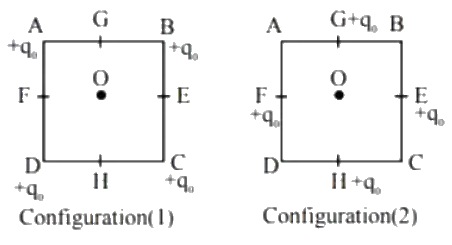
In the first configuration (1) as shown in the figure, four identical charges \(\left(q_0\right)\) are kept at the corners \(A, B, C\) and \(D\) of square of side length 'a'. In the second configuration (2), the same charges are shifted to mid points \(\mathrm{G}, \mathrm{E}, \mathrm{H}\) and F, of the square, If \(\mathrm{K}=\frac{1}{4 \pi \varepsilon_0}\), the difference between the potential energies of configuration (2) and (1) is given by :JEE Main/MCQ/Medium/Electric Potential and Potential Energy/With diagram - 170Two charges and are placed at and respectively. Given, , the electrostatic potential energy of the charge configuration is :JEE Main/MCQ/Medium/Electric Potential and Potential Energy
- 171At the centre of a half ring of radius and linear charge density , the potential is . The value of is _______JEE Main/Numerical/Medium/Electric Potential and Potential Energy
- 172Two charged conducting spheres of radii and are connected to each other by a conducting wire. The ratio of charges of the two spheres respectively is:JEE Main/MCQ/Medium/Electric Potential and Potential Energy
- 173The distance between charges and is and between and is . The electrostatic potential at point at a distance from centre is , where the value of is ______. (Use )
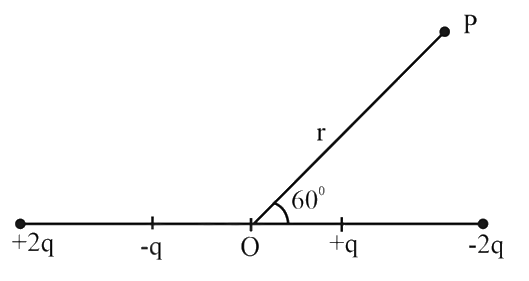 JEE Main/Numerical/Medium/Electric Potential and Potential Energy/With diagram
- 174The electrostatic potential due to an electric dipole at a distance varies as :JEE Main/MCQ/Medium/Electric Potential and Potential Energy
- 175The electric potential at the surface of an atomic nucleus of radius is . What is the value of ?
(Charge of proton )JEE Main/Numerical/Medium/Electric Potential and Potential Energy - 176An electric charge is placed at origin of co-ordinate system. Two points and are situated at and respectively. The potential difference between the points and will be :JEE Main/MCQ/Medium/Electric Potential and Potential Energy
- 177If is the gravitational potential due to sphere of uniform density on its surface, then its value at the centre of sphere will be:JEE Main/MCQ/Medium/Electric Potential and Potential Energy
- 178Three concentric spherical metallic shells and of radius and respectively have surface charge densities and , respectively. The shells and are at same potential. If the radii of X&Y are and , respectively. The radius of shell is _____.JEE Main/Numerical/Medium/Electric Potential and Potential Energy
- 179Electric potential at a point due to a point charge of is . The distance of from the point charge is:
(Assume, )JEE Main/MCQ/Medium/Electric Potential and Potential Energy - 180For a uniformly charged thin spherical shell, the electric potential radially away from the centre of shell can be graphically represented as
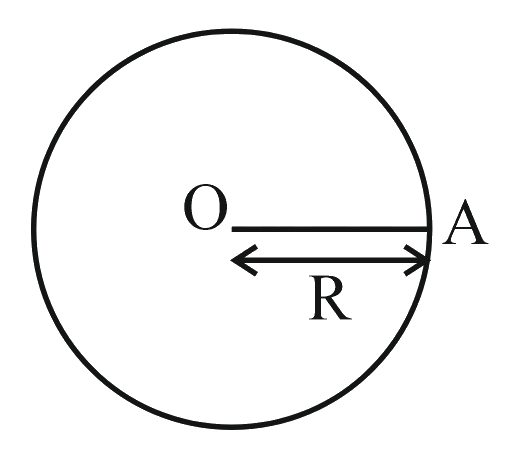 JEE Main/MCQ/Medium/Electric Potential and Potential Energy/With diagram
- 181Which of the following correctly represents the variation of electric potential of a charged spherical conductor of radius with radial distance from the centre?JEE Main/MCQ/Medium/Electric Potential and Potential Energy
- 182Two isolated metallic solid spheres of radii and are charged such that both have same charge density . The spheres are then connected by a thin conducting wire. If the new charge density of the bigger sphere is . The ratio is :JEE Main/MCQ/Medium/Electric Potential and Potential Energy
- 183For a charged spherical ball, electrostatic potential inside the ball varies with as .
Here, and are constant and is the distance from the center. The volume charge density inside the ball is . The value of is ______.
permittivity of medium.JEE Main/Numerical/Medium/Electric Potential and Potential Energy - 184A point charge is moved from to in a uniform electric field of directed along positive -axis. If coordinates of and are respectively, the work done by electric field will beJEE Main/MCQ/Medium/Electric Potential and Potential Energy
- 185The electric potential at the centre of two concentric half rings of radii and , having same linear charge density is
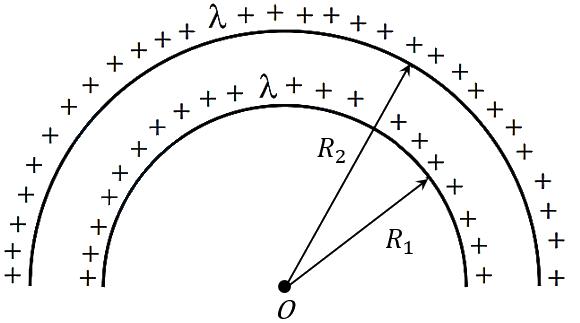 .JEE Main/MCQ/Medium/Electric Potential and Potential Energy/With diagram
- 186Given below are two statements.
Statement I : Electric potential is constant within and at the surface of each conductor.
Statement II : Electric field just outside a charged conductor is perpendicular to the surface of the conductor at every point.
In the light of the above statements, choose the most appropriate answer from the options give below.JEE Main/MCQ/Medium/Electric Potential and Potential Energy - 187Two uniformly charged spherical conductors and of radii and are separated by a distance of . If the spheres are connected by a conducting wire, then in equilibrium condition, the ratio of the magnitudes of the electric fields at the surface of the sphere and will beJEE Main/MCQ/Medium/Electric Potential and Potential Energy
- 188If the electric potential at any point in space is given by volt. The electric field at the point will be :JEE Main/MCQ/Medium/Electric Potential and Potential Energy
- 189 identical drops are charged at each. They combine to form a bigger drop. The potential of the bigger drop will be _____ .JEE Main/Numerical/Medium/Electric Potential and Potential Energy
- 190The two thin coaxial rings, each of radius and having charges and respectively are separated by a distance of . The potential difference between the centres of the two rings is :JEE Main/MCQ/Medium/Electric Potential and Potential Energy
- 191 similar drops of mercury are maintained at each. All these spherical drops combine into a single big drop. The potential energy of the bigger drop is ___________ times that of a smaller drop.JEE Main/Numerical/Medium/Electric Potential and Potential Energy
- 192In an electrical circuit, a battery is connected to pass of charge through it in a certain given time. The potential difference between two plates of the battery is maintained at . The workdone by the battery is _______ JEE Main/Numerical/Medium/Electric Potential and Potential Energy
- 193 identical drops of mercury are charged to a potential of each. The drops are joined to form a single drop. The potential of this drop is in Volt.JEE Main/Numerical/Medium/Electric Potential and Potential Energy
- 194Ten charges are placed on the circumference of a circle of radius R with constant angular separation between successive charges. Alternate charges have charge each, while have charge each. The potential V and the electric field E at the centre of the circle are respectively : (Take at infinity)JEE Main/MCQ/Medium/Electric Potential and Potential Energy
- 195A two point charges and are fixed on the -axis at and , respectively. If the third point charge ‘ ’ is taken from the origin to along the semicircle as shown in the figure, the energy of the charge will:
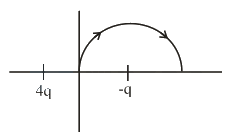 JEE Main/MCQ/Medium/Electric Potential and Potential Energy/With diagram
- 196Concentric metallic hollow spheres of radii R and 4R hold charges and respectively. Given that surface charge densities of the concentric spheres are equal, the potential difference is:JEE Main/MCQ/Medium/Electric Potential and Potential Energy
- 197Consider two charged metallic spheres and of radii and respectively. The electric fields (on ) and (on ) on their surfaces are such that Then the ratio (on ) (on ) of the electrostatic potentials on each sphere is:JEE Main/MCQ/Medium/Electric Potential and Potential Energy
- 198In free space, a particle of charge is held fixed at point . Another particle of the same charge and mass is kept at a distance of from If is released, then its velocity at a distance of from is:
[Take ]JEE Main/MCQ/Medium/Electric Potential and Potential Energy - 199A uniformly charged ring of radius and total charge is placed in plane centred at origin. A point charge is moving towards the ring along the axis and has speed at . The minimum value of such that it crosses the origin is:JEE Main/MCQ/Medium/Electric Potential and Potential Energy
- 200A system of three charges are placed as shown in the figure:
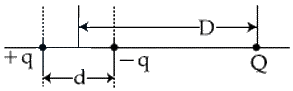
If the potential energy of the system is best given by:JEE Main/MCQ/Medium/Electric Potential and Potential Energy/With diagram - 201The electric field in a region is given by where is in and is in metres. The values of constants are unit and unit. If the potential at is and that at is then isJEE Main/MCQ/Medium/Electric Potential and Potential Energy
- 202A solid conducting sphere, having a charge is surrounded by an uncharged conducting hollow spherical shell. Let the potential difference between the surface of the solid sphere and that of the outer surface of the hollow shell be If the shell is now given a charge of the new potential difference between the same two surfaces is:JEE Main/MCQ/Medium/Electric Potential and Potential Energy
- 203There is a uniform spherically symmetric surface charge density at a distance from the origin. The charge distribution is initially at rest and starts expanding because of mutual repulsion. The figure that represents best the speed of the distribution as a function of its instantaneous radius is:JEE Main/MCQ/Medium/Electric Potential and Potential Energy
- 204Three charges and are placed at the vertices of a right-angle isosceles triangle as shown below. The net electrostatic energy of the configuration is zero, if the value of is
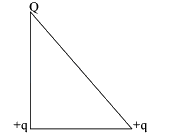 JEE Main/MCQ/Medium/Electric Potential and Potential Energy/With diagram
- 205The given graph shows variation (with distancer from centre) of:
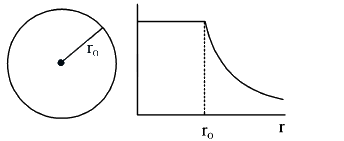 JEE Main/MCQ/Medium/Electric Potential and Potential Energy/With diagram
- 206Four equal point charges each are placed in the plane at and . The work required to put a fifth charge at the origin of the coordinate system will be:JEE Main/MCQ/Medium/Electric Potential and Potential Energy
- 207Charges and , located at and , respectively, constitute an electric dipole. Distance , is the mid point of the dipole and is perpendicular to . A charge is placed at where and . The charge experiences an electrostatic force . If is now moved along the equatorial line to such that the force on will be close to
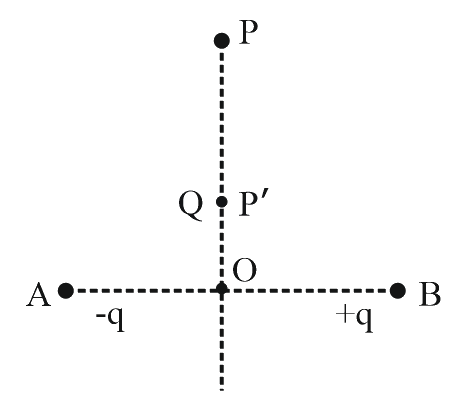 JEE Main/MCQ/Medium/Electric Potential and Potential Energy/With diagram
- 208A charge is distributed over three concentric spherical shells of radii such that their surface charge densities are equal to one another.
The total potential at a point at distance from their common centre, where would be:JEE Main/MCQ/Medium/Electric Potential and Potential Energy - 209Three concentric metal shells and of respective radii and have surface charge densities <c) charge="" densities="" have="" math="" surface=""> and respectively. The potential of shell is:</c)>JEE Main/MCQ/Medium/Electric Potential and Potential Energy
- 210The energy stored in the electric field produced by a metal sphere is . If the sphere contains charge, its radius will be: JEE Main/MCQ/Medium/Electric Potential and Potential Energy
- 211There is a uniform electrostatic field in a region. The potential at various points on a small sphere centred at , in the region, is found to vary between the limits to . What is the potential at a point on the sphere whose radius vector makes an angle of with the direction of the field?JEE Main/MCQ/Medium/Electric Potential and Potential Energy
- 212Within a spherical charge distribution of charge density N equipotential surfaces of potential are drawn and have increasing radii respectively. If the difference in the radii of the surfaces is constant for all values of then :JEE Main/MCQ/Medium/Electric Potential and Potential Energy
- 213The potential (in volts) of a charge distribution is given by
for
for .
does not depend on x and y. If this potential is generated by a constant charge per unit volume (in units of ) which is spread over a certain region, then choose the correct statement.JEE Main/MCQ/Medium/Electric Potential and Potential Energy - 214An electric field exists in a region of space. If the potential at the origin is taken to be zero then the potential at , is:JEE Main/MCQ/Medium/Electric Potential and Potential Energy
- 215A uniformly charged solid sphere of radius R has potential (measured with respect to ) on its surface. For this sphere the equipotential surfaces with potential and have radius , and respectively. Then
Note : This question had two option correct at the time of examination. Proper corrections are made in the question to avoid it.JEE Main/MCQ/Medium/Electric Potential and Potential Energy - 216Assume that an electric field exists in space. Then the potential difference , where VO is the potential at the origin and VA the potential at x = 2 m is :JEE Main/MCQ/Medium/Electric Potential and Potential Energy
- 217The gravitational field in a region is given by:
If the potential at the origin is taken to be zero, then the ratio of the potential at the points and is :JEE Main/MCQ/Medium/Electric Potential and Potential Energy - 218This question has Statement-1 and Statement-2. Of the four choices given after the Statements, choose the one that best describes the two Statements.
Statement 1: No work is required to be done to move a test charge between any two points on an equipotential surface.
Statement 2 : Electric lines of force at the equipotential surfaces are mutually perpendicular to each other.JEE Main/MCQ/Medium/Electric Potential and Potential Energy - 219A point charge of magnitude is fixed at , . An isolated uncharged spherical conductor, is fixed with its center at . The potential and the induced electric field at the centre of the sphere is :JEE Main/MCQ/Medium/Electric Potential and Potential Energy
- 220A charge Q is uniformly distributed over a long rod AB of length L as shown in the figure. The electric potential at the point O lying at a distance L from the end A is :
 JEE Main/MCQ/Medium/Electric Potential and Potential Energy/With diagram
- 221A charge of total amount is distributed over two concentric hollow spheres of radii and ) such that the surface charge densities on the two spheres are equal. The electric potential at the common centre isJEE Main/MCQ/Medium/Electric Potential and Potential Energy
- 222The electric potential in a region around the origin is given by volts. The electric charge enclosed in a cube of side with its centre at the origin is (in coulomb)JEE Main/MCQ/Medium/Electric Potential and Potential Energy
- 223This question has statement and statement . Of the four choices given after the statements, choose the one that best describes the two statements.
An insulating solid sphere of radius has a uniformly positive charge density . As a result of this uniform charge distribution there is a finite value of electric potential at the centre of the sphere, at the surface of the sphere and also at a point out side the sphere. The electric potential at infinity is zero.
Statement : When a charge is taken from the centre to the surface of the sphere, its potential energy changes by
Statement : The electric field at a distance from the centre of the sphere is JEE Main/MCQ/Medium/Electric Potential and Potential Energy - 224The electrostatic potential inside a charged spherical ball is given by where is the distance from the centre; are constants. Then the charge density inside ball isJEE Main/MCQ/Medium/Electric Potential and Potential Energy
- 225Two points and are maintained at the potentials of and respectively. The work done in moving 100 electrons from to isJEE Main/MCQ/Medium/Electric Potential and Potential Energy
- 226This question contains Statement-1 and Statement-2. Of the four choices given after the statements, choose the one that best describes the two statements.
Statement - 1: For a charged particle moving from point to point , the net work done by an electrostatic field on the particle is independent of the path connecting point to point .
Statement-2: The net work done by a conservative force on an object moving along a closed loop is zeroJEE Main/MCQ/Medium/Electric Potential and Potential Energy - 227The potential at a point (measured in ) due to some charges situated on the -axis is given by . The electric field at is given byJEE Main/MCQ/Medium/Electric Potential and Potential Energy
- 228An electric charge is placed at the origin of co-ordinate system. Two points and are situated at and respectively. The potential difference between the points and will beJEE Main/MCQ/Medium/Electric Potential and Potential Energy
- 229Two insulating plates are both uniformly charged in such a way that the potential difference between them is . (i.e. plate 2 is at a higher potential). The plates are separated by and can be treated as infinitely large. An electron is released from rest on the inner surface of plate 1 . What is its speed when it hits plate
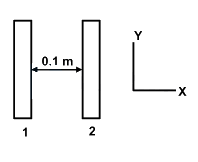 JEE Main/MCQ/Medium/Electric Potential and Potential Energy/With diagram
- 230Two thin wires rings each having a radius are placed at a distance apart with their axes coinciding. The charges on the two rings are and . The potential difference between the centres of the two rings isJEE Main/MCQ/Medium/Electric Potential and Potential Energy
- 231An -particle of energy is scattered through by a fixed uranium nucleus. The distance of the closest approach is of the order ofJEE Main/MCQ/Medium/Electric Potential and Potential Energy
- 232A charged particle is shot towards another charged particle which is fixed, with a speed it approaches upto a closest distance and then returns. If were given a speed , the closest distances of approach would beJEE Main/MCQ/Medium/Electric Potential and Potential Energy
- 233A thin spherical conducting shell of radius has a charge . Another charge is placed at the centre of the shell. The electrostatic potential at a point a distance from the centre of the shell isJEE Main/MCQ/Medium/Electric Potential and Potential Energy
- 234On moving a charge of 20 coulombs by of work is done, then the potential difference between the points isJEE Main/MCQ/Medium/Electric Potential and Potential Energy
- 235A rigid dipole undergoes a simple harmonic motion about its centre in the presence of an electric field . If another electric field is introduced to the system, what will be the percentage change in the frequency of the oscillation (approximate)?JEE Main/MCQ/Medium/Electric Dipole
- 236Two short electric dipoles and having dipole moment and respectively are placed with their axis mutually perpendicular as shown in the figure. The resultant electric field at a point is making an angle of with the line joining points and . The ratio of the dipole moments is _______.
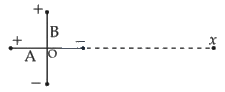 JEE Main/MCQ/Medium/Electric Dipole/With diagram
- 237Three charges and are situated at and respectively in the plane. The resultant dipole moment about origin is .JEE Main/MCQ/Medium/Electric Dipole
- 238Two shorts dipoles having charges and length 1 cm and having charges and length 1 cm are placed with their centres 80 cm apart as shown in the figure. The electric field at a point , equi-distant from the centres of both dipoles is N/C.
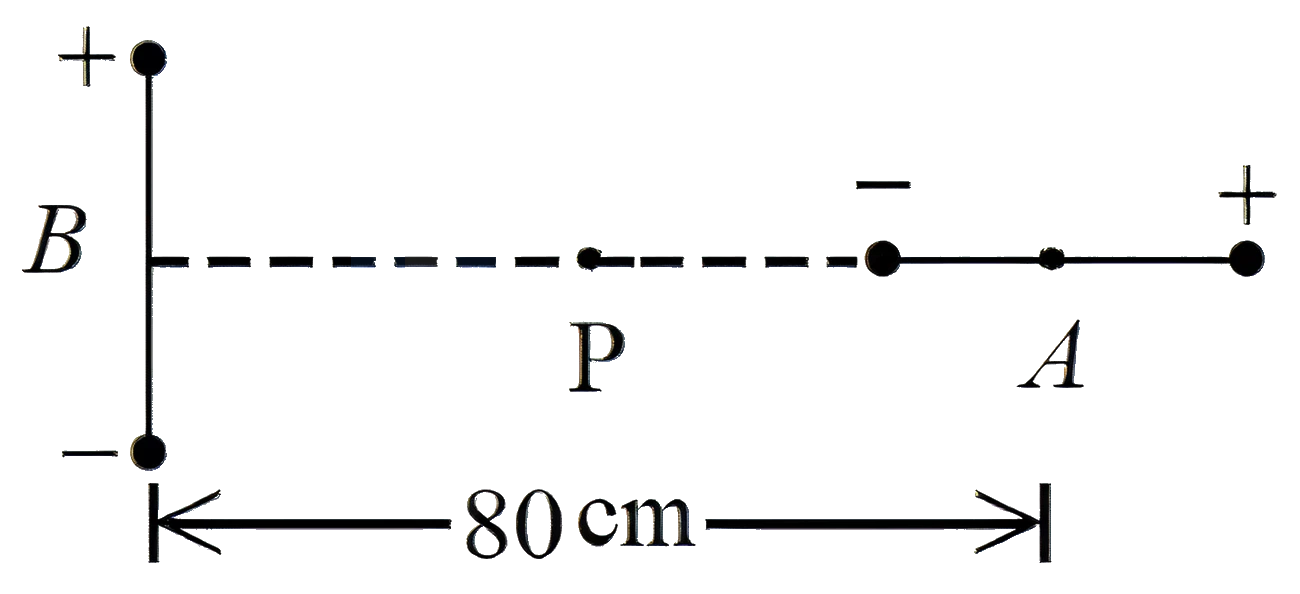 JEE Main/MCQ/Medium/Electric Dipole/With diagram
- 239A dipole with two electric charges of magnitude each, with separation distance , is placed between the plates of a capacitor such that its axis is parallel to an electric field established between the plates when a potential difference of 5 V is applied. Separation between the plates is 0.5 mm. If the dipole is rotated by from the axis, it tends to realign in the direction due to a torque. The value of torque is :JEE Main/MCQ/Medium/Electric Dipole
- 240Given below are two statements : one is labelled as Assertion (A) and the other is labelled as Reason (R).
Assertion (A) : Net dipole moment of a polar linear isotropic dielectric substance is not zero even in the absence of an external electric field.
Reason (R) : In absence of an external electric field, the different permanent dipoles of a polar dielectric substance are oriented in random directions.
In the light of the above statements, choose the most appropriate answer from the options given below :JEE Main/MCQ/Medium/Electric Dipole - 241An electric dipole is placed at a distance of 2 cm from an infinite plane sheet having positive charge density . Choose the correct option from the following.
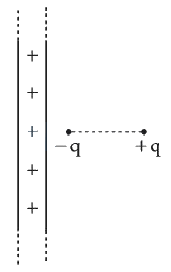 JEE Main/MCQ/Medium/Electric Dipole/With diagram
- 242An electric dipole of mass m, charge q, and length \(l\) is placed in a uniform electric field \(\overrightarrow{\mathrm{E}}=\mathrm{E}_0 \hat{i}\). When the dipole is rotated slightly from its equilibrium position and released, the time period of its oscillations will be:JEE Main/MCQ/Medium/Electric Dipole
- 243An electric dipole of dipole moment is placed in uniform electric field of magnitude . Initially, the dipole moment is parallel to electric field. The work that needs to be done on the dipole to make its dipole moment opposite to the field, will be ____ J.JEE Main/Numerical/Medium/Electric Dipole
- 244Two point charges and , constituting an electric dipole, are placed at and in a uniform electric field of strength . The work done on the dipole in rotating it from the equilibrium through is :JEE Main/MCQ/Medium/Electric Dipole
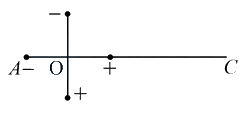
- 245A point particle of charge is located at along the axis of an electric dipole 1 at a distance as shown in the figure. The point P is also on the equatorial plane of a second electric dipole 2 at a distance r . The dipoles are made of opposite charge q separated by a distance . For the charge particle at P not to experience any net force, which of the following correctly describes the situation?
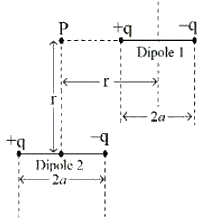 JEE Main/MCQ/Medium/Electric Dipole/With diagram
- 246For a short dipole placed at origin , the dipole moment is along -axis, as shown in the figure. If the electric potential and electric field at A are and , respectively, then the correct combination of the electric potential and electric field, respectively, at point on the -axis is given by
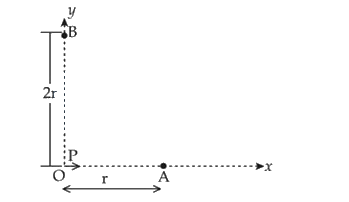 JEE Main/MCQ/Medium/Electric Dipole/With diagram
- 247The electric field at point due to an electric dipole is . The electric field at point on equitorial line will be . The value of :
 JEE Main/Numerical/Medium/Electric Dipole/With diagram
- 248Two charges of and are placed at the points and located in an electric field . The magnitude of the torque acting on the dipole is , where _________.JEE Main/Numerical/Medium/Electric Dipole
- 249The electric field due to a short electric dipole at a large distance from center of dipole on the equatorial plane varies with distance as :JEE Main/MCQ/Medium/Electric Dipole
- 250Two charges of each magnitude and separated by a distance of constitute an electric dipole. If the dipole is placed in an uniform electric field of making angle with the magnitude of torque acting on dipole is:JEE Main/MCQ/Medium/Electric Dipole
- 251Given below are two statements: one is labelled as Assertion A and the other is labelled as Reason R.
Assertion A : If an electric dipole of dipole moment is enclosed by a closed surface, the net flux coming out of the surface will be zero.
Reason R : Electric dipole consists of two equal and opposite charges.
In the light of above, statements, choose the correct answer from the options given below.JEE Main/MCQ/Medium/Electric Dipole - 252An electric dipole of dipole moment is placed in a uniform electric field of in such a way that dipole moment is along electric field. The work done in rotating dipole by in this field will be_______.JEE Main/Numerical/Medium/Electric Dipole
- 253A dipole comprises of two charged particles of identical magnitude and opposite in nature. The mass of the positive charged particle is half of the mass of the negative charged particle. The two charges are separated by a distance . If the dipole is placed in a uniform electric field ; in such a way that dipole axis makes a very small angle with the electric field, . The angular frequency of the oscillations of the dipole when released is given by:JEE Main/MCQ/Medium/Electric Dipole
- 254Two electric dipoles of dipole moments and are placed in two difference uniform electric fields of strengths and respectively. The ratio of maximum torque experienced by the electric dipoles will be . The value of is _____ .JEE Main/Numerical/Medium/Electric Dipole
- 255Two ideal electric dipoles and , having their dipole moment and respectively are placed on a plane with their centres at as shown in the figure. At point on the axis of dipole , the resultant electric field is making an angle of with the axis. The ratio of the dipole moment of and is take
 JEE Main/MCQ/Medium/Electric Dipole/With diagram
- 256An electric dipole is placed on axis in proximity to a line charge of linear charge density Line charge is placed on axis and positive and negative charge of dipole is at a distance of and from the origin respectively. If total force of is exerted on the dipole, find out the amount of positive or negative charge of the dipole.JEE Main/MCQ/Medium/Electric Dipole
- 257Two identical electric point dipoles have dipole have dipole moments and and are held on the -axis at distance '' from each other. When released, they move along the -axis with the direction of their dipole moments remaining unchanged. If the mass of each dipole is '', their speed when they are infinitely far apart is :JEE Main/MCQ/Medium/Electric Dipole
- 258An electric dipole of moment at the origin . The electric field due to this dipole at (note that ) is parallel to:JEE Main/MCQ/Medium/Electric Dipole
- 259A Point dipole is kept at the origin. The potential and electric field due to this dipole on the at a distance are, respectively: (Taken at infinity)JEE Main/MCQ/Medium/Electric Dipole
- 260An electric dipole is formed by two equal and opposite charges with separation . The charges have same mass m. It is kept in a uniform electric field If it is slightly rotated from its equilibrium orientation, then its angular frequency is:JEE Main/MCQ/Medium/Electric Dipole
- 261Determine the electric dipole moment of the system of three charges, placed on the vertices of an equilateral triangle, as shown in the figure:
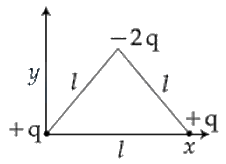 JEE Main/MCQ/Medium/Electric Dipole/With diagram
- 262An electric field of is applied to an electric dipole at angle of . The value of electric dipole moment is What is the potential energy of the electric dipole?JEE Main/MCQ/Medium/Electric Dipole
- 263Two electric dipoles, with respective dipole moments and are placed on the -axis with a separation as shown in the figure
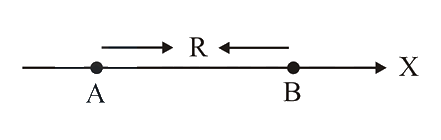
The distance from at which both of them produce the same potential is:JEE Main/MCQ/Medium/Electric Dipole/With diagram - 264An electric dipole has fixed dipole moment , which makes angle with respect to axis. When subjected to an electric field it experiences a torque . When subjected to another electric field it experiences a torque . The angle is:JEE Main/MCQ/Medium/Electric Dipole
- 265Two point dipoles of dipole moment and are at a distance from each other and .
The force between the dipoles is :JEE Main/MCQ/Medium/Electric Dipole - 266A electric dipole is placed at an angle of to a non-uniform electric field. The dipole will experienceJEE Main/MCQ/Medium/Electric Dipole
- 267Two point charges and are located at cm and cm, respectively on the -axis. The ratio of electric flux due to these charges through two spheres of radii cm and cm with their centers at the origin is _______.JEE Main/MCQ/Medium/Electric Flux and Gauss Law
- 268Two point charges and are placed at vertex and centre of face of the cube as shown in figure. The electric flux passing through the cube is :
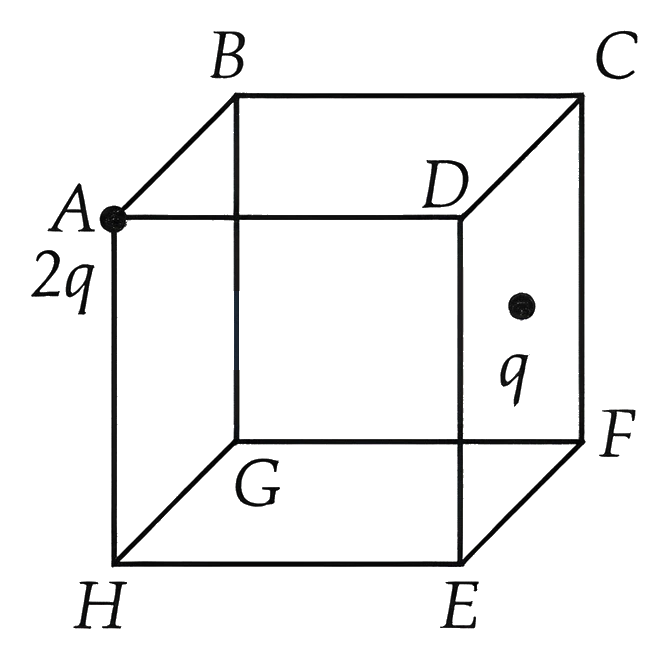 JEE Main/MCQ/Medium/Electric Flux and Gauss Law/With diagram
- 269An infinitely long wire has uniform linear charge density . The net flux through a Gaussian cube of side length , if the wire passes through any two corners of the cube, that are maximally displaced from each other, would be , where x is :
[Neglect any edge effects and use SI units]JEE Main/MCQ/Medium/Electric Flux and Gauss Law - 270The electric field in a region is given by . The flux of the field through a rectangular surface parallel to plane is . The area of the surface is ________ .JEE Main/Numerical/Medium/Electric Flux and Gauss Law
- 271A point charge causes an electric flux of to pass through a spherical Gaussian surface of 8.0 cm radius, centred on the charge. The value of the point charge is :
(Given )JEE Main/MCQ/Medium/Electric Flux and Gauss Law - 272A square loop of sides is held normally in front of a point charge . The flux of the electric field through the shaded region is , where the value of p is _____.
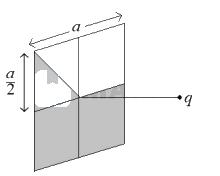 JEE Main/Numerical/Medium/Electric Flux and Gauss Law/With diagram
- 273A line charge of length is kept at the center of an edge of a cube having edge length ' ' as shown in the figure. If the density of line charge is C per unit length, then the total electric flux through all the faces of the cube will be _______. (Take, as the free space permittivity)
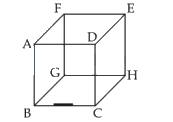 JEE Main/MCQ/Medium/Electric Flux and Gauss Law/With diagram
- 274An electric field exists in space. A cube of side is placed in the space as per figure given below. The electric flux through the cube is ______ .
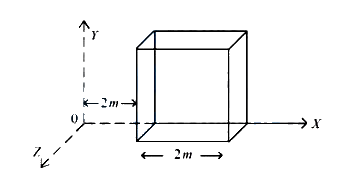 JEE Main/Numerical/Medium/Electric Flux and Gauss Law/With diagram
- 275Five charges and are situated as shown in the figure. The electric flux due to this configuration through the surface is :
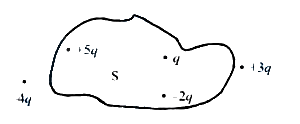 JEE Main/MCQ/Medium/Electric Flux and Gauss Law/With diagram
- 276An electric field, passes through the surface of area having unit vector . The electric flux for that surface is ______ .JEE Main/Numerical/Medium/Electric Flux and Gauss Law
- 277Ques:
is the uniform surface charge density of a thin spherical shell of radius . The electric field at any point on the surface of the spherical shell is :JEE Main/MCQ/Medium/Electric Flux and Gauss Law - 278A charge is placed at the center of one of the surface of a cube. The flux linked with the cube is:JEE Main/MCQ/Medium/Electric Flux and Gauss Law
- 279 and are two hollow concentric cubes enclosing charges and respectively as shown in figure. The ratio of electric flux passing through and is:
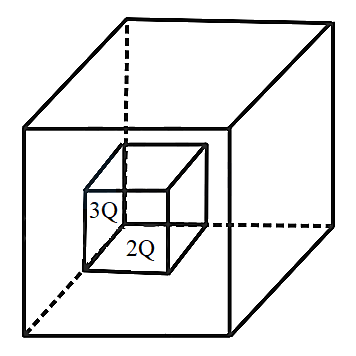 JEE Main/MCQ/Medium/Electric Flux and Gauss Law/With diagram
- 280An electric field is given by . The electric flux through a surface area lying in YZ-plane(in SI unit) is:JEE Main/MCQ/Medium/Electric Flux and Gauss Law
- 281Match List I with List II
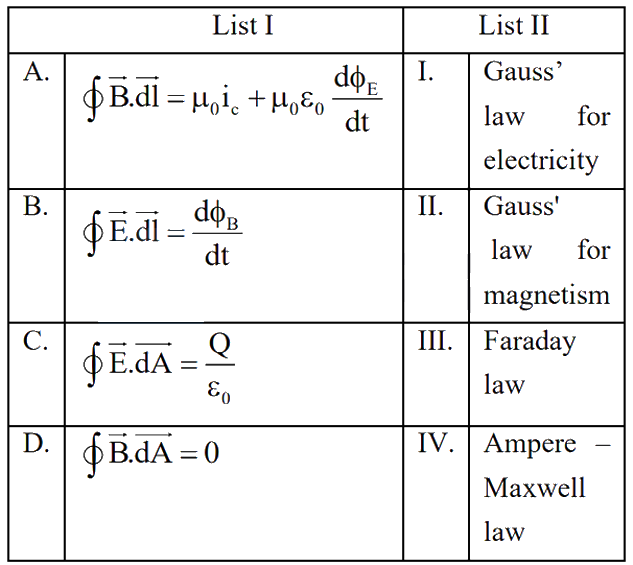
Chose the correct answer from the options given belowJEE Main/MCQ/Medium/Electric Flux and Gauss Law/With diagram - 282Two charges of and are situated at the points and respectively. The electric flux through a sphere of radius having centre at origin is:JEE Main/MCQ/Medium/Electric Flux and Gauss Law
- 283Let be the uniform surface charge density of two infinite thin plane sheets shown in figure. Then the electric fields in three different region and
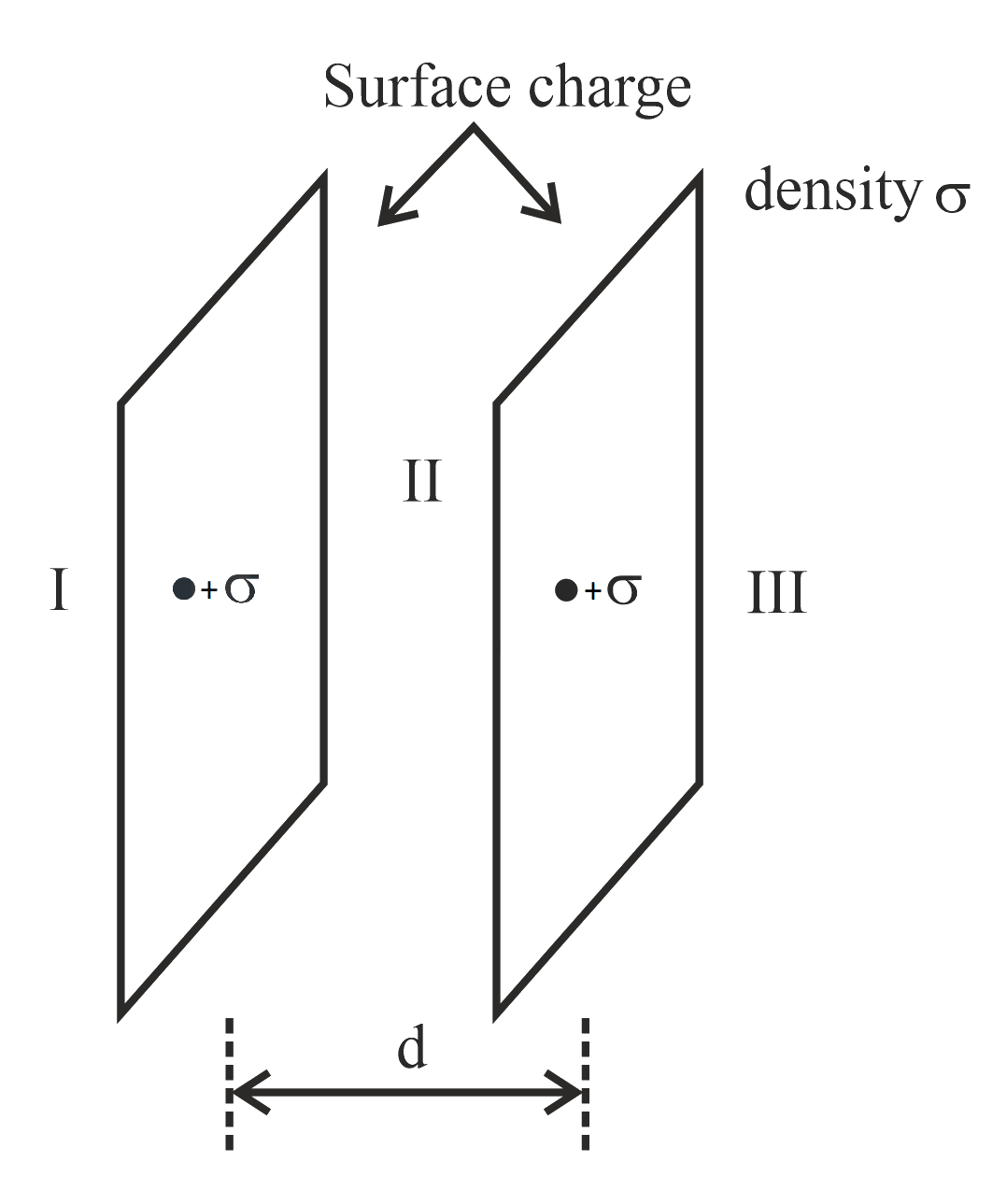 JEE Main/MCQ/Medium/Electric Flux and Gauss Law/With diagram
- 284Expression for an electric field is given by . The electric flux through the cube of side when placed in electric field (as shown in the figure) is ______ .
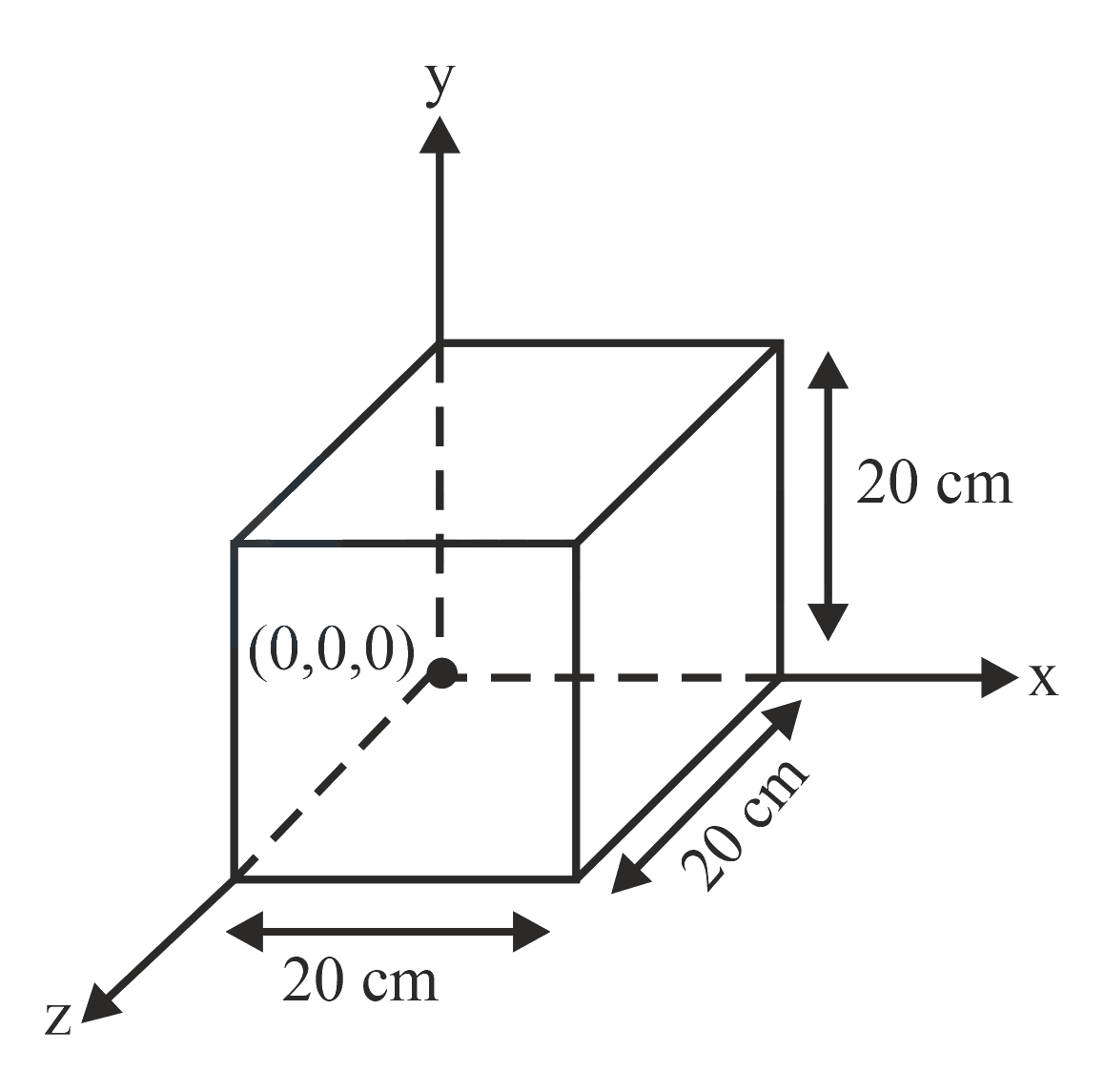 JEE Main/Numerical/Medium/Electric Flux and Gauss Law/With diagram
- 285As shown in figure, a cuboid lies in a region with electric field . The magnitude of charge within the cuboid is .
The value of is ______ (if dimension of cuboid is )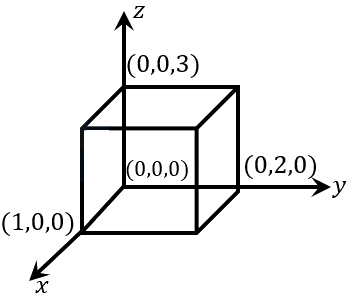 JEE Main/Numerical/Medium/Electric Flux and Gauss Law/With diagram
- 286In a cuboid of dimension , a charge is placed at the centre of the surface having area of . The flux through the opposite surface to is given byJEE Main/MCQ/Medium/Electric Flux and Gauss Law
- 287A long cylindrical volume contains a uniformly distributed charge of density . The electric field inside the cylindrical volume at a distance from its axis is _____ .
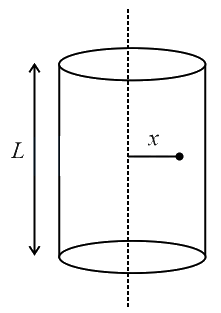 JEE Main/Numerical/Medium/Electric Flux and Gauss Law/With diagram
- 288The volume charge density of a sphere of radius is . The number of lines of force per unit surface area coming out from the surface of the sphere is _____
[Given : Permittivity of vacuum ]JEE Main/Numerical/Medium/Electric Flux and Gauss Law - 289If a charge is placed at the centre of a closed hemispherical non-conducting surface, the total flux passing through the flat surface would be
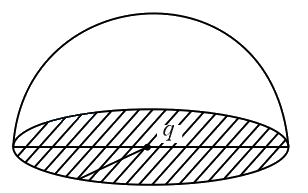 JEE Main/MCQ/Medium/Electric Flux and Gauss Law/With diagram
- 290A cube is placed inside an electric field, The side of the cube is and is placed in the field as shown in the given figure. The charge inside the cube is:
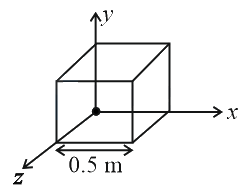 JEE Main/MCQ/Medium/Electric Flux and Gauss Law/With diagram
- 291A solid metal sphere of radius having charge is enclosed inside the concentric spherical shell of inner radius and outer radius as shown in the figure. The approximate variation electric field , as a function of distance , from centre , is given by:
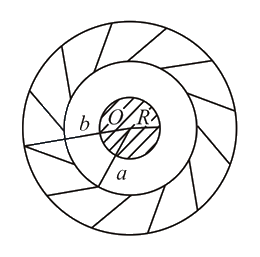 JEE Main/MCQ/Medium/Electric Flux and Gauss Law/With diagram
- 292The total charge enclosed in an incremental volume of located at the origin is if electric flux density of its field is found asJEE Main/Numerical/Medium/Electric Flux and Gauss Law
- 293The electric field in a region is given by with The flux of this field through a rectangular surface, area parallel to the plane is _______ .JEE Main/Numerical/Medium/Electric Flux and Gauss Law
- 294The electric field intensity is produced by the radiation coming from a bulb at a distance of is . The electric field intensity produced by the radiation coming from at the same distance is . Where the value of _________ .JEE Main/Numerical/Medium/Electric Flux and Gauss Law
- 295Find out the surface charge density at the intersection of point plane and -axis, in the region of uniform line charge of lying along the -axis in free space.JEE Main/MCQ/Medium/Electric Flux and Gauss Law
- 296A charge is placed at one corner of a cube as shown in figure. The flux of electrostatic field through the shaded area is:
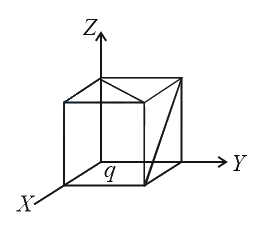 JEE Main/MCQ/Medium/Electric Flux and Gauss Law/With diagram
- 297The electric field in a region is given by . The ratio of flux of reported field through the rectangular surface of area (parallel to plane) to that of the surface of area (parallel to plane) is where [Here and are unit vectors along and -axes respectively]JEE Main/Numerical/Medium/Electric Flux and Gauss Law
- 298A point charge of is at a distance vertically above the centre of a square of side as shown in figure. The magnitude of the electric flux through the square will be _______
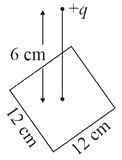 JEE Main/Numerical/Medium/Electric Flux and Gauss Law/With diagram
- 299An electric field passes through the box shown in figure. The flux of the electric field through surfaces and are marked as and respectively. The difference between is (in ) ____________.
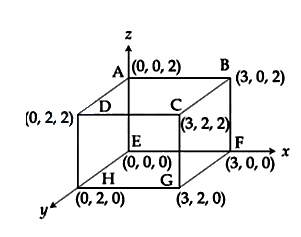 JEE Main/Numerical/Medium/Electric Flux and Gauss Law/With diagram
- 300In finding the electric field using Gauss law the formula is applicable. In the formula is permittivity of free space, is the area of Gaussian surface and is charge enclosed by the Gaussian surface. This equation can be used in which of the following situation?JEE Main/MCQ/Medium/Electric Flux and Gauss Law
- 301Let a total charge be distributed in a sphere of radius with the charge density given by where is the distance from the centre. Two charges and , of each, are placed on diametrically opposite points, at equal distance, a, from the centre. If and do not experience any force, then:JEE Main/MCQ/Medium/Electric Flux and Gauss Law
- 302Shown in the figure is a shell made of a conductor. It has inner radius and outer radius , and carries charge . At its centre a dipole is placed as shown then:
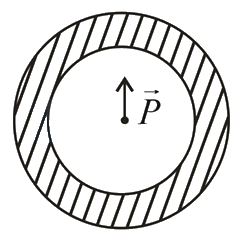 JEE Main/MCQ/Medium/Electric Flux and Gauss Law/With diagram
- 303A charge is placed at a distance above the centre of a square surface of side length . The electric flux through the square surface due to the charge would be?
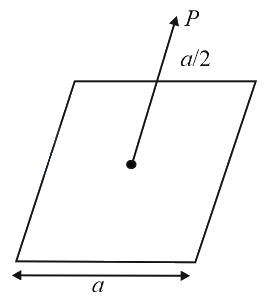 JEE Main/MCQ/Medium/Electric Flux and Gauss Law/With diagram
- 304A charge is placed at a distance above the centre of the square surface of edge a as shown in the figure. The electric flux through the square surface is:
 JEE Main/MCQ/Medium/Electric Flux and Gauss Law/With diagram
- 305Four closed surfaces and corresponding charge distributions are shown below.
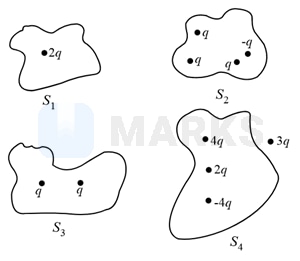
Let the respective electric fluxes through the surfaces be and . Then:JEE Main/MCQ/Medium/Electric Flux and Gauss Law/With diagram - 306The electric field in a region of space is given by, where . The flux of this field through a circular surface of radius parallel to the plane is nearlyJEE Main/MCQ/Medium/Electric Flux and Gauss Law
- 307A cone of base radius and height is located in a uniform electric field parallel to its base. The electric flux entering the cone is:JEE Main/MCQ/Medium/Electric Flux and Gauss Law
- 308The magnitude of the average electric field normally present in the atmosphere just above the surface of the Earth is about , directed inward towards the center of the Earth. This gives the total net surface charge carried by the Earth to be : [Given : ]JEE Main/MCQ/Medium/Electric Flux and Gauss Law
- 309The flat base of a hemisphere of radius a with no charge inside it lies in a horizontal plane. A uniform electric field is applied at an angle with the vertical direction. The electric flux through the curved surface of the hemisphere is
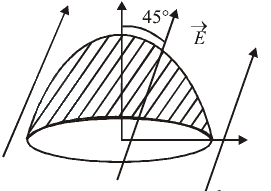 JEE Main/MCQ/Medium/Electric Flux and Gauss Law/With diagram
- 310If the electric flux entering and leaving an enclosed surface respectively is and , the electric charge inside the surface will beJEE Main/MCQ/Medium/Electric Flux and Gauss Law
- 311A charged particle is placed at the centre of cube of length (A B C D E F G H). Another same charge is placed at a distance from . Then the electric flux through is
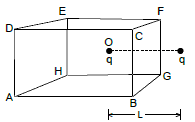 JEE Main/MCQ/Medium/Electric Flux and Gauss Law/With diagram
NEET question paper PDF
This chapter includes NEET questions. Open a year to read the full paper, or download the PDF.
Opening paper…
JEE Main question paper PDF
This chapter includes JEE Main questions. Open a shift to read the paper, or download the PDF.
Opening paper…
Other Physics chapters
Current Electricity 380Kinematics 308Ray Optics 295Rotational Motion 280Magnetic Effects & Magnetism 276Atoms & Nuclei 239Gravitation 223Laws of Motion 210Semiconductors 209Dual Nature of Matter 200Oscillations 194Fluid Mechanics 192Wave Optics 191Alternating Current 190Thermodynamics 190Work Energy Power 183Capacitors 180Kinetic Theory 168Electromagnetic Waves 165Electromagnetic Induction 153Units & Dimensions 149Waves 142Center of Mass, Momentum & Collision 130Thermal Properties of Matter 126Mathematics in Physics 121Mechanical Properties of Solids 118Experimental Physics 70Magnetic Properties of Matter 57Modern Physics 5
Stuck on a Electrostatics question from your book?
Snap it and get a whiteboard video that solves it step by step. Your first video needs no login.