Question 169 of 311
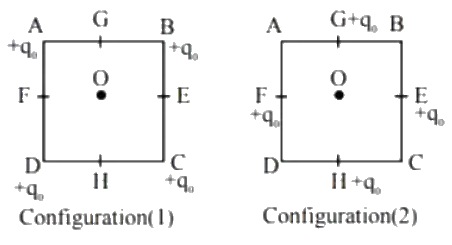
In the first configuration (1) as shown in the figure, four identical charges \(\left(q_0\right)\) are kept at the corners \(A, B, C\) and \(D\) of square of side length 'a'. In the second configuration (2), the same charges are shifted to mid points \(\mathrm{G}, \mathrm{E}, \mathrm{H}\) and F, of the square, If \(\mathrm{K}=\frac{1}{4 \pi \varepsilon_0}\), the difference between the potential energies of configuration (2) and (1) is given by :
Show answer and solution
Answer: (D)
\begin{aligned}
& u_{\oplus}=\left(2 \frac{K q_0}{a}+\frac{K q_0}{\sqrt{2} a}\right) q_0 \times 2 \\
& u_0=\left(2 \frac{K q_0 \sqrt{2}}{a}+\frac{K q_0}{a}\right) q_0 \times 2
\end{aligned}$
$\begin{aligned}
& \text { So, } \quad \Delta u=u_2-u_1=2 q_0 \frac{k q_0}{a}\left[2 \sqrt{2}+1-2-\frac{1}{\sqrt{2}}\right] \\
& \Rightarrow \quad \Delta u=\frac{2 q_0^2}{4 \pi \varepsilon_0 a}\left[\frac{4-\sqrt{2}-1}{\sqrt{2}}\right]=\frac{2 q_0^2}{4 \pi \varepsilon_0 a} \frac{(3-\sqrt{2})}{\sqrt{2}} \\
& \Rightarrow \quad \Delta u=\frac{2 k q_0^2}{a}\left[\frac{3-\sqrt{2}}{\sqrt{2}}\right]=\frac{k q_0^2}{a}(3 \sqrt{2}-2)
\end{aligned}
%20as%20shown%20in%20the%20figure%2C%20four%20identical%20charges%20%5C(%20(q0%20)%5C)%20are%20kept%20at%20the%20corners%20%5C(A%2C%20B%2C%20C%5C)%20and%20%5C(D%5C)%20of%20square%20of%20side%20length%20'a'.%20In%20the%20second%20configuration%20(2)%2C%20the%20same%20charges%20are%20shifted%20to%20mid%20points%20%5C(G%2C%20E%2C%20H%5C)%20and%20F%2C%20of%20the%20square%2C%20If%20%5C(K%3D(1)%2F(4%20%CF%80%200)%5C)%2C%20the%20difference%20between%20the%20potential%20energies%20of%20configuration%20(2)%20and%20(1)%20is%20given%20by%20%3A%0A(A)%20K%20q0%5E2a(4-2%20%E2%88%9A(2))%0A(B)%20K%20q0%5E2a(3-%E2%88%9A(2))%0A(C)%20Kq0%5E2a(4%20%E2%88%9A(2)-2)%0A(D)%20Kq0%5E2a(3%20%E2%88%9A(2)-2))