Physics · NEET, JEE Main
Atoms & Nuclei
239 practice questions with a worked solution for each. Tap an option to see instantly if you are right.
190MCQ49Numerical11With diagram
- 1The energy of an electron in the ground state of hydrogen atom is . In the first excited state (), its energy is:NEET/MCQ/Medium
- 2Nuclear force between two nucleons is:NEET/MCQ/Medium
- 3Given below are two statements : one is labelled as Assertion (A) and the other is labelled as Reason (R).
Assertion (A) : Emission of electrons in photoelectric effect can be suppressed by applying a sufficiently negative electron potential to the photoemissive substance.
Reason (R) : A negative electric potential, which stops the emission of electrons from the surface of a photoemissive substance, varies linearly with frequency of incident radiation.
In the light of the above statements, choose the most appropriate answer from the options given below :JEE Main/MCQ/Medium/Atomic Models - 4The mass defect in a particular reaction is . The amount of energy liberated is , where _____. (speed of light )JEE Main/Numerical/Medium/Atomic Models
- 5Given below are two statements:
Statement I: Most of the mass of the atom and all its positive charge are concentrated in a tiny nucleus and the electrons revolve around it, is Rutherford's model.
Statement II: An atom is a spherical cloud of positive charges with electrons embedded in it, is a special case of Rutherford's model.
In the light of the above statements, choose the most appropriate from the options given below.JEE Main/MCQ/Medium/Atomic Models - 6In Rutherford's alpha-particle scattering experiment, only a few alpha particles rebound back because
A. The size of gold nucleus is very small as compared to the size of gold atom.
B. Alpha particle and gold nucleus have equal charge.
C. The impact parameter is minimum for a few alpha particles.
D. A few alpha particles have very high kinetic energy.
E. Only a few alpha particles undergo head-on collision with the nuclei.
Choose the correct answer from the options given below:JEE Main/MCQ/Medium/Atomic Structure - 7If an alpha particle with energy 7.7 MeV is bombarded on a thin gold foil, the closest distance from nucleus it can reach is m. (Atomic number of gold and in SI units)JEE Main/MCQ/Medium/Atomic Structure
- 8Given below are two statements: one is labelled as Assertion A and the other is labelled as
Reason R.
Assertion A: The Bohr model is applicable to hydrogen and hydrogen-like atoms only.
Reason R : The formulation of Bohr model does not include repulsive force between electrons.
In the light of the above statements, choose the correct answer from the options given below :JEE Main/MCQ/Medium/Atomic Structure - 9Considering Bohr's atomic model for hydrogen atom :
(A) the energy of H atom in ground state is same as energy of ion in its first excited state.
(B) the energy of H atom in ground state is same as that for ion in its second excited state.
(C) the energy of H atom in its ground state is same as that of ion for its ground state.
(D) the energy of ion in its first excited state is same as that for ion in its ground state
Choose the correct answer from the options given below :JEE Main/MCQ/Medium/Atomic Structure - 10In an alpha particle scattering experiment distance of closest approach for the particle is . If target nucleus has atomic number 80 , then maximum velocity of - particle is _______ approximately.
SI unit, mass of particle JEE Main/Numerical/Medium/Atomic Structure - 11Read the following statements:
(A) Volume of the nucleus is directly proportional to the mass number.
(B) Volume of the nucleus is independent of mass number.
(C) Density of the nucleus is directly proportional to the mass number.
(D) Density of the nucleus is directly proportional to the cube root of the mass number.
(E) Density of the nucleus is independent of the mass number.
Choose the correct option from the following options.JEE Main/MCQ/Medium/Atomic Structure - 12 is the ratio of energies of photons produced due to transition of an electron of hydrogen atom from its
(i) third permitted energy level to the second level and
(ii) the highest permitted energy level to the second permitted level.
The value of will beJEE Main/Numerical/Medium/Atomic Structure - 13Hydrogen atom from excited state comes to the ground by emitting a photon of wavelength . The value of principal quantum number of the excited state will be :
( Rydberg constant)JEE Main/MCQ/Medium/Atomic Structure - 14 and are the impact parameters corresponding to scattering angles and respectively, when an particle is approaching a gold nucleus. For , the value of will be _____ .JEE Main/Numerical/Medium/Atomic Structure
- 15Choose the correct option from the following options given below :JEE Main/MCQ/Medium/Atomic Structure
- 16In Bohr's atomic model, the electron is assumed to revolve in a circular orbit of radius If the speed of electron is Then the current associated with the electron will be__________ [Take as JEE Main/Numerical/Medium/Atomic Structure
- 17Imagine that the electron in a hydrogen atom is replaced by a muon The mass of muon particle is times that of an electron and charge is equal to the charge of an electron. The ionization potential of this hydrogen atom will be:-JEE Main/MCQ/Medium/Atomic Structure
- 18A particle of mass moves in a circular orbit in a central potential field If Bohr's quantization conditions are applied, radii of possible orbitals vary with , where is _______ .JEE Main/Numerical/Medium/Atomic Structure
- 19The recoil speed of a hydrogen atom after it emits a photon in going from state to state will beJEE Main/MCQ/Medium/Atomic Structure
- 20Muon is negatively charged with a mass , where is the mass of the electron and e is the electronic charge. If is bound to a proton to form a hydrogen like atom, identify the correct statements
(A) Radius of the muonic orbit is 200 times smaller than that of the electron
(B) the speed of the in the th orbit is times that of the election in the nth orbit
(C) The lonization energy of muonic atom is 200 times more than that of an hydrogen atom
(D) The momentum of the muon in the nth orbit is 200 times more than that of the electronJEE Main/MCQ/Medium/Atomic Structure - 21A neutron moving with a speed 'v' makes a head on collision with a stationary hydrogen atom in ground state. The minimum kinetic energy of the neutron for which perfactly inelastic collision will take place is :JEE Main/MCQ/Medium/Atomic Structure
- 22If one were to apply the Bohr model to a particle of mass and charge moving in a plane under the influence of a magnetic field 'B', the energy of the charged particle in the level will be:JEE Main/MCQ/Medium/Atomic Structure
- 23A electron beam is used to bombard gaseous hydrogen at room temperature. It will emit:JEE Main/MCQ/Medium/Atomic Structure
- 24In the Rutherford experiment, -particles are scattered from a nucleus as shown. Out of the four paths, which path is not possible?
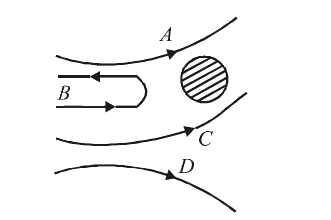 JEE Main/MCQ/Medium/Atomic Structure/With diagram
- 25An alpha nucleus of energy bombards a heavy nuclear target of charge Ze. Then the distance of closest approach for the alpha nucleus will be proportional toJEE Main/MCQ/Medium/Atomic Structure
- 26The manifestation of band structure in solids is due toJEE Main/MCQ/Medium/Atomic Structure
- 27The ratio of momentum of the photons of the and line of Balmer series of Hydrogen atoms is . The possible values of and are:-JEE Main/MCQ/Medium/Bohr's Atomic Model
- 28In the hydrogen atom, the electron makes a transition from the higher orbit () to a lower orbit (). The ratio of the radius of the orbits in given by . The wavelength of photon emitted due to this transition is _____ nm.
(Given Rydberg constant /m)JEE Main/MCQ/Medium/Bohr's Atomic Model - 29Using Bohr's model, calculate the ratio of the magnetic fields generated due to the motion of the electrons in the and orbits of hydrogen atom _______.JEE Main/Numerical/Medium/Bohr's Atomic Model
- 30Angular momentum of an electron in a hydrogen atom is , then the energy of the electron is _______ eV.JEE Main/MCQ/Medium/Bohr's Atomic Model
- 31Two electrons are moving in orbits of two hydrogen like atoms with speeds and respectively. If the radii of these orbits are nearly same then the possible order of energy states are respectively.JEE Main/MCQ/Medium/Bohr's Atomic Model
- 32The energy of an electron in an orbit of the Bohr's atom is where is the ground state energy. If is the angular momentum of the electron in this orbit and is the Planck's constant, then is :JEE Main/MCQ/Medium/Bohr's Atomic Model
- 33In a hydrogen like ion, the energy difference between the excitation energy state and ground is 108.8 eV. The atomic number of the ion isJEE Main/MCQ/Medium/Bohr's Atomic Model
- 34Considering the Bohr model of hydrogen like atoms, the ratio of the ratio of the radius orbit of the electron in and isJEE Main/MCQ/Medium/Bohr's Atomic Model
- 35An electron in the hydrogen atom initially in the fourth excited state makes a transition to energy state by emitting a photon of energy 2.86 eV. The integer value of will be ____.JEE Main/Numerical/Medium/Bohr's Atomic Model
- 36Assuming the validity of Bohr's atomic model for hydrogen like ions the radius of ion in its ground state is given by , where _______. (Where is the first Bohr's radius.)JEE Main/MCQ/Medium/Bohr's Atomic Model
- 37The frequency of revolution of the electron in Bohr's orbit varies with , the principal quantum number asJEE Main/MCQ/Medium/Bohr's Atomic Model
- 38Radius of a certain orbit of hydrogen atom is . If energy of electron in this orbit is . then _____
(Given energy of electron in ground state).JEE Main/Numerical/Medium/Bohr's Atomic Model - 39The angular momentum of an electron in a hydrogen atom is proportional to :
(Where is the radius of orbit of electron)JEE Main/MCQ/Medium/Bohr's Atomic Model - 40An electron rotates in a circle around a nucleus having positive charge Ze. Correct relation between total energy (E) of electron to its potential energy (U) is :JEE Main/MCQ/Medium/Bohr's Atomic Model
- 41According to Bohr's theory, the moment of momentum of an electron revolving in orbit of hydrogen atom is:JEE Main/MCQ/Medium/Bohr's Atomic Model
- 42An electron revolving in Bohr orbit has magnetic moment . If , the value of is:JEE Main/MCQ/Medium/Bohr's Atomic Model
- 43The ratio of the magnitude of the kinetic energy to the potential energy of an electron in the excited state of a hydrogen atom is :JEE Main/MCQ/Medium/Bohr's Atomic Model
- 44The radius of third stationary orbit of electron for Bohr's atom is . The radius of fourth stationary orbit will be:JEE Main/MCQ/Medium/Bohr's Atomic Model
- 45An atom absorbs a photon of wavelength and emits another photon of wavelength . The net energy absorbed by the atom in this process is . The value ofis [Assume the atom to be stationary during the absorption and emission process] (Take ).JEE Main/Numerical/Medium/Bohr's Atomic Model
- 46The radius of orbit of of Bohr's model is and that of fourth orbit of is represented as Now the ratio is The value of is _____.JEE Main/Numerical/Medium/Bohr's Atomic Model
- 47A electron beam is used to bombard gaseous hydrogen at room temperature. The number of spectral lines emitted will be:JEE Main/MCQ/Medium/Bohr's Atomic Model
- 48The energy of ion in its first state is, (The ground state energy for the Hydrogen atom):JEE Main/MCQ/Medium/Bohr's Atomic Model
- 49The angular momentum for the electron in Bohr’s orbit is . If the electron is assumed to revolve in second orbit of hydrogen atom, then the change in angular momentum will beJEE Main/MCQ/Medium/Bohr's Atomic Model
- 50The radius of fifth orbit of is_______\times {10}^{-12}m. Take: radius of hydrogen atomJEE Main/Numerical/Medium/Bohr's Atomic Model
- 51Nucleus a having and equal number of protons and neutrons has binding energy per nucleon. Another nucleus of has total nucleons and binding energy per nucleons. The difference of binding energy of and will be ______ .JEE Main/Numerical/Medium/Bohr's Atomic Model
- 52An electron of a hydrogen like atom, having , jumps from energy state to energy state, The energy released in this process, will be: (Given )
Where Rydberg
constant Speed of light in vacuum
Planck's constantJEE Main/MCQ/Medium/Bohr's Atomic Model - 53A light of energy is incident on a hydrogen atom in its ground state. The atom absorbs the radiation and reaches to one of its excited states. The angular momentum of the atom in the excited state is . The value of is ______ (use )JEE Main/Numerical/Medium/Bohr's Atomic Model
- 54The mass of proton, neutron and helium nucleus are respectively . The binding energy of helium nucleus is:JEE Main/MCQ/Medium/Bohr's Atomic Model
- 55The radius of electron's second stationary orbit in Bohr's atom is . The radius of orbit will beJEE Main/MCQ/Medium/Bohr's Atomic Model
- 56For hydrogen atom, and are the wavelengths corresponding to the transitions and respectively as shown in figure. The ratio of and is . The value of is ______.
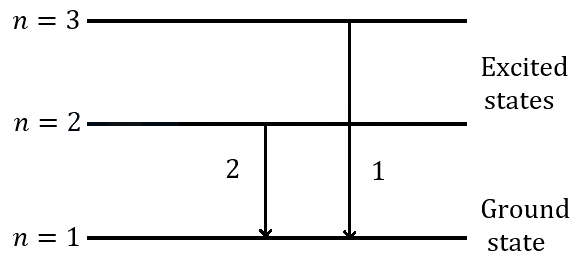 JEE Main/Numerical/Medium/Bohr's Atomic Model/With diagram
- 57Speed of an electron in Bohr’s orbit for Hydrogen atom is . The corresponding speed of the electron in orbit, in is :JEE Main/MCQ/Medium/Bohr's Atomic Model
- 58The momentum of an electron revolving in orbit is given by : (Symbols have their usual meanings)JEE Main/MCQ/Medium/Bohr's Atomic Model
- 59Given below are two statements
Statement I: In hydrogen atom, the frequency of radiation emitted when an electron jumps from lower energy orbit to higher energy orbit , is given as
Statement II: The jumping of electron from higher energy orbit to lower energy orbit is associated with frequency of radiation given as . This condition is Bohr's frequency condition.
In the light of the above statements, choose the correct answer from the options given below:JEE Main/MCQ/Medium/Bohr's Atomic Model - 60A hydrogen atom in its ground state absorbs of energy. The angular momentum of electron of the hydrogen atom will increase by the value of (Given, Planck's constant ).JEE Main/MCQ/Medium/Bohr's Atomic Model
- 61Which of the following figure represents the variation of with (if radius of a nucleus and its mass number)JEE Main/MCQ/Medium/Bohr's Atomic Model
- 62The ratio for the speed of the electron in the orbit of to the speed of the electron in the orbit of hydrogen atom will be :JEE Main/MCQ/Medium/Bohr's Atomic Model
- 63In Bohr's atomic model of hydrogen, let and are the kinetic energy, potential energy and total energy of the electron respectively. Choose the correct option when the electron undergoes transitions to a higher level :JEE Main/MCQ/Medium/Bohr's Atomic Model
- 64The X-ray of molybdenum has wavelength . If the energy of a molybdenum atom with a electron knocked out is , the energy of this atom when an electron is knocked out will be . (Round off to the nearest integer ) JEE Main/Numerical/Medium/Bohr's Atomic Model
- 65The radiation corresponding to transition of a hydrogen atom falls on a gold surface to generate photoelectrons. These electrons are passed through a magnetic field of . Assume that the radius of the largest circular path followed by these electrons is , the work function of the metal is:
(Mass of electron )JEE Main/MCQ/Medium/Bohr's Atomic Model - 66Which level of the single ionized carbon has the same energy as the ground state energy of hydrogen atom?JEE Main/MCQ/Medium/Bohr's Atomic Model
- 67If an electron is moving in the orbit of the hydrogen atom, then its velocity for the orbit is given as:JEE Main/MCQ/Medium/Bohr's Atomic Model
- 68According to Bohr atom model, in which of the following transitions will the frequency be maximum?JEE Main/MCQ/Medium/Bohr's Atomic Model
- 69The energy required to ionise a hydrogen like ion in its ground state is Rydbergs. What is the wavelength of the radiation emitted when the electron in this ion jumps from the second excited stale to the ground state?JEE Main/MCQ/Medium/Bohr's Atomic Model
- 70The electron in a hydrogen atom first jumps from the third excited state to the second excited state and subsequently to the first excited state. The ratio of the respective wavelengths of the photons emitted in this process is:JEE Main/MCQ/Medium/Bohr's Atomic Model
- 71An excited ion emits two photons in succession, with wavelengths and in making a transition to the ground state. The quantum number , corresponding to its initial excited state is
(for a photon of wavelength , energy )JEE Main/MCQ/Medium/Bohr's Atomic Model - 72In,electron in first Bohr orbit is excited to a level by a radiation of wavelength.When the ion gets de excited to the ground state in all possible ways (including intermediate emissions), a total of six spectral lines are observed. What is the value of ?
(Given: )JEE Main/MCQ/Medium/Bohr's Atomic Model - 73A ion is in its first excited state. Its ionization energy is:JEE Main/MCQ/Medium/Bohr's Atomic Model
- 74Radiation coming from transitions to of hydrogen atoms fall on ions in and states. The possible transition of helium ions as they absorb energy from the radiation is:JEE Main/MCQ/Medium/Bohr's Atomic Model
- 75In a Frank - Hertz experiment, an electron of energy passes through mercury vapour and emerges with an energy The minimum wavelength of photons emitted by mercury atoms is close to:JEE Main/MCQ/Medium/Bohr's Atomic Model
- 76A particle of mass moves in a circular orbit in a central potential field If Bohr's quantization conditions are applied, radii of possible orbitals and energy levels vary with quantum number as:JEE Main/MCQ/Medium/Bohr's Atomic Model
- 77In a hydrogen like atom, when an electron jumps from the M-shell to the L-shell, the wavelength of emitted radiation is . If an electron jumps from -shell to the -shell, the wavelength of emitted radiation will be:JEE Main/MCQ/Medium/Bohr's Atomic Model
- 78A hydrogen atom, initially in the ground state is excited by absorbing a photon of wavelength . The radius of the atom in the excited state, in terms of Bohr radius , will be:JEE Main/MCQ/Medium/Bohr's Atomic Model
- 79The energy required to remove the electron from a singly ionized Helium atom is times the energy required to remove an electron from helium atom. The total energy required to ionize the Helium atom completely is close toJEE Main/MCQ/Medium/Bohr's Atomic Model
- 80The energy required to remove the electron from a singly ionized Helium atom is times the energy required to remove an electron from Helium atom. The total energy required to ionize the Helium atom completely is:JEE Main/MCQ/Medium/Bohr's Atomic Model
- 81The acceleration of an electron in the first orbit of the hydrogen atom () is :JEE Main/MCQ/Medium/Bohr's Atomic Model
- 82According to Bohr's theory, the time averaged magnetic field at the centre (i.e., nucleus) of a hydrogen atom due to the motion of electrons in the orbit is proportional to: ( principal quantum number)JEE Main/MCQ/Medium/Bohr's Atomic Model
- 83If the binding energy of the electron in a hydrogen atom is , the energy required to remove the electron from the first excited state of is :JEE Main/MCQ/Medium/Bohr's Atomic Model
- 84In the Bohr's model of hydrogen-like atom the force between the nucleus and the electron is modified as , where is a constant. For this atom, the radius of the orbit in terms of the Bohr radius is :JEE Main/MCQ/Medium/Bohr's Atomic Model
- 85Orbits of a particle moving in a circle are such that the perimeter of the orbit equals an integer number of de-Broglie wavelengths of the particle. For a charged particle moving in a plane perpendicular to a magnetic field, the radius of the orbital will therefore be proportional to :JEE Main/MCQ/Medium/Bohr's Atomic Model
- 86In the Bohr model an electron moves in a circular orbit around the proton. Considering the orbiting electron to be a circular current loop, the magnetic moment of the hydrogen atom, when the electron is in excited state, is :JEE Main/MCQ/Medium/Bohr's Atomic Model
- 87In a hydrogen like atom electron makes transition from an energy level with quantum number to another with quantum number . If , the frequency of radiation emitted is proportional to :JEE Main/MCQ/Medium/Bohr's Atomic Model
- 88Which of the plots shown in the figure represents speed of the electron in a hydrogen atom as a function of the principal quantum number ?
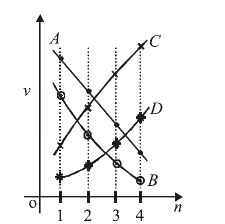 JEE Main/MCQ/Medium/Bohr's Atomic Model/With diagram
- 89Ionisation energy of Li (Lithium) atom in ground state is . Binding energy of an electron in ion in ground state is . Energy required to remove all three electrons of Lithium (Li) atom isJEE Main/MCQ/Medium/Bohr's Atomic Model
- 90A diatomic molecule is made of two masses and which are separated by a distance . If we calculate its rotational energy by applying Bohr's rule of angular momentum quantization, its energy will be given by ( is an integer)JEE Main/MCQ/Medium/Bohr's Atomic Model
- 91Energy required for the electron excitation in from the first to the third Bohr orbit is :JEE Main/MCQ/Medium/Bohr's Atomic Model
- 92Suppose an electron is attracted towards the origin by a force where ' ' is a constant and ' ' is the distance of the electron from the origin. By applying Bohr model to this system, the radius of the orbital of the electron is found to be ' ' and the kinetic energy of the electron to be . Then which of the following is true?JEE Main/MCQ/Medium/Bohr's Atomic Model
- 93Which of the following transitions in hydrogen atoms emit photons of highest frequency?JEE Main/MCQ/Medium/Bohr's Atomic Model
- 94If the binding energy of the electron in a hydrogen atom is , the energy required to remove the electron from the first excited state of isJEE Main/MCQ/Medium/Bohr's Atomic Model
- 95Which of the following atoms has the lowest ionization potential?JEE Main/MCQ/Medium/Bohr's Atomic Model
- 96If energy is required to ionize the hydrogen atom, then the energy required to remove an electron from isJEE Main/MCQ/Medium/Bohr's Atomic Model
- 97In hydrogen atom spectrum, Rydberg's constant A. the maximum wavelength of the radiation of Lyman series is B. the Balmer series lies in the visible region of the spectrum C. the minimum wavelength of the radiation of Paschen series is D. the minimum wavelength of Lyman series is Choose the correct answer from the options given below :JEE Main/MCQ/Medium/Atomic Spectrum
- 98The smallest wavelength of Lyman series is 91 nm. The difference between the largest wavelengths of Paschen and Balmer series is nearly nm .JEE Main/MCQ/Medium/Atomic Spectrum
- 99For a hydrogen atom, the ratio of the largest wavelength of Lyman series to that of the Balmer series is.JEE Main/MCQ/Medium/Atomic Spectrum
- 100The number of spectral lines emitted by atomic hydrogen that is in the energy level, isJEE Main/MCQ/Medium/Atomic Spectrum
- 101Arrange the following in the ascending order of wavelength :
(A) Microwaves
(B) Ultraviolet rays
(C) Infrared rays
(D) X-rays
Choose the most appropriate answer from the options given below :JEE Main/MCQ/Medium/Atomic Spectrum - 102During the transition of electron from state A to state C of a Bohr atom, the wavelength of emitted radiation is and it becomes when the electron jumps from state B to state C. Then the wavelength of the radiation emitted during the transition of electrons from state A to state B isJEE Main/MCQ/Medium/Atomic Spectrum
- 103A hydrogen atom in ground state is given an energy of . How many spectral lines will be emitted due to transition of electrons?JEE Main/MCQ/Medium/Atomic Spectrum
- 104In Franck-Hertz experiment, the first dip in the current-voltage graph for hydrogen is observed at 10.2 V. The wavelength of light emitted by hydrogen atom when excited to the first excitation level is _________ . (Given ).JEE Main/Numerical/Medium/Atomic Spectrum
- 105The longest wavelength associated with Paschen series is : (Given unit)JEE Main/MCQ/Medium/Atomic Spectrum
- 106The ratio of the shortest wavelength of Balmer series to the shortest wavelength of Lyman series for hydrogen atom is :JEE Main/MCQ/Medium/Atomic Spectrum
- 107The shortest wavelength of the spectral lines in the Lyman series of hydrogen spectrum is . The longest wavelength of spectral lines in the Balmer series will be _____ .JEE Main/Numerical/Medium/Atomic Spectrum
- 108A hydrogen atom changes its state from to . Due to recoil, the percentage change in the wave length of emitted light is approximately . The value of is_____.
[Given mass of the hydrogenatom ]JEE Main/Numerical/Medium/Atomic Spectrum - 109A particular hydrogen - like ion emits the radiation of frequency when it makes transition from to The frequency of radiation emitted in transition from to is when _____.JEE Main/Numerical/Medium/Atomic Spectrum
- 110The minimum energy required by a hydrogen atom in ground state to emit radiation in Balmer series is nearly :JEE Main/MCQ/Medium/Atomic Spectrum
- 111If the wavelength of the first member of Lyman series of hydrogen is . The wavelength of the second member will beJEE Main/MCQ/Medium/Atomic Spectrum
- 112An electron of hydrogen atom on an excited state is having energy . The maximum number of allowed transitions to lower energy level is _______.JEE Main/Numerical/Medium/Atomic Spectrum
- 113Hydrogen atom is bombarded with electrons accelerated through a potential different of , which causes excitation of hydrogen atoms. If the experiment is being formed at . The minimum potential difference needed to observe any Balmer series lines in the emission spectra will be , where _________.(Write the value to the nearest integer)JEE Main/Numerical/Medium/Atomic Spectrum
- 114When a hydrogen atom going from to emits a photon, its recoil speed is . Where _______. (Use: mass of hydrogen atom , charge of electron JEE Main/Numerical/Medium/Atomic Spectrum
- 115If Rydberg's constant is , the longest wavelength of radiation in Paschen series will be , where ______.JEE Main/Numerical/Medium/Atomic Spectrum
- 116As per given figure and are the first, second and third excited energy levels of hydrogen atom respectively. If the ratio of the two wavelengths is , then the value of will be
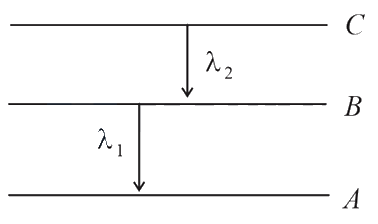 JEE Main/Numerical/Medium/Atomic Spectrum/With diagram
- 117A monochromatic light is incident on a hydrogen sample in ground state. Hydrogen atoms absorb a fraction of light and subsequently emit radiation of six different wavelengths. The frequency of incident light is . The value of x is ________
(Given )JEE Main/Numerical/Medium/Atomic Spectrum - 118If be the lowest wavelength of Lyman series then the lowest wavelength of Balmer series will be .JEE Main/Numerical/Medium/Atomic Spectrum
- 119The ratio of wavelength of spectral lines and in the Balmer series is . The value of is _____.JEE Main/Numerical/Medium/Atomic Spectrum
- 120The energy levels of an hydrogen atom are shown below. The transition corresponding to emission of shortest wavelength is
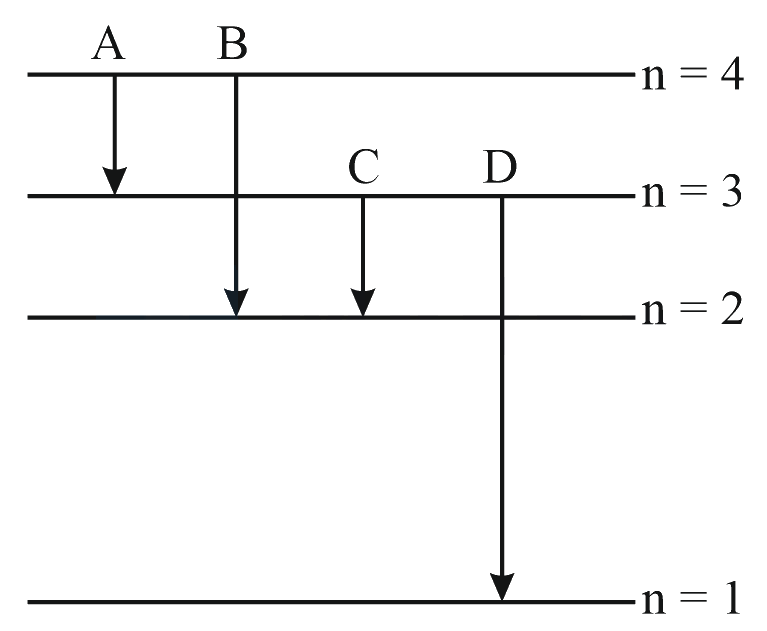 JEE Main/MCQ/Medium/Atomic Spectrum/With diagram
- 121The energy levels of an atom is shown is figure.
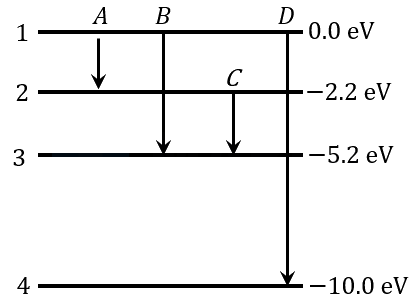
Which one of these transitions will result in the emission of a photon of wavelength ?
Given ()JEE Main/MCQ/Medium/Atomic Spectrum/With diagram - 122The wavelength of the radiation emitted is when an electron jumps from the second excited state to the first excited state of hydrogen atom. If the electron jumps from the third excited state to the second orbit of the hydrogen atom, the wavelength of the radiation emitted will be . The value of is________.JEE Main/Numerical/Medium/Atomic Spectrum
- 123A photon is emitted in transition from level in hydrogen atom. The corresponding wavelength for this transition is (given, )JEE Main/MCQ/Medium/Atomic Spectrum
- 124Find the ratio of energies of photons produced due to transition of an election of hydrogen atom from its(i) second permitted energy level to the first level, and (ii) the highest permitted energy level to the first permitted level.JEE Main/MCQ/Medium/Atomic Spectrum
- 125In a hydrogen spectrum be the wavelength of first transition line of Lyman series. The wavelength difference will be "" between the wavelength of transition line of Paschen series and that of transition line of Balmer Series where _____.JEE Main/Numerical/Medium/Atomic Spectrum
- 126A beam of monochromatic light is used to excite the electron in from the first orbit to the third orbit. The wavelength of monochromatic light is found to be . The value of is _____ .
[Given ]JEE Main/Numerical/Medium/Atomic Spectrum - 127A free electron of energy collides with a ion. This results in the formation of a hydrogen atom in the first excited state and a photon is released. Find the frequency of the emitted photon. JEE Main/MCQ/Medium/Atomic Spectrum
- 128 different wavelength may be observed in the spectrum from a hydrogen sample if the atoms are excited to states with principal quantum number ? The value of isJEE Main/Numerical/Medium/Atomic Spectrum
- 129A particular hydrogen like ion emits radiation of frequency when it makes transition from to . The frequency in of radiation emitted in transition from to will be:JEE Main/MCQ/Medium/Atomic Spectrum
- 130The atomic hydrogen emits a line spectrum consisting of various series. Which series of hydrogen atomic spectra is lying in the visible region?JEE Main/MCQ/Medium/Atomic Spectrum
- 131The first three spectral lines of -atom in the Balmer series are given considering the Bohr atomic model, the wave lengths of first and third spectral lines are related by a factor of approximately . The value of , to the nearest integer, is ________.JEE Main/Numerical/Medium/Atomic Spectrum
- 132If and are the wavelengths of the third member of Lyman and first member of the Paschen series respectively, then the value of is :JEE Main/MCQ/Medium/Atomic Spectrum
- 133The wavelength of the photon emitted by a hydrogen atom when an electron makes a transition from to state is:JEE Main/MCQ/Medium/Atomic Spectrum
- 134In the given figure, the energy levels of hydrogen atom have been shown along with some transitions marked and .
The transitions and respectively represent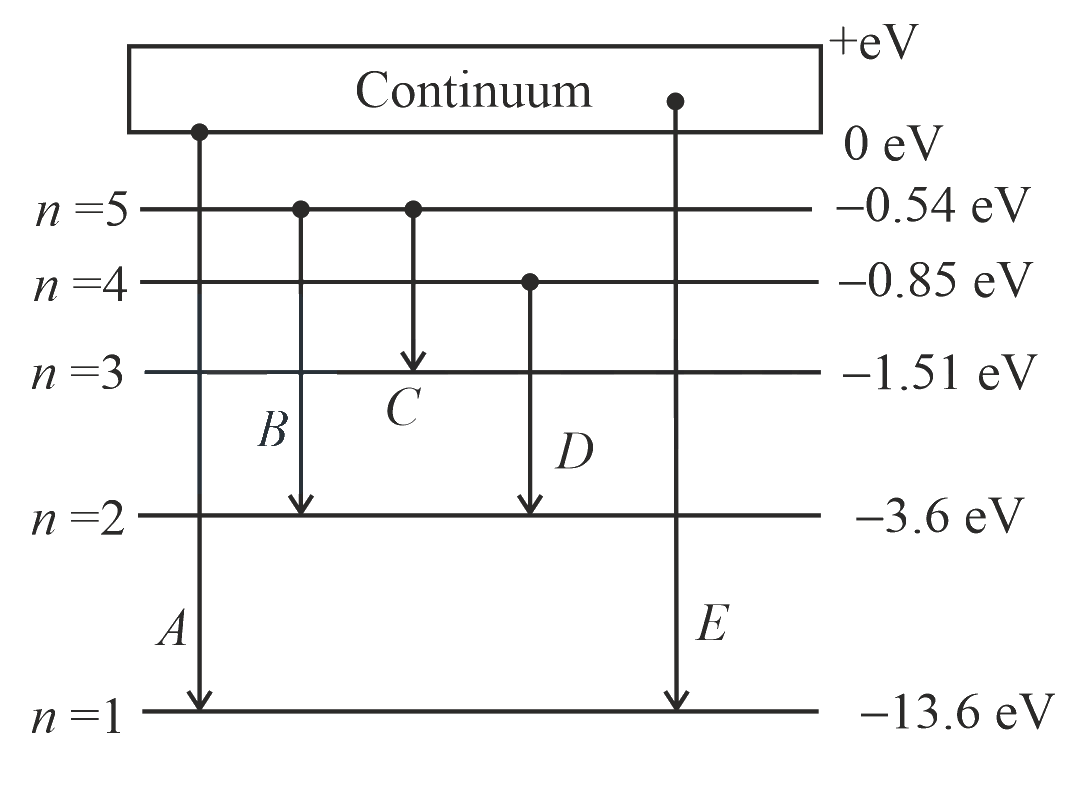 JEE Main/MCQ/Medium/Atomic Spectrum/With diagram
- 135In the line spectra of hydrogen atom, difference between the largest and the shortest wavelengths of the Lyman series is . The corresponding difference for the Paschan series in is:________JEE Main/Numerical/Medium/Atomic Spectrum
- 136In a hydrogen atom the electron makes a transition from level to the level. If , the frequency of radiation emitted is proportional to :JEE Main/MCQ/Medium/Atomic Spectrum
- 137The first member of the Balmer series of hydrogen atom has a wavelength of . The wavelength of the second member of the Balmer series (in nm) is_____________JEE Main/Numerical/Medium/Atomic Spectrum
- 138The time period of revolution of electron in its ground state orbit in a hydrogen atom is The frequency of revolution of the electron in its first excited state (in ) is:JEE Main/MCQ/Medium/Atomic Spectrum
- 139Taking the wavelength of first Balmer line in hydrogen spectrum to as , the wavelength of the Balmer line to will be :JEE Main/MCQ/Medium/Atomic Spectrum
- 140Both the nucleus and the atom of some element are in their respective first excited states. They get de-excited by emitting photons of wavelengths respectively. The ratio is closest to:JEE Main/MCQ/Medium/Atomic Spectrum
- 141Two electrons are moving with non-relativistic speeds perpendicular to each other. If corresponding de Broglie wavelengths are and , their de Broglie wavelength in the frame of reference attached to their centre of mass is:JEE Main/MCQ/Medium/Atomic Spectrum
- 142If the series limit frequency of the Lyman series is then the series limit frequency of the Pfund series is:JEE Main/MCQ/Medium/Atomic Spectrum
- 143An electron from various excited states of hydrogen atom emit radiation to come to the ground state. Let be the de Broglie wavelength of the electron in the state and the ground state respectively. Let be the wavelength of the emitted photon in the transition from the state to the ground state. For large n, (A, B are constants)JEE Main/MCQ/Medium/Atomic Spectrum
- 144Some energy levels of a molecule are shown in the figure. The ratio of the wavelengths , is given by:
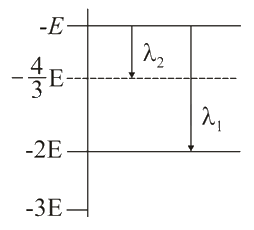 JEE Main/MCQ/Medium/Atomic Spectrum/With diagram
- 145An electron in a hydrogen atom makes a transition from to and emits a photon. This photon strikes a doubly ionized lithium atom which was already in an excited state and completely removes the orbiting electron. The least quantum number for the excited state of the lithium-ion for the process isJEE Main/MCQ/Medium/Atomic Spectrum
- 146As an electron makes a transition from an excited state to the ground state of a hydrogen-like atom/ionJEE Main/MCQ/Medium/Atomic Spectrum
- 147Match the List-I (Phenomenon associated with electromagnetic radiation) with List-II (Part of electromagnetic spectrum) and select the correct code from the choices given below this lists:
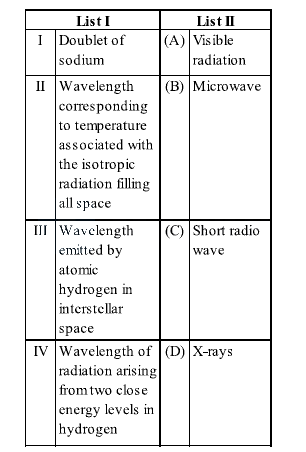 JEE Main/MCQ/Medium/Atomic Spectrum/With diagram
- 148Hydrogen (1H1), Deuterium (1H2), singly ionised Helium (2He4)+ and doubly ionised lithium (3Li6)++ all have one electron around the nucleus. Consider an electron transition from to . If the wave lengths of emitted radiation are and respectively then approximately which one of the following is correct ?JEE Main/MCQ/Medium/Atomic Spectrum
- 149The radiation corresponding to transition of hydrogen atom falls on a metal surface to produce photoelectrons. These electrons are made to enter a magnetic field of . If the radius of the largest circular path followed by these electrons is 10.0 mm, the work function of the metal is close to :JEE Main/MCQ/Medium/Atomic Spectrum
- 150A doubly ionised atom is excited from its ground to state. The wavelengths of the spectral lines are given by and . The ratio and are, respectivelyJEE Main/MCQ/Medium/Atomic Spectrum
- 151A hypothetical atom has only three energy levels. The ground level has energy, . The two excited states have energies, and . Then which of the following wavelengths will not be present in the emission spectrum of this atom?JEE Main/MCQ/Medium/Atomic Spectrum
- 152The electron of a hydrogen atom makes a transition from the orbit to the orbit. For large the wavelength of the emitted radiation is proportional toJEE Main/MCQ/Medium/Atomic Spectrum
- 153Hydrogen atom is excited from ground state to another state with principal quantum number equal to . Then the number of spectral lines in the emission spectra will beJEE Main/MCQ/Medium/Atomic Spectrum
- 154The transition from the state to in a hydrogen like atom results in ultraviolet radiation. Infrared radiation will be obtained in the transition fromJEE Main/MCQ/Medium/Atomic Spectrum
- 155The diagram shows the energy levels for an electron in a certain atom. Which transition shown represents the emission of a photon with the most energy ?
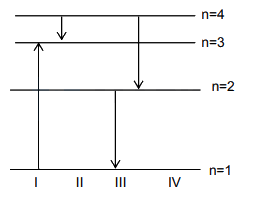 JEE Main/MCQ/Medium/Atomic Spectrum/With diagram
- 156The wavelengths involved in the spectrum of deuterium are slightly different from that of hydrogen spectrum, becauseJEE Main/MCQ/Medium/Atomic Spectrum
- 157A nucleus has mass number and radius . Another nucleus has mass number and radius . If then is:JEE Main/MCQ/Medium/Nuclear structure
- 158An atom is bombarded by shower of fundamental particles and in 10 s this atom absorbed 10 electrons, 10 protons and 9 neutrons. The percentage growth in the surface area of the nucleons is recorded by:JEE Main/MCQ/Medium/Nuclear structure
- 159Which of the following pair of nuclei are isobars of the element?JEE Main/MCQ/Medium/Nuclear structure
- 160-particle scatters from a target material of atomic number 79. From the given data the estimated diameter of nuclei of the target material is (approximately) m. and electron charge JEE Main/MCQ/Medium/Nuclear structure
- 161For a nucleus of mass number and radius , the mass density of nucleus can be represented asJEE Main/MCQ/Medium/Nuclear structure
- 162Given below are two statements: one is labelled as Assertion (A) and the other is labelled as Reason (R).
Assertion (A) : The density of the copper nucleus is greater than that of the carbon nucleus.
Reason (R): The nucleus of mass number A has a radius proportional to .
In the light of the above statements, choose the most appropriate answer from the options given below :JEE Main/MCQ/Medium/Nuclear structure - 163Choose the correct nuclear process from the below options
[p: proton, n : neutron, : electron, : positron, neutrino, : antineutrino]JEE Main/MCQ/Medium/Nuclear structure - 164From the statements given below :
(A) The angular momentum of an electron in orbit is an integral multiple of .
(B) Nuclear forces do not obey inverse square law.
(C) Nuclear forces are spin dependent.
(D) Nuclear forces are central and charge independent.
(E) Stability of nucleus is inversely proportional to the value of packing fraction.
Choose the correct answer from the options given below :JEE Main/MCQ/Medium/Nuclear structure - 165The radius of a nucleus of mass number is fermi. Then the mass number of another nucleus having radius of fermi is where is _________.JEE Main/Numerical/Medium/Nuclear structure
- 166A nucleus has mass number and volume . Another nucleus has mass number and volume . If relation between mass number is , then _______.JEE Main/Numerical/Medium/Nuclear structure
- 167The mass number of nucleus having radius equal to half of the radius of nucleus with mass number is:JEE Main/MCQ/Medium/Nuclear structure
- 168A free neutron decays into a proton but a free proton does not decay into neutron. This is becauseJEE Main/MCQ/Medium/Nuclear structure
- 169Given below are two statements : one is labelled as Assertion A and the other is labelled as Reason R
Assertion A : The nuclear density of nuclides can be arranged as
Reason R : The radius of nucleus is related to its mass number as , where is a constant.
In the light of the above statement, choose the correct answer from the options given below :JEE Main/MCQ/Medium/Nuclear structure - 170The ratio of the density of oxygen nucleus and helium nucleus isJEE Main/MCQ/Medium/Nuclear structure
- 171Assume that protons and neutrons have equal masses. Mass of a nucleon is and radius of nucleus is . The approximate ratio of the nuclear density and water density is . The value of is _____.JEE Main/Numerical/Medium/Nuclear structure
- 172Mass numbers of two nuclei are in the ratio of . Their nuclear densities will be in the ratio ofJEE Main/MCQ/Medium/Nuclear structure
- 173Consider the following statements:
. Atoms of each element emit characteristics spectrum.
According to Bohr's Postulate, an electron in a hydrogen atom revolves in a certain stationary orbit.
The density of nuclear matter depends on the size of the nucleus.
A free neutron is stable but a free proton decay is possible.
Radioactivity is an indication of the instability of nuclei. Choose the correct answer from the options given below.JEE Main/MCQ/Medium/Nuclear structure - 174The radius of a nucleus of mass number can be estimated by the formula . It follows that the mass density of n nucleus is of the order of: JEE Main/MCQ/Medium/Nuclear structure
- 175The ratio of mass densities of nuclei of and is close to:JEE Main/MCQ/Medium/Nuclear structure
- 176Which of the following Statements is correct?JEE Main/MCQ/Medium/Nuclear structure
- 177If radius of nucleus is estimated to be Fermi then the radius nucleus be nearlyJEE Main/MCQ/Medium/Nuclear structure
- 178A nucleus disintegrates into two nuclear parts which have their velocities in the ratio . The ratio of their nuclear sizes will beJEE Main/MCQ/Medium/Nuclear structure
- 179The energy released if hydrogen atoms are combined to form is __________ MeV. (Take binding energies per nucleon of and as MeV and MeV, respectively)JEE Main/MCQ/Medium/Nuclear energy
- 180The energy released when kg of is converted into by proton bombardment is eV. The value of is _______. (Nearest integer) (Mass of u, mass of u, mass of proton u and u MeV/c and Avogadro number )JEE Main/Numerical/Medium/Nuclear energy
- 181Assuming the experimental mass of as , the mass defect of atom is _______ .
(Mass of proton , mass of neutron , and is the speed of the light in vacuum).JEE Main/MCQ/Medium/Nuclear energy - 182Two nuclei of mass number combine with another nucleus of mass number to yield a nucleus of mass number . If the binding energy per nucleon for the mass numbers , and are MeV, MeV and MeV, respectively, then in the process, _____ MeV.JEE Main/MCQ/Medium/Nuclear energy
- 183The binding energy per nucleon of is _______ MeV.
JEE Main/MCQ/Medium/Nuclear energy - 184The binding energy for the following nuclear reactions are expressed in MeV.
If denote the stability of and , respectively, then the correct order is :JEE Main/MCQ/Medium/Nuclear energy - 185Given below are two statements:
Statement I: For all elements, greater the mass of the nucleus, greater is the binding energy per nucleon.
Statement II: For all elements, nuclei with less binding energy per nucleon transforms to nuclei with greater binding energy per nucleon.
In the light of the above statements, choose the correct answer from the options given belowJEE Main/MCQ/Medium/Nuclear energy - 186The minimum frequency of photon required to break a particle of mass 15.348 amu into particles is kHz.
[mass of He nucleus = and ]JEE Main/MCQ/Medium/Nuclear energy - 187Energy released when two deuterons fuse to form a helium nucleus is :
(Given : Binding energy per nucleon of and binding energy per nucleon of )JEE Main/MCQ/Medium/Nuclear energy - 188Given below are two statements. One is labelled as Assertion (A) and the other is labelled as Reason (R).
Assertion (A) : The binding energy per nucleon is found to be practically independent of the atomic number A, for nuclei with mass numbers between 30 and 170.
Reason (R): Nuclear force is long range.
In the light of the above statements, choose the correct answer from the options given below :JEE Main/MCQ/Medium/Nuclear energy - 189A nucleus at rest disintegrates into two smaller nuclei with their masses in the ratio of . After disintegration they will move :JEE Main/MCQ/Medium/Nuclear energy
- 190A star has helium composition. It starts to convert three into one via triple alpha process as . The mass of the star is and it generates energy at the rate of . The rate of converting these to is , where is _________
[ Take, mass of , mass of ]JEE Main/Numerical/Medium/Nuclear energy - 191The energy equivalent of of substance is :JEE Main/MCQ/Medium/Nuclear energy
- 192If is the mass of isotope and are the masses of proton and neutron, then nuclear binding energy of isotope is :JEE Main/MCQ/Medium/Nuclear energy
- 193Binding energy of a certain nucleus is . How much is the difference between total mass of all the nucleons and nuclear mass of the given nucleus:JEE Main/MCQ/Medium/Nuclear energy
- 194The disintegration energy for the nuclear fission of is ______ .
Given atomic masses of ,
Value of JEE Main/Numerical/Medium/Nuclear energy - 195The atomic mass of is and that of is . The required energy to remove a neutron from , if mass of neutron is , will be:JEE Main/MCQ/Medium/Nuclear energy
- 196In a nuclear fission process, a high mass nuclide with binding energy Nucleon dissociated into two middle mass nuclides , having binding energy of Nucleon. The energy released in the process would be _______ .JEE Main/Numerical/Medium/Nuclear energy
- 197Given below are two statements: one is labelled as Assertion A and the other is labelled as Reason R
Assertion A : The binding energy per nucleon is practically independent of the atomic number for nuclei of mass number in the range to .
Reason R : Nuclear force is short ranged.
In the light of the above statements, choose the correct answer from the options given belowJEE Main/MCQ/Medium/Nuclear energy - 198
In the given nuclear reaction, the approximate amount of energy released will be:
[Given, mass of , mass of , mass of ]JEE Main/MCQ/Medium/Nuclear energy - 199A nucleus with mass number and binding energy per nucleon as breaks into two fragment each with mass number . If each fragment nucleus has binding energy per nucleon as the total gain in binding energy is _______MeV.JEE Main/Numerical/Medium/Nuclear energy
- 200For a nucleus having mass number A and atomic number
A. The surface energy per nucleon
B. The Coulomb contribution to the binding energy .
C. The volume energy
D. Decrease in the binding energy is proportional to surface area.
E. While estimating the surface energy, it is assumed that each nucleon interacts with 12 nucleons. ( and are constants)
Choose the most appropriate answer from the options given below:JEE Main/MCQ/Medium/Nuclear energy - 201If the binding energy of ground state electron in a hydrogen atom is , then, the energy required to remove the electron from the second excited state of will be: . The value of is _____.JEE Main/Numerical/Medium/Nuclear energy
- 202The -value of a nuclear reaction and kinetic energy of the projectile particle, are related asJEE Main/MCQ/Medium/Nuclear energy
- 203Nucleus is having mass number and its binding energy per nucleon is . It splits in two fragments and of mass numbers and . The binding energy of nucleons in and is per nucleon. The energy released per fission will be:JEE Main/MCQ/Medium/Nuclear energy
- 204From the given data, the amount of energy required to break the nucleus of aluminium is __________
Mass of neutron
Mass of proton
Mass of Aluminium nucleus
(Assume corresponds to of energy)
(Round off to the nearest integer)JEE Main/Numerical/Medium/Nuclear energy - 205A nucleus with mass number initially at rest emits an particle. If the value of the reaction is calculate the kinetic energy of the particle.JEE Main/MCQ/Medium/Nuclear energy
- 206You are given that Mass of Mass of and Mass of When of is converted into He by proton capture, the energy liberated, (in ), is : [Mass of nucleon ]JEE Main/MCQ/Medium/Nuclear energy
- 207Find the Binding energy per nucleon for . Mass of proton , mass of neutron and mass of tin nucleus . (take )JEE Main/MCQ/Medium/Nuclear energy
- 208Imagine that a reactor converts all the given mass into energy and that it operates at a power level of . The mass of the fuel consumed , in the reactor, will be:
(velocity of light, is )JEE Main/MCQ/Medium/Nuclear energy - 209Assume that a neutron breaks into a proton and an electron. The energy released during this process is (Mass of neutron mass of proton mass of electron JEE Main/MCQ/Medium/Nuclear energy
- 210A nucleus of mass is at rest and decays into two daughter nuclei of equal mass each. Speed of light is .
40. The binding energy per nucleon for the parent nucleus is and that for the daughter nuclei is . ThenJEE Main/MCQ/Medium/Nuclear energy - 211The above is a plot of binding energy per nucleon , against the nuclear mass correspond to different nuclei. Consider four reactions:
(i)
(ii)
(iii) and
(iv) where is the energy released? In which reactions is positive?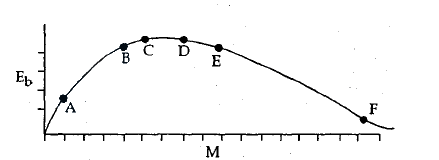 JEE Main/MCQ/Medium/Nuclear energy/With diagram
- 212This question contains Statement and Statement-2. Of the four choices given after the statements, choose the one that best describes the two statements.
Statement - I:
Energy is released when heavy nuclei undergo fission or light nuclei undergo fusion. and
Statement - II
For heavy nuclei, binding energy per nucleon increases with increasing while for light nuclei it decrease with increasing .JEE Main/MCQ/Medium/Nuclear energy - 213If is the mass of an oxygen isotope and are the masses of a proton and a neutron respectively, the nuclear binding energy of the isotope isJEE Main/MCQ/Medium/Nuclear energy
- 214A solid which is transparent to visible light and whose conductivity increases with temperature is formed byJEE Main/MCQ/Medium/Nuclear energy
- 215If mass-energy equivalence is taken into account, when water is cooled to form ice, the mass of
water shouldJEE Main/MCQ/Medium/Nuclear energy - 216The average energy released per fission for the nucleus of is 190 MeV. When all the atoms of 47 g pure undergo fission process, the energy released is . The value of is .
(Avogadro Number per mole)JEE Main/Numerical/Medium/Nuclear reactions - 217Match the LIST-I with LIST-II
Choose the correct answer from the options given below :JEE Main/MCQ/Medium/Nuclear reactions - 218The energy released in the fusion of of hydrogen deep in the sun is and the energy released in the fission of of is . The ratio is approximately:
(Consider the fusion reaction as , energy released in the fission reaction of is per fission nucleus and JEE Main/MCQ/Medium/Nuclear reactions - 219In a hypothetical fission reaction
The identity of emitted particles ( is :JEE Main/MCQ/Medium/Nuclear reactions - 220If three helium nuclei combine to form a carbon nucleus then the energy released in this reaction is _____. (Given , atomic mass of helium )JEE Main/Numerical/Medium/Nuclear reactions
- 221Which of the following nuclear fragments corresponding to nuclear fission between neutron and uranium isotope is correct :JEE Main/MCQ/Medium/Nuclear reactions
- 222In a nuclear fission reaction of an isotope of mass , three similar daughter nuclei of same mass are formed. The speed of a daughter nuclei in terms of mass defect will be :JEE Main/MCQ/Medium/Nuclear reactions
- 223The explosive in a Hydrogen bomb is a mixture of and in some condensed form. The chain reaction is given by ;
During the explosion the energy released is approximately [Given : and ]JEE Main/MCQ/Medium/Nuclear reactions - 224The energy released per fission of nucleus of is . The energy released if all the atoms in of pure undergo fission is _____.
(Given )JEE Main/Numerical/Medium/Nuclear reactions - 225Two lighter nuclei combine to form a comparatively heavier nucleus by the relation given below:
The binding energies per nucleon and are and respectively. The energy released in this process is_____ .JEE Main/Numerical/Medium/Nuclear reactions - 226In the following nuclear reaction,
Mass number of is and atomic number is . Mass number and atomic number of respectively will beJEE Main/MCQ/Medium/Nuclear reactions - 227The decay of a proton to neutron is :JEE Main/MCQ/Medium/Nuclear reactions
- 228Given the masses of various atomic particles , , , , , where proton, neutron, electron, antineutrino and deuteron. Which of the following process is allowed by momentum and energy conservation :JEE Main/MCQ/Medium/Nuclear reactions
- 229Consider the nuclear fission, . Given that the binding energy/nucleon of and are , respectively. Identify the correct statement:JEE Main/MCQ/Medium/Nuclear reactions
- 230An unstable heavy nucleus at rest breaks into two nuclei which move away with velocities in the ratio of . The ratio of the radii of the nuclei (assumed to be spherical ) is:JEE Main/MCQ/Medium/Nuclear reactions
- 231Two deuterons undergo nuclear fusion to form a Helium nucleus. The energy released in this process is (given binding energy per nucleon for deuteron and for helium)JEE Main/MCQ/Medium/Nuclear reactions
- 232When Uranium is bombarded with neutrons, it undergoes fission. The fission reaction can be written as :
energy)
where three particles named are produced and energy is released. What is the name of the particle ?JEE Main/MCQ/Medium/Nuclear reactions - 233A nucleus of mass is at rest and decays into two daughter nuclei of equal mass each. Speed of light is .
The speed of daughter nuclei isJEE Main/MCQ/Medium/Nuclear reactions - 234If the binding energy per nucleon in and nuclei are and respectively, then in the reaction
energy of proton must beJEE Main/MCQ/Medium/Nuclear reactions - 235When nuclei are bombarded by protons, and the resultant nuclei are , the emitted particles will beJEE Main/MCQ/Medium/Nuclear reactions
- 236A nuclear transformation is denoted by . Which of the following is the nucleus of element ?JEE Main/MCQ/Medium/Nuclear reactions
- 237The binding energy per nucleon of deuteron and helium nucleus is and respectively. If two deuteron nuclei react to form a single helium nucleus, then the energy released isJEE Main/MCQ/Medium/Nuclear reactions
- 238A nucleus with emits the following in a sequence:
. Then of the resulting nucleus isJEE Main/MCQ/Medium/Nuclear reactions - 239When a nucleus originally at rest, decays by emitting an alpha particle having a speed ' ', the recoil speed of the residual nucleus isJEE Main/MCQ/Medium/Nuclear reactions
NEET question paper PDF
This chapter includes NEET questions. Open a year to read the full paper, or download the PDF.
Opening paper…
JEE Main question paper PDF
This chapter includes JEE Main questions. Open a shift to read the paper, or download the PDF.
Opening paper…
Other Physics chapters
Current Electricity 380Electrostatics 311Kinematics 308Ray Optics 295Rotational Motion 280Magnetic Effects & Magnetism 276Gravitation 223Laws of Motion 210Semiconductors 209Dual Nature of Matter 200Oscillations 194Fluid Mechanics 192Wave Optics 191Alternating Current 190Thermodynamics 190Work Energy Power 183Capacitors 180Kinetic Theory 168Electromagnetic Waves 165Electromagnetic Induction 153Units & Dimensions 149Waves 142Center of Mass, Momentum & Collision 130Thermal Properties of Matter 126Mathematics in Physics 121Mechanical Properties of Solids 118Experimental Physics 70Magnetic Properties of Matter 57Modern Physics 5
Stuck on a Atoms & Nuclei question from your book?
Snap it and get a whiteboard video that solves it step by step. Your first video needs no login.