Atoms & Nuclei

JEE Main level, single correct, medium

59 of 239

Question 59 of 239

Given below are two statements
Statement I: In hydrogen atom, the frequency of radiation emitted when an electron jumps from lower energy orbit
(E1)\left({E}_{1}\right) to higher energy orbit (E2)\left({E}_{2}\right), is given as hf=E1−E2hf={E}_{1}-{E}_{2}
Statement II: The jumping of electron from higher energy orbit
(E2)\left({E}_{2}\right) to lower energy orbit (E1)\left({E}_{1}\right) is associated with frequency of radiation given as f=(E2−E1)hf=\dfrac{\left({E}_{2}-{E}_{1}\right)}{h}. This condition is Bohr's frequency condition.
In the light of the above statements, choose the correct answer from the options given below:

Show answer and solution

Answer: (D) Statement I is incorrect but statement II is true.
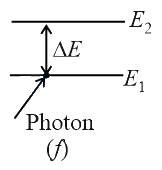

According to Bohr's model, when electron makes the transition from lower orbit to higher orbit, its energy can be given as

∆E=Efinal−Einitial=hf∆E={E}_{final}-{E}_{initial}=hf, here, hh is Planck's constant.
Then,
f=E2−E1hf=\dfrac{{E}_{2}-{E}_{1}}{h}.
Bohr's frequency condition is the law that state that the frequency of the radiation emitted or absorbed during the transition of an atomic system between two stationary states equals the difference in the energies of the states divided by Planck's constant.

Hence, Statement I is incorrect but statement II is true.

JEE Main question paper PDF

Open a shift to read the full paper on this page, or download it.

JEE Main 2025 Apr 2 Shift 1 question paper

Open Download PDF

Opening paper…

Explain it as a whiteboard videoStep-by-step, in Hinglish or English. Your first video needs no login.Solved it on paper but got it wrong?Upload a photo of your working. Mistake Doctor marks the exact line that broke.
See it move: Atoms: Rutherford, Bohr and X-rays simulationDrag the sliders and watch the numbers in this question change.Revise Modern Physics firstFormula sheet, solved examples and the traps students fall into.

More Physics practice

JEE Main Physics practice question on Atoms & Nuclei (Bohr's Atomic Model), with the answer and a step-by-step solution. Scan a question from your own book or paper to get a whiteboard video.