Physics · JEE Main, NEET
Thermal Properties of Matter
126 practice questions with a worked solution for each. Tap an option to see instantly if you are right.
101MCQ25Numerical17With diagram
- 1A black body at temperature radiates power . If its temperature is raised to , the radiated power is (in W):JEE Main/Numerical/Medium
- 2The efficiency of a Carnot engine operating between and is:NEET/MCQ/Medium
- 3The temperature of a body in air falls from to in 4 minutes. The temperature of the air is . The temperature of the body in the next 4 minutes will be:JEE Main/MCQ/Medium/Thermometry
- 4Which of the following figure represents the relation between Celsius and Fahrenheit temperatures ?JEE Main/MCQ/Medium/Thermometry
- 5On celcius scale the temperature of body increases by . The increase in temperature on Fahrenheit scale is :JEE Main/MCQ/Medium/Thermometry
- 6On a temperature scale '', the boiling point of water is and the freezing point is . Assuming that the scale is linear. The equivalent temperature corresponding to on the Fahrenheit scale would beJEE Main/MCQ/Medium/Thermometry
- 7A faulty thermometer reads in melting ice and in steam. The correct temperature on absolute scale will be ______ when the faulty thermometer reads .JEE Main/Numerical/Medium/Thermometry
- 8The graph between two temperature scales and is shown in the figure. Between upper fixed point and lower fixed point there are equal divisions of scale and divisions on scale . The relationship for conversion between the two scales is given by :
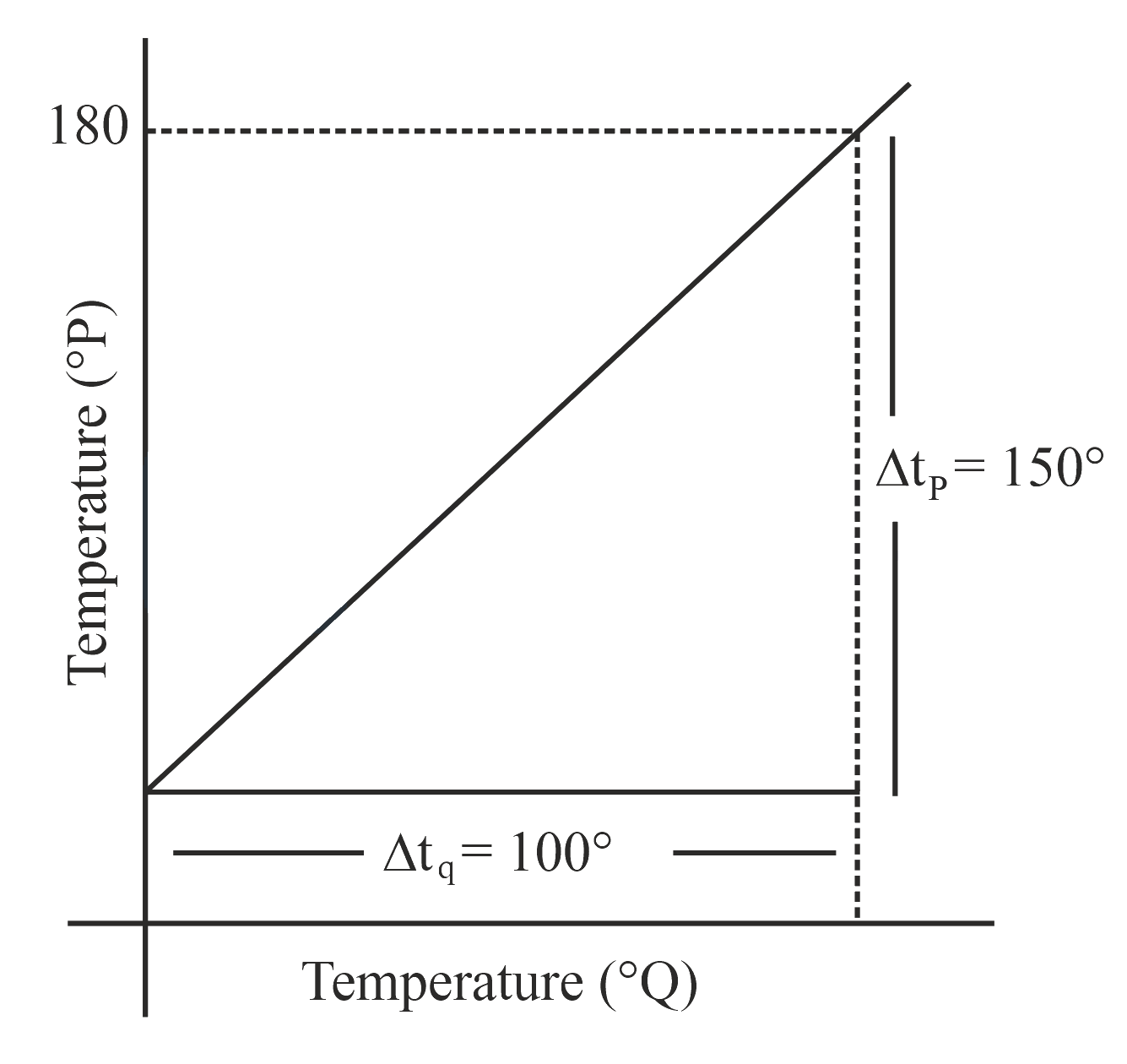 .JEE Main/MCQ/Medium/Thermometry/With diagram
- 9Two different metal bodies and of equal mass are heated at a uniform rate under similar conditions. The variation of temperature of the bodies is graphically represented as shown in the figure. The ratio of specific heat capacities is:
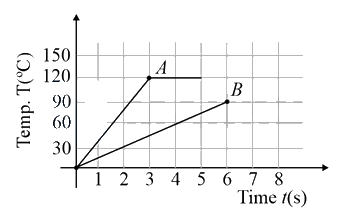 JEE Main/MCQ/Medium/Thermometry/With diagram
- 10A thermometer graduated according to a linear scale reads a value when in contact with boiling water, and when in contact with ice. What is the temperature of an object in , if this thermometer in the contact with the object reads JEE Main/MCQ/Medium/Thermometry
- 11On a linear temperature scale , water freezes at and boils at . On this scale, a temperature of would be read as : (water freezes at and boils at )JEE Main/MCQ/Medium/Thermometry
- 12Time taken by a heater to heat one litre of water from to isJEE Main/MCQ/Medium/Thermometry
- 13The temperature of a metal strip having coefficient of linear expansion is increased from to resulting in increase of its length by . The temperature is further increased from to such that the increase in its length is . Given and , the value of is ______.JEE Main/MCQ/Medium/Thermal Expansion
- 14A brass wire of length 2 m and radius 1 mm at is held taut between two rigid supports. Initially it was cooled to a temperature of creating a tension in the wire. The temperature to which the wire has to be cooled in order to increase the tension in it to , is .JEE Main/MCQ/Medium/Thermal Expansion
- 15An aluminium and steel rods having same lengths and cross-sections are joined to make total length of 120 cm at . The coefficient of linear expansion of aluminium and steel are and , respectively. The length of this composite rod when its temperature is raised to , is cm.JEE Main/MCQ/Medium/Thermal Expansion
- 16Consider a rectangular sheet of solid material of length and width . The coefficient of linear expansion is at room temperature and one atmospheric pressure. The mass of sheet and the specific heat capacity . If the amount of heat supplied to the material is then change in area of the rectangular sheet is :-JEE Main/MCQ/Medium/Thermal Expansion
- 17At room temperature , the resistance of a heating element is . The temperature coefficient of the material is . The temperature of the element, when its resistance is , is _____ .JEE Main/Numerical/Medium/Thermal Expansion
- 18The resistances of the platinum wire of a platinum resistance thermometer at the ice point and steam point are and respectively. After inserting in a hot bath of temperature , the resistance of platinum wire is :JEE Main/MCQ/Medium/Thermal Expansion
- 19A steel rod of length and cross-sectional area is heated from to without being allowed to extend or bend. The compressive tension produced in the rod is _____. (Given Young's modulus of steel , coefficient of linear expansion )JEE Main/Numerical/Medium/Thermal Expansion
- 20A thin rod having a length of and area of cross-section is suspended vertically from one end. The rod is cooled from to . After cooling, a mass is attached at the lower end of the rod such that the length of rod again becomes . Young's modulus and coefficient of linear expansion of the rod are and , respectively. The value of is ______ . (Take )JEE Main/Numerical/Medium/Thermal Expansion
- 21A hole is drilled in a metal sheet. At , the diameter of hole is . When the sheet is heated to , the change in the diameter of hole is . The value of will be _____, if coefficient of linear expansion of the metal is JEE Main/Numerical/Medium/Thermal Expansion
- 22A unit scale is to be prepared whose length does not change with temperature and remains , using a bimetallic strip made of brass and iron each of different length. The length of both components would change in such a way that difference between their lengths remains constant. If length of brass is and length of iron will be _____ .
and .JEE Main/Numerical/Medium/Thermal Expansion - 23At what temperature a gold ring of diameter be heated so that it can be fitted on a wooden bangle of diameter ? Both the diameters have been measured at room temperature .
(Given: coefficient of linear thermal expansion of gold )JEE Main/MCQ/Medium/Thermal Expansion - 24A solid metallic cube having total surface area is uniformly heated. If its temperature is increased by , calculate the increase in volume of the cube. (Given ).JEE Main/MCQ/Medium/Thermal Expansion
- 25A steel rod of length is clamped on a table vertically at its lower end and is free to rotate in the vertical plane. The upper end is pushed so that the rod falls under gravity. Ignoring the friction due to clamping at its lower end, the speed of the free end of the rod when it passes through its lowest position is _______m{s}^{-1}.
(Take JEE Main/Numerical/Medium/Thermal Expansion - 26Two thin metallic spherical shells of radii and are placed with their centres coinciding. A material of thermal conductivity is filled in the space between the shells. The inner shell is maintained at temperature and the outer shell at temperature The rate at which heat flows radially through the material is :JEE Main/MCQ/Medium/Thermal Expansion
- 27An ideal gas is expanding such that constant. The coefficient of volume expansion of the gas is:JEE Main/MCQ/Medium/Thermal Expansion
- 28A bimetallic strip consists of metals and . It is mounted rigidly as shown. The metal has higher coefficient of expansion compared to that of metal . When the bimetallic strip is placed in a cold both, it will :
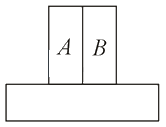 JEE Main/MCQ/Medium/Thermal Expansion/With diagram
- 29Given below are two statements: one is labelled as Assertion and the other is labelled as Reason .
Assertion : When a rod lying freely is heated, no thermal stress is developed in it.
Reason : On heating, the length of the rod increases.
In the light of the above statements, choose the correct answer from the options given below:JEE Main/MCQ/Medium/Thermal Expansion - 30Each side of a box made of metal sheet in cubic shape is at room temperature , the coefficient of linear expansion of the metal sheet is . The metal sheet is heated uniformly, by a small temperature , so that its new temperature is . Calculate the increase in the volume of the metal box.JEE Main/MCQ/Medium/Thermal Expansion
- 31Three rods of identical cross-section and length are made of three different materials of thermal conductivity and , respectively. They are joined together at their ends to make a long rod (see figure). One end of the long rod is maintained at and the other at (see figure). If the joints of the rod are at and in steady and there is no loss of energy from the surface of the rod, the correct relationship between and is :
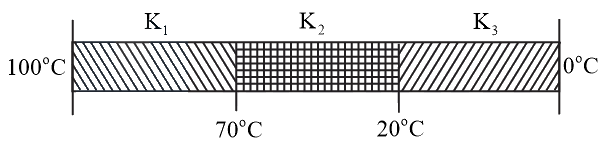 JEE Main/MCQ/Medium/Thermal Expansion/With diagram
- 32Two different wires having lengths and and respective temperature coefficient of linear expansion and are joined end-to-end. Then the effective temperature coefficient of linear expansion is :JEE Main/MCQ/Medium/Thermal Expansion
- 33The specific heat of water and the latent heat of ice k. grams of ice at is placed in of water at . The amount of ice that will melt as the temperature of water reaches is close to (in grams)JEE Main/MCQ/Medium/Thermal Expansion
- 34A bakelite beaker has volume capacity of at . When it is partially filled with volume (at ) of mercury, it is found that the unfilled volume of the beaker remains constant as temperature is varied. If where is the coefficient of volume expansion, then (in ) is close to JEE Main/Numerical/Medium/Thermal Expansion
- 35When the temperature of a metal wire is increased from , its length increases by .The percentage change in its mass density will be closed to:JEE Main/MCQ/Medium/Thermal Expansion
- 36A non-isotropic solid metal cube has coefficients of linear expansion as: along the x-axis and along the y and the z-axis. If the coefficient of volume expansion of the solid is then the value of is _____________JEE Main/Numerical/Medium/Thermal Expansion
- 37A uniform cylindrical rod of length and radius r, is made from a material whose Young’s modulus of Elasticity equals When this rod is heated by temperature T and simultaneously subjected to a net longutudinal compressional force F, its length remains unchanged. The coefficient of volume expansion, of the material of the rod, is (nearly) equal to:JEE Main/MCQ/Medium/Thermal Expansion
- 38At a brass wire of radius is hung from the ceiling. A small mass, is hung from the free end of the wire. When the wire is cooled down from to it regains its original length of The value of is close to:
(Coefficient of linear expansion and Young’s modulus of brass are and respectively; )JEE Main/MCQ/Medium/Thermal Expansion - 39Two rods and of identical dimensions are at temperature . If is heated upto and upto then the new lengths are the same. If the ratio of the coefficients of linear expansion of and is then the value of isJEE Main/MCQ/Medium/Thermal Expansion
- 40A steel rail of length and area of cross section is prevented from expanding along its length while the temperature rises by . If coefficient of linear expansion and Young's modulus of steel are and respectively, the force developed in the rail is approximately:JEE Main/MCQ/Medium/Thermal Expansion
- 41A compressive force, is applied at the two ends of a long thin steel rod. It is heated, simultaneously, such that its temperature increases by . The net change in its length is zero. Let be the length of the rod, A its area of cross-section, its Young's modulus, and its coefficient of linear expansion. Then, is equal to:JEE Main/MCQ/Medium/Thermal Expansion
- 42An external pressure is applied on a cube at so that it is equally compressed from all sides. is the bulk modulus of the material of the cube and is its coefficient of linear expansion. Suppose we want to bring the cube to its original size by heating. The temperature should be raised by:JEE Main/MCQ/Medium/Thermal Expansion
- 43A simple pendulum made of a bob of mass m and a metallic wire of a negligible mass has a time period of at . If the temperature of the wire is increased, and the corresponding change in its time period is plotted against its temperature, the resulting graph is a line of slope . If the coefficient of linear expansion of metal is , then the value of isJEE Main/MCQ/Medium/Thermal Expansion
- 44A pendulum clock loses 12 s a day if the temperature is C and gains 4s a day if the temperature is C. The temperature at which the clock will show correct time, and the co-efficient of linear expansion of the metal of the pendulum shaft are respectively:JEE Main/MCQ/Medium/Thermal Expansion
- 45The pressure that has to be applied to the ends of a steel wire of length to keep its length constant when its temperature is raised by is :
(For steel, Young's modulus is and coefficient of thermal expansion is )JEE Main/MCQ/Medium/Thermal Expansion - 46The ratio of the coefficient of volume expansion of a glass container to that of a viscous liquid kept inside the container is . What fraction of the inner volume of the container should the liquid occupy so that the volume of the remaining vacant space will be same at all temperatures ?JEE Main/MCQ/Medium/Thermal Expansion
- 47A wooden wheel of radius is made of two semicircular parts (see figure); The two parts are held together by a ring made of a metal strip of cross sectional area S and length . is slightly less than . To fit the ring on the wheel, it is heated so that its temperature rises by and it just steps over the wheel. As it cools down to surrounding temperature, it presses the semicircular parts together. If the coefficient of linear expansion of the metal is , and its Youngs' modulus is , the force that one part of the wheel applies on the other part is :
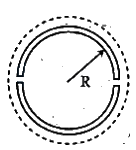 JEE Main/MCQ/Medium/Thermal Expansion/With diagram
- 48The heat extracted out of gram of water initially at to cool it down to is sufficient to evaporate gram of water also initially at . The value of (closest integer) is _______.
(Take latent heat of water , specific heat capacity of water )JEE Main/Numerical/Medium/Calorimetry - 4910 kg of ice at is added to 100 kg of water to lower its temperature from 25 . Consider no heat exchange to surroundings. The decrement to the temperature of water is .
(specific heat of ice , specific heat of water , latent heat of fusion of ice )JEE Main/MCQ/Medium/Calorimetry - 50Which of the following best represents the temperature versus heat supplied graph for water, in the range of to ?JEE Main/MCQ/Medium/Calorimetry
- 51A gas based geyser heats water flowing at the rate of 5.0 litres per minute from to . The rate of consumption of the gas is .
(Take heat of combustion of gas ) specific heat capacity of water JEE Main/MCQ/Medium/Calorimetry - 52Water falls from a height of 200 m into a pool. Calculate the rise in temperature of the water assuming no heat dissipation from the water in the pool.
Take , specific heat of water JEE Main/MCQ/Medium/Calorimetry - 53A gun fires a lead bullet of temperature 300 K into a wooden block. The bullet having melting temperature of 600 K penetrates into the block and melts down. If the total heat required for the process is 625 J , then the mass of the bullet is grams.
(Latent heat of fusion of lead and specific heat capacity of lead JEE Main/MCQ/Medium/Calorimetry - 54An amount of ice of mass and temperature is transformed to vapour of temperature by applying heat. The total amount of work required for this conversion is, (Take, specific heat of ice , specific heat of water , specific heat of steam , Latent heat of ice and Latent heat of steam )JEE Main/MCQ/Medium/Calorimetry
- 55A block of ice at is slowly heated and converted to steam at . Which of the following curves represent the phenomenon qualitatively:JEE Main/MCQ/Medium/Calorimetry
- 56 of water at is converted into steam at by boiling at atmospheric pressure. The volume of water changes from as a liquid to as steam. The change in internal energy of the system during the process will be (Given latent heat of vaporisation , Atmospheric pressure JEE Main/MCQ/Medium/Calorimetry
- 57A water heater of power is used to heat water. The specific heat capacity of water is . The efficiency of heater is . Time required to heat of water from to is _____ .
(Assume that the specific heat capacity of water remains constant over the temperature range of the water).JEE Main/Numerical/Medium/Calorimetry - 58Heat energy of is given to ice of mass at , Specific heat of ice is 2222.3J{kg}^{–1}^{\circ}{C}^{–1} and latent heat of ice is .
(A) Final temperature of system will be
(B) Final temperature of the system will be greater than
(C) The final system will have a mixture of ice and water in the ratio of
(D) The final system will have a mixture of ice and water in the ratio of
(E) The final system will have water only
Choose the correct answer from the options given below :JEE Main/MCQ/Medium/Calorimetry - 59According to law of equipartition of energy the molar specific heat of a diatomic gas at constant volume where the molecule has one additional vibrational mode is :-JEE Main/MCQ/Medium/Calorimetry
- 60An ice cube of dimensions is placed in an insulation box of wall thickness . The box keeping the ice cube at of temperature is brought to a room of temperature . The rate of melting of ice is approximately: (Latent heat of fusion of ice is and thermal conducting of insulation wall is 0.05W{m}^{-1}^{\circ}{C}^{-1})JEE Main/MCQ/Medium/Calorimetry
- 61A block of ice of mass at temperature is put in of water at . The of ice melts as the temperature of the water reaches . The value of is
[Use: Specific heat capacity of water , Latent heat of ice ]JEE Main/Numerical/Medium/Calorimetry - 62A cylinder of fixed capacity of litres contains helium gas at standard temperature and pressure. The amount of heat needed to raise the temperature of gas in the cylinder by will be (Given gas constant )JEE Main/MCQ/Medium/Calorimetry
- 63A lead bullet penetrates into a solid object and melts. Assuming that of its kinetic energy is used to heat it, the initial speed of bullet is
(Given, initial temperature of the bullet ,
Melting point of the bullet ,
Latent heat of fusion of lead ,
Specific heat capacity of lead )JEE Main/MCQ/Medium/Calorimetry - 64A geyser heats water flowing at a rate of per minute from to . If geyser operates on a gas burner, the rate of combustion of fuel will be _____ .
[Heat of combustion , Specific heat of water ]JEE Main/Numerical/Medium/Calorimetry - 65A copper block of mass is heated to a temperature of and is placed on a large ice block. What is the maximum amount of ice that can melt?
[Specific heat of copper : and latent heat of fusion of water : ]JEE Main/MCQ/Medium/Calorimetry - 66A steam engine intakes of steam at per minute and cools it down to . If latent heat of vaporization of steam is , then the heat rejected by the steam engine per minute is _____
(Given : specific heat capacity of water : )JEE Main/Numerical/Medium/Calorimetry - 67A of iron nail is hit by a hammer striking at a velocity of . What will be the rise in the temperature of the nail if one fourth of energy of the hammer goes into heating the nail ? [Specific heat capacity of iron ]JEE Main/MCQ/Medium/Calorimetry
- 68Due to cold weather, a water pipe of cross-sectional area is filled with ice at Resistive heating is used to melt the ice. Current of is passed through resistance. Assuming that all the heat produced is used for melting, what is the minimum time required?
(Given latent heat of fusion for water/ice specific heat of ice =2\times {10}^{3}J{kg}^{-1}^{\circ}{C}^{-1} and density of ice JEE Main/MCQ/Medium/Calorimetry - 69The temperature of equal masses of three different liquids and are and respectively. The temperature of mixture when is mixed with is and that when is mixed with is . The temperature of mixture when and are mixed will be :JEE Main/MCQ/Medium/Calorimetry
- 70A container is divided into two chambers by a partition. The volume of first chamber is and second chamber is . The first chamber contain moles of gas at pressure and second chamber contain moles of gas at pressure . After the partition is removed and the mixture attains equilibrium, then, the common equilibrium pressure existing in the mixture is . Value of (nearest integer) isJEE Main/Numerical/Medium/Calorimetry
- 71A calorimeter of water equivalent contains of water at . ' grams of steam at is mixed in it till the temperature of the mixture is . The value of is close to (Latent heat of water, specific heat of water)JEE Main/MCQ/Medium/Calorimetry
- 72Three containers and have water at different temperatures. The table below shows the final temperature when different amounts of water (given in liters) are taken from each container and mixed (assume no loss of heat during the process)
The value of (in to the nearest integer) is___________JEE Main/Numerical/Medium/Calorimetry - 73 grams of steam at is mixed with of ice at its melting point in a thermally insulated container. If it produces liquid water at [heat of vaporization of water is and heat of fusion of ice is ], the value of is ________JEE Main/Numerical/Medium/Calorimetry
- 74 of water, at is heated in an electric kettle whose heating element has a mean (temperature averaged) resistance of The rms voltage in the mains is . Ignoring heat loss from the kettle, time taken for water to evaporate fully is close to
[ Specific heat of water =4200J{kg}^{-1}^{\circ}{C}^{-1} Latent heat of water ]JEE Main/MCQ/Medium/Calorimetry - 75When gram of ice at (specific heat ) is added to gram of water at finally no ice is left and the water is at . The value of latent heat of ice, in is:JEE Main/MCQ/Medium/Calorimetry
- 76Two identical beakers and contain equal volumes of two different liquids at each and left to cool down. Liquid in has density of and specific heat of while the liquid in has density and specific heat of . Which of the following best describes their temperature versus time graph schematically? (assume the emissivity of both the beakers to be the same)JEE Main/MCQ/Medium/Calorimetry
- 77A thermally insulated vessel contains of water at . Then the air from the vessel is pumped out adiabatically. A fraction of water turns into ice and the rest evaporates at itself. The mass of evaporated water will be closest to: (Latent heat of vaporization of water and Latent heat of Fusion of water )JEE Main/MCQ/Medium/Calorimetry
- 78Ice at is added to of water at , When the temperature of the mixture reaches it is found that 20 of ice is still unmelted. The amount of ice added to the
water was close to (Specific heat of water
Specific heat of Ice
Heat of fusion of water at JEE Main/MCQ/Medium/Calorimetry - 79In an experiment, a sphere of aluminium of mass is heated up to . Immediately, it is put into water of volume at kept in a calorimeter of water equivalent to . The final temperature of the system is . The specific heat of the aluminium is(take )JEE Main/MCQ/Medium/Calorimetry
- 80A copper ball of mass is at a temperature . It is dropped in a copper calorimeter of mass filled with of water at room temperature. Subsequently, the temperature of the system is found to be . is given by:
(Given: room temperature , specific heat of copper =0.1cal{g}^{-1}^{\circ}{C}^{-1})JEE Main/MCQ/Medium/Calorimetry - 81An experiment takes to raise the temperature of water in a container from to and another to convert it totally into steam by a heater supplying heat at a uniform rate. Neglecting the specific heat of the container and taking specific heat of the water to be , the heat of vaporization according to this experiment will come out to be:JEE Main/MCQ/Medium/Calorimetry
- 82Water of volume 2 L in a closed container is heated with a coil of 1 kW. While water is heated, the container loses energy at a rate of 160 J/s. In how much time will the temperature of water rise from 27oC to 77oC ? (Specific heat of water is 4.2 kJ/kg and that of the container is negligible).JEE Main/MCQ/Medium/Calorimetry
- 83A mass of of water in a closed vessel, with surroundings at a constant temperature takes 2 minutes to cool from to . A mass of of another liquid in an identical vessel with identical surroundings takes the same time to cool from to . The specific heat of the liquid is :
(The water equivalent of the vessel is .)JEE Main/MCQ/Medium/Calorimetry - 84 of water and of ice at are in a calorimeter whose water equivalent is of steam at is added to it. Then water in the calorimeter is : (Latent heat of ice , Latent heat of steam )JEE Main/MCQ/Medium/Calorimetry
- 85Given that of water in liquid phase has volume and in vapour phase at atmospheric pressure and the latent heat of vaporization of water is ; the change in the internal energy in joules for of water at when it changes from liquid phase to vapour phase at the same temperature is :JEE Main/MCQ/Medium/Calorimetry
- 86 of water is heated from to . Ignoring the slight expansion of the water, the change in its internal energy is (specific heat of water is ):JEE Main/MCQ/Medium/Calorimetry
- 87Heat given to a body which raises its temperature by isJEE Main/MCQ/Medium/Calorimetry
- 88Rods and of equal dimensions but of different materials are joined as shown in figure. Temperatures of end points and are maintained at and respectively. Given the thermal conductivity of is three times of that of , the temperature at junction points and are (close to):
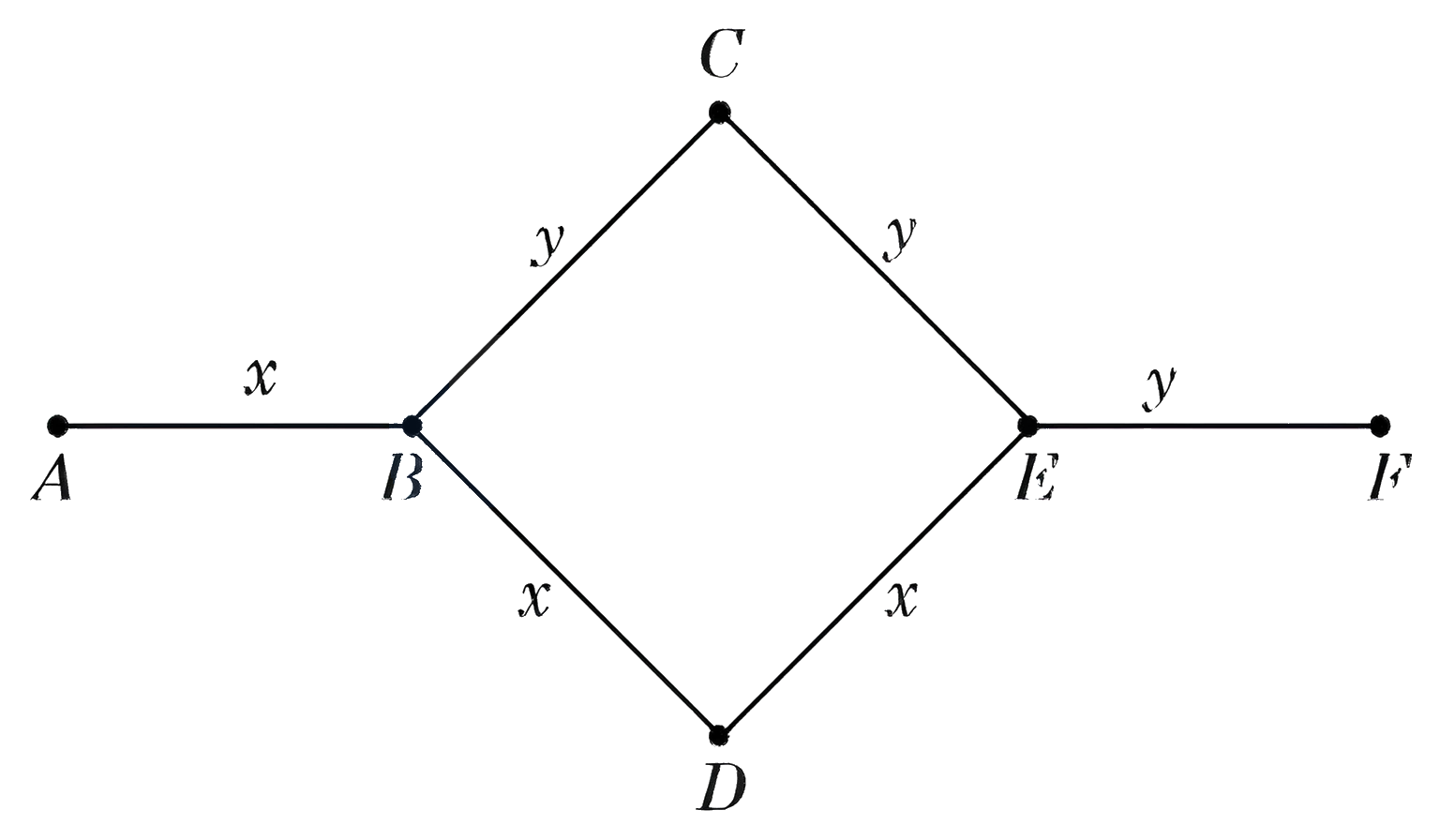 JEE Main/MCQ/Medium/Conduction/With diagram
- 89Two cylindrical rods A and B made of different materials, are joined in a straight line. The ratio of lengths, radii and thermal conductivities of these rods are :
and . The free ends of rods A and B are maintained at , respectively. The temperature of rods interface is ________ K, when equilibrium is established.JEE Main/Numerical/Medium/Conduction - 90Three conductors of same length having thermal conductivity and are connected as shown in figure.
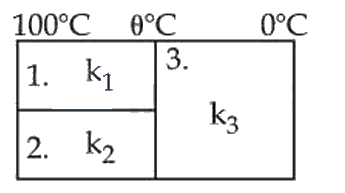
Area of cross sections of and conductor are same and for conductor it is double of the conductor. The temperatures are given in the figure. In steady state condition, the value of is
_______ .
(Given : )JEE Main/Numerical/Medium/Conduction/With diagram - 91Two conductors have the same resistances at but their temperature coefficients of resistance are and . The respective temperature coefficients for their series and parallel combinations are :JEE Main/MCQ/Medium/Conduction
- 92Two plates A and B have thermal conductivities and respectively. They have same surface area and same thickness. They are placed in contact along their surfaces. If the temperatures of the outer surfaces of A and B are kept at and respectively, then the temperature of the surface of contact in steady state is_____ .JEE Main/Numerical/Medium/Conduction
- 93Two metallic wires of identical dimensions are connected is series. If and are the conductivities of the these wires respectively, the effective conductivity of the combination is :JEE Main/MCQ/Medium/Conduction
- 94If and are the thermal conductivities and are the lengths and and are the cross sectional areas of steel and copper rods respectively such that . Then, for the arrangement as shown in the figure. The value of temperature of the steel - copper junction in the steady state will be
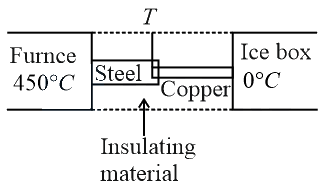 JEE Main/MCQ/Medium/Conduction/With diagram
- 95As per the given figure, two plates and of thermal conductivity and are joined together to form a compound plate. The thickness of plates are and respectively and the area of cross-section is for each plate. The equivalent thermal conductivity of the compound plate is , then the value of will be _____ .
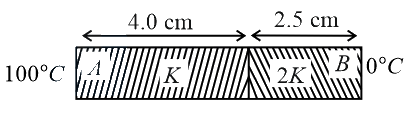 JEE Main/Numerical/Medium/Conduction/With diagram
- 96Resistance of the wire is measured as and at and respectively. Temperature coefficient of resistance of the material of the wire isJEE Main/MCQ/Medium/Conduction
- 97Two metallic blocks and of same area of cross-section are connected to each other (as shown in figure). If the thermal conductivity of is then the thermal conductivity of will be : [Assume steady state heat conduction]
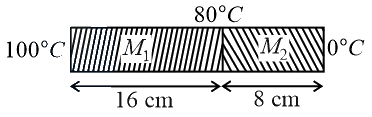 JEE Main/MCQ/Medium/Conduction/With diagram
- 98A rod of thermal resistance is joined at the middle of an identical rod as shown in figure. The ends and are maintained at and respectively. The heat current in is . The value of is
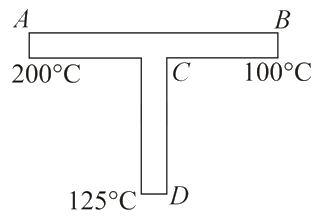 JEE Main/Numerical/Medium/Conduction/With diagram
- 99Two identical metal wires of thermal conductivities and respectively are connected in series. The effective thermal conductivity of the combination is:JEE Main/MCQ/Medium/Conduction
- 100The temperature at the junction of two insulating sheets, having thermal resistances and as well as top and bottom temperatures and (as shown in figure) is given by :
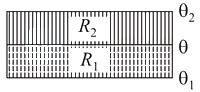 JEE Main/MCQ/Medium/Conduction/With diagram
- 101Two materials having coefficients of thermal conductivity and and thickness and respectively, are joined to form a slab as shown in the figure. The temperatures of the outer surfaces are and respectively, The temperature at the interface is
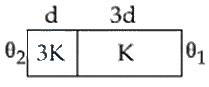 JEE Main/MCQ/Medium/Conduction/With diagram
- 102A cylinder of radius is surrounded by a cylindrical shell of inner radius and outer radius . The thermal conductivity of the material of the inner cylinder is and that of the outer cylinder is . Assuming no loss of heat, the effective thermal conductivity of the system for heat flowing along the length of the cylinder is:JEE Main/MCQ/Medium/Conduction
- 103A heat source at is connected to another heat reservoir at by a copper slab which is thick. Given that the thermal conductivity of copper is , the energy flux through it in the steady-state is:JEE Main/MCQ/Medium/Conduction
- 104Temperature difference of is maintained between two ends of a uniform rod of length Another bent rod of same cross-section as and length is connected across (See figure). In steady state, temperature difference between and will be close to:
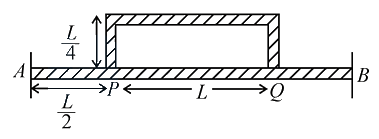 JEE Main/MCQ/Medium/Conduction/With diagram
- 105Three rods of Copper, Brass and Steel are welded together to form a Y-shaped structure. Area of cross-section of each rod is . End of copper rod is maintained at . Where as ends of brass and steel are kept at . Lengths of the copper, brass and steel rods are and respectively. The rods are thermally insulated from surroundings except at ends. Thermal conductivities of copper, brass and steel are and CGS units respectively. Rate of heat flow through copper rod is :JEE Main/MCQ/Medium/Conduction
- 106A large cylindrical rod of length is made by joining two identical rods of copper and steel of length each. The rods are completely insulated from the surroundings. If the free end of copper rod is maintained at and that of steel at then the temperature of junction is (Thermal conductivity of copper is 9 times that of steel)JEE Main/MCQ/Medium/Conduction
- 107Two conductors have the same resistance at but their temperature coefficients of resistance are and . The respective temperature coefficients of their series and parallel combinations are nearlyJEE Main/MCQ/Medium/Conduction
- 108A long metallic bar is carrying heat from one of its ends to the other end under steady-state. The variation of temperature along the length of the bar from its hot end is best described by which of the following figure.JEE Main/MCQ/Medium/Conduction
- 109One end of a thermally insulated rod is kept at a temperature and the other at . The rod is composed of two sections of lengths and and thermal conductivities and respectively. The temperature at the interface of the two sections is
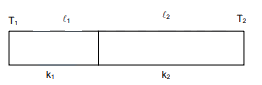 JEE Main/MCQ/Medium/Conduction/With diagram
- 110The figure shows a system of two concentric spheres of radii and and kept at temperatures and respectively. The radial rate of flow of heat in a substance between the two concentric sphere is proportional to
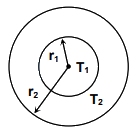 JEE Main/MCQ/Medium/Conduction/With diagram
- 111The thermo emf of a thermocouple varies with the temperature of the hot junction as in volts where the ratio is . If the cold junction is kept at , then the neutral temperature isJEE Main/MCQ/Medium/Conduction
- 112The thermistors are usually made ofJEE Main/MCQ/Medium/Conduction
- 113The temperature of two outer surfaces of a composite slab, consisting of two materials having coefficients of thermal conductivity and and thickness and , respectively are and . The rate of heat transfer through the slab, in a steady state is , with equal to
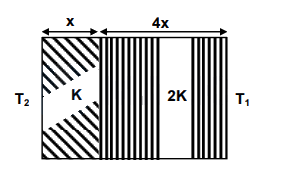 JEE Main/MCQ/Medium/Conduction/With diagram
- 114If , is the inversion temperature, is the neutral temperature, is the temperature of the cold junction, thenJEE Main/MCQ/Medium/Conduction
- 115A wire of length 10 cm and diameter 0.5 mm is used in a bulb. The temperature of the wire is and power radiated by the wire is 94.2 W. Its emissivity is where _______
(Given and assume that the emissivity of wire material is same at all wavelength.)JEE Main/Numerical/Medium/Radiation - 116A cup of coffee cools from to in t minutes when the room temperature is . The time taken by the similar cup of coffee to cool from to at the same room temperature is :JEE Main/MCQ/Medium/Radiation
- 117Two spherical bodies of same materials having radii 0.2 m and 0.8 m are placed in same atmosphere. The temperature of the smaller body is 800 K and temperature of the bigger body is 400 K . If the energy radiated from the smaller body is E, the energy radiated from the bigger body is (assume, effect of the surrounding temperature to be negligible),JEE Main/MCQ/Medium/Radiation
- 118A body cools in minutes from to . The temperature of the surrounding is . The temperature of the body after the next minutes will beJEE Main/MCQ/Medium/Radiation
- 119Nearly of the power of a light bulb is converted to visible radiation. The change in average intensities of visible radiation, at a distance of from the bulb to a distance of is . The value of '' will beJEE Main/Numerical/Medium/Radiation
- 120A black coloured solid sphere of radius and mass is inside a cavity with a vacuum inside. The walls of the cavity are maintained at temperature . The initial temperature of the sphere is . If the specific heat of the material of the sphere varies as per unit mass with the temperature of the sphere, where is a constant, then the time taken for the sphere to cool down to temperature will be
( is Stefan Boltzmann constant)JEE Main/MCQ/Medium/Radiation - 121The heat radiated per unit area in 1 hour by a furnace whose temperature is is )JEE Main/MCQ/Medium/Radiation
- 122Assuming the sun to be a spherical body of radius at a temperature of , evaluate the total radiant power, incident on Earth, at a distance from the Sun.JEE Main/MCQ/Medium/Radiation
- 123If the temperature of the sun were to increase from to and its radius from to , then the ratio of the radiant energy received on earth to what it was previously will beJEE Main/MCQ/Medium/Radiation
- 124The earth radiates in the infra-red region of the spectrum. The spectrum is correctly given byJEE Main/MCQ/Medium/Radiation
- 125Two spheres of the same material have radii and and temperatures and respectively. The ratio of the energy radiated per second by the first sphere to that by the second isJEE Main/MCQ/Medium/Radiation
- 126Which of the following is more closed to a black body?JEE Main/MCQ/Medium/Radiation
NEET question paper PDF
This chapter includes NEET questions. Open a year to read the full paper, or download the PDF.
Opening paper…
JEE Main question paper PDF
This chapter includes JEE Main questions. Open a shift to read the paper, or download the PDF.
Opening paper…
Other Physics chapters
Current Electricity 380Electrostatics 311Kinematics 308Ray Optics 295Rotational Motion 280Magnetic Effects & Magnetism 276Atoms & Nuclei 239Gravitation 223Laws of Motion 210Semiconductors 209Dual Nature of Matter 200Oscillations 194Fluid Mechanics 192Wave Optics 191Alternating Current 190Thermodynamics 190Work Energy Power 183Capacitors 180Kinetic Theory 168Electromagnetic Waves 165Electromagnetic Induction 153Units & Dimensions 149Waves 142Center of Mass, Momentum & Collision 130Mathematics in Physics 121Mechanical Properties of Solids 118Experimental Physics 70Magnetic Properties of Matter 57Modern Physics 5
Stuck on a Thermal Properties of Matter question from your book?
Snap it and get a whiteboard video that solves it step by step. Your first video needs no login.