Physics · JEE Main, NEET
Mechanical Properties of Solids
118 practice questions with a worked solution for each. Tap an option to see instantly if you are right.
78MCQ40Numerical16With diagram
- 1A wire of length and radius is stretched by length under tension . A wire of same material of length and radius under tension will be stretched by:JEE Main/MCQ/Medium
- 2Young's modulus of a perfectly rigid body is:NEET/MCQ/Medium
- 3A steel wire of length and area is stretched by . Work done in stretching is ():JEE Main/MCQ/Medium
- 4Given below are two statements : one is labelled as Assertion (A) and the other is labelled as Reason (R)
Assertion (A) : The property of body, by virtue of which it tends to regain its original shape when the external force is removed, is Elasticity.
Reason (R) : The restoring force depends upon the bonded inter atomic and inter molecular force of solid.
In the light of the above statements, choose the correct answer from the options given below :JEE Main/MCQ/Medium/Elasticity - 5Given below are two statements: one is labelled as Assertion A and the other is labelled as Reason R
Assertion (A) : Steel is used in the construction of buildings and bridges.
Reason (R) : Steel is more elastic and its elastic limit is high.
In the light of above statements, choose the most appropriate answer from the options given belowJEE Main/MCQ/Medium/Elasticity - 6The elastic behaviour of material for linear stress and linear strain, is shown in the figure. The energy density for a linear strain of is _____ . Assume that material is elastic upto the linear strain of ,
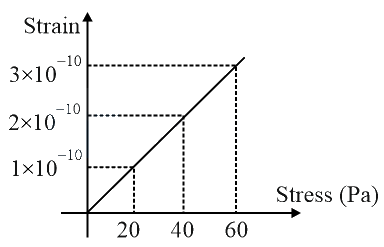 JEE Main/Numerical/Medium/Elasticity/With diagram
- 7The load versus elongation graphs for four wires of same length and made of the same material are shown in the figure. The thinnest wire is represented by the line
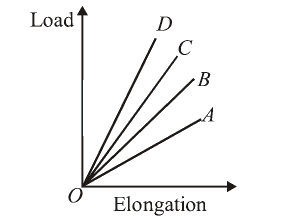 JEE Main/MCQ/Medium/Elasticity/With diagram
- 8Figure represents the extension () of a wire of length meter, suspended from the ceiling of the room at one end with a load connected to the other end. If the cross-sectional area of the wire is m then the Young's modulus of the wire is __________ N/m.
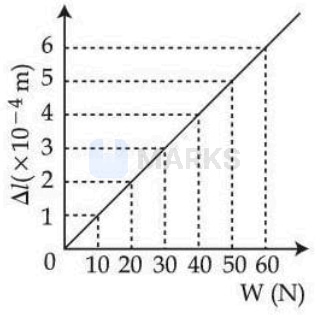 JEE Main/MCQ/Medium/Young’s Modulus and Breaking Stres/With diagram
- 9The two wires and of equal cross-section but of different materials are joined together. The ratio of Young's modulus of wire and wire is . When the joined wire is kept under certain tension the elongations in the wires and are equal. If the length of wire is m, then the length of wire is _______ m.JEE Main/MCQ/Medium/Young’s Modulus and Breaking Stres
- 10A lift of mass kg is supported by thick iron wire. If the maximum stress which the wire can withstand is N/m and its radius is mm, then maximum acceleration the lift can take is _______ m/s. (take m/s and )JEE Main/MCQ/Medium/Young’s Modulus and Breaking Stres
- 11Two wires as shown in the figure below, made of steel and have breaking stress of N/m. Area of cross-section of upper wire is cm and of lower wire is cm. The maximum mass that can be added to pan without breaking any wire is _____ kg.
(take m/s)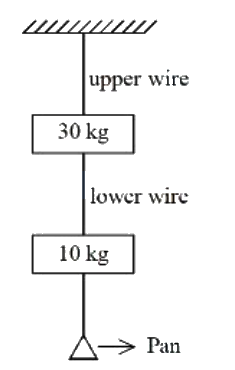 JEE Main/MCQ/Medium/Young’s Modulus and Breaking Stres/With diagram
- 12The Young's modulus of steel wire of radius and length is . If the radius and length of the wire are doubled then the value of JEE Main/MCQ/Medium/Young’s Modulus and Breaking Stres
- 13A metal string is suspended from a rigid support and its free end is attached to a block of mass . Second block having mass is suspended at the bottom of the first block using a string . The area of cross sections of strings and are same. The ratio of lengths of strings of to is and the ratio of their Young's moduli is . The ratio of elongations in to is ______.JEE Main/MCQ/Medium/Young’s Modulus and Breaking Stres
- 14A string of length m and Young's modulus N/m is connected to another string of length and Young's modulus both twice of those of . This series combination of strings is then suspended from a rigid support and its free end is fixed to a load of mass kg. The net change in length of the combination is _____ mm. (radius of both the strings is mm and acceleration due to gravity m/s) (Mass of both strings is to be neglected as compared to the mass of load)JEE Main/MCQ/Medium/Young’s Modulus and Breaking Stres
- 15A uniform wire of length of weight is suspended from the roof with a weight of at the other end. The stress in the wire at distance from the top is , where, is the cross sectional area of the wire. The value of is _______.JEE Main/Numerical/Medium/Young’s Modulus and Breaking Stres
- 16The diameter of a wire measured by a screw gauge of least count cm is cm. The length measured by a scale of least count cm is cm. When a weight of N is applied to the wire, the extension in length is cm, measured by a micrometer of least count cm. The error in the measured Young's modulus is N/m. The value of is _______.
(Ignore the contribution of the load to Young's modulus error calculation)JEE Main/MCQ/Medium/Young’s Modulus and Breaking Stres - 17Two wires and made of different materials of lengths 6.0 cm and 5.4 cm, respectively and area of cross sections and , respectively are stretched by the same magnitude under a given load. The ratio of the Young's modulus of to that of is . The value of is .JEE Main/MCQ/Medium/Young’s Modulus and Breaking Stres
- 18The strain-stress plot for materials and is shown in the figure. Which material has the largest Young's modulus ?
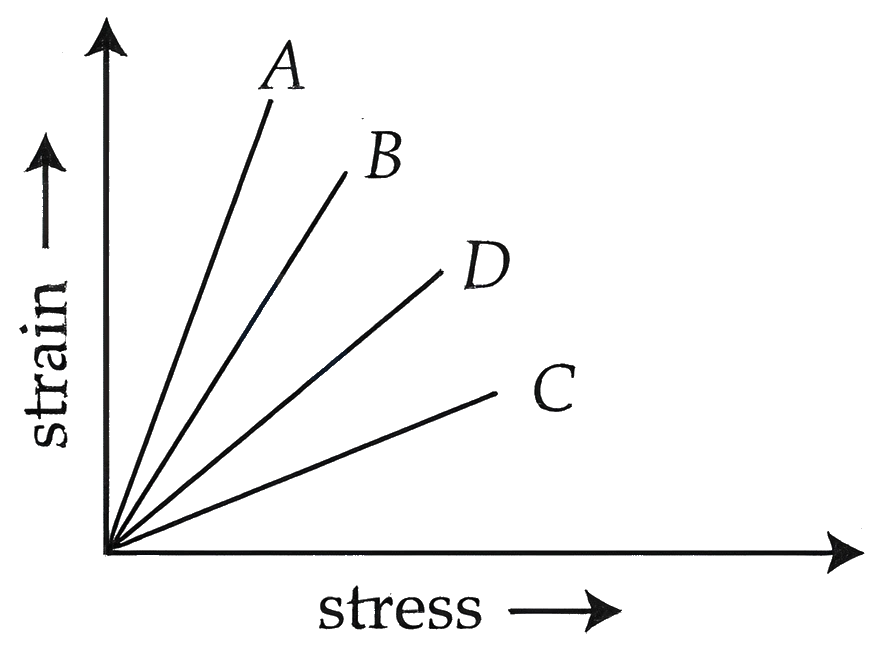 JEE Main/MCQ/Medium/Young’s Modulus and Breaking Stres/With diagram
- 19Two persons pull a wire towards themselves. Each person exerts a force of on the wire. Young's modulus of the material of wire is . Original length of the wire is and the area of cross section is . The wire will extend in length by ______ .JEE Main/Numerical/Medium/Young's Modulus and Breaking Stres
- 20A wire of cross sectional area A, modulus of elasticity and length is stretched between two vertical rigid supports. When a mass of is suspended at the middle it sags lower from its original position making angle radian on the points of support. The value of is _______ (consider ).
(given : )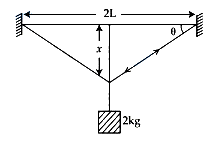 JEE Main/Numerical/Medium/Young's Modulus and Breaking Stres/With diagram
- 21Match List-I with List-II :
$\begin{array}{|c|c|c|c|}
\hline & \text { List-I } & & \text { List-II } \\
\hline \text { (A) } & \text { A force that restores an elastic body of unit area to its original state } & \text { (I) } & \text { Bulk modulus } \\
\hline \text { (B) } & \text { Two equal and opposite forces parallel to opposite faces } & \text { (II) } & \text { Young's modulus } \\
\hline \text { (C) } & \begin{array}{l}
\text { Forces perpendicular everywhere to the surface per unit area } \\
\text { same everywhere }
\end{array} & \text { (III) } & \text { Stress } \\
\hline \text { (D) } & \text { Two equal and opposite forces perpendicular to opposite faces } & \text { (IV) } & \text { Shear modulus } \\
\hline
\end{array}$
Choose the correct answer from the options given below :JEE Main/MCQ/Medium/Young's Modulus and Breaking Stres - 22The density and breaking stress of a wire are and respectively. The wire is suspended from a rigid support on a planet where acceleration due to gravity is of the value on the surface of earth. The maximum length of the wire with breaking is _____ m (take, ).JEE Main/Numerical/Medium/Young's Modulus and Breaking Stres
- 23An elastic spring under tension of has a length . Its length is under tension . For its length , the value of tension will be______.JEE Main/Numerical/Medium/Young's Modulus and Breaking Stres
- 24One end of a metal wire is fixed to a ceiling and a load of hangs from the other end. A similar wire is attached to the bottom of the load and another load of hangs from this lower wire. Then the ratio of longitudinal strain of upper wire to that of the lower wire will be
[Area of cross section of wire and ]JEE Main/Numerical/Medium/Young's Modulus and Breaking Stres - 25With rise in temperature, the Young's modulus of elasticityJEE Main/MCQ/Medium/Young's Modulus and Breaking Stres
- 26Two blocks of mass and are connected by a metal wire going over a smooth pulley as shown in figure. The radius of wire is and Young's modulus of the metal is . The longitudinal strain developed in the wire is . The value of is _____. [Use )
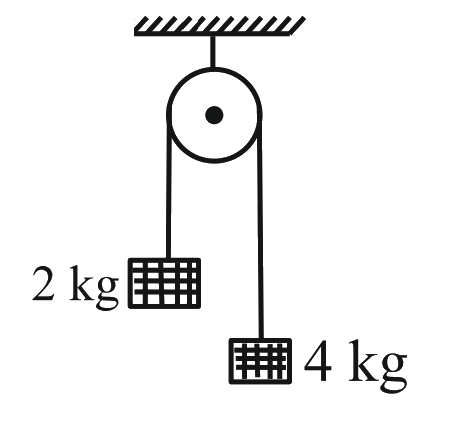 JEE Main/Numerical/Medium/Young's Modulus and Breaking Stres/With diagram
- 27Each of three blocks and shown in figure has a mass of . Each of the wire and has cross-sectional area and Young's modulus . Neglecting friction, the longitudinal strain on wire is _____ . (Take )
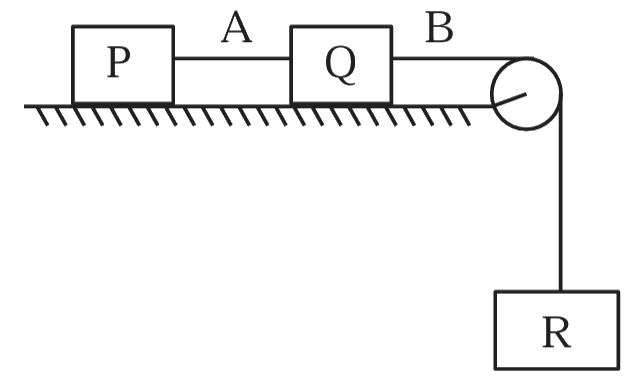 JEE Main/Numerical/Medium/Young's Modulus and Breaking Stres/With diagram
- 28Young's modules of material of a wire of length and cross-sectional area is If the length of the wire is doubled and cross-sectional area is halved then Young's modules will be:JEE Main/MCQ/Medium/Young's Modulus and Breaking Stres
- 29Two metallic wires and have same volume and are made up of same material. If their area of cross sections are in the ratio and force is applied to , an extension of is produced. The force which is required to produce same extension in is . The value of is ______.JEE Main/Numerical/Medium/Young's Modulus and Breaking Stres
- 30A wire of length and radius is clamped at one end. If its other end is pulled by a force , its length increases by . If the radius of the wire and the applied force both are reduced to half of their original values keeping original length constant, the increase in length will become:JEE Main/MCQ/Medium/Young's Modulus and Breaking Stres
- 31A wire of length and radius is clamped rigidly at one end. When the other end of the wire is pulled by a force, its length increases by . Another wire of same material of length and radius is pulled by a force . Then the increase in its length will be:JEE Main/MCQ/Medium/Young's Modulus and Breaking Stres
- 32The length of a wire becomes and when and tension are applied respectively. If , then the natural length of wire will be . Here the value of isJEE Main/Numerical/Medium/Young's Modulus and Breaking Stres
- 33Young’s moduli of the material of wires A and B are in the ratio of , while its area of cross sections are in the ratio of . If the same amount of load is applied to both the wires, the amount of elongation produced in the wires A and B will be in the ratio of [Assume length of wires A and B are same]JEE Main/MCQ/Medium/Young's Modulus and Breaking Stres
- 34Two wires each of radius and negligible mass, one made of steel and the other made of brass are loaded as shown in the figure. The elongation of the steel wire is ______. [Young's modulus for steel and ]
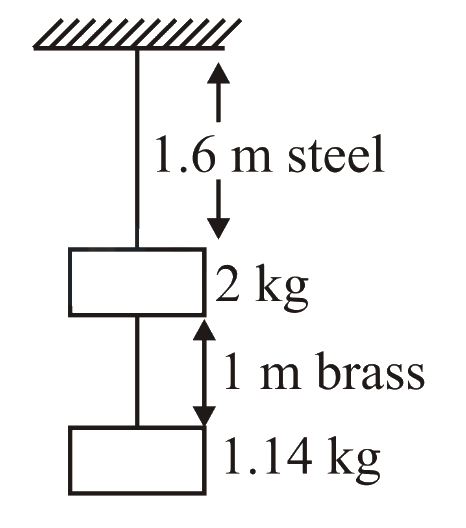 JEE Main/Numerical/Medium/Young's Modulus and Breaking Stres/With diagram
- 35An aluminium rod with Young’s modulus undergoes elastic strain of . The energy per unit volume stored in the rod in unitJEE Main/MCQ/Medium/Young's Modulus and Breaking Stres
- 36A metal block of mass is suspended from a rigid support through a metal wire of diameter . The tensile stress developed in the wire under equilibrium state is . The value of mass is ______ .
(Take and )JEE Main/Numerical/Medium/Young's Modulus and Breaking Stres - 37A steel rod has a radius of and a length of A force of stretches it along its length. Young's modulus of steel is . The longitudinal strain produced in the wire is _________\times {10}^{-5}.JEE Main/Numerical/Medium/Young's Modulus and Breaking Stres
- 38The Young's modulus of a steel wire of length and cross-sectional area , is . The wire is suspended from its support on a given planet. A block of mass is attached to the free end of the wire. The acceleration due to gravity on the planet is of its value on the earth. The elongation of wire is (Take on the earth ):JEE Main/MCQ/Medium/Young's Modulus and Breaking Stres
- 39Under the same load, wire A having length and cross section stretches uniformly by the same amount as another wire of length and a cross section of stretches. The ratio of the Young's modulus of wire to that of wire will be:JEE Main/MCQ/Medium/Young's Modulus and Breaking Stres
- 40A force is applied to a steel wire , rigidly clamped at one end. As a result elongation in the wire is . If same force is applied to another steel wire of double the length and a diameter times that of the wire , the elongation in the wire will be (wires having uniform circular cross sections)JEE Main/MCQ/Medium/Young's Modulus and Breaking Stres
- 41As shown in the figure, in an experiment to determine Young's modulus of a wire, the extension-load curve is plotted. The curve is a straight line passing through the origin and makes an angle of with the load axis. The length of wire is and its diameter is . The Young's modulus is found to be
The value of is _______.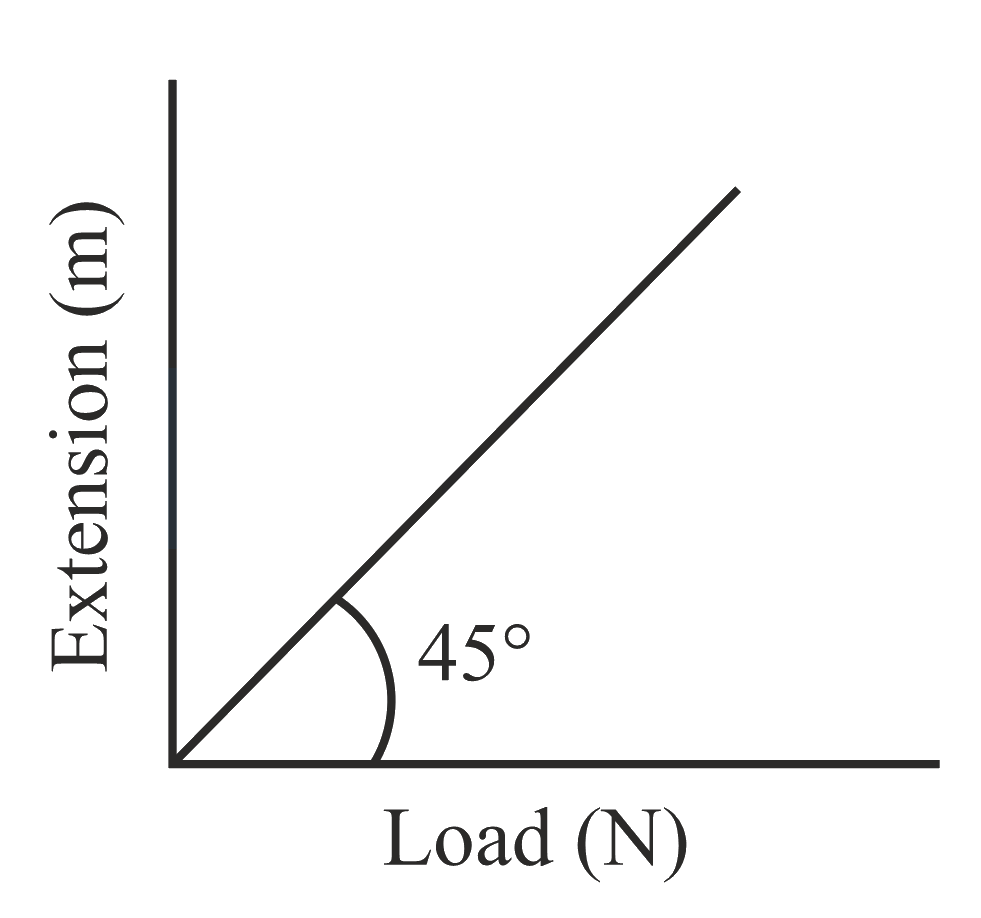 JEE Main/Numerical/Medium/Young's Modulus and Breaking Stres/With diagram
- 42A long wire having cross-sectional area and Young's modulus is is subjected to a load of , then the elongation in the wire will be :JEE Main/MCQ/Medium/Young's Modulus and Breaking Stres
- 43A metal wire of length and cross-sectional area has breaking stress . A block of is attached at one end of the string and is rotating in a horizontal circle. The maximum linear velocity of block will be _____ .JEE Main/Numerical/Medium/Young's Modulus and Breaking Stres
- 44If the length of a wire is made double and radius is halved of its respective values. Then, the Young's modulus of the material of the wire will :JEE Main/MCQ/Medium/Young's Modulus and Breaking Stres
- 45A string of area of cross-section and length is connected with a rigid body of mass . The body is rotated in a vertical circular path of radius . The body acquires a speed of at the bottom of the circular path. Strain produced in the string when the body is at the bottom of the circle is _____ . (Use Young's modulus and )JEE Main/Numerical/Medium/Young's Modulus and Breaking Stres
- 46The force required to stretch a wire of cross-section to double its length will be :
(Given Yong's modulus of the wire )JEE Main/MCQ/Medium/Young's Modulus and Breaking Stres - 47In an experiment to determine the Young's modulus, steel wires of five different lengths ( and ) but of same cross-section were taken and curves between extension and load were obtained. The slope (extension/load) of the curves were plotted with the wire length and the following graph is obtained. If the Young's modulus of given steel wires is , then the value of is _____ .
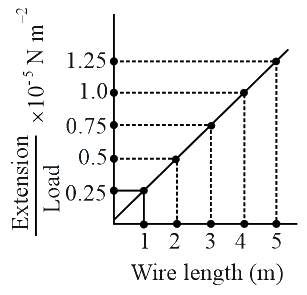 JEE Main/Numerical/Medium/Young's Modulus and Breaking Stres/With diagram
- 48A steel wire of length and a copper wire of length , both of radius are connected end to end. When stretched by a load, the net elongation is found to be . The load applied, in Newton, will be: (Given )JEE Main/MCQ/Medium/Young's Modulus and Breaking Stres
- 49A uniform heavy rod of mass . Cross sectional area and length is hanging from a fixed support. Neglecting the lateral contraction, the elongation in the rod due to its own weight is . The value of is _____ .
(Given. Young's modulus and )JEE Main/Numerical/Medium/Young's Modulus and Breaking Stres - 50The area of cross section of the rope used to lift a load by a crane is . The maximum lifting capacity of the crane is metric tons. To increase the lifting capacity of the crane to 25 metric tons, the required area of cross section of the rope should be
(take )JEE Main/MCQ/Medium/Young's Modulus and Breaking Stres - 51A wire of length and radius is clamped rigidly at one end. When the other end of the wire is pulled by a force , its length increases by . Another wire of the same material of length and radius is pulled by a force under same conditions. The increase in length of this wire is _____ .JEE Main/Numerical/Medium/Young's Modulus and Breaking Stres
- 52A wire of length is hanging from a fixed support. The length changes to and when masses and are suspended respectively from its free end. Then the value of is equal toJEE Main/MCQ/Medium/Young's Modulus and Breaking Stres
- 53Four identical hollow cylindrical columns of mild steel support a big structure of mass The inner and outer radii of each column are and respectively. Assuming uniform local distribution, calculate the compression strain of each column.
[use ]JEE Main/MCQ/Medium/Young's Modulus and Breaking Stres - 54A uniform heavy rod of weight cross-sectional area and length is hanging from a fixed support. Young modulus of the material of the rod is Neglecting the lateral contraction, find the elongation of rod due to its own weight:JEE Main/MCQ/Medium/Young's Modulus and Breaking Stres
- 55Wires and are made of same material having the breaking stress of and have cross-sectional area of and , respectively. Masses of and hang from them as shown in the figure. The maximum mass that can be placed in the pan without breaking the wires is _____ (Use
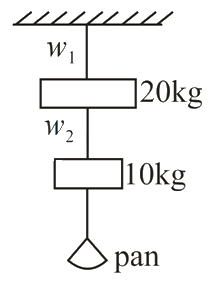 JEE Main/Numerical/Medium/Young's Modulus and Breaking Stres/With diagram
- 56Two blocks of masses and are connected by a metal wire going over a smooth pulley. The breaking stress of the metal is . What is the minimum radius of the wire ?
( take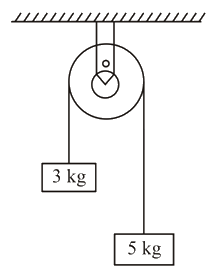 JEE Main/MCQ/Medium/Young's Modulus and Breaking Stres/With diagram
- 57Two wires of same length and radius are joined end to end and loaded. The Young's moduli of the materials of the two wires are and . The combination behaves as a single wire then its Young's modulus is:JEE Main/MCQ/Medium/Young's Modulus and Breaking Stres
- 58The length of a metal wire is when the tension in it is and is when the tension is The natural length of the wire is:JEE Main/MCQ/Medium/Young's Modulus and Breaking Stres
- 59The value of tension in a long thin metal wire has been changed from to . The lengths of the metal wire at two different values of tension and are and , respectively. The actual length of the metal wire is:JEE Main/MCQ/Medium/Young's Modulus and Breaking Stres
- 60Two separate wires and are stretched by and respectively, when they are subjected to a force of Assume that both the wires are made up of same material and the radius of wire is times that of the radius of wire The length of the wires and are in the ratio of Then can be expressed as , where is _____.JEE Main/Numerical/Medium/Young's Modulus and Breaking Stres
- 61The length of metallic wire is when tension in it is . It is when the tension is . The original length of the wire will be :JEE Main/MCQ/Medium/Young's Modulus and Breaking Stres
- 62A uniform metallic wire is elongated by when subjected to a linear force The elongation, if its length and diameter is doubled and subjected to the same force will be _________ JEE Main/Numerical/Medium/Young's Modulus and Breaking Stres
- 63If and are the values of Young's modulus, bulk modulus and modulus of rigidity of any material respectively. Choose the correct relation for these parameters.JEE Main/MCQ/Medium/Young's Modulus and Breaking Stres
- 64A wire of density is stretched between two clamps apart. The resulting strain in the wire is . The lowest frequency of the transverse vibrations in the wire (Young's modulus of wire ), (to the nearest integer),_______JEE Main/Numerical/Medium/Young's Modulus and Breaking Stres
- 65A body of mass is attached to one end of a wire of length . What is the maximum angular speed (in ) with which it can be rotated about its other end in a space station without breaking the wire?
[Breaking stress of wire and area of cross-section of the wire]JEE Main/Numerical/Medium/Young's Modulus and Breaking Stres - 66Speed of a transverse wave on a straight wire (mass length and area of cross-section is . If the Young's modulus of wire is , the extension of wire over its natural length is:JEE Main/MCQ/Medium/Young's Modulus and Breaking Stres
- 67In an experiment, brass and steel wires of length each with areas of cross section are used. The wires are connected in series and one end of the combined wire is connected to a rigid support and other end is subjected to elongation. The stress required to produce a net elongation of is,
[Given, the Young's Modulus for steel and brass are, respectively, and ]JEE Main/MCQ/Medium/Young's Modulus and Breaking Stres - 68The elastic limit of brass is . The minimum diameter of a brass rod if it is to support a load without exceeding its elastic limit will beJEE Main/MCQ/Medium/Young's Modulus and Breaking Stres
- 69Young's moduli of two wires and are in the ratio . Wire is long and has radius Wire is long and has radius If the two wires stretch by the same length for a given load, the value of is close to:JEE Main/MCQ/Medium/Young's Modulus and Breaking Stres
- 70A steel wire having a radius of , carrying a load of is hanging from a ceiling. Given that what will be the tensile stress that would be developed in the wire?JEE Main/MCQ/Medium/Young's Modulus and Breaking Stres
- 71A boy’s catapult is made of rubber cord which is long, with diameter of cross-section and of negligible mass. The boy keeps a stone weighing on it and stretches the cord by by applying a constant force. When released, the stone flies off with a velocity of . Neglect the change in the area of cross-section of the cord while stretched. The Young’s modulus of rubber is closest to:JEE Main/MCQ/Medium/Young's Modulus and Breaking Stres
- 72A rod, of length at room temperature and uniform area of cross section is made of a metal having coefficient of linear expansion It is observed that an external compressive force is applied on each of its ends, prevents any change in the length of the rod when its temperature rises by Young's modulus, for this metal is:JEE Main/MCQ/Medium/Young's Modulus and Breaking Stres
- 73A man grows into a giant such that his linear dimensions increase by a factor of Assuming that his density remains same, the stress in the leg will change by a factor of:JEE Main/MCQ/Medium/Young's Modulus and Breaking Stres
- 74A uniformly tapering conical wire is made from a material of Young's modulus and has a normal, unextended length . The radii, at the upper and lower ends of this conical wire, have values and , respectively. The upper end of the wire is fixed to a rigid support and a mass is suspended from its lower end. The equilibrium extended length, of this wire, would equal:JEE Main/MCQ/Medium/Young's Modulus and Breaking Stres
- 75A pendulum made of a uniform wire of cross sectional area A has time period T. When an additional mass M is added to its bob, the time period changes to . If the Young's modulus of the material of the wire is , then is equal to:
(gravitational acceleration)JEE Main/MCQ/Medium/Young's Modulus and Breaking Stres - 76In materials like aluminium and copper, the correct order of magnitude of various elastic modulii is :JEE Main/MCQ/Medium/Young's Modulus and Breaking Stres
- 77Two blocks of masses and are connected by means of a metal wire of cross-sectional area A passing over a frictionless fixed pulley as shown in the figure. The system is then released. If , then the stress produced in the wire is:
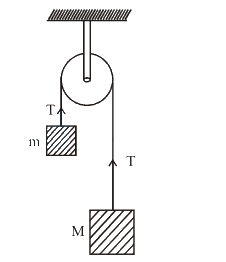 JEE Main/MCQ/Medium/Young's Modulus and Breaking Stres/With diagram
- 78A copper wire of length and a steel wire of length having equal cross-sectional areas are joined end to end. The composite wire is stretched by a certain load which stretches the copper wire by . If the Young's modulii of copper and steel are respectively and , the total extension of the composite wire is :JEE Main/MCQ/Medium/Young's Modulus and Breaking Stres
- 79A uniform wire (Young's modulus ) is subjected to longitudinal tensile stress of . If the overall volume change in the wire is , the fractional decrease in the radius of the wire is close to:JEE Main/MCQ/Medium/Young's Modulus and Breaking Stres
- 80If the ratio of lengths, radii and Young's moduli of steel and brass wires in the figure are and respectively, then the corresponding ratio of increase in their lengths is :
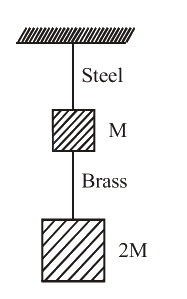 JEE Main/MCQ/Medium/Young's Modulus and Breaking Stres/With diagram
- 81A steel wire can sustain weight without breaking. If the wire is cut into two equal parts, each part can sustain a weight ofJEE Main/MCQ/Medium/Young's Modulus and Breaking Stres
- 82A structural steel rod has a radius of and length of . A force stretches it along its length. Young's modulus of structural steel is . The percentage strain is aboutJEE Main/MCQ/Medium/Young's Modulus and Breaking Stres
- 83Two wires are made of the same material and have the same volume. However wire 1 has crosssectional area and wire-2 has cross-sectional area . If the length of wire 1 increases by on applying force , how much force is needed to stretch wire 2 by the same amount?JEE Main/MCQ/Medium/Young's Modulus and Breaking Stres
- 84A wire elongates by when a load is hanged from it. If the wire goes over a pulley and two weights each are hung at the two ends, the elongation of the wire will be (in )JEE Main/MCQ/Medium/Young's Modulus and Breaking Stres
- 85The increase in the pressure required to decrease the volume of water is N/m. The percentage decrease in the volume is _____. (Bulk modulus of water N/m.)JEE Main/MCQ/Medium/Bulk Modulus
- 86A sample of a liquid is kept at 1 atm. It is compressed to 5 atm which leads to change of volume of . If the bulk modulus of the liquid is 2 GPa , the initial volume of the liquid was _______ litre. Take JEE Main/Numerical/Medium/Bulk Modulus
- 87The fractional compression \(\left(\frac{\Delta \mathrm{V}}{\mathrm{V}}\right)\) of water at the depth of 2.5 km below the sea level is
______ \(\%\). Given, the Bulk modulus of water \(=2 \times 10^9 \mathrm{~N} \mathrm{~m}^{-2}\), density of water \(=10^3\) \(\mathrm{kg} \mathrm{m}^{-3}\), acceleration due to gravity \(=\mathrm{g}=10 \mathrm{~m} \mathrm{~s}^{-2}\).JEE Main/MCQ/Medium/Bulk Modulus - 88The volume contraction of a solid copper cube of edge length 10 cm , when subjected to a hydraulic pressure of , would be ____ .
(Given bulk modulus of copper )JEE Main/Numerical/Medium/Bulk Modulus - 89The increase in pressure required to decrease the volume of a water sample by is . Bulk modulus of water is . The value of P is JEE Main/Numerical/Medium/Bulk Modulus
- 90The depth below the surface of sea to which a rubber ball be taken so as to decrease its volume by is _____ .
(Take density of sea water , Bulk modulus of rubber , and )JEE Main/Numerical/Medium/Bulk Modulus - 91If average depth of an ocean is and the bulk modulus of water is , then fractional compression of water at the bottom of ocean is . The value of is _______, (Given, )JEE Main/Numerical/Medium/Bulk Modulus
- 92Under isothermal condition, the pressure of a gas is given by where is a constant and is the volume of the gas. The bulk modulus at constant temperature is equal toJEE Main/MCQ/Medium/Bulk Modulus
- 93A certain pressure '' is applied to litre of water and litre of a liquid separately. Water gets compressed to whereas the liquid gets compressed to . The ratio of Bulk modulus of water to that of the liquid is . The value of is ______.JEE Main/Numerical/Medium/Bulk Modulus
- 94Choose the correct relationship between Poisson ratio , bulk modulus and modulus of rigidity of a given solid object:JEE Main/MCQ/Medium/Bulk Modulus
- 95The bulk modulus of a liquid is . The pressure required to reduce the volume of liquid by is :JEE Main/MCQ/Medium/Bulk Modulus
- 96When a rubber ball is taken to a depth of _______ in deep sea, its volume decreases by
(The bulk modulus of rubber Density of sea water ,)JEE Main/Numerical/Medium/Bulk Modulus - 97An object is located at beneath the surface of the water. If the fractional compression is , the ratio of hydraulic stress to the corresponding hydraulic strain will be ______[Given: density of water is and JEE Main/MCQ/Medium/Bulk Modulus
- 98The normal density of a material is and its bulk modulus of elasticity is . The magnitude of increase in density of material, when a pressure is applied uniformly on all sides, will be :JEE Main/MCQ/Medium/Bulk Modulus
- 99A cube of metal is subjected to a hydrostatic pressure . The percentage change in the length of the side of the cube is close to : (Given bulk modulus of metal, )JEE Main/MCQ/Medium/Bulk Modulus
- 100A solid sphere of radius r made of a soft material of bulk modulus K is surrounded by a liquid in a cylindrical container. A massless piston of area floats on the surface of the liquid, covering entire cross-section of cylindrical container. When a mass m is placed on the surface of the piston to compress the liquid, the fractional decrement in the radius of the sphere , is:JEE Main/MCQ/Medium/Bulk Modulus
- 101A bottle has an opening of radius and length . A cork of length and radius where , is compressed to fit into the opening completely (see figure). If the bulk modulus of cork is and the coefficient of friction between the bottle and cork is , then the force needed to push the cork into the bottle is
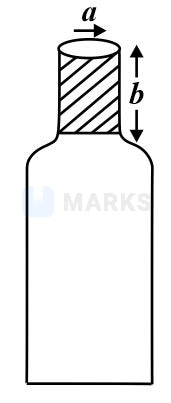 JEE Main/MCQ/Medium/Bulk Modulus/With diagram
- 102The bulk moduli of ethanol, mercury and water are given as and respectively in units of . For a given value of pressure, the fractional compression in volume is . Which of the following statements about for these three liquids is correct ?JEE Main/MCQ/Medium/Bulk Modulus
- 103A cube has side length cm and modulus of rigidity N/m. The displacement produced by a force of N in the upper face of cube is _____ mm.JEE Main/Numerical/Medium/Shearing stress
- 104A cylindrical rod of length 1 m and radius 4 cm is mounted vertically. It is subjected to a shear force of at the top. Considering infinitesimally small displacement in the upper edge, the angular displacement of the rod axis from its original position would be : (shear moduli, JEE Main/MCQ/Medium/Shearing stress
- 105Two slabs with square cross section of different materials with equal sides and thickness and such that and . Considering lower edges of these slabs are fixed to the floor, we apply equal shearing force on the narrow faces. The angle of deformation is . If the shear moduli of material 1 is , then shear moduli of material 2 is , where value of is ________.JEE Main/Numerical/Medium/Shearing stress
- 106A square aluminium (shear modulus is ) slab of side and thickness is subjected to a shearing force (on its narrow face) of . The lower edge is riveted to the floor. The displacement of the upper edge is _____ .JEE Main/Numerical/Medium/Shearing stress
- 107The velocity of water in a river is near the surface. If the river is deep, find the shearing stress between the horizontal layers of water. The coefficient of viscosity of water.JEE Main/MCQ/Medium/Shearing stress
- 108Steel ruptures when a shear of is applied. The force needed to punch a diameter hole in a steel sheet thick is nearly:JEE Main/MCQ/Medium/Shearing stress
- 109A copper wire of length is stretched by by applying an external force. The volume of the wire is . The elastic potential energy stored in the wire in stretched condition would be _______ J.
(Given Young modulus of copper )JEE Main/Numerical/Medium/Work Done in Stretching a Wire - 110A steel wire of length 2 m and Young's modulus is stretched by a force. If Poisson ratio and transverse strain for the wire are 0.2 and respectively, then the elastic potential energy density of the wire is _______ (in SI units)JEE Main/Numerical/Medium/Work Done in Stretching a Wire
- 111The elastic potential energy stored in a steel wire of length stretched through is The cross sectional area of the wire is _____ (Given, )JEE Main/Numerical/Medium/Work Done in Stretching a Wire
- 112A stone of mass is projected from a rubber catapult of length and area of cross section stretched by an amount The velocity of the projected stone is (Young's modulus of rubber )JEE Main/Numerical/Medium/Work Done in Stretching a Wire
- 113The area of cross-section of a railway track is The temperature variation is Coefficient of linear expansion of material of track is The energy stored per meter in the track is (Young's modulus of material of track is )JEE Main/Numerical/Medium/Work Done in Stretching a Wire
- 114Two steel wires having same length are suspended from a ceiling under the same load. If the ratio of their energy stored per unit volume is the ratio of their diameters is:JEE Main/MCQ/Medium/Work Done in Stretching a Wire
- 115If is stress and is Young's modulus of material of a wire, the energy stored in the wire per unit volume isJEE Main/MCQ/Medium/Work Done in Stretching a Wire
- 116A wire suspended vertically from one of its ends is stretched by attaching a weight of to the lower end. The weight stretches the wire by . Then the elastic energy stored in the wire isJEE Main/MCQ/Medium/Work Done in Stretching a Wire
- 117A 3 m long wire of radius 3 mm shows an extension of 0.1 mm when loaded vertically by a mass of 50 kg in an experiment to determine Young's modulus. The value of Young's modulus of the wire as per this experiment is , where the value of P is: (Take JEE Main/MCQ/Medium/Young's Modulus and Breaking Stress
- 118Two wires A and B are made of same material having ratio of lengths and their diameters ratio . If both the wires are stretched using same force, what would be the ratio of their respective elongations?JEE Main/MCQ/Medium/Young's Modulus and Breaking Stress
NEET question paper PDF
This chapter includes NEET questions. Open a year to read the full paper, or download the PDF.
Opening paper…
JEE Main question paper PDF
This chapter includes JEE Main questions. Open a shift to read the paper, or download the PDF.
Opening paper…
Other Physics chapters
Current Electricity 380Electrostatics 311Kinematics 308Ray Optics 295Rotational Motion 280Magnetic Effects & Magnetism 276Atoms & Nuclei 239Gravitation 223Laws of Motion 210Semiconductors 209Dual Nature of Matter 200Oscillations 194Fluid Mechanics 192Wave Optics 191Alternating Current 190Thermodynamics 190Work Energy Power 183Capacitors 180Kinetic Theory 168Electromagnetic Waves 165Electromagnetic Induction 153Units & Dimensions 149Waves 142Center of Mass, Momentum & Collision 130Thermal Properties of Matter 126Mathematics in Physics 121Experimental Physics 70Magnetic Properties of Matter 57Modern Physics 5
Stuck on a Mechanical Properties of Solids question from your book?
Snap it and get a whiteboard video that solves it step by step. Your first video needs no login.