Question 156 of 311
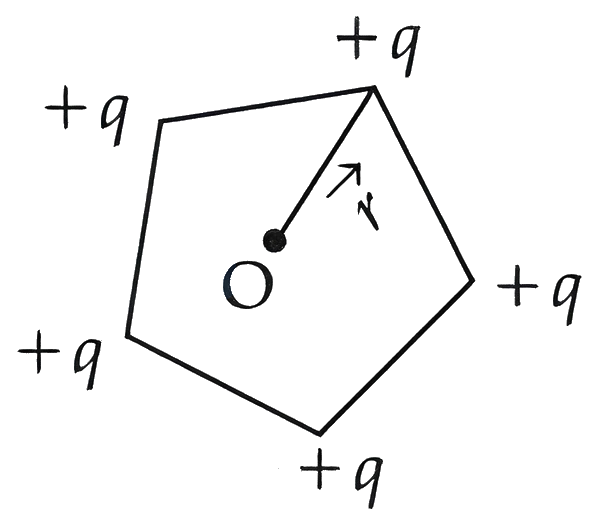
Five positive charges each having charge are placed at the vertices of a pentagon as shown in the figure. The electric potential and the electric field at the center of the pentagon due to these five positive charges are:
Show answer and solution
Answer: (B)
The electric potential at center O is the scalar sum of contributions from all 5 charges.
Each charge is equidistant from center, so .
The electric field is a vector sum of field vectors from all 5 charges.
Due to 5-fold rotational symmetry of a regular pentagon, the 5 field vectors point radially outward from center, equally spaced at 72° angles.
The vector sum of 5 equally spaced unit vectors is zero, so .
