Question 245 of 311
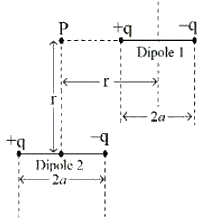
A point particle of charge is located at along the axis of an electric dipole 1 at a distance as shown in the figure. The point P is also on the equatorial plane of a second electric dipole 2 at a distance r . The dipoles are made of opposite charge q separated by a distance . For the charge particle at P not to experience any net force, which of the following correctly describes the situation?
Show answer and solution
Answer: (D)
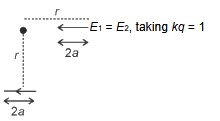
$\begin{aligned}
& \Rightarrow \frac{1}{(r-a)^2}-\frac{1}{(r+a)^2}=\frac{2 a}{\left(a^2+r^2\right)^{3 / 2}} \\
& \frac{4 a r}{\left(r^2-a^2\right)^2}=\frac{2 a}{\left(a^2+r^2\right)^{3 / 2}} \\
& \left(r^2-a^2\right)^2=2 r\left(a^2+r^2\right)^{3 / 2} \\
& \left(1-\frac{a^2}{r^2}\right)^2=2\left(1+\frac{a^2}{r^2}\right)^{3 / 2} \\
& \left(1-x^2\right)^2=2\left(1+x^2\right)^{3 / 2}\left(x=\frac{a}{r}\right) \\
& \frac{\left(1-x^2\right)^2}{\left(1+x^2\right)^{3 / 2}}=2
\end{aligned}$
Now for
We get
[But for point charge will between the dipole where ]
