Oscillations

JEE Main level, single correct, medium

48 of 194

Question 48 of 194

An oscillator of mass MM is at rest in its equilibrium position in a potential, V=12k(x–X)2V=\dfrac{1}{2}k{\left(x–X\right)}^{2} . A particle of mass mm comes from the right with speed uu and collides completely inelastic with MM and sticks to it. This process repeats every time the oscillator crosses its equilibrium position. The amplitude of oscillations after 1313 collisions is: (M=10,m=5,u=1,k=1)\left(M=10,m=5,u=1,k=1\right)

Show answer and solution

Answer: (B) 13\dfrac{1}{\sqrt{3}}

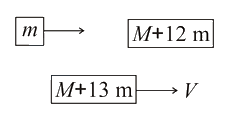
In the first collision mu\text{mu} momentum will be imparted to the system. In the second collision when the momentum of (M+m)(M+m) is in the opposite direction mu momentum of the particle will make its momentum zero. On 13th{13}^{th} collision,


Applying momentum conservation

mu=(M+13m)vmu=(M+13m)v

⇒v=muM+13m=u15\Rightarrow v=\dfrac{mu}{M+13m}=\dfrac{u}{15} ⇒M=2m\Rightarrow M=2m
⇒v=ωA\Rightarrow v=\omega A

⇒u15=KM+13m×A\Rightarrow \dfrac{u}{15}=\sqrt{\dfrac{K}{M+13m}}\times A

⇒A=115751=13\Rightarrow A=\dfrac{1}{15}\sqrt{\dfrac{75}{1}}=\dfrac{1}{\sqrt{3}}

JEE Main question paper PDF

Open a shift to read the full paper on this page, or download it.

JEE Main 2025 Apr 2 Shift 1 question paper

Open Download PDF

Opening paper…

Explain it as a whiteboard videoStep-by-step, in Hinglish or English. Your first video needs no login.Solved it on paper but got it wrong?Upload a photo of your working. Mistake Doctor marks the exact line that broke.
See it move: Simple pendulum simulationDrag the sliders and watch the numbers in this question change.

More Physics practice

JEE Main Physics practice question on Oscillations (Simple Harmonic Motion), with the answer and a step-by-step solution. Scan a question from your own book or paper to get a whiteboard video.