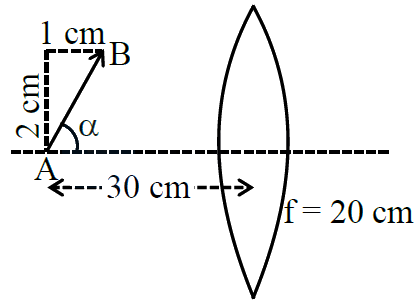
Question 121 of 295
A thin biconvex lens is prepared from the glass () both curved surfaces of which have equal radii of cm each. Left side surface of the lens is silvered from outside to make it reflecting. To have the position of image and object at the same place, the object should be placed, from the lens at a distance of ________ cm.
Show answer and solution
Answer: (A)
When one surface of a lens is silvered, the system behaves like an equivalent mirror. The light refracts through the lens, reflects off the silvered surface, and refracts through the lens again, so the equivalent power is:
Power of the biconvex lens:
For a thin biconvex lens with , and , the lens maker's formula gives:
So, .
Power of the silvered surface (acting as a concave mirror):
The back surface has radius of curvature , so its focal length is:
Equivalent focal length:
Since , the system behaves as a converging (concave) equivalent mirror of focal length .
Object position for object and image to coincide:
For a concave mirror, the image coincides with the object when the object is placed at the centre of curvature, i.e., at a distance from the mirror:
Hence, the correct option is .