Ray Optics

JEE Main level, single correct, medium

127 of 295

Question 127 of 295

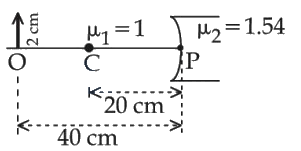
Refer the figure given below. μ1\mu_1 and μ2\mu_2 are refractive indices of air and lens material. The height of image will be _______ cm.
Show answer and solution

Answer: (A) 11

Taking the pole PP as the origin and the direction of incident light as positive:
μ1=1\mu_1 = 1 (air), μ2=1.5\mu_2 = 1.5 (lens)
u=−40 cmu = -40\text{ cm}
R=−20 cmR = -20\text{ cm} (centre of curvature lies to the left of PP)
ho=+2 cmh_o = +2\text{ cm}

Using the formula for refraction at a single spherical surface:

μ2v−μ1u=μ2−μ1R\dfrac{\mu_2}{v} - \dfrac{\mu_1}{u} = \dfrac{\mu_2 - \mu_1}{R}

1.5v−1−40=1.5−1−20\dfrac{1.5}{v} - \dfrac{1}{-40} = \dfrac{1.5 - 1}{-20}

1.5v+140=−140\dfrac{1.5}{v} + \dfrac{1}{40} = -\dfrac{1}{40}

1.5v=−240=−120\dfrac{1.5}{v} = -\dfrac{2}{40} = -\dfrac{1}{20}

v=−30 cmv = -30\text{ cm}

The negative sign indicates a virtual image formed
30 cm30\text{ cm} to the left of PP.

The transverse magnification for refraction at a spherical surface is:

m=μ1⋅vμ2⋅u=1⋅(−30)1.5⋅(−40)=−30−60=0.5m = \dfrac{\mu_1 \cdot v}{\mu_2 \cdot u} = \dfrac{1 \cdot (-30)}{1.5 \cdot (-40)} = \dfrac{-30}{-60} = 0.5

Therefore:

hi=m⋅ho=0.5×2=1 cmh_i = m \cdot h_o = 0.5 \times 2 = 1\text{ cm}

Hence, the correct option is
(1) 1(1)\ 1.

JEE Main question paper PDF

Open a shift to read the full paper on this page, or download it.

JEE Main 2025 Apr 2 Shift 1 question paper

Open Download PDF

Opening paper…

Explain it as a whiteboard videoStep-by-step, in Hinglish or English. Your first video needs no login.Solved it on paper but got it wrong?Upload a photo of your working. Mistake Doctor marks the exact line that broke.
See it move: Lens ray diagram simulationDrag the sliders and watch the numbers in this question change.Revise Ray Optics firstFormula sheet, solved examples and the traps students fall into.

More Physics practice

JEE Main Physics practice question on Ray Optics (Lens Formula, Refraction of light from curved surface), with the answer and a step-by-step solution. Scan a question from your own book or paper to get a whiteboard video.