Ray Optics

JEE Main level, single correct, medium

214 of 295

Question 214 of 295

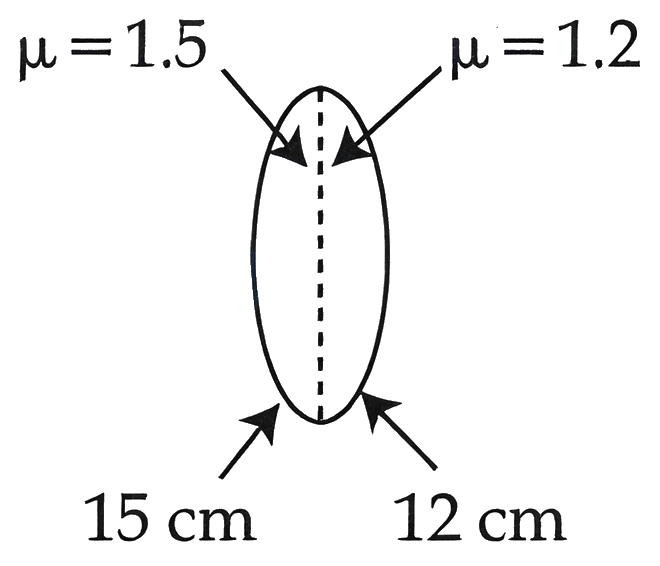
A biconvex lens is formed by using two thin planoconvex lenses, as shown in the figure. The refractive index and radius of curved surfaces are also mentioned in figure. When an object is placed on the left side of lens at a distance of 30 cm from the biconvex lens, the magnification of the image will be :
Show answer and solution

Answer: (A) -2

The biconvex lens is a combination of two thin plano-convex lenses in contact.
For the first plano-convex lens:
μ1=1.5\mu_1 = 1.5, R1=15R_1 = 15 cm, R2=∞R_2 = \infty.
Using lens maker's formula:

1f1=(μ1−1)(1R1−1R2)\frac{1}{f_1} = (\mu_1 - 1) \left( \frac{1}{R_1} - \frac{1}{R_2} \right)
=(1.5−1)(115−1∞)= (1.5 - 1) \left( \frac{1}{15} - \frac{1}{\infty} \right)
=0.5×115=130= 0.5 \times \frac{1}{15} = \frac{1}{30} cm−1^{-1}.
For the second plano-convex lens:

μ2=1.2\mu_2 = 1.2, R1=∞R_1 = \infty, R2=−12R_2 = -12 cm.
Using lens maker's formula:

1f2=(μ2−1)(1R1−1R2)\frac{1}{f_2} = (\mu_2 - 1) \left( \frac{1}{R_1} - \frac{1}{R_2} \right)
=(1.2−1)(1∞−1−12)= (1.2 - 1) \left( \frac{1}{\infty} - \frac{1}{-12} \right)
=0.2×112=160= 0.2 \times \frac{1}{12} = \frac{1}{60} cm−1^{-1}.
The equivalent focal length
FF of the combination is given by:
1F=1f1+1f2=130+160\frac{1}{F} = \frac{1}{f_1} + \frac{1}{f_2} = \frac{1}{30} + \frac{1}{60}
=2+160=360=120= \frac{2+1}{60} = \frac{3}{60} = \frac{1}{20} cm−1^{-1}.
Thus,
F=20F = 20 cm.
Given object distance
u=−30u = -30 cm. Using the lens formula 1v−1u=1F\frac{1}{v} - \frac{1}{u} = \frac{1}{F}:
1v−1−30=120\frac{1}{v} - \frac{1}{-30} = \frac{1}{20}
⇒1v=120−130=3−260=160\Rightarrow \frac{1}{v} = \frac{1}{20} - \frac{1}{30} = \frac{3-2}{60} = \frac{1}{60}.
So,
v=60v = 60 cm.
Magnification
m=vu=60−30=−2m = \frac{v}{u} = \frac{60}{-30} = -2.

JEE Main question paper PDF

Open a shift to read the full paper on this page, or download it.

JEE Main 2025 Apr 2 Shift 1 question paper

Open Download PDF

Opening paper…

Explain it as a whiteboard videoStep-by-step, in Hinglish or English. Your first video needs no login.Solved it on paper but got it wrong?Upload a photo of your working. Mistake Doctor marks the exact line that broke.
See it move: Lens ray diagram simulationDrag the sliders and watch the numbers in this question change.Revise Ray Optics firstFormula sheet, solved examples and the traps students fall into.

More Physics practice

JEE Main Physics practice question on Ray Optics (Combination of Lens and Mirrors), with the answer and a step-by-step solution. Scan a question from your own book or paper to get a whiteboard video.