Question 246 of 280
A solid sphere of mass ' ' and radius ' ' is allowed to roll without slipping from the highest point of an inclined plane of length ' ' and makes an angle with the horizontal. The speed of the particle at the bottom of the plane is . If the angle of inclination is increased to while keeping constant. Then the new speed of the sphere at the bottom of the plane is . The ratio is
Show answer and solution
Answer: (A)
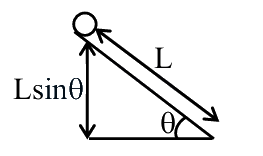
using WET
$\begin{aligned}
& \mathrm{W}_{\mathrm{g}}=\mathrm{k}_{\mathrm{f}}-\mathrm{k}_{\mathrm{i}} \\
& \mathrm{Mg} \mathrm{~L} \sin \theta=\mathrm{k}_{\mathrm{f}}-\mathrm{k}_{\mathrm{i}}
\end{aligned}$
K.E. in pure rolling
$\begin{aligned}
& =\frac{1}{2} \mathrm{mV}^2+\frac{1}{2} \times \frac{2}{5} \mathrm{mR}^2 \frac{\mathrm{~V}^2}{\mathrm{R}^2} \\
& \frac{7}{10} \mathrm{mV}^2
\end{aligned}$
$\begin{aligned}
& \mathrm{V}_{\mathrm{f}}^2 \propto \sin \theta \\
& \left(\frac{\mathrm{~V}_1}{\mathrm{~V}_2}\right)^2=\frac{\sin \theta_1}{\sin \theta_2}=\frac{\sin 30^{\circ}}{\sin 45^{\circ}}=\frac{1}{\sqrt{2}}
\end{aligned}$