Physics · Class 12 · JEE / NEET / AP Physics
Bohr's Atomic Model & Hydrogen Spectra
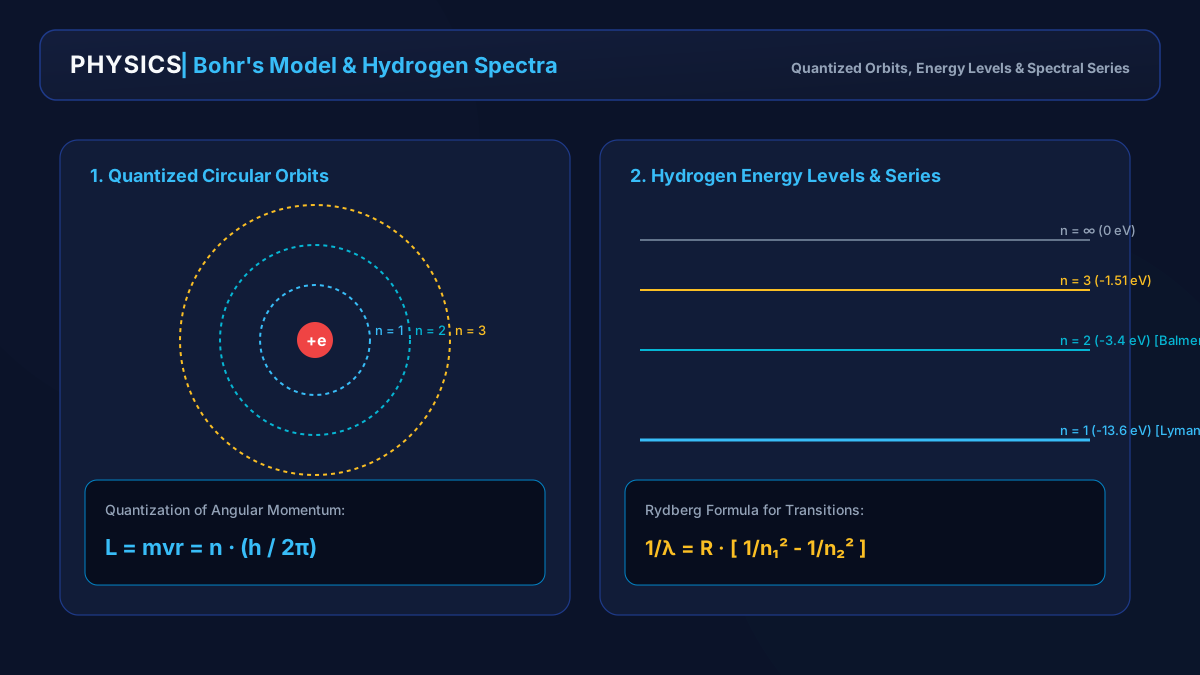
Niels Bohr resolved Rutherford's atomic instability paradox by postulating that electrons revolve only in specific non-radiatingstationary orbitswhere angular momentum is quantized: .
11. Visual Overview & Intuitive Discovery: Bohr's Atomic Model & Hydrogen Spectra
In classical 19th-century electromagnetism, James Clerk Maxwell proved that an accelerating electric charge MUST radiate electromagnetic waves and lose energy. An electron orbiting a nucleus is under constant centripetal acceleration. Classical physics calculated that every atom in the universe should collapse into its nucleus in less than 0.0000000001 seconds! The physical universe around us shouldn't exist. Niels Bohr boldly solved this paradox by quantizing orbital angular momentum.
 Full size
Bohr's Quantized Orbits & Hydrogen Spectral Series
Concentric quantized circular orbits and hydrogen energy level diagram showing Lyman (UV), Balmer (Visible), and Paschen (IR) series.
- 1Bohr Quantization Postulate — L = m v r = n · (h / 2π) for integer n = 1, 2, 3...
- 2Bohr Radius (r₁) — r_n = 0.529 · (n² / Z) Å
- 3Energy Formula — E_n = -13.6 · (Z² / n²) eV
- 4Rydberg Formula — 1/λ = R · Z² [1/n₁² - 1/n₂²] where R ≈ 1.097 × 10⁷ m⁻¹
Interactive Study Prompts (Click to Explore)
Clickable22. Physical Mechanism Flowchart: Bohr's Atomic Model & Hydrogen Spectra
Bohr's Atomic Model & Hydrogen Spectra Step-by-Step Flowchart
- 1
Initial State
Initial parameters and boundary conditions are established.
- 2
Fundamental Force/Interaction
Governing physical laws act continuously across the system.
- 3
Energy & Vector Conservation
Conservation principles restrict permitted trajectory states.
- 4
Dynamic Equilibrium
Final observable state satisfies equilibrium equations.
Follow the numbered pipeline above. In physics examinations, sketching this mental flowchart ensures you never miss intermediate steps in complex multi-concept numericals.
33. Rigorous Mathematical Proofs & Governing Equations
Derivation — Derivation of Governing Formula for Bohr's Atomic Model & Hydrogen Spectra
- 1
Starting from Newton's foundational law
- 2
Integrating over displacement
Fundamental Relation
Core Physical Variables
| Variable | Symbol | SI Unit |
|---|---|---|
| Energy | E | Joules (J) |
| Power | P | Watts (W) |
Energy
- Symbol
- E
- SI Unit
- Joules (J)
Power
- Symbol
- P
- SI Unit
- Watts (W)
44. Astrophysics: Decoding the Composition of Stars Billions of Miles Away
How do astronomers know that the atmosphere of a star 1,000 light-years away contains hydrogen, helium, iron, and carbon without ever visiting it? Spectral fingerprints! Because electron energy levels are quantized (), every chemical element absorbs and emits light at precise, unique atomic frequencies. By analyzing the dark absorption lines in starlight using spectrometers, astrophysicists read the elemental recipes of distant stars.
55. Solved Standard & Advanced Exam Problems
Exam question · JEE Standard
- A.A
- B.B
- C.C
- D.D
- Step 1
Answer: A. A
What it tests: Explanation
Exam question · NEET & JEE Main
- A.1 : 4
- B.1 : 2
- C.4 : 1
- D.1 : 9
- 1. Shortest wavelength (series limit) corresponds to transition from n₂ = ∞.
- 2. For Lyman: 1/λ_Lyman = R [1/1² - 1/∞²] = R ⇒ λ_Lyman = 1/R.
- 3. For Balmer: 1/λ_Balmer = R [1/2² - 1/∞²] = R/4 ⇒ λ_Balmer = 4/R.
- 4. Ratio: λ_Lyman / λ_Balmer = (1/R) / (4/R) = 1/4.
Answer: A. 1 : 4
What it tests: The Lyman series limit has 4 times higher photon energy than the Balmer series limit.
Remember
- Balmer series transitions end at n = 2 and produce spectral lines in the visible spectrum.
- Lyman series transitions end at n = 1 and produce spectral lines in the ultraviolet (UV) region.
- The negative total energy indicates that the electron is bound to the nucleus.
Check yourself
Question 1
Which hydrogen spectral series falls entirely in the visible wavelength range?