Physics · Class 9-10 · CBSE
Light and Convex Lenses
Aconvex lensis a converging lens, meaning it brings parallel rays of light together at a single point. Understanding how light interacts with these lenses is crucial for predicting image formation.
1How Convex Lenses Work
A convex lens is thicker in the middle and thinner at the edges. It causes parallel rays of light toconvergeat a point called the principal focus (). This converging property is why they are used in magnifying glasses and cameras.
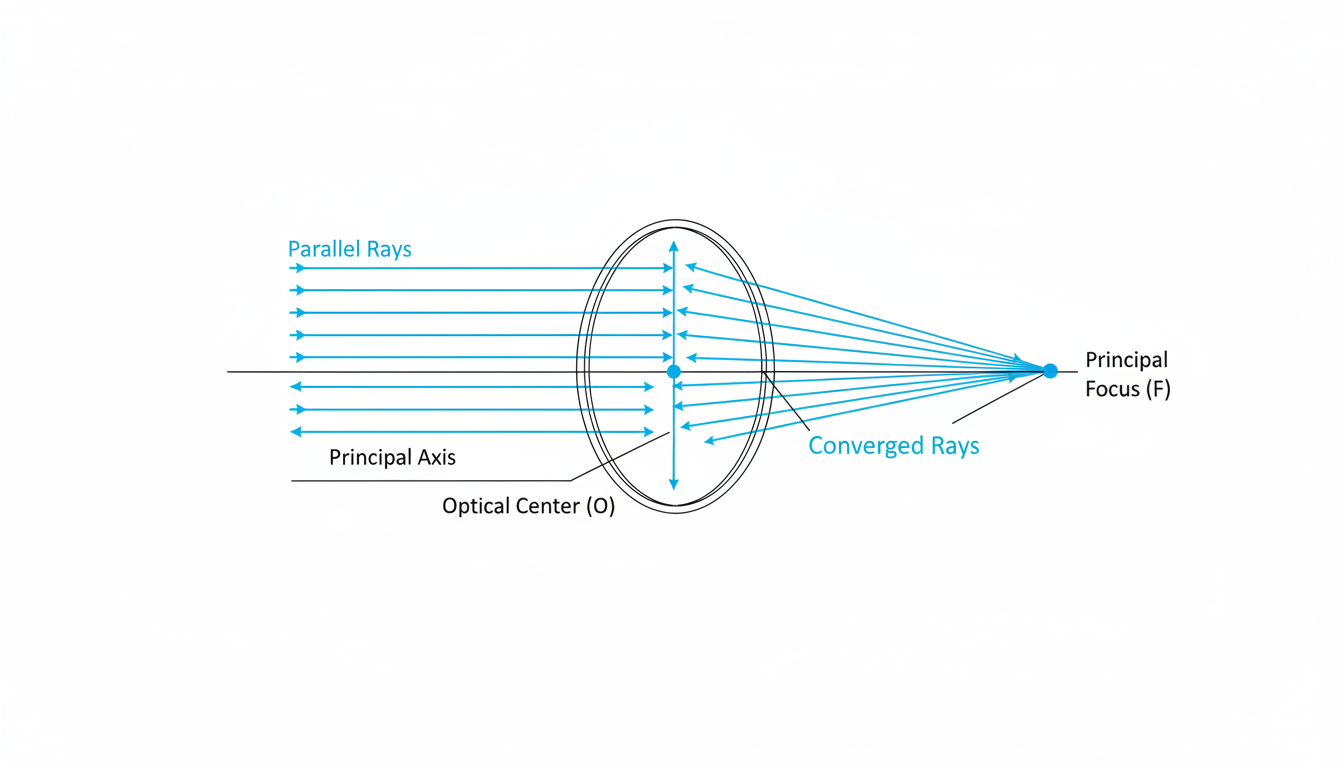 Full size
Light Rays Through a Convex Lens
Parallel light rays converge at the principal focus after passing through a convex lens.
- 1Principal Axis — Imaginary line passing through the optical center
- 2Optical Center (O) — Central point of the lens
- 3Principal Focus (F) — Point where parallel rays converge
- 4Parallel Rays — Light rays entering the lens
- 5Converged Rays — Rays after passing through the lens
2Key Ray Tracing Rules
To predict where an image will form, we useray tracingwith specific rules. By drawing just two or three principal rays, we can locate the image's position, size, and nature.
Rules for Ray Tracing with Convex Lenses
| Incident Ray | Refracted Ray |
|---|---|
| Parallel to principal axis | Passes through principal focus (F) on the other side |
| Passing through principal focus (F) | Becomes parallel to principal axis |
| Passing through optical center (O) | Goes undeviated |
Parallel to principal axis
- Refracted Ray
- Passes through principal focus (F) on the other side
Passing through principal focus (F)
- Refracted Ray
- Becomes parallel to principal axis
Passing through optical center (O)
- Refracted Ray
- Goes undeviated
3Image Formation at Different Object Positions
Theposition of the objectrelative to the convex lens significantly changes the characteristics of the image formed. We define as the principal focus and as twice the focal length.
Image Characteristics with Object Position
- 1
Object at Infinity
Image at F, real, inverted, highly diminished
- 2
Object beyond 2F
Image between F and 2F, real, inverted, diminished
- 3
Object at 2F
Image at 2F, real, inverted, same size
- 4
Object between F and 2F
Image beyond 2F, real, inverted, enlarged
- 5
Object at F
Image at infinity, real, inverted, highly enlarged
- 6
Object between F and O
Image on same side as object, virtual, erect, enlarged
4Lens Formula and Magnification
Thelens formularelates the object distance (), image distance (), and focal length (). Magnification () describes how much larger or smaller the image is compared to the object.
Lens Formula
- = object distance
- = image distance
- = focal length
Magnification Formula
- = magnification
- = height of image
- = height of object
5Example: Object between F and 2F
Real-life example · Image Formation Example
An object is placed 15 cm from a convex lens with a focal length of 10 cm. Here, the object is between F (10 cm) and 2F (20 cm). Using the lens formula, we find the image distance cm. The image is formed beyond 2F, is real, inverted, and enlarged (). This setup is similar to a projector.
6Exam Corner
Important for exams
- Convex lenses areconverging lenses.
- Principal focus () is where parallel rays converge.
- Ray tracing rules help locate images.
- Image characteristics (real/virtual, erect/inverted, size) depend onobject position.
- Lens formula: .
- Magnification: .
- Sign conventions are crucial for calculations.
Exam question · NEET 2019 style
- A.Real, inverted, diminished
- B.Real, inverted, same size
- C.Virtual, erect, enlarged
- D.Real, erect, enlarged
- When an object is placed at 2F for a convex lens, the image is formed at 2F on the other side.
- The image formed is real, inverted, and of the same size as the object.
Answer: B. Real, inverted, same size
What it tests: Tests knowledge of image formation rules for convex lenses at a specific position.
Remember
- Convex lensesconvergelight rays.
- Image characteristics depend on theobject's positionrelative to F and 2F.
- Ray tracingand thelens formulaare used to predict image formation.
- Real images areinverted, virtual images areerect.
- Magnification indicates thesize of the imagerelative to the object.
Check yourself
Question 1
Which of the following statements is true for a convex lens?Question 2
If an object is placed between the principal focus (F) and the optical center (O) of a convex lens, the image formed will be:Question 3
A convex lens has a focal length of 20 cm. An object is placed 30 cm from the lens. What is the nature of the image?