Physics · Class 12 · JEE / NEET / AP Physics 2
Capacitance & Dielectrics
ACapacitoris an electrical device designed to store electrical energy in the electric field between two conducting plates. Inserting aDielectricmaterial increases its capacitance by reducing the net internal electric field.
11. Visual Overview & Intuitive Discovery: Capacitance & Dielectrics
When you tap the glass screen of your smartphone, you are interacting with millions of microscopic transparent capacitors made of indium tin oxide. Your fingertip is an electrical conductor. Touching the screen alters the local capacitance at that exact coordinate, allowing the microprocessor to track your gestures at 120 frames per second.
 Full size
Capacitance & Dielectric Polarization
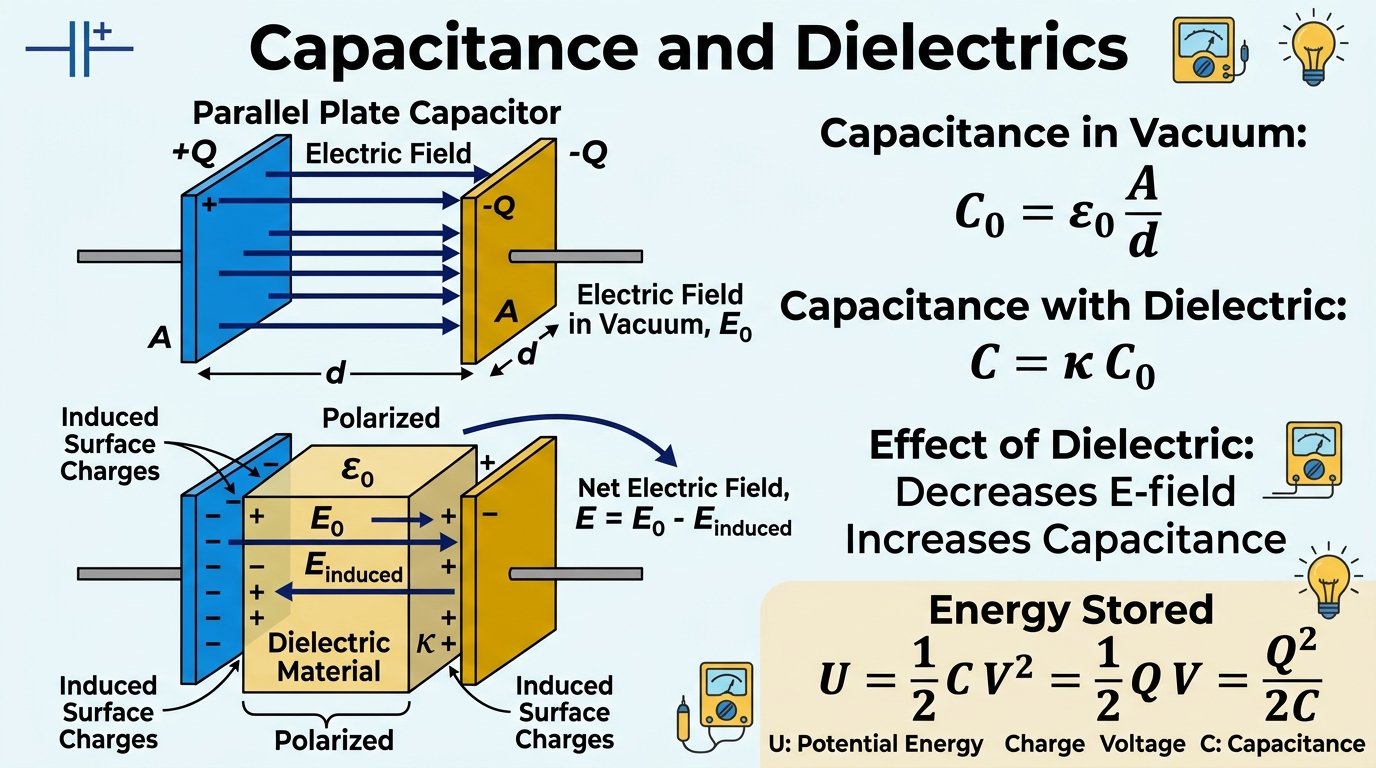
Parallel plate capacitor in vacuum and with dielectric slab insertion, showing polarization charges and stored energy formulas.
- 1Vacuum Capacitance — C₀ = ε₀ A / d, proportional to plate area A and inversely to separation d
- 2Dielectric Constant (κ) — C = κ · C₀ where κ > 1 increases capacitance by polarising bound dipoles
- 3Electric Field Reduction — Net field E = E₀ - E_induced = E₀ / κ
- 4Stored Potential Energy — U = 1/2 C V² = 1/2 Q V = Q² / (2C)
- 5Energy Density — u_E = 1/2 ε₀ E² (Joules per cubic meter of electric field)
Interactive Study Prompts (Click to Explore)
Clickable22. Physical Mechanism Flowchart: Capacitance & Dielectrics
Capacitance & Dielectrics Step-by-Step Flowchart
- 1
Initial State
Initial parameters and boundary conditions are established.
- 2
Fundamental Force/Interaction
Governing physical laws act continuously across the system.
- 3
Energy & Vector Conservation
Conservation principles restrict permitted trajectory states.
- 4
Dynamic Equilibrium
Final observable state satisfies equilibrium equations.
Follow the numbered pipeline above. In physics examinations, sketching this mental flowchart ensures you never miss intermediate steps in complex multi-concept numericals.
33. Rigorous Mathematical Proofs & Governing Equations
Derivation — Derivation of Governing Formula for Capacitance & Dielectrics
- 1
Starting from Newton's foundational law
- 2
Integrating over displacement
Capacitance Combinations
- = In parallel, voltages are equal and capacitances add directly
- = In series, charge Q is identical across all capacitors
Core Physical Variables
| Variable | Symbol | SI Unit |
|---|---|---|
| Energy | E | Joules (J) |
| Power | P | Watts (W) |
Energy
- Symbol
- E
- SI Unit
- Joules (J)
Power
- Symbol
- P
- SI Unit
- Watts (W)
44. Medical Marvel: The Automated External Defibrillator (AED)
During sudden cardiac arrest, a human heart fibrillates into chaotic, uncoordinated spasms. A chemical battery cannot deliver 300 Joules of energy in 5 milliseconds—it has too much internal resistance. Instead, an AED charges an internal high-voltage capacitor to 2,000 Volts over several seconds, storing electrostatic potential energy (). When the shock button is pressed, the capacitor discharges all 300 Joules into the patient's chest in under 3 milliseconds, rebooting the heart's natural electrical pacemaker.
55. Solved Standard & Advanced Exam Problems
Exam question · JEE Standard
- A.A
- B.B
- C.C
- D.D
- Step 1
Answer: A. A
What it tests: Explanation
Exam question · JEE Main / NEET
- A.1.6 C₀
- B.2.0 C₀
- C.4.0 C₀
- D.0.8 C₀
- 1. The system can be modeled as two capacitors in series: C₁ with dielectric of thickness d/2, and C₂ with air of thickness d/2.
- 2. C₁ = κ ε₀ A / (d/2) = 2 κ C₀ = 2(4) C₀ = 8 C₀.
- 3. C₂ = ε₀ A / (d/2) = 2 C₀.
- 4. Equivalent series capacitance: 1/C_eq = 1/C₁ + 1/C₂ = 1/(8C₀) + 1/(2C₀) = 5 / (8C₀).
- 5. Inverting: C_eq = 8/5 C₀ = 1.6 C₀.
Answer: A. 1.6 C₀
What it tests: Partial dielectric insertion behaves as a series combination of dielectric and vacuum capacitors.
Remember
- Capacitance C = Q/V depends solely on geometry and dielectric medium, not on the applied voltage.
- Inserting a dielectric increases capacitance by factor κ (C = κ C₀).
- If a capacitor is disconnected from the battery and dielectric is inserted: Charge Q remains constant, V decreases, U decreases.
- If connected to a constant battery: Voltage V remains constant, Charge Q increases, U increases.
Check yourself
Question 1
A parallel plate capacitor is charged by a battery and then disconnected. A dielectric slab (κ = 4) is inserted between the plates. What happens to the stored energy?