Physics · Class 12 · JEE / NEET / AP Physics 2
Current Electricity & Kirchhoff's Rules
Current Electricitydescribes the flow of electric charges through conductors. Complex multi-loop electrical networks that cannot be solved by simple series-parallel reductions are solved usingKirchhoff's Rules.
11. Visual Overview & Intuitive Discovery: Current Electricity & Kirchhoff's Rules
When you flip a light switch on your wall, the bulb 10 feet away illuminates almost instantaneously. Many people assume this means electrons inside the wire are traveling at the speed of light. In reality, individual electrons in copper wire drift at a sluggish pace of less than 0.1 millimeters per second—slower than a garden snail! What travels near the speed of light is the electromagnetic wave field propagating through the wire.
 Full size
Current Electricity & Circuit Network Analysis
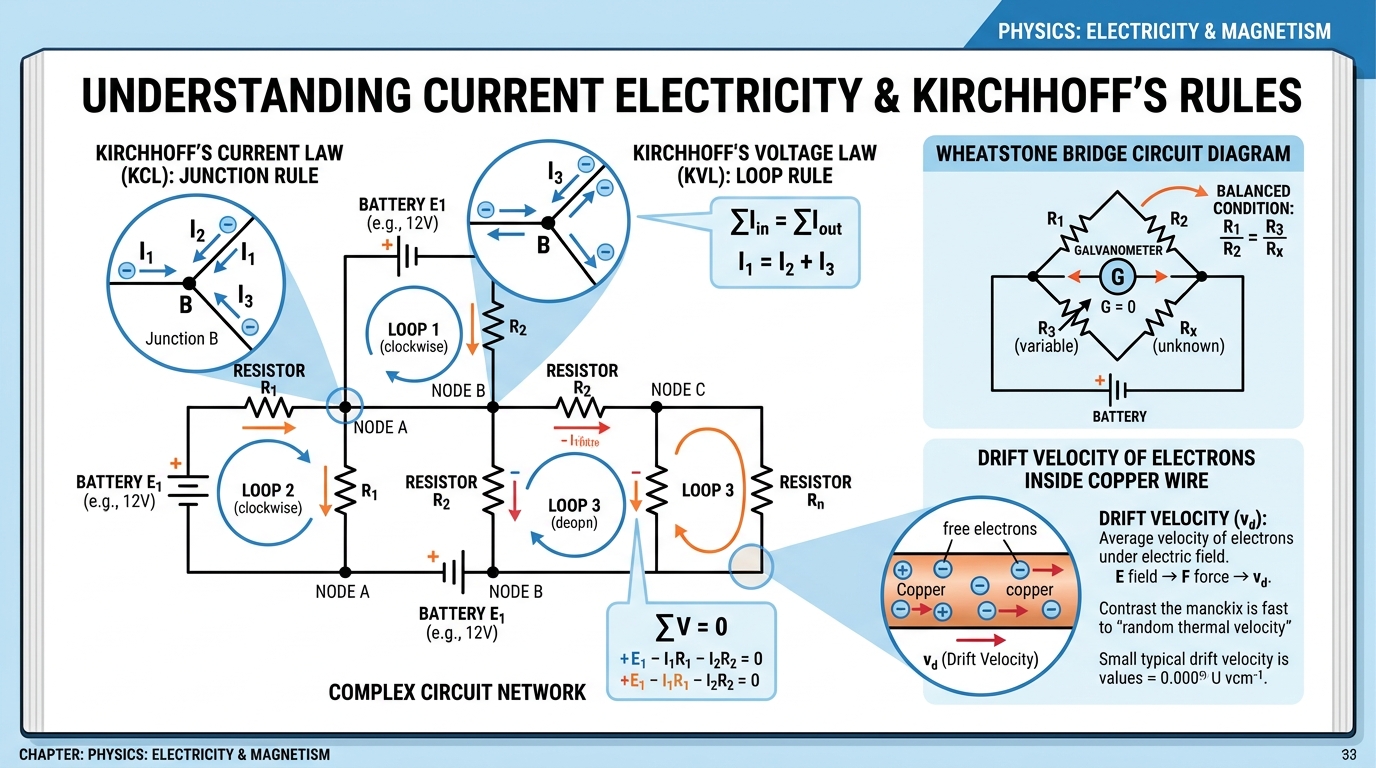
Circuit network displaying Kirchhoff's Junction Rule (KCL), Loop Rule (KVL), electron drift velocity in copper, and Wheatstone bridge.
- 1Kirchhoff's Current Law (KCL) — Σ I_in = Σ I_out at any junction (Conservation of Charge)
- 2Kirchhoff's Voltage Law (KVL) — Σ ΔV = 0 around any closed loop (Conservation of Energy)
- 3Drift Velocity (v_d) — v_d = e E τ / m, slow net progression of electrons (~mm/s) superimposed on fast thermal motion
- 4Wheatstone Bridge — When balanced (Galvanometer I_g = 0), the ratio R1/R2 = R3/Rx
Interactive Study Prompts (Click to Explore)
Clickable22. Physical Mechanism Flowchart: Current Electricity & Kirchhoff's Rules
Current Electricity & Kirchhoff's Rules Step-by-Step Flowchart
- 1
Initial State
Initial parameters and boundary conditions are established.
- 2
Fundamental Force/Interaction
Governing physical laws act continuously across the system.
- 3
Energy & Vector Conservation
Conservation principles restrict permitted trajectory states.
- 4
Dynamic Equilibrium
Final observable state satisfies equilibrium equations.
Follow the numbered pipeline above. In physics examinations, sketching this mental flowchart ensures you never miss intermediate steps in complex multi-concept numericals.
33. Rigorous Mathematical Proofs & Governing Equations
Derivation — Derivation of Governing Formula for Current Electricity & Kirchhoff's Rules
- 1
Starting from Newton's foundational law
- 2
Integrating over displacement
Ohm's Law & Microscopic Form
- J = Current density (A/m²)
- = Electrical conductivity (S/m)
- = Drift velocity (m/s)
- = Relaxation time between electron collisions
Core Physical Variables
| Variable | Symbol | SI Unit |
|---|---|---|
| Energy | E | Joules (J) |
| Power | P | Watts (W) |
Energy
- Symbol
- E
- SI Unit
- Joules (J)
Power
- Symbol
- P
- SI Unit
- Watts (W)
44. Instrumentation: Strain Gauges and Structural Health Monitoring
How do civil engineers know when a suspension bridge, airplane wing, or nuclear containment vessel is bending under dangerous stress? They cement a Wheatstone bridge circuit with a microscopic metal foil strain gauge to the steel girders. When the bridge flexes by mere micrometers, the foil stretches, changing its resistance by 0.001%. This unbalances the Wheatstone bridge, producing a millivolt signal that alerts engineers before catastrophic collapse occurs.
55. Solved Standard & Advanced Exam Problems
Exam question · JEE Standard
- A.A
- B.B
- C.C
- D.D
- Step 1
Answer: A. A
What it tests: Explanation
Exam question · JEE Main & NEET
- A.Strictly zero
- B.Equal to total battery current
- C.Infinite
- D.Proportional to battery EMF
- 1. In a balanced Wheatstone bridge, the ratio of resistances satisfies R₁/R₂ = R₃/R₄.
- 2. This condition guarantees that the electrical potentials at the two bridge junctions are identical: V_B = V_D.
- 3. Since the potential difference across the galvanometer is ΔV = V_B - V_D = 0, Ohm's law dictates I_g = ΔV / R_g = 0.
Answer: A. Strictly zero
What it tests: Zero current flows between equipotential nodes.
Remember
- KCL represents conservation of electric charge at any junction node.
- KVL represents conservation of energy along any closed conducting loop.
- The balanced Wheatstone bridge condition R₁/R₂ = R₃/R₄ allows precision resistance measurement without drawing galvanometer current.
- Drift velocity of electrons is surprisingly small (fractions of mm/s), while electrical signals propagate near the speed of light.
Check yourself
Question 1
Kirchhoff's First Law (Junction Rule) and Second Law (Loop Rule) are respective consequences of conservation of: