Physics · Class 12 · JEE / NEET / AP Physics 2
Electrostatics: Coulomb's Law & Electric Potential
Electrostaticsstudies stationary electrical charges.Coulomb's Lawdictates the fundamental inverse-square electrostatic force, whileElectric Potential ()measures the work required to assemble charge distributions.
11. Visual Overview & Intuitive Discovery: Electrostatics: Coulomb's Law & Electric Potential
If you could remove just 1% of the electrons from a single grain of sand and place them 1 meter away from the remaining positive ions, the repulsive force between them would exceed the weight of the entire planet Earth! Electrostatic force is unimaginably powerful— times stronger than gravity. The only reason we don't experience this overwhelming force in daily life is the almost perfect balance of positive protons and negative electrons in ordinary matter.
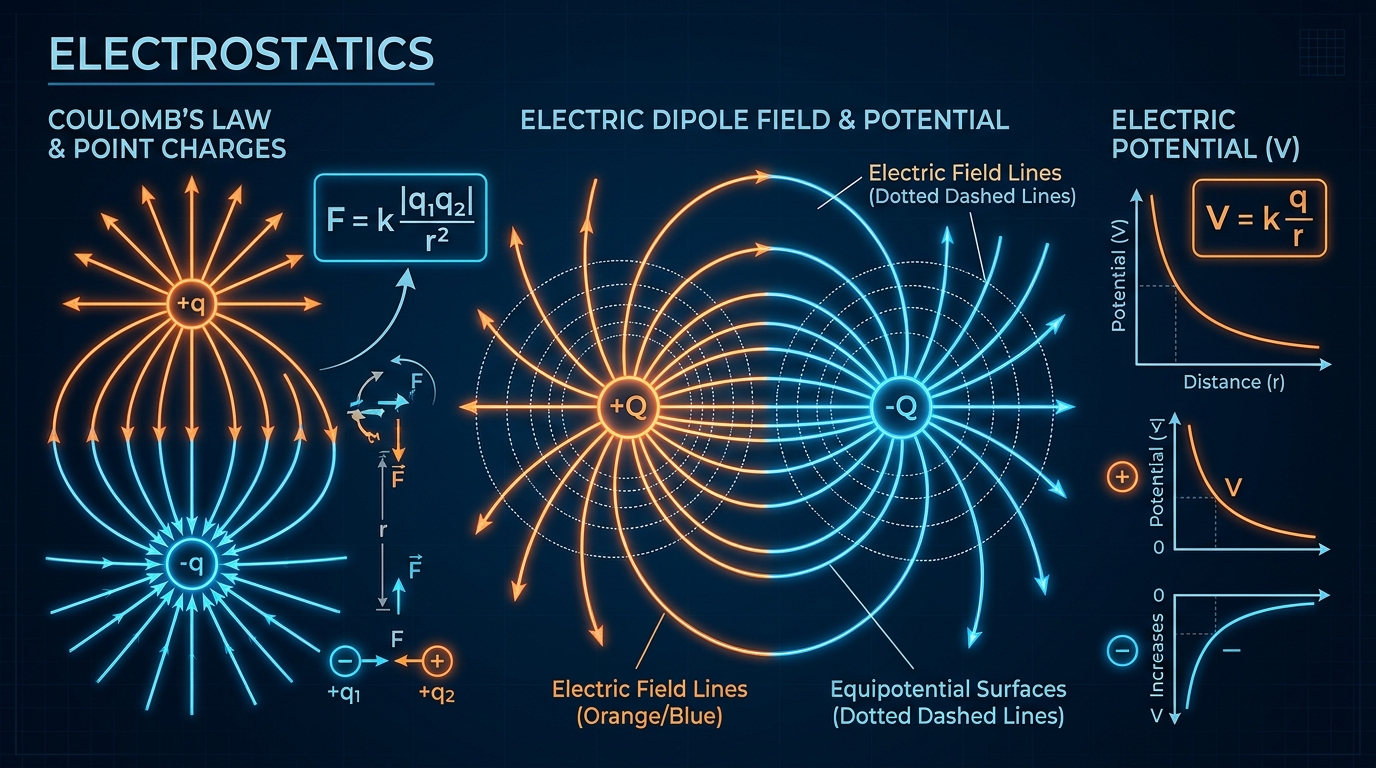 Full size
Electrostatics: Coulomb Force & Dipole Potential
Detailed electrostatic field map showing Coulomb force vectors, electric dipole field geometry, and concentric equipotential contour surfaces.
- 1Coulomb's Law — F = k |q1 q2| / r² where k = 1/(4πε₀) ≈ 8.99 × 10⁹ N·m²/C²
- 2Electric Field Vector — E = F / q₀, radiating radially outward from +Q and inward toward -Q
- 3Electric Dipole — Two equal and opposite charges ±q separated by 2a, with dipole moment p = q · 2a directed from - to +
- 4Electric Potential (V) — Scalar field V = k q / r, representing potential energy per unit positive test charge
- 5Equipotential Contours — Surfaces of constant V; zero work is required to move a charge along an equipotential surface
Interactive Study Prompts (Click to Explore)
Clickable22. Physical Mechanism Flowchart: Electrostatics: Coulomb's Law & Electric Potential
Electrostatics: Coulomb's Law & Electric Potential Step-by-Step Flowchart
- 1
Initial State
Initial parameters and boundary conditions are established.
- 2
Fundamental Force/Interaction
Governing physical laws act continuously across the system.
- 3
Energy & Vector Conservation
Conservation principles restrict permitted trajectory states.
- 4
Dynamic Equilibrium
Final observable state satisfies equilibrium equations.
Follow the numbered pipeline above. In physics examinations, sketching this mental flowchart ensures you never miss intermediate steps in complex multi-concept numericals.
33. Rigorous Mathematical Proofs & Governing Equations
Derivation — Derivation of Governing Formula for Electrostatics: Coulomb's Law & Electric Potential
- 1
Starting from Newton's foundational law
- 2
Integrating over displacement
Coulomb Force & Electric Field Relations
- = Permittivity of free space (8.854 × 10⁻¹² C²/N·m²)
- = Magnitudes of interacting charges
- V = Electric potential in Volts (J/C)
- = Electric field in N/C or V/m
Electric Field & Potential of a Dipole ($p = 2aq$)
| Location | Electric Field Magnitude () | Electric Potential () |
|---|---|---|
| Axial Line (Distance r ≫ a) | ||
| Equatorial Line (Distance r ≫ a) | (Potential is strictly zero everywhere on equator) | |
| General Point |
Axial Line (Distance r ≫ a)
- Electric Field Magnitude ($E$)
- Electric Potential ($V$)
Equatorial Line (Distance r ≫ a)
- Electric Field Magnitude ($E$)
- Electric Potential ($V$)
- (Potential is strictly zero everywhere on equator)
General Point
- Electric Field Magnitude ($E$)
- Electric Potential ($V$)
44. Medical Application: Electrocardiograms (ECG) and Cardiac Dipoles
Every human heartbeat is fundamentally an electrostatic event. When pacemaker cells in the sinoatrial node fire, waves of sodium () and potassium () ions rush across cell membranes, creating a macroscopic traveling electric dipole vector . Hospital ECG electrodes placed on your chest and wrists detect the tiny millivolt potential differences () produced by this cardiac dipole, plotting the famous P-QRS-T wave that reveals heart health.
55. Solved Standard & Advanced Exam Problems
Exam question · CBSE Class 12 & AP Physics Standard
- A.24 cm from +4 μC (between the charges)
- B.10 cm from +4 μC
- C.6 cm from -1 μC outside the charges
- D.Both 24 cm between them and 40 cm outside near -1 μC
- 1. Electric potential V is a scalar sum: V = k(q1/r1 + q2/r2) = 0 ⇒ q1/r1 = -q2/r2.
- 2. Case 1 (Internal point at distance x from +4 μC): 4/x = 1/(30 - x) ⇒ 120 - 4x = x ⇒ 5x = 120 ⇒ x = 24 cm.
- 3. Case 2 (External point at distance y from -1 μC): 4/(30 + y) = 1/y ⇒ 4y = 30 + y ⇒ 3y = 30 ⇒ y = 10 cm from -1 μC (40 cm from +4 μC).
Answer: D. Both 24 cm between them and 40 cm outside near -1 μC
What it tests: Because potential is a scalar quantity, zero-potential points exist both between unlike charges and externally on the side of the smaller magnitude charge.
Exam question · JEE Main & NEET
- A.Zero
- B.4kq / a²
- C.2kq / a²
- D.8kq / a²
- 1. Electric field is a vector quantity.
- 2. Diagonal opposite charges are identical in magnitude and equidistant from the center.
- 3. The electric field vector from one corner charge is exactly matched by an equal and opposite field vector from the diagonally opposing charge.
- 4. Vector sum: E_net = E₁ + E₂ + E₃ + E₄ = 0.
Answer: A. Zero
What it tests: High spatial geometric symmetry causes vector cancellation of electric field vectors at the center.
Remember
- Coulomb force is an inverse-square force that obeys Newton's third law in vector form.
- Electric field lines never cross each other because a single point cannot have two distinct field directions.
- Work done moving a charge q between two points is W = q · ΔV and is path-independent in electrostatics.
- The electric field inside an electrostatic conductor in equilibrium is always zero.
Check yourself
Question 1
What is the work done in moving a test charge of 5 μC along an equipotential surface of 50 V for a distance of 10 cm?