Physics · Class 11-12 · JEE / NEET / AP Physics
Fluid Mechanics: Bernoulli's Principle & Viscosity
Fluid dynamics describes liquid and gas transport.Bernoulli's Principlestates that for an incompressible, non-viscous fluid in streamline flow, an increase in fluid speed occurs simultaneously with a decrease in static pressure.
11. Visual Overview & Intuitive Discovery: Fluid Mechanics: Bernoulli's Principle & Viscosity
How can a 500-ton Boeing 777 aircraft carrying 300 passengers, 150 tons of cargo, and thousands of gallons of fuel rise gracefully into the sky? The secret is sculpted into the curvature of its wings. By shaping the upper airfoil surface with higher camber, air rushes faster across the top than across the flat bottom. By Bernoulli's Principle, this speed difference generates thousands of tons of upward aerodynamic lift.
 Full size
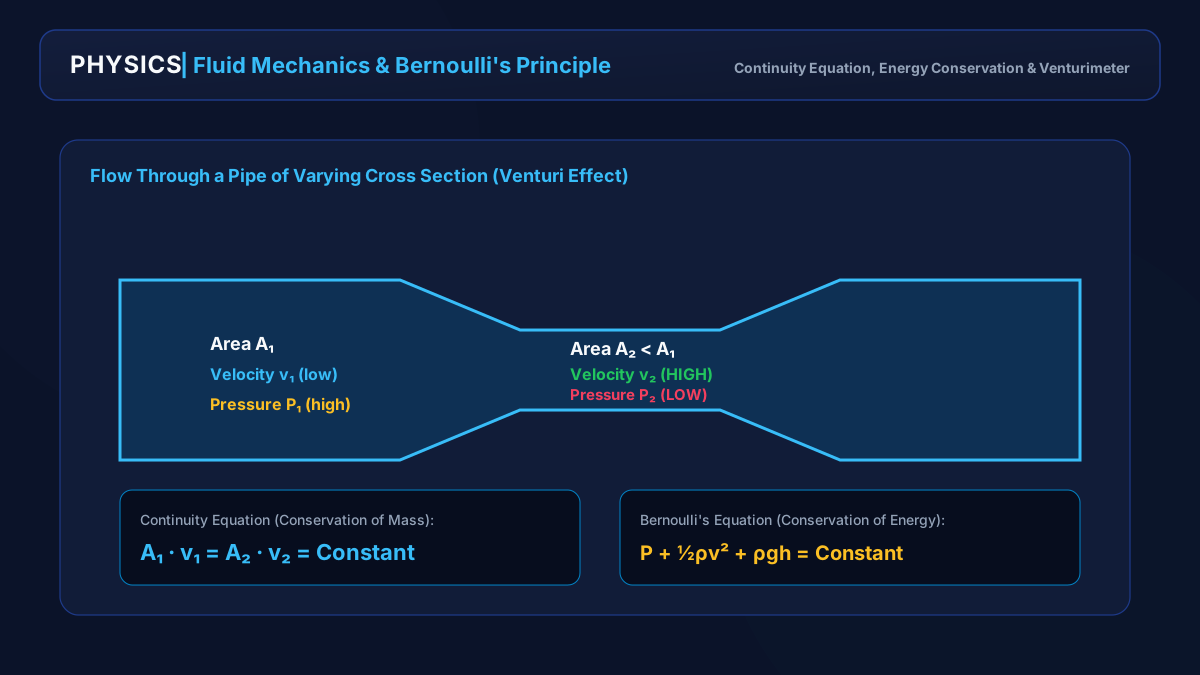
Fluid Mechanics: Continuity & Bernoulli Venturi Effect
Flow through varying pipe section showing area narrowing, fluid velocity increase, and pressure drop in a Venturimeter.
- 1Continuity Equation — A₁ v₁ = A₂ v₂ = Constant (Conservation of Mass)
- 2Bernoulli's Equation — P + 1/2 ρ v² + ρ g h = Constant (Conservation of Energy)
- 3Torricelli's Law of Efflux — v = √(2gh) for liquid leaking from an orifice at depth h
- 4Stokes' Viscous Drag Law — F_v = 6 π η r v for a sphere of radius r moving through fluid of viscosity η
- 5Terminal Velocity — v_t = 2 r² (ρ - σ) g / (9 η) when drag balances net gravitational force
Interactive Study Prompts (Click to Explore)
Clickable22. Physical Mechanism Flowchart: Fluid Mechanics: Bernoulli's Principle & Viscosity
Fluid Mechanics: Bernoulli's Principle & Viscosity Step-by-Step Flowchart
- 1
Initial State
Initial parameters and boundary conditions are established.
- 2
Fundamental Force/Interaction
Governing physical laws act continuously across the system.
- 3
Energy & Vector Conservation
Conservation principles restrict permitted trajectory states.
- 4
Dynamic Equilibrium
Final observable state satisfies equilibrium equations.
Follow the numbered pipeline above. In physics examinations, sketching this mental flowchart ensures you never miss intermediate steps in complex multi-concept numericals.
33. Rigorous Mathematical Proofs & Governing Equations
Derivation — Derivation of Governing Formula for Fluid Mechanics: Bernoulli's Principle & Viscosity
- 1
Starting from Newton's foundational law
- 2
Integrating over displacement
Fundamental Relation
Core Physical Variables
| Variable | Symbol | SI Unit |
|---|---|---|
| Energy | E | Joules (J) |
| Power | P | Watts (W) |
Energy
- Symbol
- E
- SI Unit
- Joules (J)
Power
- Symbol
- P
- SI Unit
- Watts (W)
44. Sports Physics: The Curveball and Magnus Effect in Soccer
In 1997, Brazilian soccer player Roberto Carlos scored a free kick against France that seemed to violate the laws of physics—the ball curved around a human wall by over 4 meters. A spinning soccer ball drags a thin boundary layer of air with it. On one side, the surface moves WITH the airflow, speeding it up (low pressure). On the opposite side, it moves AGAINST the airflow, slowing it down (high pressure). This lateral pressure imbalance (the Magnus Effect, derived from Bernoulli's equation) curves the ball into the top corner of the goal.
55. Solved Standard & Advanced Exam Problems
Exam question · JEE Standard
- A.A
- B.B
- C.C
- D.D
- Step 1
Answer: A. A
What it tests: Explanation
Exam question · JEE Advanced / AP Physics
- A.19.8 m/s
- B.14.0 m/s
- C.39.2 m/s
- D.9.8 m/s
- 1. Apply Torricelli's Law of Efflux derived from Bernoulli's equation: v = √(2gh).
- 2. Substitute values: v = √(2 × 9.8 m/s² × 20 m) = √(392) ≈ 19.8 m/s.
- 3. Notice this equals the velocity an object would achieve falling freely from height h.
Answer: A. 19.8 m/s
What it tests: Potential energy of the water column mgh converts completely into kinetic energy of efflux 1/2 mv².
Remember
- High fluid velocity corresponds to low static pressure (Venturi effect / Aerodynamic lift).
- The speed of liquid flowing out of an open tank orifice is identical to free fall from height h: v = √(2gh).
- Terminal velocity is directly proportional to the square of the sphere's radius: v_t ∝ r².
Check yourself
Question 1
According to Bernoulli's principle, when water flows from a wide pipe into a constricted narrow pipe at the same elevation: