Physics · Class 12 · JEE / NEET / AP Physics C
Gauss's Law & Its Applications
Gauss's Lawrelates the total electric flux passing through any closed surface to the net enclosed charge: . It provides an elegant method to calculate electric fields in high-symmetry systems.
11. Visual Overview & Intuitive Discovery: Gauss's Law & Its Applications
During a violent lightning storm, striking bolts carrying 300 million volts and 30,000 amperes hit commercial aircraft multiple times a year. Yet passengers inside the cabin sip coffee without feeling a static shock. Why? The conductive aluminum skin of the fuselage acts as a complete Faraday cage—an inescapable physical consequence of Gauss's Law where excess charges reside exclusively on the outer surface, leaving the interior electric field strictly zero.
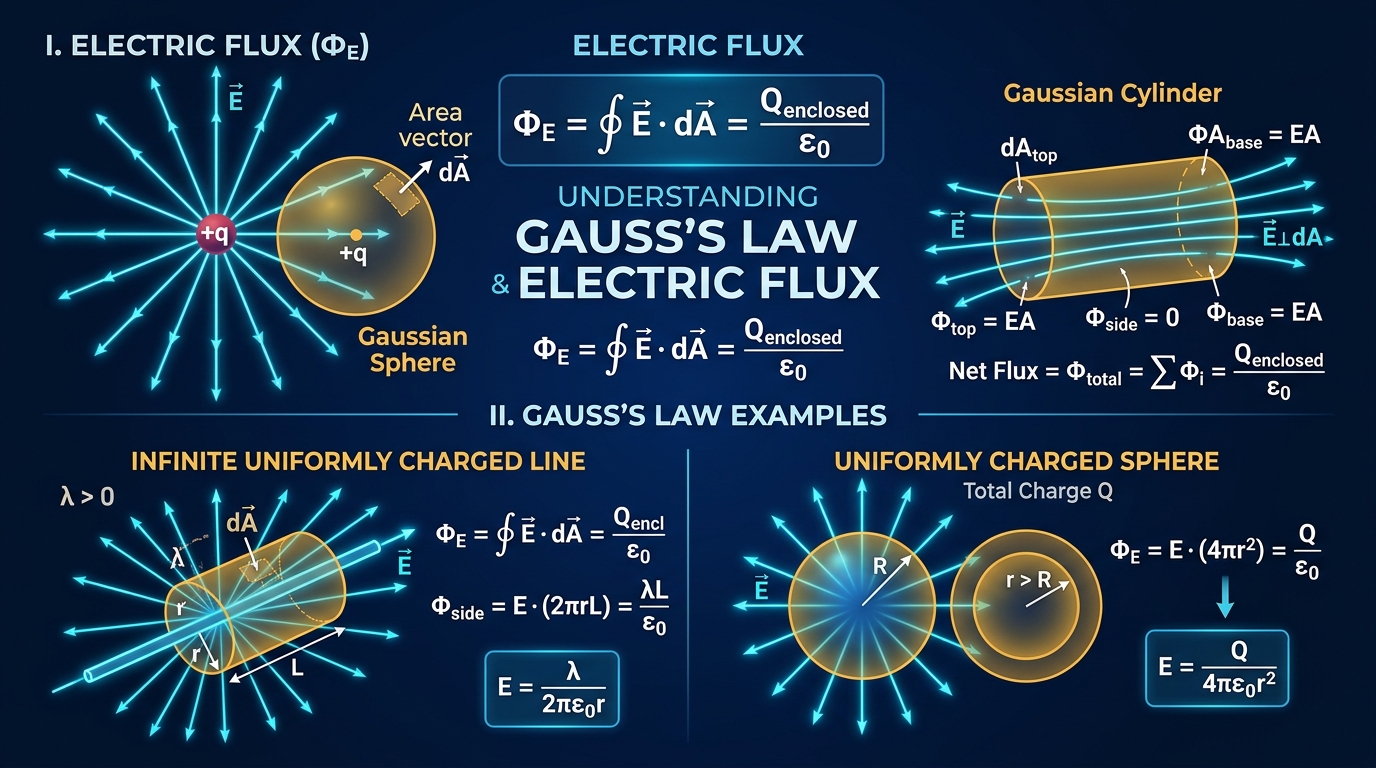 Full size
Gauss's Law & Gaussian Surfaces
Electric flux formulations and Gaussian surfaces enclosing charges: cylindrical surface for infinite wire and spherical surface for charged shell.
- 1Electric Flux Definition — Φ_E = ∫ E · dA = E A cos(θ), measuring field penetrating a surface
- 2Gauss's Law Master Formula — ∮ E · dA = Q_enclosed / ε₀
- 3Infinite Line of Charge — Using a coaxial cylinder of length L and radius r yields E = λ / (2πε₀r)
- 4Charged Spherical Shell — Outside (r > R): E = Q/(4πε₀r²); Inside (r < R): E = 0 since Q_enclosed = 0
- 5Infinite Conducting Sheet — Field near an infinite sheet with surface density σ is E = σ / (2ε₀)
Interactive Study Prompts (Click to Explore)
Clickable22. Physical Mechanism Flowchart: Gauss's Law & Its Applications
Gauss's Law & Its Applications Step-by-Step Flowchart
- 1
Initial State
Initial parameters and boundary conditions are established.
- 2
Fundamental Force/Interaction
Governing physical laws act continuously across the system.
- 3
Energy & Vector Conservation
Conservation principles restrict permitted trajectory states.
- 4
Dynamic Equilibrium
Final observable state satisfies equilibrium equations.
Follow the numbered pipeline above. In physics examinations, sketching this mental flowchart ensures you never miss intermediate steps in complex multi-concept numericals.
33. Rigorous Mathematical Proofs & Governing Equations
Derivation — Derivation of Governing Formula for Gauss's Law & Its Applications
- 1
Starting from Newton's foundational law
- 2
Integrating over displacement
Gauss's Law (Integral & Differential Forms)
- = Electric flux (N·m²/C)
- = Net charge inside Gaussian boundary
- = Volumetric charge density (C/m³)
Standard Applications of Gauss's Law
| Charge Distribution | Gaussian Surface Type | Electric Field () |
|---|---|---|
| Infinite Line Charge (Density ) | Coaxial Cylinder | |
| Infinite Non-Conducting Sheet (Density ) | Pillbox Cylinder crossing sheet | (constant at all distances) |
| Spherical Shell (Radius R, Charge Q, ) | Concentric Sphere | |
| Spherical Shell ( inside) | Concentric Sphere | (No enclosed charge) |
Infinite Line Charge (Density )
- Gaussian Surface Type
- Coaxial Cylinder
- Electric Field ($E$)
Infinite Non-Conducting Sheet (Density )
- Gaussian Surface Type
- Pillbox Cylinder crossing sheet
- Electric Field ($E$)
- (constant at all distances)
Spherical Shell (Radius R, Charge Q, )
- Gaussian Surface Type
- Concentric Sphere
- Electric Field ($E$)
Spherical Shell ( inside)
- Gaussian Surface Type
- Concentric Sphere
- Electric Field ($E$)
- (No enclosed charge)
44. High-Tech Application: Semiconductor Fab Cleanrooms & Faraday Shielding
Modern microprocessors have transistors just 3 nanometers across—smaller than a strand of human DNA. A static charge of mere millivolts would instantly fry these microscopic silicon gates. Chip fabrication cleanrooms enclose sensitive lithography tools inside grounded metallic Faraday shields governed by Gauss's law, guaranteeing that zero stray electrostatic flux can penetrate.
55. Solved Standard & Advanced Exam Problems
Exam question · JEE Standard
- A.A
- B.B
- C.C
- D.D
- Step 1
Answer: A. A
What it tests: Explanation
Exam question · CBSE Class 12 / AP Physics
- A.Remain unchanged
- B.Double
- C.Become four times
- D.Be halved
- 1. By Gauss's Law, total electric flux depends solely on the net charge enclosed: Φ_E = Q_enclosed / ε₀.
- 2. Doubling the radius increases surface area by 4 times, but the electric field decreases by 1/4 (inverse-square law).
- 3. These two effects cancel out exactly: Φ_E remains strictly unchanged.
Answer: A. Remain unchanged
What it tests: Total electric flux through any closed boundary is invariant under changes to the boundary's size or shape as long as enclosed charge is constant.
Remember
- Total electric flux through any closed surface is determined entirely by the enclosed charge: Φ = Q_encl / ε₀.
- Charges located outside a closed Gaussian surface contribute zero net flux through the surface.
- The electric field inside a hollow charged conducting sphere is identically zero at all points.
- The electric field of an infinite non-conducting sheet is uniform and independent of the distance from the sheet.
Check yourself
Question 1
If a charge Q is placed at the center of a cube of edge length a, what is the electric flux through ONE of its six faces?