Physics · Class 11-12 · AP Physics 1
Projectile Motion and Kinematics
Projectile motionis the motion of an object projected into the air, moving solely under the influence of gravity along a curved parabolic path, demonstrating independence of horizontal and vertical motions.
1Independence of Motions & Trajectory Diagram
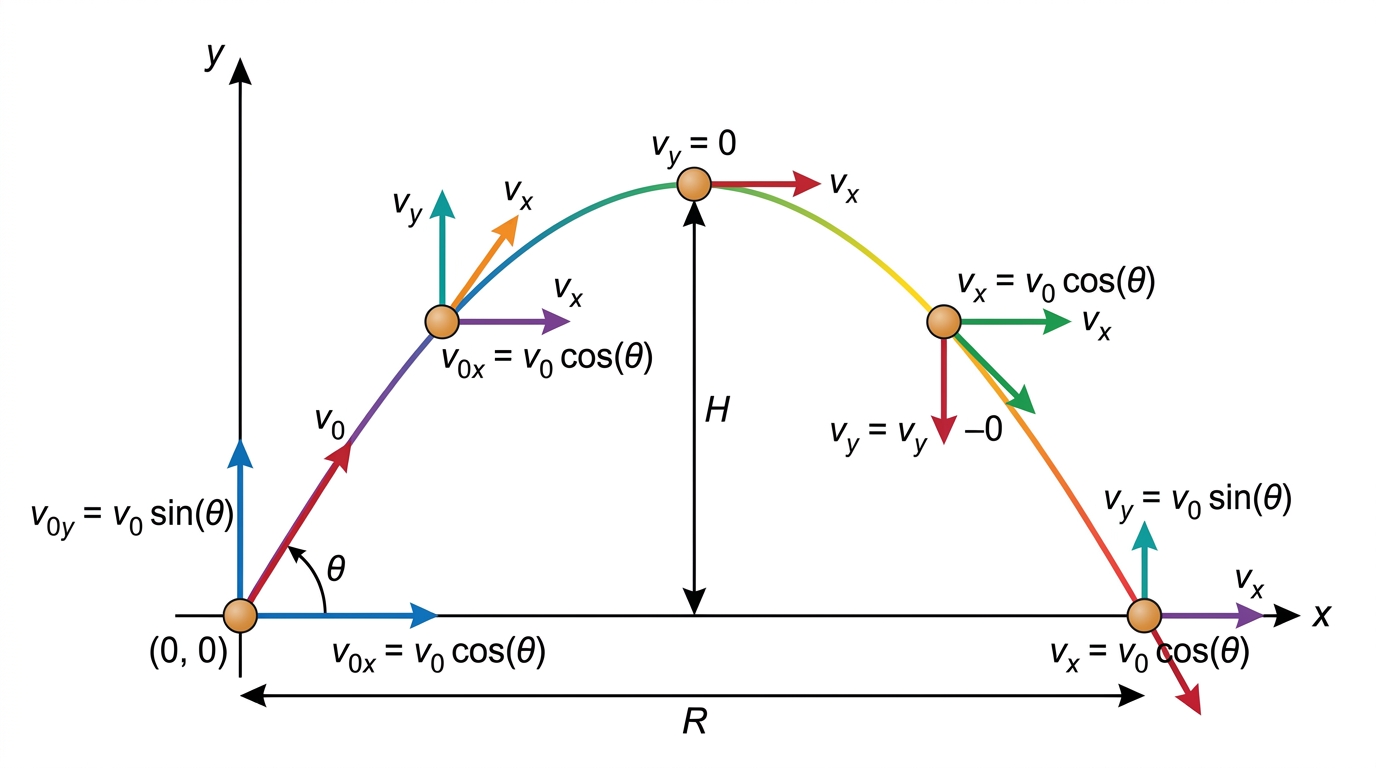
Galileo first demonstrated that projectile motion can be split into twomutually independent motions: uniform motion at constant velocity horizontally, and uniformly accelerated motion vertically due to gravity. Below is the complete trajectory with velocity vectors at every stage of flight.
 Full size
Projectile Trajectory and Velocity Vector Components
A classical parabolic trajectory launched at angle theta. Notice that the horizontal velocity vector vx remains constant in magnitude throughout flight, while vertical velocity vy decreases to 0 at the peak and reverses downward.
- 1Launch Point (0,0) — Initial speed v0 directed at launch angle theta above horizontal
- 2Initial Components — v0x = v0 cos(theta) and v0y = v0 sin(theta)
- 3Ascending Flight — Vertical velocity vy reduces due to downward gravitational acceleration g
- 4Apex / Maximum Height H — At the top, vy = 0 instantly; speed is strictly equal to vx
- 5Descending Flight — vy points downward and increases in magnitude until impact
- 6Total Range R — The horizontal distance travelled when the projectile returns to launch height
Horizontal vs. Vertical Kinematic Components
| Dimension | Acceleration | Velocity Behavior | Governing Equation |
|---|---|---|---|
| Horizontal (x) | Constant: | ||
| Vertical (y) | Changes linearly: |
Horizontal (x)
- Acceleration
- Velocity Behavior
- Constant:
- Governing Equation
Vertical (y)
- Acceleration
- Velocity Behavior
- Changes linearly:
- Governing Equation
2Derivations for Time of Flight, Height, and Range
Derivation — Maximum Height H and Time of Flight T
- 1
Vertical velocity equation
- 2
- 3
Total flight time for level ground
- 4
- 5
Horizontal range using 2sin(theta)cos(theta) = sin(2theta)
3Key Formulas & Quick Reference Table
Standard Projectile Formulas (Level Ground)
| Quantity | Symbol | Formula | Condition for Maximum |
|---|---|---|---|
| Time of Flight | Maximized at (vertical throw) | ||
| Maximum Height | Maximized at | ||
| Horizontal Range | Maximized at (where ) |
Time of Flight
- Symbol
- Formula
- Condition for Maximum
- Maximized at (vertical throw)
Maximum Height
- Symbol
- Formula
- Condition for Maximum
- Maximized at
Horizontal Range
- Symbol
- Formula
- Condition for Maximum
- Maximized at (where )
4Worked Problem Step by Step
Real-life example · Worked Numerical Problem
A football is kicked with an initial speed of at an angle of to horizontal (take ).
1. Initial velocities:
2. Time of flight:
3. Maximum height:
4. Range:
.
Exam question · AP Physics 1 / JEE Main
- A.Velocity is zero; acceleration is zero.
- B.Velocity is horizontal (); acceleration is downward.
- C.Velocity is vertical; acceleration is horizontal.
- D.Velocity is ; acceleration is zero.
- 1. At the peak, vertical velocity , but the horizontal component remains unchanged.
- 2. Gravity acts downward continuously, so acceleration is constant at downwards at all points during flight.
Answer: B. Velocity is horizontal (); acceleration is downward.
What it tests: Horizontal velocity never changes (no air resistance), and gravity always exerts downward acceleration.
Remember
- Projectile motion is a superposition of constant velocity horizontal motion and constant acceleration vertical motion.
- Horizontal acceleration is zero (); vertical acceleration is constant downwards ().
- At the highest point, vertical velocity is zero (), but horizontal velocity is non-zero ().
- The range is identical for complementary angles and .
- Maximum horizontal range occurs at launch angle .
Check yourself
Question 1
At what launch angle is the horizontal range of a projectile on level ground maximized?Question 2
Which launch angle will give the exact same horizontal range as an angle of 25°?Question 3
If air resistance is neglected, what happens to the horizontal component of velocity during flight?Question 4
If the initial velocity of a projectile is doubled, what happens to its maximum height ?