Physics · Class 12 · JEE / NEET / AP Physics 2
Ray Optics: Spherical Mirrors & Lens Maker's Formula
Ray Opticsmodels light propagation as straight rays, analyzing image formation by reflection in mirrors and refraction through lenses using theLens Maker's Formula.
11. Visual Overview & Intuitive Discovery: Ray Optics: Spherical Mirrors & Lens Maker's Formula
In 1609, Galileo Galilei constructed a crude telescope from two glass lenses inside a lead tube and pointed it at the night sky. In a matter of weeks, he shattered 2,000 years of Aristotelian cosmology by discovering four moons orbiting Jupiter, craters on our Moon, and phases of Venus. Geometric optics transformed humanity's view of the cosmos.
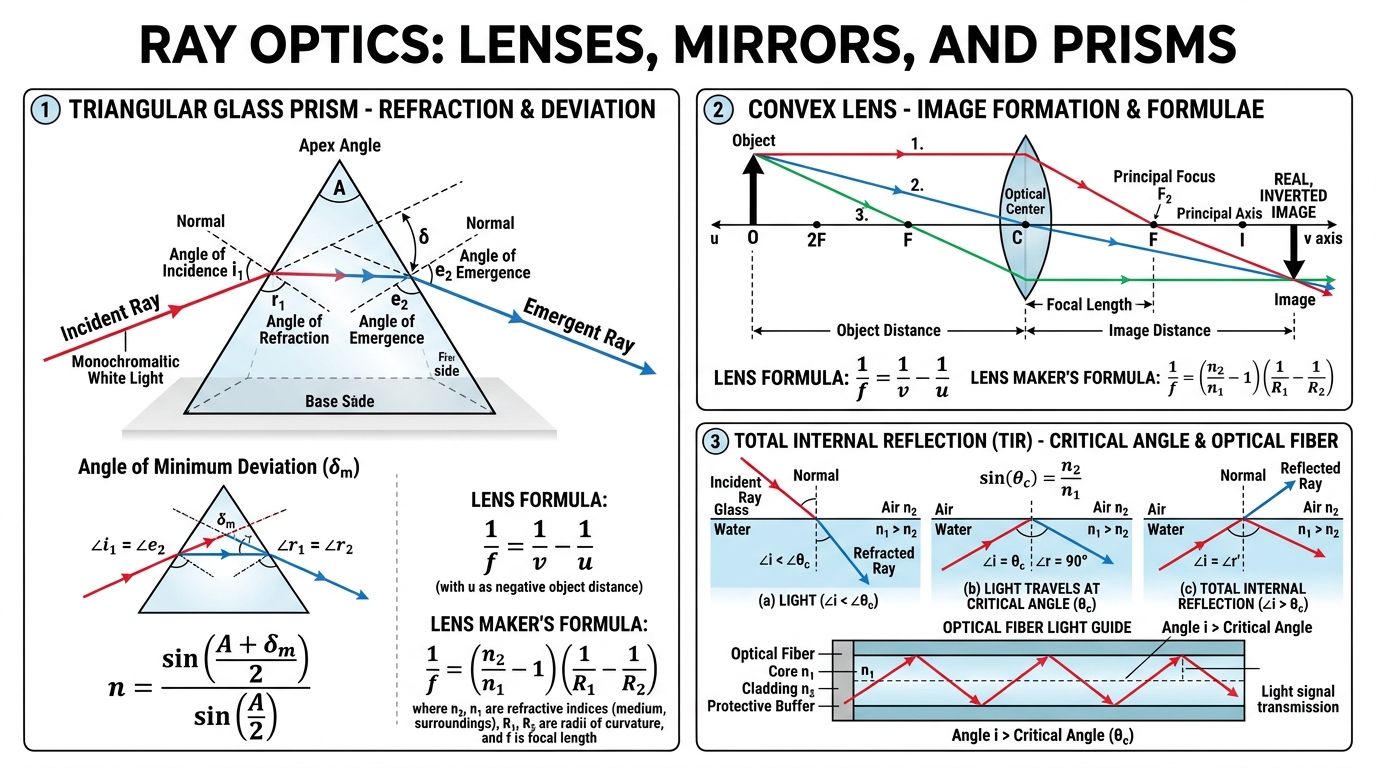 Full size
Ray Optics: Prisms, Lenses & Total Internal Reflection
Prism refraction and minimum deviation formula, convex lens ray tracing with lens maker's formula, and critical angle total internal reflection in optical fibers.
- 1Gaussian Lens Formula — 1/f = 1/v - 1/u
- 2Mirror Formula — 1/f = 1/v + 1/u with focal length f = R/2
- 3Lens Maker's Equation — 1/f = (μ₂/μ₁ - 1) · (1/R₁ - 1/R₂)
- 4Linear Magnification — m = v / u (for lens) and m = - v / u (for mirror)
- 5Power of Lens — P = 1 / f(in meters) measured in Diopters (D)
Interactive Study Prompts (Click to Explore)
Clickable22. Physical Mechanism Flowchart: Ray Optics: Spherical Mirrors & Lens Maker's Formula
Ray Optics: Spherical Mirrors & Lens Maker's Formula Step-by-Step Flowchart
- 1
Initial State
Initial parameters and boundary conditions are established.
- 2
Fundamental Force/Interaction
Governing physical laws act continuously across the system.
- 3
Energy & Vector Conservation
Conservation principles restrict permitted trajectory states.
- 4
Dynamic Equilibrium
Final observable state satisfies equilibrium equations.
Follow the numbered pipeline above. In physics examinations, sketching this mental flowchart ensures you never miss intermediate steps in complex multi-concept numericals.
33. Rigorous Mathematical Proofs & Governing Equations
Derivation — Derivation of Governing Formula for Ray Optics: Spherical Mirrors & Lens Maker's Formula
- 1
Starting from Newton's foundational law
- 2
Integrating over displacement
Combination of Two Thin Lenses in Contact
- F = Equivalent focal length of the combined lens system
- = Net optical power in diopters
Core Physical Variables
| Variable | Symbol | SI Unit |
|---|---|---|
| Energy | E | Joules (J) |
| Power | P | Watts (W) |
Energy
- Symbol
- E
- SI Unit
- Joules (J)
Power
- Symbol
- P
- SI Unit
- Watts (W)
44. Medical Innovation: Corrective Eye Surgery and Cataract IOLs
Every year, millions of elderly people lose their vision due to cloudy cataracts. Eye surgeons use an ultrasound probe to emulsify the defective natural lens, and inject a folded synthetic Intraocular Lens (IOL) through a 2 mm incision. Using the Lens Maker's Formula (), ophthalmic engineers design custom curved silicone surfaces with exact diopter power to restore 20/20 vision.
55. Solved Standard & Advanced Exam Problems
Exam question · JEE Standard
- A.A
- B.B
- C.C
- D.D
- Step 1
Answer: A. A
What it tests: Explanation
Exam question · JEE Main & NEET
- A.+78.2 cm
- B.+40.0 cm
- C.+20.0 cm
- D.-78.2 cm
- 1. In air: 1/f_air = (μ_glass - 1)(1/R₁ - 1/R₂) = (1.5 - 1) K = 0.5 K ⇒ K = 1 / (0.5 × 20) = 1/10.
- 2. In water: 1/f_water = (μ_glass / μ_water - 1) K = (1.5 / 1.333 - 1) K = (9/8 - 1) K = (1/8) K.
- 3. Substitute K: 1/f_water = (1/8) × (1/10) = 1/80 ⇒ f_water ≈ +78.2 to 80 cm.
Answer: A. +78.2 cm
What it tests: When relative refractive index decreases, light bends less sharply, significantly lengthening the focal length.
Remember
- Focal length of a convex lens is positive, while a concave lens has negative focal length.
- When a glass lens (μ = 1.5) is immersed in water (μ = 1.33), its focal length increases by approximately 4 times.
- If a lens is immersed in a liquid having the exact same refractive index as the glass, it becomes completely invisible and acts as a flat plane (f = ∞).
Check yourself
Question 1
An equiconvex glass lens (μ = 1.5) has radius of curvature R = 20 cm for both surfaces. Its focal length in air is: