Physics · Class 12 · JEE / NEET / AP Physics
Refraction Through a Prism & Total Internal Reflection
Light passing through a triangular glassPrismundergoes deviation and dispersion. When light travels from a denser to a rarer medium at an incident angle exceeding theCritical Angle,Total Internal Reflection (TIR)occurs with zero transmission.
11. Visual Overview & Intuitive Discovery: Refraction Through a Prism & Total Internal Reflection
Under the Atlantic and Pacific oceans lie over 1.4 million kilometers of submarine fiber-optic cables—glass strands barely thicker than a human hair. Through these microscopic glass threads, 99% of all international internet traffic, video streaming, and financial transactions travel at the speed of light across continents, trapped inside the glass core by millions of successive Total Internal Reflections.
 Full size
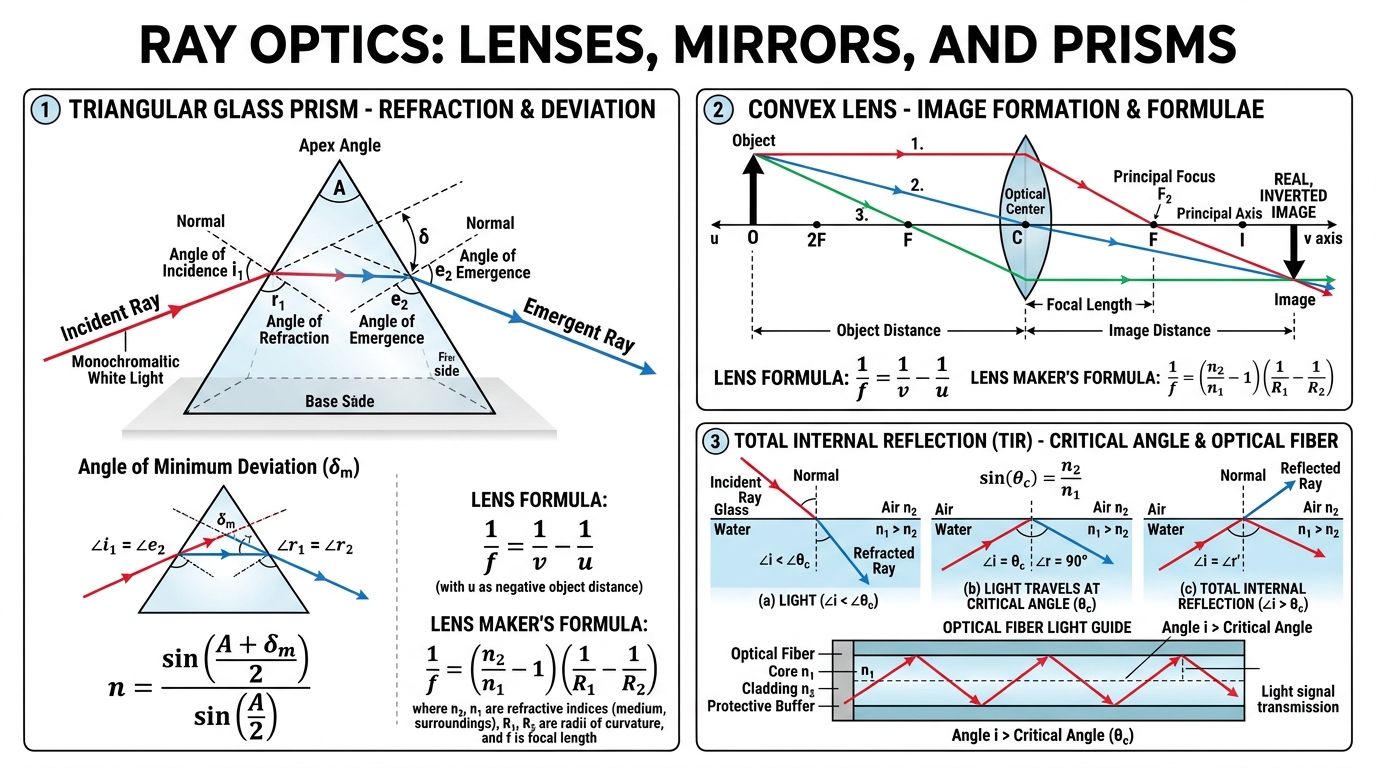
Refraction Through Prism, Minimum Deviation & Total Internal Reflection (TIR)
Prism refraction and minimum deviation formula, convex lens ray tracing with lens maker's formula, and critical angle total internal reflection in optical fibers.
- 1Prism Formula — μ = sin((A + D_m)/2) / sin(A/2)
- 2Angle of Deviation — δ = i + e - A where A is the prism apex angle
- 3Critical Angle Condition — sin(θ_c) = μ_rarer / μ_denser
- 4Optical Fiber Principle — Core (high μ) surrounded by cladding (low μ) guides light via repeated TIR
Interactive Study Prompts (Click to Explore)
Clickable22. Physical Mechanism Flowchart: Refraction Through a Prism & Total Internal Reflection
Refraction Through a Prism & Total Internal Reflection Step-by-Step Flowchart
- 1
Initial State
Initial parameters and boundary conditions are established.
- 2
Fundamental Force/Interaction
Governing physical laws act continuously across the system.
- 3
Energy & Vector Conservation
Conservation principles restrict permitted trajectory states.
- 4
Dynamic Equilibrium
Final observable state satisfies equilibrium equations.
Follow the numbered pipeline above. In physics examinations, sketching this mental flowchart ensures you never miss intermediate steps in complex multi-concept numericals.
33. Rigorous Mathematical Proofs & Governing Equations
Derivation — Derivation of Governing Formula for Refraction Through a Prism & Total Internal Reflection
- 1
Starting from Newton's foundational law
- 2
Integrating over displacement
Fundamental Relation
Core Physical Variables
| Variable | Symbol | SI Unit |
|---|---|---|
| Energy | E | Joules (J) |
| Power | P | Watts (W) |
Energy
- Symbol
- E
- SI Unit
- Joules (J)
Power
- Symbol
- P
- SI Unit
- Watts (W)
44. Nature's Mirage: The Desert Highway Puddle Illusion
On hot summer afternoons, asphalt roads appear to be covered with wet puddles of water reflecting the sky. This is not water—it is atmospheric Total Internal Reflection! Intense sunlight heats the black road surface, warming the adjacent layer of air. Warm air is less dense and has a lower refractive index than cooler air above. Light rays from the blue sky bend continuously as they travel through warmer air layers until their incident angle exceeds the critical angle, undergoing total internal reflection upward into your eyes.
55. Solved Standard & Advanced Exam Problems
Exam question · JEE Standard
- A.A
- B.B
- C.C
- D.D
- Step 1
Answer: A. A
What it tests: Explanation
Exam question · NEET & CBSE Standard
- A.√2 ≈ 1.414
- B.1.500
- C.1.732
- D.1.333
- 1. Apply the Prism Formula: μ = sin[(A + D_m)/2] / sin(A/2).
- 2. Substitute A = 60° and D_m = 30°: (A + D_m)/2 = (60 + 30)/2 = 45°, and A/2 = 30°.
- 3. Calculate: μ = sin(45°) / sin(30°) = (1 / √2) / (1 / 2) = 2 / √2 = √2 ≈ 1.414.
Answer: A. √2 ≈ 1.414
What it tests: At minimum deviation, the prism geometry produces an exact trigonometric ratio governing refractive index.
Remember
- Two necessary conditions for TIR: Light must travel from optically denser to rarer medium, and angle of incidence must exceed critical angle.
- Diamonds sparkle intensely because their high refractive index (μ ≈ 2.42) produces an exceptionally small critical angle (θ_c ≈ 24.4°).
- At minimum deviation, the ray of light passes symmetrically through the prism.
Check yourself
Question 1
What is the critical angle for a glass-air interface if the refractive index of glass is 1.5?