Physics · Class 11-12 · JEE / NEET / AP Physics C
Rotational Motion & Moment of Inertia
Rotational Motiondescribes the movement of a rigid body around an axis. Just as mass resists linear acceleration,Moment of Inertia ()measures a body's resistance to rotational acceleration produced by torque.
11. Visual Overview & Intuitive Discovery: Rotational Motion & Moment of Inertia
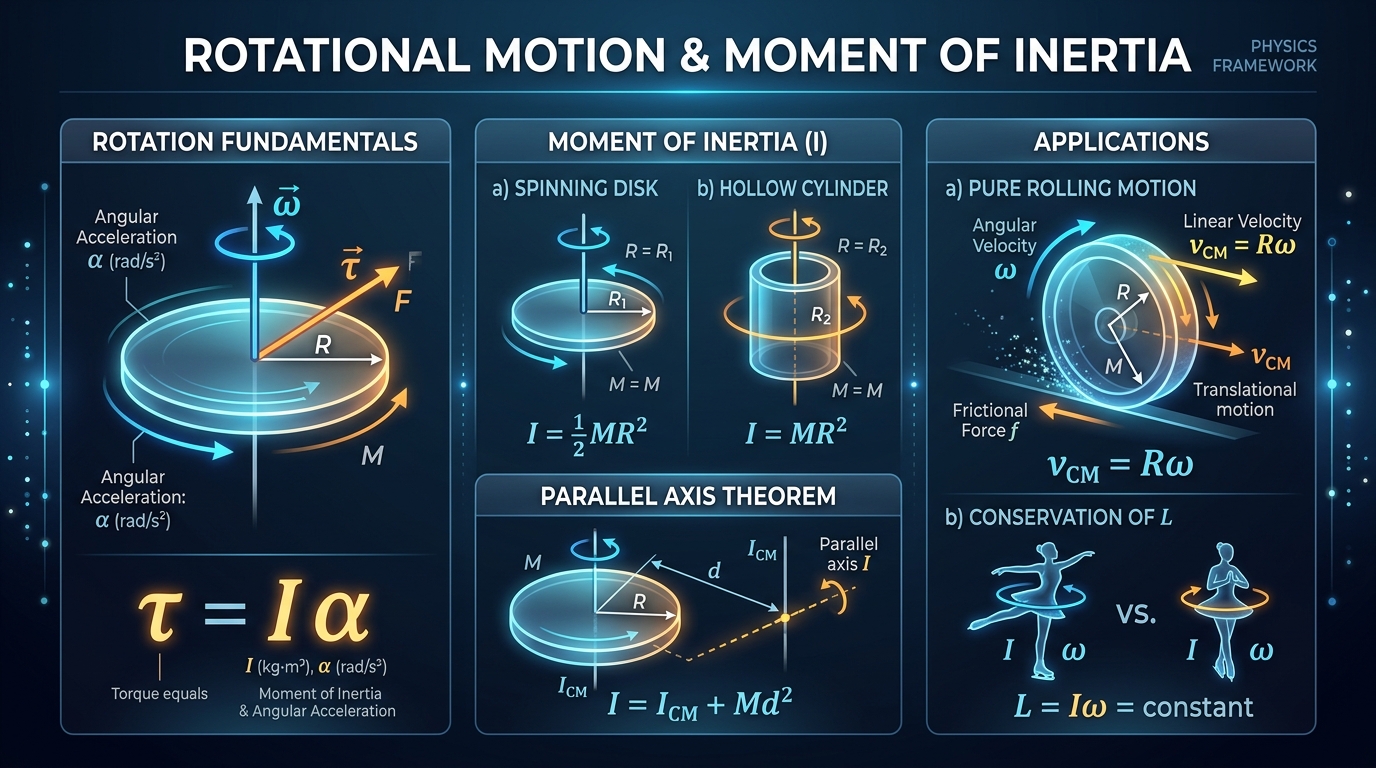
Have you ever watched an Olympic figure skater perform a dizzying scratch spin? She starts with arms and legs outstretched, rotating at a leisurely pace. Then, she snaps her limbs tight against her chest—and suddenly spins into an incomprehensible blur! She touches no motor and pushes against no ice. Her secret is the absolute conservation of angular momentum.
 Full size
Rotational Motion & Moment of Inertia Framework
Rotational fundamentals showing torque, parallel axis theorem I = I_cm + Md², moment of inertia for disks and cylinders, and pure rolling conditions.
- 1Torque Formula — τ = I · α = r × F, measuring the rotational effectiveness of a force
- 2Moment of Inertia (Disk) — I = 1/2 M R² for a solid uniform disk rotating about its central symmetry axis
- 3Parallel Axis Theorem — I = I_cm + M d², finding inertia about any axis parallel to center-of-mass axis
- 4Pure Rolling Condition — v_cm = R · ω and a_cm = R · α with zero relative slipping at the contact point
- 5Conservation of L — L = I · ω remains constant when net external torque Στ_ext = 0
Interactive Study Prompts (Click to Explore)
Clickable22. Physical Mechanism Flowchart: Rotational Motion & Moment of Inertia
Rotational Motion & Moment of Inertia Step-by-Step Flowchart
- 1
Initial State
Initial parameters and boundary conditions are established.
- 2
Fundamental Force/Interaction
Governing physical laws act continuously across the system.
- 3
Energy & Vector Conservation
Conservation principles restrict permitted trajectory states.
- 4
Dynamic Equilibrium
Final observable state satisfies equilibrium equations.
Follow the numbered pipeline above. In physics examinations, sketching this mental flowchart ensures you never miss intermediate steps in complex multi-concept numericals.
33. Rigorous Mathematical Proofs & Governing Equations
Derivation — Derivation of Governing Formula for Rotational Motion & Moment of Inertia
- 1
Starting from Newton's foundational law
- 2
Integrating over displacement
Torque and Newton's Second Law for Rotation
- = Torque in Newton-meters (N·m)
- I = Moment of inertia (kg·m²)
- = Angular acceleration (rad/s²)
- L = Angular momentum (kg·m²/s)
Moments of Inertia for Standard Symmetrical Bodies
| Geometry | Axis Location | Moment of Inertia () |
|---|---|---|
| Thin Ring / Hoop | Central axis perpendicular to plane | |
| Solid Uniform Disc / Cylinder | Central symmetry axis | |
| Solid Sphere | Through diameter | |
| Hollow Spherical Shell | Through diameter | |
| Thin Rod (Length L) | Through center perpendicular to length | |
| Thin Rod (Length L) | Through one end perpendicular to length |
Thin Ring / Hoop
- Axis Location
- Central axis perpendicular to plane
- Moment of Inertia ($I$)
Solid Uniform Disc / Cylinder
- Axis Location
- Central symmetry axis
- Moment of Inertia ($I$)
Solid Sphere
- Axis Location
- Through diameter
- Moment of Inertia ($I$)
Hollow Spherical Shell
- Axis Location
- Through diameter
- Moment of Inertia ($I$)
Thin Rod (Length L)
- Axis Location
- Through center perpendicular to length
- Moment of Inertia ($I$)
Thin Rod (Length L)
- Axis Location
- Through one end perpendicular to length
- Moment of Inertia ($I$)
44. Spacecraft Engineering: Reaction Wheels and Gyroscopic Stabilization
How does the Hubble Space Telescope or the James Webb Space Telescope aim with sub-arcsecond precision at distant galaxies billions of light-years away without firing thrusters that would waste fuel or contaminate optical mirrors? They use reaction wheels! By spinning heavy internal electric flywheels faster or slower, the spacecraft rotates in the opposite direction via conservation of angular momentum (), executing silent, precise pointing in the vacuum of space.
55. Solved Standard & Advanced Exam Problems
Exam question · JEE Advanced & NEET Standard
- A.Solid Sphere
- B.Solid Cylinder
- C.Hollow Sphere
- D.All three reach at the exact same time
- 1. Linear acceleration for pure rolling on incline is a = g sin(θ) / (1 + I / MR²).
- 2. Solid Sphere: I / MR² = 2/5 = 0.40.
- 3. Solid Cylinder: I / MR² = 1/2 = 0.50.
- 4. Hollow Sphere: I / MR² = 2/3 = 0.67.
- 5. Lowest rotational inertia ratio gives the highest acceleration a, so the Solid Sphere reaches first.
Answer: A. Solid Sphere
What it tests: The object with the smallest moment of inertia dedicates less energy to rotation, resulting in higher linear translational speed.
Exam question · JEE Advanced / AP Physics C
- A.3g / (2L)
- B.g / L
- C.2g / (3L)
- D.3g / L
- 1. Torque about the hinge: Weight Mg acts at the center of mass (distance L/2 from hinge): τ = Mg × (L/2).
- 2. Moment of inertia of a thin rod about one end: I = 1/3 M L².
- 3. Apply Newton's second law for rotation: τ = I α.
- 4. Mg(L/2) = (1/3 M L²) α ⇒ α = [Mg(L/2)] / [1/3 M L²] = 3g / (2L).
Answer: A. 3g / (2L)
What it tests: The torque produced by gravity acts at the center of mass, and rotational inertia must be evaluated about the pivot point.
Remember
- Moment of inertia depends on both the total mass and its distribution relative to the axis of rotation.
- Parallel Axis Theorem: I = I_cm + Md² applies to all 3D rigid bodies.
- Perpendicular Axis Theorem: I_z = I_x + I_y applies ONLY to 2D planar lamina.
- Total kinetic energy in pure rolling is the sum of translational and rotational kinetic energies: K = 1/2 m v² + 1/2 I ω².
- Angular momentum is conserved whenever external torque is zero.
Check yourself
Question 1
When a spinning ice skater pulls her arms inward, what happens to her moment of inertia and angular velocity?Question 2
What is the condition for pure rolling without slipping for a cylinder of radius R on a stationary surface?