Chemistry · Class 12 / JEE & NEET
Surface Chemistry: Adsorption, Catalysis & Colloids
Master interface chemistry: Physisorption vs Chemisorption, Freundlich adsorption isotherm (), Tyndall effect, and Hardy-Schulze coagulation rule.
11. Visual Overview & Intuitive Discovery: Surface Chemistry: Adsorption, Catalysis & Colloids
🔍 Clickable Interactive Study Prompts (Click to explore or jump to section):
Clickable### Intuitive Foundations & Real-World Reality
Surface phenomena occur at boundaries between phases because surface molecules experience unbalanced inward residual attractive forces compared to bulk molecules. In 1909, Herbert Freundlich formulated the empirical adsorption isotherm (), unlocking gas-mask activated carbon filters that saved millions of soldiers from chlorine gas attacks in World War I.
 Full size
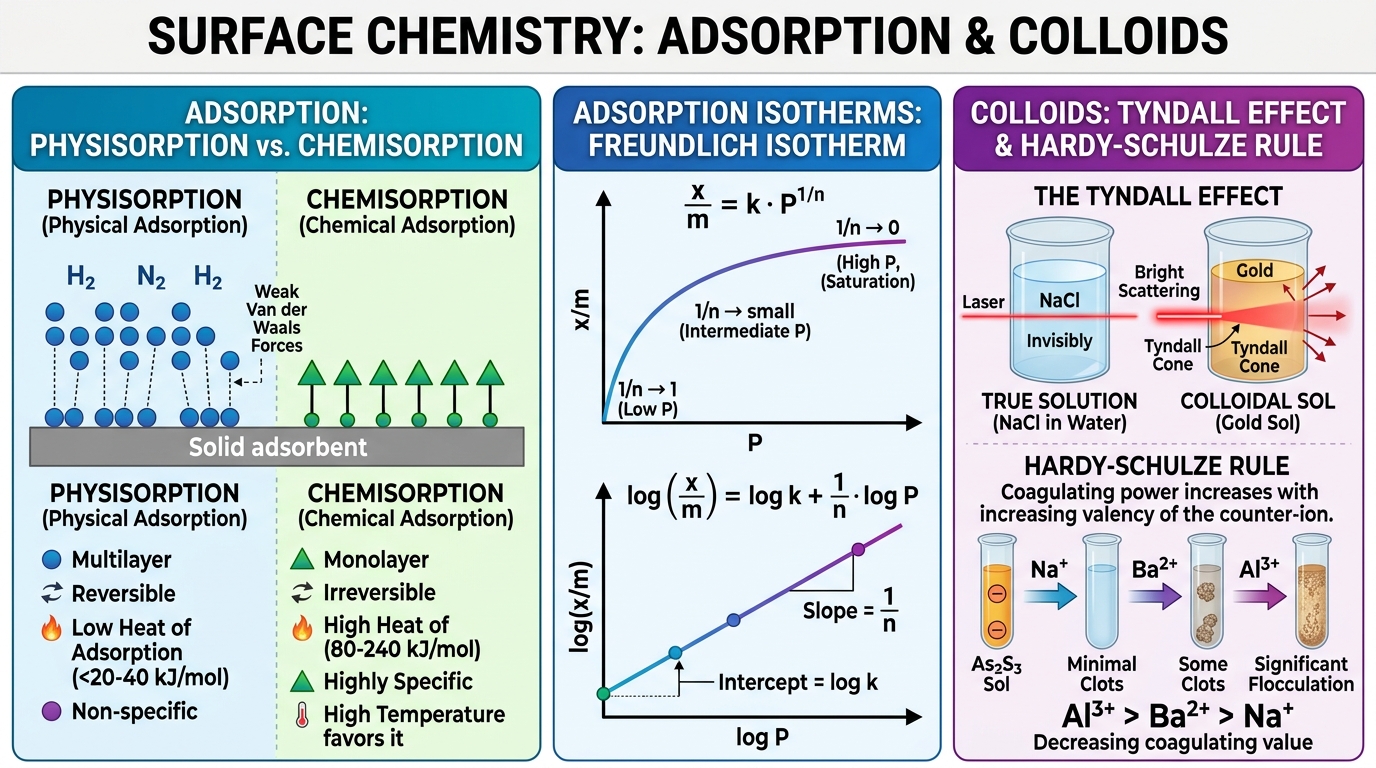
Surface Chemistry: Adsorption & Colloidal State
Physisorption vs Chemisorption comparison, Freundlich adsorption isotherm plot, Tyndall scattering effect, and Hardy-Schulze coagulation rules.
- 1Core Anchor 1 — Physisorption vs Chemisorption Complete Comparison
- 2Core Anchor 2 — Derive Freundlich Adsorption Isotherm Equation
- 3Core Anchor 3 — Tyndall Effect & Brownian Motion in Colloidal Systems
- 4Core Anchor 4 — Hardy-Schulze Rule for Coagulation of Lyophobic Sols
22. Concept & Decision Flowchart: Adsorption & Colloid Coagulation Flowchart
Adsorption & Colloid Coagulation Flowchart
- 1
1. Distinguish Adsorption Type
Physisorption (weak Van der Waals forces, reversible, multi-molecular layers, low enthalpy ~20-40 kJ/mol). Chemisorption (covalent/coordinate bonds, irreversible, unimolecular layer, high enthalpy ~80-240 kJ/mol).
- 2
2. Apply Freundlich Isotherm
At low pressure: x/m ∝ p¹. At moderate pressure: x/m = k p^(1/n) (where 0 < 1/n < 1). At high pressure: saturation is reached (x/m becomes constant).
- 3
3. Classify Colloidal Sol
Lyophilic (solvent loving, highly stable, reversible). Lyophobic (solvent hating, easily coagulated by trace electrolytes).
- 4
4. Hardy-Schulze Coagulation Rule
The coagulating power of an opposing electrolyte ion increases exponentially with its valency: Al³⁺ > Ba²⁺ > Na⁺ for negatively charged sols (e.g., As2S3).
33. Step-by-Step Derivation & Verification: The Freundlich Adsorption Isotherm
Derivation — Step-by-Step Derivation & Verification: The Freundlich Adsorption Isotherm
- 1
x is mass of gas adsorbed on mass m of solid adsorbent at gas equilibrium pressure p.
- 2
Converts the power relationship into a linear equation of form y = mx + c.
- 3
A straight line verifies Freundlich adsorption behavior within moderate pressure ranges.
- 4
Accurately models surface saturation where all active surface sites are occupied.
44. Real-World Case Study & Industrial Application
### Environmental Engineering: Municipal Water Purification by Alum Coagulation
Raw river water contains suspended clay and organic mud particles carrying negative surface electrical charges that prevent settling due to mutual electrostatic repulsion. Water treatment plants dose potash alum (KAl(SO4)2·12H2O). The trivalent Al³⁺ ions rapidly neutralize negative colloid charges according to the Hardy-Schulze rule, forming heavy floc precipitates that settle out within minutes.
55. High-Yield Reference Data & Solved Problems
High-Yield Comparison & Key Constants
| Characteristic | Physisorption (Physical) | Chemisorption (Chemical) |
|---|---|---|
| Forces Involved | Weak Van der Waals forces | Strong covalent or ionic bonds |
| Enthalpy of Adsorption | Low (20 - 40 kJ/mol) | High (80 - 240 kJ/mol) |
| Specificity | Non-specific (any gas adsorbs) | Highly specific |
| Reversibility | Reversible | Irreversible |
| Layering | Multimolecular layers at high p | Unimolecular layer strictly |
| Effect of Temperature | Decreases steadily with temperature | Initially increases (needs Ea) then decreases |
Forces Involved
- Physisorption (Physical)
- Weak Van der Waals forces
- Chemisorption (Chemical)
- Strong covalent or ionic bonds
Enthalpy of Adsorption
- Physisorption (Physical)
- Low (20 - 40 kJ/mol)
- Chemisorption (Chemical)
- High (80 - 240 kJ/mol)
Specificity
- Physisorption (Physical)
- Non-specific (any gas adsorbs)
- Chemisorption (Chemical)
- Highly specific
Reversibility
- Physisorption (Physical)
- Reversible
- Chemisorption (Chemical)
- Irreversible
Layering
- Physisorption (Physical)
- Multimolecular layers at high p
- Chemisorption (Chemical)
- Unimolecular layer strictly
Effect of Temperature
- Physisorption (Physical)
- Decreases steadily with temperature
- Chemisorption (Chemical)
- Initially increases (needs Ea) then decreases
Exam question · JEE Main, Advanced & NEET Standard
- 1. Governing Law: Hardy-Schulze Rule, which states that for coagulating a colloidal sol, the active ion carries a charge opposite to that of the sol, and its coagulating power increases rapidly with the magnitude of its valency.
- 2. The Ferric Hydroxide sol is POSITIVELY charged ([Fe(OH)3]Fe³⁺). Therefore, negative anions act as the coagulating ions.
- 3. The anions and their valencies are:
- - Cl⁻ from NaCl (valency = -1)
- - SO4²⁻ from Na2SO4 (valency = -2)
- - PO4³⁻ from Na3PO4 (valency = -3)
- - [Fe(CN)6]⁴⁻ from K4[Fe(CN)6] (valency = -4)
- 4. Increasing coagulating power order:
- NaCl < Na2SO4 < Na3PO4 < K4[Fe(CN)6].
Answer: 1. Governing Law: Hardy-Schulze Rule, which states that for coagulating a colloidal sol, the active ion carries a charge opposite to that of the sol, and its coagulating power increases rapidly with the magnitude of its valency.
2. The Ferric Hydroxide sol is POSITIVELY charged ([Fe(OH)3]Fe³⁺). Therefore, negative anions act as the coagulating ions.
3. The anions and their valencies are:
- Cl⁻ from NaCl (valency = -1)
- SO4²⁻ from Na2SO4 (valency = -2)
- PO4³⁻ from Na3PO4 (valency = -3)
- [Fe(CN)6]⁴⁻ from K4[Fe(CN)6] (valency = -4)
4. Increasing coagulating power order:
NaCl < Na2SO4 < Na3PO4 < K4[Fe(CN)6].
What it tests: Tests rigorous conceptual mastery, dimensional analysis, and multi-step deduction.
Remember
- Surface Chemistry: Adsorption, Catalysis & Colloids: Foundational law governing physical, chemical, and biological phenomena.
- Mastered derivation: Step-by-Step Derivation & Verification: The Freundlich Adsorption Isotherm.
- Avoided classic trap: Students often confuse absorption with adsorption. Absorption is a BULK phenomenon where substance penetrates ...
- Real-world relevance: Proven clinical, aerospace, and industrial significance.
- High-yield exam rule: Always verify dimensional consistency and physical boundary conditions.
Check yourself
Question 1
What is the primary governing principle of Surface Chemistry: Adsorption, Catalysis & Colloids?Question 2
In competitive examinations (JEE/NEET), what is the most critical pitfall in Surface Chemistry: Adsorption, Catalysis & Colloids?