Physics · Class 11-12 · JEE / NEET / AP Physics 2
Thermodynamics: First & Second Laws
Thermodynamicsgoverns the relationship between heat, work, and internal energy. TheFirst Lawestablishes conservation of energy, while theSecond Lawintroduces entropy and limits heat engine efficiency.
11. Visual Overview & Intuitive Discovery: Thermodynamics: First & Second Laws
In 1824, a 28-year-old French military engineer named Sadi Carnot asked a profound question: Is there an absolute theoretical limit to how much mechanical work a steam engine can extract from a ton of coal? His short 118-page book founded the science of thermodynamics and proved that no heat engine, no matter how perfectly engineered, can ever convert 100% of heat into useful mechanical work.
 Full size
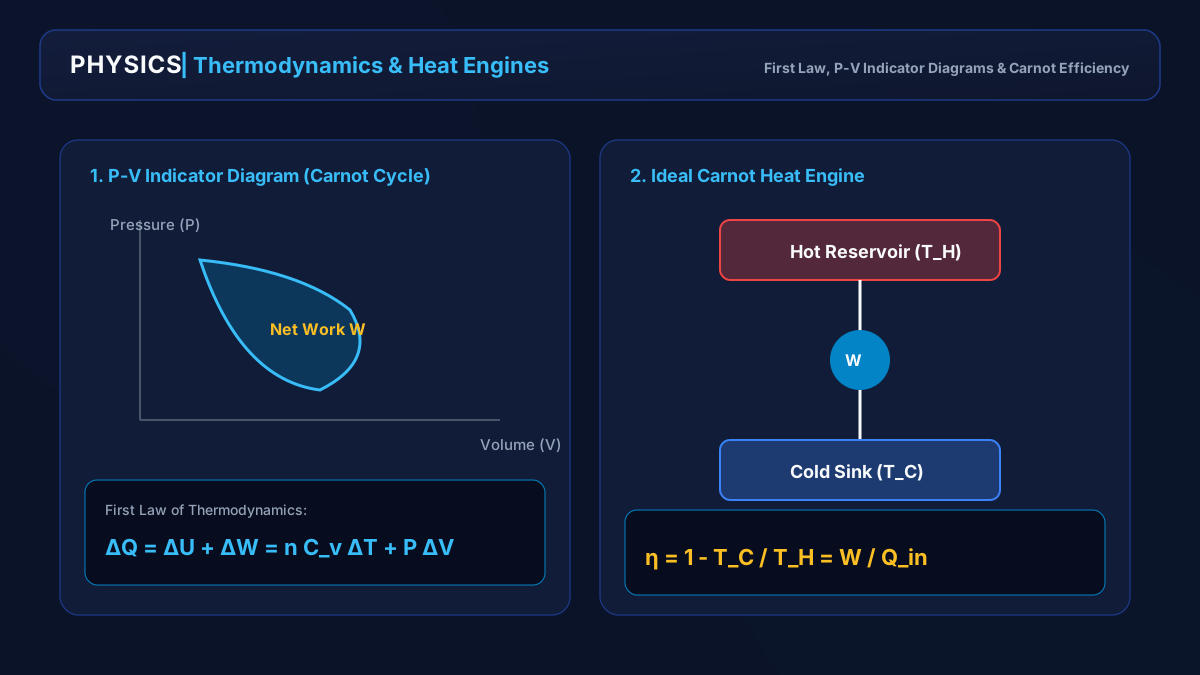
Thermodynamic P-V Indicator & Carnot Engine Cycle
Carnot cycle P-V indicator diagram showing enclosed work and heat engine energy flow from hot reservoir T_H to cold sink T_C.
- 1First Law of Thermodynamics — ΔQ = ΔU + ΔW where ΔU = n C_v ΔT depends solely on temperature
- 2Isothermal Process — T = constant ⇒ ΔU = 0 ⇒ Q = W = nRT ln(V_f / V_i)
- 3Adiabatic Process — Q = 0 ⇒ P V^γ = constant ⇒ W = (P_i V_i - P_f V_f)/(γ - 1)
- 4Carnot Efficiency — η = 1 - T_C / T_H, the absolute upper limit for any heat engine operating between two reservoirs
Interactive Study Prompts (Click to Explore)
Clickable22. Physical Mechanism Flowchart: Thermodynamics: First & Second Laws
Thermodynamics: First & Second Laws Step-by-Step Flowchart
- 1
Initial State
Initial parameters and boundary conditions are established.
- 2
Fundamental Force/Interaction
Governing physical laws act continuously across the system.
- 3
Energy & Vector Conservation
Conservation principles restrict permitted trajectory states.
- 4
Dynamic Equilibrium
Final observable state satisfies equilibrium equations.
Follow the numbered pipeline above. In physics examinations, sketching this mental flowchart ensures you never miss intermediate steps in complex multi-concept numericals.
33. Rigorous Mathematical Proofs & Governing Equations
Derivation — Derivation of Governing Formula for Thermodynamics: First & Second Laws
- 1
Starting from Newton's foundational law
- 2
Integrating over displacement
Fundamental Relation
Core Physical Variables
| Variable | Symbol | SI Unit |
|---|---|---|
| Energy | E | Joules (J) |
| Power | P | Watts (W) |
Energy
- Symbol
- E
- SI Unit
- Joules (J)
Power
- Symbol
- P
- SI Unit
- Watts (W)
44. Aerospace Engineering: Jet Engines and the Brayton Cycle
Commercial passenger jets flying at 35,000 feet rely on gas turbine engines operating on the Brayton thermodynamic cycle. Ambient air is compressed to 40 atmospheres, mixed with jet fuel, combusted at 1,700°C, and expanded through turbine blades to generate 100,000 pounds of thrust. Engineers apply thermodynamic efficiency limits () to push combustion temperatures higher using single-crystal ceramic-coated blades to maximize fuel economy.
55. Solved Standard & Advanced Exam Problems
Exam question · JEE Standard
- A.A
- B.B
- C.C
- D.D
- Step 1
Answer: A. A
What it tests: Explanation
Exam question · JEE Advanced / NEET
- A.100 K
- B.50 K
- C.150 K
- D.200 K
- 1. Initial state: η₁ = 1 - T_C / T_H1 = 0.40 ⇒ T_C / T_H1 = 0.60 ⇒ T_H1 = 300 / 0.60 = 500 K.
- 2. Desired state: η₂ = 1 - T_C / T_H2 = 0.50 ⇒ T_C / T_H2 = 0.50 ⇒ T_H2 = 300 / 0.50 = 600 K.
- 3. Increase required: ΔT_source = T_H2 - T_H1 = 600 K - 500 K = 100 K.
Answer: A. 100 K
What it tests: Carnot efficiency increases with higher source temperature for a fixed sink temperature.
Remember
- Internal energy of an ideal gas depends solely on its temperature (Joule's Law).
- Adiabatic curves are steeper than isothermal curves on a P-V indicator diagram by a factor of γ = C_p / C_v.
- No real heat engine can achieve 100% thermal efficiency without violating the Second Law of Thermodynamics.
Check yourself
Question 1
A Carnot engine operates between temperatures 600 K and 300 K. Its maximum theoretical efficiency is: