Physics · Class 11-12 · JEE / NEET / AP Physics 1
Wave Motion & Doppler Effect
Waves transfer energy without transferring matter. When a source of sound moves relative to an observer, the observed pitch shifts—a phenomenon known as theDoppler Effect.
11. Visual Overview & Intuitive Discovery: Wave Motion & Doppler Effect
Have you ever stood beside a racetrack and listened to a Formula 1 car roar past? As the car approaches at 200 mph, you hear a high-pitched whine: "EEEEEEE". The instant it zooms past and races away, the sound drops to a low growl: "OOOOOOR". The race car engine didn't change its RPM. What shifted was the spacing of the acoustic pressure waves in the air—the Doppler Effect.
 Full size
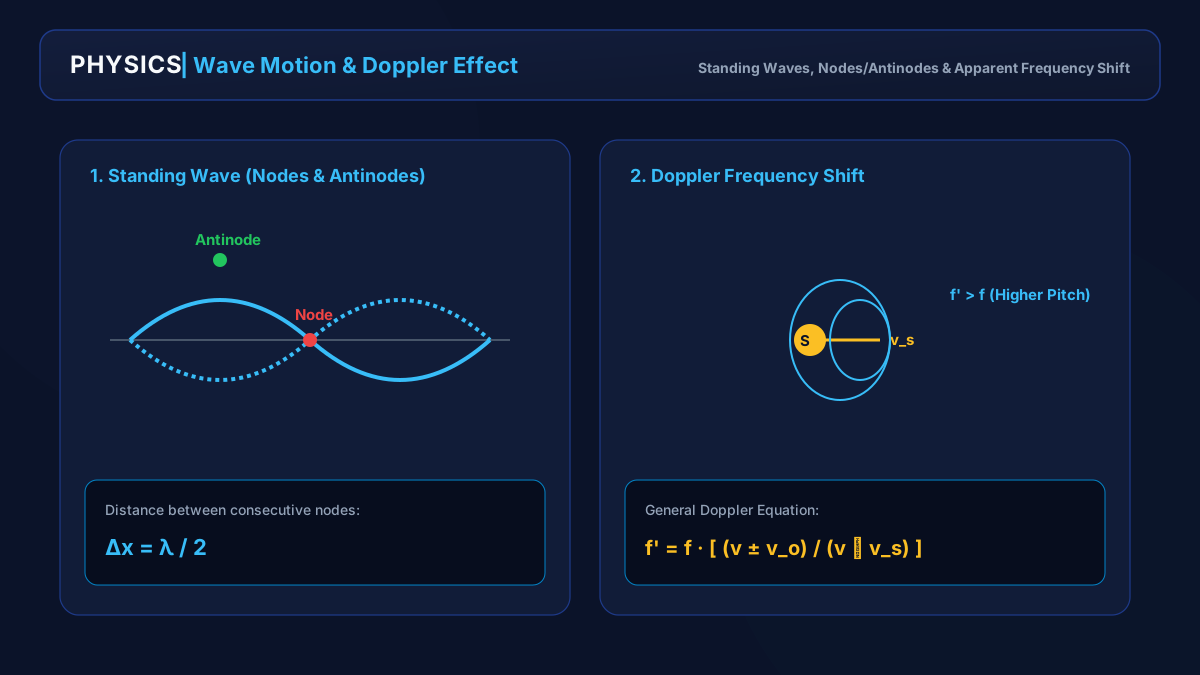
Standing Waves & Doppler Effect Frequency Shift
Standing wave nodes/antinodes spacing and compressed acoustic wavefronts in front of an approaching source causing frequency rise.
- 1Node-to-Node Distance — Δx = λ / 2 between consecutive nodes or antinodes
- 2General Doppler Formula — f' = f · [ (v ± v_o) / (v ∓ v_s) ]
- 3Open Organ Pipe — Contains all harmonics: f_n = n · v / (2L) for n = 1, 2, 3...
- 4Closed Organ Pipe — Contains only odd harmonics: f_n = (2n - 1) · v / (4L)
- 5Beat Frequency — f_beat = |f₁ - f₂|
Interactive Study Prompts (Click to Explore)
Clickable22. Physical Mechanism Flowchart: Wave Motion & Doppler Effect
Wave Motion & Doppler Effect Step-by-Step Flowchart
- 1
Initial State
Initial parameters and boundary conditions are established.
- 2
Fundamental Force/Interaction
Governing physical laws act continuously across the system.
- 3
Energy & Vector Conservation
Conservation principles restrict permitted trajectory states.
- 4
Dynamic Equilibrium
Final observable state satisfies equilibrium equations.
Follow the numbered pipeline above. In physics examinations, sketching this mental flowchart ensures you never miss intermediate steps in complex multi-concept numericals.
33. Rigorous Mathematical Proofs & Governing Equations
Derivation — Derivation of Governing Formula for Wave Motion & Doppler Effect
- 1
Starting from Newton's foundational law
- 2
Integrating over displacement
Fundamental Relation
Core Physical Variables
| Variable | Symbol | SI Unit |
|---|---|---|
| Energy | E | Joules (J) |
| Power | P | Watts (W) |
Energy
- Symbol
- E
- SI Unit
- Joules (J)
Power
- Symbol
- P
- SI Unit
- Watts (W)
44. Cosmology: Edwin Hubble and the Expanding Universe
In 1929, astronomer Edwin Hubble measured the Doppler shift of light emitted by distant galaxies. To his astonishment, light from almost every galaxy was systematically shifted toward longer, redder wavelengths ("Redshift"). Applying the optical Doppler equation, Hubble made the greatest cosmological discovery in history: the galaxies are rushing away from us, proving that our entire universe is expanding from the Big Bang!
55. Solved Standard & Advanced Exam Problems
Exam question · JEE Standard
- A.A
- B.B
- C.C
- D.D
- Step 1
Answer: A. A
What it tests: Explanation
Exam question · JEE Main & AP Physics
- A.444.4 Hz
- B.400.0 Hz
- C.360.0 Hz
- D.480.0 Hz
- 1. Source is moving toward a stationary observer: f' = f [ v / (v - v_s) ].
- 3. Calculate: f' = 400 × [ 330 / (330 - 33) ] = 400 × [ 330 / 297 ] = 400 × (10 / 9) ≈ 444.44 Hz.
Answer: A. 444.4 Hz
What it tests: Approaching source compresses apparent wavelength, raising observed frequency by factor v / (v - v_s).
Remember
- Standing waves transmit zero net energy across space because energy is trapped between nodes.
- When an observer moves toward a stationary source, wavelength remains unchanged but relative speed increases.
- When a source moves toward a stationary observer, the wave speed remains unchanged but apparent wavelength shrinks.
Check yourself
Question 1
An organ pipe closed at one end of length L has a fundamental frequency of 100 Hz. What is the frequency of its next higher harmonic?