Physics · Senior High School & College Physics
What is Gravity? From Newton to Einstein and Quantum Physics
Gravityis the fundamental interaction governing everything from falling apples to the motion of galaxies. But is it an attractive force pulling across empty space, the geometric curvature of four-dimensional spacetime, or an exchange of quantum particles? Here is the complete answer across classical physics, relativity, and quantum mechanics.
1Visual Comparison: The Three Eras of Gravity
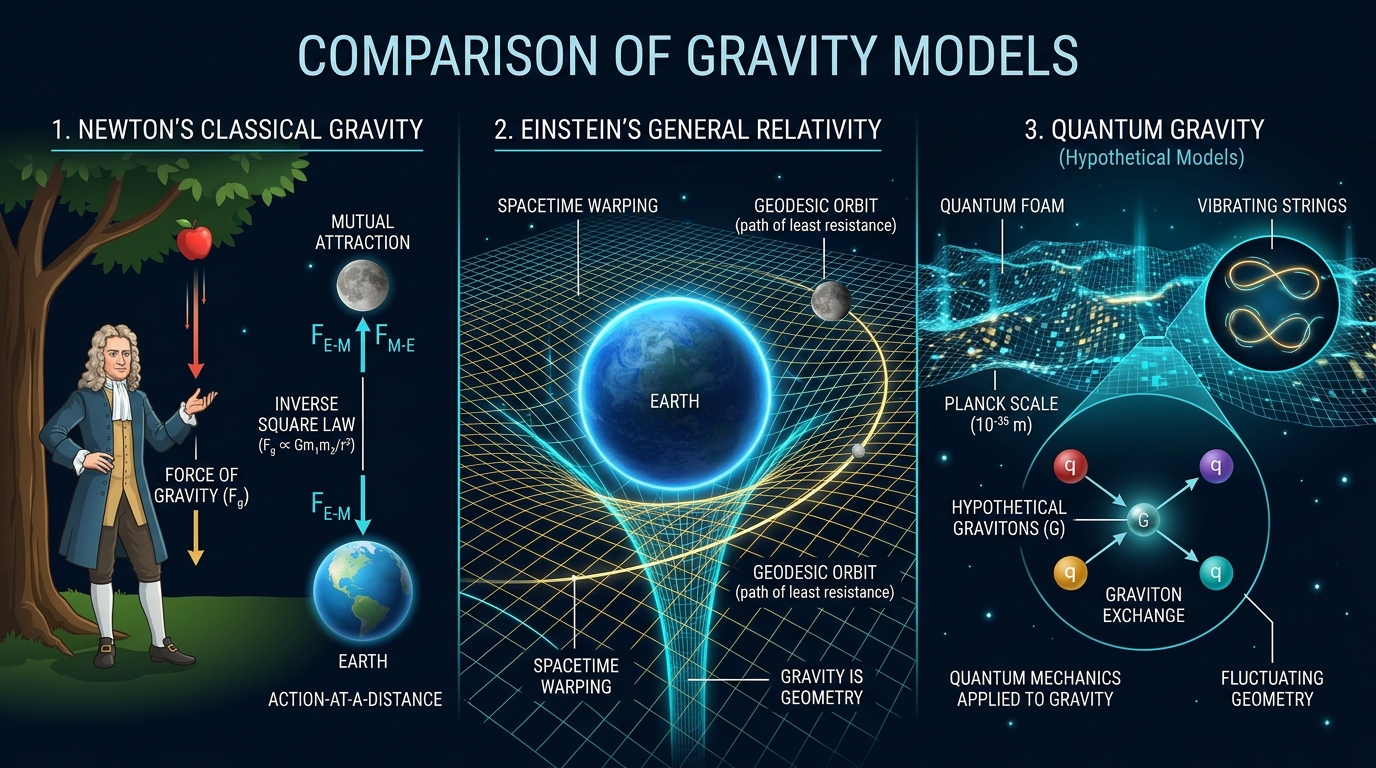
Physics has radically redefined gravity twice in human history—and is currently in the middle of a third revolution. Below is the master visual comparison showing how our understanding evolved from Newton's mechanical pull to Einstein's warped geometry, and finally to the quantum realm.
 Full size
Comparison of Gravity Models: Newton, Einstein & Quantum Gravity
Three fundamental frameworks: 1. Newton's inverse-square attractive force, 2. Einstein's spacetime warping and geodesic orbits, and 3. Quantum gravity with Planck-scale quantum foam, vibrating strings, and hypothetical graviton exchange.
- 1Newtonian Classical Gravity — Gravity as an invisible, instantaneous attractive force pulling directly between any two masses across empty space
- 2Inverse Square Law — Gravitational force F is directly proportional to product of masses and inversely proportional to r squared
- 3Einstein General Relativity — Gravity is NOT a force; massive bodies warp the 4D spacetime fabric, creating curved paths called geodesics
- 4Geodesic Orbits — Planets and moons travel along the straightest possible paths through warped geometry, appearing to orbit
- 5Quantum Foam & Planck Scale — At 10^-35 meters, smooth spacetime breaks down into turbulent, fluctuating quantum bubbles
- 6Hypothetical Graviton Exchange — Quantum field theory predicts gravity is mediated by a massless, spin-2 gauge boson called the graviton
Comparative Framework of the Three Gravity Theories
| Feature | 1. Newton (1687) | 2. Einstein (1915) | 3. Quantum Gravity (Frontier) |
|---|---|---|---|
| Nature of Gravity | Attractive mechanical force | Curvature of 4D spacetime geometry | Exchange of quantum particles (Gravitons) |
| How it Acts | Action-at-a-distance across void | Energy & mass bend the spacetime fabric | Quantum field interaction at subatomic scale |
| Speed of Propagation | Infinite (instantaneous) | Speed of light c (finite: 300,000 km/s) | Speed of light c |
| Governing Equation | Unsolved (String Theory / Loop Quantum Gravity) | ||
| Domain of Validity | Everyday engineering & slow speeds | Cosmology, GPS, black holes, high speeds | Planck scale (10^-35 m), Big Bang, singularities |
Nature of Gravity
- 1. Newton (1687)
- Attractive mechanical force
- 2. Einstein (1915)
- Curvature of 4D spacetime geometry
- 3. Quantum Gravity (Frontier)
- Exchange of quantum particles (Gravitons)
How it Acts
- 1. Newton (1687)
- Action-at-a-distance across void
- 2. Einstein (1915)
- Energy & mass bend the spacetime fabric
- 3. Quantum Gravity (Frontier)
- Quantum field interaction at subatomic scale
Speed of Propagation
- 1. Newton (1687)
- Infinite (instantaneous)
- 2. Einstein (1915)
- Speed of light c (finite: 300,000 km/s)
- 3. Quantum Gravity (Frontier)
- Speed of light c
Governing Equation
- 1. Newton (1687)
- 2. Einstein (1915)
- 3. Quantum Gravity (Frontier)
- Unsolved (String Theory / Loop Quantum Gravity)
Domain of Validity
- 1. Newton (1687)
- Everyday engineering & slow speeds
- 2. Einstein (1915)
- Cosmology, GPS, black holes, high speeds
- 3. Quantum Gravity (Frontier)
- Planck scale (10^-35 m), Big Bang, singularities
21. Newton's View: The Classical Universal Force
In 1687, Sir Isaac Newton proposed theLaw of Universal Gravitation. He realized that the same force causing an apple to drop from a tree also holds the Moon in orbit around the Earth.
Newton's Law of Universal Gravitation
- = Gravitational force of attraction (N)
- G = Universal gravitational constant (6.674 \times 10^{-11} \text{ N}\cdot\text{m}^2/\text{kg}^2)
- = Masses of the interacting bodies (kg)
- r = Distance separating their centers of mass (m)
32. Einstein's General Relativity: Gravity is Geometry, Not a Force
In 1915, Albert Einstein revolutionized our view of reality. He realized that space and time are interwoven into a single four-dimensional continuum calledspacetime. Massive objects do not pull on each other; they warp the spacetime fabric around them.
Definition
Wheeler's Maxim — "Spacetime tells matter how to move; matter tells spacetime how to curve." — John Archibald Wheeler
How Einsteinian Gravity Works
- 1
Mass-Energy Presence
Massive bodies (like Earth or the Sun) depress and curve the 4D spacetime fabric
- 2
Geodesic Trajectory
Nearby objects in free fall travel along geodesics—the shortest lines in curved geometry
- 3
Apparent Force
To an observer, following a curved geodesic looks like an invisible pulling force
- 4
Light Deflection
Because space itself is bent, even massless light bends around stars (Gravitational Lensing)
- 5
Gravitational Time Dilation
Clocks run measurably slower closer to heavy masses where spacetime is more deeply curved
Einstein Field Equations (Core Form)
- = Einstein tensor (curvature and geometry of spacetime)
- = Cosmological constant term (accelerating expansion)
- = Stress-energy tensor (density and flux of energy, momentum, and stress)
- c = Speed of light in vacuum
43. The Quantum Frontier: Why Relativity and Quantum Physics Clash
In modern physics, the other three fundamental forces (electromagnetism, strong nuclear, and weak nuclear) are completely explained byQuantum Field Theorythrough the exchange of messenger particles (photons, gluons, W/Z bosons). Gravity is the only force that has stubbornly refused to be quantized.
The Fundamental Clash Between Relativity and Quantum Mechanics
| Parameter | General Relativity (Einstein) | Quantum Mechanics (Planck/Heisenberg) |
|---|---|---|
| Scale Governed | Cosmic & Astronomical (Stars, Galaxies) | Subatomic & Microscopic (Quarks, Electrons) |
| Fabric Nature | Smooth, continuous, deterministic sheet | Granular, probabilistic, vibrating quanta |
| At Planck Scale | Predicts infinite density (Mathematical breakdown) | Space boils into chaotic "quantum foam" |
| Carrier Particle | None (gravity is curvature) | Hypothetical Graviton (massless spin-2 boson) |
Scale Governed
- General Relativity (Einstein)
- Cosmic & Astronomical (Stars, Galaxies)
- Quantum Mechanics (Planck/Heisenberg)
- Subatomic & Microscopic (Quarks, Electrons)
Fabric Nature
- General Relativity (Einstein)
- Smooth, continuous, deterministic sheet
- Quantum Mechanics (Planck/Heisenberg)
- Granular, probabilistic, vibrating quanta
At Planck Scale
- General Relativity (Einstein)
- Predicts infinite density (Mathematical breakdown)
- Quantum Mechanics (Planck/Heisenberg)
- Space boils into chaotic "quantum foam"
Carrier Particle
- General Relativity (Einstein)
- None (gravity is curvature)
- Quantum Mechanics (Planck/Heisenberg)
- Hypothetical Graviton (massless spin-2 boson)
Leading Theories of Quantum Gravity
- String Theory / M-Theory: Postulates that fundamental entities are vibrating one-dimensional strings. A closed string vibrating in a specific harmonic mode naturally acts as the Graviton!
- Loop Quantum Gravity (LQG): Suggests that spacetime itself is woven from tiny, discrete quantum loops of area and volume (~10^-35 m). Spacetime has atomic "pixels" and cannot be continuously subdivided.
- Black Hole Singularities: Inside a black hole or at the moment of the Big Bang, massive matter is compressed into zero volume. Only a true theory of Quantum Gravity can calculate what really happens at a singularity without mathematical infinities.
5Thought Experiments & Conceptual Check
Exam question · College Physics & Astrophysics Conceptual
- A.Earth would instantly shoot off in a straight line at the exact microsecond of disappearance.
- B.Earth would continue orbiting normally for approximately 8.3 minutes before shooting off tangentially.
- C.Earth would be immediately sucked into the void where the Sun was.
- D.Earth would stay in orbit forever because space remains permanently bent.
- 1. Under Newton's theory, Earth would fly off instantly because gravity was thought to be an instantaneous action-at-a-distance.
- 2. Under Einstein's General Relativity, gravitational ripples travel at the speed of light (c).
- 3. Sunlight takes ~8 minutes and 20 seconds (500 seconds) to travel from the Sun to Earth (150 million km).
- 4. The gravitational wavefront takes the exact same time: Earth would stay in orbit for 8.3 minutes and see the Sun shine normally, until both light and gravitational curvature vanish simultaneously!
Answer: B. Earth would continue orbiting normally for approximately 8.3 minutes before shooting off tangentially.
What it tests: Gravitational influence propagates as ripples in spacetime at the speed of light, not instantaneously.
Remember
- In Newtonian physics, gravity is treated as an instantaneous attractive force between masses: F = G(m1 m2)/r^2.
- In Einstein's General Relativity, gravity is NOT a force—it is the geometric warping of four-dimensional spacetime caused by mass and energy.
- Planets, moons, and light beams simply travel along the straightest possible paths (geodesics) through curved spacetime.
- Gravity travels at a finite speed—exactly equal to the speed of light in a vacuum (c = 300,000 km/s).
- The greatest unsolved mystery in physics is Quantum Gravity: combining the smooth spacetime of General Relativity with the discrete, probabilistic quantum realm at the Planck scale.
Check yourself
Question 1
According to Einstein's General Relativity, why do planets orbit the Sun?Question 2
What is the hypothetical elementary particle predicted by quantum field theories to mediate gravitational interactions?Question 3
At what scale does Einstein's smooth spacetime break down into chaotic quantum foam?Question 4
What happens to a clock placed closer to a massive gravitational body like Earth compared to a clock far away in deep space?