Physics · Class 11-12 · JEE / NEET / AP Physics
Work, Energy, and Power
Work, Energy, and Powerform the foundational pillar of mechanics. Work is done when an applied force causes a displacement, transforming mechanical energy betweenkineticandpotentialstates.
11. Visual Overview & Intuitive Discovery: Work, Energy, and Power
Imagine standing at the highest crest of a colossal 100-meter roller coaster. For a brief second, you are motionless in the sky. Behind this exhilarating sensation lies one of the most elegant universal truths in the cosmos: energy can neither be created nor destroyed—it merely morphs from silent gravitational potential into a thundering kinetic roar.
 Full size
Work, Energy, and Power Framework
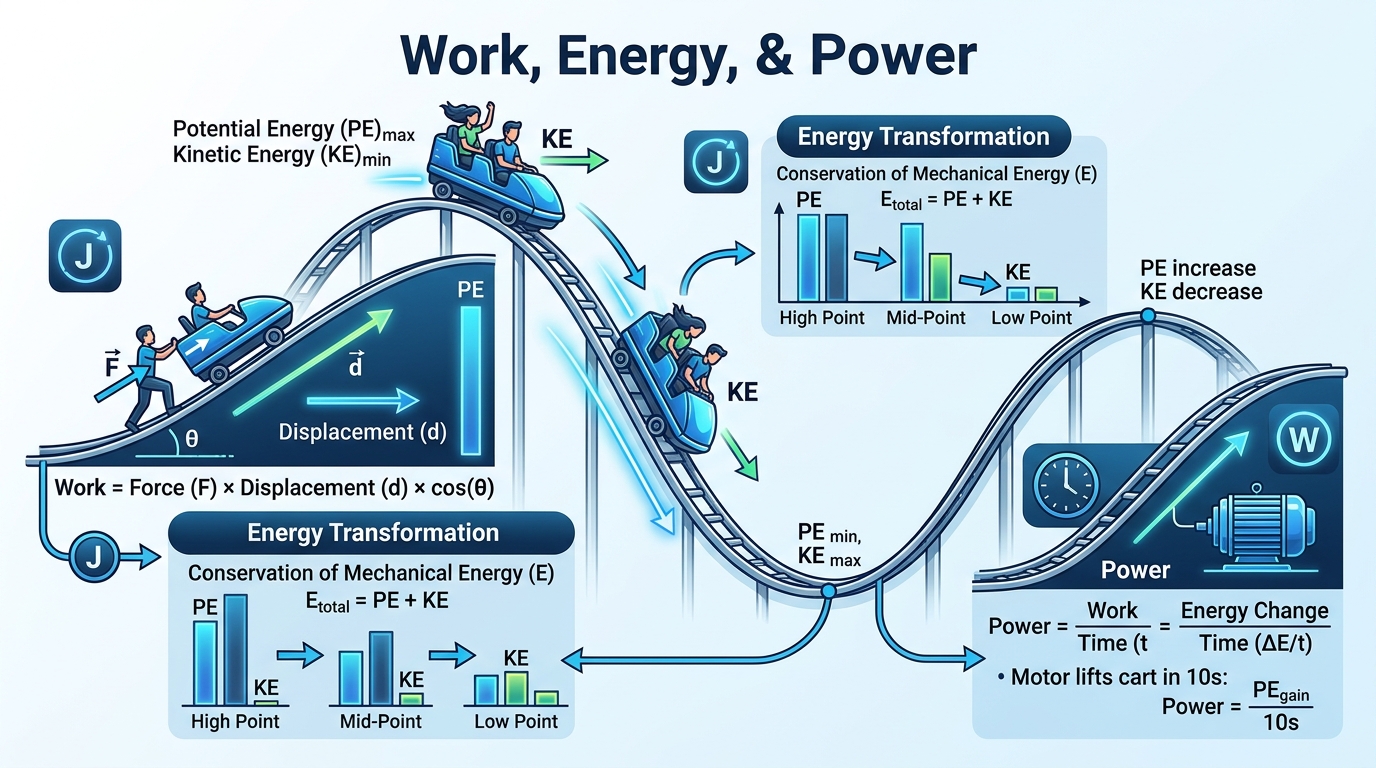
Energy transformation on a roller coaster track showing potential energy at the peak converting into maximum kinetic energy at the base, along with mechanical power calculation.
- 1Work Formula — W = F · d · cos(θ), measuring the dot product of force and displacement vectors
- 2Potential Energy Peak — PE = mgh is maximized at maximum height where velocity is minimal
- 3Kinetic Energy Maximum — KE = 1/2 m v² is highest at the lowest elevation of the trajectory
- 4Conservation of Energy — E_total = PE + KE remains constant when non-conservative friction is neglected
- 5Power Rating — P = W / t = F · v, the rate of doing work measured in Watts (Joules per second)
Interactive Study Prompts (Click to Explore)
Clickable22. Physical Mechanism Flowchart: Work, Energy, and Power
Work, Energy, and Power Step-by-Step Flowchart
- 1
Initial State
Initial parameters and boundary conditions are established.
- 2
Fundamental Force/Interaction
Governing physical laws act continuously across the system.
- 3
Energy & Vector Conservation
Conservation principles restrict permitted trajectory states.
- 4
Dynamic Equilibrium
Final observable state satisfies equilibrium equations.
Follow the numbered pipeline above. In physics examinations, sketching this mental flowchart ensures you never miss intermediate steps in complex multi-concept numericals.
33. Rigorous Mathematical Proofs & Governing Equations
Derivation — Derivation of Governing Formula for Work, Energy, and Power
- 1
Starting from Newton's foundational law
- 2
Integrating over displacement
The Work-Energy Theorem
- = Net work done by all acting forces (conservative + non-conservative)
- = Change in kinetic energy of the body
- m = Mass of the object
- = Final and initial velocities
Conservative vs. Non-Conservative Forces
| Feature | Conservative Force (e.g., Gravity, Spring) | Non-Conservative Force (e.g., Friction, Drag) |
|---|---|---|
| Work over Closed Loop | Zero (∮ F · dr = 0) | Non-zero (energy lost as heat/sound) |
| Path Dependence | Completely independent of path taken | Directly depends on the total path length |
| Potential Energy Association | Has an associated Potential Energy: F = -dU/dr | No potential energy function exists |
Work over Closed Loop
- Conservative Force (e.g., Gravity, Spring)
- Zero (∮ F · dr = 0)
- Non-Conservative Force (e.g., Friction, Drag)
- Non-zero (energy lost as heat/sound)
Path Dependence
- Conservative Force (e.g., Gravity, Spring)
- Completely independent of path taken
- Non-Conservative Force (e.g., Friction, Drag)
- Directly depends on the total path length
Potential Energy Association
- Conservative Force (e.g., Gravity, Spring)
- Has an associated Potential Energy: F = -dU/dr
- Non-Conservative Force (e.g., Friction, Drag)
- No potential energy function exists
44. Real-World Engineering: Regenerative Braking in Electric Vehicles
In conventional gasoline cars, stepping on the brakes forces friction pads against spinning metal rotors, permanently throwing away precious kinetic energy as useless heat into the atmosphere. In modern electric vehicles (like Tesla and Formula E cars), the electric motor reverses its role during deceleration. It operates as an electric generator, turning the car's kinetic energy back into electrical potential energy stored in the lithium-ion battery pack—recovering up to 70% of energy that would otherwise be wasted!
55. Solved Standard & Advanced Exam Problems
Exam question · JEE Main & AP Physics Standard
- A.-34 Joules
- B.-98 Joules
- C.+64 Joules
- D.-64 Joules
- 1. Calculate initial potential energy: PE = mgh = 2 × 9.8 × 5 = 98 J.
- 2. Calculate final kinetic energy: KE = 1/2 m v² = 1/2 × 2 × (8)² = 64 J.
- 3. Apply Work-Energy Theorem: W_gravity + W_friction = KE_final - KE_initial.
- 4. 98 + W_friction = 64 ⇒ W_friction = 64 - 98 = -34 J.
Answer: A. -34 Joules
What it tests: Friction always opposes displacement, doing negative work equal to the mechanical energy dissipated as heat.
Exam question · JEE Advanced / AP Physics C
- A.3.0 m/s
- B.5.74 m/s
- C.33.0 m/s
- D.4.5 m/s
- 1. Calculate net work done by integrating the variable force: W = ∫[0 to 3] (3x² - 2x + 5) dx.
- 2. Evaluate the integral: W = [x³ - x² + 5x] from 0 to 3 = (27 - 9 + 15) - 0 = 33 Joules.
- 3. Apply the Work-Energy Theorem: W_net = ΔK = 1/2 m v_f² - 1/2 m v_i².
- 4. Since v_i = 0: 33 J = 1/2 × 2 kg × v_f² ⇒ v_f² = 33 ⇒ v_f = √33 ≈ 5.74 m/s.
Answer: B. 5.74 m/s
What it tests: Work done by a position-dependent variable force is always the area under the F-x curve, which directly equals the kinetic energy acquired by the object.
Remember
- Work is the scalar product of force and displacement: W = F · d cos(θ).
- The net work done on a particle equals the change in its kinetic energy (Work-Energy Theorem).
- Conservative forces conserve total mechanical energy and depend solely on initial and final positions.
- Power is the time rate at which energy is transferred: P = dW/dt = F · v.
- Minimum speed required to complete a vertical loop of radius R under gravity is √(5gR) at the lowest point.
Check yourself
Question 1
Under what condition does an applied force do ZERO work on an object?Question 2
What is the instantaneous power delivered to a car of mass m traveling at constant velocity v against resistive force f?