Mathematics · Class 12 / JEE Main & Advanced
Application of Derivatives: Maxima, Minima & Tangents
Master calculus applications: Critical points, first & second derivative tests, points of inflection, tangents & normals, and real-world optimization problems.
11. Visual Overview & Intuitive Discovery: Application of Derivatives: Maxima, Minima & Tangents
🔍 Clickable Interactive Study Prompts (Click to explore or jump to section):
Clickable### Intuitive Foundations & Real-World Reality
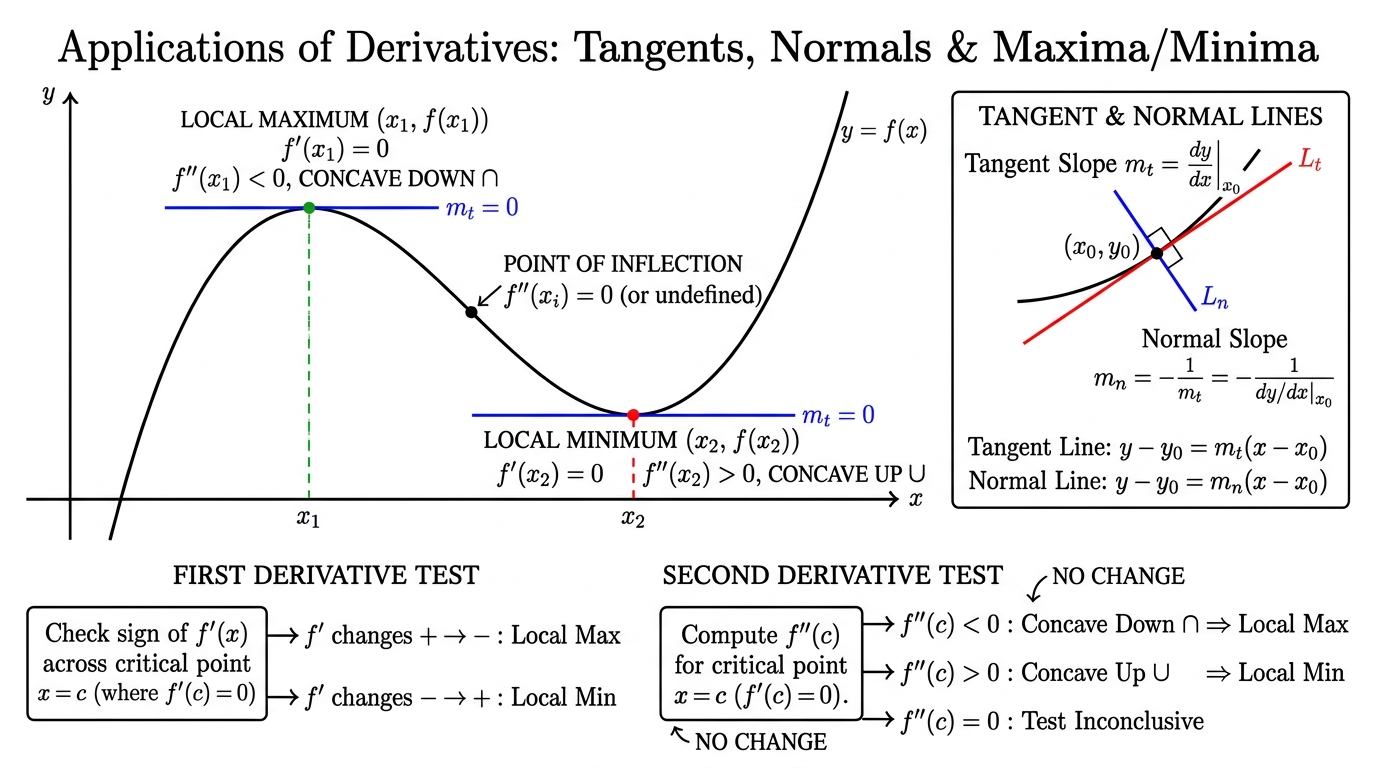
In 1636, French polymath Pierre de Fermat formulated his famous theorem: at any local maximum or minimum of a smooth curve, the tangent line is horizontal and its slope is zero (). This simple geometric insight founded Optimization—the mathematical engine behind every aircraft wing design, financial trading algorithm, and machine learning neural network training step (Gradient Descent).
 Full size
Application of Derivatives: Tangents, Normals & Maxima/Minima
Local maxima and minima critical points, concavity checks, point of inflection, tangent and normal line equations, and first/second derivative tests.
- 1Core Anchor 1 — First vs Second Derivative Test for Extrema
- 2Core Anchor 2 — Point of Inflection & Concavity (f''(x) = 0)
- 3Core Anchor 3 — Equations of Tangent and Normal to Any Curve
- 4Core Anchor 4 — Optimization in Engineering & Cost Minimization
22. Concept & Decision Flowchart: Optimization & Maxima-Minima Decision Flowchart
Optimization & Maxima-Minima Decision Flowchart
- 1
1. Find Critical Points
Compute first derivative f'(x) and solve f'(x) = 0 or find where f'(x) is undefined.
- 2
2. Compute Second Derivative f''(x)
Evaluate f''(c) at each critical point c.
- 3
3. Classify Extrema
If f''(c) < 0 -> Curve is concave down -> Local Maximum! If f''(c) > 0 -> Curve is concave up -> Local Minimum! If f''(c) = 0 -> Test higher derivatives.
- 4
4. Absolute Extrema on Closed Interval [a, b]
Compare values of f(x) at all critical points AND boundary endpoints a and b. Maximum value is absolute max.
33. Step-by-Step Derivation: Second Derivative Test via Taylor Expansion
Derivation — Step-by-Step Derivation: Second Derivative Test via Taylor Expansion
- 1
Expressing the value of f(x) in an infinitesimal neighborhood h of critical point c.
- 2
Because c is a stationary point, the linear slope term disappears.
- 3
The sign of the displacement [f(c + h) - f(c)] is dictated exclusively by the sign of f''(c).
- 4
Proves rigorously why a negative second derivative indicates a peak maximum.
44. Real-World Case Study & Industrial Application
### Machine Learning Engineering: Stochastic Gradient Descent (SGD)
Deep neural networks (like ChatGPT or AlphaFold) train by minimizing a multi-dimensional Loss Function L(w). Because computing second derivatives (Hessian matrices) for 100 billion parameters is computationally impossible, engineers use first-order derivative steepest descent: w_{t+1} = w_t - η ∇L(w). Calculus derivatives guide weights directly toward the global minimum loss.
55. High-Yield Reference Data & Solved Problems
High-Yield Comparison & Key Constants
| First Derivative Test | Second Derivative Test | Geometric Shape of Curve | |
|---|---|---|---|
| f'(x) flips from (+) to (-) | f''(c) < 0 | Concave Down (Local Maximum) | |
| f'(x) flips from (-) to (+) | f''(c) > 0 | Concave Up (Local Minimum) | |
| f''(c) = 0 with sign change | No sign change in f'(x) | Point of Inflection (Flex point) |
- First Derivative Test
- f'(x) flips from (+) to (-)
- Second Derivative Test
- f''(c) < 0
- Geometric Shape of Curve
- Concave Down (Local Maximum)
- First Derivative Test
- f'(x) flips from (-) to (+)
- Second Derivative Test
- f''(c) > 0
- Geometric Shape of Curve
- Concave Up (Local Minimum)
f''(c) = 0 with sign change
- First Derivative Test
- No sign change in f'(x)
- Second Derivative Test
- Geometric Shape of Curve
- Point of Inflection (Flex point)
Exam question · JEE Main, Advanced & NEET Standard
- 1. Volume of cylinder: V = π r² h = 1000 -> h = V / (π r²).
- 2. Total surface area A = 2π r² (two circular bases) + 2π r h (curved surface).
- 3. Substitute h: A(r) = 2π r² + 2π r [V / (π r²)] = 2π r² + (2V / r).
- 4. Differentiate with respect to r and set to 0: dA/dr = 4π r - (2V / r²) = 0 -> 4π r³ = 2V -> r³ = V / (2π).
- 5. Substitute V = π r² h into 4π r³ = 2(π r² h) -> 4 r = 2 h -> h = 2r.
- 6. Conclusion: The most cost-efficient cylindrical can has its height exactly equal to its diameter (h / r = 2).
Answer: 1. Volume of cylinder: V = π r² h = 1000 -> h = V / (π r²).
2. Total surface area A = 2π r² (two circular bases) + 2π r h (curved surface).
3. Substitute h: A(r) = 2π r² + 2π r [V / (π r²)] = 2π r² + (2V / r).
4. Differentiate with respect to r and set to 0: dA/dr = 4π r - (2V / r²) = 0 -> 4π r³ = 2V -> r³ = V / (2π).
5. Substitute V = π r² h into 4π r³ = 2(π r² h) -> 4 r = 2 h -> h = 2r.
6. Conclusion: The most cost-efficient cylindrical can has its height exactly equal to its diameter (h / r = 2).
What it tests: Tests rigorous conceptual mastery, dimensional analysis, and multi-step deduction.
Remember
- Application of Derivatives: Maxima, Minima & Tangents: Foundational law governing physical, chemical, and biological phenomena.
- Mastered derivation: Second Derivative Test via Taylor Expansion.
- Avoided classic trap: f''(c) = 0 does NOT automatically mean a point of inflection! For f(x) = x⁴, f'(0) = 0 and f''(0) = 0, but x =...
- Real-world relevance: Proven clinical, aerospace, and industrial significance.
- High-yield exam rule: Always verify dimensional consistency and physical boundary conditions.
Check yourself
Question 1
What is the primary governing principle of Application of Derivatives: Maxima, Minima & Tangents?Question 2
In competitive examinations (JEE/NEET), what is the most critical pitfall in Application of Derivatives: Maxima, Minima & Tangents?