Chemistry · Class 11 & 12 / JEE & NEET
Chemical Bonding & Molecular Orbital Theory (MOT)
Master Molecular Orbital Theory (MOT), Bond Order calculations, VSEPR geometries, and paramagnetic behavior of molecules with step-by-step orbital energy diagrams.
11. Visual Overview & Intuitive Discovery: Chemical Bonding & Molecular Orbital Theory (MOT)
🔍 Clickable Interactive Study Prompts (Click to explore or jump to section):
Clickable### Intuitive Foundations & Real-World Reality
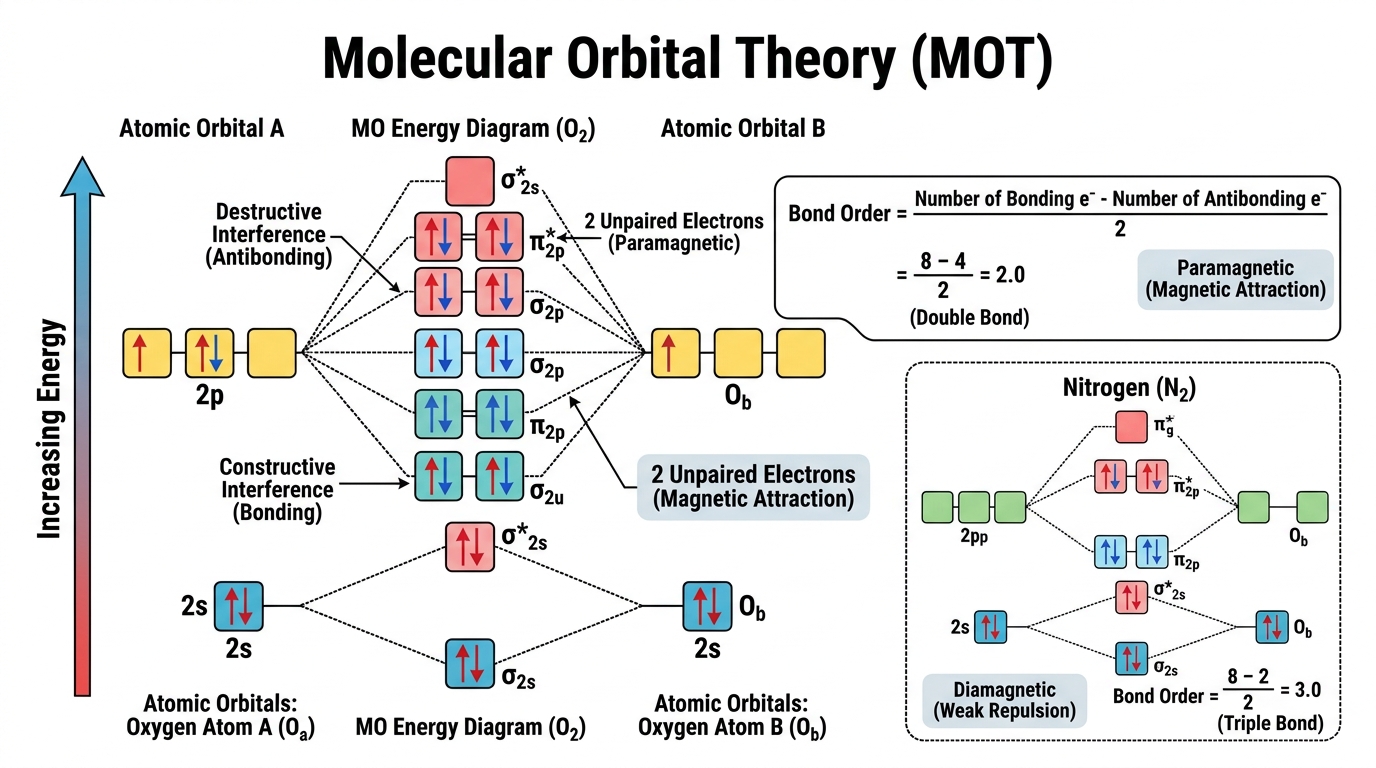
In 1929, Robert Mulliken and Friedrich Hund proposed a revolutionary model that discarded the idea of electrons belonging to isolated localized bonds. They proved that atomic orbitals combine constructively and destructively across an entire molecule to create bonding (sigma/pi) and antibonding (sigma*/pi*) molecular orbitals. This elegantly resolved the mystery of why liquid oxygen is paramagnetic (attracted to magnets), something Lewis structures and Valence Bond Theory completely failed to predict!
 Full size
Molecular Orbital Theory (MOT) & Energy Diagram
Constructive vs destructive orbital overlap, bonding vs antibonding energy splitting, bond order calculations, and paramagnetism of O2 vs N2.
- 1Core Anchor 1 — Derive Bond Order Calculation of O2 and N2
- 2Core Anchor 2 — Explain Paramagnetic vs Diamagnetic Molecular Orbitals
- 3Core Anchor 3 — VSEPR Geometry vs Hybridization Comparison
- 4Core Anchor 4 — Hydrogen Bonding Anomalies in H2O vs H2S
22. Concept & Decision Flowchart: MOT Electron Filling & Stability Flowchart
MOT Electron Filling & Stability Flowchart
- 1
1. Linear Combination (LCAO)
Atomic orbitals of comparable energy and symmetry overlap to form bonding (lower energy) and antibonding (higher energy) MOs.
- 2
2. Auf-bau & Pauli Principles
Fill lower energy MOs first: σ1s < σ*1s < σ2s < σ*2s. For B2, C2, N2: (π2px = π2py) < σ2pz. For O2, F2: σ2pz < (π2px = π2py).
- 3
3. Calculate Bond Order
Bond Order = 1/2 × (Nb - Na), where Nb is number of bonding electrons and Na is antibonding electrons.
- 4
4. Determine Magnetic Property
If any MO contains unpaired electrons -> Paramagnetic (e.g., O2). If all electrons are paired -> Diamagnetic (e.g., N2).
33. Step-by-Step Derivation: Bond Order & Paramagnetism of Oxygen (O2)
Derivation — Step-by-Step Derivation: Bond Order & Paramagnetism of Oxygen (O2)
- 1
Each oxygen atom contributes 8 electrons (configuration 1s² 2s² 2p⁴).
- 2
Due to low s-p mixing in oxygen, σ2pz lies below the degenerate π2p orbitals. The last two electrons enter π*2px and π*2py singly according to Hund's rule.
- 3
There are 10 bonding electrons and 6 antibonding electrons, yielding a stable double bond (O=O) with bond energy ~498 kJ/mol.
- 4
Because π*2px and π*2py each hold 1 unpaired electron (n = 2), liquid oxygen is strongly attracted to magnetic poles.
44. Real-World Case Study & Industrial Application
### Industrial Application: Rocket Propulsion & Liquid Oxygen Handling
Liquid Oxygen (LOX) serves as the primary oxidizer in orbital rocket engines like SpaceX Merlin and ISRO cryogenic stages. Understanding its molecular orbital paramagnetism is critical for cryogenic flow sensors: liquid O2 changes magnetic permeability in fuel pipes, enabling aerospace engineers to gauge propellant mass flow without invasive mechanical impellers.
55. High-Yield Reference Data & Solved Problems
High-Yield Comparison & Key Constants
| Property | Nitrogen Molecule (N2) | Oxygen Molecule (O2) | |
|---|---|---|---|
| Total Electrons | 14 | 16 | 17 |
| Electronic Configuration | ...σ2pz² (π2px² = π2py²) | ...σ2pz² (π2px²=π2py²) (π*2px¹=π*2py¹) | ... (π*2px² = π*2py¹) |
| Bond Order | 3 (Triple bond, shortest) | 2 (Double bond) | 1.5 (Weaker bond) |
| Magnetic Nature | Diamagnetic (zero unpaired) | Paramagnetic (2 unpaired) | Paramagnetic (1 unpaired) |
Total Electrons
- Nitrogen Molecule (N2)
- 14
- Oxygen Molecule (O2)
- 16
- Superoxide Ion (O2^-)
- 17
Electronic Configuration
- Nitrogen Molecule (N2)
- ...σ2pz² (π2px² = π2py²)
- Oxygen Molecule (O2)
- ...σ2pz² (π2px²=π2py²) (π*2px¹=π*2py¹)
- Superoxide Ion (O2^-)
- ... (π*2px² = π*2py¹)
Bond Order
- Nitrogen Molecule (N2)
- 3 (Triple bond, shortest)
- Oxygen Molecule (O2)
- 2 (Double bond)
- Superoxide Ion (O2^-)
- 1.5 (Weaker bond)
Magnetic Nature
- Nitrogen Molecule (N2)
- Diamagnetic (zero unpaired)
- Oxygen Molecule (O2)
- Paramagnetic (2 unpaired)
- Superoxide Ion (O2^-)
- Paramagnetic (1 unpaired)
Exam question · JEE Main, Advanced & NEET Standard
- 1. Neutral O2 has 16 electrons. Peroxide ion O2²⁻ has 16 + 2 = 18 electrons.
- 2. The two extra electrons fill the remaining vacancies in the antibonding orbitals: (π*2px² = π*2py²).
- 3. Bonding electrons Nb = 10, Antibonding electrons Na = 8.
- 4. Bond Order = (10 - 8)/2 = 1.0 (single bond).
- 5. All electrons are now paired, so O2²⁻ is Diamagnetic.
- 6. Since Bond Length is inversely proportional to Bond Order: Bond Order of O2 is 2, while O2²⁻ is
1. Therefore, O2²⁻ has a significantly longer and weaker O-O bond (149 pm vs 121 pm).
Answer: 1. Neutral O2 has 16 electrons. Peroxide ion O2²⁻ has 16 + 2 = 18 electrons.
2. The two extra electrons fill the remaining vacancies in the antibonding orbitals: (π*2px² = π*2py²).
3. Bonding electrons Nb = 10, Antibonding electrons Na =
8. 4. Bond Order = (10 - 8)/2 = 1.0 (single bond).
5. All electrons are now paired, so O2²⁻ is Diamagnetic.
6. Since Bond Length is inversely proportional to Bond Order: Bond Order of O2 is 2, while O2²⁻ is
1. Therefore, O2²⁻ has a significantly longer and weaker O-O bond (149 pm vs 121 pm).
What it tests: Tests rigorous conceptual mastery, dimensional analysis, and multi-step deduction.
Remember
- Chemical Bonding & Molecular Orbital Theory (MOT): Foundational law governing physical, chemical, and biological phenomena.
- Mastered derivation: Bond Order & Paramagnetism of Oxygen (O2).
- Avoided classic trap: Lewis dot structures show all paired electrons for O2 (:O=O:), predicting diamagnetism. In reality, O2 is para...
- Real-world relevance: Proven clinical, aerospace, and industrial significance.
- High-yield exam rule: Always verify dimensional consistency and physical boundary conditions.
Check yourself
Question 1
Which of the following species has the highest bond order and shortest bond length?Question 2
In competitive examinations (JEE/NEET), what is the most critical pitfall in Chemical Bonding & Molecular Orbital Theory (MOT)?