Chemistry · Class 12 / JEE & NEET
Chemical Kinetics: Rate Laws & Arrhenius Equation
Learn rate laws, zero & first order integrated rate equations, half-life derivations, pseudo-first order reactions, and activation energy ().
11. Visual Overview & Intuitive Discovery: Chemical Kinetics: Rate Laws & Arrhenius Equation
🔍 Clickable Interactive Study Prompts (Click to explore or jump to section):
Clickable### Intuitive Foundations & Real-World Reality
In 1889, Svante Arrhenius proposed that molecules must overcome a critical energy barrier—the Activation Energy ()—to react upon collision. This explains why a mixture of methane and oxygen can remain stable for centuries at room temperature, but explodes in milliseconds when ignited by a tiny spark! The Arrhenius equation mathematically connected temperature and reaction speed.
 Full size
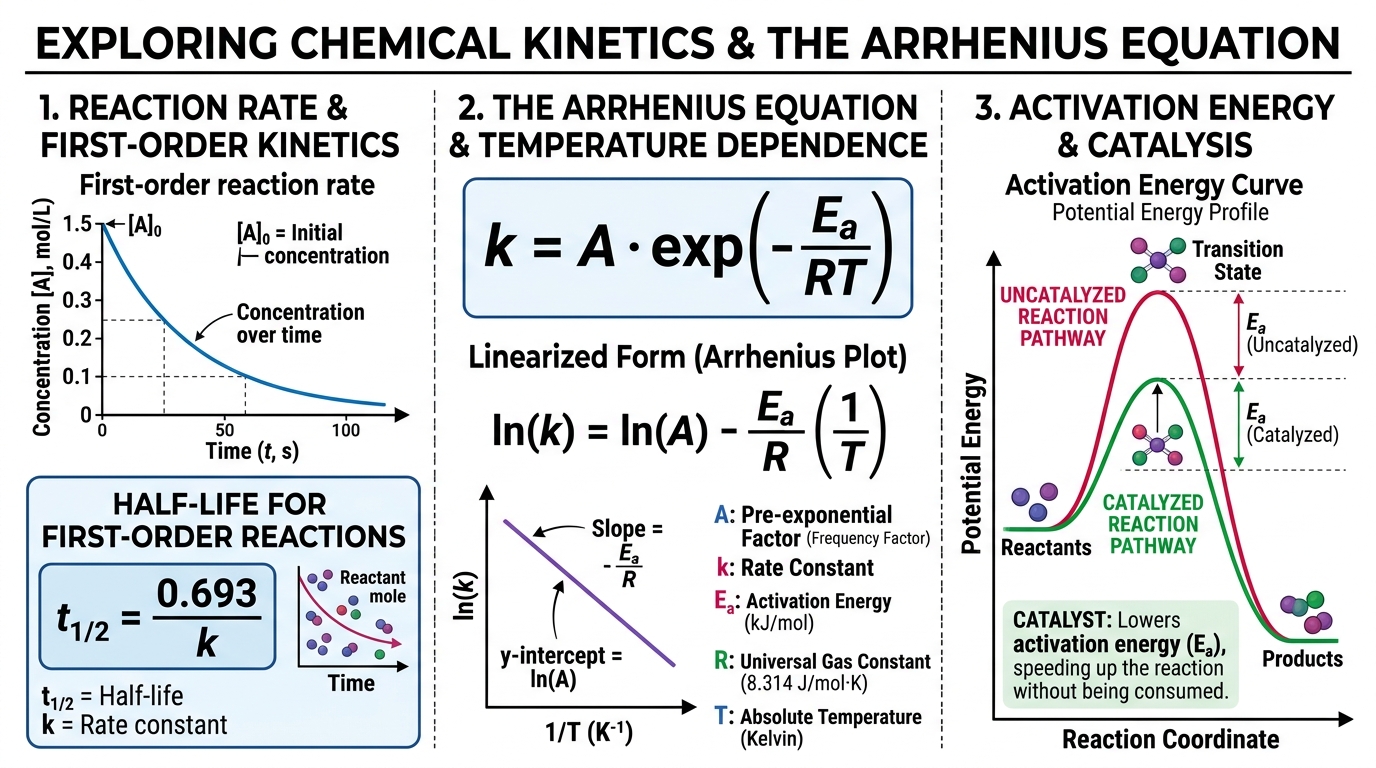
Chemical Kinetics & Arrhenius Activation Energy
First-order concentration decay curve, half-life formula t1/2 = 0.693/k, Arrhenius equation with linear plot, and uncatalyzed vs catalyzed reaction pathways.
- 1Core Anchor 1 — Derive Zero vs First Order Integrated Rate Law
- 2Core Anchor 2 — Half-Life Formulas & Graphical Analysis
- 3Core Anchor 3 — Arrhenius Equation & Activation Energy Slope
- 4Core Anchor 4 — Pseudo-First Order Reactions (Ester Hydrolysis)
22. Concept & Decision Flowchart: Reaction Kinetics Analysis Flowchart
Reaction Kinetics Analysis Flowchart
- 1
1. Determine Order of Reaction
Examine experimental rate data or units of rate constant k (mol^(1-n) L^(n-1) s^(-1)).
- 2
2. Select Integrated Rate Law
Zero order: [A]t = [A]o - kt. First order: ln([A]o/[A]t) = kt. Second order: 1/[A]t - 1/[A]o = kt.
- 3
3. Calculate Half-Life (t1/2)
Zero order: t1/2 = [A]o / (2k). First order: t1/2 = ln(2)/k = 0.693/k (independent of initial concentration!).
- 4
4. Determine Activation Energy
Plot ln(k) vs 1/T: slope = -Ea / R. Or use two temperatures: log10(k2/k1) = Ea/(2.303 R) × (T2 - T1)/(T1 T2).
33. Step-by-Step Derivation: Integrated First Order Rate Law & Half-Life
Derivation — Step-by-Step Derivation: Integrated First Order Rate Law & Half-Life
- 1
For a first-order decomposition reaction A -> Products, the rate is proportional to concentration to the power 1.
- 2
Integrating from initial time t = 0 (concentration [A]o) to time t (concentration [A]t).
- 3
This shows exponential decay of reactant concentration over time.
- 4
Crucially, first order half-life is completely independent of initial concentration [A]o.
44. Real-World Case Study & Industrial Application
### Pharmacokinetics: Drug Elimination & Half-Life in the Human Body
Most pharmaceuticals (e.g., penicillin, acetaminophen) follow first-order elimination kinetics in the liver and kidneys. Clinical dosing intervals are directly calculated using t1/2 = 0.693/k. If a patient takes 500 mg of a medication with a 4-hour half-life, 250 mg remains after 4 hours, 125 mg after 8 hours, and after ~5 half-lives (20 hours), 97% of the drug is eliminated.
55. High-Yield Reference Data & Solved Problems
High-Yield Comparison & Key Constants
| Order (n) | Rate Equation | Integrated Form | Half-Life (t1/2) | Units of Rate Constant k |
|---|---|---|---|---|
| 0 | [A]o / (2k) | mol L⁻¹ s⁻¹ | ||
| 1 | 0.693 / k | s⁻¹ | ||
| 2 | Rate = k[A]² | 1 / (k[A]o) | L mol⁻¹ s⁻¹ |
0
- Rate Equation
- Integrated Form
- Half-Life (t1/2)
- [A]o / (2k)
- Units of Rate Constant k
- mol L⁻¹ s⁻¹
1
- Rate Equation
- Integrated Form
- Half-Life (t1/2)
- 0.693 / k
- Units of Rate Constant k
- s⁻¹
2
- Rate Equation
- Rate = k[A]²
- Integrated Form
- Half-Life (t1/2)
- 1 / (k[A]o)
- Units of Rate Constant k
- L mol⁻¹ s⁻¹
Exam question · JEE Main, Advanced & NEET Standard
- 1. For a first order reaction, 75% completion means [A]t = 25% of [A]o = 0.25 [A]o. This corresponds to exactly 2 half-lives!
- 2. Therefore, 2 × t1/2 = 60 min -> t1/2 = 30 minutes.
- 3. Rate constant k = 0.693 / 30 = 0.0231 min⁻¹.
- 5. t = (2.303 / k) log10([A]o / 0.001 [A]o) = (2.303 / 0.0231) log10(1000) = (2.303 / 0.0231) × 3 ≈ 299 minutes (~10 half-lives).
Answer: 1. For a first order reaction, 75% completion means [A]t = 25% of [A]o = 0.25 [A]o. This corresponds to exactly 2 half-lives!
2. Therefore, 2 × t1/2 = 60 min -> t1/2 = 30 minutes.
3. Rate constant k = 0.693 / 30 = 0.0231 min⁻¹.
4. For 99.9% completion, [A]t = 0.001 [A]o.
5. t = (2.303 / k) log10([A]o / 0.001 [A]o) = (2.303 / 0.0231) log10(1000) = (2.303 / 0.0231) × 3 ≈ 299 minutes (~10 half-lives).
What it tests: Tests rigorous conceptual mastery, dimensional analysis, and multi-step deduction.
Remember
- Chemical Kinetics: Rate Laws & Arrhenius Equation: Foundational law governing physical, chemical, and biological phenomena.
- Mastered derivation: Integrated First Order Rate Law & Half-Life.
- Avoided classic trap: Students often confuse molecularity with order of reaction. Molecularity is theoretical (number of colliding s...
- Real-world relevance: Proven clinical, aerospace, and industrial significance.
- High-yield exam rule: Always verify dimensional consistency and physical boundary conditions.
Check yourself
Question 1
If the temperature of a reaction is raised from 300 K to 310 K, the reaction rate typically doubles. This is primarily because:Question 2
In competitive examinations (JEE/NEET), what is the most critical pitfall in Chemical Kinetics: Rate Laws & Arrhenius Equation?