Chemistry · Class 11 & 12 / JEE & NEET
Chemical Thermodynamics: Enthalpy, Entropy & Gibbs Free Energy
Master thermodynamic state functions: First Law, Hess Law, Entropy (S), Gibbs Free Energy (ΔG = ΔH - TΔS), and criterion for spontaneity.
11. Visual Overview & Intuitive Discovery: Chemical Thermodynamics: Enthalpy, Entropy & Gibbs Free Energy
🔍 Clickable Interactive Study Prompts (Click to explore or jump to section):
Clickable### Intuitive Foundations & Real-World Reality
In 1876, American mathematical physicist Josiah Willard Gibbs unified mechanics, heat, and chemistry into a single master parameter: Gibbs Free Energy (). By defining at constant temperature and pressure, Gibbs gave chemists the ultimate oracle: without running an experiment, one could calculate whether two compounds will spontaneously react, generate electricity, or remain completely inert forever.
 Full size
Thermodynamics: Enthalpy, Entropy & Gibbs Free Energy
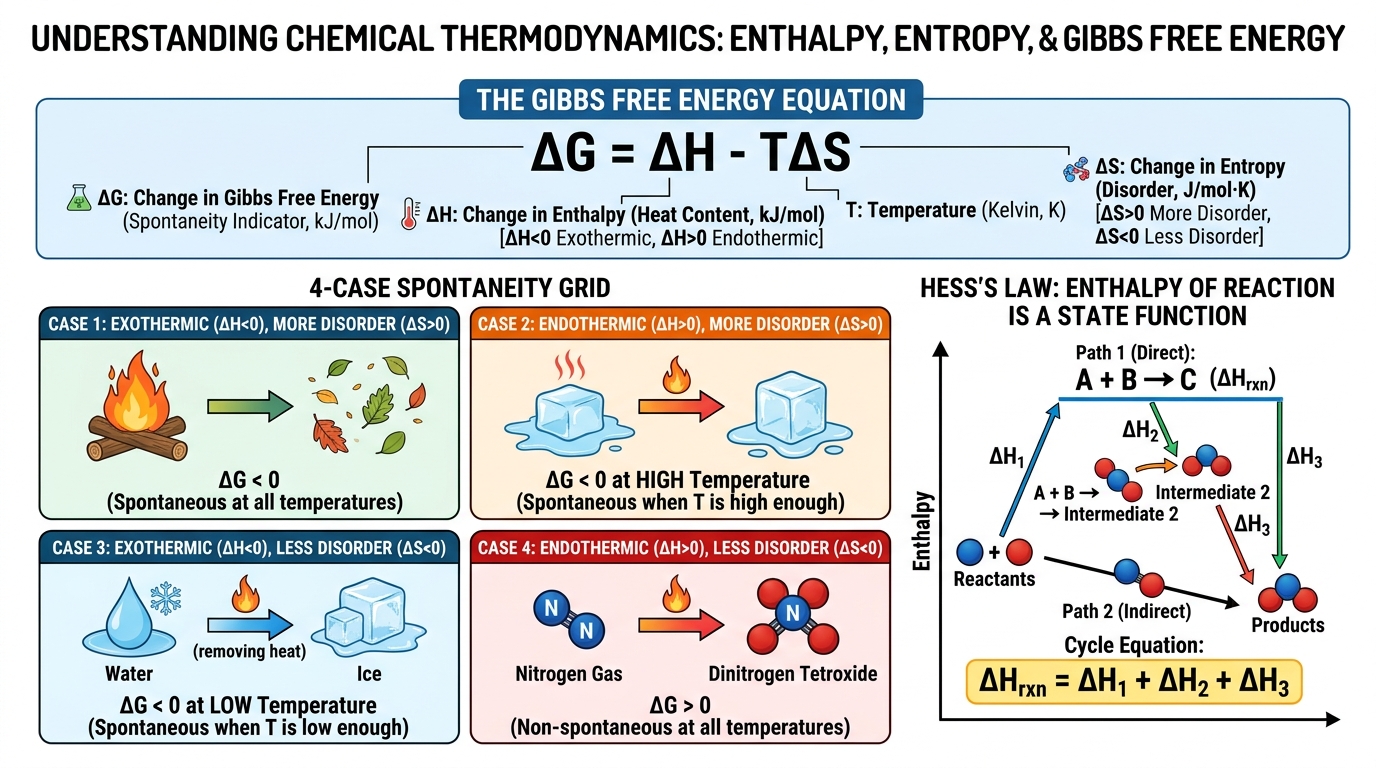
Master Gibbs equation ΔG = ΔH - TΔS, 4-case temperature spontaneity grid, and Hess law state function cycle for enthalpy of reaction.
- 1Core Anchor 1 — Derive Spontaneity Criterion (ΔG = ΔH - TΔS)
- 2Core Anchor 2 — Hess Law of Constant Heat Summation Applications
- 3Core Anchor 3 — Standard Enthalpy of Formation vs Bond Dissociation Energy
- 4Core Anchor 4 — Third Law of Thermodynamics & Absolute Entropy
22. Concept & Decision Flowchart: Thermodynamic Spontaneity Decision Flowchart
Thermodynamic Spontaneity Decision Flowchart
- 1
1. Calculate Enthalpy Change (ΔH)
ΔH < 0 (Exothermic: heat released); ΔH > 0 (Endothermic: heat absorbed).
- 2
2. Calculate Entropy Change (ΔS)
ΔS > 0 (Disorder increases: gas moles increase); ΔS < 0 (Disorder decreases).
- 3
3. Compute Gibbs Energy (ΔG = ΔH - TΔS)
If ΔH < 0 and ΔS > 0 -> ΔG is ALWAYS negative (Spontaneous at all T). If ΔH > 0 and ΔS < 0 -> Non-spontaneous at all T.
- 4
4. Temperature Dependent Cases
If ΔH > 0 and ΔS > 0 -> Spontaneous only at HIGH temperatures (T > ΔH/ΔS). If ΔH < 0 and ΔS < 0 -> Spontaneous only at LOW temperatures.
33. Step-by-Step Derivation: Gibbs-Helmholtz Spontaneity Criterion
Derivation — Step-by-Step Derivation: Gibbs-Helmholtz Spontaneity Criterion
- 1
For any spontaneous natural process, the total entropy of the universe must strictly increase.
- 2
Heat lost by the system is absorbed by surroundings at temperature T.
- 3
Defining Gibbs Free Energy as ΔG = -TΔS_total.
- 4
Because ΔS_total > 0 for spontaneity, ΔG_sys must be negative at constant temperature and pressure.
44. Real-World Case Study & Industrial Application
### Industrial Metallurgy: Ellingham Diagrams in Blast Furnaces
Ellingham diagrams plot ΔG° vs temperature for metal oxide formation. In steel manufacturing, carbon can reduce iron oxide (Fe2O3) to molten iron only above 710°C, because the oxidation of carbon to carbon monoxide (2C + O2 -> 2CO) has ΔS > 0 (gas moles increase), causing its ΔG° line to plunge downward and cross below the iron oxide curve.
55. High-Yield Reference Data & Solved Problems
High-Yield Comparison & Key Constants
| ΔH | ΔS | ΔG = ΔH - TΔS | Spontaneity Condition | Example Reaction |
|---|---|---|---|---|
| Negative (-) | Positive (+) | Always Negative (-) | Spontaneous at all temperatures | Combustion of hydrocarbons |
| Positive (+) | Negative (-) | Always Positive (+) | Non-spontaneous at all temperatures | Splitting water into H2 + O2 without energy |
| Negative (-) | Negative (-) | Negative at low T | Spontaneous only at LOW temperatures | Condensation of steam into water |
| Positive (+) | Positive (+) | Negative at high T | Spontaneous only at HIGH temperatures | Melting of ice above 0°C |
Negative (-)
- ΔS
- Positive (+)
- ΔG = ΔH - TΔS
- Always Negative (-)
- Spontaneity Condition
- Spontaneous at all temperatures
- Example Reaction
- Combustion of hydrocarbons
Positive (+)
- ΔS
- Negative (-)
- ΔG = ΔH - TΔS
- Always Positive (+)
- Spontaneity Condition
- Non-spontaneous at all temperatures
- Example Reaction
- Splitting water into H2 + O2 without energy
Negative (-)
- ΔS
- Negative (-)
- ΔG = ΔH - TΔS
- Negative at low T
- Spontaneity Condition
- Spontaneous only at LOW temperatures
- Example Reaction
- Condensation of steam into water
Positive (+)
- ΔS
- Positive (+)
- ΔG = ΔH - TΔS
- Negative at high T
- Spontaneity Condition
- Spontaneous only at HIGH temperatures
- Example Reaction
- Melting of ice above 0°C
Exam question · JEE Main, Advanced & NEET Standard
- 1. Convert ΔS° to kJ: ΔS° = -198.3 / 1000 = -0.1983 kJ/(mol·K).
- 2. Formula: ΔG° = ΔH° - TΔS°.
- ΔG° = -92.4 - (298 × -0.1983) = -92.4 - (-59.09) = -92.4 + 59.09 = -33.31 kJ/mol.
- 4. Since ΔG° < 0, synthesis of ammonia is spontaneous at 298 K.
Answer: 1. Convert ΔS° to kJ: ΔS° = -198.3 / 1000 = -0.1983 kJ/(mol·K).
2. Formula: ΔG° = ΔH° - TΔS°.
3. Substitute values at T = 298 K:
ΔG° = -92.4 - (298 × -0.1983) = -92.4 - (-59.09) = -92.4 + 59.09 = -33.31 kJ/mol.
4. Since ΔG° < 0, synthesis of ammonia is spontaneous at 298 K.
What it tests: Tests rigorous conceptual mastery, dimensional analysis, and multi-step deduction.
Remember
- Chemical Thermodynamics: Enthalpy, Entropy & Gibbs Free Energy: Foundational law governing physical, chemical, and biological phenomena.
- Mastered derivation: Gibbs-Helmholtz Spontaneity Criterion.
- Avoided classic trap: Many students believe endothermic reactions (ΔH > 0) can never be spontaneous. In reality, dissolution of ammo...
- Real-world relevance: Proven clinical, aerospace, and industrial significance.
- High-yield exam rule: Always verify dimensional consistency and physical boundary conditions.
Check yourself
Question 1
At what temperature will a reaction with ΔH = +30 kJ/mol and ΔS = +100 J/(mol·K) become spontaneous?Question 2
In competitive examinations (JEE/NEET), what is the most critical pitfall in Chemical Thermodynamics: Enthalpy, Entropy & Gibbs Free Energy?