Mathematics · Class 11 / JEE Main & Advanced
Conic Sections: Ellipse & Hyperbola Eccentricity & Asymptotes
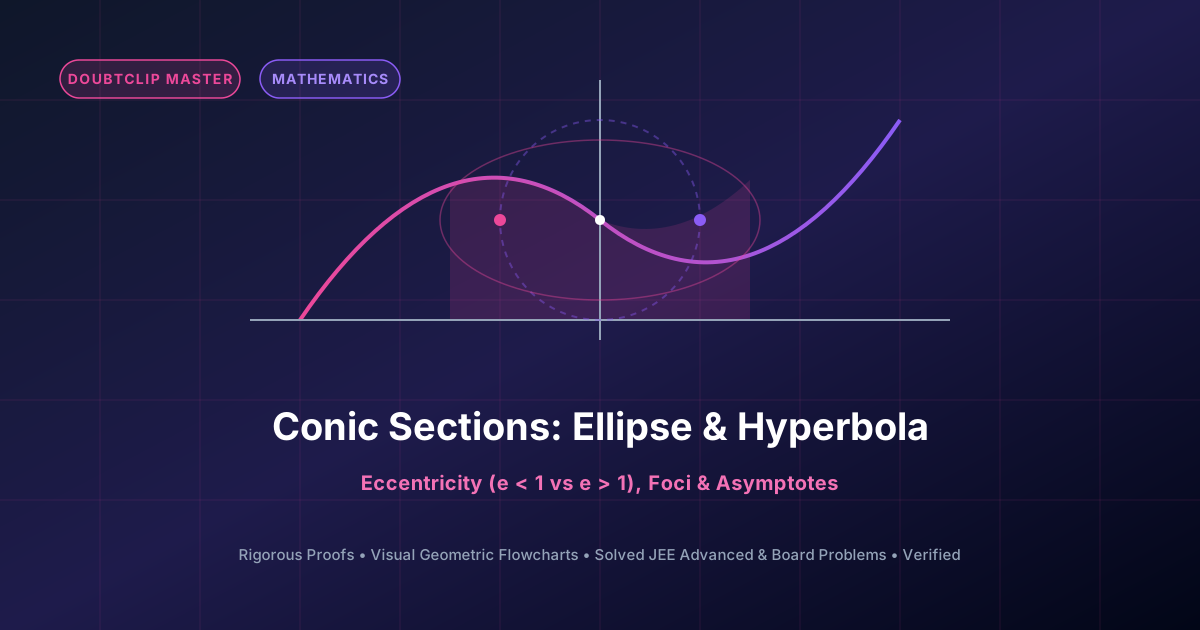
Master central conics: Ellipse (e < 1) vs Hyperbola (e > 1), foci, directrices, auxiliary circles, eccentric angles, asymptotes, and rectangular hyperbolas ().
11. Visual Overview & Intuitive Discovery: Conic Sections: Ellipse & Hyperbola Eccentricity & Asymptotes
🔍 Clickable Interactive Study Prompts (Click to explore or jump to section):
Clickable### Intuitive Foundations & Real-World Reality
In 1609, Johannes Kepler broke with two millennia of Aristotelian dogma by proving that planets orbit the Sun in Ellipses (eccentricity e < 1), with the Sun sitting at one focus. Decades later, Isaac Newton proved that unbound celestial visitors (like interstellar asteroid 'Oumuamua) follow Hyperbolic escape trajectories (e > 1), permanently escaping our solar system into interstellar space.
 Full size
Conic Sections: Ellipse & Hyperbola Eccentricity & Asymptotes Conceptual Framework
Master central conics: Ellipse (e < 1) vs Hyperbola (e > 1), foci, directrices, auxiliary circles, eccentric angles, asymptotes, and rectangular hyperbolas ($xy = c^2$).
- 1Core Anchor 1 — Eccentricity Formulations: b² = a²(1 - e²) vs b² = a²(e² - 1)
- 2Core Anchor 2 — Asymptotes of Hyperbola: y = ±(b/a)x and Orthogonality
- 3Core Anchor 3 — Kepler's First Law: Planetary Orbits as Ellipses with Sun at Focus
- 4Core Anchor 4 — Rectangular Hyperbola xy = c² and Parametric Coordinates (ct, c/t)
22. Concept & Decision Flowchart: Conic Section Eccentricity Decision Flowchart
Conic Section Eccentricity Decision Flowchart
- 1
1. Check Eccentricity e
e = 0 -> Circle; 0 < e < 1 -> Ellipse; e = 1 -> Parabola; e > 1 -> Hyperbola; e = √2 -> Rectangular Hyperbola.
- 2
2. Standard Ellipse (x²/a² + y²/b² = 1, a > b)
Eccentricity: e = √(1 - b²/a²). Foci at (±ae, 0). Sum of focal distances is constant: SP + S'P = 2a.
- 3
3. Standard Hyperbola (x²/a² - y²/b² = 1)
Eccentricity: e = √(1 + b²/a²). Foci at (±ae, 0). Difference of focal distances is constant: |SP - S'P| = 2a.
- 4
4. Hyperbola Asymptotes
Equations: y = ±(b/a)x. Angle between asymptotes = 2 arctan(b/a). If asymptotes are perpendicular -> Rectangular Hyperbola (a = b, e = √2).
33. Step-by-Step Proof: The Focal Distance Property of the Ellipse SP + S'P = 2a
Derivation — Step-by-Step Proof: The Focal Distance Property of the Ellipse SP + S'P = 2a
- 1
The distance to each focus S(ae, 0) and S'(-ae, 0) is e times the perpendicular distance to the corresponding directrix x = a/e and x = -a/e.
- 2
Evaluating the horizontal distances from point P(x, y) to the vertical directrices.
- 3
Multiplying through by eccentricity e.
- 4
The ex terms cancel, proving the sum of distances from any point on an ellipse to its two foci is constant and equal to the major axis length 2a.
44. Real-World Case Study & Industrial Application
### Astrophysics & Spacecraft Navigation: Gravitational Slingshot Maneuvers
Planetary probes (like Voyager 1 and NASA Cassini) travel between planets along elliptical transfer orbits (e < 1). To reach Saturn and Jupiter without massive fuel loads, NASA trajectories route probes around Venus and Jupiter in Hyperbolic flyby arcs (e > 1). Conservation of momentum transfers orbital kinetic energy from the giant planet to the probe, boosting speed by 10 km/s for free!
55. High-Yield Reference Data & Solved Problems
High-Yield Comparison & Key Constants
| Feature | Ellipse (x²/a² + y²/b² = 1) | Hyperbola (x²/a² - y²/b² = 1) |
|---|---|---|
| Eccentricity (e) | e = √(1 - b²/a²) < 1 | e = √(1 + b²/a²) > 1 |
| Foci Coordinates | (±ae, 0) | (±ae, 0) |
| Directrices | x = ±a/e | x = ±a/e |
| Focal Distance Identity | ||
| Asymptotes | None (Closed curve) | y = ±(b/a)x (Open curve) |
Eccentricity (e)
- Ellipse (x²/a² + y²/b² = 1)
- e = √(1 - b²/a²) < 1
- Hyperbola (x²/a² - y²/b² = 1)
- e = √(1 + b²/a²) > 1
Foci Coordinates
- Ellipse (x²/a² + y²/b² = 1)
- (±ae, 0)
- Hyperbola (x²/a² - y²/b² = 1)
- (±ae, 0)
Directrices
- Ellipse (x²/a² + y²/b² = 1)
- x = ±a/e
- Hyperbola (x²/a² - y²/b² = 1)
- x = ±a/e
Focal Distance Identity
- Ellipse (x²/a² + y²/b² = 1)
- Hyperbola (x²/a² - y²/b² = 1)
Asymptotes
- Ellipse (x²/a² + y²/b² = 1)
- None (Closed curve)
- Hyperbola (x²/a² - y²/b² = 1)
- y = ±(b/a)x (Open curve)
Exam question · JEE Main, Advanced & NEET Standard
- 1. Divide by 144 to write in standard form: (x² / 16) - (y² / 9) = 1.
- 2. Here a² = 16 (a = 4) and b² = 9 (b = 3).
- 3. Compute eccentricity: e = √(1 + b²/a²) = √(1 + 9/16) = √(25/16) = 5/4 = 1.25.
- 4. Focus distance ae = 4 × (5/4) =
5. Coordinates of foci: (±5, 0). - 5. Equations of asymptotes: y = ±(b/a)x -> y = ±(3/4)x or 3x ± 4y = 0.
Answer: 1. Divide by 144 to write in standard form: (x² / 16) - (y² / 9) =
1. 2. Here a² = 16 (a = 4) and b² = 9 (b = 3).
3. Compute eccentricity: e = √(1 + b²/a²) = √(1 + 9/16) = √(25/16) = 5/4 = 1.25.
4. Focus distance ae = 4 × (5/4) =
5. Coordinates of foci: (±5, 0).
5. Equations of asymptotes: y = ±(b/a)x -> y = ±(3/4)x or 3x ± 4y = 0.
What it tests: Tests rigorous conceptual mastery, dimensional analysis, and multi-step deduction.
Remember
- Conic Sections: Ellipse & Hyperbola Eccentricity & Asymptotes: Foundational law governing physical, chemical, and biological phenomena.
- Mastered derivation: Step-by-Step Proof: The Focal Distance Property of the Ellipse SP + S'P = 2a.
- Avoided classic trap: Students often forget the sign differences between ellipse and hyperbola eccentricity formulas. For an ellipse...
- Real-world relevance: Proven clinical, aerospace, and industrial significance.
- High-yield exam rule: Always verify dimensional consistency and physical boundary conditions.
Check yourself
Question 1
What is the primary governing principle of Conic Sections: Ellipse & Hyperbola Eccentricity & Asymptotes?Question 2
In competitive examinations (JEE/NEET), what is the most critical pitfall in Conic Sections: Ellipse & Hyperbola Eccentricity & Asymptotes?